
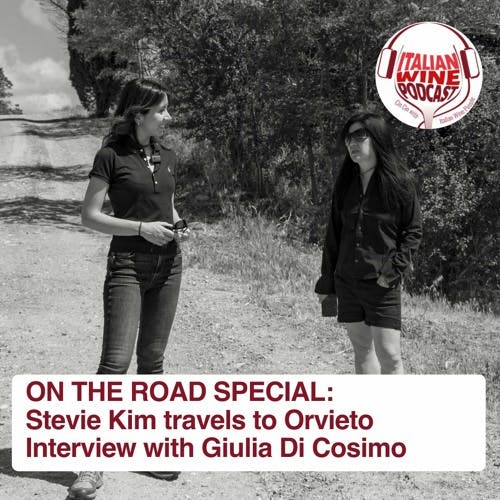
Ep. 1115 Giulia Di Cosimo | On The Road With Stevie Kim
On the Road with Stevie Kim
Episode Summary
Content Analysis Key Themes and Main Ideas 1. The ""Benvenuto Orvieto"" event as a platform for presenting new wine vintages. 2. The unique and diverse four terroirs (clay, sandy, volcanic, alluvial) of the Orvieto wine region. 3. The Orvieto Consortium's efforts to study, define, and promote these distinct sub-areas or ""crus."
About This Episode
The hosts of the Italian wine podcast discuss their upcoming edition, which will focus on wine communication. They will use the blind tasting method to demonstrate the differences between the four t voegils and emphasize the importance of differentiation among them. The consortium of Orvietta has been selling for four years and held a stag opposite event called La Palumbella, which is a re-reliary ceremony for the upcoming season. The consortium is one of the biggest sellers in the industry and has a lot of growers, with a large number of sellers. The wines are re-reliary, and they have a large number of festivals.
Transcript
Welcome to the Italian wine podcast. This episode has been brought to you by the wine to wine business forum twenty twenty two. This year, we'll mark the ninth edition of the forum to be held on November seventh and eighth of twenty twenty two in Verona Italy. This year will be an exclusively in person edition. The main theme of the event will be all around wine communication. Tickets are on sale now. So for more information, please visit us at wine to wine dot net. Welcome to another episode of On the Road Edition, hosted by Stevie Kim. Each week, she travels to incredible wine destinations, interviewing some of the Italian wine scene's most interesting personalities, talking about wines, the foods, as well as the incredible travel destinations. I'm here with Julia Dicosimo. She is the neo elected vice president of consortium of Orvieto. So I'm going to chow Julia. Okay. So I would would you mind telling us what Benvenuto Olvieto is. The Benvenuto is our wine preview. So it's the event to which we present to the public, the new vintage, the new release. And yesterday, we had this big, big event here in a town with a lot of journalists coming from Italy, but also from abroad. We had a master class in the morning, a very interesting one. The focus of the master class was, to provide people with an overview on, Orvieto Docs, especially on the four terawatts of Orvieto because, pretty much unbelievable, but Orvieto is small, small area, has support different rewards. So you did something interesting, right, kind of an experiment? An experiment. Yes. We we're now studying on and we're working on, find this area. We want to work to develop probably in the future, some crews. Exploring these differentiations, these four terawatts, which are clay, sandy soil, volcanic, and aluvinal, and they indeed provide the wine, give to the wines different culture. Different characteristics. And that's very important. So as a consultant, we are working to develop cruise, sub areas, and to explain to the public, to journalists what the difference are. So I think yesterday was very, very important day. So tell us what you did exactly in terms of the master class to demonstrate the four different types of soil. Okay. We selected four different wines. We don't discover the producers. So it was, an unknown label, but each one was coming from a different larva, of course. So it was like a blind tasting. Blind tasting. We completely blind tasting. We put the, label of the consorts, of course. So we're starting with the clay. We moved to the volcanic soil We've got we kept going with the, aluminal, and we ended the with the sandy soil. So four different types of soils. Right? So you started with clay, then volcanic soil, then, alluvial. Alluvial, and And then, Sandy, in the end. And, it was very nice because we could appreciate differentiation among them. So, descending is more, let's say, delicate, more respectful of the aromas, especially the primary aromas, volcanic was more more mineral, much more deep, mineral and vertical, I would say. The clay soil was more structured, kind of wine, with more body, longer aftertaste. While the Luvian olive was a little bit more elegant compared with the others, a lighter in body, so each one was different from the others. It was very interesting also for me, actually, because I I tried when we selected a couple of months ago, But, you know, when you do the research and all this stuff, it's not so easy on the same. Yesterday, I think was, more and more interesting for for all us. So why are the four different types of soils interesting for, let's say, for the wine professionals Mhmm. And wine lovers. How does it translate into the wines? Because this is terwar terwar terwar is the sow, the the true identity of the wines. And, it's, from what everything started. You know, we can be very good in the cellar. We can we can change a lot of things in in the cellar, manage a lot of things, but everything starts in the terroir. Everything starts in the ground. Are you enjoying this podcast? Don't forget to visit our YouTube channel, mama jumbo shrimp, for fascinating videos covering Stevie Kim, and her travels across Italy and beyond. Meeting winemakers, eating local food, and taking in the scenery. Now, back to the show. So having this profound differentiations as an impact in what we do. And we have to be better to explain this differentiation and explain to the public that here in Norviet, we have this beautiful diversity. So it's been or something new or it's been something you've been doing for many years? We've been doing for four years. Four years. Which you even during the pandemic? Of course, during the pandemic was a smaller version, more symbolic. Rather than a real testing, a real event. But we kept going on, doing the ceremony of the tile in the via duomo, with a major, doing some video testing, but was, of course, not the same. And how many producers are the in the consortium of Orvietta? As a seller, we are more than thirty sellers. Then, of course, there are a lot of growers. So the consortium is pretty much big, less than two thousand actors. But the sellers as in numbers of sellers are not so huge. Just a little bit more than thirty. So, you know And is this the period we're in late May right now? This is o you always have it during this period? Yes. And we choose by purpose. In the sense that you know, that, the majority of the wine preview are in February and March. Mhmm. Exactly. When we decided, we thought it could be interesting to have in another moment of the year because first of all, February and March are very, very busy for the, the preview for death trade fairs. And so was would have been very tough for us to grab people to catch people. So first reason is strategic. Reason. And also because in May, June, Norway is very, crowded. And also, we have a lot of festivals like La Palumbella. What is Palumbella? They are re religious ceremonies that we do in town, and they're very, very important for the town. So we thought that it would be also a nice moment of the year to have a lot of people here, to have people that come for this, religious ceremonies and can also participate to the testing, to the wines. Okay. So you are the new kind of how many members are there in the board of the consortium? Twelve members. Twelve members. Twelve members. So what are your plans for? Your newly elected vice president? Yes. Right. You're you're quite young. What what are we to expect from the consortium within the next couple of years? What are your ambitions? In the perfect world, what would you like to achieve? So my first commitment would be to provide a consultant with a structure and with an an organization because now a day, the competition out there is very tough. So it's important to have professional people doing professional things like events, communication, and all this stuff. So we cannot do entirely by ourselves. We have to hire people that are able to do the things in a in a professional way. So first of all, create an organization, create a structure, and then, define, altogether a strategy for the next three years. That's very important. We have to be to all agree what we want to go what we want to achieve in the near future, and then put the the program on the paper, make the strategies together and, work for it. Okay. Great. Alrighty. And when will be the next, Ben Venator Vietta? Next year. Probably in June, connected with the religious festivals we have in town, but for for sure, next year. Okay. There you go. So that's it. It's a wrap from Umbria. We've been here for, couple of days, visiting some wineries, organized by the consortium, and we hope to see you soon, maybe next year. We hope you enjoy today's episode brought to you by the wine to wine business forum. Twenty twenty two. This year, we'll mark the ninth edition of the forum to be held on November seventh and eighth twenty twenty two in verona Italy. Remember, tickets are on sale now. So for more information, please visit us at wine to wine dot net. Hi, guys. I'm Joy Livingston, and I am the producer of the Italian wine podcast. Thank you for listening. We are the only wine podcast that has been doing a daily show since the pandemic began. This is a labor of love and we are committed to bringing you free content every day. Of course, this takes time and effort not to mention the cost of equipment, production, and editing. We would be grateful for your donations, suggestions, requests, and ideas. For more information on how to get in touch, go to Italian wine podcast dot com.
Episode Details
Keywords
Related Episodes

Ep. 2597 Wine in Transition: Declining Demand, De-Alcoholised Wine & New Alternatives with Robert Joseph | On the Road with Stevie Kim
Episode 2597

Ep. 2595 Where Wine Won In 2025 with Erica Duecy | On the Road with Stevie Kim
Episode 2595

Ep. 2583 Women For WineSense and the Houston Rodeo Wine Competition with Amy Gross | On the Road with Stevie Kim
Episode 2583

Ep. 2564 Understanding the Albanian market with Erjola Braha - CEO of Alehandro Group | On the Road with Stevie Kim
Episode 2564

Ep. 2554 In conversation with Marco Alberti, the Italian Ambassador in Tirana | On the Road with Stevie Kim
Episode 2554

Ep. 2463 Lamberto Frescobaldi | On the Road with Stevie Kim
Episode 2463