
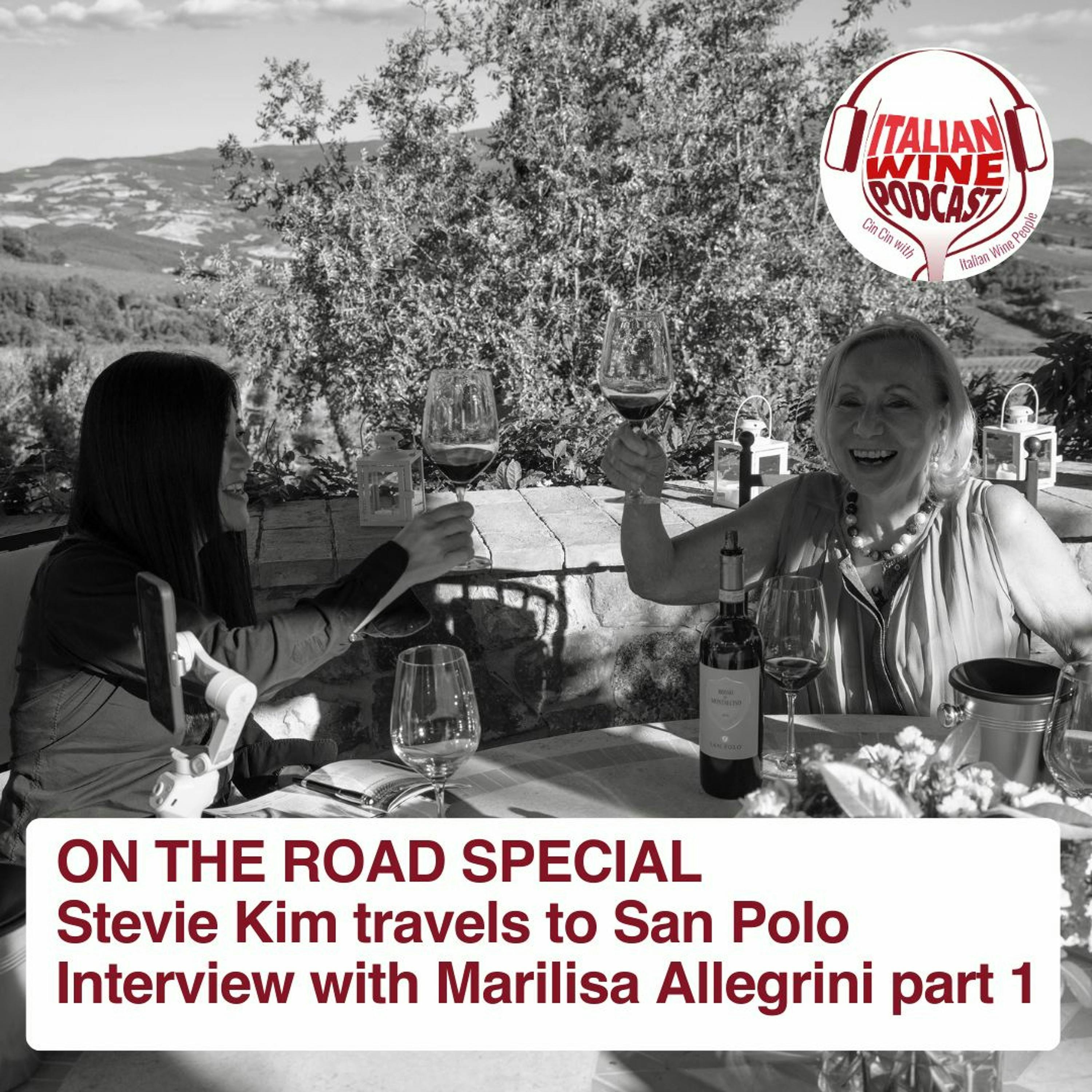
Ep. 1217 Marilisa Allegrini Pt. 1 | On The Road Edition With Stevie Kim
On the Road with Stevie Kim
Episode Summary
Content Analysis Key Themes and Main Ideas 1. Marilisa Allegrini's expansion from Valpolicella to Tuscany, specifically Montalcino. 2. The unique terroir, microclimate, and historical significance of the San Pola estate in Montalcino. 3. San Pola's commitment to 100% Sangiovese wine production and organic farming. 4. The challenges and philosophy of adapting winemaking knowledge to new terroirs. 5. An overview of San Pola's wine portfolio and market presence. Summary In this ""On The Road Edition"" episode of the Italian Wine Podcast, host Stevie Kim interviews Marilisa Allegrini at her San Pola estate in Montalcino. Allegrini, renowned for her Valpolicella wines, discusses her strategic decision to invest in Tuscany after her father's passing, first in Bolgheri and then acquiring San Pola in Montalcino in 2006. She contextualizes San Pola's prime location in the ""historical part"" of the Brunello di Montalcino appellation, detailing its 450-meter altitude and the critical role of its chalk and limestone-rich soils for Sangiovese. Allegrini emphasizes her radical decision to commit San Pola entirely to Sangiovese, even removing international varietals, and the journey to achieving organic certification by 2017. She shares insights on the welcoming local Montalcino community and the personal challenge of adapting her Valpolicella expertise to a completely different winemaking philosophy and terroir. The conversation concludes with a description of San Pola's wine range, which includes an IGT and three distinct Brunellos, highlighting the personality derived from specific vineyard plots. Takeaways * Marilisa Allegrini (of Valpolicella's Allegrini wines) expanded her winemaking ventures to Tuscany, acquiring the San Pola estate in Montalcino in 2006. * San Pola is situated in a historically significant and high-altitude (450m) part of Montalcino, characterized by unique Galestro, chalk, and limestone soils beneficial for Sangiovese. * The estate is dedicated to 100% Sangiovese production, having removed international grape varieties previously planted. * San Pola has been fully certified organic since 2017, following a challenging but successful transition period starting in 2014. * Allegrini had to learn and adapt to the Montalcino terroir, rather than applying her Valpolicella knowledge directly. * The San Pola portfolio includes an entry-level IGT (""Rubio"") and three distinct Brunello labels (a blend, Podernovi single vineyard, and Vinavec single vineyard), with a Riserva produced in select vintages. * The Montalcino community was welcoming to Allegrini as an ""outside"" winemaker. Notable Quotes * ""So we are in the most municipality of Montecino. And we are in the beautiful hill of Saint Pollo, which is one of the historical part of the Bruno de Montalcino appalachian..."
About This Episode
The speakers discuss their experience in Tuscany, a historical winery, and their investment in Tuscany. They also discuss the various geological and agricultural portions of their wine success, including a new wine study and potential opportunity for collectors to collect water from the wines. They share their experience with Tuscany and the challenges of their wines, including the use of organic certification and the use of a YouTube channel for more information. They also discuss the use of organic certification and the use of a V navigia winery in Spain.
Transcript
Some of you have asked how you can help us while most of us would say we want wine. Italian wine podcast is a publicly funded sponsor driven enterprise that needs the Moola. You can donate through Patreon or go fund me by heading to Italian wine podcast dot com. We would appreciate it Oh, yeah. Welcome to another episode of on the road edition hosted by Stevie Kim. Each week, she travels to incredible wine destinations interviewing some of the Italian wine scene's most interesting personalities, talking about wines, the foods, as well as the incredible travel destinations. Okay. Welcome to another episode of Italian wine podcast on the road edition. And today, we are here with a very good friend of mine. Her name is Marilisa Lagrini. Of course, you know her from, Alegrini. Everything that has to do with Alegrini. But today, we are actually in Montaccino, because she has also an estate in, actually she has two estates in Tuscany, one in Bulgaria. And here today, we're in Monteaccino. So tell us where we are. Can you contextualize where we are exactly? First, in Tuscany, and then, of course, in Montecino. Yes. So we are in the most municipality of Montecino. And we are in the beautiful hill of Saint Pollo, which is one of the historical part of the Bruno de Montalcino appalachian because we are very close to the winery that, started, to make Brunoo the Montalcino. And we are at an altitude of four hundred and fifty meters facing Mount Amyaka and, castiglione Dortone, the other side, and then on this side, castil Gongo de La Batte. So, Madiliza, I mean, why in the world did you decide to come to one touch, you know. I mean, wasn't when when weren't you busy enough working with, you know, the winery going all over the place, trying to promote your alegrini wines? You know, at one point of my life, after I develop, together with my brother, the Lagrene company, when my father passed away, when I was, We were quite young, and so it was a big challenge for us to carry on his, job in a successful way. And one, we felt very comfortable. We decided to invest in Tuscany. And the first stop was, or the first step was, bulgari, where we founded, Podjal Tesoro starting from scratch, felling along with the Tuscan area in general. And then I think that, Montancino was, another challenge, but, it was a company that was already existing. So we didn't start to to found the company, but we started developing a company that already exist, and that that was set in the best way because, the vineyard were there, the beautiful guest house and also the winery. And, I think that for me was very interesting to deal with this, two different wine producing one with the international grape variety and Montecino, very focused on the native grape variety that is, San Jose. So when did you come to, Of course, the name of the wineries, first of all, San polo, polo, polo. Yes. Not polo. Polo. Polo. Polo. Okay. San polo. I'm going to have nightmares. Sam, San polo. No. You still use two l. San polo. It's a little bit better. Very soft with the l. So when did you come to the San polo? I arrived here. It was, November two thousand and six. And then, one of the the the previous owner decided that they want to sell the company And so I fell in love with the location. And, I came the first time with our agronomist from, Bulgaria. And, he said, Marie Lisa, remember that Tim Boll, we have, microclimate that is very similar, but in Montalcino, it differs a lot. And the difference according to the altitude, because with a different altitude, you can have different ventilation different soil, different exposure. So he said, Santolo is located in one of the best part of Montalcino. And this was the first reason why I decided to buy the company. And the second reason was the winery. The winery is built, according to the bio architecture. So it was a very advanced concept, some years ago, fifteen years ago, almost So, you know, it's crazy windy hit today. We, while we were waiting for you, with your winemaker Ricardo and Claudia, we went up to the hill. And he was so windy. We made a TikTok, you know, about, like, surfing, windsurfing. So tell us a little bit about the microclimate here. First of all, the altitude and, of course, the different areas that you have. What is so special about the soil, about the typology, of this area. Because you said he was so special. Right? Yes. Yes. Altitude is, important in Valporicella for the native grape variety that we have, Corvina. And the same thing is here. Altitude is very important for the sangiovese. When you go to the valley floor, you have clay soil. When you come up to the hill, you have, more, Galestro. So more chalk and, limestone. And, this is good for the sangiovese. And it's good because, the upper part of the hill where we are. How how high is it, you know? This is four hundred and fifty meters. So, throughout the different eras and the different earthquake that happened, the upper part of the soil was the first that emerged from the sea. So the top soil is very, cal there is a lot of calcare, less clay. And so you have a very good drainage. And good drainage means that the vines look for water. So the roots absorb the different minerals, and I think that the result is, that we have very good minerality in the white. Are you enjoying this podcast? There's so much more high quality wine content available for mama jumbo shrimp. Check out our new wine study maps. Our books on Italian wine including Italian wine unplugged, the jumbo shrimp guide to Italian wine, sangiovese Lambrusco, and other stories, and much much more. On our website, mama jumbo shrimp dot com. Now back to the show. The, you know, the the water here. Do you have enough of water? Because the rainfall is such an issue all over the world right now, especially in its way. You know that, Montecino, until few years ago, didn't, was not possible to, irrigate, irrigate, but, in summertime, we can have rain storm that, start from the mountain, Yatta. And so maybe we can have rain here So in the recent year, we experienced that that is a blessed area also in term of, the rain that we can have. So do you are you do you have, like, a possibility to collect the water when there's so much water. And we need to dig and we need to, like, a well. Yeah. Yes. But so far, we didn't, do this. So we have a natural rain. And the one thing that, is an advantage is that we have old vines. So the old vines already developed a very deep roots. But when you say old vines, how old are your old one. Some of the vines were planted at the beginning of eighties. Some were planted in the early two thousand. And we have only one part that was planted very recently. By us because we took away, the red grape variety that were not sangiovese. We are in term of reds, a hundred percent sangiovese. Yeah. I mean, Marie Lisa, I feel like that's so radical. Like, Why did you make that decision to do hundred percent sangiovese? Because I recall I was here, maybe, like, I don't know, like, ten years ago. I can't Ten years ago. Maybe. And we had also yeah. You also had some international credit card. And Cabernet Franio. And it was something that we didn't plant. It was planted by the previous owner. Mhmm. But, and you were making wines with Yes. We have an entry level wine, which is a rubio. And is an identity. And for this, is allowed to use, of course, it's an identity. And so you can use the grape variety that, you want according to the kind of philosophy that, you have. But, together with, Ricardo Ricardo, Ricardo Fraton, our analogist, we decide that, this, place must be only sangiovese because Montecino demand for Sanjay, but also, I think, especially in this beautiful location. Alright. So let me ask you a question, something a little bit more personal. So you're, veronese. Right? Yes. You bought your this winery belong to other veronese. How do how were the what do you call the people from Montecina? Montecinazy? No. It's like the Chinese? No. No. No. No. One word. Oh, okay. It's easy. It just sounds like a bad Italian. It's like the way I speak. So okay. For the record, for our audience, let me just make that correction. People from Montalcino are called Echinezi. Yes. Echinezi. What? Why? Single. That's so funny. Because it's the historical name that come from Elchinos, I think is the Latin name, but he's the mount of lecce. The mount of, the lecceo lecceo is the vegetation that you see here in, Montecino, and it's so funny. Echinos come from. Okay. Anyways, my question was my original question was, how did the, embrace your, your presence here as a winemaker, a foreign winemaker, if you will. Very, very well. I I was very welcome today. And so I So a little different from from Bulgaria. More welcoming here. No. Also, Bulgaria was very welcoming. So so what are the, what were the main challenges? And what what are the main challenges, compared to Vapolicella, for example, what, like, the the similarities and the differences, I guess. That's what I'm asking. In specifically, perhaps to the most representative grape, Corvina from Vapolicella, and hear San Giovanni, obviously. But at the beginning, the main challenge was to, understand that, you don't have to introduce, your knowledge, your valpolicella knowledge, to the different territories. So, at the beginning, you have to study, you have to understand, the difference, you have to understand the, you have to understand the different climate. Mhmm. And so this was a very, very good exercise for me. And it was an exercise that, from which I developed, synergies, but was also very inspiring. Because, you can learn from, your tradition. And, so my tradition, of course, is, but you can, clean your mind from what you learn and start from scratch, start from the grape variety, the different terroir, and the different vinification process to give the personality of the different wine producing it. So we, walked around the vineyards, and, of course, visited the cantina with your, winemaker. So now we're gonna taste some wines with you. Okay? So give me kind of an overview. How many labels do you have in terms of the production volume and where the wine is available? Export versus Italy. Okay. You mean, give me an overview. Okay. So I said before that we have an entry level wine, which is rubio, and is n I g t. And then, also this was a very long process because at the beginning, we only had two wines. Rosa de Montecino, and Brunoo de Montecino. And in some vintages, we were able to produce a reserve. And then, starting from two thousand and fifteen, when I started working with Ricardo, but also I became the, only owner of the company. So we identify the different plot giving the specific personality, and then we result the the this process resulted in two aspects. One was that we were able to become organic. So to So you're completely, certified organic. Yes. As you can see. Right. From we started the process in two thousand in a very challenging year. Two thousand and fourteen, which was an extreme vintage because it was cold and rainy. And so we said to ourselves, if we were able to, manage the vineyard in the organic way in the two thousand and fourteen, definitely, we have to go in that direction. And so we, from two thousand and seventeen, we were able to have the organic certification. But, let's go back to two thousand and fifteen when we identify the different part, and we introduced the concept for sample of the single vineyard. And so one vineyard was, dedicated to the production of Pudernavi, And another one was dedicated to the production of Vinavec. So now we have three different brunellas. One is the mix of the different vineyard or blend of the different vineyard. And then put a novie and Vina Becca. And again, every two, three years, we also produce, the reserve. So in total, how many labels? You have Rubvio, for the for the and the Thank you for joining us on another installment of On The Road Edition, hosted by Stevie Kim. Join her again next week for more interesting content in the Italian wine scene. You can also find us at Italian wine podcast dot com or wherever you get your pods. You can also check out our YouTube channel, mama jumbo shrimp, to watch these interviews and the footage captured of each location.
Episode Details
Keywords
Related Episodes

Ep. 2720 Ep. 21: L’Isola del Vino Selvatico | Pellegrinaggio Enoico con Attilio Scienza
Episode 2720

Ep. 2649 Ep. 9: Dai Vini Retici al Prosecco | Pellegrinaggio Enoico con Attilio Scienza
Episode 2649
Ep. 2637 Ep. 7: Toscana, quando il territorio diventa vino |Pellegrinaggio Enoico con Attilio Scienza
Episode 2637

Ep. 2631 Ep. 6: La Vigna Ritrovata di Leonardo | Pellegrinaggio Enoico con Attilio Scienza
Episode 2631

Ep. 2600 Ep. 1: Costruire le Fondamenta | Pellegrinaggio Enoico con Attilio Scienza
Episode 2600

Ep. 2597 Wine in Transition: Declining Demand, De-Alcoholised Wine & New Alternatives with Robert Joseph | On the Road with Stevie Kim
Episode 2597