
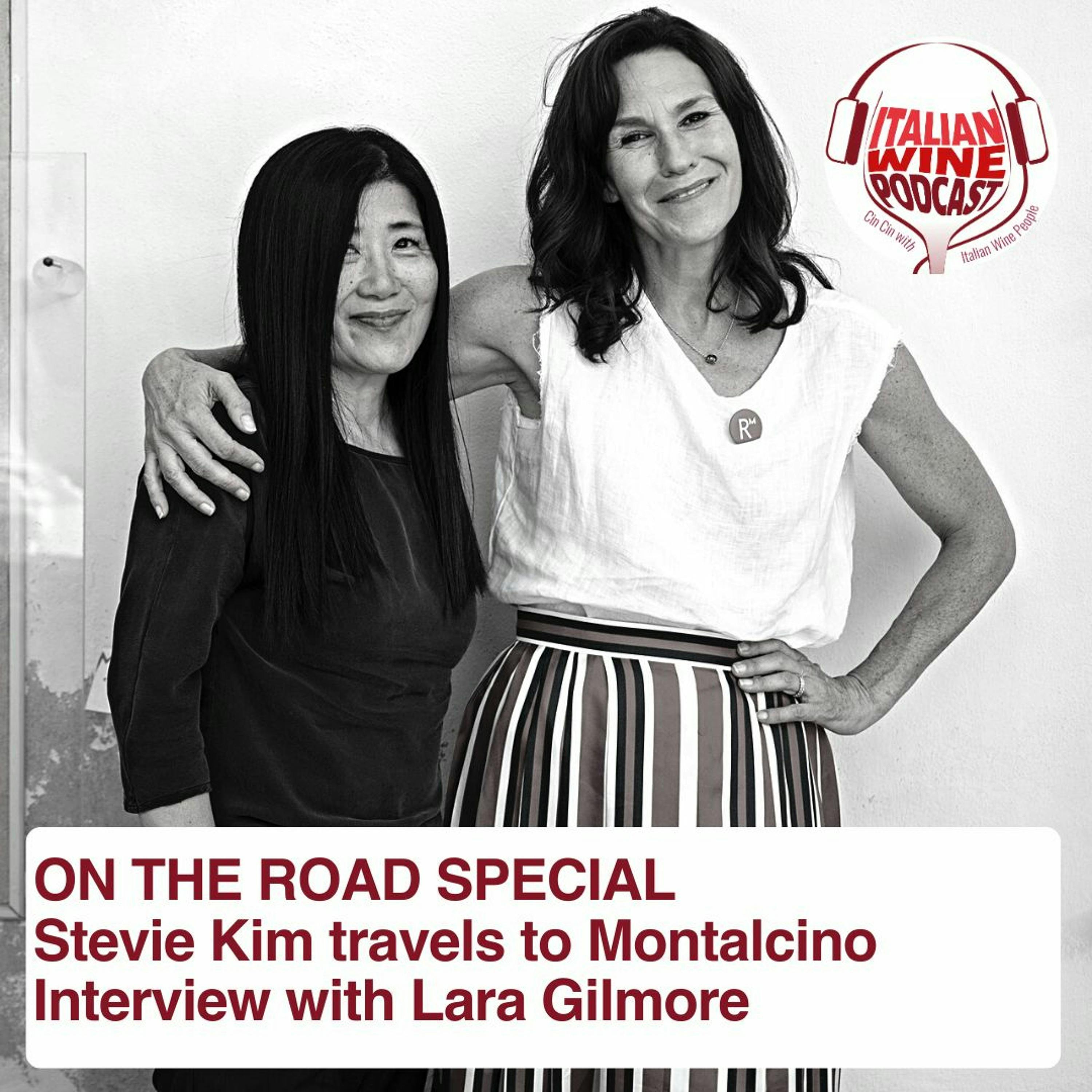
Ep. 1330 Lara Gilmore | On The Road Edition With Stevie Kim
On the Road with Stevie Kim
Episode Summary
Content Analysis Key Themes and Main Ideas 1. The influence of progressive education and collaborative learning on personal and professional development. 2. The ""power of two"" and the importance of dynamic partnership in achieving shared visions. 3. The diverse portfolio of projects by Massimo Bottura and Lara Gilmore, extending beyond fine dining. 4. The social mission and philanthropic initiatives, particularly Food for Soul and Tortellante, addressing food waste and social inclusion. 5. The concept of gastronomy as a tool for social good and community building. 6. The journey, challenges, and sacrifices involved in achieving culinary excellence and societal impact. 7. The legacy and future vision for Italian cuisine and hospitality, emphasizing social responsibility and nurturing new talent. Summary This ""On The Road Edition"" of the Italian Wine Podcast features an interview with Lara Gilmore, wife and partner of renowned chef Massimo Bottura. Gilmore reflects on her unique, progressive elementary school education, emphasizing collaboration and creativity, which shaped her approach to life and work. She discusses the strength of her partnership with Bottura, highlighting the ""power of two"" in their personal and professional endeavors. Gilmore elaborates on their impressive array of projects: Osteria Francescana as their ""cultural lab,"" the casual Franceschetta, the hospitality venture Casa Maria Luigia, and their significant social initiatives. She passionately describes Food for Soul, dedicated to combating food waste and fostering dignity through shared meals for vulnerable individuals, and Tortellante, a project empowering autistic young adults by teaching them to make traditional tortellini. Gilmore also touches upon the long and challenging path to achieving three Michelin stars, the sacrifices involved, and how the COVID-19 pandemic offered unexpected family time. She concludes by sharing her aspirations for their legacy: promoting Modena, cultivating future culinary talent, and demonstrating how gastronomy can be a powerful force for social change, addressing contemporary issues like food waste and inclusivity. Takeaways * Early childhood education focused on collaboration and creativity can profoundly impact one's life philosophy. * A strong, complementary partnership is crucial for navigating challenges and achieving ambitious goals. * Successful culinary figures can leverage their platform to create diverse ventures, from fine dining to casual eateries and hospitality. * Gastronomy has significant potential to address pressing social issues, such as food waste, homelessness, and providing opportunities for people with disabilities. * Achieving top-tier recognition (e.g., three Michelin stars) is a long and arduous journey, and the true value lies in how that platform is used for broader societal benefit. * The COVID-19 pandemic prompted adaptation in social projects and offered unique personal reflections on work-life balance. * The legacy of culinary leaders can extend beyond dishes and restaurants to include community building, talent development, and social advocacy. Notable Quotes * ""We learn through certain kinds of spaces and how we interact with people is what elevates us as human beings."
About This Episode
Speaker 1 and Speaker 2 discuss their love for the Italian wine scene and their desire for the power of two to create experiences. They talk about upcoming projects, including a new restaurant and a social project with their chef friends. They also discuss their experiences with food insecurity and rebuilding their Guinea, and how they were able to pivot quickly into meals to be delivered. They share their hopes for being recognized as a three Michelin star chef and discuss the challenges of working in a pandemic and creating a program called kitchen quarantine to help people with their needs. They also talk about their community and the importance of social issues and future plans.
Transcript
By now, you've all heard of Italian wine Unplugged two point o. The latest book published by Mamma jumbo shrimp. It's more than just another wine book. Fully updated second edition was inspired by students of the Vin Italy International Academy and painstakingly reviewed and revised by an expert panel of certified Italian wine ambassadors from across the globe. The book also includes an addition by professor Atilio Shenza. Italy's leading vine geneticist. The benchmark producers feature is a particularly important aspect of this revised edition. The selection makes it easier for our readers to get their hands on a bottle of wine that truly represents a particular grape or region to pick up a copy, just head to Amazon dot com, or visit us at mama jumbo shrimp dot com. Welcome to another episode of On The Road Edition, hosted by Stevie Kim. Each week, she travels to incredible wine destinations interviewing some of the Italian wine scene's most interesting personalities, talking about wines, the foods, as well as the incredible travel destinations. Where did you go to school? I went to, a local public school very progressive elementary school called West Pat and Elementary School. It was so progressive because it was all in one level, windows everywhere, corridors that connected all the different areas, no doors, except on the bathrooms. No adults. We had no classrooms. It was open classrooms. No desks. We worked at round tables. It was all about collaboration, creating a plaza for people to share about coincidence, about serendipity. They were first graders mixed with second graders. Third graders mixed with second there was this idea that together we were gonna learn. And in the center of the school, there were two things. The very center of the school, there was the art lab And next to the art lab, there was a library. So there was this very strong imprinting in me that we learn through certain kinds of spaces and how we interact with people is what elevates us as human beings. Art and the library and how that comes together in the world, through storytelling, through visual storytelling, through words themselves, through how we in now that I'm in the world of hospitality, think about creating experiences, whether you're sitting at a table for three hours, or whether you're just gonna come on a tour with me of Modena, or I'm going to take you through an Achaetalia, or you're going to read a book that we've written about our dishes, about our ideas, about how we move forward, also an ethical practice with food for soul. Something magical can happen. If you don't scrape your knee too badly, you can actually see the world from another point of view. And when you see the world from another point of view, That opens up a window to poetry to the unexpected, to circumstances, and serendipity, and you never know what could happen the next few hours of the pure day. Okay. So I think that's a good segue into, your serendipity. I have to be honest with you. I, I've met Massimo on, several occasions, for work. And, I feel like you're Hillary Clinton, you know? Like, I feel like you are very much the woman behind the man. And this is why I'm so excited to be having this conversation with you today. You know, and it's not about being behind someone. I think it's a really it is about the power of two. And the idea that you can bounce ideas off of another person because you trust them, and they have your back, and they're gonna tell you the hard truth But they're also going to take you out of any moment of delusion or getting too comfortable with yourself or you've forgotten why you're here on this planet and what you need to do and you wake the other person up and maybe they don't wanna be woken up because it's six in the morning, but you do that. And that's what Massimo and I do for each other. And, you know, he is material and fast and leads the way. And when Massimo has an idea, there's no turning back. It's not as if I can convince him not to do something. But sometimes I'm able to accompany it and help that idea, that vision happen quicker, happen the way he wants it to happen. I maybe add a little bit of my own touch, little sparkle, little dust so that it sparkles in a different way. And, that's that's our project. Yeah. So, you know, that I, like, I'm going through I just went through your Instagram grid because Oh, no. Yeah. So because I kind of feel like, you know, on your, insta profile usually, people who work, like, both of us, we put the things that kind of we want to show. Right? And so first of all, you have Osteria Fraciana as as the link. And then you have food for soul. Yes. You have Casa Maria luigi. Yes. You have Franchesqueta. Yes. And then you have tortilla. Yes. So first of all, tell us a little bit about each of these projects. The reason that I can be involved in so many projects is because I have we have so many amazing people who work for us, and the team has grown over the years, and Our central office is a dynamic place where there are people doing a little bit of everything, and that makes things possible. Oscar, Franciscana, is the home base. It's the lab. It's the Cultural Lab. It's where many of our ideas over the last twenty seven years, which are celebrating now, have formed, and where we basically learn to we have a Podega, Rina Chamentale, where young people are learning, they're working, they're creating, they're making art. They're also making future. They're thinking about how to do things better, whether it's in our organization or in the organization of the kitchen, the people we hire, how to bring up the next generation of so many days and front of house and chefs and thinkers who can collaborate with the dynamic and difficult and complicated and continually changing the world of hospitality, which we see today. So Franciscana has is our base. It's our home. It's where everything begins, and nothing would be possible without Franciscana. From Franciscana, then we branched out And we opened a little Franchesquita. Franchesquita was always meant to be, the little sister, casual. It's in a recovered tire shop, a gomista. It's in Marina. It's about ten minute walk from Franchesquana. Franchesquita is an opportunity to let them shine. And work together and create their own team. We let them to be very much independent. And, Moderna loves Franchesquita because it's easy informal, and yet they're always trying to bring along the guests to try something new to look at a tortellino in a different way. We have a ravioli with Robiola, and there's some chamomile. And, you know, things that you wouldn't classically put together in Moderna, and yet there's a trust in Franchesquita and a willingness to have fun. The price. The prices specifically kept at a certain level so that people can feel that they're going there to have fun. It doesn't have to be the important dinner of, you know, their lifetime. And that way, they're a little bit more open to experimenting. Also experimenting with the wines. We were with a lot of biodynamic AAA. And it's a very casual staff. Our chefs come out. Our wait staff are in the kitchen. We're moving people around, and it's an experiment. So, is our probably our newest project. Two thousand and nineteen. A cousin of Luigi was something that Massimo had always dreamed about, having a place to entertain, to share, with guests, a little bit more of us and our passions, and a little bit more of Moderna. Not only Moderna city center, but the a million countryside. It's in San Demazo. It's about fifteen minute drive from downtown Moderna. It is a place where we can invite our guests to explore our passion for contemporary art as we've put into every single room, a lot of the artists that we adore and love and who have inspired us in our thinking. And as a guest, talented, small rooms? Oh, so It's small. It's small. It's very intimate. And then our two social projects. Yes. So the first one being food for soul, which is what you're presenting. Which I'm presenting today, and it was kind of the a beautiful invitation from Russell Montocino to add to their program to this first red Montalcino. The possibility also to talk about not just what we do at the table eating and drinking, but how much of the experience of being at a table can also change someone's life especially when they're in a moment of fragility or experiencing homelessness or experiencing food insecurity, and that being invited around a beautiful table. A table where you're going to be served as if you're in a restaurant, where you're going to be taken care of during the meal, where no one is going to ask you to get up and leave, but welcome you. Can also be the beginning of rebuilding your dignity. This project started an experiment with expo. Oh, and many of our friends were coming. Our chef friends were coming to expo. We renovated a theater. So we did this during expo in Tiatto Greiko. We're not in the expo fair. We're in an external structure. And we've been working since then to continue opening refiturios, sharing this idea that around the table we are equals, and that we can rebuild dignity through a beautiful meal shared together. So it's based on volunteers. Are you enjoying this podcast? There's so much more high quality wine content available for mama jumbo shrimp. Check out our new wine study maps, our books on Italian wine, including Italian wine unplugged, the jumbo shrimp guide to Italian wine, Sanjay Vazil, and other stories, and much much more. On our website, mama jumbo shrimp dot com. Now back to the show. We have many, many volunteers. Right. Of course, we have our staff as well. We have program directors Right. Culinary directors always based on a partnership. We partner with organizations around the world because food for sale is based in Italy, and we are here. So we can't be here and there at the same time. Yeah. And so in Milan, we partnered with a Refatorio Ambrosiano. In, Naples, we partnered with, Maiden cloister, which is a cultural organization. In Bologna, we've partnered with the, Antoniano, which has been running a mensa or soup kitchen since the nineteen fifties. We have partners around the world to do different things, but they also wanted to jump in and be part of this project with us. You've built this community. It's all about community, and I think food is about community, and drinking wine is about community. And being around the table, it's these many communities that can be formed for just one night, or they can be repeated every week or every Sunday? What happened during the COVID when the pandemic outbreak? How did you manage all of these community, related activities? Ford for sale, it was, we were all in a panic Fortunately, we had begun two years earlier something that we call the learning network. So, basically, all the different organizations, all of our projects, we connect once a month and speak to each other. We share problems. We share triumphs. We share difficulties. So everyone has a relationship. And so that learning network started talking, and we were able to pivot very quickly into meals to be delivered. Right. So you picked up. Okay. Because we didn't wanna stop our our meal services. Of course, we couldn't have guests staying inside, but that continuity of knowing there was someone there for them meant a lot. And it still does. So what is it now, the status? Is it pretty much back to normal? More or less. That's very nice. Listen. And then you have, tortellante. Tortellante was this tiny little idea that began with two friends of mine Sylvia Panini, and Erica Copelli, both who have, yeah, sons on the autistic spectrum. Our son, Charlie Boutura, is not on the autistic spectrum, but has a disability and has many characteristics of autism. And we were speaking together about what could we do differently than what was being done in the in in in the arena of rehabilitation for, you know, young people. Because there's basketball and there's speech therapy, and then there's, you know, other kinds of activities, but no one was talking about cooking or being in the kitchen. Right. Especially around these young men. Mhmm. And Sylvia had the idea, why don't we organize an after school tortellini making class, like as an after school activity, as is an after school activity. And we were using an abandoned elementary school And everyone called on every Res daughter, nonna, zia, an aunt, or someone they knew who knew how to make handmade pasta, who knew how to make tortellini because they were the ones who could they were the only ones who could be the teachers. Because they know it in their hands. Right. It doesn't even need to be communicated with words. A lot of these young men don't speak. They don't have language. And so we had all these grandmothers and family members teaching a group of young men, how to make Tardellini. Well, you know, when they read about you or when they see you, the couplehood, they the power couple kind of thing, you know, you think there aren't any struggles or challenges You know, everything happened over and I kind of think. Oh, yeah. That's So that means seriously, you know, we It's been, you know, it took us eighteen years to get our three michelin stars. Yeah. I think people don't understand that. And in a way, I was speaking this morning. Massma has always been very focused. He's always known he's wanted, you know, to have Michelin Stars, but for a reason, he wants to move the Italian kitchen forward. He wanted to get those stars on his own terms in his own kitchen with his own ideas. Being provocative, being an agitator, being someone who says we can look at the Italian kitchen from another point of view and still be recognized. But once we had those stars and Massimo had his jacket hanging, on the bedroom door for the first week because he couldn't believe that it actually happened. Okay. Two thousand eleven, we realized very shortly within that moment that we had received them that it's not about getting three Michelin Stars. It's about what you're gonna do with your three Michelin Stars. And it's about the voice that you have been given from your hard work, from your struggles, from your challenges. You earned that voice, but that voice needs to be used for something other than just your own business. You know, you've been married for how many years now. So, July fifteenth, it's gonna be twenty seven. Oh my goodness. And we met in nineteen ninety three. Congratulations. First of all, it's no small miracle nowadays. I know. Right? With all the also challenges that you have. I don't think anybody who makes it is ever it's ever easy. Also, because there's a lot of sacrifices. We had this moment those three months of the first kind of lockdown quarantine. We created a program called kitchen quarantine in our house because finally Massimo was at home cooking. Okay. And my children and I could see and participate and be part of it. That's right. And we were a family for the first time. It's like a reality show. We've always been living a restaurant life where every night, I'm out one part. Masa was out in another part, you know, and our kids are kind of get, you know, they're they're they're adults now, but, it was a moment for us to have a family life that we had never had. And that made me realize what a sacrifice it has been also for our children to have parents who are crazy and dynamic and doing a million things and hopefully inspiring in some way, but not the traditional mother and father home around the dinner table. So I guess my last question is, how would you like to be remembered as? Like, what kind of what would you like to leave behind? Not just for your children. Right. But for for our world. Three things to be very quickly. First, I've always believed in Modana. I've always believed in Amelia Romania being, an extraordinary place that has a lot to share. We've invested a lot in Moderna, and that Moderna is growing. Partly, thanks to our great effort and our and our and our true love for for that region. Second thing, creating more future in our future, not only for our restaurant group, but for all the young people who pass through our kitchen, our offices, our front of house who then go on to do incredible things, we are building the next generation of restaurateurs, of thinkers, people who are willing to put in the time and energy, make sacrifices, and bring the Italian kitchen forward. So there's so many different platforms that we love to share. But I think the thing that moves me the most is when we are recognized for, oh, he's the guy who's working on food waste. Trying to intercept the chain of food waste that happens and not recognized for being a three Michelin star chef. I think that's a legacy that we will live behind or the tortellante project where with an ingredient that is so iconic to Moderna, a torta a tortilino is a container for an idea. Can we shift that idea and think about it being an inclusive idea? Can gastronomy be inclusive? Can it really address are social issues of today. Can it move forward and be an influencer in a much greater way than just a new dish, a new restaurant, a new award. So that's what I hope we leave behind. Well, I think that's that's the very good way to end this episode. Italian Mind Podcast. Italian Mind Podcast, but I want the t shirt. Yeah. I I someone has promised me a t shirt. Yes. There you go. I am covered in Italian wine podcast. Okay. So guys, this is such an honor. Thank you so much. Wine makes us funner, more joyful, and also more interesting people. Okay. Sound of Chadagatse. Thank you for joining us on another installment of On The Road Edition. Hosted by Stev Kim. Join her again next week for more interesting content in the Italian wine scene. You can also find us at Italian wine podcast dot com or wherever you get your pods. You can also check out our YouTube channel. Mama jumbo shrimp to watch these interviews and the footage captured of each location.
Episode Details
Related Episodes

Ep. 2789 ColleMassari: a long-term vision rooted in Montecucco with Giuseppe Di Gioia | On The Road With Stevie Kim
Episode 2789

Ep. 2788 Ep. 14: Austria and Hungary | Study Smart for your WSET Level 3
Episode 2788

Ep. 2785 From Volunteer to Speaker at TEXSOM with Samantha Cole Johnson | TEXSOM 2026
Episode 2785
Ep. 2766 Inside the U.S. Non-Alcoholic Wine Market: What Wineries Need to Know with Jill Sites | Masterclass US Wine Market
Episode 2766
Ep. 2761 Winemaking and Consulting Across Sicily with Alessandro Serughetti | Wine, Food & Travel with Marc Millon
Episode 2761
Ep. 2759 Part 2 – The VIA Educational Program & Italian Wine | Heart-to-Heart Conversation with Sarah Looper
Episode 2759