
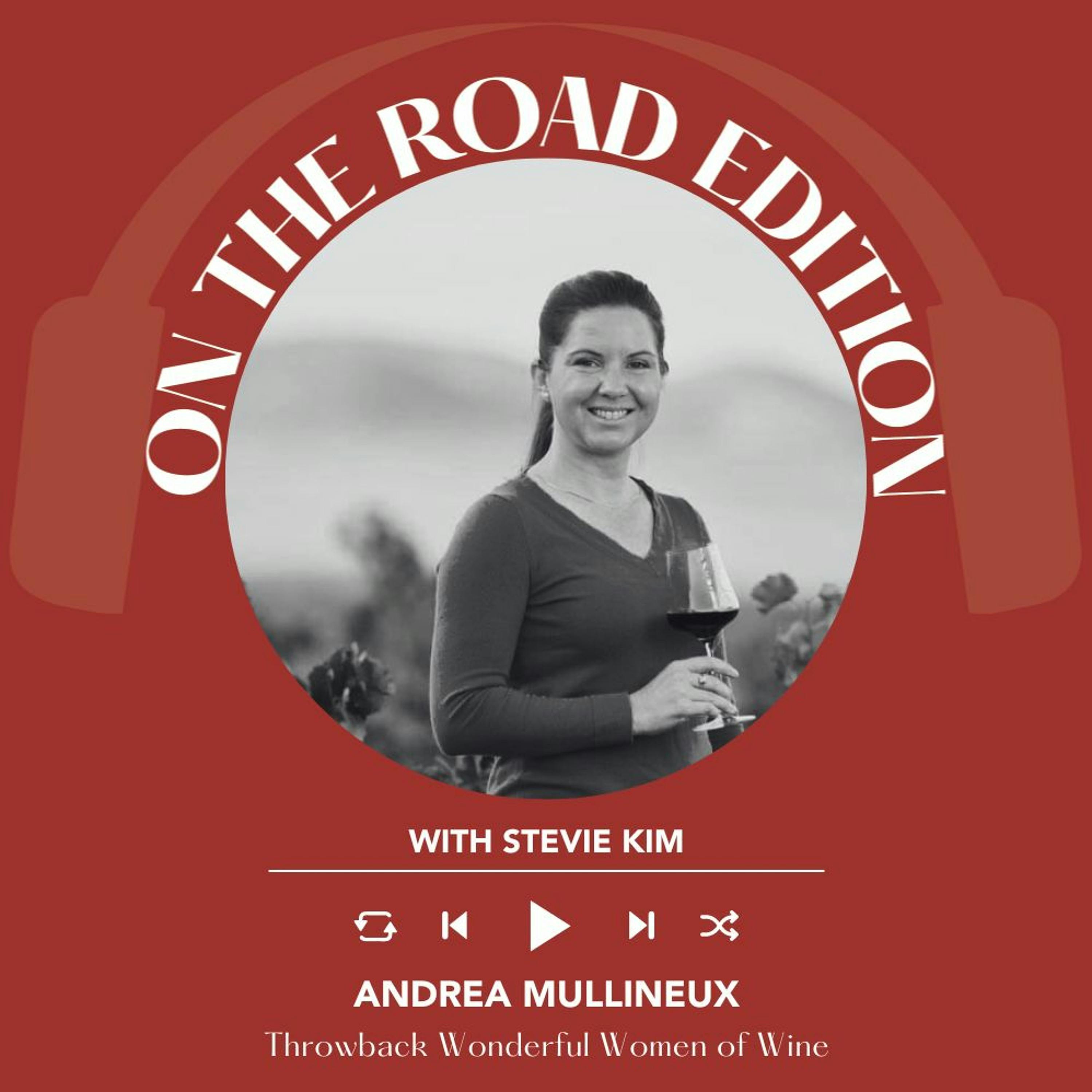
Ep. 1551 Andrea Mullineux | On The Road With Stevie Kim Throwback Instalive
On the Road with Stevie Kim
Episode Summary
Content Analysis Key Themes and Main Ideas 1. The ""On the Road"" series of the Italian Wine Podcast, hosted by Stevie Kim, featuring interviews with international wine personalities. 2. An in-depth interview with Andrea, an American winemaker who co-founded Molineux Wines in Swartland, South Africa. 3. The unique terroir of Swartland, particularly its ancient viticultural soils (granite, schist, iron, quartz) and their influence on wine characteristics. 4. Molineux Wines' philosophy emphasizing purity, texture, and minimal intervention winemaking, including the use of indigenous yeasts. 5. The impact of South Africa's COVID-19 alcohol bans on the wine industry and the challenges faced by wineries. 6. The resilience and consistency offered by old vines in diverse climatic conditions. 7. Stylistic comparisons of South African wines, particularly Syrah, to Northern Rhône examples. Summary In this episode of the Italian Wine Podcast's ""On the Road"" series, host Stevie Kim interviews Andrea, an American winemaker who, alongside her South African husband, founded Molineux Wines in the Swartland region. Andrea details her journey to South Africa and the winery's focus on expressing the region's ancient, diverse soils—some dating back 400 million years. She explains how different soil types, like granite and schist, impart distinct characteristics to wines such as their Old Vine Chenin Blanc and signature Syrah. The discussion also covers the significant challenges faced by the South African wine industry due to repeated COVID-19 alcohol bans. Andrea highlights Molineux's winemaking philosophy, emphasizing natural processes like indigenous yeast fermentation and the importance of texture and consistency, particularly in wines from old vines. She also touches on related projects, like their wine club and L'Eau Pissante, before concluding with a stylistic comparison of South African Syrah to Northern Rhône wines, emphasizing terroir over imitation. Takeaways * The ""On the Road"" segment of the Italian Wine Podcast explores winemaking globally, not just in Italy. * Molineux Wines, co-founded by American winemaker Andrea, is based in the Swartland region of South Africa. * Swartland possesses some of the world's oldest viticultural soils, significantly influencing wine character. * Different soil types (e.g., granite vs. schist) profoundly impact grape expression and wine texture. * Old vines (e.g., 45-year-old Chenin Blanc, 1900-planted vineyards) offer greater consistency and resilience against climatic fluctuations compared to young vines. * The South African wine industry endured severe economic hardship due to government-imposed alcohol bans during the COVID-19 pandemic. * Molineux's winemaking prioritizes indigenous yeast fermentation, minimal intervention, and maintaining wine stability without excessive manipulation. * South African Syrah/Shiraz can stylistically align with Northern Rhône wines, particularly those grown on similar schist soils. Notable Quotes * ""The amazing Terroir of the country is just what really drew me in, got under my nails and has kept me here."
About This Episode
The speakers discuss their tasting plans and experiences with wines, including their own winery and family name. They also talk about their backgrounds and love for wine and alcohol, including their success in the alcohol industry and plans to expand internationally. They emphasize the importance of consistency and seasonality in wine production, as well as the importance of river pressure and genetics for creating pure wines. They also mention their joint venture with a winemaker in a region called community.
Transcript
Since two thousand and seventeen, the Italian wine podcast has exploded. Recently hitting six million listens support us by buying a copy of Italian wine unplugged two point o or making a small donation. In return, we'll give you the chance to nominate a guest and even win lunch with Steven Kim and professor Atilio Shenza. Find out more at Italian One podcast dot com. Welcome to another episode of On the road edition hosted by Stevie Kim. Each week, she travels to incredible wine destinations, interviewing some of the Italian wine scene's most interesting personalities, talking about wines, the foods, as well as the incredible travel destinations. Okay. Hi. Hello, Christina. I know her. Oh my god. Is this Costa Stonnis? Are you costas tonnies? Can someone check out who costas? No. It's this other dude wants to go live with me. Hey, Andrea. You know, some other dude wanted to connect. I was confused. I thought you Oh, no. It wasn't me. Like, Costa Stonese. Hey, dude. Nope. No. I don't understand. Okay. You guys were doing these two great lines right here. Enjoy. How are you? Fantastic. How are you? Are you cutting your cut? Know. You've cut your hair. Yeah. It's actually grown already. My hair grows like girly fast. It'll be like yours, like, next time I see it. Fantastic. Listen. The background, is that your is that a window? Is that a picture? It's not even a virtual background. It's like a painting that I have in the background. This is in the Swartland because I'm actually sitting in the office right now. So it is the vineyard. It's, some old vine Grenache blanc that we have. This is what I want. Thank you so much for doing this. I know you're, like, you're right now doing your winemaking. Right? You're in the environment. Right in the middle of a harvest. We're about ninety percent done with all the white grapes. And we are working on all the red wines right now for the Swartland. And then we have another project as well that's, mostly Stellenbosch Cabernet and and Chardonnay. So that's a little bit later. Okay. So listen. I'm here with a bunch of people. I don't know. Okay. They're called my tasting panel. Okay. So I have, like, one serious person and then some others not so serious. They're actually I'm much more technically challenged in terms of wine than they are. Let me just quickly introduce you to my tasting panel. So we have Rebecca. She's a huge fan of yours. She's our WSet in house educator and also Italian Line Ambassador. Hi. She's our in house technologist. She used to work for this crazy guy, like, Luca Gardini. I don't know if you know what I mean. This is Lan. He is our the International International Academy coordinator. This is Elena. Elena is from Siberia. She's in charge. Okay. And then Franco is our W SIP APP coordinator and then Yacapo. So I have no idea what he does. He's actually my classmate, incredible palette. Okay. He's the he's doing the w set diploma with me right now, but also our Italian Line Ambassador and Shalen. She's also my classmate from w set diploma. There you go. So tell us a little bit about your winery, you know, a little bit of an overview, your obsession with this schist and granite and Just, I guess, the geology of Swartman in general. I know it's a lot, but if you can do it in a compact way before we start tasting the wines. Sure. Well, I just have to just go one step back first. So most people will hear I don't have a South African accent. I did grow up in California. And I'm in a long chair. Well, you have that california in that sense. But, I was drawn to South Africa. To be honest, just from my gut and my heart first, and when I arrived in the country, and I realized just the amazing lines the amazing people, but the amazing Terwall of the country is just what really drew me in, got under my nails and has kept me here. So I arrived in the country in two thousand four, and in two thousand seven, the person who I was going to Mary, and I decided to start Melanie wines. We got married later in two thousand seven, but, Can he say the name molyneux? I've been saying molyneux. It's been self africanized to Molineux, so it would have been originally from the name of Moulano in to Watermill. So it's a Hugano name. And in South Africa, there's a big history of Hugano immigration into South Africa. And, yeah, but it was changed, you know, just from generations of immigration to Molineux where it dropped a few letters. So Melanie does come from Willow, which means water mill, and that is why the millstone is our logo on the label, but also the Swartland, which is known for grape, amazing vineyards, but fifty years ago was known more for its grain production and is still the breadbasket of South Africa. So between the vineyards on the mountains in the valleys and between wheat oats and other grains, and so also that link, that millstone is sort of our link of our family name, but also because of the wheat history in South Africa as well. So this time, you followed, you see, are you married to the same man or another one? Yes. Yes. So we it's a funny story there before I talk about the Switzerland. So I was drawn to South Africa first. I always think that's a very important topic. And then I left and was working in the south of France and Chachanov to pop and was on a train to Champagne, and that's actually where I met my husband who happened to be South African. We came back to South Africa together and then decided to start the winery. I only hear these stories, like, in movies. Like, it's so romantic and all this, you know, setting, you know, from Chateau Nuf and Champagne and all that. Listen, didn't make it a chapter in my autobiography. But we neither of us came from winemaking backgrounds. My grandparents were Italian American immigrants, and to winem tell me that. Yeah. My grandmother from the Veneto. So I think, Oh my gosh. Yeah. So but I did come from a winemaking family and music to my husband, but I grew up, you know, with wine, art, music, culture, everything, travel, with all part of what I grew up in. And so I was very drawn to the wine industry from a very young age. Until I was seventeen, I wanted to be an astronaut, and then, wanted to be a wine carrier. So I'm very ambitious at all. Yeah. He's near my toes. So the reason why we were drawn to the Swartland though was because of the soil. So because we didn't come from winemaking backgrounds, we had a blank slate of what we could accomplish. We didn't have to fulfill anyone else's dreams. It was just our own dreams. And The Swatland has some of the oldest Viticulture soils in the world. They're up to about four hundred million years old. People think, okay, dirt and rocks and soil. It's all earth. It all came from the same time, but it actually doesn't. Four hundred million year old soils in the Swatland, whereas in Europe, a lot of soils are very young, push up off the ocean floor or what's happening in Sicily right now, you know, volcanoes making new soil. And so the old soils of the swartland allow for very large areas of single soil types. So we work with four main soil types, granite, schist, iron, and quartz soils. And we're not talking about, you know, in a vineyard, the size of a a living room in Burgundy, for example, you can have, like, five different soil types in that area because it's younger soils, but we're talking about ten square kilometers of single soil types. So we feel that we can give very pure expressions of Shannon, of Sarat, on those soil types. Listen, just one quick questions before we start tasting the wines. What is the state of the art of the alcohol that has it been lifted? And how has it impacted the liners? What is going on right now? Because I remember originally, we even signed that petition on your behalf and then it was lifted. And then it was reinforced again. Right? Thank you for helping and for everyone who has supported us through that. We're now in the fourth phase of an alcohol ban. The original alcohol ban was not just prohibition, but it actually prevented us from doing any sales of wine at all, including exports. So the wine industry was completely shut down for the first nine weeks. This is all COVID related in South Africa there is a history of alcohol abuse and to help curb using up too many hospital beds, for example, they decided to complete blanket ban on alcohol and other substances that might make people more susceptible to going to the hospital. But what they didn't consider was encouraging responsible drinking, that allowing exports, and that the wine industry, wine is an agricultural product. It's not just alcohol. It's consumed of food. It's part of the culture. So there was a lifting of four exports, but all in all of you add up all the bands and all the days that we have not been allowed to sell. It's been about forty percent of the year's worth of sales days that we've had alcohol band for. So it's been absolutely devastating for the industry, and all the knock on them as well. You know, it's not just about the winery who's selling bottles. You know, we have forty employees and about two hundred dependents of those employees in total. So and that's just us But then it comes down to the bottle suppliers, the people who print labels, you know, in all their employees. It's a very long chain reaction, not to mention the farm workers as well that it's been affecting. So we're working with closely with the government to show that, you know, we are encouraging responsible consumption and that, yeah, wine is a cultural and agricultural product. It's not booze per se. But right now, there's still the off call ban. Is that correct? Yeah. It's it's been partially lifted. We have, restricted hours and days in which we're allowed to trade, but luckily restaurants are allowed to sell alcohol again with food because that was that was very heavily restricted for a long time. So the restaurants have been also terribly suffering. Okay. Wine to wine business forum. Everything you need to get ahead in the world of wine, supersize your business network. Share business ideas with the biggest voices in the industry. Join us in verona on November thirteen to fourteen twenty twenty three. Tickets available now at point wine dot net. Alright. So listen, we're going to start tasting the wines. If there's anything else we can do to help the industry, let us know. Of course, we're always, you know, open to that. We want to help other wine industries in general and especially women winemakers like yourself. So we're going to be tasting two wines today to Clooff. I hope I said that correctly. Is that correct? Mhmm. Perfect. Yep. Street in Blanc, and that is the old line. And then, of course, your other signature line Shisharae Brownstone. So I guess we'll, of course, taste the first one. By the way, listen, I think if every winery had your website, I think it's such a benchmark website. Congratulations. I would recommend any winery to go to your website because it has absolutely everything, everything for everyone. There's this special section dedicated to trade journalists where you can just get the text sheets the labels, the bottle, pix, etcetera, and then just generic information as well. And then I love the wine club as well that you've installed. Is that doing well? Has that been successful? The wine club? It is. It has been fantastic for us. Obviously, it's it's been wonderful having, you know, no closer interactions with our direct to consumer channels. It allows just better interaction, you know, question, answer. They get special wines that we make only for the wine club. So anything experimental or if I'm bottling a single variety that normally goes into a blend, but people wanna know what Clarek launch tastes like on its own. That's what we have the wine club for. So it's it's definitely more of a geeky style wine club in terms of people who really want to learn, but at the same time for people who just want the romance, just want some special bottles. It's works great for that too. Yeah. So who does your wine's website? I mean, have you got an agency? Or do you do it yourselves? Is it in house? Thank you. I know we we spend a lot of time on it. So, obviously, from a design point of view, we have someone that helps us with it, but all the content is ourselves. Listen. Really great. I love your website. There you go. I think Thanks so much. Let me go have a look at the benchmark website. How to? Okay. Let's taste our first line. What would you like to tell us about your Shannon Blanc? Sure. So Shannon Blanc is a very important variety in South Africa. In all of South Africa, there's about seventeen thousand hectares planted, so it's about twice that of the law. One of the reasons why Shannon used to be called Steam, which means stone is that reason, is the cornerstone of South African wine. So it previously even as recently as maybe fifteen years ago, used to be known for making a drive, but, like, with too much sunshine, too much. They weren't very interesting lines before about fifteen, twenty years ago. And in the last twenty years, there's been huge renaissance of Shenobranch in South Africa, you know, making more dry styles, but you still need to taste that sunshine. And South African Shenan is all about texture, not coming from residual sugar, but coming from the sun itself. You need to have those apple pear influences in it, but also that minerality that comes naturally with Shenenblanc. Cloop Street is the name of the street we lived on when we started the winery, and a Cloop is just a small little valley. So almost every town in South Africa, has a poop street. It tends to be the lower streets of each town. And, yeah, Shannon belong to its Old Vine, Shannon Blanc. So we really believe that Old vines do make amazingly weathered wines in that, you know, they can survive from year to year much easier than young vines. We're a very warm, dry climate. Old vines I mean, our oldest vineyards that we're working with date back to well, the year nineteen hundred that have never been irrigated. Wow. And I've seen these droughts, have seen wet years, I've seen incredible changes from year to year. And they weather the storm the same way an experienced person. They don't get stressed out as easy because they know that they're gonna get through it. The vineyards in this particular wine are about forty five years old, bushvine, dry land, there's been nerds, all things that we think really just exude what we're looking for in South African wine, which is texture, but purity as well. Listen, do you, Andrea, do you see the question from Sherylbaum nineteen seventy seven? What type of fruits do you get on your on gravely rocky soils most important in your wines? So in terms of, like, what characters am I picking up? I guess you said it, like, apple pear. I think that's what he's referring to. Yeah. We tend to get, like, white fruit like that. So, like, apple and pear. And in our riper sites, it's a good segue into talking about the soils. So on the granite soils that we work with, and this Club Street wine is grown mostly on granite soil, it's deep and well drained. And so in a dry climate, the roots can get really deep as well. And because vines always wanna reflect above the ground, what's happening below the ground, If you have deep well drained soil, the roots can get really deep. And so you get more shade in the canopy in the fruit growing area. So that means that on granite soils, we tend to get more white fruit, more purity, more linearity. But on our schist soils, we actually get the opposite. On schist soils, the roots can never get as deep. So the vine is more compact. The leaf area is smaller, but also the bunches are smaller. And you get therefore, then more sunshine coming through the canopy or the leaf growing area. So for white grapes grown on shris soils, you tend to take more more yellow fruit. So more peach direction of fruit when it's on the SHIFT. Listen, I'm going to cast you on to show in. And let me just give you usually, I have a prop for, like, every winemaker. This is what I found in my office here. I don't know if you can see. In honor of your old vine. Gordon. That was the best. Oh my goodness. I love that. I love that. Hi, Andrea. So, like, Spatement is, very famous for is dry found always one, especially Shenying. So can you share with us some firsthand experience, how the grapes looks like, and how the one tastes like, like some general characteristics? Yep. Absolutely. So When you have dry land, yield or the amount of grapes you're going to get mustn't be a priority because when you have dry land vineyards in a drought ridden climate, you're gonna have very low yields, so meaning that there's not a lot of fruit per vine. So we typically get around four tons of hectare on our dry land vineyards. So that means that the vines don't produce as much fruit per vine, but it's all that flavors concentrated into that fruit that you have. And so you do get wines with more texture and more flavor concentration, you know, even at lower ripeness levels, they don't need to be high in alcohol to have flavor concentration. And texture for me is very important in the wines that come out of old wines. You know, oftentimes when people talk about food, they talk about if they don't like, you know, a particular food item, it's because they don't like the texture of it. And people don't talk about texture enough when it comes to even liquid products, like wine. So texture for me is the most important thing in the wine coming from old wines for what to look for. And then in terms of how the vineyards look, it's all bush wine. So me, and that creates an umbrella over the vineyard. So it means that no matter what time of day, whether it's, you know, morning or afternoon, it doesn't matter which way the vineyard row is going because bushbines, there aren't really rows. So what you end up getting is baffled, like, all day long instead of more intense light in the morning or more intense light in the afternoon. So for us to protect from the intensity of the sunshine is very important, but we don't want full shade, but the diffused light is the most important. Okay. Great. We have about nine more minutes. So I think we should go into the second one. Okay. So this is, like, you make a very small production here on your sheet says four thousand eight hundred and twelve bottles. So very small, small scale production. Tell us about this. It's kind of your signature wine. Right? I mean, ovine. Yes. And also she's is kind of like your thing. So tell us about this one when it started also a little bit of the background there. Great. So as I mentioned, we we only started the winery two thousand seven, so we're still, a new winery, I mean, relatively speaking. And we're noticing from the beginning of how much of a chameleon of terroirah is. And how immensely different on the different soil types, so as I mentioned earlier, from granitic soils, more linearity and more purity. From iron soils, iron a rich red gravely soil suit. So it makes all things mid pallet in the wines. You get more of those characteristics of, like, hemoglobin and tintamato just rounding this on the palette. And then the shift for me is is the most exciting one because as I mentioned with white grapes that grow on schist soils, It's smaller roots and a smaller canopy. So it's more of like a bonsai vine in a way. They're smaller vines with smaller bunches, tiny berries, and thicker skins. And I absolutely love these vines because they're survivors. They have completely adapted to the environment grow in the way that they need to. So, almost just soils. We get more density, more brooding, but I'm not trying to make a big jammie wine by any means. When I talk about density, it still needs to be balanced and Perity needs to be sophisticated still. I don't want to make a over the top line. So I want to express the schist soil type with the density relative to the granite and to the iron, but still make something balanced and pure and fragrant. On the schist soils, we tend to get the darkest roots, so moving more into blueberries and blackberries, but also, like, dark purple violets. So very aromatic on the nose as well. With a bit of that pepperiness that is so beautiful about syrup. So we started doing the single soil wines, the single terroir wines in two thousand ten. And the idea in South Africa, where on these vineyards, all other aspects of terroir being given equal. So the people in the vineyard, the the rainfall, the age of the vineyards, the microbes, all the things that make up tear well are actually the same as much as can be controlled except for the soil itself. And that's why we're very proud to put schist very big on the label. Shist being a baked slate. Listen, there's a question coming in from one of the audience. Lisa Cimane Sumenge. This goes back to Shanin, but can you tell us that the relationship between consistency in wine and old vines? I wonder if she's referencing, like, young versus old vines? I I believe so because Okay. So young vines, we absolutely adore because you cannot have young vines or you can't have old vines without having young vines, but young vines tend to show vintage variation much more. So when you're a teenager, you're full of energy, and, you know, you grow really fast and you're still a teenager. Like, a lot to say and a lot louder. And it's the same with vines, young vines, make more fruit, they grow faster, but they haven't weathered life as much. So when a drought comes, they take it a lot worse, or if it's wet year, they show dilution. But with old vines, you actually get more consistency from year to year So you still absolutely show vintage variation. You're going to taste if it's a warmer or cooler year. Absolutely. But the vines don't fluctuate as much. It doesn't drop all of its fruit naturally because it's so dry. It's much more, resistant to disease. Vines almost have a memory and a metabolism. Sorry. I can't figure the word right now when you're resistant to disease themselves and the older the vines, the more resilient they actually are to the fluctuations. Oh, there's another question, but I don't think we can get to that today. Could you tell us just a few things about amazing and new Versant range as well? Before Lonis. Forgive me a butcher name. I think we have another question from our tasting panel, and then we'll see if we have time for costa, Lonis. Hi, Andrea. I just was really interested in the fact that you're not using any yeast mean, commercial use, obviously, and not doing anything really with rack and finding, filtering, no other agents. So how do you maintain the consistency that an international market expects, specifically with things like, you know, Shannon and Sarah, which can be a little bit volatile? Yep. So for me, so the indigenous yeast Remi is one hundred percent the most important factor of this. You know, even though my title is the winemaker, it's that yeast that's making the wine. And with indigenous yeast, you're not just using one yeast that you would get from a packet. It's a minimum of, you know, probably seven to fifteen different types of yeast that are taking the fermentation through, and each of those is giving a different character. When it comes to the stabilization of the line, I think I heard you say minimal or no racking. Racking actually is very important. Age is a line, and being as clean as possible with that, and also racking on more days. I really pay attention to atmospheric pressure, barometric pressure, and days of high air pressure where, you know, it's clear air and especially cold in the winter. When people talk about biodynamics, which is a very important topic, there is a scientific connection as well. And so looking at weather patterns and natural cycles of nature is actually incredibly important for not just making a natural one, but just making more pure wines, and by racking the lines on higher air pressure days, especially when it's cold, it settles the leaves much more because there's no gas coming out of the leaves. And so I tend to try and rack you know, taking the wine off the leaves on days like that and leaving as much behind as I need to to make sure that it's clean. Because for me, I don't mind if a wine has a bit of, you know, volatility and maybe is a little bit funky, but I don't wanna faulty wine. Yeah. Well, I want the wine that you're drinking there in Italy or if somebody is in Hong Kong or New York City. I want it to be the same expression that I put into the bottle. So, yeah, the wines might not be, you know, if you look under a microscope, maybe not one hundred percent perfect, but they are stable lines. That's awesome. Thank you. That's great. If you want to answer Costellones, is quickly just comment that she's short list because in general, don't close. So Alera say is a so I also make a straw line from Shenen Blanc, like a pacito from Shenen Blanc, and the Alera say is a fractional blending of it. So a Salera style, but we're not allowed to say Salera, so I call it Alera say. And, yeah, and it's a fantastic expression of straw wine made from Shannon Blanc. And the l'eau pisante is a winery that we started based in a region called Franschhoek, which is about one hour south of the Swartland. And that is focusing on not just some of the oldest vineyards in the South Africa. But they said it's JV, with JV joint venture? Ah, yes. Yeah. And it's focusing on Sorry. Also, the older winemaking style. So going back to the way they made wine in the middle of the last century in South Africa. So, making more oxidative style of chardonnay and doing a caps and so blend, which has the style of wine that they used to make in South Africa post phylloxera until about the nineteen nineties, and then it almost disappeared. And now there's this kind of renaissance of looking back at the way wines used to be made that were truly South African and weren't trying to copy styles from other parts of the world. So that's where Lou Santes focused. Great. Listen. Just one last question. How would you compare your wine with lines in terms of stylistically from the northern road, for example. So it's interesting because, in South Africa, we are allowed to say Sarat or Chiraz. There's no rule. And people who make Sarat tend to be more inspired by more classically styled Siraz, like from the Northern Rome, so focusing a bit more on purity, on freshness, on balance, and people who say Taraz tend to make more maybe route forward, maybe more new oak, for example. So we feel that we're more inspired by the northern round. I mean, there's a cooler area. So for me, like, coat roti would be more more of the the benchmark area for us, especially with the the schist soils being similar to coverty in terms of the soil. And so if people ever compare our wines to the northern round, and they're like, oh, it reminds me a lot of the northern round, and I'll be like, oh, well, did you realize it's actually the same soil type, whereas our granite soils are maybe more Emitage style, but it's not that we're trying to copy a style. It's that the consumer is actually subconsciously tasting those differences in soils. Great. Thank you so much. We're going to wrap it up. We're going to do the tasting notes, and then we'll publish them so that we can also share with our students and everybody else. It is obviously more w stud style tasting notes because we're trying to standardize all the notes for especially the Italian minds for everybody. So thanks again and everyone. Yeah. Thank you. Thank you everyone for your support and enjoy the ones. Time, and hope to see you really, really, really, really soon. Thank you for joining us on another installment of on the road edition hosted by Stev Kim. Join her again next week for more interesting content in the Italian wine scene. You can also find us at Italian wine podcast dot com or wherever you get your pods. Can also check out our YouTube channel, mama jumbo shrimp to watch these interviews and the footage captured of each location.
Episode Details
Related Episodes

Ep. 2789 ColleMassari: a long-term vision rooted in Montecucco with Giuseppe Di Gioia | On The Road With Stevie Kim
Episode 2789

Ep. 2788 Ep. 14: Austria and Hungary | Study Smart for your WSET Level 3
Episode 2788

Ep. 2785 From Volunteer to Speaker at TEXSOM with Samantha Cole Johnson | TEXSOM 2026
Episode 2785
Ep. 2766 Inside the U.S. Non-Alcoholic Wine Market: What Wineries Need to Know with Jill Sites | Masterclass US Wine Market
Episode 2766
Ep. 2761 Winemaking and Consulting Across Sicily with Alessandro Serughetti | Wine, Food & Travel with Marc Millon
Episode 2761

Ep. 2759 Part 2 – The VIA Educational Program & Italian Wine | Heart-to-Heart Conversation with Sarah Looper
Episode 2759