
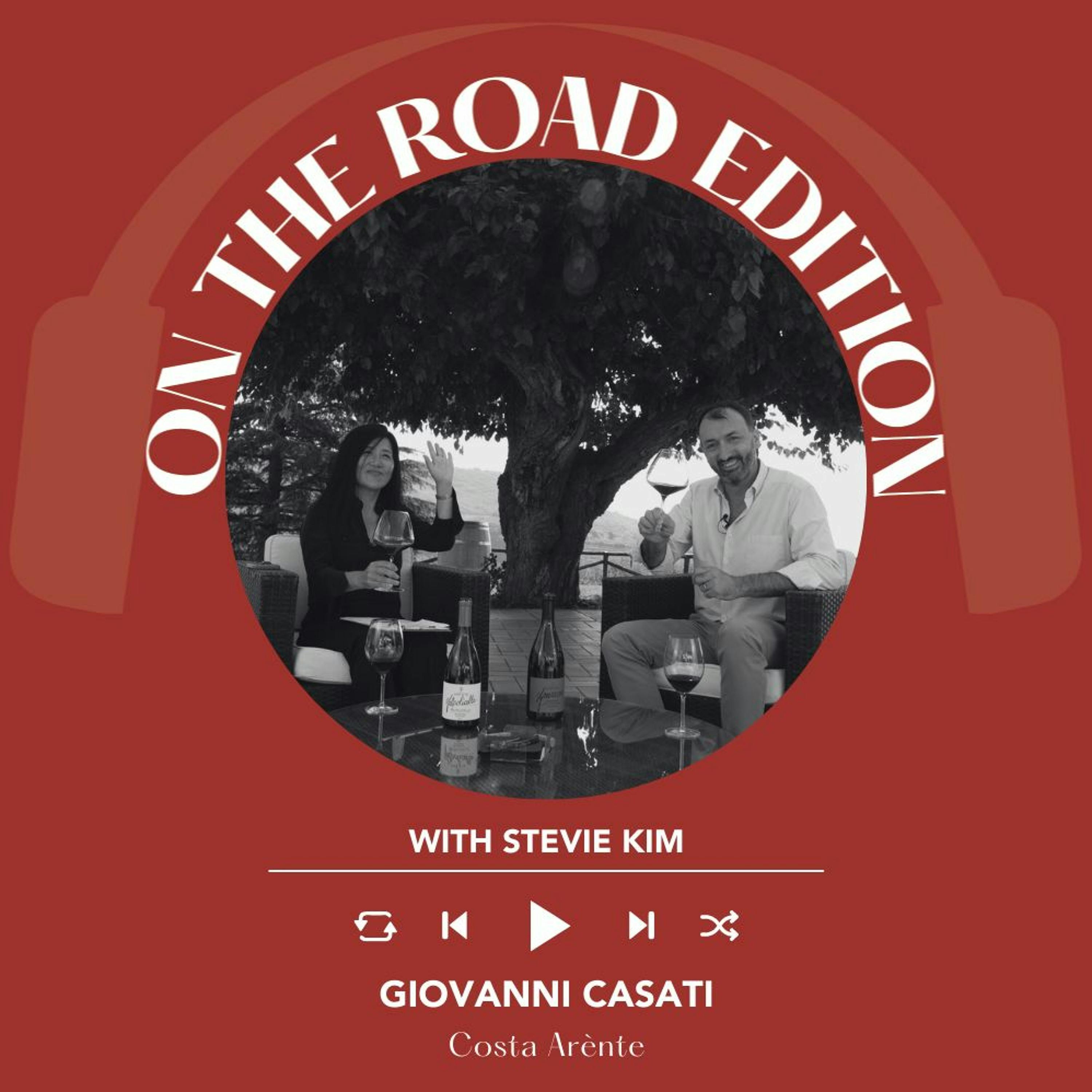
Ep. 1601 Giovanni Casati Of Costa Arènte | On The Road With Stevie Kim
On the Road with Stevie Kim
Episode Summary
Content Analysis Key Themes and Main Ideas 1. Introduction to Costa Arrente winery, its location, and its connection to Generali Insurance. 2. Giovanni Casati's background and role as winemaker and estate manager at Costa Arrente. 3. Details about Valpolicella and Amarone production at Costa Arrente, including specific grape varieties and winemaking techniques. 4. The unique terroir and microclimate of Valpantena as a sub-zone of Valpolicella. 5. Challenges faced in winemaking, particularly concerning global warming and vineyard diseases like Downy Mildew. 6. Costa Arrente's commitment to sustainability and future plans, including traditional method sparkling wine. Summary In this ""On The Road Edition"" of the Italian Wine Podcast, host Stevie Kim visits Costa Arrente, a newly redeveloped winery in Valpantena, Verona. She interviews Giovanni Casati, the estate manager and winemaker, who discusses his journey from Tuscany to leading this project. Costa Arrente is part of Le Tenute Leon Alato, a new agricultural holding by Generali Insurance. Giovanni elaborates on the unique characteristics of the Valpantena region, its specific grape varieties like Corvina, Corvinone, and Rondinella, and the microclimate that contributes to the wines' elegance and fruitiness. They taste and discuss Costa Arrente's Valpantena Superiore 2021 and their first Amarone 2018, noting its velvety texture and complexity. Casati also addresses the significant challenge of global warming, their efforts towards sustainability and biodiversity, and the impact of Downy Mildew. The interview concludes with a look into the future, including plans for organic certification and the upcoming release of a traditional method sparkling wine made from Corvina. Takeaways - Costa Arrente is a new winery in Valpantena, Verona, associated with Generali Insurance's agricultural ventures. - Giovanni Casati, an experienced Tuscan winemaker, spearheads winemaking at Costa Arrente. - Valpantena is a distinct sub-zone within Valpolicella, known for its unique soil, altitude, and microclimate. - Costa Arrente focuses on producing Valpolicella Superiore and Amarone, emphasizing elegance, fruitiness, and drinkability. - The winery utilizes traditional grape varieties like Corvina, Corvinone, and Rondinella. - Sustainability and biodiversity are key aspects of their vineyard management, with plans for organic certification and solar energy use. - Global warming and diseases like Downy Mildew pose significant challenges to quality wine production. - Costa Arrente plans to release a traditional method sparkling wine made from Corvina in the near future. Notable Quotes - ""The Valpantina is in the center of Vantoli Chala denomination."
About This Episode
The speakers discuss the Costa Arrente wine winery, which is located in a small town near a town called Val Pantena. They discuss the production and selling of wine wines, including the use of traditional techniques and the challenges of producing vintages due to climate change. They also discuss the use of label measurements and the use of different types of fruit and mix. The speakers emphasize the importance of sustainability and the use of solar panels for the wine production. They mention a follow-up interview with Speaker 2 about the Italian wine industry and offer information on ticket prices and points of sale.
Transcript
Since two thousand and seventeen, the Italian wine podcast has exploded. Recently hitting six million listens support us by buying a copy of Italian wine unplugged two point o or making a small donation. In return, we'll give you the chance to nominate a guest and even win lunch with Steve Kim and Professor Atilio Shenza. Find out more at Italian One podcast dot com. Welcome to another episode of on Road Edition hosted by Stevie Kim. Each week, she travels to incredible wine destinations interviewing some of the Italian wine scene's most interesting personalities, talking about wines, the foods, as well as the incredible travel destinations. Hello, everybody. Welcome to Italian Wine Podcast on the road edition. My name is Stevie Kim, and we are once again traveling in the vicinity of Vorona. We're not very far. We're actually in a fairly new winery. It's called Costa Arrente, and we're in a town just above Gretzana, I believe. Is that correct? Yeah. We're here today with our special guest. Chevani Casati. He's the big cheese around here. He's the resident, the state manager, but also the winemaker. And he oversees this new group, which is called. Okay. Let's repeat that. Which means a state. States. Right? And le on a lato. Like, lion with flying wings. Yeah. Perfect. Right. What what what's going on? Why is it called le tenute le on a flying not flying pigs, flying lions. Why is it called that? Because the the history is that our property Mhmm. Is from, general insurance. That is from Venice. Right. And the leon alato is the symbol. Or for Venice. Yeah. So I don't know if you, our audience is familiar, but Jennadale is, is it the biggest now? It's the probably. Probably, we don't know, but probably If not the biggest, probably one of the biggest insurance companies in Italy. However, they also have interest in, you know, in the agriculture overall and some, of course, wine business as well. So this is a new kind of, I suppose, holding. Is it correct to say that? And it's this le tenute le on a a lot. Alat. Okay. So there you go. This is the presentation. Giovanni, tell us a little bit about yourself, Giovanni, who you are, when you started working here. But, generally, how long have you been in the wine business? Thank you, TV. You're welcome. Okay. And you're welcome, ma'am, about my history. Mhmm. I'm studying in agriculture, Imogoramist, and the neurologist, sister, and I started my experience in the world of the wine in Tuscany with a thirteen years of experience, through the montepulciano, Montalcino, Marima, Kianti, So you're a Tuscant. Are you originally from Tuscany? No. No. No. I'm from, the lake of Kumo. Uh-huh. Okay. I'm not from North Italy. Yeah. Okay. And my experience in Tuscany, in particular, about the best red wines, like, Montecino and a Marima. Mhmm. And then in Kanti, and I start my new life, and, really, the new life here in Verona with, this challenger because, letting you to the learn a lot about this estate in a twenty fifteen. So it's a new winery. Was there already an existing winery? No. It's already existed, but we rebuild completely in particular the hospitality and, in particular, the seller. And, we build that because we are speaking about, we're talking about the new fruitio. And, we start, our first production internally made in a castorente in a twenty eighteen. Okay. So it cost that the first vintage was two thousand eighteen. We stopped our first vintage. It was a two thousand six in. Okay. But we winified wine in the other seller because we are rebuilding. We employed two years to rebuild the new seller. Okay. So tell me why it's called Costa Arrente? Costa rent. The costa is a top on him. Mhmm. It's a the place. The costa is in the middle of the hill through Gurtzana Village in the plain and the Romagna village. Upstairs. Yes, sir. The Romagna for those of who are less familiar is on the very top. Right? Yeah. On in go. Is the town in the bottom. In the bottom. And this area is called Val Pantena, right? So, which is part of Valicella. Is that correct? Yeah. Because I think most of our audience, they've never heard of Valpantina. I'm really sorry to say. The Valpantina is in the center of Vantoli Chala denomination. Mhmm. And in the Vipuricella valley is the valley closer to Verona Town. And, in the fifteen minutes, we are in, the arena parking. So it's very short valley about Viticulture and, it finished here in Urzana. It's eight kilometers Mhmm. About vineyards. The particularity is that this valley is very close. There is a good ventilation or during or the day now too. And the the soil is a calcareous clay white. It means to have a very long vegetation about vineyards. It could be, the perfect target to have the product, the grapes, with a good acidity and the fruitiness. So tell us a little bit in terms of the altitude, the microclimate. Yeah. Give me some numbers just so that we can orient ourselves. In terms of the acreage and, type of labels, how many lines? To give me an, a skinny, very skinny overview. Okay. Okay. We have, forty hectares of, estate and seventeen hectares of vineyards. Mhmm. The system training is for seventy percent pergola veronese, the historical, system training. And, we have, the varieties typical for verona. Corvina, Corvina, Rondinella, and, another native variety called spigamonti. And, spigamonti. Yeah. The scientists found it in here, near here, near Cabolo in the the other part of the valley. And we are at two hundred meters of altitude, and the the the climate is very windy and dry and cold. Probably in the past, the grapes, the varieties, take not in the perfect harvest, but with the climate change, the global warming, it's, probably the new challenge the new border of the domination of a valpolicella because with the same alcohol and the structure, it's possible to obtain the wine with elegance and fruitiness. We produce the classical products of, Voporicella, like Amarrone, Amarrone reserve, Ricardo, Repaso, and Voporicella superiore. And the new one, the newborn, is, molinara. That is, in the past, it was the fourth variety in the amarone blend. But, thinking about sparkling wine, rosette, and, Charamato, the long, six months on the lees. So in total, how many labels? In total is six? Six labels. Six labels. Okay. And I see two wines here. Are these your would you say your signature wines, the two wines that we have here? Here we have a, Okay. Twenty twenty one vintage and our first amarone twenty eighteen vintage. The first one, because Eric Peter is, the first one produced it completely in this state. Mhmm. From the vineyards to battle. Okay. So, let me just ask you a question here. I see. So, but do you have like, No. We produce only but Why is that? Can I ask why? Superior because, we have naturally the higher quality from the vineyards from the production about the grapes, and the alco de Greas is more high and the quality too about stunning. So we unbattled one year later than a very basic one. Mhmm. But that's the that's the requirement, right, to be superior. Yes, sir. We write on the label, Balpantina, because it is the only subgenre in the Balpura denomination. But Giovanni, I mean, Don't you think it's kind of confusing in a way? Like you have. Okay. And then you have. Okay. Do you think it's not confusing? No. Because, for me, it's, explain to consumer the particular area Mhmm. Of, Valpolicella. Valentena. To speak about Balpartana and to, right. And the label, it, to recognize more quality and, another difference about the the Vapolicella classica or normal Voprocella. Okay. Let's taste this Vipontina. Yes. Not Vipontina. There's no Vapontina basic. There's only Vipantana superior superior. Superior. Okay. Let's taste the wine. Okay. Okay. I love this color. Yeah. Right? It's it seems like Pino. Right? Perfect. Yeah. Alright. So tell me how this wine is made. Okay. What goes in here? The blend is a sixty percent Corvina, thirty percent Corvina on it and percent, rondinella. No Molinata. No Molinata. No Molinata. And that other native grape. No. Yeah. Right? I think that, it's possible to understand the philosophy and the style about the seller in, Baricella, starting it to tasting the wine from the Baricella. Particularly, the first step is the color. You say it's a very good color because it's a very red ruby color, but not deep. It's possible when explained to the consumer, to the guest, how understand the the the particular style that it's possible to view the finger through the glass because, the color from the variety Fanger to the glass. Yeah. So, like, you take the Yeah. It's possible to to to see your finger. Okay. Because, the variety, typical color of verona, have not color Mhmm. Only in London. You say Corvina is like a pinot noir. It's like a wild pinot noir. It's spicy though. Yeah. We make this wine. We start the fermentation in the steel tank. And one part in the out for us. Mhmm. And at the animal part, little one in New Barrick. What is the percentage? Thirty thirty thirty. Okay. Okay. So it's significant. The unification. Okay. And we start fermentation. But we age for one year in, the arm for us. Mhmm. And in bigger wood. Okay. Because, we want it too complex, the color and the tanning, but take a respect there for the fruit and for the flower. I love this wind blowing behind us. I feel like you're missing a hammock because then you can just, you know, I could just stay here all day. Right? Okay. So, how many bottles do you produce of this? Normally, thirty thousand. Okay. So it's not a big production. And where do you sell these wines? Mostly Italy or abroad? No. In other countries that, out of Europe, normally. Okay. Yeah. But, our channel is Oreka. Okay. Let's taste the other one, which is, of course, Amarone. Amarone? The first vintage, twenty eighteen. Mhmm. I'm very proud because it's my first song. Yes. So, two thousand eighteen, Amarrone de La Balice. Do you have just one type of Amarone? Yeah. Only one. And, we produced it. There is airbag two. Okay. And this is the current release. Yeah. This is what it's available in the market. How many bottles? We are, thirty thousand. It's like a common number, thirty thousand. Yeah. Apolicella, thirty thousand, amarone. This vintage is too was a very good vintage. It's, the first amarone produced completely in the the costa rente. The grapes are dried in the new Fortaio. It's the blend of, sixty percent, the corvina, thirty percent corvina, and ten percent, Rondinella. No Molinara, because with Molinara, we produce another kind of wine. And, it ages for two years in a different room, five hundred liters, and one year more in a bigger wood. Mhmm. And one year in the bottle. I think that, the bottle is really important. I think about, variety from verona that are like San Jose or Nebula there are aristocratic varieties. Mhmm. They have, in the genetic potentiality flavor about quality. Mhmm. Normally, the people ask me, when the moron is ready? My husband is, a moron is ready when he's ready. B must have edges. Because, every vintage talking about the onion history. So we want to appreciate this history and, we want to drink this wine when it is ready. So let me ask you a cheeky question. Okay? Blind tasting. Blind tasting. Yeah. There are ten amarones. Yeah. How can you know that this is your amarone? Okay. The fruit. Okay. Because, fruitiness and elegance is like, I hate when people say elegance, everybody says that. Okay. When when you taste it, you can taste it like velvet. There is a good balance of the acid and tiny. So the texture is velvety. Yeah. More velvety than other amarones? Yeah. Because sometime it is, the morone could be aggressive. Mhmm. And the mouth is not sweet because, the sugar level is a good balance sheet. Mhmm. And, but in particular, the quality is, drinkability. Okay. Is, seventeen In Italian, they said, Can I say that you? Beavour. Beavour. Okay. It's a very good Beavour. Yeah. Yeah. Because it's not Vachella Beavour. No. No. No. No. No. It's a sixteen point five percent in alcohol. It's not even midday yet. This is what we call the breakfast of champions. There's no spittoon here. Usually, so I've been drinking this. Okay. So that's how you can tell. The velvety texture and more fruit or less fruit? Less fruit. Less fruit. When the maroni is a very good maroni, you can leave in the glass, and it changed completely the flavor. Mhmm. And then probably you start smelling a a cherry ripe cherry. Mhmm. And after some hour, you can smell a coffee, torrefaction, and, fix, and a little note of bitter orange. Okay. Like a kino. Yes, kino. Kino. The color is the same, then you can find in, the style in the Balicella basic one because, it's a deep, but it's light in the same time. Wine to wine business forum. Everything you need to get ahead in the world of wine, supercise your business network. Share business ideas with the biggest voices in the industry. Join us in Verona on November thirteen to fourteen twenty twenty three. Tickets available now at point wine dot net. Okay. So, Giovanni, as you go forward, right? The two thousand nineteen vintage, how is it different from the two thousand eighteen? It's better than, the first one. So just throw this down. Yeah. Because it's the second song. So, no. Because, when you discover a new state, you want discovery year after year, you must discover year after year how the vineyards can give you and the the potentiality, the particularity. And so this is the first one, but, I taste the the new one vintage twenty nineteen. There is more elegance there is more fruit is, the second step to improve, to make a very best of my role. What is your philosophy between just very general terms? Like, what is your philosophy in terms of the vineyard management and winemaking here at costa renta. To respect the territory and to understand what, the territory can give us and, looking at the past, but, thinking the future what the modern consumer wants and, what, we can give to the consumer. Okay. I would say technically speaking, we are done, but I suppose what I would like to ask you is what are the biggest challenges that you face as a winemaker at Costa Rica. It's a good question. The bigger challenge Mhmm. Is to continue to produce quality wine because we have a a bigger challenge is global warming. Mhmm. And, every vintage is really difficult to understand to interpret it. We want to improve the quality of our wines, respecting the nature. We have a very big biodiversity in the in the state. So the bigger part of the state is the food. We have a animal everywhere. To produce the product in modern style, but, looking in the past. Listen Giovanni. Are your vineyards organic or are you going towards organic? Not yet. Is that your objective? Yeah. Yeah. In the future. Yeah. And, but, we are Well, you've just started. Right? Yeah. But we are not a certified. Mhmm. But, we are monitoring the biodiversity with the the different project We use the system technology, like the assess, the system support system to reduce, pesticide, using the pesticide in the vineyard we are monitoring the biodiversity with the Trebee's project. We are looking for the sustainability about the solar energy because we are, you know, the furtado is, catch the big energy. Mhmm. So you have solar panels? Yeah, solar panels. Okay. What kind of economy do you have? Do you have, like, ten percent, twenty percent autonomy from the solar panels? Oh, total. During the sandwich total, yes, because we have, one hundred and fifty kilowatt of energy. From the solar panels. Yeah. Okay. Excellent. What about the Perenospora? Downy mildew. Was that a problem this year? Because everyone is talking about the damage that Downy mildew has caused in the vineyards. The Perunopura in this vintage is it was a very big problem. Mhmm. But, so we are lucky in Costa because there is a good climate, big ventilation, and our system train pergola, protect the the grapes from humidity. Mhmm. Because, you know, with the pergola, the grapes stay at one meter and a half above the the grass and, in particular, during the harvest, there is no problem about the boutrates. It's not, we had Pronospora in, in some vineyards, but, probably, it will be a problem for next year. Because there is a big pressure about this disease. Mhmm. And we have a think how to manage in next year. And what about this year's harvest? When did you start and when are you planning to finish the harvest time. We start, at the first, a week of September Mhmm. To with the molineara for the sparkling wine in the second, half of September with the selection of the best grapes, to dry for a moroni. Mhmm. And, probably, we start in the first October, the first week of October with the harvest up about, by Policello. Okay. And then, one last last question before we go. No white wine in the future? Not white wine, but a new wine from Corvina, classic method, Oh, okay. And, Rosie. So traditional method. Thirty thirty six months of aging and, but, yeah. Have you started this process already? We already started in, the vintage is a twenty twenty one. Right. When will we get a chance to taste the first vintage traditional method? The next in Italy, known in the next one, but the one. Not twenty four. The one after. Okay. So we don't have any sparkling wines to do, but We certainly have an Amaroni. Okay. So that's a wrap. Chinchin with Italian wine people, and that was Giovanni Casati from Costa Arrente. Thank you for joining us on another installment of On The Road Edition, Hosted by Stevie Kim. Join her again next week for more interesting content in the Italian wine scene. You can also find us at Italian wine podcast dot com or wherever you get your pods. You can also check out our YouTube channel. Mama jumbo shrimp to watch these interviews and the footage captured of each location.
Episode Details
Keywords
Related Episodes

Ep. 2597 Wine in Transition: Declining Demand, De-Alcoholised Wine & New Alternatives with Robert Joseph | On the Road with Stevie Kim
Episode 2597

Ep. 2595 Where Wine Won In 2025 with Erica Duecy | On the Road with Stevie Kim
Episode 2595

Ep. 2583 Women For WineSense and the Houston Rodeo Wine Competition with Amy Gross | On the Road with Stevie Kim
Episode 2583

Ep. 2564 Understanding the Albanian market with Erjola Braha - CEO of Alehandro Group | On the Road with Stevie Kim
Episode 2564

Ep. 2554 In conversation with Marco Alberti, the Italian Ambassador in Tirana | On the Road with Stevie Kim
Episode 2554

Ep. 2463 Lamberto Frescobaldi | On the Road with Stevie Kim
Episode 2463