
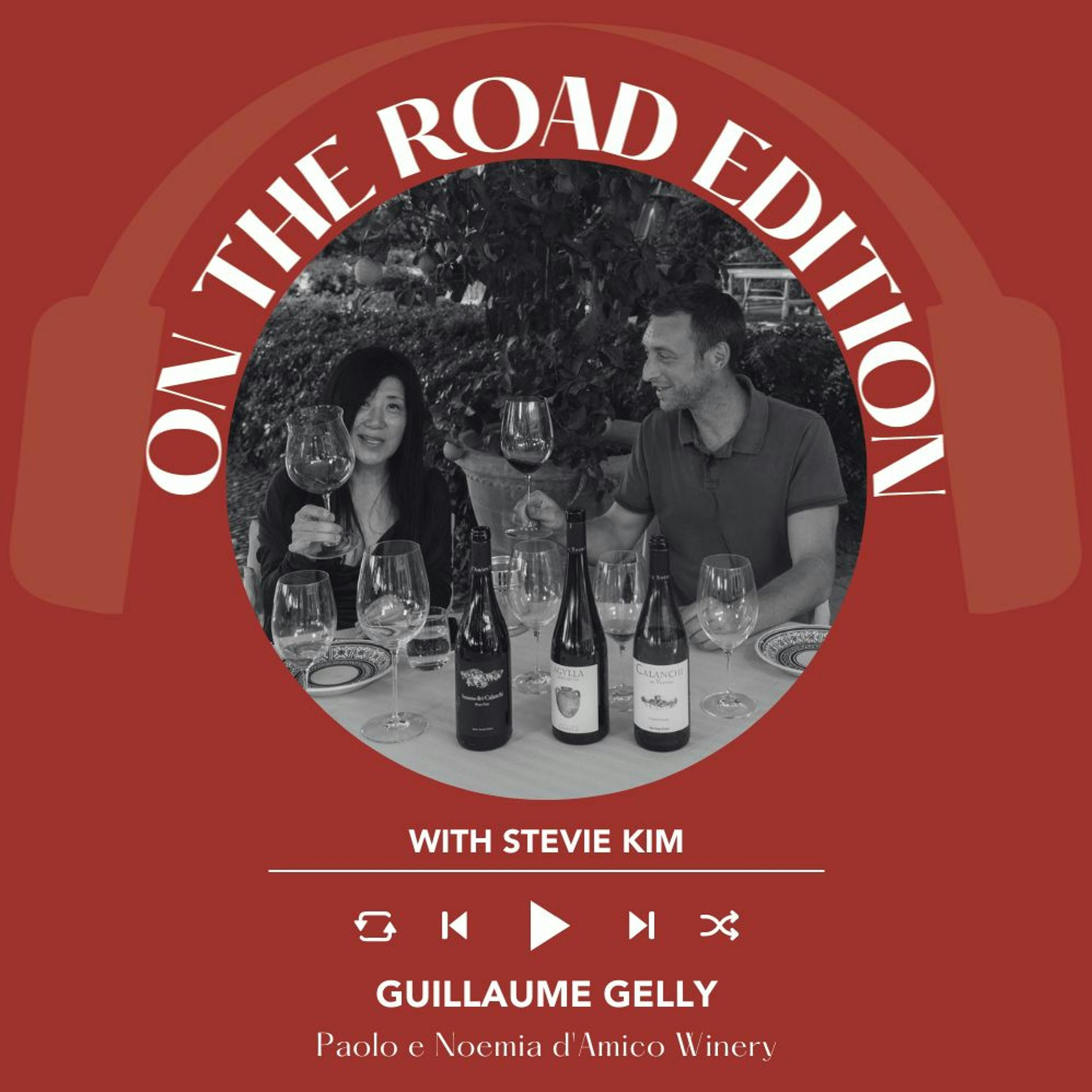
Ep. 1651 Guillaume Gelly Of Paolo E Noemia D'Amico Winery | On The Road With Stevie Kim
On the Road with Stevie Kim
Episode Summary
Content Analysis Key Themes and Main Ideas 1. The unique winemaking philosophy and terroir of Paolo e Noemia D'Amico winery. 2. The influence of volcanic soil on grape varieties, especially Chardonnay and Pinot Noir. 3. The balance between international and indigenous grape varieties in Italian winemaking. 4. Sustainable and organic viticulture practices and philosophy. 5. The role of traditional and innovative winemaking techniques (e.g., amphora aging). Summary In this ""On the Road Edition"" of the Italian Wine Podcast, host Stevie Kim visits Villa Tirena, located on the border of Lazio and Umbria, to interview Guillaume, the French winemaker at Paolo e Noemia D'Amico winery. Guillaume details the winery's 31 hectares of organically farmed vineyards, which produce 10 different wine labels, totaling 200,000 bottles annually. He explains the winery's unique position, nestled near a ""green canyon"" formed by an ancient volcano, and how this volcanic soil profoundly influences their wines, particularly their signature Chardonnay, Calanqi di Vaiano. Guillaume discusses their commitment to expressing terroir through minimalist winemaking (stainless steel for Chardonnay) and their innovative use of amphora for their Grechetto, Ajila, to achieve depth and aging potential. He also touches on the challenges of cultivating Pinot Noir in the region and the winery's broader philosophy of authenticity, sustainability, and passing on a healthy landscape to future generations, even as they pursue organic certification. Takeaways - Paolo e Noemia D'Amico winery is located on the border of Lazio and Umbria, characterized by unique volcanic soil. - Guillaume, the winemaker, is French but has been in Italy for 11 years, bringing his expertise to the winery. - The winery cultivates 31 hectares organically and produces 10 different labels (6 white, 4 red). - The volcanic soil significantly impacts the wines, providing freshness and acidity, especially beneficial for Chardonnay and Pinot Noir. - Their Calanqi di Vaiano Chardonnay is fermented in stainless steel to express the pure volcanic terroir. - The Ajila Grechetto is a unique wine aged in amphora, aiming for complexity and significant aging potential. - The winery embraces a philosophy of authentic taste, terroir expression, and sustainability, prioritizing the land for future generations. - They are in the process of obtaining organic certification, aligning with their existing practices. Notable Quotes - ""We are just in front of the kind of green canyon in the border between Latio and Umbria. That landscape was built over the years by the volcanic eruptions from the volcano."
About This Episode
The speakers discuss their wine wines and their commitment to sustainability and protecting the environment. They discuss the number of labels and the characteristics of their wines, including the Orvieto, Chardonnay, Chardon, and Chardonnay. They also emphasize the importance of organic and sustainable ingredients in maintaining the taste and potential of their wine. The speakers emphasize the need for sustainable production and the importance of protecting the environment. They also discuss the release of their wines and the challenges of improving the quality of their wine.
Transcript
The Italian wine podcast is the community driven platform for Italian winegeeks around the world. Support the show by donating at italian wine podcast dot com. Donate five or more Euros, and we'll send you a copy of our latest book, my Italian Great Geek journal. Absolutely free. To get your free copy of my Italian GreatGeek journal, click support us at italian wine podcast dot com, or wherever you get your pods. Welcome to another episode of On the Road Edition, hosted by Stevie Kim. Each week, she travels to incredible wine destinations interviewing some of the Italian wine scene's most interesting personalities, talking about wines, the foods, as well as the incredible travel destinations. Hello, everybody. My name is Stevie Kim, and we are back on the road edition of Italian wine podcast through Mamma Jumbo shrimp YouTube channel. So don't forget to subscribe to our channel. We've started this about ten months ago. And today, we're here in I'm kinda confused. I don't know if it's lots here or umbria, but we are here with Guillaume. He's actually a Frenchmanman. In Italy. And he's the winemaker for the winery. It's called paulo en Nuevia Damico. That's the name of the winery. Right? It's it's quite long. So Kim tell us a little bit about yourself what you do at the winery. Hi. So thanks for having me. So, basically, in the we're running thirty one hectares of vineyard driving on the organic way. And then, basically, taking care about the vineyard Managing and the winemaking. So where are we? Tell us explain to us where we are. So it's exactly. Exactly. So it's a very, very special spot. We are just in front of the kind of green canyon in the border between Latio andumbria. That landscape was built over the years by the volcanic eruptions from the volcano volcano, who became now one of the deepest lake in Europe. So it's a a famous place for the Truscon in the past. So we are in Los Angeles. Just ten minutes from Tuscany, five minutes from Mumbria. Ten minutes from Tuscany? Yeah. Exactly. Yeah. So we are really on the border on the very rich cultural area. That's why we are here to to bring Yeah. To bring her to show up this place. So the wine estate is located also in Villa Terrena. Is that And you have a magnificent view of this green canyon, as Guillaume said. You can tell by his accent he's French. He has that terrible French accent. How long have you been living here? Living here? No. It's, about eleven years. Okay. Eleven years. So, you know, Jim, I have to confess that I was not expecting this type of winery in this area because I see that your wines are in a way different from the other whiners here in this area where everyone is focused on the indigenous Greek varieties. You have gone the complete opposite way, if you will. Just give me kind of an overview because I know you're quite busy and we don't have very much time, but I would like for you to tell our audience how many labels you have and what kind of grits you use. Yeah. So about researching one hectares of vineyards. We have ten different labels. From the Orvieto, we're testing together yesterday Mhmm. Until the going to two different hundred percent varietal wine, more international, like our chardonnay, I just told you the Calanqui de Valiano, with a hundred percent chardonnay, that Calaki you mentioned before. And on this side, you have to think that the wine area was created back in the eighty five. Mhmm. And having a look on the, international side of the wine business It was more about the chardonnay, the international variety, like the merlot or the pinot noir. And about the chardonnay, I mean, no, because their top ten grapes just show up, let's say, a bit more well known for the last five eight years, let's say, before, it was quite difficult about the canyonolo, Trebiano to understand for the consumer. And this variety, like, the chardonnay, for example, is is the white variety most planted around the world. It will be a reason. The reason is first, the chardonnay is allowed you to have a very low yield quality, like sixty, six tone characters until fifty or even the triple. So you can ask him to produce low yield or big yield up to the objective of the one you want to make. Then the chardon is one of the best translation from the soil. Mhmm. So let him you can handle him, let's say, to express very well different kind of terroir. And as we are in the volcanic soil, it was very, let's say, clear that the chardonnay will be one of the best expression. And At the end, it's just a few places around the world making wine on the on the volcanic spots. So it's a special fish city we have to bring in and to show to the wine. And the volcanic soil together with the the sharpener variety just an amazing wedding. Let's say. So, you know, I've asked you to show us three kind of your signature wines. Right? So this is our first wine, which is chardonnay. Yes. One hundred percent chardonnay. So tell us about a little bit just briefly about, I would say, the vineyard conditions. Yes. The soil, the microclimate without going into specific details. Just a very broad overview, and, of course, the white making. So this is one of the our flagship for the whites, the the Calanque divayano. So it is a hundred percent, sharpened in two thousand twenty, and only stainless steel. So first, it's coming from the our oldest Vigna who is now thirty seven years old. So it's kind of the golden age for the vineyards, the vineyard, the golden age for the vineyard is like from thirty to eighty years, a bit like us, and about the yield, about the complexity, the aromatic complexity, we can reach in, during the maturity in the grapes. And that's why it's only stainless steel fermented. It doesn't need any oak. It doesn't need any malolactic. We just want the pure expression coming out from the volcanic soil. So this is our flagship in sense of it just show all the complexity coming from the soil just on a simple wine making way. So once again, we are not here to really make wine, but to express the quality of the soil. So this is kind of the essence of the chardonnay from this area. Yes. That's what you want. And no aging in other vessels. So it's aging eight months on the stainless steel on the fine lids to give what I told you about some rawness, but not even, but even some stability, allowing me to have a very, very sulfites rights. In the other side, the Calan key is expression It's an amazing complexity as it's kind of wine. It's so easy on the winemaking that it tell you the story of the vintage. And two thousand twenty, is a nice example, the same chardonnay, the same maturity and as a kind of soil. We have a very low acidity and be very, let let's say heavy on the palette. Here, thanks to the freshness kept by the volcanic soil. It's thanks to the beauty of the volcanic soil. It's allowed me to keep a very nice acidity and have having a balanced wine at the end. So no wood at all. No wood engine on this one. We got another version of the chardonnay with the Valleza with a aukey chardonnay, but let's say this one, it's you wanna have a first approach or a first, touch to the winery. I mean, the Calan key after the Avieto, the Calan key is really meaning a lot for us. And how many bottles are you producing of this? Of this one, we are about thirty thousand bottles. And in total? So we're still on the family size winery, and it's about two hundred thousand bottle a year. Mhmm. So the second one, still speaking about the variety. Mhmm. So here we are back on the autocton variety. We got our or Viator was made with the autocton variety. And then the Ajilla. Ajila is our newborn wine existing for three years now. It's a hundred percent Gregeto with our local grapes, or tungsten grapes here in the Tucia, in the Calangi, and is fermented in amphora. So it was not just about doing a Gregeto, in stainless steel oil, oak, but it was looking deeply, or we can reach a bigger body, having an aging potential more important but staying on the flutipa. And, until now, it was more assimilated to the bowel. So the bowel have, taste impact, organoleptic impact, obviously. And here, we're looking. The amphora brings some neutrality on the taste, but let the wine breathe like bowel. You got, a full expression of the deregator, and it's all inefficient by the amphora. So it's a kind of newer reason. It's back to the basic. I mean, we are here. The amphora was was told here. The truest vertices and twitch can, for how you saw on the label. Mhmm. So the and the name is linked to the etruscan Amfa four r two. We are just looking back in the past and, applicating to the new method. Let's say. And is this a smaller production? I mean, you're using the m fours, so I'm imagining that it be a smaller production. Yeah. At the moment, we are about five thousand bottle a year. Mhmm. Increasing the production because we are very pleased that the project gets, nice success about the our clients. So it will increase in the, in the future. But, still, staying on the small production. And what is the aging capability of these wines? I mean, infinity. This wine will, so this one is a two thousand two twenty one. Just bottle, just bone. And it will have easily ten to twelve years to age. Okay. But when does it reach the maximum? Like, it doesn't get better after that period? I mean, after eight, nine years. Okay. So the optimum period would be to drink after eight or Yeah. From eight until fifteen will be the top period. And then maybe you will have some, you will find some evolution. Are you enjoying this podcast? Don't forget to visit our YouTube channel, mama jumbo shrimp for fascinating videos covering Stevie Kim and her travels across Italy and beyond, meeting winemakers, eating local foods, and taking in the scenery. Now back to the show. But once again, staying on the final lease, give a very good stability to the wine, and it's like having a reductive part against the oxidation of the wine. Even open, we saw just putting back the cork, keeping for two, three days, just getting more and more open, giving you more complexity and just getting better and better. Is not afraid by the oxygen. It's just helping him to get more open. So the unification is made that the wine are stable by itself and not thanks to the the help of the sulfites, for example. So, I mean, talking about sulfites, are all of your wines organic? So we are organic without certification for the moment. Because I didn't see any of the labels. We just start the process because I would tell you the certification is about the market. Maybe the marketing, but we're doing organic for what you see outside. Mhmm. We are the closest to the Karanki Valle. So it's kind of our responsibility today to be sustainable organic for the moment biodynamic may be in the future is the way to protect the nature. And, obviously, our goal is not only making wine from this terroir. It's to keep the potential of the soil that will be the same strains, the same potential the next ten, twenty, hundred years. So we're here. We're just here for a a passage, you know, for a few short of time, then to the next generation we're coming over, and it's a responsibility. Our generation, it's kind of responsibility taking care about the landscape or what we're making. The one is coming from and result or with a certification. You know, people right now, of course, organic is very trendy. Right? Sure. Sure. You can say Oh, natural wines. Yeah. Oh, vegan wines. Right? But how do you feel about sustainable wines? How do you differentiate for you personally? Yeah. What is the difference between organic and sustainable line. So, basically, sustainable is taking care about it without any official restriction. So it's sustainable for me. It's a sense for you as another for every people to get a sense up to our own action in our everyday life. Being organic, it's just, you know, moving on on this philosophy and making clear to the clients, like the natural wine, it's just having the pure expression. Then you can have some nice expression, expression that you doesn't really like, but the aim, the objective at the end, is always having the true product, the authenticity of the taste. And that's what I'm fighting against. Is the imagination or the taste became uniform Mhmm. To the people like the sweets, people like most wheat, the bitter almost disappeared the last, years. Everyone wants to have dry wines. And even more round wine, a lot of roundness, ready drinking wine. Mhmm. So something a bit too easy compared to the complexity of the wine world. Wine needs time. A great wine will never be ready straight away. Then markets needs everything. Wine already the first year, then maybe able to age. But, I mean, when you're respecting the wine, it's always about time. And so going on the authenticity of the taste is back to the organic, is back of the terroir speak, having the expression of the vintage, this is the same, sustainable at the end, the results will be going on the expression of the vintage, And then you can choose natural wine. You can vegan. We could be vegan certificated as the no wines get ever, fine because it's about defining. Mhmm. But we're doing that for us, you know, for the marketplace. So, I mean, at the end, The intention is always positive, then it's all you can handle it and already you want to push it forward. Mhmm. Like the amphora, the non sulphide wines, always all deep you can to reach the most authentic taste. Okay. Very good. So you have ten wines and how many roads and how many whites? So six whites and four reds. Okay. And what are your four red wines? So the first one are great varieties. Is a or a metal Sierra, but a young one only only stainless steel that we're putting on the market every year with the new vintage, playing on the freshness, on the flavor, and on the silky, very discreet tannin, very subtle. And a very nice expression of the vintage. Then we have the pinot, pinot noir, notur no dee calanqui. I'll just pour you now two thousand eighteen. And here we got another example of the pinot noir of the volcanic soils. This is why existing just sinks the volcanic soil. So not to know the Calan key that it's all. We are always very linked to the Calan key. It's our identity and the piano. So the piano is maybe the most difficult variety I have to deal with because you have to protect him from the sun. Otherwise, the sun just burn all the acidity and all the flavors. And a lot of people What is what is the altitude here? We have about three hundred meters above the sea level. So not really high, but you can still feel it even during nighttime. And the pineau, so we are very low yield. We are about five point five tone perimeters naturally. And we have to protect the sun, from the sun. When do you call this ordinarily? You know? And the hardest thing is about mid September. Let's say from the ten to the fifteenth September, about the hours. And here, it's important to reach the phenolic maturity, not about the sugar and being taking care that the sugar is not going really high. And a lot of people, when they're coming to us, I said, oh, your pinot will be kind of jammy. Right? I said, no. Because we are on the volcanic soil. And here, you see the beauty of the volcanic soil that's allowed us to produce the nocturnal de calangi. Why is it called notur, you know, de calangi? So not to know the Calan key is like, serenade by nighttime on the Calan key. So having glass so it's always really on the seductive part of the piano that reveals you the, you know, the atmosphere about the Calan key, and the serenade is always very romantic. And when do you release this wine? Because we're drinking now that Eighteen. Eighteen. So Is this the current vintage in the market? Yes. Exactly. Okay. So after twelve, fifteen months up to the vintage, aging the French old barrel, this wine was bottled. And then just lay down. And it just release every vintage when you reach the full maturity. You know, the bottling is always the most stressful period for the wine because coming from long and easy, lazy, aging period to the stress of the bottom line. Why needs time to get back and to reach the balance that it was before? So, again, is it because your branch that we have all these French, grit, varietal, or let's say international? Or did you find all the wines like this when you started? No. I was I started the wine before I came. I got I'm fortunate to find this place. The variety, it was because he opened our missus and miss Danico fault in law of his burgundy. That's why we have Chardonnay and Pino. Mhmm. And as I told you, when you arrived, they were looking for this place first to start the vineyard. Right. And Viano where we are was well known in the past to be a high quality post for the grapes. So we're speaking about the eight thousand century, eighteen hundred, and fixing the price for all the arrea until of yet. Mhmm. So they decided to start the journey here and, fortunately, they stayed on the top of the hill because once you're going down to the hill, you find a heavy clay, and it's a totally different world. Here on the gray to form the volcanic soil, we got unique spots. Okay. So we're running out of time. So let me just ask you one last question. How would you like Dominique go to be going forward in terms of wine styles and wine making in the next two, two, three years. So, you know. Yeah. So Short term. I mean, short term, the bases are already on. I mean, with the the organic, next step will be the certification to really show to the people or the client, the new customer, don't really know us already. That's the way of producing. But then, I mean, it's not, you know, every year, it's a challenge. Mhmm. Every year, we try to do better in a sense of way. So that's the real challenge keeping the quality. The quality base are always looking for more authenticity. It will be maybe through the biodynamic in a few years. Maybe it will be staying like this, but new method like the amphora. At the moment, it is crazy world having a stable identity and, looking deeper in its we start changing and we start looking what everyone are doing, but just what is the best for you, for where you are from, that's a good target. Okay. So that's it. Signing up, and it's a wrap from Villa Tirena, from the winery that is hold Paulo and Namica from kind of Latica toscana. Latica. So that's it. And, hope to see you soon on the next episode. Thank you. Bye bye guys. Bye bye. Thank you for joining us on another installment of on the road edition, hosted by Stevie Kim. Join her again next week for more interesting content in the Italian wine scene. You can also find us at italian wine podcast dot com or wherever you get your pods. You can also check out our YouTube channel. Mama jumbo shrimp to watch these interviews and the footage captured of each location.
Episode Details
Keywords
Related Episodes

Ep. 2787 Prosecco Superiore by Dr Susan H. Gordon | Book Club with Richard Hough
Episode 2787

Ep. 2784 The Other Side of Valpolicella: Volcanic Soils & Sparkling Wines with Francesca Marcato of Talestri Winery | Wine, Food & Travel with Marc Millon
Episode 2784

Ep. 2780 The Bridge between the Past and the Future of Wine with Serena Costanzo from Palmento Costanzo on Etna | Clubhouse Ambassadors' Corner
Episode 2780

Ep. 2773 Trento DOC: one of Italy’s finest sparkling wines with Alessandra Caroni of Maso Martis | Wine, Food & Travel with Marc Millon
Episode 2773

Ep. 2749 The Many Faces of Etna: Climate, Contrade and the Art of Volcano Winemaking with Federico Graziani | Wine, Food & Travel with Marc Millon
Episode 2749

Ep. 2744 Ep 25: Pantelleria, Salina e il fascino del vino insulare | Pellegrinaggio Enoico con Attilio Scienza
Episode 2744