
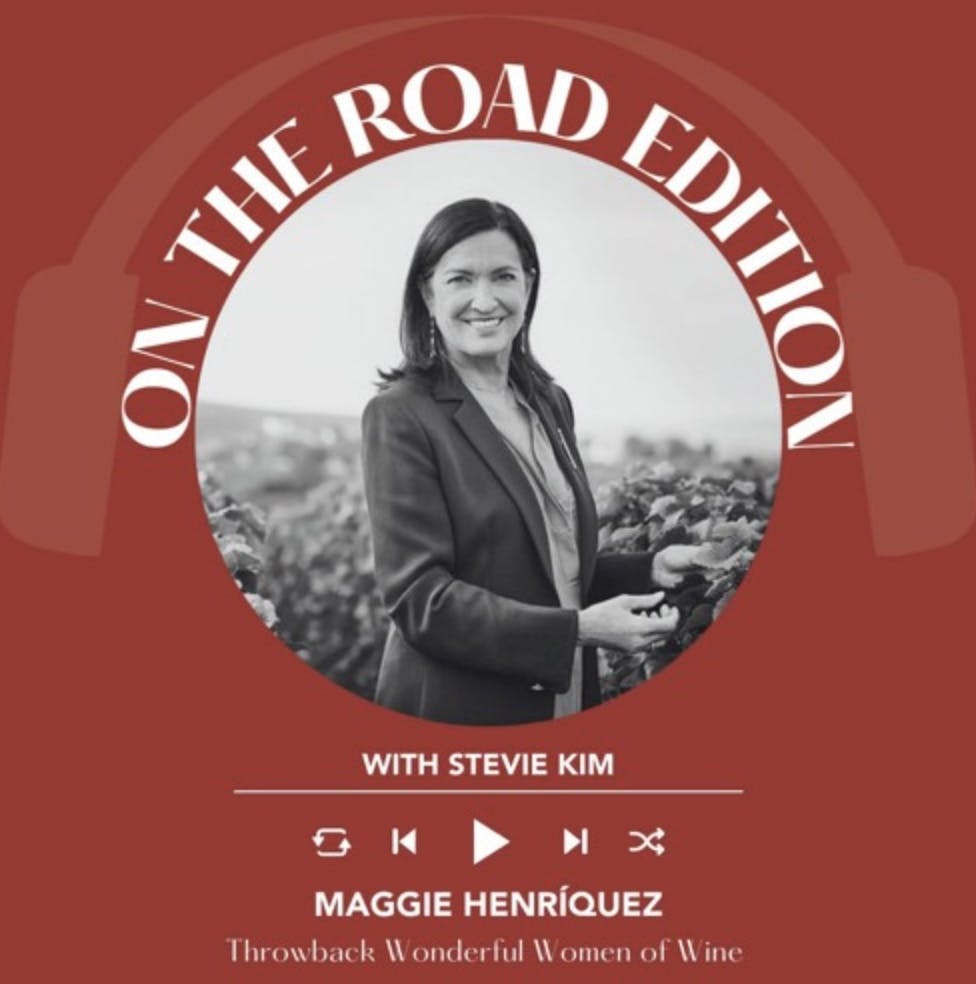
Ep. 1695 Margareth Henríquez | On The Road With Stevie Kim Throwback Instalive
On the Road with Stevie Kim
Episode Summary
Content Analysis Key Themes and Main Ideas 1. The unique philosophy and intricate winemaking process of Krug Champagne. 2. Maggie Henriquez's definition of luxury in the context of wine and her academic research. 3. The importance of proper glassware for enjoying Champagne. 4. The impact of global crises (like 2020) on the luxury wine industry and strategies for resilience. 5. The blend of tradition and innovation in a historic Champagne house. Summary In this episode of the Italian Wine Podcast, host Stevie Kim interviews Maggie Henriquez, the esteemed CEO of Krug Champagne. Maggie shares insights into her twelve-year tenure at Krug and her unique background, including a PhD dissertation on luxury wine that challenges existing theories. The core of the discussion revolves around Krug's distinct philosophy, particularly for its Grand Cuvée, which involves blending up to 198 different wines from various plots and years, a practice unique in Champagne, rooted in founder Joseph Krug's vision. Maggie explains the meticulous tasting and blending process led by the cellar master, emphasizing the goal of expressing the ""symphony of Champagne"" each year. She passionately advocates for using a white wine glass over a flute for Champagne to fully appreciate its complexity. The interview also touches on how Krug navigated the 2020 crisis, highlighting the push towards digital transformation, activating new markets, and the fundamental human connection inherent in the wine world. Takeaways * Maggie Henriquez, CEO of Krug, holds a PhD focusing on luxury wine theory, arguing for a distinct category for high-end wines. * Luxury, for Maggie, is defined by creating something non-existent, provoking emotions, and offering a full, high-quality, and freeing experience. * Krug's Grand Cuvée is uniquely made by blending a vast number of wines (up to 198) from different plots and years, accumulating a ""library"" of reserve wines. * The blending process at Krug involves a committee tasting thousands of base wines over several months, with the cellar master making final selections to achieve a harmonious ""symphony."
About This Episode
The speakers discuss the importance of luxury brands and wine in the wine industry, with Speaker 3 emphasizing the need for good class and a tasting panel in-house. They also discuss the importance of good class and the need for a good class in the wine industry, as well as the importance of staying connected and celebrating life. The pandemic has led to weakening the industry, but the speakers have built areas where they were weak, and they remind attendees to check out the YouTube channel for more interesting content.
Transcript
The Italian wine podcast is the community driven platform for Italian winegeeks around the world. Support the show by donating at italian wine podcast dot com. Donate five or more Euros, and we'll send you a copy of our latest book, my Italian Great Geek journal. Absolutely free. To get your free copy of my Italian GreatGeek journal, click support us at italian wine podcast dot com, or wherever you get your pods. Welcome to another episode of on Road Edition hosted by Stevie Kim. Each week, she travels to incredible wine destinations interviewing some of the Italian wine scene's most interesting personalities, talking about wines, the foods, as well as the incredible travel destinations. Hello, everybody. Welcome to our tasting panel. We did one last week with Valentino Jolas, and here people are coming on. We're waiting for Maggie now. I'm here. Oh, Maggie. Thank goodness. I mean, we practiced yesterday. How are you, Maggie? You did your hair and everything. I didn't do my makeup. No. Luke, I am well dressed today. I know you did your hair and everything. No. The hair is the same as yesterday. So listen. Welcome, Maggie. Thank you so much for doing this. As you know, Maggie Erriguez, she's one of the women that I really admire the most in the wine industry. She is, of course, the CEO of could. And if you ever go on YouTube, there's a wonderful video of her riding on a bike. I think she's going from the train station to work. Right? Because you take the train from Paris to Shampers. I think they're trying to arrange. I am here in the house of proof. Here is the house of proof. Right. Right. Before I mentioned person, and I saw that video, and I said, this is so romantic. Like, this is all fake. You know, like, fake news. Like, they make her to be this romantic. But in reality, I discovered that it's completely true because when we were doing club house the other day, right, and she was actually literally on a bike trying to multitask going on a bike and doing the clubhouse conversations. This is absolutely true. This is a wonderful woman. How long have you been with Kirk? I've been twelve years already because I came here in in two thousand nine, January. So it's been already twelve years, this year. So listen, Maggie, I don't know if everybody knows. You did your PhD. It took you about one hundred years to do. Right? I started my PhD in two thousand seven and two thousand eight. I did all my, you know, the university side and the courses and for two years. Where did you do it? Where did you do your PhD? It wasn't this with the Swiss management, center. It was, one of his first seven in Europe in distance. Now everybody does distance, but when I did, nobody was doing that. And, they are very strong on that. And I finished the courses and it was the year to do my thesis in two thousand and nine and it was the year I came here and it was not possible to think about doing any thesis. And so I asked in the professor in Argentina because I was doing it with a chapter in Argentina. He was really cool and he helped me a lot and he found these ten years with the university. So I had to finish in two thousand nineteen, which I did. And I'm very grateful because I said to the teacher that I would do something related to these years of experience, which I did. What was the the thesis of your PhD. And so you know that in PhD, you have to always push the limits of knowledge. So it's very difficult. You have to bring something that is new. And so the point what I brought was the fact that in the documentary world, all the luxury theories that are available now. They cannot explain luxury or high end ones. Can you give us in few sentences? How do you define luxury? The point is you define luxury in a way that you create something that is way beyond that exists to provoke emotions and sensations around some statement. It's a very high quality product that is beautiful that creates pleasure that is a full emotion, full, experience, and that gives you freedom. This is what luxury is. Normally, it is somebody who just brings out something that does not exist. The first luxury product ever was a wine in in fifteen twenty one. What do you mean by that? The first luxury product was mine? It is known because it's the one that they gave the name and people were looking for. Because Obrion was the first to change a kind of, light, very light, of wines into the you know today. And this is what luxury is. Luxury is somebody who comes in, like, was withdrawn and says, white, does, not, what ladies do not have a special way of carrying their Vit mounted, their robes, and he creates and yours and let's, look at the shape, and, Shanelle says, I don't want to dress like others, and she just came and provoked and created something new. So, luxury is always. This is why innovation is so important. Or in the case of wines, it is about bringing something that is outstanding and impossible to find elsewhere. And so the point was that all theories are about, you know, luxury brands and they control their whole value chain, and we do not do it in wines. And the base was, I did a research on different houses, and it was to show that it should exist the chapter dedicated to wine. So different houses, meaning champagne houses or other wineries. Why? Why? I say wine houses, all houses. The no champagne. You didn't include champagne. I didn't include champagne because champagne is in between the luxury brands and wines. And wines would be completely on the side of a totally different approach to the building of a luxury wine. It's it is not included in any of the books I have found. Can we have a read at your dissertation somewhere? Yes. Of course. I can send it. Where do we find it? I can send it to you and then you can do whatever. And I can sell it. Like, I can sell it like it online. Like, you know, my people pay for it. It makes them extra money. Listen. You don't send. But it's interesting. Yeah. We would love to read it. Of course, you're a guest at wine to wine. You came to Veronica. It was like three years ago already, I think. Are you enjoying this podcast? Don't forget to visit our YouTube channel, mama jumbo shrimp for fascinating videos covering Stev Kim and her travels across Italy and beyond. Meeting winemakers, eating local foods, and taking in the scenery. Now, back to the show. Maggie, I want to introduce you to the tasting panel we have today. I just got quick hello. So we have Hello? She's my classmate from W Set diploma program. Right. We have Land. Okay. I think you met Land in Verona. Did you meet her? Yeah. Yeah. Okay. Yes. He just met when I was there. He is actually the coordinator for Vine Italy International Academy. He thinks he's the boss. Okay? Right. We have Rebecca. She's our wine educator for W Set, and, of course, he she's our Italian wine ambassador. We have Elena. Hello? She's the real boss. She has complete control of over my agenda. I do everything. She's from she was a professional swimmer. From Siberia. She's really tough. Okay? Good. This is Franco. He says he's runs our w set school. And then Christina, she's a our house technologist. Yocopo. Incredible incredible taste test. So this is our tasting panel in house today. And, of course, we'll be tasting your hundred and sixty eighth anniversary. So do you wanna tell us a little bit about just the generic idea about the grand couvet. It's a little bit confusing, actually, because it seems like the opposite. Right? So we're going to serve the line. And then if you want to start talking about it, and then Our tasting panel has some specific questions regarding, of course, the, you know, the Viticulture and Vidification. Sure. Perfect. Okay. Super good. So we can serve, and I will do it also. Yep. We're going to start serving the wine. And it's, fruit grandcave, hundred sixty eight edition. Yes. Actually, no. Because that was the only thing I can get hold of at the last minute. I really have a lot of crudes in the I do Italian wine, as you know, This is a great excuse for me to, you know, drink champagne because otherwise, I'm drinking, and. So he's not. He's not. Yes. It's I love it. Love it. Need to talk to you more often. Very good. Probably the first thing we have to say is just to talk about your public is the importance of a good class. Always a class. Oh my god. We don't have good class. You're going to go crazy on me. You see, this is the class we have. Perfect. Perfect. Okay. You're talking about the class because I'm kind of obsessed about no flute. Right? You're, like, you're the crazy woman, like, no flute. No. No. No. No. No. I don't want to see it. I am obsessed because I think the flute It's like if you go to a concert with the earplugs or you go to a museum and you see, a masterpiece have covered. And this this makes me sad because I think the beauty is there and you will miss half of it because you don't have the right class. This is why I am obsessed with me. Okay. So what kind of glass? What kind of glass How do you say that glass is perfect? A white one glass. Yeah. This we use it for everything, basically, for, you know, it's a universal glass and it's perfect. That glass. And I think this is what we have to tell people. You don't need a special glass to taste a good champagne. You just need a white wine glass, one you have at home, and you will enjoy it, and you will enjoy it really discovering all the beauty that has been created within it. So just to come into this, this champagne, this is the reason of existence of the house. And it is about this man who arrives in eighteen, thirty four in Champagne. And it's interesting to know that eighteen twenty to eighteen fifty is a big expansion of Champagne. So Champagne is doing well. It's almost a hundred years after the first house of Champagne has been founded. Even all those hundred years after more attention also, the Champagne has already way way to do things, way to approach Champagne making, and he is not very comfortable with the proposal. He doesn't like to wait for a good year to make a good champagne because normally every house makes a non vintage, which is a light champagne, easy to drink, not complexity at all. And then good years, they will make a vintage. And so he was not very comfortable with this proposal, and he had this dream. I want to see what I can offer, which is the best I can offer a career to our clients. So, true friend here is his idea. Is his dream is a dream of this man. Idea of which man? Joseph Crew, you know, just appeared. You can see him here. You see, this is the founder. Yeah. He's hot. Mhmm. Hot. He's really hot. He's really caught. We we we we put this over in the middle. She doesn't get it. Okay. Sorry. Yes. He was he was super guy, and what I liked from him is that he decided to leave everything written in a little book that we found that is this image. Right. The little book we found in April twenty ten, and this allowed us to understand you all his philosophy, which starts by understanding every plot through its wine as one terroir. This is the philosophy of this house since the foundation, and his idea was every year, I cannot make the a great year every year, but I could receive every tone colors, flavors, aromas of the different plots every year. And I could build a library with wines separated by plot. From different years, and I could have in this library everything I need to recreate every year, the most generous expression of champagne. And this is his idea. Still is the most original champagne of the house. It is unique in Champagne. And the whole idea is to offer in a glass, all flavors and aromas option. And so when we want to know what is inside, first, we have to taste. You know, for me, I always said you like it, you do This is mostly important. Okay. Let's taste it. Did you see you can feel generosity? You can feel this roundness. There's so many flavors. You know, you know, the French have a really good expression. You know, I love this expression that the French have. Family. Well, this is an expression you say when you know, you don't have anything else to say. Yeah. Exactly. We're tasting the wines. So I'm going to take, like, first question from the panel. Are you okay with that? Alright. So I'm going to go to Rebecca. So you're using a hundred and ninety eight wines to blend across the. I have. How do you choose How do you make your selection? It's a very, very nice question. During because I just came from that. Every day, we do it fifteen wines can be the wines of the year or reserved wines. We do fifteen base wines during five months. And we are around five to six people in the room in a tasting committee. So during five months, we do around one thousand tastings. What? Why didn't you call me? Why don't you call me when you do this? I want to quit my job and come and do be one of the dozen taste it. You know, base wines are not so easy to taste, because you have to imagine how they would evolve, and how they will develop in company with others. What the whole idea is we have a digital system that is called Black Boopris totally digital system so we can follow the plots. We know what has happened in the last six years because we have the systems in six years, and it's the profile of the wine. And so we comment we comment completely descriptive way, and also we give some notes and waiting, and all of this information will be accumulated. And this is the base with which our center master now, Julie Camille, for twenty years Yeah. You've changed your seller master. Right? Judy grew with a Eric for fourteen years. Eric is still a deputy director. So he's he's there to support. He's doing all the projects for the group, but he's there to support. Because for me, white making in this house is absolutely the essence. It's the heart of the house. And so I wanted to make sure I have an organization that guarantees as much as possible the continuity. So, Julie, we'll almost disappear during fifteen days. The end of March, and then she will do her creations. When we are tasting already in the second time of tastings of every one of the year, she starts noting a little bit. This can go. This can be in the in group gradually. This can be, as as in a vintage if we do a vintage because the idea is set in the little book of the founder. The sharpay number one of the house is frequently. Is this idea of generosity? And the champagne number two is the vintage. And there's no better champagne or the other. He says it very clear. Good House of champagne should create only two champagne. The same quality. So we have no difference of quality. One is about fullness and the other is about preciseness. It's the precise story of one year. So when she's tasting, wherever, for instance, you feed a lot of fruit. Normally, these can, you know, intentionally thought to go in the wholesale. And then when you have this diversity of flavors at low mass, then probably you will be sent to group gradually. Then when she goes out in these two weeks, She will start combining this not easy because you have to understand also the library you live. So it's a real complex process where she would put together to find the harmony you get in this class. So we do have an idea of what is this most generous expression we want to create. Of course, it's never going to be the same. Every new addition is the new addition of the dream of this man bringing together all flavors and aromas of champagne, but it's never going to be the same. So how we select through these five months She's already taking notes, especially in the last three months about where this wine could be placed. And some of them, she would think that better they go in the reserve wine because reserve They will grow. They will get deeper. They will get the rounder. They will get wiser. And you feel it. When you taste back the results, even we have tasted the previous year, you can feel how in a very reductive space because they are in very, very close tags state of the art. But very well, they get like round or wiser, and they bring so much to the blend. And normally, like here, you have forty two percent of reserve wines. And so depending on the year, the year that, which is the year around which this champagne was created is twenty twenty. Twenty twelve, you have a lot of character. So it's good to bring, you know, elegance, finesse, and chardonnay, that would bring some kind of light tension to it. And so this is the philosophy with which she will select the wines of the year to then go into the selection of the research. I just can't imagine, like, what that means, hundred and ninety eight eight wines. It just seems like it's almost like science fiction. Yes. You know? But your yours is the only house that does this. Is that correct? Exactly. Alright. So I'm going to give another question to one of our other panel members Yakapo. You remember the one that who sleeps all the time? I'm blessed. This is good. You sleep. You come to the office. They sound a bad boss. Look at look at him. Okay. What is your question? My question is always about to blame. Dylan. It's correct to say that bland one hundred and ninety eight wides is not just a signature fact, but he also gave a picture of what is Champagne area because I saw that wines came from different areas. So different soils, different amounts of chalk is one of the purpose of the wine, give an aspect of what champagne is in general. I really like your question because You like him or you like his question? I like him because he sleeps when he's bored like me. Okay. Alright. Let's hear. Let's hear. No. He's my friend. He's my friend. So I like the question because the question answers a bit the origin of the idea in Joseph crook. He understood that Champagne could be very diverse. And so what he wanted is to make a tribute to Champagne. And to bring all flavors in aromas of Champagne, you have to and the high quality he wanted. You have to understand every single plot. Doesn't matter how small it is as one line. And with these, you really understand a good tour, a good tour, and also you understand the region, the area where these tour is, and the type of grade. And so we'd like to say that the terroir is the musician. The type of grade is the instrument and the score is the year. And this is what we kind of get and this exactly what you say. What we try to bring together is this symphony of champagne. So every year, the symphony is gonna be different. We then when we are tasting like today, we said we have new sounds, new sounds from the sounds, and then we we deep started from, orb, and no resay. We started discussing about the differences from the sounds, from resay, and all. So this is what we try to look for. And of course, because the tones are different according to the year. This is why we have to go through ten different years. But group rent is about bringing this complexity and the beauty together of the region of Chandra. And to get here, we have to discover the essence of every area and grower to be able to finally achieve this creation. Are you satisfied with my good answer? I mean, what I always like to say? He said it's acceptable. Exceptable answer. That's great. We're kinda towards the end. I just wanna ask you a personal question. Two thousand twenty. It's been kind of a tough year, right, for the house of cook, but in general, for the champagne area, how have you lived through two thousand twenty? I know you you're not an nostradamus But what do you see in two thousand twenty one? Well, you know, Stevie, me as a good Latin American, I have gone through crisis all my life since eighty nine Yeah. You win. Your competition. You win. Yeah. What is the difference of this crisis? We have to all be aware this crisis pushes to be distant. And so we have to try to find a connection. We have to connect like you do through these ways through words. We have to try to find ways we can create this good energy because almost every way to create good energy are caught. You cannot go concerned because of two parties. So this is where great wines, great champagans have a place. This is where this kind of program has a place because we can really give, and people can receive, and this is the key of this crisis. So how do we live this crisis? I understood that many things we've done were strong and we had to protect. But we were also weak in digital. We didn't have the studio where I am today. We were not so good in CRM. At all. And so we started to build areas where we were weak, and the crisis showed us that we were weak. And my idea always is crisis shows you the end of a cycle and the beginning of a new one. And this is the way I see it. And so we are getting, you know, stronger when we were weaker, and we have to leave this crisis stronger than what we got into it. This is the way we see it. We were able to do everything. The big step you know, this house. We the creations are all made in April, decided, in May, blended. In June, they are bottled. So everything, you know, they are steps so important. Harvest, of course, in August this year, very early. Everyone was really at the service of the house and we were able to do everything we needed. We have activated the markets because some markets were slower or doormats, like airlines, So we had some buttons. After almost five years, we didn't have one button. So now we have some buttons to give to new clients, to activate new markets. So I see as always. It's a crisis we don't like because it's a sad crisis. It has put all our partners, our restaurants, hotels in a very difficult situation, and that's makes us sad. But, you know, we haven't brought this crisis. So now we have to understand how these crisis will help us to get stronger. And this is the way we treat it. And this is the way we're going. So, you know, we'll be talking about this, actually, if anyone's interested. We're on another panel in clubhouse tonight at eight o'clock. We'll be talking about how to phase two thousand twenty one, in the wine business. But don't you miss, like, I personally miss kind of the physical contact? I mean, I have to be honest. You know, the Italians are crazy about kissing everybody, and I'm perfectly happy now that I don't have to kiss everybody. I have to be honest. But sometimes I do miss those people I'd like. I miss hugging them and kissing them and the physical contact. Of course, this is the most terrible part of this crisis. Most terrible part of this crisis. This crisis is pushing us to be distant. And what creates the energy is to be closed. When you are with people is people who will give you back the energy. And this, we have to miss. We are missing. And the wine wine word is a word of people. It's about connecting with people. And this is so much missing all all of us. The people who are in the other side and us, but you know, this is a reality. We have to keep connected. We have to keep connecting, and we will love so much when we are back together. And then we can embrace each other and celebrate life. Okay. So with that, I think I've just let me just tell you when we do these tasting panels, usually we have a spittoon. I just want you to know nobody's been using it as you can understand. I understand. So we just like to do a bit in this year. I say cheers. Okay. Good afternoon. Thank you so much. Thank you for joining us on another installment of On The Road Edition. Hosted by Stevie Kim. Join her again next week for more interesting content in the Italian wine scene. You can also find us at Italian wine podcast dot com or wherever you get your pods. You can also check out our YouTube channel, mama jumbo shrimp to watch these interviews and the footage captured of each location.
Episode Details
Keywords
Related Episodes

Ep. 2620 Lisa Lazzaretto interviews Tancredi Biondi Santi of Castello di Montepò in Maremma, Tuscany | Clubhouse Ambassadors' Corner
Episode 2620

Ep. 2597 Wine in Transition: Declining Demand, De-Alcoholised Wine & New Alternatives with Robert Joseph | On the Road with Stevie Kim
Episode 2597

Ep. 2595 Where Wine Won In 2025 with Erica Duecy | On the Road with Stevie Kim
Episode 2595

Ep. 2583 Women For WineSense and the Houston Rodeo Wine Competition with Amy Gross | On the Road with Stevie Kim
Episode 2583

Ep. 2564 Understanding the Albanian market with Erjola Braha - CEO of Alehandro Group | On the Road with Stevie Kim
Episode 2564

Ep. 2554 In conversation with Marco Alberti, the Italian Ambassador in Tirana | On the Road with Stevie Kim
Episode 2554