
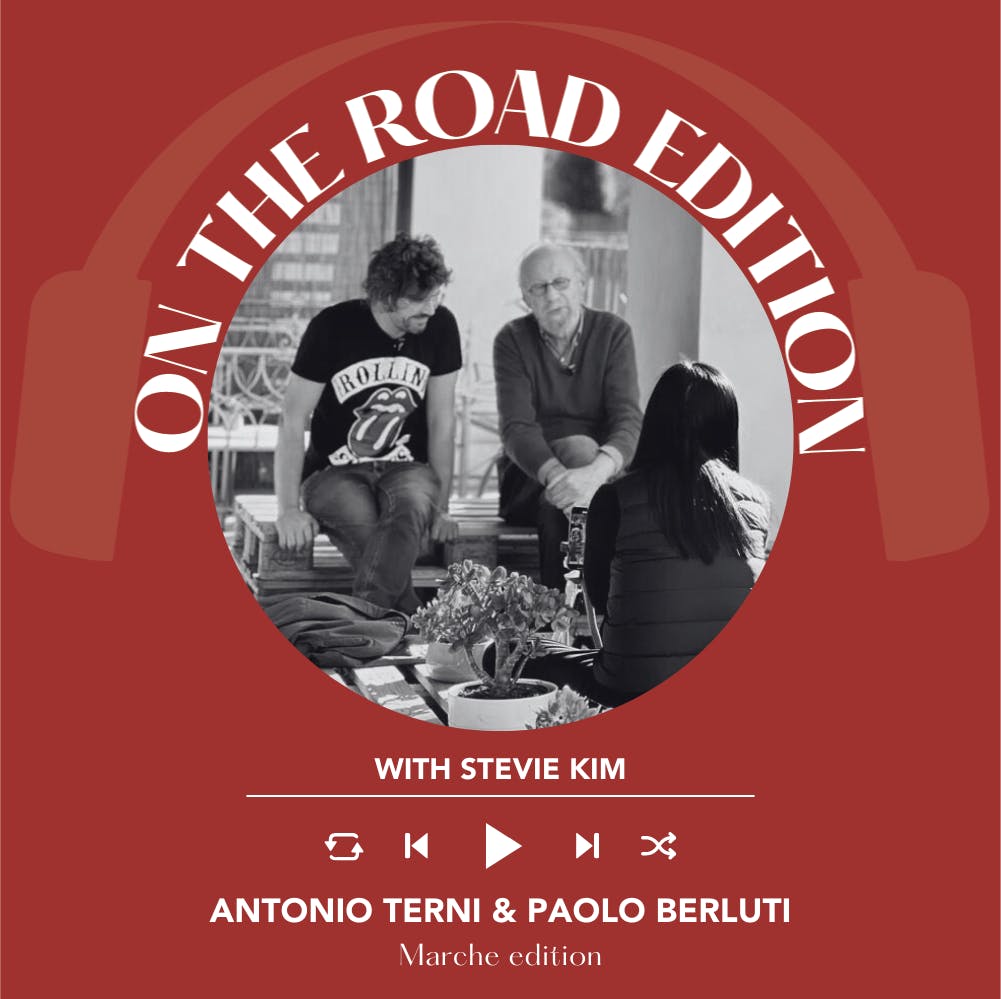
Ep. 1750 Antonio Terni And Paolo Berluti In Marche | On The Road With Stevie Kim
On the Road with Stevie Kim
Episode Summary
Content Analysis Key Themes and Main Ideas 1. Exploring winemaking philosophies in the Rosso Conero region of Italy. 2. The nuanced definition and practice of ""traditional"" versus ""organic"" viticulture. 3. The importance of terroir and soil health in expressing wine character, particularly for Montepulciano. 4. Contrasting and converging perspectives of established and newer wine producers in the same region. 5. Promoting the Rosso Conero area as a dynamic wine tourism destination. Summary In this ""On The Road Edition"" episode of the Italian Wine Podcast, host Stev Kim interviews two prominent winemakers from Italy's Rosso Conero region: Antonio from Fattoria Le Terrazze and Paolo from La Calcinara. Antonio, representing a winery established in 1882, discusses his ""traditional"" approach, which he describes as ""more organic than organic"" due to its adherence to historical cultivation methods, albeit without official organic certification. He aims to produce ""more drinkable"" Montepulciano wines. Paolo, from the certified organic La Calcinara founded in 2007, emphasizes soil vitality, root health, and expressing the ""bones"" of the wine through less barrel aging, focusing on the mineral sensation from the terroir. Despite their differing certifications, both producers converge on the importance of the land and reflect on how true traditional practices often align with organic principles. The episode concludes with an invitation to visit the beautiful Conero region, especially during the less crowded autumn months. Takeaways - Winemaking practices in Italy's Rosso Conero region encompass both long-standing traditional approaches and modern certified organic methods. - The distinction between ""traditional"" and ""organic"" can be philosophical; some traditional methods inherently align with organic principles. - Producers prioritize the expression of terroir and soil health to produce authentic wines, particularly from the Montepulciano grape. - There is a shared goal among producers to create wines that are characterful and enjoyable, regardless of specific certification. - The Conero region is highlighted as an attractive destination for wine tourism, with recommendations for visiting during off-peak seasons. Notable Quotes - Antonio: ""I think that organic is more traditional than non organic because organic has its roots on the old way of cultivating grapes."
About This Episode
Speaker 3 from On The Road Edition interviews wineowners and tour their wines, emphasizing their approach to winemaking which is more traditional and based on traditional methods. They use a mix of technical techniques and organic farming for the production of roots and the soil, using copper and different paths to analyze the plants and the soil. They invite listeners to visit their podcasts and discuss the Italian wine scene.
Transcript
The Italian wine podcast is the community driven platform for Italian winegeeks around the world. Support the show by donating at italian wine podcast dot com. Donate five or more Euros, and we'll send you a copy of our latest book, my Italian Great Geek journal. Absolutely free. To get your free copy of my Italian GreatGeek journal, click support us at italian wine podcast dot com, or wherever you get your pods. Welcome to another episode of On The Road Edition, hosted by Stev Kim. Each week, she travels to incredible wine destinations interviewing some of the Italian wine scene's most interesting personalities, talking about wines, the foods, as well as the incredible travel destinations. Can you guys introduce yourself to producers from Rosoconello area until you go first? Yes. I'm the owner of, Fatrillo Terrace, which is based in, Numana. And is, the one in state about eighteen hectares, and most of them are Monte Puciano. Okay. I am Paulo Loperluti from La Calchinara winery here in Conroe in Canada Village. We are an eleven actors of Vineyard producing cornrow in an organic way. Okay. Organic or biodynamic? I mean, we are certified for organic agriculture, not for biodynamic. It means that we wanted to be more free to express and do what we can do at the moment. And how long have you been producing wines for both of you? Well, my the wine estate belongs to my family since, eighteen eighty two. And we have always been producing wine, but we started bottling it in the late sixties. And what about Apollo? Yeah. So we are the third generation of wine producers. So, our family have about total from ninety sixty eight. So the first vintage for the connor operation, but, Calchinera is a new project, everything in organic way. So, ma'am, our project started in two thousand seven. Our first vintage was two thousand seven. So you both presented your to that, and you have a very different approach in terms of winemaking. Right? Antonio, you go first. Yes. We have a different approach. But what we are trying to make now is wines which keeping the tipicity of our terroir, but they are more drinkable. They are more friendly. You don't have to eat them, to drink them with fork and knife, which is not very easy with the multiple channel because the multiple channel is very generous in terms of tie ins, and it's not easy to keep it within certain extraction, and certain quantity of contaminants. But how would you describe your your winemaking if you had to categorize? Would you call it traditional? Would you call it? Well, you're not organic. Right? Well, I think that organic is more traditional than non organic because organic has its roots on the old way of cultivating grapes. So I think that non organic is much more traditional than non organic because they, use traditional ways of keeping the vineyards. So for you traditional is organic equals organic? Yes. What about organic then? Is organic necessarily traditional? Well, yes. It is. So there's no difference between traditional and organic. Wow. Now organic means something very specific. But I think that, the philosophy of organic between brackets is based on traditional ways of cultivating the vineyards using only sulfur and the copper using no no chemicals. That's the way they used to grow grapes fifty years ago when they had no, no modern techniques. So you would qualify yourself as organic producer. Are you certified organic? I'm not organic at all. You're traditional. More organic than organic. I'm not organic in the sense that if I need chemical stuff, to keep my grapes in a good shape. I will use them. And I don't want anybody to to tell me how I have to to keep my my grapes in a good shape. Okay. Let's go over to Paolo. Paula give me your perspective and how your winery is run. Our views is not so different from the Antonio one because we are looking for the terroir. So it's really important. Montepul channel, it's a grape, it's a fruity grape, but it's not what we are looking for. We are looking for from the salty, from the mineral sensation that we find under our feet That's the reason because we are using, less barrels now than before, for example, because we wanna go inside of the wine. We wanna taste the bones of the wine. And we don't wanna, too much musculos wine. And then the same philosophy of Antonio in the production. So everyone can have the same fluid, but, no one else can have your territorial. Yeah. So that's what we are looking for. We think that we could be a little bit different. The organic agriculture is the best way to have, to for the production of the roots for how do you say Permethrinevidans? No. We wanna analyze the roots and the soil. So the plant is just the point, the head of the iceberg. The rest of the plant is under the soil. So we are trying to make, vitality and stronger life in the soil. That's what is important, really important for us. So you put tons of copper in the soil? No. Oh, yes. No. No. We we don't have a tons of copper. I mean, if you work just with, Portilla, bordeaux is, yeah, you were putting more. At the moment, we can use little level of copper, and there are not so many problem with sulfur as well. So it means that we try to make more energy in the vineyard using revenue using different kind of elements emitted. So we try to don't intervene in the vineyard. Less is possible. Do you think you've got YouTube? In a way, when I listened to you, at least before, it seemed like you're the extreme opposite of everything, even the music choices, you're Rolling Stone. You're Bob Dilt. I'm Rolling Stone as well. Never who's in danger in the sixties. They grew up with the Rolling Stones. Come on. Yeah. In reality, We we follow different paths. Yeah. In Two words, great wines. Different paths doesn't mean extremely different wines. Because at the end, mean organic or not organic is more a thing of, philosophy, ideology, more than different results. You get almost the same grapes, organic or not organic. That's what I thought. Antonio was, for the one headliner of Connor. So I was younger and was drinking the wines from Antonio. So, I mean, Okay. Yeah. My birthday, I was drinking sassaneda. So so, I mean, please. No. I think it's nice to have young people like, like Paolo, for a different pastor. Maybe they will find a very good path and maybe one day I will follow it. I don't know. I'm I'm open to new things because I'm old, but I'm not fixed on all this philosophy of thinking. So I invite you to visit us. Okay. I will come. Is there anything else you would like to say to our listeners about the fantastic place of Connero and come and visit us but not only in summer because, in summer, it's very crowded. There are a lot of people beautiful because you kind of swim and whatever. It's so beautiful to that. Yeah. But, it seems September, October. It will enter as well. I think you will be happy visiting us. Well, thank you very much for joining us. This is the Italian one podcast on the road edition. And all about Rosa Conero today. See you. Thank you very much. Thank you for joining us on another installment of on the road edition hosted by Stev Kim. Join her again next week for more interesting content in the Italian wine scene. You can also find us at Italian wine podcast dot com or wherever you get your pods, you can also check out our YouTube channel, mama jumbo shrimp to watch these interviews and the footage captured of each location.
Episode Details
Keywords
Related Episodes

Ep. 2597 Wine in Transition: Declining Demand, De-Alcoholised Wine & New Alternatives with Robert Joseph | On the Road with Stevie Kim
Episode 2597

Ep. 2595 Where Wine Won In 2025 with Erica Duecy | On the Road with Stevie Kim
Episode 2595

Ep. 2583 Women For WineSense and the Houston Rodeo Wine Competition with Amy Gross | On the Road with Stevie Kim
Episode 2583

Ep. 2564 Understanding the Albanian market with Erjola Braha - CEO of Alehandro Group | On the Road with Stevie Kim
Episode 2564

Ep. 2554 In conversation with Marco Alberti, the Italian Ambassador in Tirana | On the Road with Stevie Kim
Episode 2554

Ep. 2463 Lamberto Frescobaldi | On the Road with Stevie Kim
Episode 2463