
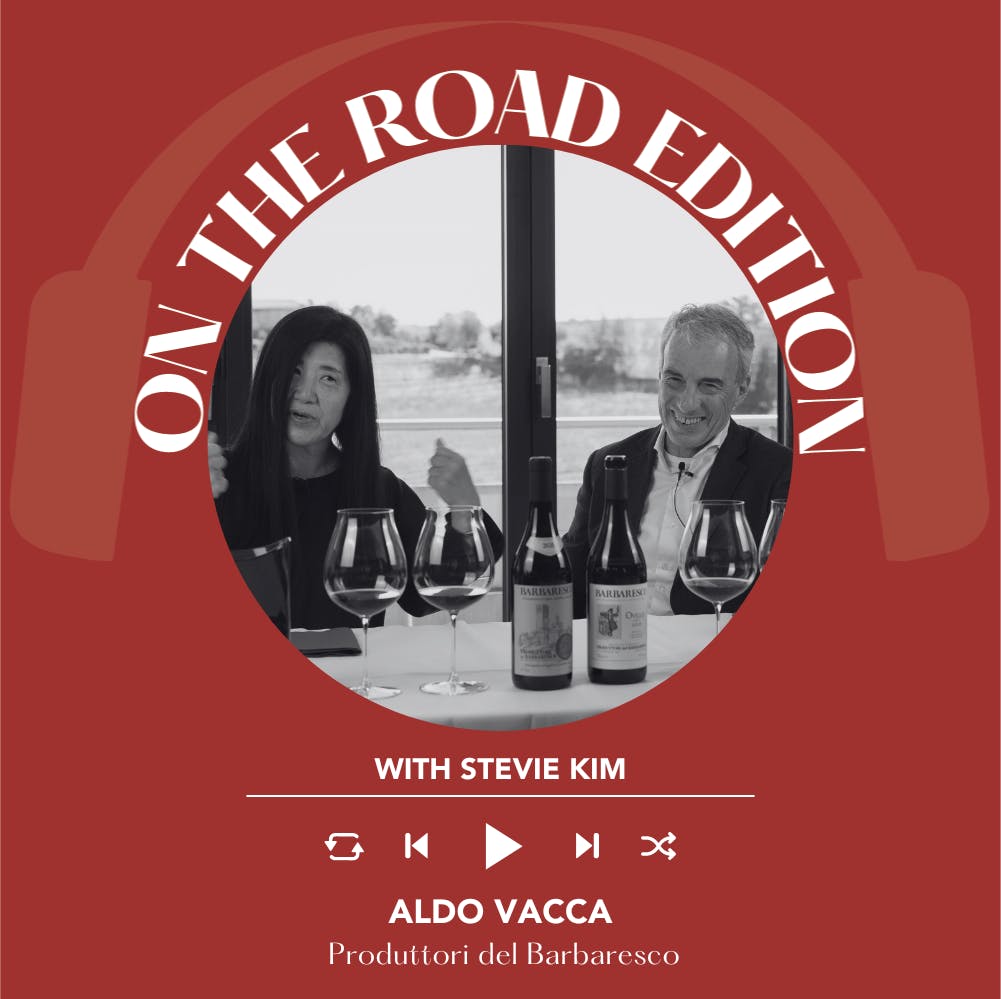
Ep. 1949 Piemonte Travel Series: Aldo Vacca of Produttori del Barbaresco | On The Road With Stevie Kim
On the Road with Stevie Kim
Episode Summary
Content Analysis Key Themes and Main Ideas 1. The historical origins and visionary leadership of Produttori del Barbaresco. 2. The unique cooperative model of Produttori del Barbaresco, focusing exclusively on Nebbiolo from its region. 3. The evolution of quality standards and grower compensation within the cooperative. 4. The impact of climate change on Nebbiolo cultivation and the resulting wine characteristics. 5. The distinct product range of Produttori del Barbaresco, including its village wine, single vineyards, and Langhe Nebbiolo. Summary In this ""On The Road Edition"" of the Italian Wine Podcast, host Stevie Kim interviews Aldo Vacca, the ""Commander in Chief"" of Produttori del Barbaresco. Vacca details the cooperative's founding in 1958 by a local priest, Don Fiorino, who galvanized 19 farmers to collectively produce only Barbaresco wine from Nebbiolo grapes, aiming to elevate its standing alongside Barolo. This pioneering vision, complemented by the prior efforts of figures like Domizio Cavazza (considered the ""father of Barbaresco""), set the cooperative's unique path. Vacca explains that Produttori del Barbaresco, now comprising 54 farmers across 120 hectares and producing around 650,000 bottles annually, maintains its focus on Nebbiolo from the Barbaresco appellation. He highlights their innovative quality payment system for farmers, established since their inception, which adapted from solely measuring sugar to including color and phenolic ripeness. The discussion also touches upon the effects of climate change, noting warmer summers lead to riper grapes and more approachable young Nebbiolo wines. The episode concludes with a tasting of the 2020 Barbaresco and 2019 Ovello Riserva, showcasing the cooperative's commitment to quality across its range, including their ""baby Barbaresco"" Langhe Nebbiolo, which comes entirely from downgraded Barbaresco fruit. Takeaways * Produttori del Barbaresco was established in 1958 by Don Fiorino with the radical vision of producing solely Barbaresco from Nebbiolo grapes. * The cooperative's success is attributed to its ""lucky"" ownership of grand cru vineyards and a deliberate ""quality mindset"" enforced by its single-wine focus. * A pioneering quality-based payment system for growers has been in place since 1958, evolving to assess sugar, color, and phenolic ripeness. * Current Barbaresco wines are generally riper and more approachable in their youth due to warming climate trends, while maintaining aging potential. * Aldo Vacca's family has deep, multi-generational roots in the Produttori del Barbaresco cooperative, with his grandfathers as founders and his father as a former director. * The Produttori del Barbaresco's Langhe Nebbiolo is unique, being 100% Nebbiolo fruit sourced from the Barbaresco zone (younger vines or downgraded grapes), effectively a ""baby Barbaresco."
About This Episode
During a conversation about Prudential's vision to create a wine company in Italian wine producing countries, they discuss the success of their success in producing one wine and their success in the Italian wine industry. They also talk about the importance of maintaining a quality mindset among growers and balancing the quality and mix in the crafting process. They also discuss the challenges of measuring quality in relation to the industry and the importance of green harvest and balancing quality and mix. They also touch on the challenges of measuring quality in relation to the industry and the use of different types of grapes for different vines. They recommend a wrap for the day and remind viewers to check out their YouTube channel for more interesting content.
Transcript
The Italian wine podcast is the community driven platform for Italian winegeeks around the world. Support the show by donating at italian wine podcast dot com. Donate five or more Euros, and we'll send you a copy of our latest book, my Italian Great Geek journal. Absolutely free. To get your free copy of my Italian GreatGeek journal, click support us at italian wine podcast dot com, or wherever you get your pots. Welcome to another episode of On The Road Edition, hosted by Stevie Kim. Each week, she travels to incredible wine destinations interviewing some of the Italian wine scene's most interesting personalities talking about wines, the foods, as well as the incredible travel destinations. Hello. My name is Stevie Kim, and welcome back to Italian wine podcast on the road edition. And you know what that means? That means that this episode will be broadcasted through our YouTube channel, mama jumbo shrimp. So if you haven't subscribed, please push the subscribe button here and if you'd like to give a thumbs up, even better. So we are moving now from Barolo to Balbaresco and today we're here with The commander in chief, Aldo Vaca, a Pruditori Baresco. I'm so excited because it is by far one of our favorite co ops in Italy in terms of wine companies. And it is very particular. So it is a co op and I'm going to have Alto. Just give us a skinny history of what Pruductor de Balbaresco is. Yes. Thank you, Stiti. So the winery, the property was founded in nineteen fifty eight. By the local priest. There's always a local priest. Exactly. Don't Fiorino was his name. And after a few years of, talking and discussing, he was able to convince nineteen farmers of the village of Barbaresco. To group together, build a little winery across the street from the church, and instead of selling their grapes to the open market to other private wineries, he was able to convince them to reunify the grapes together, make wine together, sell the wine and share the profit. Not an easy task because, you know, people, these farmers are notoriously a little narrow minded to say the least, especially in the 50s, but the priest had enough charisma to convince them. But what made Prudito Babresco special in the world of wine cooperatives was also the vision of the priest because, not only he convinced the nineteen farmers to group together, but he also convinced them to make only one wine, that wine being Barbara. In those days, on these hills, like anywhere else in Pimonte, many grapes were grown, and many different wines were made. He told to the farmers. I know you grow other varieties, keep those varieties at home, sell them to other wineries here to the Proctor de barbaresco winery in the center of the village. You bring only the nebbiolo grapes because here we're gonna make only Barbaresco. We have to bring Barbaresco back where it belongs side by side with Barolo. And we started that with that goal in nineteen fifty eight, and I would say We as as long as many other producers have been quite successful in that. Yes. So he was a visionary, a charismatic visionary personality to aggregate nineteen producers to produce one wine Yes. As a coop by Baraisco. And today, where are we? How many producers are there? Can you give me some numbers? Yes. We still are in the same, vision. So we make we crush only nebbiolo grapes from the barbaresco population. We make a barbaresco, some barbaresco single vineyards, and then a longuella, which is our second wine, if you want to say also from one hundred percent from barbaresco, but, sold the younger. Therefore, it carries the Languee operation. Fifty four farmers now? Hundred. Five four. Five four. Mhmm. One hundred twenty hectares. Okay. Which is basically sixteen percent of the total barbaresco population. And we make about six hundred and fifty thousand bottles every year. Divided among these three wines. And the production has been relatively stable in the last ten years, but has been steadily growing through the 90s and the first part of the new millennium because our farmers, every time an old vineyard of Dolceto, Barbera, Moscato needs to be replanted. These days, they tend to play in the Biola, the Biola here's the fastest growing grape variety in the language if we want to say so. It's, Babresque and Barola are in high demand. So there's a good market for those wines and also the new climate, warmer climate allows to plan the biolo in, venias where in the old days were considered too cold like the East exposed vineyards, the northwest exposed vineyards, now they can produce very good quality. So the production of Barbarisco, the production of Barolo, and Langanebiolo has been steadily growing through the years. We are now at, six hundred fifty thousand bottles. Okay. In total. Yes. Between, Babaresco, Lange. Yes. And, Barbarisco reserve. We make a The cruise. The cruise. Yeah. We make nine single vineyards, nine cruise. They're all sold with the white label, and they're all sold under the reserve a program. So we make, nine barbaresco reserve a single vineyards. Together, they come for twenty five, thirty percent of the total production of the winery. Another twenty, twenty five percent is the lung gonna be all of the young wine that we make for earlier consumption from young wines, mainly. And then, the bulk of the production, fifty, fifty five percent is the the barbaresco. That we make by blending nebbiolo grapes from different vineyards in the barbares compilation. Are you enjoying this podcast? Don't forget to visit our YouTube channel, mama jumbo shrimp. For fascinating videos covering Stevie Kim and her travels across Italy and beyond, meeting winemakers, eating local foods, and taking in the scenery. Now, back to the show. So we will be doing two wines today in terms of a quick tasting. However, I'll do. I would like for you to talk about the symbol. This is not on the label. Yeah. Right? On the barbaresco wine, the straight barbaresco, which is our main wine. There is the a little drawing of the village of barbaresco itself. You can see the tower. Oh, yeah. Yeah. Church. And the winery where we are here now is next to the church in the little square. So this kind of symbolize our deep connection with the village itself. It's a cooperative, fifty four farmers, fifty four villagers. So we like to have the barbarisco Village on the label. It's very significant for us. On our reserve program, we have this nice poster. We call it the Junduya, but it's basically a night holding. A Junduya. Like the chocolate. Exactly. Is a night holding a bottle of Barbarresco. This poster was created in, nineteen ten by the man whether we consider the father of Barbarresco, Mr. Domicio Calazzo was the owner of the castle down the street. But now it's owned by Gaia. By the Gaia family. But, he bought to the castle in eighteen eighty eight. His family. He lived there with his family. His two sons were born there. He was also the director of the wine school of Alba. Leaving in Barbaresco. So it was a man of science, an analogist, a man who knew how to make wine, and he started to recognize the potential of Bararesco as a wine village. In those days, at the end of the nineteenth century, Barrola was already relatively established. But Barescos was not really on the map. We were growing the same grapey and the biolo, mainly turned into red wine or salt to make barolo. There was not a docG in those days. Mhmm. So, Mr. When did the doc the docG started in nineteen sixty three. Okay. Barolo barbaresco together, and the docG started in nineteen eighty one. Both wines together with Brunelo and Chianti were the first in the Italian wine, the nomination. First for DOC and first for DOCG. The first official Barbarescope zone and barolo zones were defined in nineteen thirty three. You know, there's a long story. We are always been at the head of the Italian wine history. But at the end of the nineteenth century, there was not such a thing. We were growing the same grape here, but they were making a wine called Barolo and Domicio Cabata was the first one to have the idea to Domizio Casa. The owner of the castle, it was the first one that decided to call the wine in Barbaresco. He started to make wine in the castle, but what he did, really like the priest, in nineteen fifty eight. In eighteen ninety four, it convinced nine land owners of the village, including my grand grandfather, by the way, to bring their nebbural grapes to the castle in order to make wine together, sell the wine with the name of the village and share in the profit. So it was kind of a cooperative. And if It wasn't officially. Exactly. Because corporate didn't exist at that day. But in eighteen ninety four in the castle of barbaresco, Mr. Galazza, started to call the the wine made, Valdo, in the name of the village. So when we were founded in nineteen fifty eight, ten years later in nineteen sixty seven, we started to make single vineyards and we decided to dedicate the single vineyard to Mr. Cabatrade. So we put the name, the poster that he created to promote Babresco on our label, and now it's kind of our main logo. So next to the name of the vineyard, we make nine. We have the poster there. In terms of the quantity, you have nine cruise. Yes. What is the production in terms of volume? The nine cruise varies from a ten thousand to twenty thousand bottles each Okay. So together, they are one hundred and twenty, one hundred and forty thousand bottles, which is, twenty five, thirty percent of the total production. Something like this is crew is called Ovelo. It's a large crew. We have twelve farmers in the Ovelo. Their names are on the back labeling frame. Oh, okay. So every crew has the name of the families of farmers. Yeah. Whose grapes are used to make that crew. Then we have a crew like a famous crew called Azilie. We only have three farmers there. PAay. We have two farmers. So that varies. So the production can vary. It can vary from vintage to vintage according to the quality of the vintage, but also varies from some larger vineyards to recruit to smaller crews. But every year we put the total number of butters produced on the label. So people know how many butters we we make from that specific vineyard side. And of course, the single vineyard buttering is is always a selection of grapes. We go into the available vineyards. We select the best grapes to make the available wine and the other grapes are well or they go in this blend. And that is true for all the nine single vineyards. And then of course we have other vineyards which are not in the single vineyard program. They always go here. So it's a distinction of, terroir, but also a distinction of quality. The best grape from the vineyard go in the single vineyard bottling and the other grapes, form the Proctor de barbaresco Barbarisco. The single vineyards are also sold as reserva. So we give them a couple of extra years of aging. Oh, okay. No. Barbara is a wine that although now, these days, it's much easier to enjoy barbaresco and Barolo younger than in the past, but still five, six, seven years from the vintage is always a good weight. So we like to hold the wine in the cellar a couple of extra years and release the single vineyards as reserve when they are a little closer to the perfect, drinkability. So Aldo, I know you're wearing a special jacket today. Yeah. That's for you. Yeah. Just everyone will say. Oh, you look so nice today. And Algo said, yes, this jacket is twenty five years old. My wife won't let me work, but I put it onto that. But I know you've been working here more than the age of your jack it. Yeah. Is that correct? Tell me a little bit about how you got involved. I started there in, nineteen ninety one. But the joke is that, my family doesn't own the company because, of course, he's a cooperative, but probably the company owns the family. Because when I I see Maka here. Exactly. When the priest put together the nineteen original founders, both my grandfathers were among the founders. Okay. So you do have a very direct link to the product. Exactly. So I, and I still have cousins, with my, the same last name that I carry, who own Vineyard and they are still part of the productor de barbaresco legacy. My father, though, was the director, was in my position, from fifty eight to eighty four. Oh, okay. Now. The classic italia. Yes. Repothesis. So so it can the tradition continues. Exactly. He he retired in nineteen eighty four. At that point, I was a student university, then in nineteen ninety one, the company needed somebody fluent in English because the export market, as you know, was exploding at the end of the 80s early 90s. So they asked me to join and since my father's been here, my cousins were part of the legacy I agreed. So I came on board in nineteen ninety one, and I took first the export, managing, and then, the overall marketing and sales. But of course, my colleague, my younger colleague, Luca, that you know. Yeah, I know Luca. His father is still a grower. Okay. His grandfather was the first president of the company. My father was the first director. So, you know, it's the company. We all work for the company, but our families are strictly linked to the legacy because most of the employees that work a proctori, they come from the same families Uh-huh. Who owns the vineyards. It's not a family winery, but it's a group of families winery. So in a way, your family have been involved with the coop. Pruditori del Balbaresco since kind of the beginning. Yes. And when I was a kid, I remember not picking grapes hanging out here while they were building, my father was working here. And then, so I grew up in the region, just like Luke and most of the other employees. And then when, it was came to go and decide what to do in my life, I decided to study with the culture. So I have a university degree from the Torino University, And at that point, when they asked me to join, I decided to join. So it's a little bit of a destiny, but, of course, So, Aldo, let me ask you a question. When we think of you know, co ops in the wine business. We don't think of them as a very necessarily quality wines, right? Instead, I would also say, you know, the co ops and Alto adige for example, those are exceptions to the role. And definitely Pruditori del Balbaresco is also because it's located right in Balbaresco. Right next to the trattoria, just front of Gaia. What is the secret of success to the trattoria del Balbaresco in your opinion? Two very important, secrets. One by luck, one by vision. The luck was that barbaresco when the one that was founded in nineteen fifty eight was definitely less developed as a wine region than Barolo. After two world war and fascism, there was not much consumption of barbaresco anyway. So the nineteen farmers that joined to form the Proctori that soon became twenty, twenty five, thirty, they actually own some of the great crews. So we are probably the only, if not one of the very few wine cooperative that can claim control on ground crews, on a lot of the top vineyards of the region. Right. Of course, when you work at Good Terroir, that's always a good start. If when you go to France, most of the cooperatives enter the village wine and the ground crews are private families. Right. In barbaresco, it's not like that. So we were lucky that the fact that barbaresco was less developed was a lucky start for us. And then the priest, Don Fiorino that funded the winery, he had this goal to bring Barbaresco back side by side with Barolo where it deserved to be. And so he told to the farmers that joined. I know you guys grow many other grapes because that's a tradition in the region. Barbera Dolceto Muscato or nace. Those grapes, you keep it home. You sell to other wine, unless you make your own wine, we don't care. Here to the Proctorio, you bring only the nebbiolo. So the decision to make only Barbaresco proved quintessential not only for the success of the company, but also to build the quality mindset among the growers. Because Barbara is not an everyday drink of wine. Now maybe a little more, but back in those days, was a wine that was consumed on special occasions, anniversaries, weddings, in those special occasions was a second choice to Barolo. Right. So to decide for a wine and to decide to make only Barbaresco, it was pieces wise, a little bit of a suicide. But if you decide to make only barbaresco, you make only one wine and kind of a specialty wine, you gotta make it good. You don't have the low end market. Right. And so that put our farmers a little ahead of the general farmers thinking of the region was always clear to us that in order to be successful, we needed to make a good high quality for a fair price. And that's pretty much our standards these days. If you make a more generic wine, you can sell it, to the low end market. You can make it fancy, but Barbarisco is really, you know, confined in the high end. And so we can find ourself in the high end. And that was very important. Then, of course, when the market exploded in the 80s, in the 90s, we were already quite established. You were positioned. Yeah. And our reputation only grew higher and higher. Yeah. I believe I don't know. Correct me if I'm wrong, but I do believe you're the only coop producing one grape and specialized in, you know. Exactly. In this region, we are the only winery making only one growing. Yeah. Vineifying only one grape. Because again, in piedmont, the the tradition is to grow many varieties, and usually not to blend them. Maybe if you go to other areas, for example, gavi, you know, gavi is an area that is very specialized. So you may find the one that makes only gavi. Mhmm. But in the language, all of Barbaresco, we are definitely the only one that took this crazy decision back in the fifties to make only Barbaresco. Yeah. You were visionary and Yeah. Yeah. It really it was risky. It was risky. Right? It was a calculated risk. But But the priesthood was really much into it. It was the priest. It was the priest. Definitely. Because, you know, in Alto Adigi, I mix them always comparison terms of quality wine in terms of co ops. They produce radiate level labels. You know, that's kind of the classic. And you are the extreme opposite of that in terms of the strategy. Also, no, keeping it simple is also a good way to reduce the mistakes at the minimum. You know, you keep it simple. You go straightforward, classic, and you stay where you are. But, you know, the first two, three decades were tough because again, barbaresco was not really and when you have a bad vintage from the viola or rain fog, then you have to deal with this not so good quality grapes. Now, you don't have a young white wine to sell instead. So it was tough, but that's also one of the reason that built this quality mindset of people, our farmers knew that green harvest is important. They knew that if they have different quality in different plots, they're delivered. Those are the wine at a different time. We make sure that the high quality vigna doesn't get mixed with the low quality vigna. So everything is done very precisely. The priest also, since the beginning, they applied the quality payment, which is something that now everybody does. Oh, okay. But the farmers since the nineteen fifty eight, they are paid according to the quality they deliver. Of course, How do you measure quality? From fifty eight to ninety eight, we measured sugar. Okay. Higher sugar. Yeah, exactly. More money per key. That was the traditional way of. Yeah. Since ninety eight, we measure sugar. Color and phenolic ripeness, which is the tenons. Right ten. So we have a system that for every load that comes to the winery, we crush, check sugar color and tenon, and only at that point we send the juice downstairs for the fermentation. But according to those three numbers, which can be balanced in a different way. Because it's not an insurance. Yeah. If you have very hot vintage, that is quite normal now. Sugar is high for everybody. So we give more importance to color and tan and in the balance of the payment. If it's a cool vintage, it may be the other way around. But the farmers know that the better quality they deliver, more money per kilo they're gonna make. Yeah. Because in the past, sugar was king, right? Yeah. Exactly. You needed sugar. Honestly, the first winters where we all of a sudden, sugar was good everywhere, was ninety seven. Prior to that. It was problematic. Was sugar was never too much? Actually sugar was never enough. Mhmm. You probably remember nineteen eighty two great vintage in the language. Our barbaresco on the label says thirteen point five alcohol. And I remember it was a big success. Mhmm. And now a light vintage like two thousand and two is fourteen percent. Right. So, since in the new millennium, the sugar levels is much easier to achieve. It's also due to climate change. Climate change is the main thing. But of course, better clones, you know, better management in the vineyards, but let's face it. Climate change is our summers are longer. October is still a summer month these days. And so it's much easier for the grapes to rip. When do you usually harvest? The harvest time, you know, in the first decade of the new millennium, it was more like end of September third, full week of September, but now quite often is first week of October, even second week of October. So we are back because I think the farmers are managing their vineyards in a way to slow down the ripening and have a nice longer ripening. So is not really the time of harvest that has been changing, because we still pick Nebula generally in October, beginning of October. Yeah, which we were doing the same in the 70s. Right. The point is the first week of October, we get fourteen point five alcohol. In the 70s, first week of October, we were getting twelve point five. Right. So quite different. So the wine's now a rander, riper, little less acidic, little easier to drink young. No, it's a different balance that allows people to enjoy the young nebbiolo fruit in Barolo and barbaresco much more than in the past, you know, but the nebbiolo based wines, especially in the barbaresco and Barolo terroir when they're grown here, they have this beautiful, spicy cherry fruit that in the old days, were simply masked by harsh tenants. Uh-huh. And you had to wait ten, fifteen years in order for the wine to balance, and you appreciated the evolution of the wine. But now, a barbariances particularly six seven years old. Yes. The tannies are there but are much more balanced. So you can really enjoy that white pepper spicy red fruit more than in the past. So I think, you know, the wines can age for fifteen, twenty years. Maybe not thirty like in the old days, but definitely they're more drinkable when they're young. Alright. You're making my mouth warmer now. So that's a good segue to taste these two wines today. So what are we tasting today? So we are, we can start with the barbaresco twenty twenty is the current release. Now, the wine has been aged for twenty month in oak, large barrels. It's a very neutral, long time in barrels. This wine was bottled one year ago. So one year in the bottles. So this is the current release. Current release, twenty twenty. Yeah. We tend to release a little later. Officially now in Barbara, you can release twenty one, but we just started with twenty twenty. You get this, this bright spiciness, the red cherry aromas, quite nicely integrated. Of course, it's not a wine to be sipped, it's a wine to be match with food. You get the ten in the nice long ten is finish. It's, it's young, but it's, quite enjoyable, I think. So what is the main difference between this and the the aging, right, and the cruz, the ovelo, for example, that we have in front of this? So the the ovelo, is twenty nineteen. So the ovelo has one extra year in wood. Mhmm. Twenty month for the valo. But the same wood. Same wood. Thirty thirty six month for the ovelo. So extra time in wood, but it's very neutral wood. So the difference is really the terroir. The ovelo is the best selection from the ovelo vineyard. And this ovelo vineyard is an area which is a little cooler than some of the other vineyards in Barbara, higher clay in the soil. So the ten is a little more aggressive. But the fruit, the nose is very youthful and bright. So you get a little extra dimension here. It's meatier though. Yeah. It's thicker. It's a little more intense. It's also nineteen. So also this was bottle one year ago. So This two wines were bottled one year ago, both of them, but, nine the nineteen of Elo spent one extra year in wood. So when we went to the cantina, there were two mainly twenty five liter cask and then fifty Yes. What what are the differences? Which one do you use for which one? Yeah. We tried to use to mix. So the available stays, almost three years in wood, and maybe it's two years in twenty five hectoliters, one year in fifty hectoliters, because once a year, wreck the wine and clean the sediment. So we don't we don't have to do any fining. We don't add anything to the wine. You're just resting and slowly, it's the main thing. So, of course, also because of, quantity, the single vineyards stay mainly in twenty five hectoliters barrels. The barbaresco mainly in fifty even seventy five hectoliters barrels, but there's also when we erect the wine, we can also mix a little bit. I see. There is not a precise formula. It's large barrels neutral used for an extensive time. Okay. And just one last thing before we go. Yes. We're not tasting today. Yeah. But in general, there is a big, I suppose because of the success of Barolo and by Barrasco, Exactly. So far. There is a limit of the capacity. So everyone else is planting nebbiolo, hence nebbiolo from language. Yes. Right? That's the big movement. Yeah. If you have a vineyard in the population of barolo and a population of barbaresco, planted with Nebula. You're allowed to call the wine barbaresco. If you're outside barbaresco and Nebula but still in the larger language region and you play Nebula, you have to call the wine langue nebula. So a lot of people are planting Nebula in the language, just to make lung and biola because it's in Appalachian, there is, trying a lot of attention. Of course, it's half the price of Barolo and barbaresco sometime even less. It delivers a similar saying global value, right? And consumers. For us, the langue nebbiolo is, still what it was used to be, a second wine for Babarico. So our langue nebbiolo label is one hundred percent barbaresco fruit that we downgrade to longuella. So, yes, it's a second quality grape compared to the barbaresco, but it is, especially from a warm of integers It's quite nice and warm, fourteen percent alcohol, nice and round, and it delivers the terroir or barbaresco. So if you taste our lancini biolo, you get that extra spicy briness in the fruit, which is typical of the barbaresco terroir. You may try lange and biola from other region in the language. They may be a little more, a little less spicy, a little less bright because the Terrero Babresco really the distinctiveness of the Terrero Babresco is this extra spiciness. In the fruit. We make lange and biola still like we were used to make as a second wine for barbaresco. So when we have nebbiolo grapes from Barbaresco vineyards, which are three, four, five years old, because the first year of production is the third year, we use those grapes to make the lange and biolo. When we have a seven years old or older vineyard, the grapes are going to the barbaresco. But you can find a lot of lung and nebulo on the market. Also, the lung and nebulo operation required to be eighty five percent minimum nebulo grapes. And then you can put some other grapes in the blend. But our longue nebbiolo is one hundred percent nebbiolo. So it's, quite, you know, it's a baby barbaresco. Okay. So longue nebbiolo. I like it. Baby Balbaresco for those who can't afford a Balbaresco, but all look, try the baby Balbaresco. For those who wanna start to understand it, then they can move up. This I think it's an absolutely first approach accessible. And I highly recommend it and so does all this. So with that, it's a wrap for today. We'll we'll have to come back and study more. There's so much to study in Balbaresco, but today was our first time coming to Balbaresco. For our audience. And that is it. It's a wrap. Thank you, guys. Change with Italian wine people. Until next time. Thank you for joining us on another installment of On The Road Edition, hosted by Stev Kim. Join her again next week. For more interesting content in the Italian wine scene. You can also find us at Italian wine podcast dot com or wherever you get your pods. You can also check out our YouTube channel. Mama jumbo shrimp to watch these interviews and the footage captured of each location.
Episode Details
Related Episodes

Ep. 2789 ColleMassari: a long-term vision rooted in Montecucco with Giuseppe Di Gioia | On The Road With Stevie Kim
Episode 2789

Ep. 2788 Ep. 14: Austria and Hungary | Study Smart for your WSET Level 3
Episode 2788

Ep. 2785 From Volunteer to Speaker at TEXSOM with Samantha Cole Johnson | TEXSOM 2026
Episode 2785
Ep. 2766 Inside the U.S. Non-Alcoholic Wine Market: What Wineries Need to Know with Jill Sites | Masterclass US Wine Market
Episode 2766
Ep. 2761 Winemaking and Consulting Across Sicily with Alessandro Serughetti | Wine, Food & Travel with Marc Millon
Episode 2761

Ep. 2759 Part 2 – The VIA Educational Program & Italian Wine | Heart-to-Heart Conversation with Sarah Looper
Episode 2759