
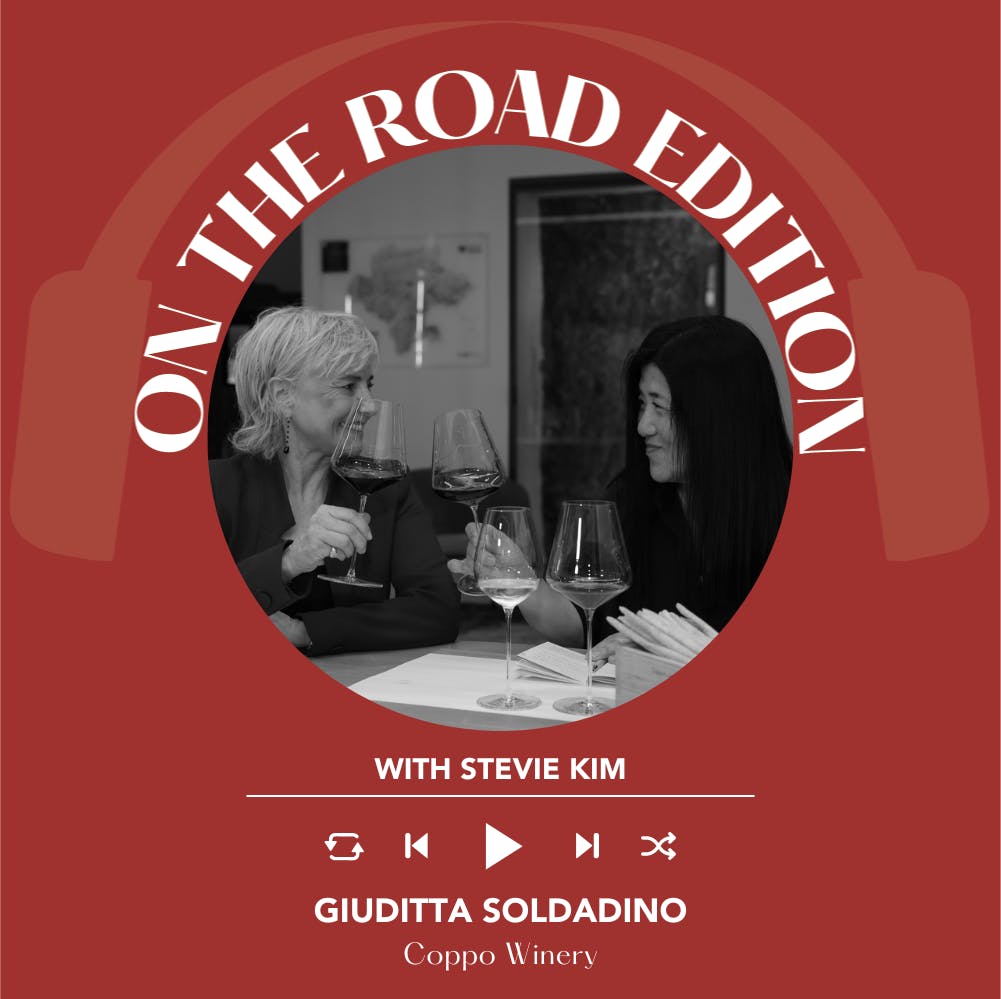
Ep. 2026 Barbera D'Asti: Giuditta Soldadino, Coppo | On The Road With Stevie Kim
On the Road with Stevie Kim
Episode Summary
Content Analysis Key Themes and Main Ideas 1. The rich history and heritage of Copo winery in Canelli, Asti province. 2. The significance of Barbera wines from the Asti region, particularly Nizza DOCG. 3. The unique underground cellars (cathedrals) of Canelli as UNESCO World Heritage sites. 4. The role of leadership and vision in preserving and modernizing historic wine estates, exemplified by Judith. 5. The deep connection between Italian wine labels, local geography, and historical storytelling. Summary This episode of the ""On The Road Edition"" of the Italian Wine Podcast features host Stevie Kim interviewing Judith, the principal of the historic Copo winery in Canelli, Asti. Established in 1892, Copo initially produced sparkling wines but later significantly invested in Barbera, which now forms a major part of its portfolio. Judith elaborates on the winery's historical location in the city center, necessitated by early logistics, and its current management of 85 hectares across different areas, including Monferrato and Langhe. A central discussion point is Copo's unique underground cathedrals, hand-dug tunnels renowned for their geological stratification, which are recognized as a UNESCO World Heritage site. Judith shares her personal story of taking over the winery after her husband's recent passing and outlines her ambitious, sustainable vision for its refurbishment and future. She introduces three of Copo's distinct wines: Monterallo (a Chardonnay named after a local street), Lavocata (a Barbera named after a strong, historical local woman), and Pomorosso (a signature Nizza Barbera blending top crus, named after local apples), emphasizing that all their labels are deeply rooted in the territory's history and characteristics. The interview concludes with Stevie Kim commending Judith's dedication to preserving and evolving the historic estate. Takeaways - Copo winery, founded in 1892 in Canelli, Asti, has a long history, initially producing sparkling wines and later focusing heavily on Barbera. - The winery possesses extensive underground cellars (cathedrals) that are part of a UNESCO World Heritage site, showcasing historical winemaking logistics and unique geology. - Barbera, particularly Nizza Barbera, is a key focus for Copo, with iconic labels like Pomorosso. - Judith has taken on the ambitious task of sustainably refurbishing and modernizing the historic winery while preserving its heritage and history. - Copo's wine labels are deeply connected to the local territory, drawing names from streets, people, and natural elements, reflecting a strong sense of place. Notable Quotes - ""Copo was, literally born in, at the end of the nineteenth century, eighteen ninety two."
About This Episode
The speakers discuss the history and success of Copo winery, including its historic location and famous wines. They also mention their own wines, including a chardening project and a signature wine called Chudita. Their mission is to revive the historic container in a sustainable way and they go through three wines, including a new winery called Monte Carlo and a chardening project called Lavocato. They also discuss their sustainability efforts and their use of old stones in their production.
Transcript
Who wants to be the next Italian wine Ambassador? Join an exclusive network of four hundred Italian wine ambassadors across forty eight countries. Vineetly International Academy is coming to Chicago on October nineteenth is twenty first. And while Mati Kazakhstan from November sixteenth to eighteenth. Don't miss out. Register now at Vineeti dot com. Welcome to another episode of On The Road Edition, hosted by Stevie Kim. Each week, she travels to incredible wine destinations interviewing some the Italian wine scene's most interesting personalities, talking about wines, the foods, as well as the incredible travel destinations. Hello. My name is Stevie Cannon. Welcome back to our journey. Our discovery journey into Palvera Dasty and Monterato wines. Today, we're here at the historic winery. It's called Copo, and I'm here with the principal. Her name is Judith How are you? Alright. Thank you. Thank you for having us today. So, Judith, will you tell us a little bit just a very skinny overview of the history of Copo winery? Yeah. Copa was, literally born in, at the end of the nineteenth century, eighteen ninety two. Thanks to the Then, in the following years, copper has been discovering also Vignas, of Barbera close to this area. Castenu Avocallcea, Aliano, area, where we have, a huge, part of Ava, producing, Barbera, Dassia and Berbera needs. So where is Copo located for our audience? Yeah. It's Copo is in, canelli. And is in the city center of Canada because in the past, you had to be close to the city center because of the logistics. There were no tracks. There were no other way of moving wines, but horses. So at the very beginning, you had to be in the city center. Then there was the difference between the one who were producing wines by the vineyards and the one selling wines by the city center. Then in the years, these things have been changed. And now we take care of almost eighty five actors, around Canelli and Mufferato area, including Langue with Barolo and BarBaresco. And then, we have also this, beautiful underground cathedral which are part of, unesco heritage. So, I mean, couple was founded about one hundred and thirty years ago originally. Yeah. Of course in Kanele, province of Astis, so famous for the bubbles. Yeah. If you will. But today, we're going to be focusing on Bavera. On Bavera. Okay. So can you give me a summary of how many labels you have and how significant is the barbera in your entire portfolio? Let's say in this area, copper was born with the bubbles. The first one in this area, producing bubbles, but starting also investing in Barbara. Actually, we have six labels where we've been working in the years. So we have a higher end, labels with two crew. So Nitza, and then the, which is our birthday together with the Camparus. Then, it's, this year, it's forty years, sir, that we produce it. It's our iconic, Nitza, Barbera Nitza, and is, really well known and well appreciated worldwide. Okay. So before we taste the wines, give us a tour of your underground cathedral. So at the beginning, you can see that this, what we are saying now, it's really the main street where, used to be canelli and, the canelli winery because, in the past, since, you had to, to go through, let's say, the main road for, logistic. Then we can discover this huge tunnel gallery, which was the only thing that it's really nice to to see it, but we have to think that it has been dicked by hand And, so it's a huge, work that was made. Also, the second gallery with the the inferno. The inferno was, actually, in the past, was the real, container inside the the winery. And where we keep the, our, big, let's say, library of all the, botogintages, and then the last part of, our, discovery is this building that was used to produce, silk in the past. Mhmm. And then, the new side of the container with this, huge wall that we've been discovering while during the the refurbishing. Okay. And and the wall is where there's this stratification of geology illustrated for literally millions of years. Is that correct? Yeah. Because, as far as, when we discover, we call the geologists and, it's been telling us that it's Very important also for them to have this, wall, a big wall that is really giving us an idea of, millions from, thirteen millions, years ago to up to six millions. The different certification of, the terroir. We have underneath the vineyards. Our storytelling about our terroir and what we find under the vineyards. We can really show how the territory during millions of years has been building up the certification. Yeah. It's absolutely fascinating. Yeah. Jaditha, we have three wines in front of us. Yeah. But before we go into the tasting, there's a little personal story to share with our audience if you don't mind. I know that your husband recently purchased this huge, huge investment in terms of the winery cokpo, the historic winery. Yeah. And then he passed recently. Yeah. And you are now the widow who's taken over and continuing his mission. Where the mission is, even better. Yes. And tell me a little bit about this mission, the vision that you have in terms of reviving in a sustainable way the entire structure. Yeah. Let's say that the first this acquisition was, very recent. It was, almost two years ago. And, so we started looking at refurbishing other container in twenty twenty two. So the first thing, the main, let's say, mission and division we had when we first came here was to really look for the history of this container that was, not really emphasized. And, so we wanted to let the people visit this container and see what, in the past, you know, other people, were were able to do by hand, and also looking at the production of the wines that were the history of discontent, So we have been working in a sustainable, let's say environment for the container, which, it's, we don't have any machinery to keep them cool since it's, everything is natural, which is the best way to keep, wines, but also everything that we've been, let's say, looking at and and working, we've been also using the old stones without destroying anything, but keeping the same and cleaning them and reusing them, which is longer. Obviously, it's more costly, but at the end, you keep the history of every single piece of this future winery. Yeah. I mean, I see that it's it's a very ambitious project Yeah. Which you have undertaken, and it stayed very much work in progress. Yeah. It's very much about in progress. So, obviously, we've been, looking also at technology. We've been, changing our production area. And we'll be also for, people welfare and, inside the on how they in the environment that they work. But everything, it's now open to people and to discover this beauty. Okay. So Let's quickly go through the wines today. Of course, you have forty labels. Yeah. But today, we're going to be going through three wines. One is a chardonnay and then two by Veradasty. Yeah. One particular specifically it's based in Nitza. So would you like to just go over the wines very quickly? Yeah. Very quickly. Okay. Monteiano, it's our iconic chardonnay and it's the same age as, it has been produced and started production. Tonight, nineteen eighty four. So it's, forty years as well, and it's very, it's one of our best, known product together with, Pomeros. So so Monterallo, it's actually the name of the router that is behind this building. So the name comes really from, it's not a fantasy name, but it's the name of the, street that is, around the building. The the second one is. Yeah. Why is it called Lavocato? Which means, of course, lawyer. Why is it called? It's called? Because, in the past, the owner of this video was a very, typical, woman, very strong character. And she was not a lawyer, but she was taking care of everybody. And, everybody was going to her to get advisor. So they were telling me, go to LaVocatna, like saying, I go to her that she's always a solution. So the vineyard was belonging to her. So the the name on on the label is, dedicated to her. I think it should be called Chudita. I called you. Just instead of avocado, Chudita. Okay. Yes. And then of course, the last wine, Last one is Poboroso. Yeah. And it's your signature wine. As our senior wine, Poboroso also, it's a Nitza, and it comes from, let's say, the blend of our best crew in this area. So it's, the top of the crew that, are in this, iconic bottle. Pomer, also the name also the name is because, let's say, Pomo in a payment. This is like Apple, and then write epola because there were a lot of trees of these, right apples. So Pomo also is, a mix between a dialect and the color of, let's say of the poll. All our labels, well, since we're speaking, we don't have fantasy name. They they belong to the territory. So there has some significance of the territory. Yes. Well, unfortunately, we don't have much time, and so I'm going to close here. But to do that, just from woman to woman, I think you're doing an incredible job, and I'm very nice to meet you. And hopefully, Good luck with everything that you do. Okay. And, hope to come back very soon when you're Yeah. Finishing everything. Thanks a lot. Okay. Chinch in. Chinch in. Thanks, sir. And that's a wrap. From Copo winery. Listen to the Italian wine podcast wherever you get your podcasts. We're on SoundCloud, Apple Podcasts, Spotify, ImLIFM, and more. Don't forget to subscribe and rate the show. If you enjoy listening, please consider donating through Italianline podcast dot com. Any amount helps cover equipment, production, and publication costs. Until next time.
Episode Details
Keywords
Related Episodes

Ep. 2787 Prosecco Superiore by Dr Susan H. Gordon | Book Club with Richard Hough
Episode 2787

Ep. 2784 The Other Side of Valpolicella: Volcanic Soils & Sparkling Wines with Francesca Marcato of Talestri Winery | Wine, Food & Travel with Marc Millon
Episode 2784

Ep. 2780 The Bridge between the Past and the Future of Wine with Serena Costanzo from Palmento Costanzo on Etna | Clubhouse Ambassadors' Corner
Episode 2780

Ep. 2773 Trento DOC: one of Italy’s finest sparkling wines with Alessandra Caroni of Maso Martis | Wine, Food & Travel with Marc Millon
Episode 2773

Ep. 2749 The Many Faces of Etna: Climate, Contrade and the Art of Volcano Winemaking with Federico Graziani | Wine, Food & Travel with Marc Millon
Episode 2749

Ep. 2744 Ep 25: Pantelleria, Salina e il fascino del vino insulare | Pellegrinaggio Enoico con Attilio Scienza
Episode 2744