
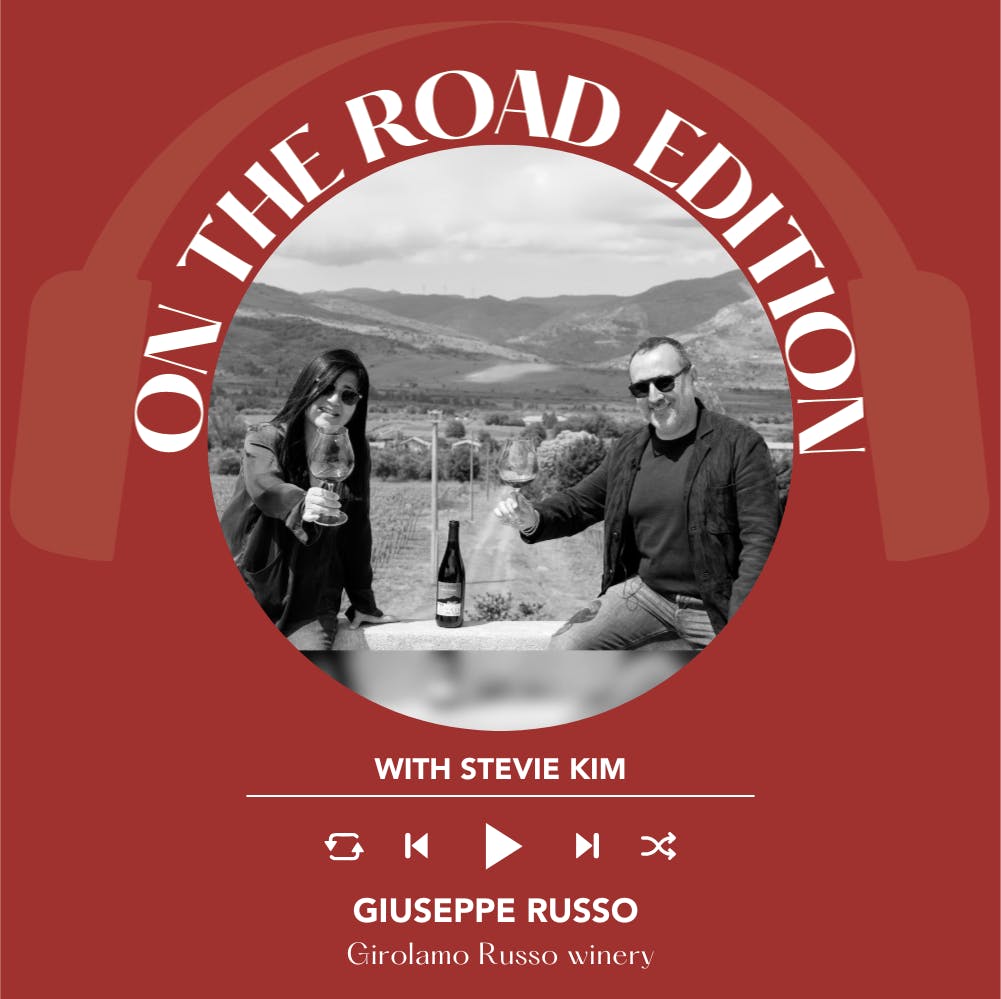
Ep. 2147 Giuseppe Russo of Girolamo Russo winery | On The Road With Stevie Kim
On the Road with Stevie Kim
Episode Summary
Content Analysis Key Themes and Main Ideas 1. The unconventional journey of Giuseppe Russo from classical piano to winemaking in Etna. 2. The unique winemaking philosophy at Gerolome Russo, inspired by musical interpretation. 3. The focus on expressing individual vineyard characteristics and old vines in Etna wines. 4. The deep family legacy and traditional roots of Gerolome Russo winery in the Etna region. 5. The significant impact of international pioneers on the global recognition and development of Etna wines. Summary In this impromptu ""On The Road Edition"" of the Italian Wine Podcast, host Stevie Kim interviews Giuseppe Russo of Gerolome Russo winery, situated on Mount Etna. Giuseppe shares his fascinating personal trajectory from a classical piano student at the conservatory to a dedicated winemaker. He draws unique parallels between the methodical interpretation of a musical piece and the intricate process of crafting wine, stating that his winemaking approach mirrors his musical training. Giuseppe elaborates on his winery's philosophy, which emphasizes expressing the ""soul"" of each single vineyard and old vine on Etna. He details the range of red and white wines produced, including specific single-vineyard labels like Salorenzo and Firdo Dimedzo. The interview also touches on the family's deep roots in the Paso Biziago area and the profound influence of foreign pioneers like Marco de Grazia and Andrea Franchetti, who, according to Giuseppe, significantly contributed to Etna's international prominence, creating opportunities for native producers. Takeaways * Giuseppe Russo, an Etna winemaker, has a background in classical piano and applies similar principles of interpretation and methodical building to winemaking. * Gerolome Russo winery focuses on small-scale, single-vineyard production, primarily from old vines in Etna, aiming to express the unique terroir of each site. * The winery produces a range of wines including four single-vineyard reds (Calduraga Sottana, Firdo Dimedzo, Salorenzo) and several white wines, with an annual production of around 90,000 bottles. * Giuseppe's father, Gerolamo, to whom the winery is dedicated, played a significant role in identifying special vineyard plots, such as ""Agosay."
About This Episode
Speaker 1 discusses their interest in creating wines and creating traditional wines using their father's name and interpreting their music notes. They dedicate four jobs, including learning about their father's name, creating their own wine, selling their wines in Italy, and creating nine levels. They are releasing for and at a price of $1,800, selling their wines in Italy, and selling their wines in the US and Europe. They are releasing for and at a price of $1,200.
Transcript
So you've studied piano at the conservatory? Yes. From It's very different. I mean, playing piano to playing wine. How do you reconcile from the music training to winemaking? I don't know. I think that it's easier to make wine than to play, a piece of chopin, of Welcome to another episode of On The Road Edition, hosted by Stevie Kim. Each week, Stevie travels to incredible wine destinations interviewing some of the Italian wine scene's most interesting personalities, talking about wines, the foods, as well as the readable travel destinations. Hello. My name's Stevie Kim, and welcome back to Italian Wine Podcast on the road edition. This is actually an impromptu episode because I wasn't really supposed to do any interviews. I am here in Edna, as you might have guessed, because I am now the, what they call, the Madrina, which means the godmother of Edna. There is for the contrade del Edna. Which is a bunch of producers from this local area. They have a celebratory event in the couple of days at Aetna. But here, we thought we actually made a sneak getaway. And we are here with Giuseppe Russo of Gerolome Russo winery from Aetna. Charles Giuseppe. We are now in you can't see, I think, right now, but just in front of me is, of course, Aetna. But, Chuseppe, what is behind us? What are we looking at? Yeah. We are the neighborly mountains that cover the at the north side of Aetna where we we stay. From the Terranian Sea. And the the Alcanda Valle, the Alcanda is a small river that runs between neighborly mountains and Aetna. So where are we for our audience who are less familiar? How can you describe where we are exactly? Hello. We are in the another side. This is a. My family was this, these vineyards. It was your your father or your grandfather? My grandfather. And, then my father continued to grow this vineyard. Since the twenty years, at least, I decided to continue to work here to make wine. So, Giuseppe, listen, were you raised and born in Aetna? Yes. I'm from, my family was from, Paso Biziago. Right. Masubizhago is the villas after the center of the northern side of Aetna, the northern area of a of Aetna. And, it's like, bagolo for bagolo Montecino for, Bruno. Yes. And, I I was born there, and, I lived for many, many years for my when I was, young. And then I I stayed to for, I studied in, Catania. I studied, classical music, piano, then when my father died two thousand and three, I decided to come back. I found this, this winery that, has my father's name dedicated to my father to Jiro Lamo. Jiro Lamo. I mean, I'm just like, yes. So, Giuseppe, you've studied piano at the conservatory? Yes. For It's very different. I mean, playing piano to playing wine. How did you reconcile from the music training to winemaking? I don't know. I think that it's easier to make wine than to play a piece of chopin, of No. Wait a minute. It's easier to make wine or it's easier to play piano? It's easier to make wine. Uh-huh. Yes. Okay. The method I developed to make wine is the same I had when I started applying, a piece of chopin, of, or rams. What do you mean? Can you expand a little bit? It's a What that means? Like, a piece of music, the the interpret the the pianist wield the interpretation Mhmm. Analyzing every every particular notes. But, having, at the same time, an idea of where to wield the whole piece is, a process in, the chronic youth build, a piece in, analyzing the, the particular notes, but, having an idea of the, the whole time of the piece is the same when I I wield a wine because I believe from the grapes of fruit that, must be another wine, but, you build this product having an attention to how to build during the time, you know? Yes. So you you're thinking about from the grape going into the end product, which is wine, all the different processes, and you're looking at your music notes, and then thinking about the big music, the end performance, I suppose. Yes. Maybe I continue to use the same method Mhmm. Likewise. Then, I don't know if the association association between and the classical music, I don't know. It's a it's a easy, easy game. Right. It's it's very interesting. I think it's also very unique. So we don't have very much time, I know, but give me an overview as to how many wines labels you make and the volume and which area you're focused and and perhaps what you're known for, your signature wine. Can you just give us an overview, quick overview? Since the beginning, I start to understand better and better my single vineyard, my old wines, in the differ and the contradas, especially Calduraga Sottana. The focus has been to express better and better every every vintage, the the soul of, each, each soil, each, s, veneers. For this reason, now, I make four single vineyard labels. Mhmm. Kalduraga Sultana, Firdo Dimedzo, where we are. And, Salorenzo, that is my most northern, contrada on Aetna DUC area. And, classic red wine, arena, three white wines, carican te Narena, dedicated to my mother, that, wanted a white wine, and, Narena means a small black a Macquizzy. Oh, okay. Right. Exactly. So I I dedicate just the four jobs, Doctor. And, since the few years, two single vineer of the white wires failed and salarance. Plus Agosay. Agosay wine. Not last year, last two thousand three. Twenty three. Twenty three because, Pagonalspeka destroyed my production of Yeah. It was a terrible harvest. Right? Yes. And, since seventeen, I added this label. This is a Salorans, a part of Saloranso, an area, a micro area of Saloranso that, my father loved particularly, he called, that means, where the dogs fly because the birds went to to to eat the grapes. My father considered this part, a special part. And after a few years few images. I, I can say that my father was right. Okay. So how many? Let's let's have a taste of this one. This is a twenty one. A very classic vintage on Aetna and a very balanced enough, rainy and the fresh. Twenty twenty twenty one. Thank you. Okay. Cheers. Cheers. Okay. It's a beautiful, wonderful place. Do you wanna tell us a little bit more about this wine for the wine geeks out there? This is fourteen point five percent. Yes. Right. And how many bottles are you producing? One thousand and eight hundred. I feel very a small production. Where do these wines go? Where do you sell them? Your wines? I sell especially in Italy. My best market are Italian, in Italy, and, USA, especially. Then also in North, Europe, in the, in Asia, too. But in some terms of percentage, international, and Italy, what Italy thirty percent, Italy, seventy percent, international. Okay. So it's mostly international. Yes. Right? So just going back to my original question, how many labels do you have in total? I have nine levels. Six three. No. Ten now. I Right. Since two thousand thirty, twenty three because I added, failed white. So you have twenty hectares. Twenty hectares plus four in the event. Okay. So you're releasing for and you're here according to this book, the Aetna guy from Fabrizio, you make ninety thousand bottles. Is that correct? Nineteen thousand, yes, you see about Yeah. More or less. Twenty three will be a little bit less. Yeah. It depends on the vintage. Twenty one has been a very good vintage also for the quantities, but not always is the same because my focus is in the during the harvest to select plant per plant because, I have especially mostly old vines and, in the old vines, you find a very good fruit for deep wines. But it needs to know how to select. Okay. So I have a question for you. You're originally from this area, and you've started a little bit later. I mean, other than, of course, Al Vafoty, who's the, you know, the alpha of Aetna. The people who started kind of the Aetna movement was, of course, you know, my bigraza, Andrea Franketti, Franklin. This is they kinda started at the same time. But they're foreigners. And you would be kind of the only tie in. What kind of relationship did you have with them and what is it now? What is your perspective? As the native son of at a great opportunity. I am here to to with you. Because before Marco de Gracian, the refern Katie, a Franco listened, came here. Mhmm. Otherwise, for the native world have been a little bit, a little bit hard. Yeah. More challenging. Yes. This is kind of the common theme, running theme. The past couple of days I've been talking to many producers is that Paradoxically, the international influence of these three, the trifecta, what I would like to call the Franketi, the gratia, and also Franco and listen, has really, really helped facilitated the national, international presence and interests and has fermented that interest and certainly at nice what is today because I'll show them. And I think you know, anyone in the wine world, they know Aetna, but he's also they were the movers and shakers who have made this possible. So that's it for now. I would like to wrap for now, but we'll have to come back because today, it's kind of an impromptu. It wasn't organized. I just came here and I said, it's so beautiful. I said, let's open a bottle of wine and have a small chat. So, Chincin, with Italian wine people directly from Aetna with Jose Peruso. Thank you for joining us on another episode of On The Road Edition, hosted by Stevie Kim. Join her again next week for more interesting content on the Italian wine scene. You can also find us at Italian wine podcast dot com or wherever you get your pods. You can check out our YouTube channel, Mamma jumbo shrimp to watch these interviews and the footage captured at each location. Changing.
Episode Details
Keywords
Related Episodes
Ep. 2644 Daniel Mwangi interviews Arber Shabani of Ridolfi winery in Montalcino, Tuscany | Clubhouse Ambassadors' Corner
Episode 2644

Ep. 2614 Mauricio de Chiaro IWA interviews Christian Carlevero of Marchesi Alfieri winery in Piedmont | Clubhouse Ambassadors' Corner
Episode 2614

Ep. 2607 Stephanie Johnson IWE interviews Matej Skerlj of Skerlj winery in Carso, FVG | Clubhouse Ambassadors' Corner
Episode 2607

Ep. 2597 Wine in Transition: Declining Demand, De-Alcoholised Wine & New Alternatives with Robert Joseph | On the Road with Stevie Kim
Episode 2597

Ep. 2595 Where Wine Won In 2025 with Erica Duecy | On the Road with Stevie Kim
Episode 2595

Ep. 2583 Women For WineSense and the Houston Rodeo Wine Competition with Amy Gross | On the Road with Stevie Kim
Episode 2583