
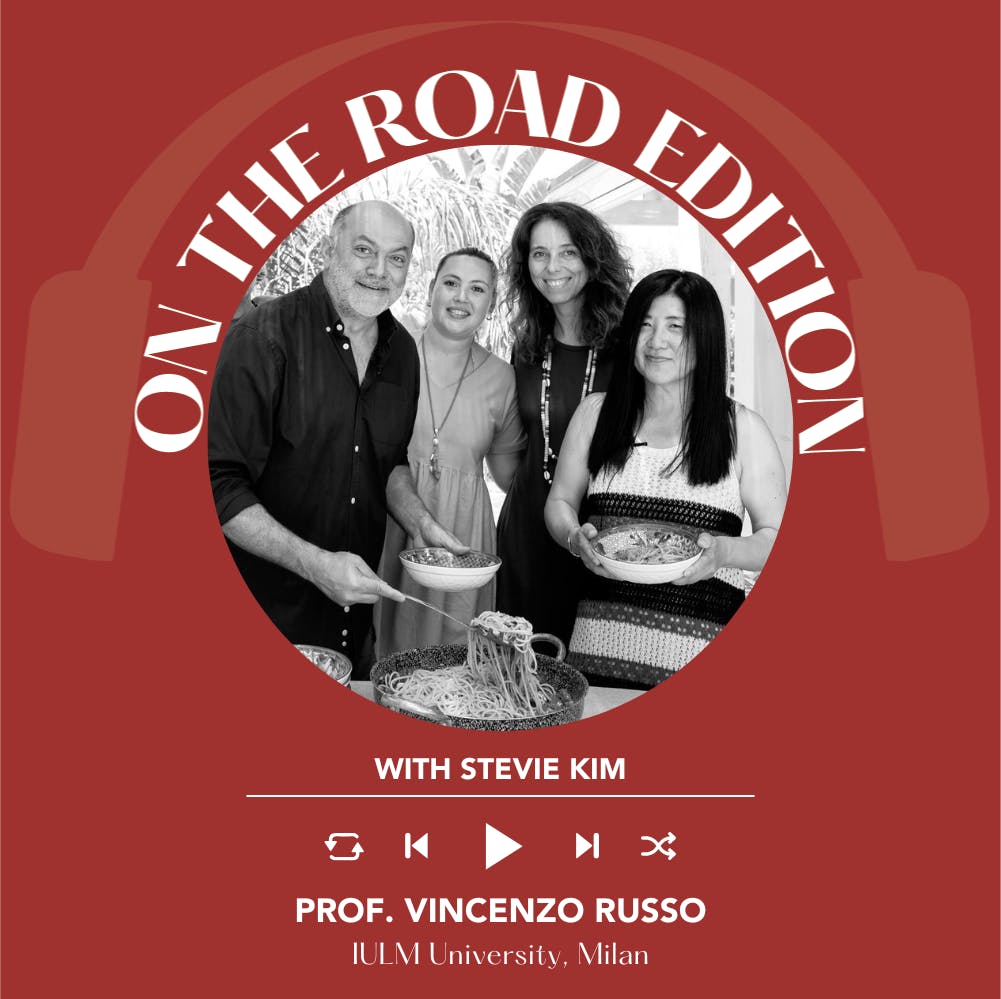
Ep. 2167 Vincenzo Russo Makes Spaghetti with Sardines | On The Road With Stevie Kim
On the Road with Stevie Kim
Episode Summary
Content Analysis Key Themes and Main Ideas 1. The historical and socio-economic context of traditional Sicilian ""poor"" cuisine. 2. Detailed exploration of ""Pasta Sal de Almare,"" a specific Sicilian spaghetti dish, including its ironic name and core ingredients. 3. The significance of local and wild ingredients in Sicilian cooking. 4. Cefalù, Sicily, as a cultural and historical travel destination. 5. The art of pairing regional Italian wines with local dishes. Summary In this ""On The Road Edition"" of the Italian Wine Podcast, host Stevie Kim travels to Cefalù, Sicily, to learn about a traditional pasta dish called ""Pasta Sal de Almare"" or ""Spaghetti with sardines on the sea."" The guest reveals that despite its name, the dish typically doesn't contain sardines due to its ""poor"" origins, with anchovies being the primary protein. He explains how the recipe evolved based on economic status, from grouper for the rich to anchovies for the very poor. The recipe features humble yet flavorful local ingredients such as wild fennel, raisins, onions, garlic, breadcrumbs, pine nuts, local olive oil, and historically, saffron. The guest emphasizes its affordability, costing less than five euros. The episode also briefly highlights Cefalù as a UNESCO site and a filming location for ""White Lotus."" Detailed cooking instructions are provided, followed by a wine pairing suggestion: a sparkling Grillo wine from Cristo di Campo Bello, showcasing the synergy between Sicilian food and wine. Takeaways - Traditional Sicilian cuisine often originates from ""poor"" recipes, utilizing readily available and affordable local ingredients. - The dish ""Pasta Sal de Almare"" is an example of a traditional Sicilian pasta, ironically often made without sardines, relying on anchovies, wild fennel, and pine nuts. - Wild fennel, raisins, pine nuts, and local olive oil are key components in many traditional Sicilian recipes. - It's possible to create a flavorful and inexpensive meal in places like Cefalù using local ingredients. - Cefalù, Sicily, is a historically rich UNESCO site with cultural significance beyond its portrayal in popular media. - Sparkling Grillo wine is a recommended pairing for traditional Sicilian pasta dishes. Notable Quotes - ""This is a very old and very poor recipe because, many, many years ago on the last century, they reached people, use the no sardines. They use the grouper for this kind of, recipe. And, the poor people who use a sardino, and the the more poor people use it, the the only anchovies."
About This Episode
The speakers discuss a recipe for a local dish called Spagetti with Italian wines, using a grouper and a different type of no navigational ingredient. They also discuss a dish called Cheffalo, which is a small town in Cheffalo, and explain the details of the dish, including the use of salt, garlic, olive oil, and local fennel. They also discuss the creation of creams on the spaghetti and the excitement of the town vintage of the dish, Chafalo. They invite listeners to check out their YouTube channel for more interesting videos.
Transcript
This is called pasta, Sal de Almare. Is that correct? Coles Salmare. But there's no sardines. Right? Yeah. Because, this is a very in the ocean. Yeah. And then the sea. Yeah. On the sea. And, the sea and people are salt, mister. So they prefer to say pasta with without, with the, sardines, on the sea, respect to pasta without the sardines. Welcome to another episode of on the road edition, hosted by Stevie Kim. Each week, Stevie travels to incredible wine destinations interviewing some of the Italian wine scene's most inter and personalities, talking about wines, the foods, as well as the incredible travel destinations. Welcome. My name's Stevie Kim, and welcome to Italian Wine Podcast on the road edition. So that means we are going constantly traveling to some parts of Italy and today we are in Chefa loo. Is that correct? Yeah. Perfect. Right next to me to my right is this is his second home here. Actually, it might be his first home. And today, he'll be sharing with us his secret recipe for a special local dish. Called. Yeah. The name is Spagetti with sardines on the sea. How do you say it anytime? Spagetti. Yeah. What about in dialect? Spagetti. Okay. We are ready. So tell us the recipe. Okay. This is a very old and very poor recipe because, many, many years ago on the last century, they reached people, use the no sardines. They use the grouper for this kind of, recipe. And, the poor people who use a sardino, and the the more poor people use it, the the only anchovies So we're, like, super dirt pool. Yeah. Really. We're the poorest of all pool because, should I see some anchovies here? Okay. So give us the recipe. How how do you make it? So we use the different, very natural ingredients. So for example, fennel, and, wild fennel. Is this fennel? Yeah. It's a fennel ball with a with a hoyle. Okay. And water tube. You can find the fennel everywhere in the in Sicily, in the in the mountain, in the near the the sea. Is a very poor, ingredients. We use a razors, and because it's a little bit sweet and, produce a very good flavor. And we use the offer, of course, onions, a little bit of onion. Chop the onions and garlic. Yes. And bread crumbs. Okay. And we cook that with a little bit, oil. Okay. And, pine nuts. This is also another very poor England that you can find everywhere. Pinali. Pinali. Pinali. Pinali. Not Pinali. Don't listen to me. Pinali. Okay. And at the end, we use it also, but this is a more expensive on the past that they do use it. But we use it a lot, Safran. Because in the yeah. Because during the, ceramic domination, many years ago, we producing sisley at Safran. Mhmm. And so maybe it was so simple to find all also for for people. But anyway, it's possible to use the the same recipe without a saffron. So the main ingredient is anchos. Right? That's the key. And then the and fennel and fennel. Yeah. And local fennel. And then We have pine nuts. We have, I see salt, saffron, bread crumbs, onions, garlic, raisins, and olive oil, of course. This is the oil for my area. It is, reproducing a little bit of oil for the families for our lives. No no more. And, maybe we spend no more than five euro. Okay. Because it's a very, very, very good. How to make a meal in Cheffalo for five under five euros. There we go. Okay. Let's do this. Okay. So we stopped. So, you know, this is this is just called pasta, Sal de almare. Is that correct? Coles almare. But there's no sardines. Right? Yeah. Because This is a very in the ocean. Yeah. In the sea. Yeah. On the sea. And, the sea season, people are salt, mister. So they prefer to say pasta with without, with the, sardines, on the sea, respect to pasta without the sardines. So, you know, Cheffalo. We know, of course, white lotus, and we think everything was filmed in Tarmina, but the truth. Let me tell you the truth is that the beach scenes were all in Cheffalo. Is that Correct? Yeah. Perfect. So tell us a little bit about Chafalo. Chafalo is a very famous, little town, very famous because it's a, UNESCO site, and for a arabic and normal, monuments. Very similar you can find in Palermo in Moriale, and there is a very incredible cathedral. We start with the onion and oil. We fry the onion, and then we put also garlic when the garlic became gold is ready. So we had the the anchovies and the races and a little bit of wine in order to create a little bit creams. We had also the funnel and we stay for a five minute, you know, to cook all the ingredients. And sometime we put also the water of the pasta because, while we prepare this receipt, we we have the water with the spaghetti that about it. And, after this, we are the also the panets. And at the hand, we mix everything, spaghetti, and, the cream that we had prepared with, saffron and that's all. It's ready. After the hand, whether there's spaghetti already, we put all together, and we mix it for, one two minutes in order to create a creams on the on the spaghetti and the dishes are ready. Okay. Thirty. Okay. It's the pasta. Okay. Alright. And that oh, you too. You too. Perfect. On q. And that's a wrap. And finally, which wine will we be pairing this lovely dish? Vincenzo. But in this case, I suggest a very good wine. It's a sparkling wine from, crystal de campo Bello, from my friend, sir Carmel Bonnet. He's incredible. It's really a really good Chao carmelo. And this is actually the vintage is two thousand nineteen, Matrudecia. So not chardonnay. Yeah. It's a grillo. Okay. And it's a wrap, everybody. Thank you for joining us on another episode of On The Road Edition, hosted by Stevie Kim. Join her again next week for more interesting content on the Italian wine scene. You can also find us at Italian wine podcast dot com or wherever you get your pods. You can check out our YouTube channel, mama jumbo shrimp to watch these interviews and the footage captured at each location. Changing.
Episode Details
Keywords
Related Episodes

Ep. 2597 Wine in Transition: Declining Demand, De-Alcoholised Wine & New Alternatives with Robert Joseph | On the Road with Stevie Kim
Episode 2597

Ep. 2595 Where Wine Won In 2025 with Erica Duecy | On the Road with Stevie Kim
Episode 2595

Ep. 2583 Women For WineSense and the Houston Rodeo Wine Competition with Amy Gross | On the Road with Stevie Kim
Episode 2583

Ep. 2564 Understanding the Albanian market with Erjola Braha - CEO of Alehandro Group | On the Road with Stevie Kim
Episode 2564

Ep. 2554 In conversation with Marco Alberti, the Italian Ambassador in Tirana | On the Road with Stevie Kim
Episode 2554

Ep. 2463 Lamberto Frescobaldi | On the Road with Stevie Kim
Episode 2463