
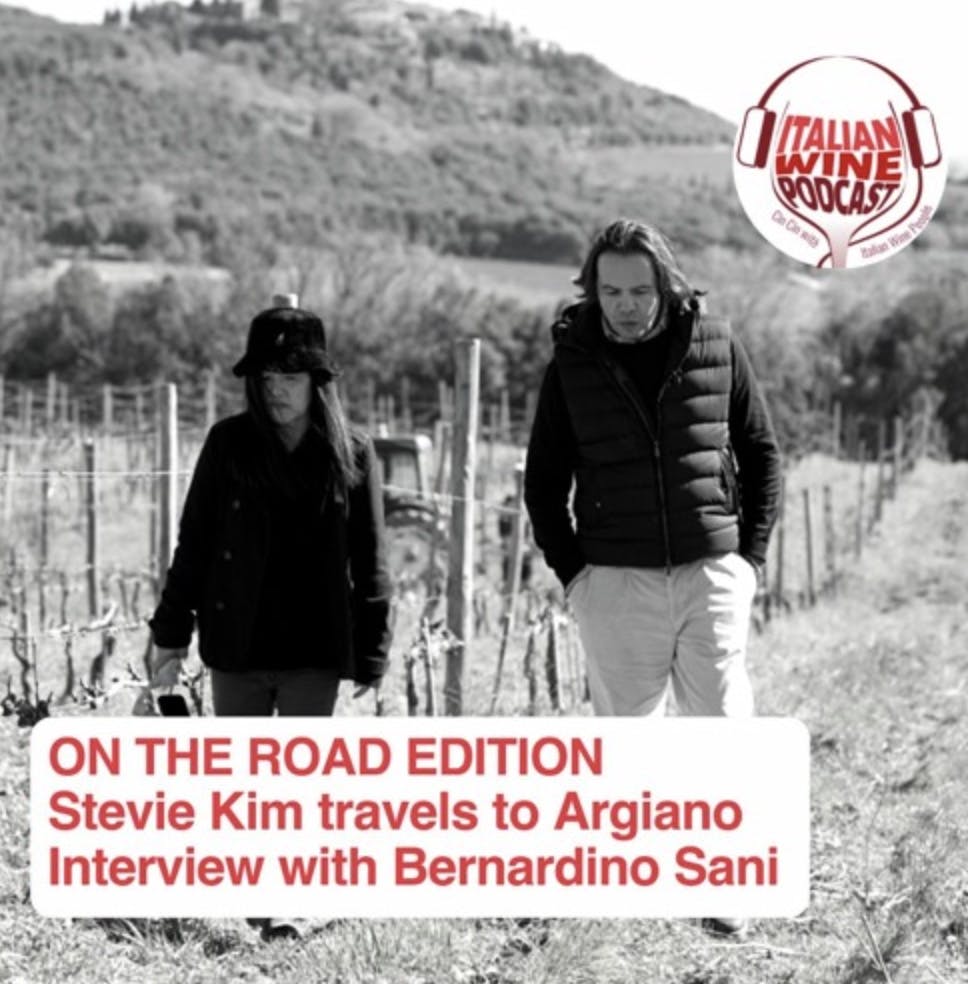
Ep. 812 Bernardino Sani | On The Road With Stevie Kim
On the Road with Stevie Kim
Episode Summary
Content Analysis Key Themes and Main Ideas 1. The rich history and evolution of Argiano Winery in Montalcino, from its origins to current ownership. 2. Argiano's winemaking philosophy, emphasizing classic, terroir-driven styles and organic certification. 3. Detailed discussion of Argiano's diverse red wine portfolio, including Brunello di Montalcino, Rosso di Montalcino, a prestigious single-vineyard Brunello (Vigna del Sorbo), and Super Tuscans (NC and Solengo). 4. The importance of terroir, microclimates, and soil composition in Montalcino, particularly for Sangiovese. 5. Sustainable practices at Argiano, including plastic-free operations and carbon neutrality. 6. The versatility of Argiano's wines in food pairing, extending beyond traditional Italian cuisine. 7. Argiano's comprehensive hospitality offerings, including rooms, a restaurant, and tailored visitor experiences. 8. The partnership between Argiano and Gallo/Folio, with an upcoming ""breaking news"" announcement. Summary In this episode of the Italian Wine Podcast Road Series, host Stevie Kim interviews Bernardino Sani, the head of Argiano Winery in Montalcino. Sani details Argiano's extensive history, dating back to the 15th-18th century, highlighting its role as a founder of the Consorzio del Brunello. He discusses the winery's philosophy under the current ownership (Atlas Invest family since 2013), which has shifted to a classic, terroir-driven winemaking style, focusing on respect for the fruit and gentle aging. The conversation delves into Argiano's six organic-certified red wines, including the Rosso di Montalcino, Brunello di Montalcino (2016 and 2013 vintages), the single-vineyard Brunello Vigna del Sorbo, and their two Super Tuscans, NC and Solengo. Sani explains the unique Montalcino terroir, including soil composition (clay, limestone, ancient shells) and the benefit of micromapping. The interview also covers food pairing versatility, sustainability efforts (plastic-free, carbon-neutral), and the winery's hospitality services. Sani alludes to an upcoming ""breaking news"" announcement on March 16th regarding Argiano's partnership with Gallo and their luxury brand, Folio. Takeaways * Argiano Winery boasts a rich history spanning over 500 years, being one of the oldest estates in Montalcino. * The winery was a founding member of the Consorzio del Brunello in 1967. * Under new ownership since 2013, Argiano has embraced a classic, terroir-focused winemaking style, moving away from high-concentration barrique aging. * Argiano produces six organic-certified red wines: Rosso di Montalcino, two Brunello di Montalcino expressions, and two Super Tuscans (NC and Solengo). * The Brunello Vigna del Sorbo is Argiano's most prestigious single-vineyard wine, known for its longevity and specific terroir. * Argiano emphasizes sustainability, being the first plastic-free winery in Montalcino and achieving carbon neutrality. * Their wines are versatile for food pairing, even with diverse international cuisines like Mexican or fried chicken. * Argiano offers comprehensive hospitality, including eleven rooms, a restaurant featuring local Tus an food, and personalized tasting experiences. * A significant announcement regarding Argiano's partnership with Gallo/Folio is expected on March 16th. Notable Quotes * ""The history is huge. Argiano stated like it is now, like a six, now dates back to the fifteenth, eighteenth century."
About This Episode
The speakers discuss the history and quality of the Arjana wines, including their success in Mexico and the importance of the Spanish-inspired tasting. They also touch on the value of the Rosulimarcheschino wine and its use in various foods. They discuss the use of various ingredients and the importance of sustainability projects, including a new wine brand and a tour of a private collection of French wines. They also mention their own hotels and their approach to the community.
Transcript
Hello. My name is Stevie Kim, and this is the, Italian podcast on the road series, which means that it will be also a video feature in the mama jumbo shrimp. So this is a special series we've created with Gallo and their luxury brand Folio. We're here with Bernardino Sandy. Is that did I bring up? Oh, sunny? Okay. Sandy. Sunday or whatever, sunny. Sunny. So Bernardino is, of course, the big cheese. He's the boss. Of of arjana winery. And right now, we are going to do some wine tasting from your winery. Right. Okay? So let's how many wines, first of all, do you do you how many labels do you have? So as you can see here, the production of Arjana wines is divided into the historical traditional wines, the sangiovese based wine, the Rosudimontalcino, Brunoo de Montalcino, and the brunello, vigna del swallow. Plus, we do have two super tuscan wines. Okay. I'm no confounded to the NC and the Solingo. So in total, we make six wines, all red wines, all produced from and grapes sourced here in, in Argentina State, organic certified. And, I have here a map for you. Okay. Just to show. We are here. Don't test me later. And all the maps are all the vineyards are surrounding us. The lead is the sangiovese. So the main production is sangiovese. Yes. Of course, being a multinational. So give us a little bit of a backgrounder. When did Arjana winery, start? From the very, very beginning. Just give us a very, brief timeline. The history is huge. The history is huge. Our genre stated like it is now, like a six, now dates back to the fifteenth, eighteenth century. And since there, they were producer of, of grapes and wine. From, the late nineteenth century, Argiano joined at Biondi Santi, among a few other wineries of Montalcino in the production of the Brunoo de Montalcino when he created that the brunello de Montalcino. In the sixty, nineteen sixty seven, Artiano was the founder, one of the founders, twenty five founders of, consourcio del Bruno, and, has been an important producer of, brunello de Montalcino. As many other one of us, historically, with a lot of history. It went through different owners, different styles, different epochs, gold times, less gold times. Recently has been both by the artist Davis family And since there, since twenty thirteen, it launched a lot of project, all based on the conception of, being Agiano, one of the most beautiful, important historical site of Montalcino. We also want to do some of the most terone driven, classic, nice expression of Montalcino wines. So for the kind of the wine geeks out there, give us a little bit about the the various microclimates terms of altitude, exposition, and the type of soil. So we are in the southwest side of the hill of Montalcino, around three hundred meters above the sea level facing directly the Mediterranean see. We do have two kind of soils, a lower side of the state where we have, soils that are very rich in clates. Then we have a North area that is also a little bit higher. It goes from three hundred to three hundred and twenty five meters above the sea level. And is this one? This one is where we have the best sangiovese for brunello di Montalcino. Why? Because the soil here is a mixture of clays and limestone. The clays are important because they give the power to the wine. But limestone is what gives, the vertical taste of the salary filling in the mouth or the longevity in the wine. Why there's a lot of lime stones here because, twenty millions years ago, the ocean was covering all these lands when it retired in that lot of shells. And now two meters, behind us, there's still a lot of those shells fossil that gives, a lot of, lambsters to the, to the soil. If you want to go very, Kiki Kiki, we did a micromapp project with, Pedro Parta. In twenty fifteen, we micromappet And in the past, aspanded. Is it, yeah, Chilean, terroir expert is a geologist. He he This is from Chile. He's, obsessive with soils. He digs two meter sticks. He analyzed the soil's composition. He analyzed the electrical conductivity of the soils. He differentiate all the different soils. And based on that, the clones that you have there, the exposition of the vineyards, altogether, it makes a a micromep, a map that, tells you about what are the very best of the best specific, lens and vineyards that you have in your state. This is the same map show with you before with the different kind of soils. If we take this and we make it bigger, we go here. In this part, we have the six best micro terrace micro, parcels of Veneers of San Jose, where we do Prunello de Montalcino. With this one, we do the vineyard solo that you will taste later. Okay. That is a single vineyard. The other goes in the final blend of the brunello. Okay. So we're going to be tasting six wines. Where do we stop? We started from the Rosudy Montecino two thousand nineteen. Okay. Let me see if it's okay. It's bad. I don't know. In my foot. And, so Rosa nineteen comes from, vineyards of San Jose between, fifteen and twenty five years old, we tends to use the vineyard that we have in front, right, here in front of the estate that is the Olivier vineyard as it gives usually the most fresh fruity expression of sangiovese. In the rosso de montalcino, what is the idea? We like to make a rosso that is a very traditional, classic sangiovese. So, not a little brunello. Completely different line, fresh, fluidy, gastronomic, with, its own characteristic, and not meant to be super complex, but very nice, fresh, red fluid, cherry, almost knows, from the San Jose And, a nice acidity, nice freshness, nice, saltiness in the mouth. That may say it very gastronomic, especially with our local food. So on capacity, pasta, cheeses, all that. It goes very well. It's what we used to drink, in the past, in regular basis, and now people drink less, but we still want people to enjoy, more than a glass, just a glass of wine. And so this is the, nineteen, the vintage. When was this released in, last year, in twenty first, it was released after nine months of, Asian in a big old barrel, five thousand liters of parrots, and the little m some months in the bottle. Is nineteen, that was a fantastic vintage. So watch out for, when the Bernelo would reach the market because nineteen, had, pretty much the same characteristic as the sixteen. Cool, which was a very one year. Yes. And a long summertime with cool nights, warm days, sun rays here and there to refresh the vines. So you have, complexity, you have color, you have richness, a good quantity in production, and at the same time, it maintained a freshness of this anchovies. So can I ask you from from a consumer perspective? How much is this wine? How much is this wine in in America? For example. So it's, usually, what's happening is that, these is extremely popular in Europe, very gastronomic wine. People here loves it. It goes very well in the restaurants here. So, is, comparing to the Bruno, the export percentage is less on the rosso di Montal chain. Any way we do Because the Europeans are smarter. This is such, you know, it's de rosso de Montecaccino. I think it's great value. It's actually, you know I agree. I I'm I, for example, my taste, I I love, Lamgenipiolo. I love, San Balpolicello. I love Rosulimontalchino. I like Sametna wines. So I like wines that have freshness. Yeah. It's very good for me. Some people, tends to prefer a little bit more full body wise. Yeah. It can be a little bit dry for someone that goes to the montage. So do you sell this? I mean, is this available in a manner? Yeah. Absolutely. And how much is a a bottle of in retail just so that I can understand. In retail, I have you sold it in wine dot com. I saw in last time I was in New York, in a pizzeria, I'm looking, you know, they are expensive. It was around fifty five dollars. But that wasn't that wasn't in In April, it would be thirty. Yep. Thirty. I mean, this is five to thirty. This is such a, you know, great value. Yes. Right? Yes. It is. It's it's not considering. It's made with the grapes, that, could be used for Bruno. It's made with Vigna treated in exactly the same way aged in the same virus of Bruno, just a shorter time, and just a different tree to maintain more freshness, less, and maybe less instruction. Yeah. I mean, a wine like this, twenty five thirty dollars retail. Great value. Yeah. Especially when you compare it to French wines. Oh, definitely. I mean Definitely. Yes. Okay. I think this is a good point is, one great thing is still You still find in Italy is that the the second wine quality is extremely good. Yeah. Overall. But it's it's a it's a paradox. Right? I mean, in Bruno, you produce more of Bernela than Yeah. The the number It's I don't understand that, really. They never wanted to expand the vineyards in Montalcino. So they they started with a very limited cause register of wines for Bernel Rosso. And, despite the success that they those one had, they never wanted to, to group with, with volumes. And so it's still, limited the number is two thousand hectares, of Bruno de Montalcino vineyards only. And so the biggest part of the grape is used for the brunello steagall. Okay. Alright. So let's go to the next line. And what are we drinking? Bruno de Montalcino, sixteen. And this was released, when? This was released in the twenty twenty. So this is the yeah. This was released two years ago after the when the COVID started after. Yes. It's it's a great year. Great visit. It's a great vintage, and, sixteen, why it's a great vintage. It's a it's a perfect, kind of, a perfect waiter for San Giovanni, because the winter days where cold or even chilly generated in this, in the springtime, sun rains in May, followed by a summertime that was, a pretty long one, but never too hot and extremely different temperature between nighttime and daytime. These are lowered to harvest in the end of October here, selecting the best parcels, the best venues of San Giovanni, fermenting them separately in cement tanks, aging them in, oak barrels between one thousand liters and five thousand liters and bottles for one year and a half. So I'm curious. So the new owner came on at two thousand seventeen. Yep. Has the wine making because this was on the cusp of with the new owners. Right? Right. Has the wine making style changed? Has it? It changed pretty much as, Arjano in the last twenty years had, a history of winemakers starting with Jakomotakis, then was Hans Winding. They all tends to make a pretty high concentration wines and, to age de San Jose in, Barrick. So the wines were rich, pretty powerful. While we've, established coming, we decided to switch to very classic style. So when I say very classic style, meaning, not too much concentration, try to be very respectful of the, of the fruit of the terroir, and, an aging in barrel that is a little bit more gentle. So not too much tunnies from the oak, pretty neutral oak aging, and wines that are probably also a little bit more long aging. We took, as examples, they are John wines from the seventies that if you drink them now, they are still very fresh, very alive. So the acid is higher. And, the way we conduct the vineyards, is with, a little bit less density. And, even sometimes some higher yields, Just not too forced too much the grapes, maintaining balance, the finesse. Okay. What are we chasing next? There is everybody, Bruno, so two thousand sixteen, And, this is just released, just been released. So you released it just now because he was longer aging. Right? Longer aging. One year more in the bottle, not in the wood. The wood agent is pretty much the same. It's coming from, specific parts of, of San Jose that is, Vigna that has a pretty high concentration, clone of San Jose. And, are they not coming from the same place this one, specifically, is almost one parcel that is, this, this one. Okay. Because, it has the higher concentration. So we think it's good to be to use that for, the more long age and wine that we do. That is the the the the reserve of the brunello. And, the fermentation is pretty much the same as in the brunello. The aging process is in a smaller cask slightly smaller casks. We go from, five hundred liters to no to one thousand liters cusp. Let's talk about a little bit about the tasting notes, just not crazy, right, peak heat, but between these two, Right? They're very similar, but one was basically age. It has longer aging rate. Right? Right? Right. So in terms of the tasting note, like, what what are the main differences So in the Bruno de Montalcino, I feel it, very classic, nose, a little fluid, the cherry notes from the sangiovese, and then, sunspice is not too much leather, not too much old behind a very fresh mouth. There is, sir, but the brunello, comparing to the, to the brunello does have already some more spicy leather notes, a little bit more complexity in the nose, some more oak in the background. And the mouth is a little bit more rich, more large. The rest of the multachino is very fruity, very, extremely fruity, nice, vibrant, fresh. And what about food pairing? What how would you pair these three lines? So they they the good point to me in this kind of wine of Agiano is that they are not the kind of brunello or Barolo where that are very rich, very concentration, high concentration, and where you need the meat, for for sure, or, big aged cheese or something like that. Here, you can play a lot. Roso de Montalcino, especially when he's a little bit chill, you can eat it, eat drink it, even with, some kind of fish. Like, the codfish or, and, with tomato sauce. Tomato, garlic sauce. And, she can, goes perfectly and, roasted pork goes perfectly pasta dishes is very good. Listen, you were telling me that you worked also in America. Yeah. Right. So what kind of American, like, international food, rather, would other than the Italian class sick food pairing, because, you know, not everyone eats Italian food every time. Well, that's what I was So so what kind of food, I don't know, tacos? For sure, we we did a tasting at the in New York, two years ago, and I don't know if I can make names, but we paired the brunello with a shake shack, bull. Oh, it's a bird horse. It's a it's it it is when is when a wine is elegant, have acidity, have salty. My offer goes very well with, pretty much every kind of food. I would avoid Japanese food. I mean, especially sushi, but for the rest, they can go from pizza. They're also with pizza. I mean, maybe they're also maybe they're also yes. Not the brunello. Mexican food goes super good. We've put it as like, Asian cuisine. Asian cuisine very well except for the very spicy or sweet, one. When it's sometime, in, in China, for example, you have depending on the region because, you know, China is like Italy. You go the region by region, the full country. How hot pot can cover this? It can kill each other. The the the the the what I love with it also is the fried chicken for his name. And, my they they Everything is good with fried chicken. I'm sorry. Less than I tried, especially Korean fried chicken. But the Another thing that I love is, rice in general, especially South American rice. So my wife is from Dominican Republic. They make rice with beans, and pork, and that with the brunello goes, especially well. And, tacos absolutely, absolutely good. And, of course, with there is there, but you can already go for the classic also. So stay cows and, steak and cheese sandwiches, all that. But even there is air back and can be drunk with different kind of Okay. Fantastic. So, I, I, I'm afraid to ask you, but there is actually another brunello. There is, there is So why why did you I'm going to pour out the rosso so that we can just compare. Why is there a need for yet another granola? So the idea behind the divinarian solo was to create something, which is where we've just been. Right? Yes. Mhmm. Was to create something that, really, and in a straight way, speak you about Arjano. So when we thought about what Arjano here is, we thought about history because this place is full of history. We've thought about elegance because, the symmetry and the beauty of the renaissance style is, the, an elegant way of doing thing. And, we thought about a specific terrar. We have a special soil composition, we are in a different position than other vineyards. What was the wine that could tell you about this? The vineyard as well is, the most ancient vineyards that we have So this is your, the most prestigious line. Right? One was the best wine for Camelo also guide in this year. So it was the best read of twenty one. Twenty two. Cambero guide. And, it's a very specific parcel. It's made out of, evinias of, sixty five years old. Specific loans, old vines, specific loans of San Giovanni. It tells you about history because it's the oldest vineyard. It's the most elegant, expression of sangiovese. So it tells you about the elegance of, Brunelluri Movaciano, and tells you about the specific terroir because, venerate Solo has the soil composition that you don't find anywhere else. What about the winemaking? So the different terms. Fermentation is happening, cement tanks. And, this is cement tanks. Yeah. Not not the eggs. The one that you saw Yeah. They have a x shape almost. Yes. Mhmm. And then the aging is in barrel x shaped that you saw over there. Okay. So the the tolerance. So what about the, the terms of the volume? How many It's five thousand volts. Oh, so it's Yeah. It's a small parcel. We don't use it, completely because we use it still in the blend of brunello remodachino. The vineyard is for hectares. Mhmm. What we use for, vineyard soil is just, a selection of grapes, and we use the rest in the Bruno Elrimental. We could do a, technically, twenty thousand bottles. Right. When did you start? What was fifteen? Fifteen was the first Yeah. This is the second week. So you've started it with a great vintage, fifteen sixteen. So Indeed, we could have been starting from the fourteen, but, We wanted to use a big vintage for the for time for launching the VINale sole, and we started with the fifteen. And what is the difference in terms of an in the on the pallet? What is the what I feel is a more complexity in the nose So it goes from the fruit to some floral notes. And, there's some spices behind, but not too much. No no later notes here is very strange. Yeah. There's no, and, and, what I love in the, in the mouth is the saltiness of the wine. It's very soury. It's almost salty. And this made it another great, food pairing wine. The acidity is high. The longevity is great in this wine. The balance and the tannies. There's a lot of tannies, but they're very silky. Very nice soft feeling in the mouth. But it's it's a tannic bug at this one. When you're making five thousand bottles, I mean, how does the allocation work? No. We just give to specific, clients based on the notoriety of the clients on this. It's almost like a club. Yes. It's almost like the napa club wine club. Right. So it goes in some specific Michelin star restaurant and some collector. So special allocation. Special allocation. Yes. But anyway, this is, in US, should be above two hundred euros for for bottle. This is, from sixty to a hundred euros. And the rest of the month Don't worry. If you get it wrong, you can't get fired because you're the boss. No. It's not me. No. No. I don't know. I don't make the price in the United States like that. And then, there should be around twenty five, thirty euros for the grocery monitoring. Listen. So no whites. No. Will they be whites in the future? No. It's not, a great area for whites. I know. I don't think we we can make any special whites. This is why we don't do it. Maybe we could do a Vincent or we could do Mhmm. Some nice Moscadello, but, sweet wines. So but white wines, so there's no I don't think they're specific. The variety is good for white. Okay. Alright. So we have two more wines. I love this wine, by the way. We have two more wines, and they're We can say super tuscan. Absolutely. Yes. Because it's a bordeauxese blend. Right? It's a bordeauxese wine, and, you know, the history, the arjano is in Montalcino. Montalcino, it's all about San Giovanni. Ninety percent of producers do San Juoza. Yeah. Of course. A Arcano in the nineties had consulted my maker. That was Jahumotakis. Mhmm. The father of all the Supertuscan wine. He went to war for Antinori, started the production of Tignanello, then he made Salaya, then he worked for Sasekaya. He came to Arjano. And in ninety five, he started to make, the Solango. Solango, it's a blend. It's a blend of Cabernet sauvignon, fifty percent with Merlo, Petiverdo, and Sanjuviso. More or less is, twenty percent Merlo, twenty five percent of Petiverdo. So it's a big powerful wine and five percent of Sanjuviso. Some years later after the Solango creation, they started to make, the nonconfounded or the NC that, followed the Solango. It's like the rosso for the Bruno. It's, a Solango, we in the similar to Solango in terms of blend because it's Cabernet, Melo, and sangio Vese. But, much more fresh, fluidy, lighter, aging, maybe less full body, less complexity, very nice, food pairing wine also here. Which one are we drinking first? We're drinking first, the NC two thousand and nine. So this is Merlo Cab and, San Juves. Yeah. What what are in the percentage of the blend? Cabernet is fifty percent. Merlo is around thirty percent and twenty percent is San Luis. Twenty percent on this one. Yeah. It's very fresh, very fruity. Actually, very fruity. Right? Full. Right. Full. And this is a vintage? Nineteen. Nineteen. Yeah. How is the nineteen vintage? Extremely good. For both San Jose and Cabernet and Merlo for for all of them was extremely good. Extremely rich vintage, but not too warm. We had, difference of times between night and days. We had, complexity, good production. So it was extremely good vintage. Incredibly. This is very good price for values in your entry. This is goes, sometimes you can find even around twenty dollars in the shelves. Yeah. It's very good value then. And how how many bottles do you produce of this We are around ten thousand cases of this. One hundred and twenty thousand bottles. So I've noticed that you don't have the family stem here, right, on these two, because be because these are the the blends? Exact so the the idea is that, our journal and and the history is Oh, they have the family stem. Right? Those are two brands that are almost separate from the from the history of Arciano, and we want to maintain this. Mhmm. Okay. Let's taste Solango. Yep. Also here is the ninth, and this is this is really just released now. So Are you just released just now? And the blend here is. Cabernet, fifty percent, thirty percent, and, around fifteen percent of, Petiverto and five percent of Central Busy. And So, basically, the, the main difference is that we're taking over the site. Yes. Very And, you know, a small percentage of such a very good. It's high in concentration and, makes this wine extremely powerful as Solango. You you know the name, Solango. It's the name, the local hunters here called the wild board. So the wild boar one is alone is called Solango. The male wild boar one is long. It's the big boy. And, the reason is that, this one is powerful and is pretty much unique in the area. And, and, indeed, it's a full body complex, long, extremely long gaging, burdo style wine. Vintage nineteen was, again, very good as it was for DNC. Much more Tannic and more yeah. Yeah. Much more, green pepper. Yeah. This is the petiverto that is this peppery spicy. Yep. Just with the small blend change, two different lines. Completely different. Yeah. They we're right because the the grapes pretty much are There's similar. Yeah. You have. Yeah. Yeah. Yeah. Yeah. Yeah. Yeah. And some older sangiovese. So older sangiovese means, two thousand sixteen, Sanjay, in the blend to give some, more acidity, more push. So listen, I so this, series, you're you're kicking off the series with Gallo and their luxury portfolio. Right. So there's something new. This is the first episode of a series that we're launching because there's going to be some breaking news. Right. Right. What is the breaking news? I cannot tell you, but, There is there there will be a rebranding everybody's super excited. Right. And, they are, you know, you know, Galo family. They take care of every detail. They study the the perfect way to to transmit their passion about, family of wines about wine, about wine quality. And so they are launching this new amazing project. I know it, but I cannot tell. Yes, sacred. Okay. But on the for the viewers out there and our audience, the sixteenth of March, they will be making this announcement. So stay tuned and, follow us and subscribe so you can get that news, directly from from us. When did Arjana become part of the, Gallo portfolio? Good question. It comes up distribution and It was, two thousand seventeen. Two thousand seventeen. So with the new owner. Right. Right. Right. Right. Right. Yeah. I told the decision. I loved the project, the lax project, the portfolio of wine, and I have, the amazing barolo from Rati, Marilisa, Amarrone, and Piero Pansoave. Yeah, man, they put together an amazing portfolio. It looked like a very, a special way of being in United States market. So I we joined them. And, we have been working closer for the past now. It's, almost five years. So we are very happy with this. So we spoke a little bit about the the Arjana history. Can you tell us a little bit more about the family stem? Right. Because we we we saw it also on the on the It's in the cellar. Yeah. In the cellar. Right. So, first of all, why this? Because, Arjano has been going through different owners today, one who start that there was, the Peggie family different from this than, Chinsano family than our Stebes family. So different owners, why this family crossed from the guy, Tanya Loatelli family, because this family was the one who was very important for Arcano development since they were the owners of Arcano at the times the Bruno started. So they started the production of Bruno, joining Buundi Santi in these And they started to use this label that came from the very beginning. So it became pretty much an iconic label for Brunoo. And, family members, the guy tani that is the wave here, papa guy tani was mentioned by Dan was the name by pope as as pope. And, that is the the the bird here, the white bird. It's a dove. Right. Yes. Yeah. And the, the they wear a count, and so they have the crown. So what I'm going to ask you now is kind of sum up, you know, our job. Right? For especially for the people who are maybe less familiar, or they've never heard of you. Right. What are kind of the five things that you want them to know? Like, five must know about Argiano, winery, and Argiano wines. Number one. Number one is, I'm I repeat myself about his history. There's not so much history in Montagino, as it is in Argentina. Similar. Yeah. It is five hundred years of, winemaking, but most more than that, the the the castle is really existing since the middle ages and then, transformer into this in the renaissance time, and then went through so much history that history is a big thing. Sometimes when you change hands in terms of ownership, sometimes there's a period when it is not as there's not a smooth transition or there's a little bit of lost in translation if you will. Right? So so number one, it's it's it has a very long history, which Yes. And maybe people are unaware. Number two. Number two is what I love of Montalcino in general, but, is the fact that, if you come to Arjano and you look around six, three sixty degrees, You don't see anything new. It's, the nature here is still untouched. The beauty of the nature is something unique. It was very isolated place and has remained untouched by human hand for so long that is still you've you're brief the same eye that you could have been briefing five hundred years ago. Okay. And number three? Number three, the wines because we went through so many new projects in the past eight years that we are all dedicated to quality. Starting from the vineyards and, going on with the cellar with the restoration of the cellar. It's so, lead by the fact of producing amazing terroir driven wines. So if you want to fill some, some taste, some wines that tells you about the world, tells you about history, tells you about what we are, you should come here and taste the new, especially the recent vintages of, of our job. And then, we do have we are pretty proud of, our sustainability projects. We have been the first. Yeah. So tell us a little bit about the because are you completely organic certified organic? You are certified organic. Besides that, we are the first, we have been the first plus free winery in Montalcino banning all the mono usable plastic. We have been doing last year carbon neutrality project that, that means that we presented a specific study that studied all our emissions and, our capacity of absorbing them. And, discount was positive for us because, we, we almost, we are able to take back, double what we produce in terms of, a carbonic gas and, and the gas responsible for global warming. Okay. And lastly, Last thing about, Arjano, in it's the people because, beside every winery, we try to have good people and, beside every wine, but not only. We have a fabulous hospitality team that, especially in the high season, in the good season. So from springtime to full time, is able to host people in, in a very specific way that is think for every single customer. So you don't do a generic tasting. You tell us what you like. We organize something specifically for you. You stay here. You brief the history. You can visit, everywhere. The seller, you will be eating good food, prepared by our So there is a restaurant. There is a restaurant that use only local ingredients, only food from Tuscany, and, you match beer and great food. It's, it's a nice, three sixty degree experience. In our journey. Listen, I would like for you to tell us a little bit about the the hospitality here in terms of you have also rooms. Yeah. Yeah. We do. We do have any rooms do you have? We have, eleven rooms in total. So it's a boutique, one dresser, and, it's three apartments, only that have been restored using, the same materials of the villa. So during the renovation of the villa, we used the, what was the woods like here for making the, the old woods to make the tables, to make the furniture. So, and the algorithm was just in front of the winery, of the villa state has a nice, pool, and relaxed area, has, the restaurant, has the possibility to do bike tour, horse riding, and, of course, to brief is made for people who wants to, not only to visit as special and beautiful place, but to learn something about wine. So it's very related for, to, to, to the wine production, wine tasting, and wine exploring. I had this pleasure of staying in one of your rooms last night. Absolutely, beautiful, and absolutely, I think, you know, it it is very worthwhile to come and stay, especially if you want to get away from, you know, the rat race, the rest of the world, because there's nothing around. It's very quiet. So I guess that that is it. We can wrap it up. One last thing is the seller where we are because, of course, we had a short tour before. What was the philosophy? Who was the architect behind the the the planning, of the seller? So it's, it's a, it's a great question, and I love to ask. We started, why we started the renovation of the seller? We started because, it was not possible anymore to age wine in bad condition like it was. So we we ask it, to fill up a schedule, local young architect from Siena, who have been working in the Vatican, so his expert about restoration Mhmm. To restore the place, making it, completely great to age the wine to store the bottles, but at the same time respecting completely what was the history, what was the soul of the place. So, basically, he started this huge restoration of the seller just cleaning everything, cleaning the walls, but leaving, like it was, leaving it like it was, trying to bring it back to the goal ages. And the only amazing thing that he did is, transforming. And that was very chaotic. I have to say, he's transforming the all well that is over there and was containing water, transforming it into a vertical cellar dedicated to the history of Purnello. So he put some circular stairs, and that goes from top to, to down. And, it's like you enter really in the, in the history. You enter in the, and you feel this, and you feel the importance of the Brunello producers, it's not only our channel. Right? There are all the most important producers of Brunneli Montagino, who made the history of this terroir show it there in the cellar, and we are we are proud of that. Yeah. And by the way, one of the, it's well, it's not the seller Not just Dargiano. There is some serious private collection of, French wines, and one area specifically of Ichem. Amazing. It is called the Golden Collection. Yes. Golden Collection. I've never seen anything like it. In terms of their private collection. So, Bernadina, thank you so much for hosting. And I have my Regina. Cheers. Cheers. And Chinchin with Italian wine people. And don't forget to tune in for the next episodes that will be on Italian wine podcast. It will go live. It will be replayed after the clubhouse additions. And there will be, of course, a new entry. You know, I love that family. The missus tornado makes a mean, mean vegetable dish, which I had the pleasure of eating. Fantastic. Yeah. Alright. What is it the vegetable all the vegetable dish called? K. A couple nata and all. Yeah. Caponata. I think best couple nata ever. So Tune in. I don't think she'll be on because I don't think she speaks English, but tune in and follow us. And don't forget to hit that subscribe button below. Mama jumbo shrimp.
Episode Details
Related Episodes

Ep. 2789 ColleMassari: a long-term vision rooted in Montecucco with Giuseppe Di Gioia | On The Road With Stevie Kim
Episode 2789

Ep. 2788 Ep. 14: Austria and Hungary | Study Smart for your WSET Level 3
Episode 2788

Ep. 2785 From Volunteer to Speaker at TEXSOM with Samantha Cole Johnson | TEXSOM 2026
Episode 2785
Ep. 2766 Inside the U.S. Non-Alcoholic Wine Market: What Wineries Need to Know with Jill Sites | Masterclass US Wine Market
Episode 2766
Ep. 2761 Winemaking and Consulting Across Sicily with Alessandro Serughetti | Wine, Food & Travel with Marc Millon
Episode 2761

Ep. 2759 Part 2 – The VIA Educational Program & Italian Wine | Heart-to-Heart Conversation with Sarah Looper
Episode 2759