

Ep. 923 Camilla Rossi Chauvenet Pt. 2 | On The Road With Stevie Kim
On the Road with Stevie Kim
Episode Summary
Content Analysis Key Themes and Main Ideas 1. Camilla Rossi Chauvenet's ambitious multi-faceted project, Maseria Kuturi, in Manduria, Puglia. 2. The historical significance of Maseria Kuturi, particularly its connection to the first Primitivo plantings in Manduria in 1881. 3. The challenges and rewards of establishing a large-scale agricultural and hospitality venture in Southern Italy, contrasting with the North. 4. Maseria Kuturi's diverse offerings: winemaking, olive groves, hospitality (rooms & glamping), education, restaurant, and agritech experimentation. 5. The philosophy of sustainability and connecting visitors with nature and local tradition. 6. The personal challenge and strategies for balancing two successful wineries and demanding projects in different Italian regions. Summary This episode of the Italian Wine Podcast's ""On the Road"" edition features host Stevie Kim interviewing Camilla Rossi Chauvenet, a young wine producer from Verona. Camilla discusses her ambitious project, Maseria Kuturi, an expansive estate in Manduria, Puglia. She recounts how she and her father, originally from Veneto, fell in love with Puglia's land and people, leading them to acquire and revitalize Maseria Kuturi, a property historically significant for being the first place where Primitivo vines were planted in Manduria in 1881. Camilla details the significant challenges faced, particularly the lack of infrastructure and bureaucracy in southern Italy, contrasting it with the ease of doing business in Veneto. She highlights the estate's diverse offerings, which include winemaking (replanting 40 hectares out of a potential 100), olive groves, a hospitality center (with nine rooms and six more under construction), a unique glamping site, an academy for agritech startups, a restaurant called ""A Don Tonio,"" and a street food bar. Camilla emphasizes the mission to create a platform that showcases a healthy, nature-connected lifestyle and teaches sustainability. She also touches on the personal struggle of balancing her two ""children"" – Masimago in Verona and Maseria Kuturi in Puglia – expressing immense trust in her dedicated teams. Her ultimate ambition is to build two distinct estates that reflect the same philosophy of sustainable agriculture and education. Takeaways - Camilla Rossi Chauvenet, a Verona winemaker (Masimago), spearheaded the Maseria Kuturi project in Manduria, Puglia. - Maseria Kuturi holds historical importance as the site of the first Primitivo plantings in Manduria in 1881. - Developing large agricultural and hospitality projects in Puglia presents unique challenges related to bureaucracy and infrastructure. - Maseria Kuturi is a multi-faceted estate encompassing winemaking, olive groves, hospitality (traditional rooms and glamping), a restaurant, and an agritech academy. - The project's philosophy centers on sustainability, connecting people with nature, and promoting a healthy lifestyle. - Camilla manages the complex task of overseeing two significant wine and hospitality businesses across different Italian regions. Notable Quotes - ""We came here and we really fall in love with the with this land and with these, soils. But especially with the people with, with the people we met here..."
About This Episode
The speakers discuss the winery and the variety and culture of the Maseria Kuturi, a masterpiece and example of innovation in the industry. They also discuss the challenges and opportunities for the project, including the need for patientism and healthy lifestyle. The winery is a masterpiece and a perfect example of innovation and quality in the industry, and the hospitality center and small restaurant are important elements. The speakers also discuss the structure and organization of the Maseria and the upcoming Glamping, with plans for a coffee drink program and a tour of a website for donating and subscribing.
Transcript
Welcome to the Italian wine podcast. This episode is brought to you by Vinitally International Academy, announcing the twenty fourth of our Italian wine Ambassador courses to be held in London, Austria, and Hong Kong. From the twenty seventh to the twenty ninth of July. Are you up for the challenge of this demanding force? Do you want to be the next Italian wine ambassador? Learn more and apply now at vunitly International dot com. Welcome to another episode of on the road edition. Hosted, Stevie Kim. Today, she is talking with Camilla rossi chauvenet at her winery, Maseria Couturi located in Nia state is massive and so are Camilla's aspirations for the future. Stay tuned as they talk about the traditions, food, wine, and the running of this amazing southern Italian property. Hello everybody. My name is Stevie Kim, and this is Italian wine podcast on the road edition. It is my great pleasure to introduce you to Camilla Rosie Chobene, a young wine producer from Verona who has started a huge, huge, very ambitious project also in Pulia. The project is called Maseria Kupuri, and it is an enormous estate with everything. There is everything going on here. Of course, obviously, the vineyards wine, there are olive groves, there are truly. She does education. She does so many things here. But today, we're just going to talk to her about to give you a small overview of why she's here and what she's doing in Pulia. And this area is called Manduria. So let's welcome Camilla. Okay. So Camilla. Where are you from originally? I came from Barito from, Balicella. And, yes. I'm a Venetian, a hundred percent. So you've you have a winery. You're a young wine producer from verona, and your winery is called Masimago. When did you start Masimago? I started in two thousand three. With thousand bottles. Right. And, right now, we are producing under the thousand bottles. So it's grown quite quickly, but it seems like it's even faster here. Right? So and then what happened? You came here in two thousand eight, I believe? Yes. We came, for, an irrational, choice. I mean, we, at Tommy Choice. We, we met, a technician who was, planting our vines in Baripolicella, and he was talking so well about Pulia, about the landscape, about the soils, how it was wonderful to be there, to produce wine there. So me and my father, we decided to to to come here and, to discover by ourselves, how was it, in in real. So we came here and we really fall in love with the with this land and with these, soils. But especially with the people with, with the people we met here, because, we discover, real, that were taken care so carefully about their vines as a as their child, as their puppies, you know. So, that's why we we we thought we we found this, masseria, and we we decided to start this really ambitious project. So when we arrived in two thousand eight, that there was nothing here because, this property, it's really famous because in eighteen eighty one, the first binds of Primitivo, has been planted in Mandoria for the first time in eighteen eighty one. In in in Mandoria. In Mandoria. So this is this the reason why it's called Maseria Kuturi eighteen eighty one. Is that the reason? Yes. This is the reason. And, the story is a love story because, the owner that created the masseria and planted the the vines in eighteen eighty one, get married with the, a contest that, was living in, Alamura So Where is Altaamura? Altaamura is a nearby. So, yeah, it's nearby. So in the opposite side of, of Volia. So in the eastern part, And, But was that was that a big deal? I mean, it's still kind of in the area. Right? Yeah. But, at that time, Primitivo wasn't here in Andrea. And, after you probably know that, right now, Primitivo of Mandarin is really popular all over the world. So how this variety came here through a love story, so through a wedding, and how this man decided to plant under the under the actors just in front of Masseria in one piece, then called the the piece. So, in dialect, and, try to experiment this new variety and then give an example for the other farmers too that decided to plant primitive as well. So you can imagine how disruptive has been, this story and, how we actually decided to plant, an an unknown variety because at that time, they were cultivating negromaro. Negramaro has been always the typical variety from, from Puya. They all talk to him variety from Pugya. So since that, the masseria has been always a point of, I mean, the the state of, kind of an example for innovation, for production, for quality, And, when when we arrived there, actually, there were even no vines at all, not not even one vine because, these families, Kevony family sold the property to another property that, took over all the vines to receive money from the European community. So you can imagine when we arrived here, there there was nothing at all. Just sheep walking around around the masseria. So we decided to renovate, and to to to give light to to this masseria and, new energy, a new, a new life. So we decided to replant the vines nowadays, we we reach forty hectares, so not finished yet. So the dream is to to be able, to plant even, the rest. So to reach the hundred actors that was, in in in the past. So there were, you have the capacity to potential of planting hundred hectares. Yeah. Absolutely. The the component. And right now, you've planted, you have forty hectares of pine. Yeah. The piece was composed of under actors, but in a special place called the Laconcadoro, which is kind of a unique, piece just in front of Masseria, and, near close to the sea. So just four kilometers from the sea. You could imagine even at that time, how I was so surprising to enter in the masseria and see all these vines altogether in one piece. That's why many, many old men are still coming here telling me, oh, you know, I was working here. How I'm so proud of you, well, of your choices to replant the vines because We were so many working here. I spent all my life in here. So amazing stories, from these people that, gave their hearts, their life, to this project and, how we could see these new vines coming over and, take the plates of the old ones. So I'm I'm really, emotionally as well, when I meet these people because, I fall in love with them because, we we are looking in the same direction, so to to renovate, to to take care of the history of this place and of this territory. So, you know, so there's a lot of love for this land. I can hear it in your voice, but there must have been some challenges, right? Like, I mean, you're coming from Vanet though, as a producer, unknown producer in Nandudia. What were your main challenges? And how did you how were you able to overcome them? You know, in a in Vanitol, we are quite used to have, something for everything for granted. So, the connection, the mobile connection, WiFi. Connectivity. Connectivity, water, electricity. Everything is for granted because, it just exists. Yeah. It just exists. If you wanna start an industry, you just raise your hand, the day after they're gonna bring you electricity, water, whatever. Right? Here is, it's not like that at all. So you need time, you need to be patient. For me, the Napoleon, entrepreneurs are kind of a heroes, because they have to fight with everything with bureaucracy with, no infrastructures. For example, So everything is really difficult, really tough. So this is the main difficulties we we we found, coming here. But, yes, this this love, are these is helping us to to forget all these, challenges and just focus on what we want on our objectives. Are you enjoying this podcast? There is so much more high quality wine content available for mama jumbo shrimp. Check out our new wine study maps or books on Italian wine including Italian wine unplugged and much much more. Just visit our website, mama jumbo shrimp dot com. Now, back to the show. So Camilla, give us a brief panoramic overview of the structure and the organization of maseria Kuturi. So Masera Kuturi is kind of a settlement, like in the past for the Mesapian population. So It's huge. Yeah. The the extension is huge. Right? Extension is big. The masseria also is quite it's quite big. But, we we thought that, our mission is, to create kind of a platform and a Zendagricola. So a farm that could show people that are coming here how our lifestyle is, healthy and close to the nature. So all the people that are coming here are surprised and amazed by by the beautiness, but also by, the sustainability and the the energy that you can feel in here because, everything is edible. So you can walk around and eat herbs through it, you feel like, in a paradise, because, it's unbelievable how in December you saw. There are some flowers just, on the grass, plenty of wildflowers just in December in Venutto. It's not like that. We we we are freezing, and here are we we have twenty degrees. So there are many activities that that could show, what is Pulia. So, we are organizing, foraging, wine tours, cooking classes, dance, and yoga class is I should come for the yoga. Yeah. We we we are trying to to give many activities because here, the best thing is to to stay here in the nature and share the butiness and, the philosophy that, we we we are having here. So tell me, how give me kind of an overview of how it's organized. So you have the masseria, how big is because right now, there's also you have hospitality here. Right? How many rooms do you have? The masseria, is composed by, right now, we have an hospitality center of, composed by nine rooms plus, six rooms that are coming, that that we are building up right now. So this summer, we we're gonna have six more rooms. We have a glamping. We are the first glamping in Pulia. We still, we only have six, tents right now. So tell me what glamping is. I have no idea what that even means. Glamping is a word composed by glamping means, glimmer and camping. The way to to introduce camping in a different way. So in a sustainable, so it's not the typical camping. So we only have, six, tents. And, these tents are really far one to the other one. So privacy and the the silent is the main thing that, you could you could do experience. You are completely surrounded by by nature. So but instead of, a natural camping, you have some facilities and some comforts that you wouldn't probably would never have in a in a normal campaign. We decided to collaborate with no disc, no disc village. And, in Italy, in Portia, we are the unique ones. Then we also have, academia, which is, a place where we, organize some courses. We are also, a place where where some startups that comes here to to, to understand and to use our fields as a playground and this ten of this, startup in, AgriTech are coming here to to to work and understand better how to, improve their ideas. And they'll be doing glamping. No. That's okay. Uh-huh. But I didn't finish yet because we are also have a small restaurant, called a dom to mount, and, another structure called it, which is, us street food, bar where we offer our wines, paired with a really simple, food, like, and simple, and traditional food, from here. And that's which means small small small little house just, near the the the street. So, it's really became popular as well, with the in in the young with with young people. So we made some concerts, some, you know, with the COVID, has been really interesting as well because, people were having food and wine, in the countryside. Under the stars, even dancing under the stars and in a really freedom, spirit. And that's, and what about the restaurant? Tell me a little bit about the restaurant. The restaurant is called So in honor with, with the, the last owner of, this property. And, we decided to create a restaurant that that could cook, everything we we found around the restaurants. So we are using, the vegetables that we have in our kitchen garden, the herbs that we found also walking around in the fields. That's why the foraging course and all the products that we are found, that we are founding, even around with, little farmers. So it's really challenging, but really fun as well because, you could really understand stand the tradition, but also this new new wave of new chef, a young chef that want to interpret the tradition in a different way, in a way. So I'm I'm really proud of, of this project. So how do you, divide yourself between Veneto and Puria? Yes. It's it's a bit a mess. Actually, because you're married. Right? You have a life You have a winery to take care of also in Masimago. Also, you have hospitality both in Verona Masimago in Padava. Mhmm. And now, this is a huge structure to organize. How do you you're just one person? How do you organize your personal life? It's really challenging because it's like having two kids that are eight hundred kilometers one to each other or from each other. So when I'm here, I feel guilty I'm not in Massimago, and, when I'm in Massimago, feel guilty because I'm not here. So, yes, it's quite difficult, but, you see, I have two, wonderful teams that are helping me to go forward, we with both, projects and they're really enthusiastic and, and really focused and professional. So they really let me go further on these projects and, they are my family. So I really trust them and I really love them how they they they act and they they work. So you said, you know, kuturi and Masimago, it's they're like two children. So I know it's unfair for me to ask you this question. But do you have a favorite? I know you're really, really young. Okay. But should you retire one day? Where would you choose to retire? In Massimaga or in kuturi? I think I know the answer, but I want to ask you. I would never, give you an answer because, you see it's difficult to choice. So I I think I wouldn't pass, always, six months in here, six months. So Alright. That's that's a very traumatic answer. Yes. Okay. But it's it's it's because when you We we have been, sharing some food and some wine. I feel like the quality of life is wonderful. You have great food, nature, and it's clean. What more can you ask for? Right? I feel like this is really a good life here. How how can you go back to Verona? That's what I'm asking. You see, you also need the stimulus. So people, that's why we are bringing bringing here people. When when I started in Massimago, I also thought the same thing how I can stay in the countryside all over the I mean, all the time long. So I was, stressed because I thought I was thinking to be alone in the countryside At that time, I I didn't have a family that were living with me in the countryside. So I I was a a city girl. So it it was scaring me. But, when when I discovered that the hospitality could help me to bring people and, smart people in these places that changed my life completely because I understood that the people could change your your point of view and your lifestyle. So the stimulus and the smart people that I I need to meet to open my mind, and make some contamination crossing agriculture with the economic, people, though, or fashion, or whatever. It would be possible only inviting them in, our farms and learn from them, even in, really comfortable and, nice place as, we are here, you know, in front of a fireplace. So yes. So listen, one last question. What is your ambition. What are your objectives for the next two, three years? What would you what are your plans? What would you like to accomplish? I I really look forward to be able to build up two completely different, east states. That, could, reflect the same, philosophy. So for me, agriculture, farms, I mean, the these farms should be, kind of, really a place where you can learn a different lifestyle, a different way to a different approach, to the nature, to learn how to be sustainable, because, sustainability, yes, you make many choices in doing, your daily job, but, it's it's not enough because you should teach people to be sustainable and how they could learn to be sustainable if they don't see the effects that pollution and contamination could take place, in in in the nature. And talking with the farmers, I think people could even, learn to be much more sensible and, to learn how to really feel the difference, and how the sustainability is important. So, for example, how are the, the weather and, of the pollution could take effect on, our life. So that's it. That's a wrap, from Maseria Kuturi in with Camilaro Cio Renee. See you next time. Chinching with Italian wine people. And this ambitious project, I think, is worth a visit. How where can they find you? It's masseria kuturi dot it. Dot com. Dot com. Masseria kuturi dot com. Thank you. Thanks for listening to this episode of Italian wine podcast. Brought to you by Vineetli Academy, home of the gold standard of Italian wine education. Do you want to be the next ambassador? Apply online at benetli international dot com. For courses in London, Austria, and Hong Kong, the twenty seventh to the twenty ninth of July. Remember to subscribe and like Italian wine podcast and catch us on SoundCloud, Spotify, and wherever you get your pods. You can also find our entire back catalog of episodes at Italian wine podcast dot com. Hi, guys. I'm Joy Livingston, and I am the producer of the Italian wine podcast. Thank you for listening. We are the only wine podcast that has been doing a daily show since the pandemic began. This is a labor of love and we are committed to bringing you free content every day. Of course, this takes time and effort not to mention the cost of equipment, production, and editing. We would be grateful for your donations, suggestions, requests, and ideas. For more information on how to get in touch, go to Italian wine podcast dot com.
Episode Details
Keywords
Related Episodes

Ep. 2720 Ep. 21: L’Isola del Vino Selvatico | Pellegrinaggio Enoico con Attilio Scienza
Episode 2720

Ep. 2649 Ep. 9: Dai Vini Retici al Prosecco | Pellegrinaggio Enoico con Attilio Scienza
Episode 2649
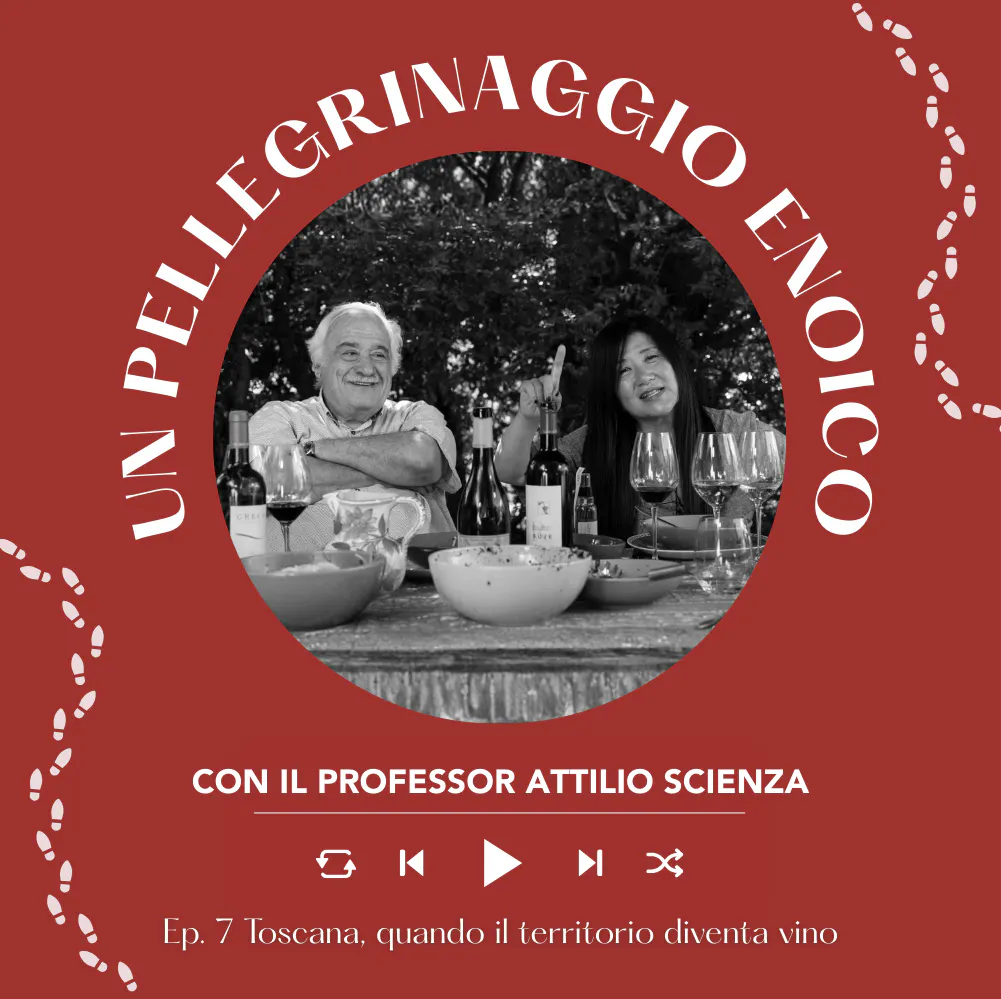
Ep. 2637 Ep. 7: Toscana, quando il territorio diventa vino |Pellegrinaggio Enoico con Attilio Scienza
Episode 2637

Ep. 2631 Ep. 6: La Vigna Ritrovata di Leonardo | Pellegrinaggio Enoico con Attilio Scienza
Episode 2631

Ep. 2600 Ep. 1: Costruire le Fondamenta | Pellegrinaggio Enoico con Attilio Scienza
Episode 2600

Ep. 2597 Wine in Transition: Declining Demand, De-Alcoholised Wine & New Alternatives with Robert Joseph | On the Road with Stevie Kim
Episode 2597