
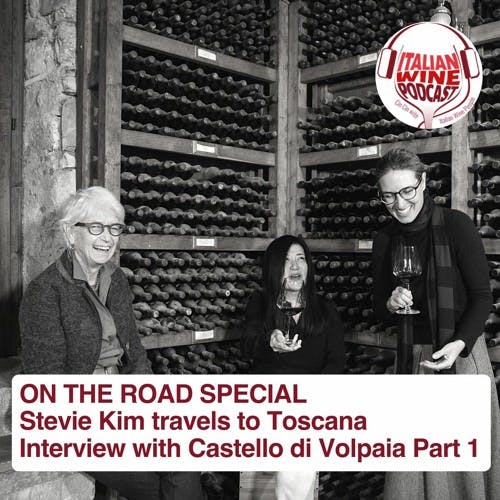
Ep. 932 Giovannella Stianti Mascheroni | On The Road With Stevie Kim
On the Road with Stevie Kim
Episode Summary
Content Analysis Key Themes and Main Ideas 1. The history and evolution of Castello di Volpaia, from a hunting reserve to a renowned winery. 2. The unique geographical and historical context of Chianti Classico, particularly Volpaia's location in Radda. 3. Castello di Volpaia's winemaking philosophy, emphasizing Sangiovese and early adoption of organic practices. 4. Detailed discussion of Volpaia's key wines: Chianti Classico, Reserva, Cortasada, and Balafico. 5. Challenges and adaptations in organic viticulture due to climate change. 6. The family dynamic and succession within the Mascheroni family and the winery's operations. Summary In this ""On The Road Edition"" of the Italian Wine Podcast, host Stevie Kim interviews Jovanilla Stanti Mascheroni and her daughter Federica at Castello di Volpaia in Tuscany. Jovanilla recounts how her industrialist father purchased the estate in 1966 primarily as a hunting reserve, not for winemaking. The family quickly transitioned into wine production, focusing on quality and economic viability. She clarifies Volpaia's location within the heart of Chianti Classico, explaining the historical distinction between ""Chianti"" and ""Chianti Classico"" wines. A key highlight is Volpaia's pioneering commitment to organic viticulture, having been certified for nearly two decades, long before it became fashionable. The discussion delves into their flagship wines, including the 100% Sangiovese Reserva, Cortasada (a single vineyard wine with a touch of Mammolo), and Balafico (their Super Tuscan blend). They also address the increasing challenges of organic farming in the face of unpredictable climate change, detailing adaptive practices like keeping grass in vineyards. The conversation underscores the family's dedication to preserving the estate's historical beauty and natural environment. Takeaways * Castello di Volpaia is a historic estate located in Radda, at the heart of the Chianti Classico region. * The estate was acquired in 1966 by Jovanilla's father for hunting, gradually evolving into a wine producer. * The Mascheroni family prioritized quality winemaking from the outset, focusing heavily on Sangiovese. * Volpaia has been organically certified since 2003/2004, a significant commitment long before organic wines became mainstream. * Their wine portfolio includes their flagship Chianti Classico, a 100% Sangiovese Reserva, a single vineyard Cortasada (with a touch of Mammolo), and the ""Super Tuscan"" Balafico (Sangiovese/Cabernet blend). * Organic farming in Chianti Classico presents growing challenges due to climate change, requiring adaptive vineyard management like specific soil practices. * The estate has invested heavily in preserving its historical landscape, including burying all electrical wires. * The difference between ""Chianti"" and ""Chianti Classico"" appellations is rooted in historical geographical regulations. Notable Quotes * ""The problem today is, that Kianti, because the area name is Kianti, but in Kianti, we don't produce Kianti. We produce Kianti classical."
About This Episode
The Italian wine podcast is held in London, Austria, and Hong Kong from the twenty-seventh to the twenty-ninth of July. Speakers discuss the success of their own business, the importance of investing in the industry, and the challenges of organic farming. They also discuss the use of Cortasada and the in-wash method of their wine. They introduce a new wine brand called Volpaya and encourage viewers to donate and share their ideas.
Transcript
Welcome to the Italian wine podcast. This episode is brought to you by Vinitally International Academy, announcing the twenty fourth of our Italian wine Ambassador courses to be held in London, Austria, and Hong Kong, from the twenty seventh to the twenty ninth of July. Are you up for the challenge of this demanding course? Do you wanna be the next Italian wine Ambassador? Learn more and apply now at viniti international dot com. Welcome to this two part episode of On The Road Edition, hosted by Stevie Kim. Today, she is at Castello di volpaya in the heart of Tuscany. Stevie Kim sits down with Jovanilla Latiente Masquero and her daughter Fiderica Masquironisiente to talk about their epic aesthetic, their amazing labels, and of course the history of this iconic family. And remember, if you would like to watch some footage of the castle and the interview, just head to our sister channel on YouTube, mama jumbo shrimp. My name's Stevie Kim. Welcome to the Italian wine podcast on the road edition. And today, we are in gandhi. Today, our special guest, Jovanilla Stanti Masqueroni. Correct. Correct. And, her bodyguard, federica Scianti, macaroni. Is that no. Or is it is it just macaroni? No? It's macaroni. Muscaroni. Why why is that? Tell us why why that is. It's I was supposed to have only the surname of my father Right. That is Masqueroni, but the surname of my mother was disappearing, and so he decided a long time ago when it was not a fashion. Now it's much more efficient to have both the two surnames. So My brother and I, we have, macaroni and Cianci together. Fantastic. Alrighty. So Giovanni is one of my favorite wine people. I've met both of them at the, first edition of opera wine. Correct. And, this is our really official first visit here. I know we were supposed to come here many, many times, but, my my husband was here, actually. Nobody thinks I have a family. I have one husband, two children, two dogs, but He came here and he absolutely fell in love with this place. Now I understand why. So, Giovanni, why don't you tell us where we are? Well, that's something that, my husband, that is being always the soul of the that's where the prison may be of the castle, but he decided to move to change this, room, because he's a room, into our storage for all the vintages. Did you say this was a prison? Yes. Oh, okay. Because in a castle, you should have a prison. You should have a church. You must have a cemetery inside. You have everything. Oh, so this was a bonafide prison. We suppose. Yes. Yeah. Okay. Okay. Alright. So, you know, for for the audience out there who have never, been to, Castelo de Volpaya, can you tell us exactly where it's located? Well, we are, I mean, starting from very large, we are in Europe. We are in Italy. We are in the center of Italy, and we are in task exactly. But when you go in Asia, you have to start this way because they don't really have very much. But I'm actually not Asian. I just I know. You're not. Yeah. I know. And we are in Tuscany, and, everybody's in the heart of the Canti Classic. But really, if you take the distance between the the border of the Canti classical, Volpaya is very much in the the center, not of Tuscany, but of the Canticlassico area. Chanteclassico area is just eliminated by very old, law of Granducatory Toskana, where already decided that we are talking about the fifteenth century, where, which was this area? The problem today is, that Kianti, because the area name is Kianti, but in Kianti, we don't produce Kianti. We produce Kianti classical. So that's How does how does that work? I don't understand. Because of different change and lows. So to be different from Kianti, Now the wine name is Chanti classical because the the wine, Chanti. Exactly. The wine Chanti is not producing Chanti, which is nonsense, but the geographically is not in and you cannot talk about, I mean, something that is produced out of a chianti area that is a product of Tuscan. Yes, but not of chianti. So, you know, we were driving up here. And from the main road, Yes. It where there's the signage that says Castello de vulpaya. Yes. It's like three and a half kilometers. Yes. So how what is the extension of a Castello de vulpaya? Exactly. How How big is it? Just to So, we, I mean, the total lectures of Office three hundred and ninety, not a vineyard luckily, but it's, woods, olive trees, and vineyards. We have something less than fifty hectares of vineyards, twelve of olive trees, all the rest is money to spend in woods. But, really, that's the reason why my father bought this place because it was a hunter. And they wanted a hunting reserva. So we started from a different approach, and then we became winemaker. So your your father is the person who purchased this area, this estate. Right? Exactly. But he was really interested in hunting, not wine. Absolutely. Absolutely. So when did the wine start? The wine was already here. So the only idea is to producing a better wine, the wine. And I think a good part of the of the fact that we have been successful. I I think I can say is that my father was not an agriculture. It was an industrial. So immediately make accounts and they decided he couldn't lose money because, industry must make money, otherwise, you close. But in agriculture, you cannot turn off the the vineyard. They start giving you grapes and wines and products. So the only way was to invest, you know, that to have a good, I mean, opportunity to have a a good economy in the whines. So it had to be economically Exactly. Viable. Right? Because you your your dad was an entrepreneur. Exactly. Okay. So when did when did the winemaking start with your family? Immediately, because as I told you, the great career And it was in nineteen six. Fifty six, we bought, but then we started in nineteen sixty eight. Really because the first two vintages, we were not really involved. And at the beginning, we were selling part of our wine, the worst part of course in bulk, you know, that to concentrate in the best grapes and the best wines, And then immediately, we started to export the wine over roller selling in Italy. And then the expert now has become very, very important for us. Thanks also to the help of Frederica. That is traveling all over the world. Have you stopped traveling? I stopped. They decided I should retire. They can they can't stand me. Wait. Wait. Wait. Objection. Objection. As always, so, like, in mother and a doctor that speaks together. Obviously, the daughter has a different perspective. Yes. A different perspective. She decided to to take care much more about the the in, inward fire work than, the export. So so let's talk about the wines. I know you have other estates. You have wines coming from Marima and, of course, panteleria. Correct? But, today, we'll focus on volpaya as we are here. So tell me how many labels and the different types of wine that we have? Well, I don't know really numbers, but we should have, that's his five, zinc per se. Something like ten, nine. I don't know how many labels I don't mind. I know that I've to sell and produce all of them, but I don't know. It's a good thing. She's not going out and trying to sell your wines now that she's here. She doesn't know. She's doesn't know either. I was counting down. I think you're right. Bricking news. Okay. So let's talk about the wines that we've gathered today. There are five bought holes I see. Tell us about these five wines. So let's start from the first label that is the Canti classico, which That's your flagship wine. Right? I mean, This is what Cantic classic or Castello de vulpaya. This is what put you on the map. And on the on the label, there is the everything that is all payer. So there is the crest of the family that they level payer that were builders of sandals. And clocks. And, then there is the church, which is a national monument by Benedict and Maiano. We didn't see the church today. Yeah. We'll do that later. Okay. And so and then in the name of Chianti Glasgow and my name as well, little one, but it's here. I never I never I never I never know. Giovanni. But if she starts selling, but, I mean, maybe she'd be federica. But he's nine. Okay. Alright. Okay. And, unfortunately, for you, from next year, it's going to be not anymore your name, but it's going to be Castella de vulpaya, because we we became, I mean, between the three of us, sting, ding, ding, ding, ding. So you better you better start saving those bottles with your name. Exactly. It will become collectible. Exactly. Very, very rare. So this is, you know, of course, this is your signature wine. Right? So how many bottles do you produce? About these wines, something like, a hundred thousand bottles. And then we have the Kianti classic reserva where we concentrate more because it's one this is as a ninety percent sangiovese and ten percent Merlo rather than reservea is one hundred Sangiovese. We immediately concentrate on the idea that sangiovese was the right grape. Remember that when we arrived here, there was also the white grapes in Jan. Yes. I remember there, it, like, the French the Roan, they you can blend in the white grapes. Exactly. Exactly. And so then they changed it, finally, the law, but we immediately understood that the white grapes would not do the right great for these areas, especially at the time, where the climate was not as warm as today. So the white grapes would make the wine even lighter. It's true that people who is looking for lighter wine. But we want a good wine, not a light wine. And as long as we don't have a big production, we are very happy to produce just the top quality wines, and not for everybody. I'm sorry, but to be very good. There must be a a different, approach. Italian wine podcast, part of the Maammar jamushimp family. So I'm going to you've touched on a lot of topics right now. Right? The fact that you have focused on your reserve. A hundred percent, San Jose. Because also, when did you start doing that? Reserve immediate. We immediately concentrate on reserve. Because now it's very trendy. You know, to focus on the indigenous grape varieties. Exactly. And also you spoke about the crust of the volpaya. Yeah. What's in there? Can you tell us a little bit about that? Well, volpaya is far Right. And on the crest, there is a fox climbing mountain. Yeah. Why is that? What is the origin? We found this piece of stone in in the village, and we decided should be the crest of the family that was living here and they were artisan. There were no noble family. They were just as I told you, I mean, builders of sandals and clark. And without, I'm never thinking of this, but my husband, it's a big collection of clock and sextant and, this, that there is one Yeah. It's great to me. So it could you could say anything. It doesn't really matter. Okay. I assure you. You come upstairs and I assure you. And so the if you want again, we found it a certain connection between Portpaya and the hobby of my husband. Oh, okay. Alright. But I don't I didn't see any sundials in the village. No. Because they are in New Zealand today. So everything is very But not even like, you know, I don't know, attached to some building. We we we thought to add something more modern. We wanted to do. And then it was too complicated. We didn't want to have something very modern and fake. So we never did. But that was one of the project. That's what it is. So the, how many bottles do you produce? Around the eighty thousand. Alright. And are the your market, principally, your most important market is America? Yes. I mean, North America and the So Canada and United States. Okay. And what do you know? Maybe also it's something you don't know. I'll just look for in wine searcher. Do you know the retail price of your Canti Glasgow? In US, you know, I will Because I think this is a very good value for such high quality. And I think, I mean, I'm just assuming, but I think the success of your wine is because of that. It's very good quality, and it very good value for Okay. For for this quality. I've also noticed that there is a the green label, which means that your certified organic Correct. Since since when? The exact date I don't remember if it was two thousand and three or two thousand and four that we have made all the transition. I'm so surprised you are running this like very successful business. Time we'd have a problem. And you you guys didn't have having a clue. I mean, it's very romantic. I love it. I love it. I really love it, but the mother and daughter team, you having a clue. Well, there is a there is the same Let me do some Wikipedia. Okay. So so sorry. I'm sorry. It's a joke. I mean My husband, I would say the same, but but he would he would not know as we do. But he would say, well, yes, we start in two thousand and to in February. This is very This is very manlike. Right? They don't understand it, but they're convincing. Exactly. Exactly. So because we were coming from data, we have decided to say always I think. Yeah. You know, how much we put in before, I think. He was a liar. Absolutely. He's no longer here, so we can say anything about him. Exactly. Exactly. Okay. So, so that's a very long time ago. You've been organic for nearly twenty years. Yes. Yeah. When it wasn't it wasn't really fashionable back then. Right? Yes. Because organic was, like, kind of alternative. But now, I think it's very fashionable and especially the younger generation. They're really looking for that organic character in a wine. Luckily, it became a fashion. It's like not because of, like, faction, but because, everybody's following. Even if you don't know, they follow. Right. So that is the good part because it's something not healthy. Sometimes it's happened to things that you don't want to, to be followed, but luckily now everybody's looking for sustainability. This is a word that Big big word. Yeah. It's too much used, but for sure, it's a comcepted that we are following in agriculture, but also conserving the environment of albaya. So trying to keep the volpeilio as it is, putting all the wire. If you walk around in volpeilio, you see. Don't see any wire. Mhmm. You've been on the trellis? Yes. In electricity electric. Oh, okay. Everything is underground. We have placed everything underground to be able to see, all the villa, and the landscape. Yeah. Yes. How it was in the past. So a big work to really keep the environment as it was So, I mean, being organic means, you know, by definition, you have minimum intervention. Right? But how did because how did the climate change? Has it affected the terroir and and the winemaking in being organic. It's more difficult. Right? Very good. Yes, sir. Yes. I mean, being organic, it's, you know, more challenges. Yes. It's much more challenging. It's everything has to be worked in advance. So you have to look and to be in the vineyard, almost more than, when you are a normal, weight, to grow the grapes. It's because it's like when, you don't have to take a medicine. You have to prevent. You have to protect it and, your your grapes. Not, at the moment that you have the problem, you can have a medicine and fix the problem. So for sure it's much more complicated. And this type of climb, where the humidity forecast is unpredictable. This is, it's quite a much more challenging for the organic producer. But, I mean, are there more challenges now than, let's say, ten years ago? Do you Do you see the climate change influence? Yeah. And how are you addressing those issues? Well, for sure, even, growing the grapes, so we work less the soil. We keep much more of the grass and decided have less, working off the water because now it's not that it doesn't rain. It rain altogether, like, in two days. And so instead of, having a open soil that can be worked by this the water. We prefer to have the grass to be able to have, the water that doesn't, break the the soil. This is one example of the the different way that we are working now in the vineyards them in the past. Okay. So the third one, which one is that that you bought out? Cortasada. Cortasada. She looked at me because, I'm the only one who was year, more most when they call tasala start. What is what does it mean? Cortasala, first of all? It's the name of the vineyard and the house, the farmhouse. Yes. So it changed dress several times. But it's the same red things inside, let's say, because he was, he started as a table wine Mhmm. Because he were not allowed to have a candy with a ninety five percent San Jose. We started in ninety eighty, working on a vineyard that was already planted at ten years before, but we grafted with the right clones of Sanjuviso. Because at that time, everybody in the eighties or the seventies, everybody were looking for quantity and not quality. So even the clothes were not the the correct one. And by the chance, we had the the receptionist of the industry of my father who was a grafted during the war. So he was here full time for us, and as you may know, grafting are paid per numbers of grafting they do per day. Actually, I didn't know that. By by now, you know, and you can say. And so everybody are trying to do as many as they can. Oh, okay. As long as he was power worker, he was doing his best. And they didn't need to meet hundred. We could do just twenty in one day, but it was they were perfect and do grafting on a ten year old vineyard. It's not as easy as the young one. We still do because everything starts from American food. So we have all the grapes. Oh, it's the ghost. It's the ghost. It's the ghost. Yes. We don't want to miss It was the prison. Exactly. The prison ward coming to get us. Okay. And But it it it is a little different. Right? You have some other great what is the blend? The blend there is ninety five percent sangiovese, and from the very beginning, five percent of manolo, which is a very strange. We would not be able to do one hundred percent, ma'amolo, but this touch of ma'amolo will make the sangiovese softer. So, you know, we do have some geeky audience, you know, they're very kiki about the the grapes and and the blinds. So what is what does Maumala bring to the wine? And why did you say that you couldn't do hundred percent Maumala? Because there is no body, really. There is a it's a lighter wine. Yes. There is much but he has this tatch mamula is violet in tuscany. Oh, okay. And so he gives a, let's say, a little, the taste of a violet. Floral notes. And so we still keep these blenders in favor. And, of course, when the day started, we started it was not organic, but then we turned it to everything, even this vineyard. But it has been always been separate from all the other's vineyards. And these are so as long as the grapes are coming from one single vineyard, if there is hail, you might not find, make a coltasala because you know that the hail is going just in one spot. It never happened luckily. Mhmm. So, you know, you have the in blind tasting. Yep. Okay. You have, coltasala Yes. And cantic classical. What is what is the in terms of the tasting notes? And then we'll taste one of the wines. But what is the tasting note, that you can recognize in blind tasting? Because I know you do blind tasting with the black glasses. Exactly. Exactly. But in a blind tasting, what is something that can say one is Canticlacico and the other is Cortisol. For sure in the structure of the wine. The the Canticlacico has type of the wine and and our multicast is definitely much lighter compared to the structure that you can find in the in the tasala. So that one is the biggest one when when it goes in the mouth, in the candy classical, we can say much more like, red fruits. And when you get in, in the for Casala, much more the black fruits, like, a blackberry or something like this. Okay. Alrighty. And then the next one? Yes. So the Balafico is the one that doesn't follow the rules of the Canti classical, we can say. Because it's, sixty five percent of San Jose, and thirty five percent of a cabernet, so it's very different and push towards So it's it's your super tuscan, let's say. Definitely. Yes. There is no black rooster. Yes. And then other things that, at the beginning, we forgot to mention He's coming. Because he's coming, they because they want to say that we are in the Rada area, that it's very important to say. It's not only Kenti classical, you know, now It's more and more the concentration of of each single soup zone of the Canti classico. And so, Volpaya is in the heart of, of a rat than Canti. That is the heart of the Canti classico. But really, the the Hard of the heart. Yes. Lega Del Canti started in Rada. So it's not a story that we invented in the twenty first century. Are you sure it was in your husband who invented it? Okay. And, what about so the the and and the last one? Balafico. I keep on forgetting. What are what are the volumes in terms of production of these bottles? Quite smaller. Because they're both single vineyard ones. Yes. It's it's around the eight thousand bottles. Right. So it's significantly smaller. Yeah. Okay. Thanks for listening to this episode of Italian wine podcast. Brought to you by Vineetli Academy, home of the gold standard of Italian wine education. Do you want to be the next ambassador? Apply online at benetli international dot com. For courses in London, Austria, and Hong Kong, the twenty seventh to the twenty ninth of July. Remember to subscribe and like Italian wine podcast and catch us on SoundCloud, Spotify, and wherever you get your pods. You can also find our entire back catalog of episodes at italian wine podcast dot com. Hi, guys. I'm Joy Livingston, and I am the producer of the Italian wine podcast. Thank you for listening. We are the only wine podcast that has been doing a daily show since the pandemic began. This is a labor of love and we are committed to bringing you free content every day. Of course, this takes time and effort not to mention the cost of equipment, production, and editing. We would be grateful for your donations, suggestions, requests, and ideas. For more information on how to get in touch, go to Italian wine podcast dot com.
Episode Details
Related Episodes

Ep. 2789 ColleMassari: a long-term vision rooted in Montecucco with Giuseppe Di Gioia | On The Road With Stevie Kim
Episode 2789

Ep. 2788 Ep. 14: Austria and Hungary | Study Smart for your WSET Level 3
Episode 2788

Ep. 2785 From Volunteer to Speaker at TEXSOM with Samantha Cole Johnson | TEXSOM 2026
Episode 2785
Ep. 2766 Inside the U.S. Non-Alcoholic Wine Market: What Wineries Need to Know with Jill Sites | Masterclass US Wine Market
Episode 2766
Ep. 2761 Winemaking and Consulting Across Sicily with Alessandro Serughetti | Wine, Food & Travel with Marc Millon
Episode 2761

Ep. 2759 Part 2 – The VIA Educational Program & Italian Wine | Heart-to-Heart Conversation with Sarah Looper
Episode 2759