
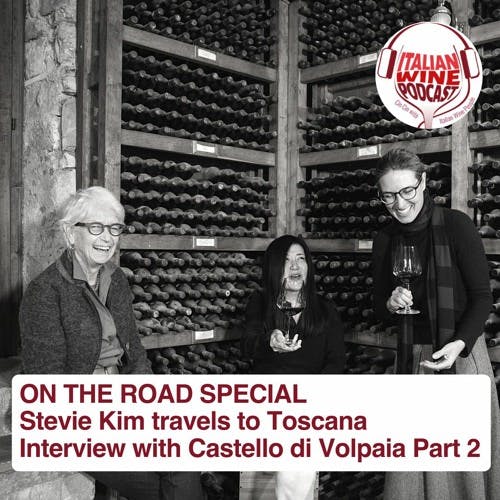
Ep. 947 Giovannella Stianti Mascheroni | On The Road With Stevie Kim
On the Road with Stevie Kim
Episode Summary
Content Analysis Key Themes and Main Ideas 1. The historical legacy and family-driven evolution of Castello di Volpaia in Chianti Classico. 2. Innovative and traditional winemaking practices, including temperature control, specific aging methods, and bottle formats. 3. The unique terroir of Volpaia (altitude, soil, microclimate) and its influence on Sangiovese. 4. The impact of climate change on Tuscan viticulture and adaptation strategies. 5. Expansion into other Italian wine regions and diverse wine projects by the Stianti Mascaroni family. 6. The importance of collaboration and community among local winemakers (Vignaioli di Radda). 7. Exploring unexpected and unconventional food pairings for Chianti Classico. Summary In this ""On The Road Edition"" of the Italian Wine Podcast, host Stevie Kim visits Castello di Volpaia in Tuscany to speak with Giovanella Stianti Mascaroni and her daughter Federica. They delve into the fascinating history of Volpaia, initiated by Giovanella's late husband and father, and how it evolved into a renowned winemaking estate integrated within an ancient borgo. The discussion covers their pioneering use of temperature-controlled stainless steel fermentation and unique aging philosophies, including the preference for magnum bottles. They taste the Volpaia Cortasala 2018, noting its specific tasting profile and the importance of bottle aging. The family also discusses their other ventures, including a Maremma estate producing Vermentino and Cabernet, and a sparkling wine project in collaboration with Giovanella's brother. They highlight Volpaia's distinct high-altitude terroir, stony soils, and significant diurnal temperature shifts, and explain how climate change is influencing their harvesting practices. The conversation touches on the roles of their winemaking team and the collaborative spirit of the ""Vignaioli di Radda"" association. Finally, they share intriguing food pairing insights for Sangiovese, suggesting unexpected matches with fatty Asian dishes and spicy Thai cuisine. Takeaways * Castello di Volpaia is a historic, family-run estate in Chianti Classico known for its integrated ""borgo"" setting. * The winery was an early adopter of temperature-controlled fermentation and emphasizes meticulous aging, including significant bottle aging, with a preference for magnum format. * High altitude (up to 650 meters), stony soils, and substantial diurnal temperature variations are key characteristics of Volpaia's terroir. * Climate change has led to earlier harvesting and a shift in focus from achieving sufficient sugar levels to managing potential over-alcoholization. * The Stianti Mascaroni family's wine ventures extend beyond Chianti Classico to include white wines from Maremma and sparkling wines from other regions. * Collaboration among local producers, exemplified by the ""Vignaioli di Radda"" association, fosters knowledge exchange and collective strength. * Sangiovese (Chianti Classico) can be surprisingly versatile in food pairings, complementing rich, fatty, and even spicy international dishes. Notable Quotes * ""My husband didn't marry me. He wanted Volpaia. And the only way to have Volpaia was to marry me."
About This Episode
The speakers discuss the importance of wine aging and learning about family history. They also talk about crafting wines and their exposure to sun and temperature differences. They discuss the association of Rada with international travel and the importance of sharing food and wine recommendations for international travel. They thank attendees for their time and discuss the importance of drinking food by herself.
Transcript
Welcome to the Italian wine podcast. This episode is brought to you by Vinitally International Academy, announcing the twenty fourth of our Italian wine Ambassador courses to be held in London Austria, and Hong Kong, from the twenty seventh to the twenty ninth of July. Are you up for the challenge of this demanding force? Do you want to be the next Italian wine Ambassador? Learn more and apply now at Vineitili International dot com. Welcome to this two part episode of On The Road Edition hosted by Stevie Kim. Today, she is at Castello di volpaglia in the heart of Tuscany. Stevie Kim sits down with Jovanella Stianti Masquironi and her daughter Federica Masquironi Stianti to talk about their epic aesthetic, their amazing labels, and of course the history of this iconic family. And remember, if you would like to watch some footage of the castle and the interview, just head to our sister channel on YouTube, mama jumbo shrimp. Alright. So let's taste one wine. What are we tasting? Why don't we taste the cold tasala? Why don't we? Since it's the only one open. Yes. Don't see it. I have all the lineup of beer. Okay. Let's taste this one wine. The cold tasala? This is a two thousand eighteen. And from the two thousand fifteen, vintage, it is a grand selection. Oh, okay. It's grand selection. Yes. Alright. So tell me, how would you give me the tasting notes? To do this. She's good. I noticed when she doesn't want to speak, she's like, you do it. Yeah. Yeah. Look at her. Yes. Well, I'm the mother. Let's say. I'm not really a person that has a lot of words, so I'm not really able now. I had noticed. Are you kidding me? I'm trying to skip since the beginning, to to to talk. But, for sure, No. You don't have to give me, like, you know. To, like, You know, I'm not asking for, you know, James Suckling. Exactly. Exactly because I was already red in the color of my my cheeks. For sure, you have if in the Canti classico, you have a cherry in the in Cortasalle, I found much more, Amarena? How do you say? I think it's Amarena. So the the, darker cherry, the the one that it's a rounder, and the less acid than the cherry is softer. And then, the blackberry And then, again, you have the structure as a wine that is aged also in Barrique. So the structure, is also coming from the wood, but what we try is like not to impress it too much with the wood. So only one third is the New Barri. Okay. And how many is in Barri? How many months? Yeah. How many months? It's a wrap depends upon the vintage, between eighteen and twenty four. And you know, anyhow, to become a Grand Salizone, you need a minimum of six months after in the bottle. Right. And bottle aging? Yes. That is very important. Sometimes a lot people doesn't really take care of at this point, but it's, it's incredibly important that the the agent in the bottle. And to me, the best bottle is the manual. It's the perfect dimension of the of the bottle and the cork on top. Oh, really? Yes. Okay. Try to have a aged, man, and the same vintage as a normal, seven hundred and fifty, and it's, It's a different. You can feel it. So, you know, you know, we were walking around the. Okay. Hamlet as we found out today. And it is incredibly for me, amazing how you are able to create a bonafide wine making facilities. Okay. So we spoke about, you know, the wine making facilities, but inside of these small buildings, right? And how it's integrated. So tell us a little bit about the BORgo and your day to day life with the workers here. Well, why don't there something that started many years ago way she looks at me. Anyhow, I mean, really is the the soul of everything was my husband. I always say that my husband didn't marry me. He wanted volpaya. And the only way to have volpaya was to marry me. Uh-huh. So I was parrot of a package. Okay. Okay. He really felt in the library with this place where we were coming just as, engaged. And, in any start work and he was going very well with my father. So at the beginning, he had no money. So my father helped. He had the idea, and my father was financing the idea. So it was a good team. And they started that one thinks at a time that we didn't do everything at the same time. And also, we never knew that we would be what we are because I'm sure that otherwise we would not do it. Because it's so fascinating. And as long as we don't make money, at least we live in a nice place. We enjoy what we do every day, and that is the best reward that we can have. But because I think your family was one of the very first utilizing the cold fermentation, control fermentation. Absolutely. Bestals. Right? That was really something that we I mean, we changed it five times the the way we ferment the wine. But every time was something new, we realized that the the one could I mean, we start doing the stainless steel. So with stainless steel, you cannot leave it open. Because you start the fermentation when it's very warm. So it's like making a soup, and have the heater at the maximum. So it boil, boil, boil, boil, and then the perfume will leave. So we immediately understood that in order would be different because they're much more, insulation, like, around. But with stainless steel, it was very important to control the temperature. And with we had this project that that this person just made for us because, there was not so much people doing this way. Now everybody are more or less abandoning this way, and they're coming back to cement that we already started the tried Now there is many different ways of fermenting. And, that's dependent from your own taste. For example, they're now the fermentals in clay. I tasted the wine. It's my personal taste. They don't like. He's not bad. Right. They don't like. Yeah. You don't have, like, the eggs, you know, the fashionable. Everyone has, like, some eggs now. Yes. Right? So let's talk about if you want a little bit about your other estates and the type of wines you make. You guys are looking at each other. Like, you take it. No. You talk about it. No. You talk about it. No. That's not my state. My father gave me this, and and her father gave the other one his state to her. Uh-huh. So everything is repeated in the years. And so that's is the president that my husband gave to Friedrich. So the one in Marima. And what about Anteleria? That one is my brother. I'm sorry. Oh, he's not here. Yeah. So we miss, the singer of the family. No. Yeah. That is a project of my brother. I think it is a problem of my family. We are not able to have a house without a vineyard. Oh, okay. So if you need a house, you buy a vineyard with it. Exactly. I think this is the main issue of the Good thing. You only had two children because otherwise you would have, yeah, ten estates. Absolutely. Okay. So tell me about a little bit about Marima. What kind of wines do you produce? It's very different. It's only two hours by car, but it's totally different in the microclimb there. It's in Castillo de la Piscaia in Marin Matuscana. So it's like, one hour drive in South, where we are located, it's near the seaside. So Marimette's quite a wide area because even very much in land also. And so being so close to the sea, we don't grow very much in San Jeviso. Actually, now we are in a process of replanting most of the vineyards. What we are very happy and, what we we see is growing very well is development. Yeah. Of course. They're following the steps of what the the Coria or, Sardinia has already done. Marima is now focusing very much in the Vermentino in the aged Vermentino. So even in reserva, so that it's, and then, obviously, have, the grapes, the red grapes on the Cabernet side. And So when When was the first vintage? Two thousand and seven. Okay. So you're But they were maintaining a rabbit a little bit later because it was not planted, and we planted there. And what about Pantaleria? Even if Nicholas isn't here? The first is two thousand eleven. Yes. So you have and do you do any sparklers? You you do it. Right? Oh, that is the passion of my brother. Oh, okay. He does it. Where is he doing that? Part is though is done here. So we have, hundred percent of San Duvez from Volpaya, from a single vineyard, the ink. And it it's method of classical. Okay. And, and we are doing since the two thousand and ten vintage. And and it's a small production. Right? So it's like, anytime you say, fitsio. I love that word. Yes. Yes. Yes. Yes. It's very fitsio. Yes. And then, in the more or less in the same moment, he he has a house. He's trying to fee to to buy something there. I'm a I am a force in here on duet, man. And so he he joined it the south and north of Italy. So the pinot noir from Ultrapa and the as a tradition, the basil area. And so it's this one is made up in the north, you know, the papa base is nothing about our own grapes, but there is this, project too, and this is partner, this is Puman. Okay. So, you know, we spoke mostly about winemaking. I briefly touched on the vineyard management. Right? Can you give me, like, like, the five things that we need to know about the different types of, microclimate, the soil structure, and altitude, the exposure to sun. Can you the wind closeness to this? Yeah. About this in because it's very elevated. Right? Where does it start? Are you enjoying this podcast? Don't forget to visit our YouTube channel, mama jumbo shrimp. For fascinating videos covering Stevie Kim and her travels across Italy and beyond. Meeting winemakers, eating local foods, and taking in the scenery. We start the the lowest vineyard is the one of the cast tillino. It's around three hundred and fifty meters. And it is the one that now we are making a sparkling wine from there because it was the low one that for most of the other people is the high one. Then, less What is the altitude? Three hundred and fifty here. Yeah. Then, from from there, we go up. The new vineyard that we have over Volvaya is, reaches six hundred and fifty meters. So very high elevated for the area. So for sure, we have elevation that is a quite a characteristic. Then, we, our exposure, we look south, southward explosion, obviously, it's nothing flat. So you will have southeast, southwest, and then in different slopes. Are you able to do mechanical harvesting? Yeah? Or no. Everything is hand harvesting. Everything is hand, hand peaking and, work. It's a lot of work. Yes. And people that come so far, the harvest, the second time, the second day, not always they come back because it's very much working going up and down, very stony. So another characteristic of alpaya, a lot of stones in the vineyard and sand. Yeah. We saw that. It's very rocky. Yeah. So this is It's really a huge difference after in the wine, so minerality. Microclimb because of the elevation, we have a devalue below. So even, in at the end of the season, like, in September, or more in October, sometimes, we see the vineyards in the bottom of the valley that could have lots already all the, leaves and still have some bunch of grapes that have to be picked. But after we don't have, a lot of fox or things like this. And so we still have all our leaves on the plants, and so they keep working, to wrap the the grade. For for sure, the microclimate, Avolpi, it's quite different. And so at the same time, a lot of wind that is good. It's always windy here. Right? Yes. It's good. I mean, in the summer, now with the change of the climb, for sure, we are reaching really high temperature. And, yeah, so now, but before we didn't we have never needed a air condition in the rooms. Now we start to have a decent accessory. What is the diurnal temperature range? Like, the difference between the high temperature and low temperature here? It it could be really high because, like, in the summer, you could be without, I mean, in t shirt, even less, but in the afternoon, you need a sweater. Right. You so it's cool. And We we I'm, some salary in Chocoza. I'll send saying to protecting the village. Oh, okay. That's un agnostic. So whatever. But it's a August. Oh, okay. And so that's in the middle of August. So it should be a very hot, day. We were doing a big party, every year in the past, and everybody was coming here, dressed it in a way at the beginning of the day of the evening. And at the end, they were everybody was wearing a it's a jacket or it's a sweater, even if it was, August. Yes. But the climate change, we helped it out very, very much. So we are very, high elevation. So previously, we didn't reach the temperature we needed. For the sugar, enough sugar. Exactly. So now the problem if you remember that the appalachian tells that reserve should reach at least at least a twelve degree alcohol. From now, they should say they cannot go over. Right. Right. Right. Because the climate and really the people who were very lucky in the sixties or the seventies, today they suffer. I always say, and it's true. I met this friend of mine a few days ago, and he just confirmed. I don't tell you the name because he's a good producer. But in two thousand and three, he asked me for in a party. Did you made wine this year? Yes. Of course. I did. Why? No. I made marmalade because there was no juice in the grapes because he's very low located. And, But are you picking earlier now? Yes. You are. Right. And what about frost? Is that a problem in this area? Usually, in this area could be, for lower altitude, but like the last floor frost in in April that this area had, we were not really impacted. I mean, we had, like, a two percent of the production, even less. But are the people got really big damage. You know, so you the elevation, just getting back to that one nanosecond, the difference in elevation, and it's predominantly Sanjay. Right? Is that correct? So do you have different clones according to different elevation? No. Not about a different elevation, but I was talking today with the winemaker and Who's the winemaker, by the way? The local one, the one, that has to live with the grapes every day. He's a lot in Toregaly. Then, we have, in, in the cellar, Roberto doesn't come to me the surname in this moment. I mean, you yeah. You're not twenty nine. No. So Alberto was not a then we have a consultant, that is recardo Cortarella. The superologist. Yeah. But, it's it's nice also to have somebody that works for different wannaries and can bring you, problems, solving problems, usually that had somebody else And then, obviously, it's very important to also the people that are working in, the vineyards. So simona Vinali, that is another important person for us, because, and has to be in energy between the three of them that has to be connected. So there is something, a new kind of association of Rada. Yes. What is what is can you tell me a little bit about that? We are now the Vigna yoli Dirada. So and the what is nice is a big connection between all of us. How many producers are there? We are over twenty now, and the the the biggest important things that we eat a lot together and we drink a lot of together. It seems like it seems like an excellent reason to have an association Yeah. And different wines. Yes. And the and the different wines. From, from the different areas of Florida. So a lot of exchanges. So next week, we have a nice tasting between all of us. Everybody brings his own wine, so we can be able to see what we are doing. But it's also an important exchange, about what are you doing, what is also even where are you buying the bottles? Because I have, problems, with my producer and exchange technical notes, practical notes, and then work together. Try to be much more sometimes the French are better. So try to be much more like French and work together as an association, you can make much more impacted and work as a Maybe because it's a small group. You can work together. Yeah. It could be. Italians are notorious. No. It's not individualist. They don't share. It's individualistic. Listen. So my last question before we close, what are what are the, food and wine recommendations for for what are the food recommendations for your wines? Visicanti classic is essential visa. So for sure, and the eat and drink at the same time. Right? Don't don't think about, for my point of view, I think about Sanjay, drink it by yourself. I think it's much more pleasure if you have some food with, I'm sorry to be rude with the vegan or vegetarian, but the meat is the best bearing, for, for this type of, of wines. So, of course, it's typical, right, county classical with fiorentina steak. But what about international foods? Like, I don't know, tacos, hamburger. Well, hamburger is very similar, but so that seems to be like a logical choice. But what are some other, food items into an out? You travel. You hate Korean foods. So definitely not Korean food. Okay. But what about some other types of international dishes? I I I tell the often Visa story because I reminded the very, shock that was one on my first trip. I was in Hong Kong and was not really able to choose the food. And I was with the journalist, and he choose the for me, the food. And, and I'm arriving in front of me. This wonderful white fish was looking like violet white fish. And I said, How How can you drink it with candy? And actually was with the very fat sauce, though you were not seen at the beginning. So, the the sweetness of the and the fatness of the that one, was pairing incredibly well with the with the structure of the wine, and it was so incredibly surprising thanking the person. So it's difficult for me to say what is the food? For example, Thai food with the spiceness it's wonderful. No. It's just wonderful. Let's slow down. It's a fantastic. So you would recommend with spicy food. Yes. When when it It doesn't cover up the, It's a it's low down the spice. Obviously, the spice is always, for me, it's always too high, but, but, the red wine, when when you have, a food to spice, usually, bring a piece of paper, paper, bread, and and then drink a glass of wine, and you will have your mouth to finally breathe again. Right. So it's making me really hungry, so I think we should stop. Okay. Thank you so much. Let's do, Chinchin. Thank you. Chinchin. And thank you so much for the invitation. Thank you very much for coming. Okay. And it's a wrap from radha c in Canti. Okay. Thanks for listening to this episode of Italian wine podcast brought to you by Vineetli Academy, home of the gold standard of Italian wine education. Do you want to be the next ambassador? Apply online at benetli international dot com. For courses in London, Austria and Hong Kong, the twenty seventh to the twenty ninth of July. Remember to subscribe and like Italian wine podcast and catch us on SoundCloud, Spotify, and wherever you get your pods. You can also find our entire back catalog of episodes at Italian wine podcast dot com. Hi, guys. I'm Joy Livingston, and I am the producer of the Italian wine podcast. Thank you for listening. We are the only wine podcast that has been doing a daily show since the pandemic began. This is a labor of love and we are committed to bringing you free content every day. Of course, this takes time and effort not to mention the cost of equipment, production, and editing. We will be grateful for your donations, suggestions, requests, and ideas. For more information on how to get in touch, go to Italian wine podcast dot com.
Episode Details
Keywords
Related Episodes

Ep. 2597 Wine in Transition: Declining Demand, De-Alcoholised Wine & New Alternatives with Robert Joseph | On the Road with Stevie Kim
Episode 2597

Ep. 2595 Where Wine Won In 2025 with Erica Duecy | On the Road with Stevie Kim
Episode 2595

Ep. 2583 Women For WineSense and the Houston Rodeo Wine Competition with Amy Gross | On the Road with Stevie Kim
Episode 2583

Ep. 2564 Understanding the Albanian market with Erjola Braha - CEO of Alehandro Group | On the Road with Stevie Kim
Episode 2564

Ep. 2554 In conversation with Marco Alberti, the Italian Ambassador in Tirana | On the Road with Stevie Kim
Episode 2554

Ep. 2463 Lamberto Frescobaldi | On the Road with Stevie Kim
Episode 2463