
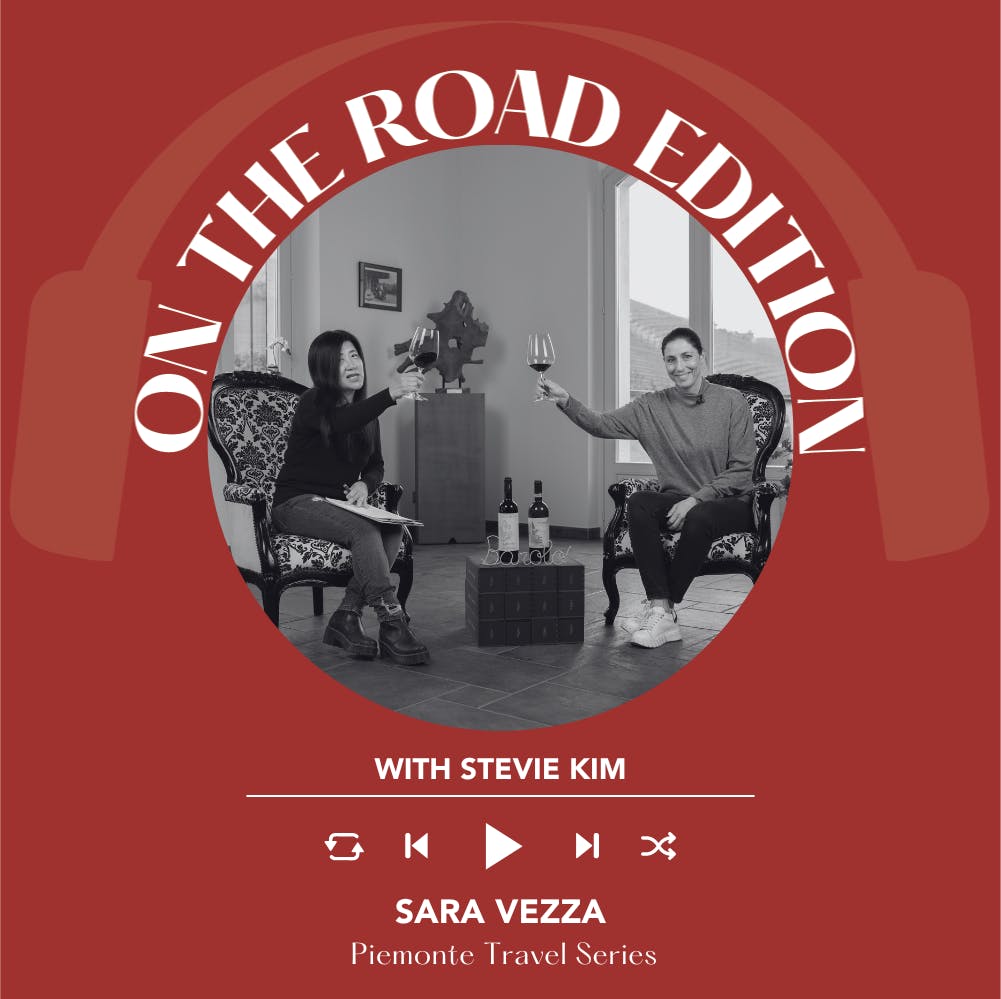
Ep. 1939 Piemonte Travel Series- Sara Vezza | On The Road With Stevie Kim
Piemonte Travel Series
Episode Summary
Content Analysis Key Themes and Main Ideas 1. The history and evolution of the Yoseta Safirio winery under Saravedza's leadership. 2. The comprehensive approach to sustainability in winemaking (environmental, economic, social). 3. The unique terroir and characteristics of the Montforte d'Alba wine region. 4. The challenges and rewards of balancing a demanding winemaking career with family life. 5. The philosophy behind brand development and winemaking to reflect authenticity and terroir. 6. The definition of ""true luxury"" as an authentic experience and connection to the land. 7. Innovative approaches to wine tourism and community engagement. Summary This episode of the Italian Wine Podcast features host Stev Kim interviewing Saravedza, the fifth-generation owner and winemaker at Yoseta Safirio in Montforte d'Alba. Saravedza recounts her journey of reviving the family winery in 2002, despite lacking formal enology training, and significantly growing its production from 1,000 to 120,000 bottles annually. A central theme is the winery's deep commitment to sustainability, encompassing organic farming, biodiversity, energy autonomy (80% self-sufficient), and social responsibility, including a unique initiative with other women winemakers to recycle label liners. She details the specific terroir of Montforte d'Alba, her winemaking philosophy focused on expressing the vineyard's characteristics, and the evolution of the winery's branding from a traditional gnome to a wild orchid symbol. Saravedza shares insights into balancing her role as a winemaker with raising four children, advocating that women should not have to choose between career and family. She introduces the concept of ""true luxury"" (lusso vero) as the authentic experience of connecting with the work and the land. Finally, she highlights the winery's hospitality, including their ""Adopt a Row"" program, which fosters long-term relationships with wine enthusiasts. Takeaways * Saravedza successfully restarted and expanded her family's winery, Yoseta Safirio, emphasizing resilience and passion over formal training. * The winery is a leader in comprehensive sustainability, integrating environmental, economic, and social practices. * Montforte d'Alba's unique and ancient terroir produces Barolo wines characterized by verticality and elegance. * The brand evolution from gnomes to wild orchids symbolizes the winery's sophisticated and deeply rooted philosophy. * Saravedza champions gender equality in the wine industry, demonstrating how women can achieve professional ambitions while nurturing a family. * ""True luxury"" in winemaking is defined by authentic connection, experience, and the privilege of living and working with the land. * Yoseta Safirio engages customers through immersive programs like ""Adopt a Row,"" fostering a strong community around its wines. Notable Quotes * ""I still today feel myself like a plant with my roots sinking in the soil."
About This Episode
Speaker 2 and Speaker 3 discuss their winery in Montangent, which is located in a municipal area and is investing heavily in sustainability and balancing forest and vineyards. They are also investing heavily in recycling and creating a future wine brand. They are part of a group called Anello Forte and are investing heavily in recycling and giving a second life to their wine. They are also investing heavily in sustainability and balancing family life, including balancing the forest with vineyards and ruffle trees, and creating a traditional family business. They are also investing heavily in recycling and creating a sustainable wine. They are also part of a group called Anello Forte and are investing heavily in recycling and giving a second life to their wine. They are also working on creating a startup project to replicate their success in other wineries and working on supporting their family members and creating a traditional family business. They are also investing heavily in sustainability and creating a sustainable wine
Transcript
The Italian wine podcast is the community driven platform for Italian winegeeks around the world. Support the show by donating at italian wine podcast dot com. Donate five or more Euros, and we'll send you a copy of our latest book, my Italian Great Geek journal. Absolutely free. To get your free copy of my Italian GreatGeek journal, click support us at italian wine podcast dot com, or wherever you get your pots. Welcome to another episode of On the Road Edition hosted by Stev Kim. Each week, she travels to incredible wine destinations interviewing some of the Italian wine scene's most interesting personalities, talking about wines, the foods, as well as the incredible travel destinations. My name is Stev Kim, and welcome to Italian Line podcast. On the road edition. And that means we are on our YouTube channel, mama jumbo shrimp. Today, we're here with Saravedza in Montforte da, just Right. Okay. And the name of the winery we're visiting today is called Yoseta Safirio. Yoseta or Yoseta? Yoseta. So, Sarah, Listen, tell us a little bit about yourself, and why is the name of the winery? Yoset Desaffidio when your name is Saraveza? Well, I mean, we have a very long story. We have about two centuries of story. And, I'm the fifth generation, but, until the middle of the eighties, my grandfather and ancestor, they were used just to be vine growers, you know. So what happened is that, in around the eighties, my mother and my father, they started to produce wine, although they decided to give the name of they say to my mother name. So this is why the winery is called Yoseto Safirio, which is my mother name. Okay. So Yosita is your mom? Okay. Is your mom still involved in the wine business. Yeah? No. I mean, she decided to stop producing wine in nineteen ninety two. And so for a few years, they didn't made any wine at all. So the reason why we are here today is because, at the age of nineteen, I started to produce again wine, and I started from nothing more or less. And I, you know, made any states growing in the year so much. So you're originally from this area? Yeah. I was born here on these hills. Yeah. Okay. And and you didn't study in knowledge in the beginning. Is that correct? It's so funny because, you know, when I said, I want to go on in the business. I was studying only ancient Latin and Greek. And then after that, I went to university, and I said, communications, but nothing about wine. So when I started, I was really unable to distinguish an apple tree from a vine. So So your father is actually a wine maker. Yeah. Right? He was the chief winemaker at Marquesi Di Barolo. For how many years? For many years. Right? For about forty years. Yeah. For about forty years. And he was the one who encouraged me to go on and developed this business. So I've been supported by him so far. But your mom was also the agronomist. Right? I mean, yes. She was a part of the estate for a few years, but, I mean, she was, the person was more in, you know, she want to sell everything, you know, and, she want to sell everything in ninety two. But, unfortunately, for her, I said, no, I want to go on. So So for those of us, art audience who are less aware of this area, tell us exactly where your winery is located. It's located in Montforted alba which is one of the eleven municipalities producing Barolo. So, actually, we are in the, Umonte, so in the north part of Italy. And in Piamonte, we are in the south part of this region. So we are about let's say one hour from the sea and one hour from the French border. Okay. Just to give you an idea. So is one of the eleven areas. Yeah. Of barolo areas. Yes. Is that correct? Okay. And what is the closest area nearing bordering Montarta. You mean the other municipalities? Yes. So we are on the board very next to castigliano Falletto, just behind us, and Sarah Lunga. And we are actually in the oldest part of the Langa. So, you know, the Langa has made from, emergent soil from a sea. And so we are in a part that emerged about eleven to twelve millions of years ago. So very long So so you say that you're the fifth generation. Right? And then your mom stopped producing wine for a bit. Is that correct? Exactly. Correct. So why why did you want to start making wine again because you didn't study wine, but all of a sudden you're like, one day you woke up and you said, I want to do wine again? I mean, because I really felt that I was so bonded with this eels, you know. And, it was such a pity that they want to sell everything. And, I still today feel myself like a plant with my roots sinking in the soil. So what wanting not not to lose everything, you know. I I wanted to go on and live here. And today, I'm sure that I've done the the right choice. So you started making one. You came back to the company when, how old were you? I started my full harvest in two thousand and two, which has been, one of the most difficult harvests. But, how old were you? Too I was twenty two years. I'm trying to think about how old you are today. Forty four, almost. I will be forty four in few days. You know, Destiny, because my father, first harvest, has been nineteen seventy two, which has been the worst Arvest Heather, they didn't make wine at all. So, you know, that's life. Yeah. Are you enjoying this podcast? Don't forget to visit our YouTube channel. Mama jumbo shrimp for fascinating videos covering Stevie Kim and her travels across Italy and beyond, meeting winemakers, eating local foods, and taking in the scenery. Now, back to the show. So give us kind of an overview of, you said, the Safirio. You know, we have this, historical brand. You know, it's the Safirio, And in the historical brand, we have all our classic labels, Nebula and, of course, Barolo and all the Barolo single vineyards. But from few years, I also started to be very curious about the future of, Viti culture. And for this reason, I bought a plot in a high part of Elanga, about seven hundred meters on the sea level. And there, starting to produce, Alta Langapilation. And I dedicated a brand to that because, egg tractors is a lot. So it's like a second estate, I would say. So it's still the same, winery, still the same property, but we have two different line and two different brands. So the historical traditional brand, Yosita Safirio focus on Barolo production, and the future, which is dedicated to the sparkling method of classical, with Saraved Sabrina. So how many labels do you have altogether? So with Yosetasaffiria, we have, ten labels, Hocus, again, on classic wines and, on Saravedza. Right now, we only have two. One is Alta Lankaa and one is the nebula sparkling, but we will add two more labels on Sarabetsa. Okay. So getting back to when you started, right now, how many bottles are you producing in total? Today, including all the production is around one hundred and twenty thousand bottles. Okay. And when you started, how many your first vintage? Right. Two thousand and two, you said? My first vintage I made about one thousand bottles of wine. So I'm I made a very big jump. Yes. It's evolved in a very significant way. Exactly. But the thing I'm most proud of is that I change this state to be just not only small, but also to very conventional. To a totally sustainable estate. So we have today twenty hectares of vineyards and sixteen hectares dedicated to forest. We take care of. So we have a forest with bees, a forest with dedicated a lot of time to be, you know, a natural reserva so that, animals can stay healthy there. And we have ruffle trees, forest. So we are really investing a lot of time and efforts to balance the actors. We have dedicated to the vineyards to balance with the forest, with the woods. Okay. So today, it's unusually nasty outside. So it's raining. And we won't be able to see any of this beautiful stuff today, but so we'll have to come back. But tell us also about your philosophy of sustainability because just behind us, what is that thing over the that is a price that I gain for sustainability two years ago dedicated to women in sustainability. And of course, it's something that makes me very proud because that means that I'm going the right path. So my ambition is to be a sort of positive model for other wineries, or other women wine producers that go on on the same path. So, you know, sustainability is kind of a big word today. Right? So for you, Sarah, it's, how do you define sustainability, especially in terms of your winery? Well, we have different shapes of sustainability for sure the environment impact. So we decided to be organic from two thousand and four for my health problem. So I decided to go in that direction because I could not go anymore in the vineyards because of chemical products, and that is one part, you know. So to be organic, to have a invest in biodiversity, and this is the part, you know, from the point of view of, you know, the agriculture, I would say. But on the other side, you have also to think about all the rest, means the economic impact, the relation you have with your employees, with the neighbors, and so also the social impact. So we are working very strongly for that to be positive and, you know, to have a sort of legacy for the future generation to invest in that direction. So to be a very positive model. So can you give me some concrete examples of what sustainability means for the winery. Yeah. We are part of a group called Anello Forte. We are women wine producers from this area. Yeah. All from Montforte, and we are investing our efforts in recycling and giving a second life to, you know, things that in the cellar would go in just in the rubbish, I would say. So is called liner that is used for the labels. You know, it's a a mix of plastic and paper. So it's a sort of, special, rubbish. And we have, a project to recycle that and give that a new life, you know. And we really would aim to be a sort of, a startup project, but, the ambition is, to create something that can be replicated in other wine regions. So this is one of the things that we do. And I understand also that you are fairly autonomous in terms of the energy production. Right. For your wineries. Can you tell us a little bit? We have, solar panel system that, I mean, until five years ago, we were producing much more of what we need. Now, I mean, the state is growing. So we are also improving that part. That means that, we don't need so much electricity, but also the building itself is done to, you know, follow the logical process of life and wine so we can really reduce the quantity of energy that we use for instance to rank up and down wine. And also the building is very, very traditional, even if it is brand new because I think that since we live in a one of the most beautiful place in the world, we must think about that, you know, and have a traditional architecture on the building. So are you completely autonomous or Well, percentage? We are about autonomy in the, I would say, eighty percent. Okay. Eight percent today because we are growing, you know, but until a few years ago, we were more than hundred percent. So what are some of the challenges that you face being a wine maker today in this area? The most challenging thing is to be supported by the other colleagues and to work in team with other colleagues, you know. Sometimes I feel that, I am a little bit I would say alone because it's difficult that people understand why you decide to be organic, and they think that it's just a fashion, you know, or why you decide to have, sort of orchard for the baby roots to replace, it's very difficult that people understand you're the season, especially if are just your neighbor, you know. So for me today is the most difficult part of my job. How many wine growers are there in Mont Forte? I would say about sixty. Sixty. Yeah. And are you considered small, medium or large? Well, small, medium. I mean, I'm not not the teach, but in general, we are old family business, you know, so the one area are pretty small and run by families, you know, in the end. So speaking of families, you have four children complaining. How old are they? Well, today, the oldest is thirteen, and the youngest is eight. So I had in five years. Two in between. In two in between twelve. So four in total. Yeah. And where do you live? We moved from the cellar to Saraonga about one year ago. How far is that a longer time? Oh, it's just five minutes. Five minutes. Five seven kilometers. So how are you organized? How do you balance? Because they're fairly still small. Right? How do you balance family life and your work life? Because you know, running a winery. It's it's a heavy duty, very demanding job. Right? So how do you balance the two? For sure, I must be very well organized, you know. So I'm lucky. I have a nanny. That support me taking care of the, of the kids. Of course, they are growing now. So, of course, right now, they are less demanding compared to a few years ago, but, to me, it's very important that as a woman, I think that women should not choose in between to be a mother or in general to have a family and to have a career. That's very important because sometimes, you know, women are divided, you know. I think that that it is important that you don't have to say no to something, you know. What I try to trust me to my kids is that I am happy if I am a mother, but also if I am a winemaker and I have my job. So you have to understand that I'm not only your mother, but also I am a woman that has own ambitions. So it's very important that they understand that for me. Are your parents still in the business? Or do they help you? My father. My father is still in the business. I mean, he would like to be retired, but he still have fun Right. Coming every day and stay with us, of course. And what about your mom? Because the name of the whiner is after your mom? Yeah. I mean, we have the brand, of course, but as I mentioned, she left in nineteen ninety two and she didn't want to come back, to be part of this project. Right. So that's it. Okay. So I want to talk a little bit about we see the two labels here. Right? And you're pivoting. You're at a critical moment in your winery, in your wine business. Because in the past, we always saw this yummy. Yep. The gnome. Yeah. Which is kind of, you know, a representative of your label. Right? Your persona. They've been, our mascot for about forty years. Yep. So that's been a it's been a long time. It has been a long time, but what happened is that, you know, few years ago, I started to produce one also under my brand. And one year ago, we entered in a holding run by Renso. So it was something that was in my heart, you know, to change the labels because, even if it is something that is so fancy, fairy tale, very easy to, you know, recognize On the other side, I wanted something more elegant and classic. So be part of this new project also pushed me to go more in that direction. So we decided to change the the label in the end. It's very, very different. It's very different. Right. Definitely. It is. This is a very So tell us a little bit about the evolution from the gnome to Yeah. To what it seems. What is it? This is a white orchid. Wild Yeah. The wild orchid. Why? Wild? Yeah. Translation of the philosophy we have. I mean, this bond because the wild orchid is, you know, very, very endemic of a specific area. So it grows only there, and it's so sensitive to the climate change, to the characteristic of the soil, to the biodiversity, and it's one of the most elegant and most cleaver, and one of the oldest vegetal on the earth. So it's so many things altogether. It's so full of significant, and for me also means, to be so bond with this soil, So I think that, it's not the gnome that disappear, but the gnome change in shape into the wild orchid. Yeah. So the gnome has evolved transformed itself into the wild orchid. Okay. This is good. I like it. Okay. And so the wild orchid now is on the symbol of your new Yeah. Wines. The the one that you know, talk about our philosophy, our approach all over the world. Mhmm. But the winemaking hasn't changed, right? What's insulin has changed? No. No. The winemaking didn't change, but every year we try to do better and better, you know, So what I've learned in the years is that we really need to know all the characteristic of that single plot of the soil of the microclimate of the terroir in general and, just to enhance all these characteristics during the winemaking process. So what we do every year is to walk kilometers all the summer in the vineyards to understand how the season is, the characteristic of, of the climate in that specific vintage and and see how the vineyards look like in that specific vintage. Then when we arrive in the cellar, we want to be very, very delicate in the winemaking process because what I do want and what is the most challenging part of my job is that when you put your nose in the glass, you recognize the grade and the area and more or less vintage, you know, because that means that I've made a very good job in an artisanal way. Otherwise, it's a standard, you know. So for our geeky audience, Tell us a little bit about where your vineyards are located. And also, I suppose you've been working for twenty plus years now. Right? So what are, like, the good vintages and the less Let's say, you know, remarkable vintages. Give us a little bit of the overview of your particular wines, of the Barallos in particular. I mean, it's always very difficult to choose in between a vintage or a wine to me because, I was used to live that specific summer or, you know, I planted that specific vineyard, so they're all my sons in some way. You know? So what I understood is that, is there is no bed vintage or bad wine, but they are the results of your choices and of the climate. So, we live in Montwater. We are very lucky because, the Nebula grown here give birth to one of the most beautiful wine in the world, and so there are wines that can be aged so well, and there are so wonderful wines in the end. So we comes from one of the oldest soil in the Langa. Although we have, the characteristic of the Castiletto Hills, which is a very steep hill. It's windy and colder compared to Saralanga, which is just in face, Sarralunga, everybody knows that he's a very big boy wines, although, and Casteleto, which is just in phase, South exposure, normally is more vertical wines, very, very elegant wines, you know. So it's so important to me that people understand that the characteristic of that specific wine is these characteristics are the result of, the single vineyard, my choices, and so many things, you know, are very, very important to me. So you have the five crews now. Right? Yes. I mean, Busia, we rented last vintage twenty twenty three. So we have to wait a little bit to test it, but we are lucky because we have, barolimon Forte, so our classic barolo as the from the municipality. And then we have, the crew, castelleto. We have the crew, we have the crew, And then also we have the clue Rivera from Nobelo municipality. Which one is your favorite? It's so difficult to say because, I mean, to me, it's the most elegant but all of that I make, But, of course, the reserve comes from the oldest vineyard planted by my grandfather. So, you know, it's the vineyard I start from, and also the Rivera. I planted in two thousand, and I have so many stories, you know, for each vineyard is a So the of these cruise, what is the volume of production? How many bottles are you producing of the different cruise? Oh, about two, three thousand each. And where do you sell these wines? To most because it's a small quantity. Right? But to most of of the turnover is on foreign countries. So most of the allocation of the cru wines are United States, and Sweden. We are very strong in the North part of Europe. Yeah. Okay. So if you were to say there is a signature line, right? Which is your signature line that most represents you as Sarah Vetsa. For sure that barolo classical because it's a sort of a business card of the estate, you know, this, this label. And which is this one right here? Exactly. Which was that right in the past. Exactly. Right. Very different. Yeah. A big jump. No. This is even taller. Yeah. So this is for sure my most representative Barolo, but, again, you know, all the crews in some way tell a part of my story. So altogether, And how many bottles are you producing of them? About twenty five thousand. Okay. Twenty five thousand. Yeah. Twenty five to thirty thousand. So, you know, we spoke about one thing when we were downstairs and you were talking about the which translates into, I suppose, real luxury. Would you like to share with their audience what you mean by that? Yeah. I think that today, the real luxury is to have the time to enjoy life in a authentic way. So that means for me when people come at the winery and I can welcome them and, you know, you know, take them in the dinners and and help them to understand all the work, all the incredible and intense work all over the year that I've done, and I can understand that drink in my wine. I really feel all this energy in my wine. So a very authentic experience. So I suppose, you know, what you mean by luso vero, maybe in English would be more accurate to a privilege, a real privilege. Yeah. Right? So that's, I think, what you mean is, do you think that's correct? I totally rather than luxury. Exactly. Alright. This is, actually what I feel. I feel that I have the privilege to live here to work here, but that means also great responsibilities for the presence and for the future. This is the reason why I do want to go on in these sustainability projects because that means future for me. Yeah. A sort of legacy. Yes. So you're kinda young to speak about legacy, but I I suppose this is also what the gen zs are kind of their philosophy of life, especially after COVID. Okay. We're going to wrap this up, Sarah. Thank you so much for having us. But before we go, would you like to just give us a small insight into the hospitality of what you're doing here at Yasekta. Yeah. I mean, we really welcome about two thousand people a year. So we have a lot of incoming at the winery because what what do they do? How do you fun hospital. They, they enjoy the testing. They enjoy the cellar tour. They come, in the vineyards. We have this, ambitious project called, Doctor. Rowe, Adautom Filare, which is a sort of, club with a lot of privilege. And we create events for these club members. What does it mean to adopt a a row of They they adopt a row for one year, and they have, of course, the wine coming from, that rose. And I enjoy the experience coming for the harvest, for instance, or coming for the pruning. They really are part of the team when they come for the events. And, we have so much fun, and I've seen that in the years, many of them go on And so we have relation that, last four years together with these adopters. I'm very proud of that. So before we go, if you were to give an advice to a young person, young woman, especially who who's thinking about venturing into the wine world, becoming, perhaps a winemaker. What kind of advice would you give her? Well, it's not an advice only for the winemaker, but in general, just really trusting yourself because you really can do whatever you want, just step by step, never give up, and go ahead. Are you sure your piemonte, so you sound more American. You know, if I look back to what I've done in these twenty years, is something that, to me, it's it's difficult to understand that I've I manage everything, you know. Also, four kids and growing this estate is something that, but but I I did. So if I did, everybody can, you know. So I I really trust that, it's very important to believe in our self. Okay. I'm not sure everyone can. But this is great encouragement for all the young women out there who's interested in getting into the wild world. Congratulations. Thank you very much. And hope to see you back soon. Okay. It's a wrap with Italian wine people. Listen to the Italian wine podcast wherever you get your podcasts. We're on SoundCloud Apple podcasts, spa qualify, email ifm, and more. Don't forget to subscribe and rate the show. If you enjoy listening, please consider donating through Italian wine podcast dot com. Any amount helps cover equipment, production, and publication costs. Until next time, Cheaching.
Episode Details
Related Episodes

Ep. 2789 ColleMassari: a long-term vision rooted in Montecucco with Giuseppe Di Gioia | On The Road With Stevie Kim
Episode 2789

Ep. 2788 Ep. 14: Austria and Hungary | Study Smart for your WSET Level 3
Episode 2788

Ep. 2785 From Volunteer to Speaker at TEXSOM with Samantha Cole Johnson | TEXSOM 2026
Episode 2785
Ep. 2766 Inside the U.S. Non-Alcoholic Wine Market: What Wineries Need to Know with Jill Sites | Masterclass US Wine Market
Episode 2766
Ep. 2761 Winemaking and Consulting Across Sicily with Alessandro Serughetti | Wine, Food & Travel with Marc Millon
Episode 2761

Ep. 2759 Part 2 – The VIA Educational Program & Italian Wine | Heart-to-Heart Conversation with Sarah Looper
Episode 2759