
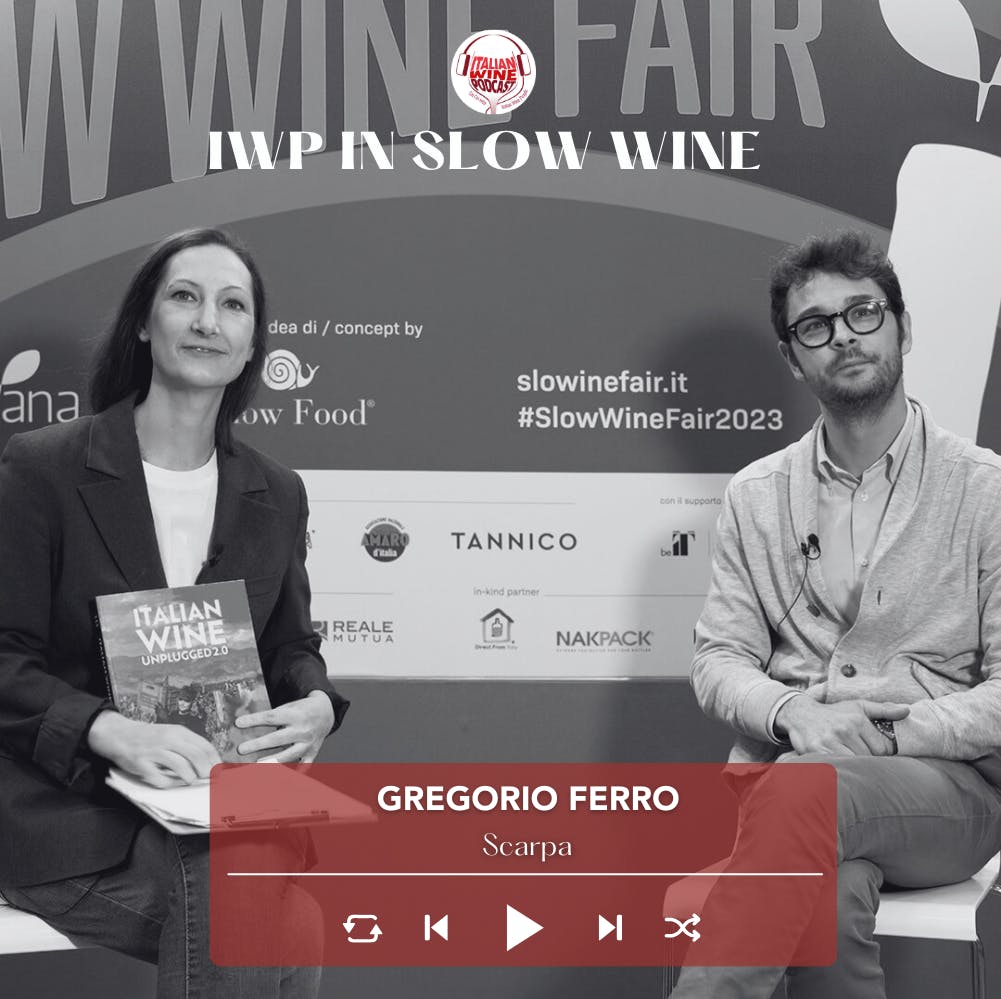
Ep. 1792 Gregorio Ferro Of Scarpa | Slow Wine 2023
Slow Wine 2023
Episode Summary
Content Analysis Key Themes and Main Ideas 1. Scarpa winery's history, location, and traditional winemaking approach. 2. The versatility and aging potential of Barbera, particularly Scarpa's ""La Bogliona"" cru. 3. Comparison of wine culture and knowledge between traditional (Italy) and emerging (Denmark) markets. 4. The importance of Barbera's acidity for food pairing. 5. Insights from the Slow Wine event in Bologna. Summary This Italian Wine Podcast episode, part of a special series from the Slow Wine event in Bologna (March 2023), features an interview with Gregorio Ferro from Scarpa winery. Ferro details Scarpa's identity as a classic, traditional winery based in Nizza Monferrato, whose main production focuses on Barbera. He explains their different Barbera expressions, including a fresh, stainless-steel-aged version and a long-aged ""cru"" called La Bogliona, which undergoes a Barolo-comparable aging process in large, non-toasted oak casks to preserve Barbera's characteristics while allowing it to age for decades. Scarpa also cultivates Nebbiolo and other niche Monferrato varietals. Ferro shares an interesting observation from working with the Danish market: while Italians might take their wine knowledge for granted due to proximity and history, newer markets like Denmark demonstrate a significantly higher level of studied wine culture, often knowing more about wine despite geographical distance from vineyards. He concludes by highlighting Barbera's ideal pairing with fatty foods due to its acidity. Takeaways - Scarpa winery, located in Nizza Monferrato, is a traditional producer known for its Barbera. - Barbera can be produced in diverse styles, from fresh, stainless-steel-aged versions to complex, long-aging ""cru"" wines. - Scarpa's La Bogliona Barbera is aged similarly to Barolo/Barbaresco, demonstrating Barbera's significant aging potential. - Barbera's high acidity makes it an excellent pairing for rich or fatty foods. - Emerging wine markets (e.g., Denmark) often exhibit a more dedicated, studious approach to wine knowledge compared to traditional wine-producing regions. - The segment was recorded during the Slow Wine event in Bologna. Notable Quotes - ""Our main cultivated grape is still Barbara, but also Nebula plays an important role in, our history and in our tradition."
About This Episode
Speaker 1 discusses the Italian wine podcast and encourages attendees to donate money to support the show. They also mention their experience with Italian wines and their approach to the Italian market, emphasizing their expertise in crafting and aging wines. Speaker 2 asks about the differences between the Italian and Venezian markets and Speaker 1 explains that they are different in terms of culture, drink, and food. They also mention their experience with the Italian market and encourage attendees to donate.
Transcript
The Italian wine podcast is the community driven platform for Italian winegeeks around the world. Support the show by donating at italian wine podcast dot com. Donate five or more Euros, and we'll send you a copy of our latest book, my Italian Great Geek journal. Absolutely free. To get your free copy of my Italian GreatGeek journal, click support us at italian wine podcast dot com, or wherever you get your pots. Welcome to this special series dedicated to slow wine held in bologna in March twenty twenty three. During the fair, we conducted several interviews with some very exciting producers. We were able to pull out some of the more interesting elements of Italian wine within the slow wine movement, tune in each week on Italian wine podcast. I'm here with somebody by the name of Gregorio Ferro. Which is iron, not steel. It's it's iron, not steel. I was just saying I was hoping it was steel because Yeah. Then I could say you're like Superman, but that's okay. And you're part of Scarpa winery. So we grabbed you and brought you here because you're actually one of the benchmark producers in the book Italian wine unplugged two point o, which is the second edition. Tell me who you are. Tell me where your winery is located. Kind of tell me a little bit about your winery. So I am Gregorio. I work for Scarpa. It's, almost seven years that I work there. Scarpa is a very classic and traditional winery. We are based in Nitza Mufferato. So our main production is about Barbara. Our main cultivated grape is Barbara. But as an historical winery, we also produce wine from Lange area, Okay. Having vineyards also there. So our most cultivated grape is still Barbara, but also Nebula plays an important role in, our history and in our tradition. Okay. Plus, Escarpa, we still, keep, a lot of other different varietals, adultness from Monferato area, such as, a bracheto that we verify in a dry version. For example, or other, different and niche varietals that we try to keep producing in four or five thousand bottles maximum per vintage. Coming back to America, Van Italy International Academy the ultimate Italian wine qualification will be held in New York City from four to six March twenty twenty four. Have you got what it takes to become the next Italian wine ambassador? Find out at the Italy dot com. And in total, the production is hundred and fifty thousand bottles. How many labels do you have? We have, eleven labels. Can you tell me a little bit about how the Barbera is made. We produce different kind of barbera, the entry level where we try to show how barbera is in our territory. So with a lot of acidity and freshness, is a barbera that just does a stainless steel aging Okay. To preserve all those characteristics How long? For one year in stainless steel. And then, of course, we also think that is important on the aging in the bottle. So usually we try to keep the wine at least six months in the bottle before releasing the new vintage. Then we have two other barberas that are in, French way. We call them the crew. They were modified separately. From the seventies on. So first vintage of La Buona, which is our most well known barbera, came in, the seventy four. And from seventy four up to today, we always identified that vineyard separately. So Bolona is not just the name of the wine, but first was the name of the vineyard. And in this, expression of Barbera, we do an aging that is comparable to a Barolo aging because we do treaters of aging and big cask. Always, cask, made from Allier wood, that is not not toasted, but just steamed. This is to preserve, again, the characteristic of Barbera. And, this is a a wine that can last for decades. And it is really important for us since we always also produce Barolo and Barbarasco, which are wines that can age very, very well for a long time. To have also a barbera that can demonstrate that also with that grape, we can achieve some really, really interesting results. Okay. Okay. Now I'm gonna ask you a question about because you were telling me a few moments ago about how You deal with people in Denmark. Can you tell me the difference to go and taste and eat and have a conversation in Denmark compared to in, let's say, Venezia or what's it like? I always and mainly work with the Italian market, but since when I also started working with Denmark, I found out some differences and some similarities. Of course, in Italy, we have a lot of history and a lot of, very history historical restaurants and restaurants. In Denmark, it's, almost, let's say, a new market, but I was, really, really satisfied with the level of culture and wines that they have because, sometimes, I feel like in Italy, we have a long history, and everyone of us as, at least a parent that was making wine. And so just because we know a lot of people who made wine, we just think that we already know So we study a little bit less. The funny thing about other markets and, for me, new markets, is that the nearest vine might be a thousand kilometers from them, but they know better than us because they have a different approach. They study a lot, and this is something really, really interesting. So when you go, like, what kind of food do they give you? Oh, usually, we always try to have, pairings that are good for Barbara. Okay. So I would say that everything that contains some fat is perfect with Barbara because, the acidity of this grape is like cleaning your mouth and preparing to continue to eat. So you start this circle where you eat and drink, eat and drink. We are talking here today with Gregorio Ferro. Iron. Iron? Winery. Thank you. Listen to the Italian wine podcast wherever you get your podcasts. We're on SoundCloud Apple Podcasts qualify, EmailIFM, and more. Don't forget to subscribe and rate the show. If you enjoy listening, please consider donating through Italianline podcast dot com. Any amount helps cover equipment, production, and publication costs. Until next time, Chitching.
Episode Details
Keywords
Related Episodes

Ep. 2787 Prosecco Superiore by Dr Susan H. Gordon | Book Club with Richard Hough
Episode 2787

Ep. 2784 The Other Side of Valpolicella: Volcanic Soils & Sparkling Wines with Francesca Marcato of Talestri Winery | Wine, Food & Travel with Marc Millon
Episode 2784

Ep. 2780 The Bridge between the Past and the Future of Wine with Serena Costanzo from Palmento Costanzo on Etna | Clubhouse Ambassadors' Corner
Episode 2780

Ep. 2773 Trento DOC: one of Italy’s finest sparkling wines with Alessandra Caroni of Maso Martis | Wine, Food & Travel with Marc Millon
Episode 2773

Ep. 2749 The Many Faces of Etna: Climate, Contrade and the Art of Volcano Winemaking with Federico Graziani | Wine, Food & Travel with Marc Millon
Episode 2749

Ep. 2744 Ep 25: Pantelleria, Salina e il fascino del vino insulare | Pellegrinaggio Enoico con Attilio Scienza
Episode 2744