
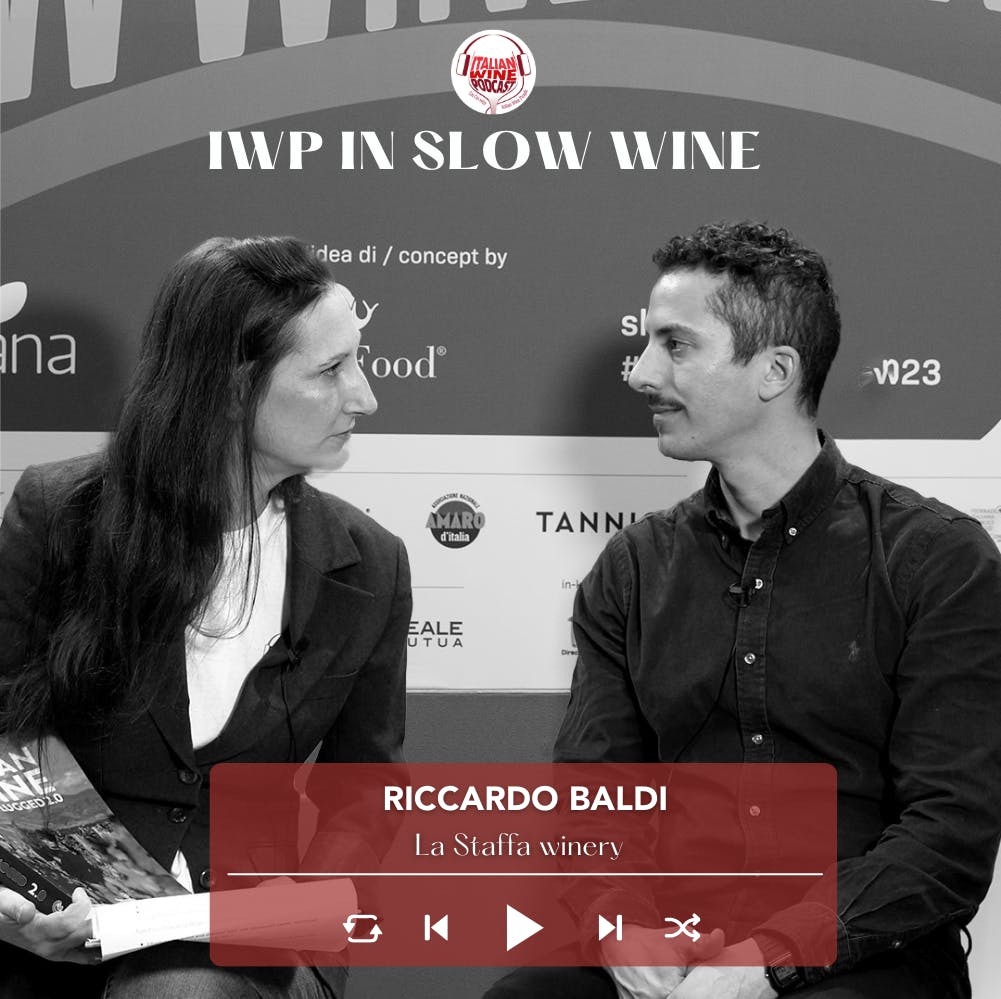
Ep. 1825 Riccardo Baldi of La Staffa winery | Slow Wine 2023
Slow Wine 2023
Episode Summary
Content Analysis Key Themes and Main Ideas 1. The distinct differences between Verdicchio dei Castelli di Jesi and Verdicchio di Matelica. 2. The unique terroir and characteristics of Verdicchio from the Staffolo area. 3. The philosophy and practices of LaSTafah winery, emphasizing organic farming and traditional methods. 4. Ricardo Baldi's journey as a small, artisanal winemaker. 5. The importance of vineyard age for producing high-quality Verdicchio. Summary This episode of the Italian Wine Podcast features an interview with Ricardo Baldi of LaSTafah winery, highlighting the nuances of Verdicchio wine. Baldi thoroughly explains the key differences between Verdicchio dei Castelli di Jesi and Verdicchio di Matelica, detailing distinctions in climate, soil composition, and the resulting wine styles. He introduces his artisanal winery, LaSTafah, located in Staffolo, where calcium carbonate-rich soils contribute to the ""fresh, citric, and salty"" character of their Verdicchio wines. Baldi shares his passion-driven journey into winemaking, starting in 2010, and underscores his commitment to organic practices and preserving traditional winemaking methods. He also discusses the winery's production volume, the significance of their older vineyards (some dating back to the 1970s), and their substantial export market, particularly to the USA. Takeaways - Verdicchio dei Castelli di Jesi and Verdicchio di Matelica differ significantly in climate (seaside vs. continental), soil composition (powerful vs. poor/rocky), and resulting wine styles (fuller body vs. skinnier/fresh). - The Staffolo area boasts clay-limestone soils rich in calcium carbonate, imparting freshness, citrus notes, and distinct saltiness to its Verdicchio wines. - LaSTafah is a small, artisanal winery producing 45,000-55,000 bottles annually from 12 hectares of Verdicchio. - Ricardo Baldi is committed to organic farming practices from the outset, believing it's crucial for the environment and wine quality. - Older vineyards (30-50 years old) are considered vital for producing high-level quality Verdicchio wines. - LaSTafah exports over half of its production, with a significant portion going to the U.S. market. - Verdicchio is presented as a wine deeply expressive of its specific terroir. Notable Quotes - ""I think there are three important different between ESE and Matelli."
About This Episode
The transcript discusses the Italian wine podcast and its success as a community-driven platform for Italian winegeeks around the world. Speakers discuss the differences between Vedicchio and Matelli, and the importance of choosing the right winery for the right quality. They also mention their production and exporting methods, and encourage viewers to donate through Italian wine podcast dot com.
Transcript
The Italian wine podcast is the community driven platform for Italian winegeeks around the world. Support the show by donating at italian wine podcast dot com. Donate five or more Euros, and we'll send you a copy of our latest book, my Italian Great Geek journal. Absolutely free. To get your free copy of my Italian GreatGeek journal, click support us at italian wine podcast dot com, or wherever you get your pots. Welcome to this special series dedicated to slow wine held in bologna in March twenty twenty three. During the fair, we conducted several interviews with some very exciting producers. We were able to pull out some of the more interesting elements of Italian wine within the slow wine movement, tune in each week on Italian wine podcast. And we are here with Ricardo Baldi. Of the LaSTafah winery. We have brought you here to talk about your wines, but we also have, this new book Italian wine unplugged. You are one of the benchmark producers mentioned in the book because you produce Vedicchio. Yeah. Ramicchio in the area of Castale Diaz. Exactly. I wanna ask you, you know, who you are and about your winery, but can you first tell me the difference between the Vedicchio Castale Diaz and the Matelli Normally, I think there are three important different between ESE and Matelli. The first one is the clima. Matellika is inside two chain of mountain. It's a completely continental clima. And the area of Casa de Yesi is very close to the seaside. Even if we are in a Hillier area, but we see we feel the influence of the sea. Where in Italy is your Central part of Italy. So in La Marque area opposite side from Tuscany. Okay. Second, the soil. In the end of Matelica, we have a little bit more poor soil because it's a valley inside the two chain of mountain. So we have more rocky during the century, all the way there put down to the valley, the rocks from the top of the mountains. In the air of Castelli Diaz, we have more powerful soil. So normally, the arbica from Yes, they are a little bit more full body and the arbica from Matelica are a little bit more skin and, fresh. The last one is that the area of Castelli Diaz is very spread out. It's very big. But the area of Matellica is very little. So normally, it's very difficult to, compare the d c and Matellica because in ESE is important to choose the correct one to pair with Matilica one. Because in the area of Matilica, we have more linear style in the denomination. In the area of ESE, we have plenty of different style, not only for the winemaker, but for the microclimate in the same composition. Your winery. Give me a bit of a an idea. My winery is a a little artisanal winery. I started to make wine when I was twenty in two thousand ten, so twelve, thirteen years ago. My father, made wine like his hobby in the past. And I fell in love with the idea to make my own wine when I finished the high school. So I start with a very few knowledge with only a lot of passion, about the way I'm making. For sure, I start in one of the most important place of the nomination. Staff Follow is a a little place with only two thousand people that live in stafffollow, but with twenty company that makes Verdic. So it's like burgundy. The most important characteristic of the soil in the staff follow. Is to have a lot of calcium carbonate in the clay limestone soil. So the wine stuff flow are really fresh, but really citric and with a lot of saltiness because of this, particular cell composition. I start, in two thousand ten with only a couple of vector of, vineyard. Then I, every year, in please a little bit, the production. Now I have a twelve vector of a Digital grape. We have, Vineyard between nineteen seventy two and two thousand ten. So a lot of Vineer from the seventies, the eighties, and the beginning of the nineties. And in my opinion, this is very important to make very high level quality wine because, you know, thirty, forty years old, fifty years old, Vineer makes wine like her. No other one. How much do you produce a year? How many bottles? Normally, between forty five and fifty five thousand bottle a year. It depends a lot about the, yeah, in twelve factories, a very still. It's pretty good. Yeah. Yeah. And and do you are you exporting yet or not yet or how? Yeah. We sell fifty, fifty five percent of our wine outside from Italy. A third of the entire production go to the US a third in, Italy and a third in La Marque region, in my region. So food and so wine, they talk a lot about, Guisto, politito Monopulita juice. That one. How does that go with your winery? Yeah. We work since the beginning in organic. And the beginning was the first step I moved when I started the company because in my opinion, it's very important for the environment. And for myself, because at the beginning, it was alone to work in the cell. Then after a few years, I understand that the way we work in the Vineyard, change a lot of the quality of the wine increased a lot, the quality of the wine. In my opinion, the border of political juicer is important for the environment and the important in my opinion, also for the tradition. So we made we are making a very traditional way in the way to make a wine that below a lot to the terroir and to the tradition of the area. So under BQ in my in my opinion, that tastes a lot like the terroir where it is. It's being made. Yeah. Absolutely. Thank you so much. You are very welcome. I really love to talk to you. Ricardo, everybody. Lastafa. Thank you. Listen to the Italian wine podcast wherever you get your podcasts. We're on SoundCloud, Apple podcasts, autify, email ifm, and more. Don't forget to subscribe and rate the show. If you enjoy listening, please consider donating through Italian wine podcast dot com. Any amount helps cover equipment, production, and publication costs. Until next time, Cheaching.
Episode Details
Keywords
Related Episodes

Ep. 2787 Prosecco Superiore by Dr Susan H. Gordon | Book Club with Richard Hough
Episode 2787

Ep. 2784 The Other Side of Valpolicella: Volcanic Soils & Sparkling Wines with Francesca Marcato of Talestri Winery | Wine, Food & Travel with Marc Millon
Episode 2784

Ep. 2780 The Bridge between the Past and the Future of Wine with Serena Costanzo from Palmento Costanzo on Etna | Clubhouse Ambassadors' Corner
Episode 2780

Ep. 2773 Trento DOC: one of Italy’s finest sparkling wines with Alessandra Caroni of Maso Martis | Wine, Food & Travel with Marc Millon
Episode 2773

Ep. 2749 The Many Faces of Etna: Climate, Contrade and the Art of Volcano Winemaking with Federico Graziani | Wine, Food & Travel with Marc Millon
Episode 2749

Ep. 2744 Ep 25: Pantelleria, Salina e il fascino del vino insulare | Pellegrinaggio Enoico con Attilio Scienza
Episode 2744