

Ep. 2156 Jessica Dupuy interviews Vincent Morrow | TexSom 2024
TexSom 2024
Episode Summary
Content Analysis Key Themes and Main Ideas 1. Vincent Morrow's Journey into Wine: His unconventional path, influenced by family and a focus on wine business systems rather than traditional sommelier routes. 2. Napa vs. Sonoma Dynamics: A detailed comparison of the geographical, climatic, cultural, and economic differences between these two prominent California wine regions. 3. The Evolution and Challenges of Napa Valley: Discussing Napa's success, its limited capacity for growth, rising land costs, and the resulting economic pressures and homogeneity. 4. Press Restaurant's Curatorial Approach: How Vincent Morrow's role at Press champions Napa Valley wines while also embracing diversity, supporting local winemakers who produce wines from grapes sourced outside Napa. 5. Climate Change Adaptations in Napa Viticulture: The observed shifts in farming practices (e.g., cover crops, canopy management) to mitigate the effects of increasing temperatures and limited water resources. 6. Redefining ""Classic"" Napa Wines: The evolving perception of what constitutes a classic Napa wine, moving beyond traditional Cabernet Sauvignon and Chardonnay to include other varieties like Chenin Blanc and Cabernet Franc. 7. The Rise of Cabernet Franc in Napa: Its growing popularity, economic value, and potential as a key grape for both blending and stand-alone varietal production. 8. Lessons for Other Wine Regions: Drawing parallels and distinctions between Napa's development and regions like Bordeaux and Bolgheri, suggesting insights for adaptation and identity. Summary This segment features an insightful interview with Vincent Morrow, the Wine Director at Press Restaurant in Napa Valley. Morrow shares his unique entry into the wine world, from his mother's enthusiasm to his formal studies in wine business at Sonoma State. He provides a clear contrast between Napa Valley and Sonoma County, emphasizing Napa's distinctive encapsulated geography and Sonoma's broader microclimates. The discussion delves into Napa's current challenges, including its ""victim of its own success"" status, with limited planting land and soaring prices, which have led to a focus on Cabernet and Chardonnay. Morrow explains how Press Restaurant navigates this landscape by championing Napa wines while also supporting local winemakers who, due to economic realities, might be crafting wines from grapes sourced outside the valley (e.g., Grenache, Mourvèdre, Cabernet Franc). A significant portion of the conversation focuses on the impact of climate change on Napa viticulture, highlighting adaptations like the increased use of cover crops and canopy management to combat extreme heat. Morrow also explores the evolving concept of ""classic"" Napa wines, noting the rising interest and economic value of varieties like Cabernet Franc. He concludes by reflecting on what Napa's journey, from mimicking Bordeaux to establishing its own identity, might offer as lessons for other wine regions internationally, particularly Bolgheri in Italy. Takeaways - Vincent Morrow's career path in wine began in business and winery roles, not typically F&B, providing a unique perspective. - Napa Valley and Sonoma County are distinctly different, with Napa being a smaller, more enclosed valley focused on premium, often higher-priced wines, while Sonoma is broader and more diverse. - Napa's success has led to high land costs and full planting capacity, driving up wine prices and narrowing varietal focus. - Press Restaurant's wine list embraces the broader Napa Valley ""story"" by featuring wines from local winemakers, even if the grapes are from outside Napa, showcasing diversity and supporting the community. - Climate change is a significant factor in Napa, driving viticultural adaptations such as widespread adoption of cover crops and allowing more vine sprawl to protect grapes from heat. - The definition of ""classic"" Napa wines is evolving; there's growing interest in and production of varieties like Chenin Blanc and Cabernet Franc. - Cabernet Franc's economic value in Napa has surged, even surpassing Cabernet Sauvignon in tonnage price in 2022, indicating a shift in planting and blending trends. - Napa's journey from emulating Bordeaux to forging its own viticultural identity offers valuable lessons for other wine regions, such as Bolgheri, which also work with Bordeaux varieties. Notable Quotes - ""Napa is a victim of its own success particularly with cabernet sauvignon and Chardonnay, and investments and land cost and everything..."
About This Episode
Speaker 1, the wine director at Press Restaurant in Napa Valley, talks about her journey to become a master sommelier and her love for Napa Valley. They discuss the importance of learning new things and working in a different area, as well as the differences between the two regions where the wine industry is located. They also discuss the success of Napa Valley and its diverse population, the importance of diversity in the community, and the potential for exploring new varieties of Napa Valley fruit and wines. They also touch on the success of their own wine club and the importance of protecting against heat and lack of water in vines. They express their desire to be friends with them and hope to learn more about the industry and their experiences.
Transcript
There's way more people asking, like, oh, like, Catfrock. What do you think? Like, we just had one. We loved it. We wanna try something. It was that was not a conversation that I recall really having ever ten years ago Amazing. Twelve years ago. Okay. So I think it's it's in combination. Okay. And maybe because Moore is being planted to blends, that there's also more varietal production of it, and then more guests are asking. Tell y'all, I'm Jessica Quui, guest host for a special Texom series covering the twenty twenty four Texom wine Conference from Dallas, Texas. Join me in the heart of the Lone Star State as we delve into the experiences and insights of key speakers and attendees. Exploring career paths, challenges, and the latest trends in the wine industry. If you enjoy the show, please subscribe and rate our show wherever you get your podcasts. Alright. Well, welcome to the Italian wine podcast Vincent. I am so happy to have you here mainly because I've never had a chance to meet you. So we're looking to get to know each other live. If that's okay with you. Yeah. That's great. Sounds good. Well, maybe you could just kinda start out just tell us your name, where you work, and a little bit about, you know, how you got into wine. Sure. Yeah. So as you know, my name is Vincent Morrow. I am the wine director at Press Restaurant in Napa Valley, in a town called Saint Alina. So about twenty five minutes north of the town of Napa proper. I got into wine through my mom. Oh. I moved out to California. It's been almost twenty years now. Where are you from originally? From Peoria, which is just outside of Phoenix, Arizona. You're from Arizona? Yes. Okay. It's one hundred and one degrees today. It's It's nothing. It's like, the humidity isn't great, but Right. So I played soccer growing up, and one of my youth coaches, had left our team to go be an assistant at Sonoma State University. Which, unbeknownst to me, and at the time, is right in the heart of Line Country, in Northern California. You drive maybe ten minutes either direction. And, I mean, you're in the petaluma gap. You're in Russian over Valley. Technically or in, Sonoma Coast. I think it qualifies for a lot of things. So my mom would come and visit, and then she started going wine tasting. Oh. What are you doing? My mom's the biggest fan. And, you know, I would drive her started driving her around to wine tastings, and, we just spend days together. And so slowly, but surely, it it kinda, it kinda crept into my life. And, I was studying business and decided to declare that as a concentration within the business within the business platform. Oh, so oh, okay. So Sonoma State, so they have that option to what was so the wine business, wine marketing, or how what was kind of the Yeah. It's called wine business systems, and it, truly is like directed at being in the business aligned. So, it was just kind of really starting to gain momentum and grow legs as I was finishing the program. Yeah. So you look back fifteen years now, and it's, it's grown so much, especially the the MBA program there for, for wine. But, yeah, it was, learning more about operations and logistics and sales and marketing and those sorts of things. But I also didn't turn twenty one until my last semester. So for the handful of classes that included wine tasting, it is legal. Like, I was not allowed to taste. Professors weren't sure Yeah. At the time. Yeah. And, I I have to imagine this different now, but, you know, I didn't get the taste, as I was learning in many classes. But, yeah, I asked myself what do people in the wine industry do, and my mom helped me get my first sort of internship and my first job. Okay. She met a winemaker's wife as the story goes at, at the Alexander Valley general store Okay. Jam Town store, which no longer exists, but it's like hundred year old sort of, like, provision store that you could get sandwiches and chips and drinks and a bottle of wine. So like a week later, I was hand bottling three barrels of Sarah with John Hart, from Hart's desire. And, a few months later, they opened a tasting room during barrel tasting. I think this is, like, March of o nine. Mhmm. And they, like, called me the day before. And, like, we think we're getting our permit tomorrow, and we have barrel tasting. So we need help. And they got the permit to open their tasting room, and day one is barrel tasting, which is, like, three or four thousand people on two separate weekends, two times, and March each spring in Sonoma. So it's, there's a lot of people, and it was a lot of repetition and great practice. That set me on the journey, not immediately in that moment, but on the journey to the MS exam. This is fascinating. So so many people I talk to that that are master sommeliers as yourself, they end up in wine because they started in restaurants oftentimes to help them get through college or whatever. To studying music, care literature. Yeah. Exactly. Whatever. Yeah. Whatever it is, we all eventually get here. But it's interesting because you literally started in the wineries, if you will, on the other side, also with an understanding of the business because of your education. And I also think it's interesting that, like, All of that was happening in Sonoma. You're working in Napa. You kind of have a real understanding of that area. I mean, probably more than most people. You know? I'll say sure. I'll get you nice to that. I think the answer is yes. Living and working in it is is just so different. It's almost like if you wanna learn Spanish Yeah. And you're doing it in a course versus go live in Mexico for six months and figure it out. Yeah. It's or just exist in it, not necessarily figured out, but exist in it organically. I think there's a lot to be said for that. And, you know, I've lived and worked in Napa since twenty eleven. I worked moved to work harvest in twenty eleven. There was a period of time where, I had moved to San Francisco to really to focus on the exam and work in bigger wine programs, and it wasn't until coming back to Nava in twenty twenty and, like, being just fully in, engrossed in all things Napa at press, that, yeah, I felt comfortable working with Napa Valley wine and California wine in general. I'd just been surrounded by it. I'd been working in different programs. You know, French Sandry had a large Napa focus Gary Danko had a large napa focus, Benu, small but mighty wine list, but we did have, a very, like, thoughtful intentional section of napa valley wine. I felt I was, like, I I feel pretty comfortable with napa. I know napa. I lived there and But then I get depressed, and it's just every single line is tied to Napa in some way with very few exceptions now. Yeah. You know, I'm happy to point those out. They have some Well, yeah. I actually wanna talk about first first, give me a contrast for people who've not I mean, this is a lot of the listeners are from the US, but a lot of them are in Italy. So if you've never been to Sonoma Napa, can you give me just, like, a quick, like, here's the difference between the two. They're so close together and oftentimes just like Dallas Fort Worth, right? They get smashed together, but they're actually two very different places. Can you kind of maybe give a quick contrast? Or Totally. So elevator pitches Sonoma has direct Pacific Ocean influence. Napa has semi Pacific Ocean influence in that Napa is encapsulated by, you know, two mountain ranges that make it this thirty mile long, roughly. And at its widest point, five mile valley, that make it this just unique place, whereas Sonoma County in contrast is much larger. It's a massively larger county than Napa and has so many different pockets and micro climates and areas that, can grow a variety of different things. Anywhere from Chardonay or even Karacante now to cabernet sauvignon and Piner de Maire and Zinfandel, Sonoma County, there's just a much, broader diversity. Yeah. In layman's terms, physically, if you have not been here, Sonoma County, it borders the coast of the ocean. Yeah. Napa does not, and it sits on the other side of a mountain range. It's about forty miles inland at its nearest point Right. From the ocean. And then you have a mountain that is a mountain range that is walking with that influence. Yeah. That okay. So that's perfect. So you definitely that geographic kind of like and we talk about that with Napa, right? Like, so mountain fruit, valley fruit, and Sonoma is more costly. Plus, I think the culture is a little bit different. Right? I think that's a fun thing to kinda poke at or to point out. I think they've just evolved very much in two different ways where if you go back fifty or sixty years, they were probably much more similar. Napa still is, but it, at one point, was very just agrarian and spread out and kinda down to earth and homey, and not to say that it isn't anymore, but because Napa is a victim of its own success Yeah. Particularly with cabernet sauvignon and Chardonnay, and investments and land cost and everything that Certainly, those challenge, not challenges, but that has existed in Sonoma, just not to the same degree that it has happened in the Napa Valley. And there's really nowhere else to plant in Napa. We are planted out. We are at capacity. So when supply is at capacity not going up and demand continues to rise? Well, then what's gonna happen, your prices are gonna go up. Right. So Basic economics. Exactly. So the type of investment and money that is now coming into Napa is generally a lot of money, and it's generally geared at a very sort of narrow window Yeah. Of what will be produced. I say all of that because I think it does have an impact on culture, at least what people think of the culture, but living and working in Napa. It's one of my favorite things because, my fiancee and I, we have our friend group, our community, our family is is so strong. And, you know, they talk about the separation of six. It's like in Napa. It's one. Like, there was one person separating you from someone that you don't know, whether you like it or not. Right. It's also, you know, a double edged sword. You've gotta it you'd just be mindful. Someone could walk in with a farmer's hat and sandals and overalls and it could be one of the greatest growers on the planet who's seen more ten times over that longer than you've lived and you just there's a lot of humility in it because you never know who you're addressing. Well, that's interesting because leads me to wanna talk about press a little bit. So if you've been to Napa and, you know, you think about where should I eat, where should I die? And I mean, press is kind of at the very, very top of the list. I mean, I was I was actually just talking to Francis Percival recently, with the world of fine wine, press ends up at the top of the list every time for being one of the best rest wine list restaurants. It's just in quantity and depth. Yeah. So it's specific to Napa and California or just Napa? Okay. So everything is through the lens of Napa. You know, when I started or took over the role, we had a the first person I asked was Samantha Red who is the Red Family owns the restaurant, Red winery. Her father Lesley started the restaurant in two thousand and five with this vision of, you know, really the ethos, everything in the restaurant living and breathing napa valve. It was a steakhouse then. Now it's more kind of intentional farmed a table. It sounds cliche, but we work directly with three farms, one of which we own. So all of our produce comes through that, but you really had this vision of championing Napa Valley. But as Napa gets more homogeneous and more expensive. The conversation when I took the role was actually my first phone call was Kelly White after that. Amazing. Okay. Kelly and I are former coworkers at Guildsom and and friends. And I said, Kelly, like, had you stayed on another five years? Pandemic doesn't happen. What do you think happens to the list of press? And, you know, we have the conversation of, you know, we're not sure if it would have stayed exclusively now, but it may have had to expand a little bit. We never made a final decision on that. But the reality is, again, Nava is increasingly planting cabernet or replanting to cabernet, and it's only getting more expensive. So how do you have a list like that is increasingly inaccessible in that regard. So one thing I noticed on the list, and I've really leaned into was, well, what about the people of Napa Valley that are producing wine from elsewhere? But their day jobs are head of X winery, head of Y winery, they can't even afford to make their own Napa Valley Cabernet, and maybe don't want to either. They're exploring Grenash or Sarah from the foothills. They're exploring Mavedra from Contra County and Carignon, and really supporting their integral to the Napa Valley community, but those grapes aren't from here. Yeah. That just feels a little like Yeah. God, why don't why don't we just sink the ship instead of letting it die a slow death? So Right. It wasn't a change. It was just like leaning a bit more into that. Running the perspective. Totally. Yeah. You know, to me, it's celebrating more diversity in in Napa people too. You can't say you support the people if, Well, then let's be honest, like, it doesn't make economic sense to explore with different varieties in Napa because CAB and Chard are the way. Right? But what about a wine list that only has CAB and Chard? Right? It's very boring. Yeah. I mean, like, it's something exciting to explore, but how cool to be able to say, we've got Merrved, we've got Karacante, we've got, you know, some other things because people are able to explore just outside of the valley. You know? And I I I I love that you're able to do that. And the kind of the flip side of that is wineries outside of the valley that produce Napa Valley fruit or produce wine from Napa Valley fruit like Dumal comes to mind. Mhmm. Dumal has been they've been a chardonnay, you know, monster for decades. I love the wines and everything Andy is doing, but he also makes tench vineyard cabernet, makes, so tench. They make a, ballard ballard vineyard, off of spring mountain, and I feel like there's a Coomsville one I'm missing. And then they just do a napa valley camera Okay. Which is great. And Andy was the winemaker at Larchmeade for a decade Yeah. With Dan Petrovsky. So You know, to me, like, just because now he's at Du Mall and just because now those chardonnays and pinos come from Russian River or Sonoma coast, like, well, they're delicious. We're gonna buy them anyway. And, you know, it's part of the napa story. Guess don't seem to be upset about it. Yeah. Yeah. Yeah. And then the last piece you said, the Napa story, there are producers or winemakers or vineyard managers, etcetera, that have long since left Napa, but once upon a time, we're an integral part of the community. I think of Nick and Andy Pay. Mhmm. And, Nick's wife Vanessa, having been at, between Peter Michael and Transberg, between the bunch of them. I'm like, yeah, that's that's delicious. That's good enough for me, and they're very gracious with access to their library and gives us a chance to, again, provide just more diversity on the list. And, yeah, so it's Napa, but with that asterisk key, if you will. I like that. So let's kind of bring it back to Texoms. So you are the speakers. Some of these are panels and everything like that, but you're talking about the classics of Napa Valley. Perhaps you can kind of lay that out since, you know, TechSoms come and gone by the time this airs. So, like, kind of tell me a little bit about how you approach that. What are the classics of Napa? What makes it classic? To me, it's a it's a Pandora's box because the context of that is that, you know, Napa only has about a hundred and seventy year history of growing and mind making It's a good reminder. Yes. Which is, you know, you look at a place like Oregon or Bordeaux. Yeah. Or basically anywhere in Europe in the history, it's like, that's a fraction of it. And we exist in a place for better or worse, I think, mostly for the better, that does not dictate what you can plant, where you can plant, for the most part, Napa, in in degrees and slopes, but it doesn't say what grapes you can plant, how they need to be made, You know, there's sort of general sandbox of rules as far as alcohol and additions and all of that, but it's not saying it needs to be seventy percent gernache minimum and the rest must be Sarajima Vendra. So when I think of, classic wines, in the sense that I was sort of raised on as a baby song, was studying all the great typical, but great producers, within their regions, And in looking at that at Napa, it's like, well, what does that even mean? Is that even relevant, especially talking about today with, windchills being down with a new generation of wine consumers that are open to many things and also maybe don't wanna spend two hundred dollars on a bottle when they can spend, you know, they can get a case for that much Right. Of tasty, delicious wine to share with friends. So to me approaching it, the best way I knew how was to approach it the same way I would if you came in to press, and said I want something that really is is special is typical, but may not necessarily be replicated by a lot of people in the valley, specifically for the reasons or primary reason of economics. Right. To me is showing what's possible. Yeah. Both what has may at one time have been considered classic that because it's such small acreage or very little producers, could we call it classic now? And I don't know. That's more of a question than an answer, but could also provide a glimpse into the future of Napo. Right. In terms of the grapes viability, but economics will be the tell all. So an example of that are grapes like Gernache and Shenobranch, both of which we, will taste tomorrow. Shhenneblanc at one point was, you know, from One of most. Right? Charles Creek used to produce over a hundred thousand cases of Shenneblanc annually Yeah. During the seventies and eighties. But now there's you can count the vineyards on one hand that have it planted. And on two hands, the amount of producers. It's a very viable grape for Napa from a a structure like acidity and sugar accumulation, crop load, but our consumer is gonna buy that. And I think to a certain extent, they will. If it's a hundred cases in a wine club or a thousand case production, you can probably sell all of that. But can that be your main I don't know. Something like ganache that is very heat tolerant, especially as we talk about access to water, and we look at just the natural increase in average temperatures. Temperature. Mhmm. I moved to California in two thousand and five. That winter, o five, and o six is one of the wettest things I've ever seen in my life. I was like, where the hell did I move? Is this Seattle? Yeah. And I look at that, you know, and for the next six or seven years, it just seemed normal that you, you have rain in the winter, and it's fairly consistent. But I look at the past five, six years. Yeah. We've been fortunate this past winter and the one prior to that, but you look at basically, like, twenty seventeen through twenty twenty was, it's just brutal during the growing season. It's only getting hotter. And you wonder, like, what is the future of all of this? I definitely wonder that. Yeah. Yeah. When I think about classics, it's like, Are we talking about wines that are might be dead, you know, literally and figuratively, or are we are we talking about, reference points to the past? I think it's maybe a little bit easier to nail down in other genres or industries, but for wine. I think people have many different definitions, and I wanna explore all of those. Yes. Yeah. And I don't know how much it will answer tomorrow, but I hope that it will maybe just inspire some thought. And if nothing else, get the taste, some cool stuff that just doesn't, make it out there. Make it out there, which is, you know, a great thing about TexOM is, you know, if we can find and discover something James Tigwell is gonna let us do it. Yeah. Yeah. When he reached out, my response with, I'd love to. What are you looking for though? Here's kind of what I'm thinking, and I just threw out, like, eight to ten wines in different categories. Like, that sounds great. Do you want to do it on your own? I'm like, sure. Okay. Then why not? So there's certainly, many, many other folks that could easily do this as well in tandem or, you know, instead of me. But, yeah, I I figured what do I have to bring to the table that's unique with regards to classic? And like, well, why don't I just let's show a little bit of what might be the experience if you came into press, and we talked about a wine off the list. Yeah. Absolutely. I think you're kind of the perfect choice. So, I mean, makes me wonder, you know, kind of like shifting the conversation over to Italy, you know, especially with the topic of Cabernet and the topic of climate change. And let's just broaden that maybe to Bordeaux varieties in general. You know, I think for a long time, Buldhury has kind of had this feel of, you know, emulating a lot of what's happening in Bordeaux. And I wonder if you think that perhaps there's something to learn from Napa Valley in terms of moving forward into the future? Like, are there ways that you're seeing things in Napa? Be more progressive, if you will. And by that, I just mean kind of moving away from the heavy parker style, like, okey okey okey okey opulence. Mhmm. And I know I'm, like, you know, shoving words into your mouth by saying that, but I'm just curious from your perspective, what you're seeing, and and what can be learned from that? Yeah. Well, I think for, I mean, for decades, you know, generations that speaking of classic, Vintners were constantly starting wineries with minimal knowledge Yeah. Minimal knowledge of the industry. And when you do that, what is your reference point? And many people were saying, well, Bordeaux, bordeaux, bordeaux, or cabernet, just like bordeaux, but, you know, one thing we'll touch on tomorrow is that we're actually very different from bordeaux, both in climate and soil, and just just because that's where it does well previously doesn't mean that Not necessarily that it can't do well because it obviously has in Napa, but that it you don't accomplish it in the same way. One example is that we get virtually zero rain between April one and October one. Okay. And there's always gonna, you know, this year we were kind of bled into May with the rain, but, like, it's been hot and dry since then. Yeah. Whereas, bordeaux is generally you don't know what to expect during the growing season. It's also more humid. Mhmm. I bring that up because At a certain point, I think people stopped using it as a reference point. Yeah. Something to learn from, but not this is my north star for how I produce. And you you saw that with wineries like Opus One that planted their put their root orientation a certain way, but then after a few years actually changed it, you see that in the heights of vines as well, how far they are off the grounds because we have different frost pressures and heat summation than Bordeaux and other parts of the world. So I say that in the what is really the length of history and length of time that bulgari or, border varieties in Italy have to have truly been recognized. It's a relatively short amount of time. Sure. And I think it's it's maybe this period that Napa was in, about a generation ago, you know, in the eighties and nineties when we really had a chance to replant the way we wanted to, and ushered in sort of this new generation of, what is the way we do things as opposed to trying to replicate another place? Like, again, taking guidance and advice, but not necessarily living and dying by that. And one thing that we're seeing in Napa now is that moving away from this idea that every vineyard needs to be this perfectly manicured, like Japanese flower garden type of a veneered lake. It's okay to have cover crop. It's actually better to have it. I'm glad you asked this because I'm gonna use this tomorrow, but we were at Domino's a year ago speaking with, Cassidy Harris, who's a former Sommelier. Great friend and has been there for, say, like, twelve or thirteen years now, but works directly with Christian, you know, what they saw after two years ago to the date on Labor Day, we had a ten day span of over a hundred and five degree highest in the valley. Completely, like, cooked, cooked vintage, not to say that everything from twenty twenty two tastes like that, but that was the challenge. And most people can only use ten, fifteen percent of their crop. What they found was their south facing side of the grapes, which typically go into napa nook, could not use most of that. Okay. A lot of direct sun exposure and just way more heat. The north side of it was was more spared, and they could use more of that. But then in the center of the canopy where the clusters were there, their heat summations never got above ninety degrees. So you're actually able to use a lot of that crop. Okay. In certain parts of the vineyard, there was no cover crop. And then in other parts of the vineyard, there was cover crop. Ground temperature, no cover crop, a hundred and eighty degrees. No. Like something insane. Like, you It's like the sun. Walking barefoot just like, you know, if anyone that has pets and dogs, like, you're mindful. But in the area where there was cover crop, just like in the eighties. Amazing. So let's just say all of their entire vineyard has cover crop now Yeah. Throughout the year. Yeah. And that's just one anecdote. The other one I'd say is moving away from manicured vineyards, more producers that I think are gonna go back to what we used to have, and that's more of a scroll. Yeah. Giving yourself the opportunity to have more vegetative protection. Yeah. And cutting that back later in the season if you do do it, potentially throwing a little bit bigger crops so that it's it's almost like, decanting a wine. Once you decant it, you can't undecant it. Once you cut away fruit and cut away canopy, you it Yeah. It will actually kinda grow back, but not in time to protect you from what if we get another ten day spell of one hundred and five. Right. So I think twenty two is a big lesson for the valley. Feels like we've learned a lot of lessons in the past five years in Napa, or I hope. Between fires and heats and dryness and lack of water, and then that heat spill. It's a good point, which, you know, we'll get to start tasting in the next few years. Right? Like seeing how those lessons have kind of taught people. Yeah. So to kind of wrap that up in a nice neat little bow, I don't know that that would be the solution in Bulkury, a place that's probably I would guess. I guess I haven't spent any time in Tuscany, unfortunately, or in Bulkury. But if you're in a more humid place, sprawl is probably not gonna work well for you, or you're gonna have to spray more. You're gonna have to do other things that don't really allow for that. Yeah. So it's how we've adapted and what we actually had right at first and then moved away from it in pursuit of riper richer styles, but I think it's something we now really have to consider. One of the kind of short to midterm solutions until we can figure out the long term solution. Correct. Yeah. And perhaps the answer is more just as as Napa has figured out its the adaptations it has needed to make in Viticulture and in the cellar, that's something that I think Bulgary has at its advantage too, right, instead of more Atlantic Seabreeze, and Coastal it's that Mediterranean and, you know, obviously, the different things that are growing around it and all of that. So, I mean, it's just a topic that's kind of interesting. And I think that, yeah, your depth of knowledge and what's kind of how Napa has evolved, even in the past. Ten years or five years. As you've said, it's it's pretty interesting. It feels like I'm observing more producers moving away from Merlo and using cabernet franc as a blender. Yeah. And you actually see in twenty two that cab franc surpassed carbonate for the first time. And I think that's because it's such a it's such a valuable tool. Tell me more about that. Are they doing any single variety? Or is it is it mainly as a blender? Okay? There's way more there's way more people asking, like, oh, like, Kat Frank, what do you think? Like, we just had one and we loved it. We wanna try something. That was that was not a conversation that I recall really having ever ten years ago Amazing. Twelve years Okay. So I think it's it's in combination. Okay. And maybe because more is being planted to blends, that there's also more varietal production of it and then more guests are asking. So it could be one of those where asking because it's there versus it just wasn't before. So Okay. So that's definitely something to watch. I love that. Okay. Yeah. The the tonnage price for Capfront was a little over ten grand in twenty twenty two, and Catherine Avenue on was just just under nine. Oh my goodness. Yeah. So we'll see. Alright. Well, thanks for the tip. That's something we could look forward to. Yeah. Benson, it has been great to talk to you and get to know you a little bit better for this show. And I actually look forward to being friends with you as we move forward. I feel like I could learn so much from you. We all could. Yeah. Come hang on a press. You never know who's sitting at the bar next to you on any given night. When it's not harvest, it's pretty, I'm never surprised anymore. I love it. I love it. Well, thank you so much for your time and for joining us, and I look forward to many more experiences. Yeah. Mine as well. Listen to the Italian wine podcast wherever you get your podcasts. We're on SoundCloud Apple Podcasts, Spotify, email ifm, and more. Don't forget to subscribe and rate the show. If you enjoy listening, please consider donating through Italianwine podcast dot com. Any amount helps cover equipment, production, and publication costs. Until next time.
Episode Details
Related Episodes

Ep. 2789 ColleMassari: a long-term vision rooted in Montecucco with Giuseppe Di Gioia | On The Road With Stevie Kim
Episode 2789

Ep. 2788 Ep. 14: Austria and Hungary | Study Smart for your WSET Level 3
Episode 2788

Ep. 2785 From Volunteer to Speaker at TEXSOM with Samantha Cole Johnson | TEXSOM 2026
Episode 2785

Ep. 2766 Inside the U.S. Non-Alcoholic Wine Market: What Wineries Need to Know with Jill Sites | Masterclass US Wine Market
Episode 2766
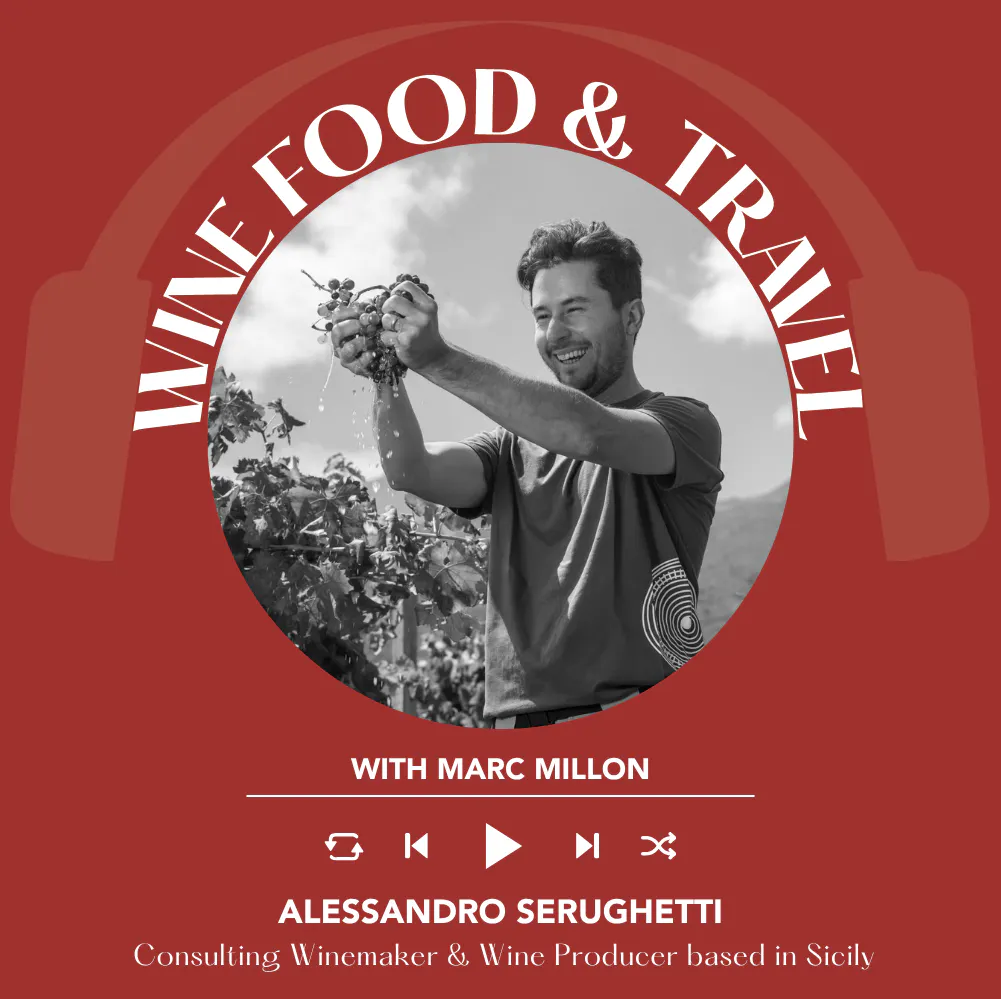
Ep. 2761 Winemaking and Consulting Across Sicily with Alessandro Serughetti | Wine, Food & Travel with Marc Millon
Episode 2761

Ep. 2759 Part 2 – The VIA Educational Program & Italian Wine | Heart-to-Heart Conversation with Sarah Looper
Episode 2759