
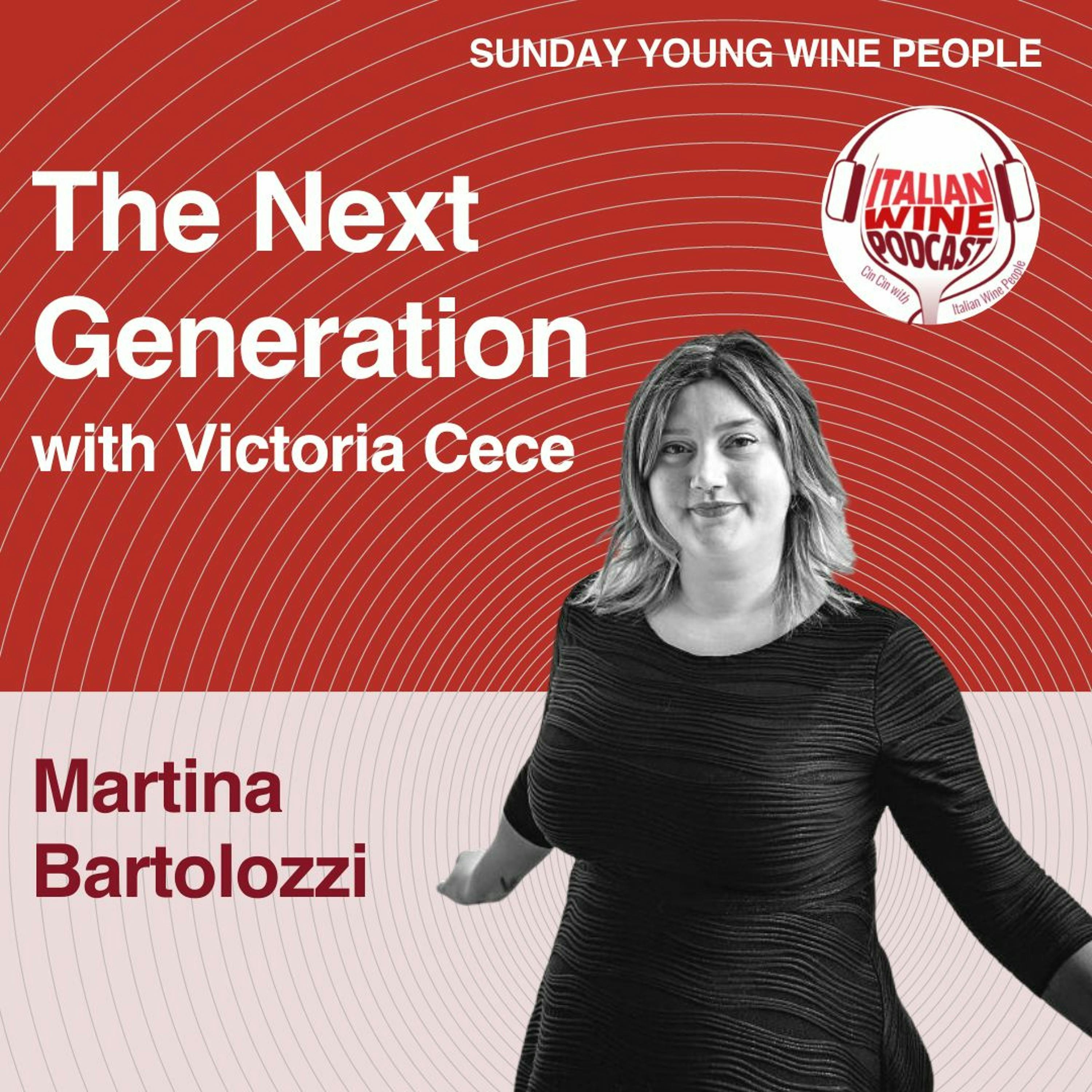
Ep. 1323 Martina Bartolozzi | The Next Generation
The Next Generation
Episode Summary
Content Analysis Key Themes and Main Ideas 1. The importance of authentic, ""behind-the-scenes"" experiences in Italian food and wine tourism. 2. The role of education and deep knowledge (e.g., ""Italian Wine Unplugged 2.0"") in understanding Italian wine. 3. The contributions of young Italian professionals in shaping the future of the country's culinary and wine scene. 4. Highlighting often-overlooked regional grapes (e.g., Vernaccia di San Gimignano) and local traditions (e.g., homemade wine festivals). 5. Florence's unique cultural nuances, from fashion and social norms to diverse neighborhood vibes. Summary This episode of ""The Next Generation"" podcast features host Victoria Chacha interviewing Martina Bartolotti, a culinary tour guide from Florence. The discussion begins with a promotion of the ""Italian Wine Unplugged 2.0"" book and an in-depth look at Vernaccia di San Gimignano, a key Tuscan white grape. Martina then shares her personal journey, growing up in a family deeply rooted in the food industry, including her stepfather, the renowned butcher Dario Cecchini. She recounts her experience learning butchering to gain a profound appreciation for raw ingredients, which now informs her passion for leading food and wine tours. Martina emphasizes taking travelers to unconventional, off-the-beaten-path locations to uncover the production processes behind Italian food and drink. A highlight is her upcoming tour to a remote Tuscan village for a unique ""homemade wine festival,"" designed to preserve local winemaking traditions and community life. The episode concludes with Martina’s recommendations for her favorite Florentine wine bars, a classic food and wine pairing (Sangiovese with Florentine steak), and insights into Florence's distinct social scenes and fashion dictates. Takeaways * ""Italian Wine Unplugged 2.0"" is presented as a comprehensive guide for Italian wine knowledge. * Vernaccia di San Gimignano is featured as a significant white wine DOCG from Tuscany, with distinct characteristics based on aging. * Martina Bartolotti, a culinary tour guide, emphasizes immersive travel that connects visitors with the origins and production of Italian food and wine. * Her background includes hands-on experience in butchering, which instilled a deep appreciation for raw ingredients and production processes. * There's a growing interest in preserving traditional practices and supporting remote communities through events like ""homemade wine festivals."
About This Episode
Speaker 2 introduces Martina Bartolotti from Florence as a famous chef and a culinary tour guide. They discuss the Italian wine industry and her personal interests, including her past experiences with eating in Florence and her own culinary career. They also discuss the importance of fashion and personal viances, including her own love for eating in Florence and her own love for culinary work. Speakers discuss a wine festival called theramade wine festival, organized by young members of the Italian wine industry, and provide advice on where to hangout and where to buy wine. They also remind viewers to catch them every Sunday on the Italian wine podcast.
Transcript
By now, you've all heard of Italian wine Unplugged two point o. The latest book published by Mamma jumbo shrimp. It's more than just another wine book. Fully updated second edition was inspired by students of the Vin Italy International Academy and painstakingly reviewed and revised by an expert panel of certified Italian wine ambassadors from across the globe. The book also includes an addition by professor Atilio Shenza. Italy's leading vine geneticist. The benchmark producers feature is a particularly important aspect of this revised edition. The selection makes it easier for our readers to get their hands on a bottle of wine that truly represents a particular grape or region to pick up a copy, just head to Amazon dot com, or visit us at mama jumbo shrimp dot com. Welcome to the next generation. I'm Victoria Chacha, join me as we chat with young Italian wine people shaking up the wine scene. We're going to geek out on a grape or grape fan and hear about all the wild wine things are destined up to. From vineyard experiments to their favorite wine bars. I don't know where you're at, but welcome to another episode of the next generation. Today, we have a wonderful guest coming on. I'm very excited to have her Martina Bartolotti from Florence, a wonderful culinary tour guide based in Florence. She is half Italian, half American. She's not Italian American. Right? Cause she is from Italy. So, like, the opposite me, from America, Italian roots. She is from Italy and she has an American mother, I think, an Italian father? Or is it the vice versa? In the way, she'll clarify we aren't perfect. We are gonna talk about all very, very exciting things, wine and food related, probably talk a little smack about Florence. No, just kidding. I love Florence about my heart, but everything you love dearly, you also I wanna say the word hate, you know, the love hate relationship thing. But, I mean, you always you have your your quips moving on. So before we get to the lovely interview, we are going to talk about Verinaccia. Again, I know in a previous episode, I introduced the Verinaccia group of grapes, so you got a little intro to Verinaccia. Now Verinaccia exists all over Italy, but There's a very famous with Anatcha that comes from Tuscany. I'm sure you guys are already going. I know. I know. Some Jimignano. If you aren't, well, that Anatcha, I need san Givignano. It is a wonderful white wine, because for the nacho di san Givignano is a white grape. That is fantastic, and there's some amazing producers, in the docG, the Ayadore, one being Montenidoli, which is very famous, Alitha. Incredible woman who has done incredible things for the history of Italian winemaking. But going back to the grape, Vernacho di san Jimignano is a DOCG wine in Italy. It's also the name of the great, specifically, it also has the same name as the ligurian variety, Picaron, which is a little fun fact. But going back to its DOCG, refers to San Jimignano, which is an ancient medieval hilltop town in Tuscany. It's gorgeous. You can go visit it. It's just south of Florence. It's, you know, walls. You have to walk up. You it's beautiful. I went there with my family once in the wintertime when it was, like, very calm and chill and is wonderful because in the summer, it gets a little crazy. You can imagine a a wall enclosed city on a hill in the middle of summer, kinda crazy, but go any time. It's still beautiful. Regardless, back to the grape. So The wines it produces, depend kind of on whether they're oaked or unoaked. So, you know, the classic or the regular verdante di san gimignano is often unoaked, which makes wines that are very pale yellow in color with a bit of green undertones, tinges. And they're clean and fresh and very citrus driven and earthy bit of sage almond. And when it comes to these out of versions, you know, we're gonna see more hints of, like, vanilla and a bit of that oak influence a little more body. Regardless, these wines are always still and dry. Now if you don't know now, I'll tell you again, all the facts are coming from the Italian wine unplugged two point o book, which you can get. It's available now. It's a really sexy book. Honestly, I really like this book. It has all the things you need to know about the fantastic Italian wine grapes and our best friend Shenza did a bit a little interest somewhere. Love him. He hasn't been in office lately, which makes it kinda sad mercy. Anyways, it's time to bring on our guests. We're very excited to have Martina. Let's get to it. Call Martina. Welcome. Thank you for having me. Oh, thank you for being on the next generation. So are you recording from Feranza from Florence right now? Yes. I am in Florence. It is one of the first warm days of the season and feeling good? I know. It is very, very warm too here in Corona and this weekend. It's like it's gonna be I I I have to go to Rome this weekend, and it's gonna be twenty two degrees. Nice. Nice. Be aware of the shoes that you wear because I just, like, went down to grab a thing from the laundromat. And I made the mistake of wearing birkenstocks with no socks and a florentine woman was like, what are you wearing? I am so happy that you said that because if there's anything I learned from living in Florence, is, like, how structured dressing is in that city, and it's dictated by the Florentine women. Like, in the elderly florentine woman, and their scowls kill. Like, you Yes. And the worst thing is that she I think she had mistaken me I mean, mistaken me for a man for an American, I am half American, but she commented on my shoes to her buddy thinking that I couldn't hear and understand. That's the worst. Oh, it was a good one. That all that happens to me often. You know, I I had the pleasure of answering her. And what did you say? She was like, she said, to her friend, which in English is, oh, look at this girl. She's wearing these slippers and no sock. It's not even that warm. And I was like, Well, actually, I am kind of warm. And so you're like, it's warm. They're also not slippers. They're broken stars. Get your facts straight. And you're like, I'm not wearing these in my house to make pasta, Lydia. I'm literally just Oh, no. I I don't know whoever's listening does, but, like, that is, like, one of the funniest things. Like, everyone thinks Florence, Renaissance are all this stuff. I just think of, first of all, how well dressed these florentine women are. And, actually, not to, like, totally get more off topic, but When I was last in Florence, I was having Aperitivo with a friend out on, tornamboni. And out of nowhere, these two, like, elderly florentine women, like, approached me. And I would got a little scared. I was like, oh, god. Am I doing something wrong? Like, I'm just I'm just trying to sip like, a rosé in the streets guys. And so they come up and they're like, we love your jacket. Where did you get it? And I literally, it's, like, rose. And I was, like, this is the best moment of my life. I've never had a florentine woman compliment me before. Like, bravo bravo. Well, I I was like, I was just I couldn't even believe it. I was like, usually you're you're looking at me because I'm doing something wrong. I don't know what it is. You know, my scarf is too light for the season. I don't know. But, yeah, that was great moment, for everyone to know, and and Martina can share. Florence dress very seasonally, and they don't care if it's eighty degrees in April, they will wear springtime clothes. Yes. And they will. Hold to it. No shorts. Never. Yes. I can't wait for a leisure to make its way over. Do you think he will ever make its way over? I hope. I hope. One can hope. I know. I hope, but I can't I can't imagine it. We will be the trailblazers. But, anyway, sorry. Here we are, like, talking about fashion. We just had ten minutes briefing, like, food and wine. I know. But it's so important. I mean, you can't talk about florence about the fashion, then the food comes in. You have to look fashionable. While you sip your Nagroni. Like, you can't. You just can't I mean, would you agree that fortunately, unfortunately, like, you kinda have to look good when you're drinking things in Florence such as kind of the vibe? I mean, it depends. You know, there's the, lougarney vibe, then there's the Santamrojo Sanfrediano vibe. There's all sorts of vibe. It depends on each individual I think, and on what is your own personal vibe. Interesting. So could you give us an example, kinda like those funny Instagram graphics we see now where they make drinks out of people or whatnot, like, the personalities do you know what I'm talking about? No. I haven't seen this yet. Oh, I'll send them. I'll send them to you. They're great. There's these, like, graphic artists that, like, will, like, personify, like, of Nagomi, and it's, like, the right little things about, like, the personality. So, but anyways, could you give us maybe an example of Yeah. Yeah. So, I can give you two examples from my own life, from when I'm feeling different vibes. So, for example, at the time of the recording, yesterday, was, international women's day, and I was part of, protest that went on in centro, and it ended in Piazza Santos Pirito. And there was dancing and singing and in the street. And, the vibe drink wise there was, let's go to the little mini mart, grab a cold beer and just enjoy sitting on the steps or just hanging out and dancing in the middle of the street. And everyone was very relaxed. Then there are other times instead, say, like, I'm on, Viator, and, I decide to go to Prokachi, get a little bubbly, get a little, then I will be in a different vibe, a different mood, and a different a setting compared to last night. And they're both valid, of course. Well, yeah. I mean, it's it's a right? It's like a city life, I think, like, sometimes everyone gets caught up in this, almost like you know, italian bubble in the sense that they think, like, oh, you do it one way or there's, like, only, like, you know, one way to do certain things. Whereas, like, you know, there's all different ways to do different things in different neighborhoods and, like, and also we're humans. Like, we don't always feel the same. You know? I mean, I'm sure some Florence ladies would older ladies would disagree with us on that, but Florence is still a a modern new city, which I'm I'm sure you have plenty of thoughts on that because that was something that always I love most about Florence was I felt like There's so much to it that a lot of people don't see because they're caught up in a lot. And and for I mean, if you don't have the knowledge, of course, like, going to Florence for the first time you think Renaissance and whatnot, but still, like, there's like a really cool, like, underground like, art scene, food, all the cool things. Right? I mean, that's how it felt for me when I was living there very briefly. Yes. Totally. But tell us a little bit about yourself in your own words. You, you lead tours. Your stepfather is Daudio Chiquini first not to jump into that. Your and your Instagram is awesome. So, yeah, you're a cool chick and tell everyone how cool chick you are because I think so. Well, that's how I start off all the times that I introduce myself. I say, well, I am a cool chick, and you gotta hear this. No. I'm kidding. So so my name is Martina Bartolacci, and I'm twenty nine years old. I was born and raised here in Tuscany specifically in the Mujello area by a florentine father and an American mother. And so I got my dad's a gesticulation, and then my mom's slightly American accent every once in a while. And I currently lead food tours all over Italy with Quudapa Travel, who's an American tour operator based in Pennsylvania. And, we go to all the unconventional off the beaten path the little towns that, most tours don't go to in just about every region except very few yet. And I also create custom travel maps to help people that are coming to Italy to figure out what they wanna do, how they wanna spend their money, how they wanna spend their calories, how they wanna spend their time. And I send them a little form that they can fill out, and then I make them a custom map based on their own personal preference and their style. That's first of all, you have the dream life. That's that's awesome. Wait. So when did you start doing well, how did you, you know, fall in love with the culinary world and start doing tours? So I've always been in the culinary world because just about every person in my family is in the food industry in one way or another. And if they're not directly in the industry, they are very passionate foodies. And, my stepfather is Valle Chiquini, who is a very, very well known butcher from a town called Panzama in Kianti, halfway between Sienna and Florence. And one of my first jobs when I was still in high school was working at one of his restaurants, flipping burgers, waiting tables, getting that pocket money to go in my own business. And so I started university, then I moved on to the offices, and I would take care of his social media, which I still do, his PR help plan his trips abroad. Then I would also travel with him, and we would go and do catering events and butchering demonstrations. Than the last two years that I worked at his establishments. I was like, hold on. So people come from all over the world to staj with value to learn how to carve meat. I talk about meat all day long, but I've never actually done it myself. And I felt like a fraud. And I wanted to learn. And so I asked him if I could start learning how to carve meat. And he said yes, but I still need you to do all the other stuff that you do. And so I would go into work two hours early every morning carve meat. Don, chain mail, apron, chain mail glove, all the fleeces, all the beanies, all the all the neck warmers because it's cold where we do the butchering. And then at ten AM, I would take all that stuff off. Put on my nice shoes, put on my nice shirt, and go on to the office. And it was such an extraordinary experience, you know, quote unquote, getting my hands dirty because it gave me a true appreciation of the raw material in its rawest purest form. And it made me understand that, for me, really knowing where my food comes from, really knowing how this dish that I'm eating came to be all of the different components that are on it. What is their story? Who processed them? How were they made? How can they be made better? I think that that is just absolutely fascinating. And so it's something that I'm very curious about in general. Are you enjoying this podcast? Don't forget to visit our YouTube channel, mama jumbo shrimp for fascinating videos covering Stevie Kim and her travels across Italy and beyond. Meeting winemakers, eating local food, and taking in the scenery. Now back to the show. Absolutely. And I I love that you bring that up because, like, that with the wide industry, that's the same thing I I I experienced was I was doing sales in New York, and I always wanted to do a harvest. And I felt like I would meet so many people in the industry that were so far removed from the actual production of wine. Like, the way that they would talk about it, I'm like, have you ever, cool, spent time in a winery? And I felt like the only way for me to even, like, begin evolving a a reliable, you know, knowledge set for myself, you know, not even if I went to sales again was to go and do a harvest. And I went in for three and a half months, and it changed my entire perspective on on wine. Yes. And I actually did I did harvest in Panzano, so so I didn't I didn't eat at the restaurants when I was there because I was busy, of course, but I did go to the food truck for lunch a couple times. Which was really wonderful. So beautiful. Yes. You have to come back and we'll do a photoshoot. Well, it's so casual. Like, you're you're in the, what is it, called the, the, the, that And it's beautiful. And then you're just, like, getting a beer and then, like, it's so funny when you're with a bunch of the winery workers because, like, everyone knows audio check you need, but you're just sitting there, like, eating the sandwich at the food truck and you're, like, covered in dirt, and you're, like, This is what people don't think about. That would be a great ad for him to do that. So you're butcher. Like Yes. I'm a trained butcher. I will train I'm a trained butcher, and now I do something else. Now I lead the food tours. But, yes, I'm a trained butcher at heart. Oh, oh, it's a butcher. Always a butcher. Okay, Dexter. It's like oh, no. We gotta love it. That's super cool. So you do the tours now. And, so what's, like, your favorite part about leading tours, like, from butcher to tour leader? Oh, well, connected to this. One of the things is helping people understand. The behind the scenes of food because all of our food tours, the main point is going to visit where food is created where food is processed. So food and drink, of course. And so we go visit wineries, we go visit breweries, we go visit butcher shops, we go visit, even fishermen with an upcoming tour, creamery's, all sorts of things, and we'd take behind the scenes tours and hands on workshops and experiences to learn how things are produced. So that one of my favorite things then is helping people understand their food and why it's so special and why Italian food is so special and seeing it with their eyes. And also, one of the things that I love is taking people to totally undiscovered places. In June, I have a tour that is almost showed up. There is literally one spot left that I am so excited about. I feel like it's a culmination of my life so far of all the places of all the people that I've met and of all the delicious food that I've had. And I'm taking people on a tour of Bulgaria. So that's some pretty good wine there. Then Palamone, which is in the province of Roseto, and then inland Marima. And I think your your listeners are going to really appreciate this one because we are going to inland many much to this tiny town of one hundred and fifty inhabitants lost, long lost away from everything hard to reach. That is, though, gorgeous, absolutely gorgeous with delicious food and a very rich winemaking history. Specifically homemade wine. This town is called, and it's built in the Tufo area. I don't know if you've ever heard about the Tulfo, Petiliano, Savannah. Yeah. No. I've heard of it. Okay. And so it's right around there. And, all the houses are built on the rocks. And what people have done throughout the years, who knows how many is that they have dug caves in the rock underneath their homes, and in these caves with no electricity, no running water, just absolutely nothing. No pavementation. They make wine. They make wine for personal consumption as they have been doing for decades in their families. And these, three young men that are in one way or another related to the town, they have started a homemade white festival to help this town stay on the map. Because what is happening is that because it's so far from everything and because communication and infrastructure is lacking, people are, leaving it. They're abandoning it as is happening, unfortunately, with many beautiful small villages in Italy. And so to put it back on the map and to help keep it alive, to help people understand this rich history of personal homemade winemaking, they created a festival. Homemade wine festival called, this year will be the fourth edition. And I'm taking a group there, one on one of my food tours, and they will be the very first Americans to participate in this competition. And what it is is that all of the people of town, they bring bottles of their homemade wine, which are then well, they're all wrapped in tinfoil, number is sharpened on the outside, so no one can know what is what. And they and the three young men of the town, they invite twelve judges from all over Italy, including, sommeliers, wine producers, wine importers, food journalists. Like, the head of the jury is. Oh, yeah. Well, wow. So it's like it's serious business at the same time as Yeah. It's very serious business. We only do serious business. We don't fool around here. So unconventional, but serious. Yes. Of course. Yes. And, so what happens is that these twelve judges, I was one of the judges last year. Sit down in the middle of the of this village because it's literally only one road on a long table, and we sit and there's the spittoons, and there's a piece of paper ripped out of a notebook and colored pencils, and we sat and judged to all the wines, twenty one reds, eight whites. And we taste the wines and give them a score out of a hundred. And in the end, they all get tallied up, and, somebody wins. And it's a great, great party. It's fantastic to taste these wines because some of them are a bit rough, let's say. But, you know, it is what it is. This is like a real deal, and I hate to bring up a contentious topic, natural wine, but it is a real deal, like, natural wine festival. Like, that's what this is. No? Does not get any more natural than this. And, yeah, I mean, this is wine for personal consumption. If you are, like, an actual winery with an actual label, you cannot purchase bait, which is why the three young men who organize this, who who are from the, right there in town, they can't participate anymore because now they're legal. And so they're very sad, but they still blame it. That is so do you have to, like, set This is Italy. Do you actually sign a waiver? If it was America, they make you sign everything away. You cannot sue us. No. I think it's just, you know, voluntary voluntarily. It's like because no one's making you drink it. No one's making you be here. Yeah. No one's making you be here at this table, drinking this wine that tastes like salam, and no, but there's some extraordinary wines, of course. Oh, I could imagine. That's so that's so special. And honestly, it reminds me of, like, for me, there's nothing I love more than when I go to any, like, you know, family or friends house, and they put, like, a really like, a bottle of wine that's label us on the table or few, and it's, like, from some random, you know, person who makes it for personal consumption. And, like, anytime you ask questions about the bottle, they just look at you and they're, like, just drink it. Like, I I don't I do you I don't know what it's made out of? And you're just like, okay. You're like, and they'll make the videos up there. I'm like, oh, we found it. It's like, alright. We we know where it is. That's all that matters. It's extraordinary because that's how many Italians grew up. That's how many Italians they have they still live. You know, they just have their homemade wine that they drink at home. And the people that are traveling through Italy usually don't have access to that. It's hard to find. It's hard to experience that. And this wine festival makes it a possibility for them. And then, of course, it's followed by an extraordinary dinner in the street and dancing. And last year, that was karaoke until two AM. And since, like, this is literally the only thing that goes on in town, Nobody complains about there being really loud music until two AM in the morning. It's just like, oh, it is the day of the year to party. And it's super fun. If anyone wants to go, don't make my same mistake and don't, like, get your stuff together. Until the very last moment because I had to end I ended up sleeping in the, what's it called? The Kanonica de La Keza. Like, the not the rectory. Anyways, like, the quiz accommodation situation. And, yeah, that's where I slept last year. Because the channel is just full, fully booked. There's nowhere else to sleep, nowhere else to sit. Oh my gosh. I almost slipped in a tent. It's it's so funny when those one things happen and if and you don't well, you knew about this event of course. But, like, when you don't know an about about an event, you're trying to go somewhere, and you're like, why is that why is every place booked in this, like, one small area on this one day? And then, like, that was something that would happen to me where I would go to this town, and I'd be like, I'm who's coming here? And then it's, like, this huge festival? But that's no. It's but still that's such a story. I mean and it's June twenty fourth, by the way, June twenty fourth. To wrap up the conversation, though, I'm gonna give you some three quick questions for you to answer for the viewers. Very easy. And, it's one of those things where it's, like, off the top of your head. Don't think too hard. Why did I say that? You're gonna think hard. Anyways, okay. First, what is Where does your favorite wine bar in Florence? Second, what is your favorite florentine wine and food pairing? Mhmm. And third, which could be the same as the first question, but Where do you go to have a good time aka get lit in Florence? Okay. So let's see. For the wine bars, I have three favorites in three different neighborhoods. One of my very favorite wine bars, which also happens to be woman led, is by Camilla Belini in the Santa Maria Nova neighborhood. Then in a Santambrojo neighborhood, I like Alasosta de Pappi. And in Santos Pirito, I like El Santino. Then for the wine and food pairing, and, you know, I will be the basic person who says, San Giovanni, and florentine style steak. It is in my blood. And the third one, where do I go to hangout? Yes. At these three wine bars, but also I'm really into mixology. And there's a strip in Sanfrediano, which is like the bermuda triangle of cocktail bars, and I love it. Oh, I know exactly where you're talking about. Yes. Absolutely. I also love Anilteca Belini I just recommended that place actually to someone. So I'm so happy you said that. Super cool. Thank you for answering that so concisely. You really are a tour leader. Martina, I wish I could talk to you so much more to chat about. I'm hungry now, but you do. Thanks so much for being on the on the pod with us today. Thanks for having me. And I wish you a day full of all the greatest food, even though you'll already be doing that in one. Likewise. Likewise. Likewise. Alright. We'll talk soon. As always, a big drops here for hanging out with me today. Remember, you can catch me every Sunday on the Italian wine podcast. Available anywhere, you can get your pops.
Episode Details
Related Episodes

Ep. 2789 ColleMassari: a long-term vision rooted in Montecucco with Giuseppe Di Gioia | On The Road With Stevie Kim
Episode 2789

Ep. 2788 Ep. 14: Austria and Hungary | Study Smart for your WSET Level 3
Episode 2788

Ep. 2785 From Volunteer to Speaker at TEXSOM with Samantha Cole Johnson | TEXSOM 2026
Episode 2785
Ep. 2766 Inside the U.S. Non-Alcoholic Wine Market: What Wineries Need to Know with Jill Sites | Masterclass US Wine Market
Episode 2766
Ep. 2761 Winemaking and Consulting Across Sicily with Alessandro Serughetti | Wine, Food & Travel with Marc Millon
Episode 2761

Ep. 2759 Part 2 – The VIA Educational Program & Italian Wine | Heart-to-Heart Conversation with Sarah Looper
Episode 2759