
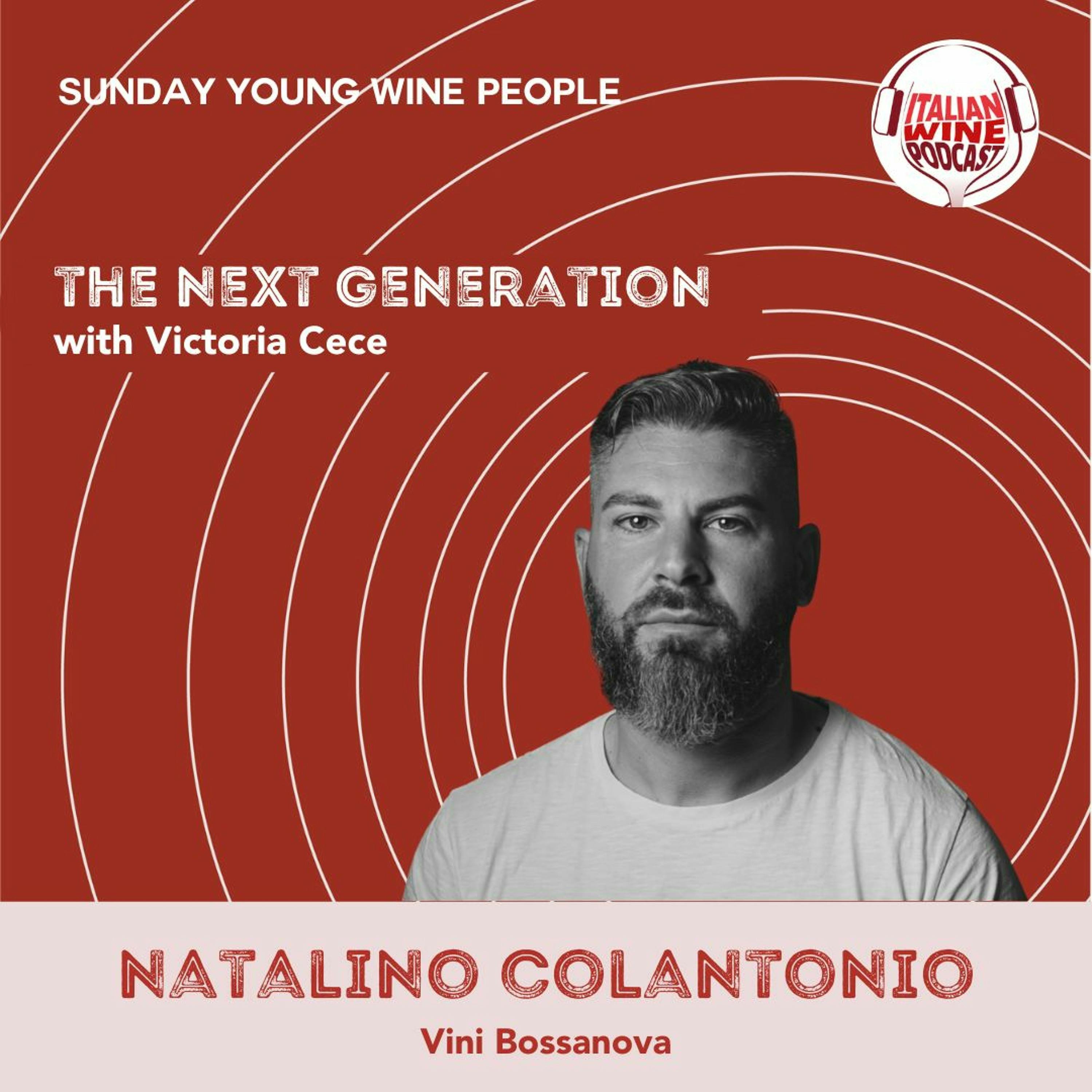
Ep. 1512 Natalino Colantonio | The Next Generation
The Next Generation
Episode Summary
Content Analysis Key Themes and Main Ideas 1. The Montepulciano Grape: Detailed discussion of its characteristics, cultivation challenges, prevalence in Italian regions (Abruzzo, Marche), and diverse wine styles, clarifying its distinction from the town of Montepulciano. 2. Natolino ""Nat"" Taurasi and Bosenov Winery: Nat's personal journey into winemaking, the establishment of Bosenov in Abruzzo, and their commitment to biodynamic farming and natural wine production. 3. The Role of Small Producers and Community (Vite Association): Emphasis on the hands-on involvement of grower-producers, the importance of land preservation, and the collaborative nature of associations like ""Vite"" for sharing knowledge and support. 4. Passion, Art, and Life Balance in Winemaking: The intersection of personal passions (music, sports) with the demanding yet rewarding lifestyle of a vigneron, highlighting the creative and human-centric aspects of natural winemaking. 5. Abruzzo as a ""Magic Region"": The unique geographical and cultural attributes of Abruzzo, showcasing its diverse appeal beyond wine. Summary This episode of the Italian Wine Podcast, part of the ""Next Generation"" series hosted by Victoria Chache, celebrates milestones and delves into the world of Italian wine. The first segment focuses on the Montepulciano grape, dispelling common confusion by explaining it's Italy's fifth most planted grape (second red), and detailing its challenging cultivation due to disease susceptibility, uneven ripening, and late maturation. It emphasizes that despite these difficulties, Montepulciano yields beautiful wines when cultivated with care, and is a dominant grape in Abruzzo and Marche, distinct from the town of Montepulciano in Tuscany. The core of the episode is an interview with Natolino ""Nat"" Taurasi, co-founder of Bosenov winery in Controguerra, Abruzzo. Nat shares his personal transition from a previous career to fulfilling a lifelong dream of becoming a vigneron, establishing Bosenov in 2018 with Andrea. He highlights their commitment to biodynamic farming and natural wine production, stressing that their wines are ""made in the vineyard"" with minimal intervention in the cellar. Nat underscores the dedication of small producers, like those in the ""Vite"" association, who physically work the land, preserve biodiversity, and foster a supportive community through shared workshops and events. He also reveals his passion for music, being in a rock band (which performs at industry events), and sports, illustrating how the freedom of his current profession allows him to integrate his diverse interests. Nat passionately describes Abruzzo as a ""magic region"" offering a wide array of natural beauty and activities. Takeaways - Montepulciano is a significant Italian grape (5th most planted overall, 2nd red) but presents cultivation challenges. - Despite difficulties like uneven ripening, Montepulciano can produce high-quality, balanced wines, including dry reds and Cerasuolo rosés. - The Montepulciano grape is distinct from the town of Montepulciano in Tuscany, where Sangiovese is primarily grown. - Bosenov winery in Abruzzo, founded by Natolino Taurasi, is a natural wine producer committed to biodynamic farming. - Small, grower-producers are vital for maintaining the authenticity, biodiversity, and agricultural integrity of Italian wine regions. - Associations like ""Vite"" provide crucial support, community, and knowledge-sharing among natural wine producers. - Natural winemaking emphasizes a ""wine made in the vineyard"" philosophy with minimal intervention in the cellar. - Many wine industry professionals, particularly winemakers, often have diverse passions like music, which they integrate into their work and lifestyle. - Abruzzo is a geographically diverse region, offering not only wine experiences but also opportunities for skiing, boating, and beach activities. Notable Quotes - ""Multiple chamu is Italy's fifth most planted grape varietal, and the second most planted red grape."
About This Episode
The speakers discuss their interest in Italian wine and their love for small vines and natural wines. They talk about their current winery and their past experiences with wine wines and their love for the Italian wine industry. They emphasize the importance of finding a community of those involved in keeping the support of the industry and finding a balance between natural and organic farming. They also discuss the challenges of finding the right balance between natural and organic farming and the importance of sharing experiences and ideas in the industry.
Transcript
Since twenty seventeen, the Italian One podcast has exploded and expects to hit six million listens by the end of July twenty twenty three. We're celebrating this success by recognizing those who have shared the journey with us and giving them the opportunity to contribute to the on the success of the shows. By buying a paper copy of the Italian wine unplugged two point o or making a donation to help the ongoing running costs, members of the international Italian wine community will be given the chance to nominate future guests and even enter a price draw to have lunch with Stevie Kim and Professor Atigioshenza. To find out more, visit us at Italian wine podcast dot com. Welcome to the next generation. I'm Victoria Chache, join me as we chat with young Italian wine people shaking up the wine scene. We're going to geek out on a grape or grape fam and hear about all the wild wine things are guests have been up to. From vineyard experiments, to their favorite wine bars. Hello. Welcome back to another episode of the next generation. Today, today, today, we are going to talk about a grape that you probably know that you probably have drank before. I'm not gonna leave you to guess because that's pretty hard. I gave you no clues. Not to be mistaken with, or the town, Monteput channel. This is the great Monteput channel. Why are we talking about Monteput channel? Because we have a fabulous interview coming up with a producer in Abruso, Montipuchano's home region, doing some very, very fun things, a small winery. But before we get to that, I'm very excited. It's very musical. Before we get to the interview, I want to dive a little bit into Muldu Picjan was a grape, from the Italian wine Unplug two point o book, give you some fun facts, and then we're gonna dive straight into it. So multiple chamu is Italy's fifth most planted grape varietal, and the second most planted red grape. It's very popular, but the funny thing of it is about multiple chamu is even though it is Why we planted? It's not that easy to work with, which is kinda funny. Why isn't that easy to work with? It is not disease resistant. It also suffers from an even ripening, even within the same single bunch. It is also a weight ripening varietal and requires a long growing season for its seeds to fully mature. So the issue with this is that it accumulates sugar very quickly, but the tannins mature later leading to wines that can have very high alcohol and also if they're not treated. These grapes are not treated with care and attention. Very imbalanced wines. Now, do not hold that against Montebuchano because it produces very beautiful wines when it's given all the love that it needs. Just like before it, give them attention. Come better. Or we hope. Moving on, multiple channel accounts for at least fifty percent of the vineyard plantings in Abruzzo, and it is also the most important red grape in the neighboring region of Limarche, and it also has a lot of plantings in Moises. So we're talking the Adriatic side of Italy, Eastern side, Eastern coast. And multiple channel is traditionally blended with other autochtinous grape varietals, but it is still the dominant influence in the line. And just to reaffirm, it has no relationship with the town of multiple channel in Tuscany, or it's wine. We don't know which is mostly made with. Sound, so this was still great. It's a lot of confusion, but remember that. Remember that. Multiple John is a grape. Multiple John is also a town that has nothing to do with the grape. It's in a completely different region. Than multiple channel at the grapes home. So if that was really confusing, let me just break it down really fast. Multiple channel, grape, from a group cell. Done. Monte blue channel town in Tuscany does not grow multiple channel great. Gross Sandroveda, ox, other varieties. In the glass, multiple channels shows a deep ruby or purple hue, It is characterized often by ripe red cherry, spiced black plum, blackberry, bramble berry, damp woodsy earth, oregano, or licorice aromas, as medium plasticity and tannins help out sometimes overly generous fruit flavors of the swine. And again, going back to the tender love and care of this grape, if it's not well managed, a synchronous ripening can lead to prettier tenant and harsh green vegetable character. Oh, not very nice. In its dry style, it can range from white, and easy drinking to full bodied and fruit forward winds with velvety tins. Some new versions may be oaked, depending on the producer's choice, although you combine it, stainless steel as well. I also want to poach on the mix really nice rosé. I have them ranging color, and those labeled cesualo tend to be deeper pink in color with a fleshier mouthfeel. More tenants and complexity than typical Rosay wines, so you can experience multiple Charmin lots of different, styles, which is really fun. So without further ado, let's move into our interview. Wonderful. We are at Vinicelli today. And we are with Basanova winery. And here we have Nat, Natolino. Tau. How are you? I'm very good. How are you? How's Vinice today? Very exciting. I see a lot of people around, so we're very happy. Awesome. So I wanna know a little bit more about you. What how did your story and wine begin? Yeah. We, established Bosenov in two thousand eighteen. We are in two. I am Andrea, my friend. And, basically, we did something different in the life before, but we had this, common dream, so to become a groover. So we left our, previous career. And, in two thousand eighteen, we started this business. We started from a small plot, one hectare of uh-uh vines that was planted by Andreas's grandfather in the seventies, so very old vineyard. And then, year by year, we launched the the the the plots. Now we we are roughly eight hectares and a half and we produce around the fifty thousand bottles. The one of the most important thing of our company or our wine that we work in biodynamic. So we are biodynamic farming, and then we produce natural wines. As all the wineries that are here with the association. Amazing. But wanna know a little more more about how you started, what, like, what started your passion in wine? Yeah. So I was, was a child when, we did the wine with my family, but just for, our consumption. And I remember I was really a little one. And I remember the, the passion of this moment in the year, the, the flavors and, and the smell during the, the harvest. And this, this is still in, in my heart, in my soul. So then I was always passionate about wine. I traveled a lot in my life, working abroad. So I had the the chance to to eat in many restaurants and to order whatever I wanted. So my passion for wine, grew up a little more. And then, because I had a very intense career, at a certain point, I decided to change life. I wanted to do something more slow, more human. And, because of my passion on why, and this was always my dream. So at the end of the day, in two thousand eighteen, long story short, they started to do the vigneron. That's it. And you came back to the land. Yeah. Exactly. And so tell us where your winery is based a little bit more about the territory Sure. We are in a brusso, a brusso in the center part of Italy on the adriatic, coast and the adriatic sea. We are roughly two hundred thirty meters above the sea level. Most of our vineyards are facing the the seed, beach, beautiful place. And it is a very important area in the Culina Terramani area, where the, let's say the, quality culture is very possible. Because of the slopes, because of the exposure of the vineyards, because of the breeze from the sea, the wind from the mountain. So it makes the perfect microclimate to grow the vines. So Abruso, Controvera. Wonderful. And so are you from Abruso? Yeah. Wonderful. And what was it like growing up? We're we're in Abruso, particularly. We are in Controvera, which is in the northern side of Abruso. So I I was born in a Bruce as well, but in my life I traveled all around the world, from US to Asia everywhere. And, as I said before, you know, at the certain point, it was a two thousand fifteen I really felt the necessity to go back to my land and do something different. So in two thousand eighteen, I did that. Amazing. And what was the thing you missed the most besides the wine when you were deciding to come back to a Well, I have to be frank. I'm not missing my previous and stressful job. It is it is hard to to to be a vigneron. But, I don't miss anything of my previous life. Even because I'm still running a company before I was a manager. So it's something similar. More risk now, but it's okay. And, I'm I'm traveling the world as well because we are, exporting in many countries in the world. So, I have, customers. I have suppliers. So let's say the the basics are are the same. Obviously, it's much more interesting because there are, beautiful human relationship. The the wine is art, the way we do our authentic wine is art. So, you know, we can mix also with music. We are musicians, so we are much more free. So that's that's a great thing. That was something I'm so happy. You brought up because I love the fact that you bossa Nova, brought that aspect into the wine because for me, personally, wine and music are so married together. They're so similar. And one of the beautiful things about this industry for anyone listening is you will meet quite a few people in the wine industry and especially winemakers who are musicians. Yeah. And it's a beautiful thing. Yeah. Absolutely. Because, making the wine, especially if you do natural wine, so, out of the emoligations and on it's something very personal where you can put all your creativity. We we do this with our label, with our boxes, with our bottles, with our communication. For instance, we are the one taking care about our, Instagram page and so on. So we can put all our effort, all our, philosophy, all our, critiveness in doing our job. So that's the most beautiful. That's freedom, you know. Absolutely. Absolutely. Are you enjoying this podcast? Don't forget to visit our YouTube channel, mama jumbo shrimp for fascinating videos covering Stev Kim and her travels across Italy and beyond. Meeting winemakers, eating local food, and taking in the scenery. Now, back to the show. And so before we get into talking about Mite and the small producers association. Is there a line here that, like, you would match with, like, a song or a band or something like that? Is there any kind of inspiration that way? Obviously, you could take this question. Whichever direction. Yeah. Well, we have a few wines. Maybe if I think to one of our wines, let's say more playful, I would say our pets not. Which is a sparkling wine, very fun and playful. And, I would pair this wine with, a song of fantastic nagrito, which is, yeah, chocolate samurai, which is a crazy song, like our wine. I love it. I love it. And, yeah, so you're in a rock band. That's right. Sure. Sure. I'm in a rock band and, yeah, Andrea. That's what was one of the common uh-uh point when we meet when we first decided to start this this thing. And, we we play in a band. We have our own rock band. And, for instance, tonight, we'll play here in Verona because we will have an after party, and I would like to invite everybody at the amen tonight. And, we will have a dinner and tasting with all our, video association's wines. And the antenna, we will play with our rock band. It it's just fantastic. There's nothing better in life sincerely. And now I know it's really important. Talk about Vite because one of, and in my heart too is the small producers are really the force behind keeping, you know, a lot of these, special territories alive in the land and the biodiversity, especially in a place, Abruzzo is, if gorgeous. So tell us about your experience in your, about Vite. Yeah. You got exactly the point during the introduction because uh-uh in Vite, there are all growers producers that the first thing they do is taking care about their land. Okay, their, area, their region, their, small villages and what's on. So, behind the, any producer, there is a a real vigneron. So we are the ones that physically work into the vineyard. We, promote our wines. We work in the cellar. So, it's not just like, another activity, second activity, and so on. So that's our main job. And this is very important also, to recall what I said before that our wines are very personal and authentic because we do really with our hands. We are the ones working through the vineyards to prune our vineyards to harvest our vineyards to make the wine in the into the cellar. So, going back to the association, we are, roughly under the fifty, producers, all natural wine producers inside that we have, wineries doing, at least organic farming, but mostly biodynamic farming, which is, which is great. And, we used to represent them, through, maybe the fair, like, here in Italy. We have a longer relationship with the with the delivery. So in this organic call, we are since, I don't know, maybe five, six years. And, and then we organize, also many, events, where we, basically, we we meet between us. We between producers. We do a lot of workshops, in order to grow together. So, if we have a problem, if we have an opportunity, if we have something to discuss about agronomy or or anything else, we share. That's very important. So, because, thanks to sharing the things, we are able to grow together. So this is very important. Have absolutely. And I think that's an important, important aspect you bring up as a community in keeping that support together because, you know, when we think about wine, you know, it's Viticulture. It is part of agriculture. You know, it it's not that the wine just appears. There's a lot of work that goes on and and and to keep that alive, that quality, you need to work together. You can't be alone. Absolutely. And then, you you got another very good point. It's agriculture. We don't have to forget because sometimes in the wine industry, we forget that behind there is a, there is a vineyard, there is agriculture, especially for us. We don't make the wines into the cellar, but we make the wines into the vineyard. That's very important. It's another approach. Obviously, then we will, make the wine into the cellar for sure, but with the absolutely low intervention. So the big challenge is into the vineyards because we are growers. We do agriculture. Yes. I always say it's like when you see the dirt there there's pride in having your hands, like, all dirty. I, like, miss it. I mean, I've I've only done a couple of harvests, but that was what I missed. Like, I did one in California, and I was, like, going in the morning at, like, six AM to get coffee at the cafe, everyone everyone had dirty hands. And I was like, yes. Yeah. Because you you you know, you you feel it. You put your hands on it so you can put your energy in what you do. So it's very, very important contamination also in this case, you know. Yeah. It's like that all that good bacteria. Yep. Good bacteria, obviously. Good. Good bacteria, not bad bacteria. Exactly. But I, just to kinda turn the conversation, to a little fun direction before we finish off. Since, obviously, you're super groovy, cool dude, as we can tell, makes cool wine, plays music. That's all we need. That's all you need in life. What do you do for fun? Like, if someone wants to come visit you? Like, what what would be the itinerary? Well, I do a lot of things for fun. First of all, playing in a rock band. And, then I'm I like to do a lot of sports, for instance, like, I do kite surfing, I do crossfit, I go with my bicycle, So and also this job give me gives me the opportunity to do so, even if it it is very intense as job. But, you know, you have, that kind of freedom, to to follow all all your passions. And then you put all your passions into the wine. That's Absolutely. So if I come visit, we're gonna be in the vineyards of doing crossfit. We have we have the beach. You can do kite surf, whatever you want. Oh, okay. I do like paddle horn. Yeah. Yeah. Cool. Awesome. A bruce is a a bruce is a really it's a magic, region. We have everything. You can, ski. You can, you can, go boating. You can swim. Sometimes in the winter, we we used to ski and you can look at the beach during this. Yeah. It's it's an outstanding place. We have lakes. We have rivers. We have beautiful beaches and a lot of culture and, architectural and historical stuff. So, come to visit the Absolutely. Thank you so much, Nath. It was a pleasure. My pleasure. And I wish you everything has That's amazing. Please, Evin Italy. And yeah, thank you so much. Thank you so much. Bye. Fun. As always, a big drops here for hanging out with me today. Remember you can catch me every Sunday on the Italian wine podcast. Available anywhere, you can get your pops.
Episode Details
Related Episodes

Ep. 2789 ColleMassari: a long-term vision rooted in Montecucco with Giuseppe Di Gioia | On The Road With Stevie Kim
Episode 2789

Ep. 2788 Ep. 14: Austria and Hungary | Study Smart for your WSET Level 3
Episode 2788

Ep. 2785 From Volunteer to Speaker at TEXSOM with Samantha Cole Johnson | TEXSOM 2026
Episode 2785
Ep. 2766 Inside the U.S. Non-Alcoholic Wine Market: What Wineries Need to Know with Jill Sites | Masterclass US Wine Market
Episode 2766
Ep. 2761 Winemaking and Consulting Across Sicily with Alessandro Serughetti | Wine, Food & Travel with Marc Millon
Episode 2761

Ep. 2759 Part 2 – The VIA Educational Program & Italian Wine | Heart-to-Heart Conversation with Sarah Looper
Episode 2759