
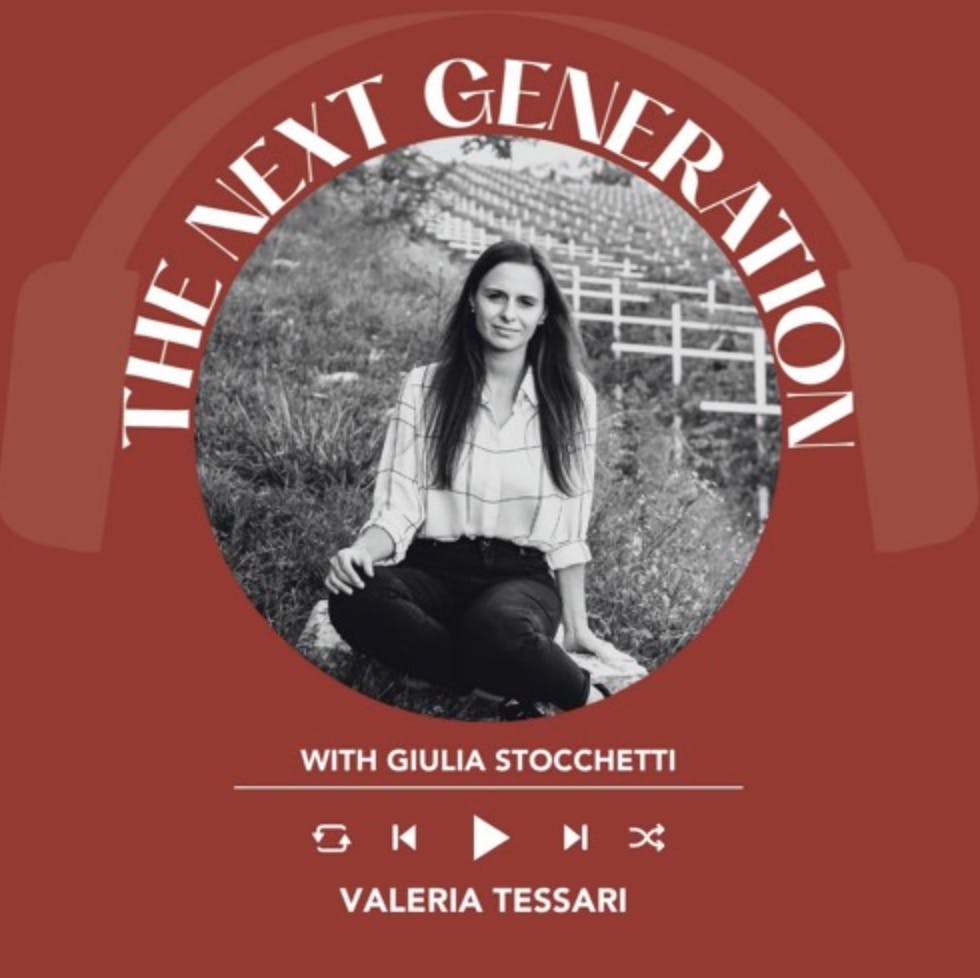
Ep. 1697 Giulia Stocchetti Interviews Valeria Tessari | The Next Generation
The Next Generation
Episode Summary
Content Analysis Key Themes and Main Ideas 1. The blend of tradition and innovation in Italian winemaking, specifically at Jani Tessari winery. 2. The cultivation and significance of Piwi (fungus-resistant) grape varieties in Italy. 3. The diverse terroir and winemaking practices within the Verona province of Veneto. 4. The intersection of local Italian gastronomy and wine culture in the Roncà area. 5. The role of the younger generation (Valeria Tessari) in the evolution and future of family wineries. 6. Sustainability and environmental consciousness in vineyard management. Summary In this episode of the Italian Wine Podcast, host Julia Stockcetti interviews Valeria Tessari, export manager and daughter of the founder of Jani Tessari winery in Roncà, Verona. Valeria discusses the family-run business and her 360-degree involvement, highlighting their 35 hectares of vineyards across the Soave, Colli Berici, and Lessini Durello DOCs, each with distinct terroirs. A central theme is the winery's embrace of innovation alongside tradition, particularly their pioneering work with Piwi (fungus-resistant) grape varieties, such as Solaris, used for their ""Rebalis"" wine. Valeria explains the environmental benefits of Piwi wines, including reduced vineyard treatments, and details the unique amphora aging process for Rebalis. She delves into the rich local culture, from the biodiversity of the Roncà area to the traditional Veronese and Vicentine cuisine, suggesting pairings for their wines, including the ""rebel"" Rebalis with dishes like polenta, Monte Veronese cheese, and Baccalà. Valeria also shares insights into young generations' increasing interest in traditional local foods and emphasizes the importance of Italian wineries staying true to their roots while integrating sustainable practices for the future. Takeaways * Jani Tessari winery, located in Roncà, Verona, is a family business led by Johnny Tessari and his daughter Valeria. * The winery cultivates 35 hectares across diverse terroirs in three DOCs: Soave (volcanic soil), Colli Berici (calcareous soil), and Lessini Durello (sparkling wine terroir). * They are pioneers in the Veneto region for planting Piwi (fungus-resistant) grape varieties, specifically Solaris, used for their ""Rebalis"" wine. * Piwi varieties offer significant environmental advantages, allowing for nearly zero treatments in the vineyard. * The winery successfully blends tradition (preserving local grapes) with innovation (adopting new resistant varieties), viewing them as complementary rather than opposing forces. * Local gastronomy, particularly traditional Veronese and Vicentine dishes like polenta, Monte Veronese, and Baccalà, is deeply integrated into the region's culture and offers unique wine pairing opportunities. * Younger generations are showing a renewed interest in traditional, local foods and culinary heritage. * The future of Italian wine emphasizes staying true to regional traditions, fostering sustainability, and adapting to market needs. Notable Quotes * ""Unofficially is a family winery. So best I do everything that nobody else is doing..."
About This Episode
Speaker 1 and Speaker 2 discuss the Italian wine industry and the benefits of hybrid vines and sustainability. They talk about the excitement of younger generations reacting to the new generation and the importance of tasting and try new flavors. They also discuss the excitement of younger generations reacting to traditional dishes and the need for a balanced approach to sustainability. They mention their plans to stay true to traditional dishes and try new local ingredients and wines while preserving their soil and terror territory in the wine industry. They also discuss their plans to grow their own wine and try new vines and traditional foods.
Transcript
The Italian wine podcast is the community driven platform for Italian winegeeks around the world. Support the show by donating at italian wine podcast dot com. Donate five or more Euros, and we'll send you a copy of our latest book, my Italian Great Geek journal. Absolutely free. To get your free copy of my Italian GreatGeek journal, click support us at italian wine podcast dot com, or wherever you get your pots. Ben Venuti, welcome to the next generation with me, your host, Julia Stockcetti. Join me as I take you on a journey to discover young stars of the Italian food and wine world, Bronte andiamo. That is located in, the Veneto region, the province is Verona, and the city is Ronka, where there is, Janiceari winery. Basically, in this area, people don't only produce out standing wines. There are also some, really, really delicious, food to eat, like, basically is a typical colquets. Bruce Skepte with local extra virgin olive oils made with the olives from the area. Monte Verona is a PDO cheese made up in the mountains and torta Espizalona as a dessert. That is basically made with some flour, some butter, and some other secret ingredients, let's say, but there are also almonds, I guess. The feature dish of today will be polenta, monte veronese cheese, and bacala. But let me introduce to you our interviewee today and her business. Jani Tessari winery is located in Ranca, province of Verona, as I said, and it's headed by Jani Tessari. Who is a well known name in the wine field of verona. He and his family works with three different territories, different and complimentary among them. They produce wines in the Montelessini, in Swada, and Colibericine. Thirty five hectares of vineyards are distributed in three DOCs. Great Swada, where we have the expression of the volcanic soil, Then we have Caliberichi with red wines that are, really complex and well balanced, where the soil is calcareous. So it's basically a different terroir. Let's say we get to have dark basaltic volcanic soil on the swaddler hills while we have white calcarried soils on the Barriji hills. So let's say white variety, black soil, red grape variety, light soil. And then we don't have to forget the sparkling Lecini Dorado. That's characterized by the minerality and finesse typical of the terrarium of the area. Valeria Tessari was born in nineteen ninety three. And she is Jenny's first born, and she enters the family business after graduating in economics at the University of Verona. She has a big passion for traveling and discovering new markets. But also to tell the story of the area and the tradition behind the wines. How are you today? I'm fine. I'm fine. Quite busy because, you know, it's Christmas time now. So a lot of stuff to do with gifts, and, luckily, wine is still a very, very popular idea for a gift in the area. So we are working quite a lot. Wow. So I guess you have, like, special offers and special packaging for the season. So if our listeners want to make, really nice, and I would say yummy present, can talk to you directly. Sure. Yeah. Of course. You know, we have wine, that is, you know, what we produce, we have different labels. So it's easy to make a box of different kind of wines are red and a white maybe or a white and sparkling and so on. Tell us, something more about you. So who are you? How old are you? Yeah. So, as you said, my name is Valeria Titsati. I'm Johnny's daughter. Johnny is the winemaker and founder of the oh, my winery. So, Johnny, the sari winery. I am thirty years old this year. So I'm entering in this phase of the life, when I think you are you are you're still young, but, you are maturing, you know, so you have a new vision of the life, or at least this is my what I felt when I've entered in this, easy stage. Okay. So you're evolving, basically. So you're young, but, like, with a different awareness and just evolving, going through this life. Exactly. Yeah. That that is the perfect word to describe, I think. Nice. What's your position? What's your role within the winery? So officially, I'm, the export manager. So I deal with the export. Unofficially is a family winery. So best I do everything that nobody else is doing, you know. So giving a little help with the bot link, and the following invoicing, answering to the phone kind of a little bit of everything. So, basically, you're you have a three hundred and sixty degree experience in, in the winery and in the wine business. You're the jolly, basically making everything. Yeah. Yeah. You know, I I always I also like to learn a lot of things. So I'm not getting back. You know, I like to learn new things. So, really, from what needs to be done, I try to do my best. Nice. So no time to get bored. But you're all doing something or up doing something. I try to. Nice. And where are we today? So as you said, we are in the small village of Ranca that is up in the hills, in the eastern part of Verona province, so, right, in close to the Vicenza province that it is the other province in Vanator, so northeast of, of Italy. Nice. And I guess there are hills all around your place with vineyard. Exactly. It's a really green place, you know, a lot of trees, a lot of vines, but also hoots, also territories that is another very important economy for this area. So a lot of, nature color, let's say. Oh, that's amazing. So so what's divide in the place? Well, I I I will say a lot of biodiversity, you know, it is still not a very known area, popular. Let's say, so we still have a lot of, diversity in the cultivation. So not only vines, even if this place is very used for wine growers. But also, as I said, some cherries, some hoots, some nature that it's still, not used for the for the economics. I I think is something really cool when you don't have just the vineyard, but also, you know, the woods, some orchards, some cherry trees or it's like dreamland. You need to come and visit. Yeah. I should definitely because I don't live far away, so we should catch up soon. Yeah, maybe to buy some Christmas presents for my friends too who, like, have so many different palettes. So I got some red and some sparkling and some white Yeah. Wow. That's the the biggest problem. Yeah. Why not? But but I know that, you also started growing pee wee, so resistant varieties. Right? Yeah. So, I mean, this is, like, something strange because actually our fellow main philosophy in the winemaking is to tell the story of the territory and of the tradition. But with PV, I think that's, something changed in a, in our mind a little bit. So for people who doesn't know Piwi is a, an acronimos for a very, very long word in German that I have no idea how to pronounce, actually, but the translation in English is a fungus resistant varieties. So, those are new varieties that are, created with breeding. So there is no manipulation. There is no GMO, but just breeding of silvatic vines with the domestic vines. And so our vines we have here in Europe and the Australian vines. So the old the the old vines, why they do this? They do this to create those kind of varieties that are naturally resistant to many, many diseases of the vine. This, for us, when we heard about this, Johnny, my father made a lot of studies to understand, basically, these new varieties, what's going on. You know, he learned that, they are, away. I will say to have a win win. You know, a win for the winemakers that needs to do low treatments. You can say zero treatments in our vigner, the four solaris in this case. Oh, wow. So also no less hand work, let's say, you know, because you don't need to go so often to the vineyard. And, on the other side, the other win is for the environment. You know, treatments means, of course, more, better air, better soil, better water, you know, what's what we always look for in this, in this time for the sustainability. I mean, so interesting. I mean, you combine tradition with the PTOs, and innovation with these resistant vines. How does it feel like having both these two features, like, in your soul? You know, somebody can think that tradition and innovation are too opposite, but I think that they are that they can combine. You know, they they can grow together because, of course, if we, on one, on one side, we want to keep the tradition. We want to keep the local grapes. On the other side, we can also help the soil to grow better, to grow with lost, low treatments using these, these different kind of grapes. So it really is is not is not like a white, you know. You can really combine and find the the perfect combination of of those. Also, because, you know, the soil is different. The soil that that I have here, in my vineyard where I plant soave is totally different from another soil that, I mean, we don't need to go that far away. You know, that Italy is so different. You just go ten kilometers by one side or another and the the soil, the the the village, the people are totally different. So I really need to think that we need to listen to our soil, to our routes and and really see what we can do with that. Nice. I don't know if I've explained myself. It's a little bit complex. You got the point. Yeah. Definitely. Good afternoon. Thank you so much. And I was wondering, do you have a different market for Piwi or basically the customers are the same, but they're buying not only the classic Pdo's, let's say, and giving a chance also to Piwi. Actually, at the beginning, we thought to to do a difference, you know, so to propose, the PV to some clients and the other, the regular line to others. But at the end, we have found that, even if our idea for the rebalis that is the PIVine was to make it different, you always feel the hand of the winemaker. So, actually, also the people that buy our regular wines get the the TV sometimes. So, really, it's a well, balanced in our whole production and in our whole distribution, I would say. So it's really important for for them to know that Johnny Tessari and you, basically, that Tessari family is behind the bottles. It's maybe even more important than buying your pee wee or your PTO wines because they're, really I mean, they really like your style. Right? Yeah. I think that exactly. That's what people know when they they they find the a bottle with our brand. They they know what will be, behind. Of course, it can be a different labels. It can be different grape, but the the style behind the label, try to do it, as we like. So, of course, this is how this is reflected in the wine. It it's really nice to have both, quality, high quality and consistency. I mean, your customers, will always appreciate you and get to have your wines, in stock. Yeah. It's also important, very quickly, you know, it's interesting what you said because we know that wine is not water. It's not a a beverage, you know, every year the grape is different. It can be more warmer, more cold, more water, less water. So, of course, starting with every year different conditions, our our idea is to bring on the table a a good wine, of course, so to do our best for that. And it seems like you're making it. So congrats. Thanks for your work to keep our palettes satisfied and happy and to keep us hydrated too. How do you see young generations reacting to to Piwi? I mean, are they interested in trying these wines or they're more linked to traditional wines? You know what? It is starting. I think we are really, really at the beginning because, when we planted the, our solaris, our PV variety is, it was twenty thirteen. And we, have been the very first in the Venator region to plant this kind of grapes. So it's just ten years ago. You know, it's really starting. Many, many people still don't know what this is. Right? In my opinion, it is starting slowly as everything. Of course, it will not be, big bulb, because there are still a small product production as small producers, but it's starting. Every time people hear about it. Ninety percent of the time, they don't know what this is, but they are always interesting to try and to see to see what this is because as I said, is a is a breeding of grapes and of course, the taste, they will be different from the traditions we are used to. But this doesn't mean that it's not, is is not the same qualities. Interesting. Thank you. I'm curious about this Solaris. How do you make this wine? I mean, how's the wine making process? Yeah. So in this case, so the name of the wine is rebalis that is lating from rebalous. So rebel, because we wanted it to be very, very different from our otherwise. As we said before, we didn't do it much because the the style stayed the same. But in this case, we decided to do a fermentation with the indigenous east is the only wine where we use this kind of yeast, and then it stays one year in the amphora for aging. So first being touched for us was twenty seventeen. And, every year we changed a little bit because as I've said, this is a new grapes Nobody knows. Nobody knows what will happen in one, two years. So every year we changed to something. So at the beginning, we were doing a longer maturation, then a a shorter one, then the more time in the downfall, less I'm in the amphora. I think now we finally found the good balance. Also to prove to prove that these wines can age, we are now keeping on sale. Of course, it's a limited production, but we keep on sale all the vintage. So if somebody comes here into the winery, he can buy twenty seventeen vintage, twenty eighteen, twenty twenty, twenty twenty one. So you think it's it could be an age worthy wine? We are still trying, but I mean, from what we have seen now, it is a wine that has a lot of aromaticity. So it can really improve with time. Oh, I'm so curious to try it as you can use it shortly for Christmas. Wow. And do you think that this wine, your rebellious, I love the name, by the way, pairs well with some typical dishes from your area? Is there any typical food? Do you like? Yes. So, you know, here, it's a little bit of a challenge because of course, as I said, rebalis, so solaris is not a great that is in our traditions. So of course, there is no an easy pairing, a traditional pairing, but if we are a little bit adventurous, if we like to try new aromas I think he will be very, very good pairing with the. So this is a a special recipe because it's a mix of a veronese style food and the Viccentino style food. As I said, Ranca is in the province of verona, but it's really, really close to the Vicenza province. So, of course, it's some style of, food are similar. So we have our polenta. We put the Monte Verona as a cheese, very, very small slices. So it can melt on the polenta and a little bit of bakala. So stockfish, codfish, at the beach and Tina style. And, of course, if you ask me, what is the traditional pairing, we can totally say that for this this dish, we pair with the, La Cimidorello. So a sparkling wine, a bubbles that is very fresh, very, volcanic style. But, you know, you can always try to, to pair with the rebellious. I think that some aromaticities some, also the bakalad that could fish is a very strong taste. You know, it is cooked with the milk for many, many times. It, it's a very ancient recipe. So let's say that, yeah, I will recommend to try also with our, rebellious for a different, different combination of aromas. Yeah. We are adventurous. So I think we should try also that one, but we we should also go for both pairings. I mean, first, we try the traditional one, like, you know, Vakala in the, La Cinidorello, and then we try rebalis with the same dish to see the differences, but I'm sure they're both really, really good and tasty. Actually, you're making it. Oh my god. And, you know, food as the wine is a lot of, it's personal, you know, so my personal taste can be totally different from yours and from somebody else. Yeah. Of course. Talking about the younger generations what are the under thirties eating and drinking in your area? What wines do they prefer? So about the eating part, I think that we around ten years ago, we started to be more international, you know, so people wants to eat something, that is different, something that is new. Let's say like sushi, you know, it boomed in the area. But right now, I think that things are starting to change again. And people, especially young people want to go back to traditions and, you know, to eat those dishes that we that we loved when we were kids. So, basically, local food. Exactly. A lot of, you know, of local restaurants. Also, you know, the top restaurants, you know, like, Michelin stars, are starting to be more, local, you know, to buy to buy ingredients from the area to work with the ingredients local wines, and this is really important because it's just your history that you are that you are telling with the food, I think. That's something really, really amazing. And I'm glad to hear that young people are interested in traditional flavors, traditional receipts, and that they're still looking for fresh local ingredients. It's also nice, yeah, to go out and experiment and just like having sushi or in Chinese food or whatever. But also, I mean, remembering the grandma's kitchen, and the grandma's food is always something that runs the parcel. And so what do you usually drink, Valeria? So let's say that I love to try new kind of wine, So different wines, I didn't study, analogies. So I think that I'm I'm still and I keep learning on the, you know, tasting basis. So I always try to say something new. I love, of course, Italian wines. Sometimes I try something also from out of Italy. Say that my one of my personal favorite that is not not from the area. It's, I love this kind of, grape from, from Frulli. It's one of my favorite right now. I would say I don't have a must. You know, I like to every time, if I am in a if I am in another region, I try to also pay some local foods and local wine. Experiment. I'm still learning. I'm thirty, but I'm still learning. I think everyone at any age is still learning something, especially in the wine world where there are so many different regions, styles, and grape varieties. So it's nice to hear that because sometimes, you know, people just because they are winemakers or they are songs or they work in a in a winery. They're like, okay, you know, everything. But, actually, the the wine world is different buildings. I love the fact that you are always looking for something new and to try, you know, probably. Yeah. See you. Thanks. Okay. So I was also curious about your vision of the future, like, what trends do you see in the future? What will new generation go for in your opinion? So I think that it's really important to to stay true to what we are. So to keep with the traditional wine, you know, sometimes I've I heard that some place that they are removing some vines and they are planting different varieties because maybe the local the traditional vines are less productive or less requested. I really hope that, you know, producers on our side will stay true, of course, today are traditions. Also, with a little bit of, innovation of something different. Of course, we need to follow the market. You know, we can't produce a wine and drink it ourselves. It's not we can't live with that. But I really think that tradition will be, especially for Italian wine, always an important and important quality. So I really hope that we can, still stay in our tradition, but maybe grow more, more good with the sustainability, with the work in the vineyards, and, I really hope that the market, the the new people, the consumers, will see that and, we'll appreciate the the effort. I'm sure they will, especially those who are passionate about wines and really good traditional food. So, well, good luck on that. We covered almost everything, what do we wanna talk about? But now I'm asking you just five things in five minutes. So let's recap the whole interview and just five bullet points. So Valeria, where are we? So we are in Romeka, in the province of verona, Venator region, Northern Italy. What's the vibe in the cuisine? Lot of, green trees. A lot of nature of bees, insects, so a lot of biodiversity, and the food is a traditional, blend of the traditional style of, verona food, and the chance of food. And what's the feature dish? The feature dish is, polenta with and the back color. Perfect. With the, let's see if you're on a traditional basis or on adventurous, basis is the rebalis made with solaris grape. So that was the wine pairing. And last but not least, let's identify one major trend in Italy wine industry future and how you're addressing this trend? Going back to the roots, really, to preserve the soil, the terror territory. And what we do is, just listen to our to our soil and, try to do the best with that. Alright. Thank you so much, Valeria. Thanks, Graci, Julia. Thanks for having me. It's been a huge pleasure, really. And I really hope to come to visit soon to get some really good wines. When you want, we are here. Got it. Thank you so much. Ciao. Bye. Bye bye. Gracier for being with me today and listening to the next generation on the Italian wine podcast, Allah prosima Chinchin.
Episode Details
Keywords
Related Episodes

Ep. 2787 Prosecco Superiore by Dr Susan H. Gordon | Book Club with Richard Hough
Episode 2787

Ep. 2784 The Other Side of Valpolicella: Volcanic Soils & Sparkling Wines with Francesca Marcato of Talestri Winery | Wine, Food & Travel with Marc Millon
Episode 2784

Ep. 2780 The Bridge between the Past and the Future of Wine with Serena Costanzo from Palmento Costanzo on Etna | Clubhouse Ambassadors' Corner
Episode 2780

Ep. 2773 Trento DOC: one of Italy’s finest sparkling wines with Alessandra Caroni of Maso Martis | Wine, Food & Travel with Marc Millon
Episode 2773

Ep. 2749 The Many Faces of Etna: Climate, Contrade and the Art of Volcano Winemaking with Federico Graziani | Wine, Food & Travel with Marc Millon
Episode 2749

Ep. 2744 Ep 25: Pantelleria, Salina e il fascino del vino insulare | Pellegrinaggio Enoico con Attilio Scienza
Episode 2744