
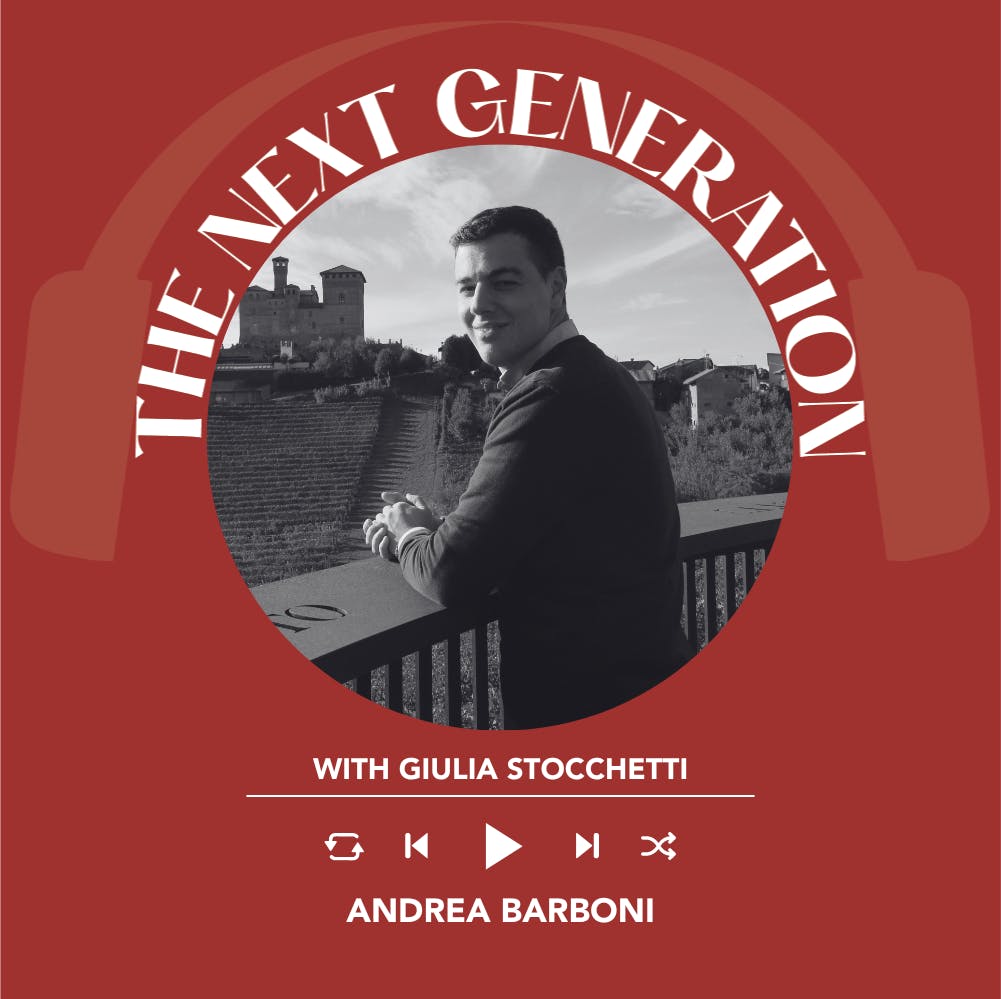
Ep. 1859 Giulia Stocchetti interviews Andrea Barboni | The Next Generation
The Next Generation
Episode Summary
Content Analysis Key Themes and Main Ideas 1. The career journey of a young export/sales manager in the Italian wine industry. 2. Tenuta Vallocchio's commitment to sustainable and organic winemaking practices. 3. The unique characteristics and aging potential of Verdicchio wine, particularly from the Marche region. 4. The diversity of wines produced by Tenuta Vallocchio, including unique local varietals like Lacrima. 5. The appeal of the Marche region as an authentic tourist destination with diverse culinary offerings. 6. Strategies for engaging younger generations with wine, focusing on transparency, sustainability, and diversity. Summary In this episode of the Italian Wine Podcast's ""Next Generation,"" host Julia Stochettie interviews Andrea Barboni, the 25-year-old export and sales manager for Tenuta Vallocchio in the Marche region. Andrea recounts his swift entry into the wine world straight out of university, highlighting Tenuta Vallocchio's dedication to sustainability through organic certification, solar energy, bee farming, and olive oil production. The discussion prominently features their flagship Verdicchio wine, Misco, known for its significant aging potential and versatility in food pairing. Andrea also sheds light on other regional wines, including the rare Lacrima grape. The conversation concludes with Andrea passionately promoting the Marche region as an authentic destination for its diverse landscapes and cuisine, and a thoughtful discussion on how the wine industry can better attract younger consumers through clear communication of sustainable practices and unique varietal characteristics. Takeaways * Andrea Barboni quickly ascended to an export and sales management role at Tenuta Vallocchio at age 25. * Tenuta Vallocchio, founded in 1973, has a strong modern focus on sustainability, including organic practices, bee farming, and solar energy. * Verdicchio from the Marche region, particularly the Misco vintage, is highlighted for its excellent aging potential, uncommon for white wines. * The Marche region offers a diverse terroir, suitable for both coastal and mountain activities, and a rich culinary scene with both seafood and farm-based dishes. * Lacrima is a rare, aromatic red grape unique to a limited number of municipalities in the Marche region, typically consumed young. * Younger generations currently gravitate more towards mixology than wine. * To attract younger consumers, the wine industry should emphasize transparency, sustainability, and the diverse characteristics of different wines. Notable Quotes * ""Challenges are what keep us, motivated, to our life journey."
About This Episode
Representatives from the Italian wine podcast discuss their love for the crafting industry and their efforts to reduce environmental impact. They also talk about their Mule de Casteli degi classico superiority and their use of French oak for the red wine production. They discuss their love for Virdicchio and their preference for the French whiskey. They recommend healthy foods and offer advice on finding the right wines and visiting markets for wine.
Transcript
The Italian wine podcast is the community driven platform for Italian winegeeks around the world. Support the show by donating at italian wine podcast dot com. Donate five or more Euros, and we'll send you a copy of our latest book, my Italian Great Geek journal. Absolutely free. To get your free copy of my Italian GreatGeek journal, click support us at italian wine podcast dot com, or wherever you get your pots. Ben Venuti, welcome to the next generation with me, your host, Julia Stochettie. Join me as I take you on a journey to discover young stars of the Italian food and wine world, Bronte andiamo, Hello. Welcome back. This is Julia from the next generation on the Italian wine podcast. And today, there's here with me, Andrea Barboni from Limarca Region. So for who doesn't know, Lemarka is located in central Italy. And it's the land of, Verbicchio and Rosopto Redwine, Russell. Hello, Andrea. Hello. Hi, everyone. How are you today? Fine. Thank you. And you? Nice. I'm good. Thank you. And I'm so excited to be here with you because I know you're really, really busy in this period of the year with events and win promotion. So thank you for finding some times for us. You're welcome. Thank you for hosting me and for giving me the possibility to tell everybody something more about, me and, of course, our winery and our region. Nice. So, Andrea, tell us everything about you. So as you have introduced me, I'm Andreleboni. I'm twenty five years old. And, nowadays, I'm, like, the export manager and, and sales manager for Tino Tevignano. Oh, wow. And responsible for the European and Italian market. And being in this world with such a young age is not the easiest thing I've ever done in my life, but, challenges are what keep us, motivated, to our life journey. Oh, wow. And how come you became basically the sales manager for both, domestic and international markets for I mean, what happened in your life that made you decide to to do this? So, yes, I'd start I've studied, languages for businesses in, the amazing city of, Urbina. Oh, wow. You know, I did the same. But in Verona, you know, that's amazing. Okay. Sorry. Go go on. And, yes, after graduating in languages for businesses, I've started, my master degree in marketing and communication. And then, I needed to do, like, an internship for graduating. And, I did my internship at, and it was my first approach in the work world, let's say. And after two months and a half, and after graduating, on the end, which is our general manager, hired me for the, at the beginning for communication and hospitality. And then, I moved to, export and sales after some months. Oh, wow. That's awesome. I mean, just right after university, you went to Toneta Vignano, and you started your wine career. Yeah. I mean, wine has always been one of my biggest passions. Since the last six, seven years. And having found a job in the wine, in the wine world has been really, really a good opportunity for me. Okay. Now I'm curious. Like, How did you fell in love with wine? What happened? I mean, here it is, wine area, and it's really typical, between the end of high school and the beginning of university to do, like, the great harvest And so I'm a curious person. So I started asking a lot of questions, and they had the possibility to really, get some knowledge about the one word and really fell in love with the with this word. And and so, yes, that's how. So, basically, hand picking the grapes made you fell in love with wines. Yes. That's really, really easy. It's a bit more complicated, but, yes, how it's working with, easy. Okay. And can you please tell us something more about and because, I mean, I guess we're we are all curious about that because looks like a lot of young people are working for winery. Yes. I mean, we are a young and dynamic group. The winery responded in nineteen seventy three with the arrival of funding in in a in a two thousand fourteen. So forty years after we had, like, a change in what is the direction of the winery. So, yes, so sustainability really became a part of our core business, let's say. So we really tried to improve our impact, on the, on the war, on the environment. And so we have, solar cells. We have converted to organic certification, and we have bees in our vineyards. So let's say, apart from, making high quality wines, we try to also, reduce our, impact on the, on the environment. Nice. That's beautiful. And I think that is really, really important also for a young generation, your commitment to sustainability and also bee farming. Right? I mean, you have bees. Yes. We produce our own honey, and we also have olive trees. So we produce our own olive oil, which is again, organic certified all around farm. Let's say, so not just wine, but also some other liter productions. That's amazing. Sounds like there's a lot of biodiversity in there. Yeah. It's really a thing also for the Appalachian. I mean, if you go to other maybe wine, areas of of Italy, you sometimes you just have vineyards, vineyards and vineyards while in our, wine region, viners are just a part of the environment. There are many other things, like woods and fields and so on. So it's really interesting. Oh, wow. That's amazing. And what kind of wines do you produce? How big is your, your reality, your winery? So we have, thirty three hectares of vineyards, but we have, low yields. So we just produce one hundred fifty thousand bottles per year. And, yes, our main gray power, of course, predict you. We are in the Castelli DSE. And so this really known white grape variety, which gives wines that can age for many, many years, which is, not so common, thing for wet wines. And then we also have, Lacrima Merlo. So also the red wines, play an important role in our production. Oh, wow. So, basically, the production is focused on verdice. Right? I mean, I guess, it's your main production. Yeah. I mean, we have thirty three actors of, vineyards and twenty one of them are planted to verdicchio. So we can say we are known for verdicchio and, Misco, which is our verdicchio de Casteli degi classico superiority. Is our most iconic wine. Let's say everybody knows us for Misco, which is this great white wine that can age for many, many years. Well, can I tell you something? I also know and love your Misco. Because I feel like I'm a very cute girl. Like, I'm a huge fan of that great variety, especially because as you said, with time with aging, it becomes even more pleasure and even more interesting. So, yeah, I love Virdicchio. Go for Verdicchio, guys. Thank you very much. No. Thank you for making wines. Verdicchio wines. I mean, when they are young, they're a bit a seed big and not so enjoyable, let's say, but with the passing of time, they get more rounded, more velvety. Those of the structure becomes more pleasant as you said. And so it's just a time of time and waiting for ridiculous wines. Wow. And can I ask you why the name? Why Misko? Misko, because it is the letting name of the river Mussone, and the vineyards just end, close to the to the river. So the river influences the, microclimate we have in the vineers and from there, the name to the wine because it is a single vineyard. We use just the grapes from the parcel of vineyard, which is close to the river. And so that's how we we gave the name Misco to the wine. Oh, nice. So a lot of history. Yeah. Young winery. I mean, you know, in Italy, we have wineries. They're all, like, hundreds years old. Yours is, like, almost sixty, I guess, right, years old if it was founded in the seventies, but you're still taking inspiration from Latin. So that that's beautiful. And, like, the vineyard is, on the hills is what's the altitude? Where are we? We are at, three hundred fifty meters, so not so high, not so low in terms of altitude, but they are not big steep slopes. They are just, moderate. We are forty minutes away from the sea and forty minutes away from the mountain. So in summer, we go to the sea. In winter, we go skiing. It's really, really, really interesting region in the in Italy. And also the place is really amazing, Chingales, known as the balcony of the market region. From there, you can see all the region and it's really, really nice place. Oh, wow. And it's, like, near your winery or somewhere else? Chingale is the municipality of the winery. So we are in the municipality of Chingale, which is one of the Oh, okay. Okay. Which during the middle age were depending from the, city of, of yes. Wow. Wow. I didn't know that. And so you grow Vedicchio, but also, like, Monte Puciana, you said. Right? San Jose, Cabernet, so you also make red. Yes. For the red wine production, we make, three wines. One is, cevidoni, rossupiciano. So rossupiciano is the appalachian, and and it refines in big oak vessels. While then we also have a lacrima hundred percent, which is this red grape variety, which is a bit aromatic, typical of the province of Encona, And then we produce, we call it supermarket because it is a montepulciano, cabernet sauvignon, and Merlo. So it's like super tuscant, but with Montepulciano instead of Saint. Oh, wow. And this reminds me in the weeks. So So, small French bottles, basically. Right? Use French oak for this supermarket red wine. Are you enjoying this podcast? Don't forget to visit our YouTube channel, mama jumbo shrimp. For fascinating videos covering Stevie Kim and her travels across Italy and beyond, meeting winemakers, eating local food, and taking in the scenery. Now, back to the show. Are you the only one, like, making supermarket or there are some others out there. I think there are other wineries. Yeah. I mean, it's normal to, combine multiple channel with other grape varieties because sometimes, you know, when it's young, it is a bit harsh because of the structure and the tannins. So with cabernet sauvignon and Monroe. And the with the break gaging, it gets a bit more, enjoyable. Let's say. And what about La Grima? Is pretty rare to find out here I mean, is that a big production of yours or you just make few bottles? No. It's just a small production, and you can just produce, like, my six municipalities in the market region. So it's really, really limited production. And nice red wine different from other red wines. It's a bit more floral. A kind of balsamic is really interesting as a red wine. And do you think it needs some oak for aging, or you make it just in inert vessels? We make it in a steel vessel, so without bulk because we think it's, more important to give value to the to the characteristics of the variety instead of adding more structure and flavors we focus. Also, for example, we have verdicchio. We just use steel and no oak at all. Also, with the more important expressions of, of verdicchio because we tend to prefer to give importance today. Varietal characteristics of the grapes instead of adding more structure and flavors. Oh, that's beautiful. So you're making terrar wines, basically. You're looking for the purity of the grapes expression. Yeah. We can say so. Nice. And LaKrima is, like, Verdicchio that, it's better with it's not better, but, like, it develops with aging or is a red wine that is meant to be drunk young. I mean, it it depends on how you make it, but normally is a red wine to drink, like, in the first three to five years of, from the harvest. And, of course, it can evolve a bit in the bottle, but longevity is not its core feature, let's say. Oh, okay. Thanks for sharing this info, but luckily. And if you have to name, like, an everyday wine for people from your region, what would it be? In my area, in the area, I live, everybody drinks Verdicchio every days. So I would say Verdicchio. And, like, what what, what's the food pairing that you would recommend with Verdicchio? Oh, the perfect pairing is, which is a rabbit cooked with in the oven with wild fennel and pork rind and This pairing is perfect because, ridiculous with aging gets a bit of these, herbal and, phenol hints. So they combine really, really well. And, yes, I would say that is the perfect, pairing for religion. Oh, wow. My mouth is watering now. I'm already hungry. Is that, like, a typical leash that you often have, like, on Sunday lunch or, like, in family moments, or it's something pretty rare to find, and you must go to special places to get this rabbit. I mean, when, for me, it's like common because my grandmother always cooks it. So for me it's really, really, common, let's say, but I would say it's not so rare to find it in, not so common, sorry, to find it in restaurants. So I don't think people eat it so often. And you have to mean it's everybody is a receipt. Everybody knows, but it's not so common to to have it, I would say. And, like, if someone goes to a market to, to your area. Let's say. What would they, find at restaurants for eating and drinking? Oh, I would say many things, from every kind of pasta with every kind of ragu. For example, wild boar is also really typical from the area, but you can also have mushrooms, truffle depending on the time of the year. Or also you can have seafood. For example, if you go to the coast, I mean, it's really diverse, kitchen, I would say, but the typical food I would say is farm animals like rabbit and chicken and all this stuff. Oh, wow. We got everything for, like, every palate from seafood to meat based dishes. Wow. We got a lot of a lot of delicious stuff to eat there in the market. It takes, like, I guess, more than two weeks to try everything. Maybe. And that's quite interesting because you get to have I repeat. I mean, mountain food, but also seafood, and Verdicu seems like works with any of them. So sounds amazing. Yes. I mean, Of course, you cannot have a white wine with, a steak, for example, but with, white meat, it goes also really, really well because it's really structured as a white wine. And also the acidity helps you to, pair it with many, many dishes. And, of course, it goes really well with seafood, with, linguine, Eloscogia, for example, which is a pasta with, seafood. And, yeah, I mean, ridiculous as a grape variety is really versatile. So also, basing on the kind of verdiction one you have, you can pair it with many of different dishes. Wow. It's like a general one. Well, for red meat, we can go for LaKrima or Montepulchan or supermarket. Right? So we got an option for everything. And, like, what's your favorite wine, kind of wine, let's say? Well, I mean, it's for not to talk every every time about Virdice, but for wet ones, it I prefer, of course, Verdice, but also riesling or, Sharpony, well, for the red wines, I really like, Nebula, for example, every kind of Nebula, every form and shape of Nebula love it. And also San Giovanni, I really really like. So I would say the big, varieties, are what really, alike. Interesting. It's really nice. And, like, you're so young, like, only twenty five years old. And with this great passion for minds. And I guess you are sharing this with your friends when you hang out together. So, what are your people's age usually drinking when they are out or when they're enjoying? I used to share my passion with people that are my peers. We like to do like blind tastings, but it's not something we do, like, every week. And so when hanging out with friends, we tend, of course, to drink some wines, but also to drink, for example, some gin tonnies or stuff just to enjoy a bit and having time together, But in terms of my peers, I'd say that's, wine is not really the first choice when, when Oh god. And what what's your first choice. I'm curious now. I mean, I would say mixology is becoming more and more a trend for people for people of my age. And so, yeah, I would say mixology like genes or these types. How would you how do you see the wine future? I mean, I think also that wine is part of our culture, and I think that growing up developing, when will be part of our, of younger people lives. And I think it's just a fact of, getting used to the taste and the flavors. And I'm not so scared. I think it's part of our culture and our society. I don't I don't think culture and society can change so easily and so fastly. So I think wine will plays will play an important role in in the future again. And it's just I think matter of how you, communicate wine, what message you give and understanding what younger generations ones. Okay. Now I got a tricky question for you. It's not easy. What do you think younger generations, would be attracted to? Talking about wines? Like, how would you communicate wine to, younger generations to make young people interested in wines and drinking wines? As I mentioned before, I think sustainability can play an important role and but also transparency in what wineries do in the in their everyday activities. So, yeah, I think transparency, sustainability and also diversity. So to make people understand why your wine is different from another wine, from another grape variety, and Yeah. I mean, these three factors, I think they can play an important role. Well, thank you very much, Manny. You're smart. Okay. So is there anything else you wanna add? You want our listeners to get to know? What I want to say is visit market, which is an amazing region, try our wines, respect our region, our way of life, which is not so chaotic and full of tourist region, but is it is instead an authentic region. With, full of great things, great places, great landscapes. And I suggest you to visit market for your next vacation. Oh, wow. Thank you so much, Andrea. And I guess there are beautiful people too in the region. You're welcome. Okay. So, and hope to see you soon in the future. Gracie for being with me today and listening to the next generation on the Italian wine podcast.
Episode Details
Related Episodes

Ep. 2789 ColleMassari: a long-term vision rooted in Montecucco with Giuseppe Di Gioia | On The Road With Stevie Kim
Episode 2789

Ep. 2788 Ep. 14: Austria and Hungary | Study Smart for your WSET Level 3
Episode 2788

Ep. 2785 From Volunteer to Speaker at TEXSOM with Samantha Cole Johnson | TEXSOM 2026
Episode 2785
Ep. 2766 Inside the U.S. Non-Alcoholic Wine Market: What Wineries Need to Know with Jill Sites | Masterclass US Wine Market
Episode 2766
Ep. 2761 Winemaking and Consulting Across Sicily with Alessandro Serughetti | Wine, Food & Travel with Marc Millon
Episode 2761

Ep. 2759 Part 2 – The VIA Educational Program & Italian Wine | Heart-to-Heart Conversation with Sarah Looper
Episode 2759