
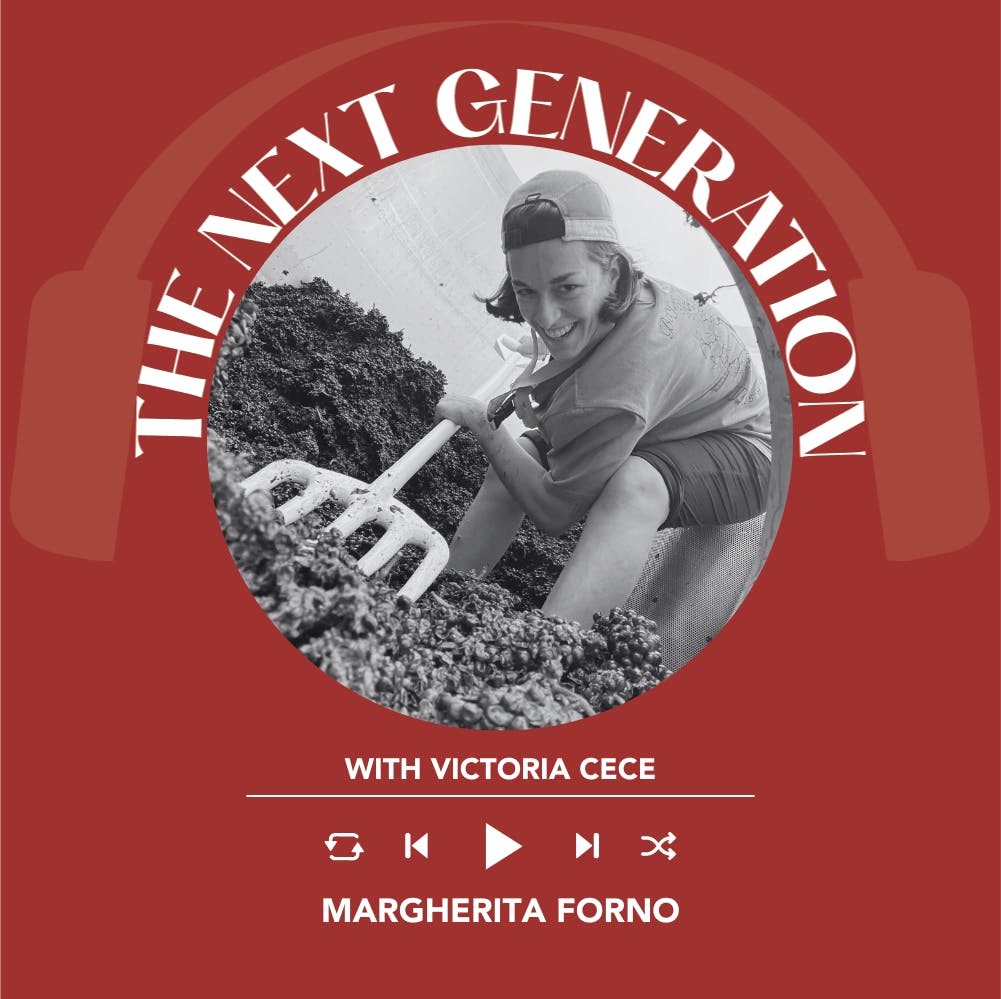
Ep. 1900 Victoria Cece interviews Margherita Forno | The Next Generation
The Next Generation
Episode Summary
Content Analysis Key Themes and Main Ideas 1. The experiences and challenges of young winemakers in Italy, particularly in traditional regions. 2. Life, community, and culture in a small Piedmontese wine village (Santa Stefano Belbo). 3. The balance between preserving winemaking traditions and embracing modern trends and mindsets. 4. Generational shifts in wine preferences and consumption habits among young Italians. 5. The versatility and enduring appeal of Barbera wine. 6. The intersection of personal passions (like music), food, and wine in Italian culture. Summary This episode of the Italian Wine Podcast's ""Next Generation"" series features an interview with Margarita Forlino, a 27-year-old winemaker from Santa Stefano Belbo in Piedmont. Margarita shares insights into growing up in a close-knit wine village and the need to attract more young people back to rural areas. She discusses her personal journey, including her past as a drummer and her deep connection to nature through winemaking. As part of her family's winery, Tenuta Forlino, Margarita is actively involved in all aspects of the business. The conversation highlights evolving wine trends, noting younger generations' preference for ""easy-drinking"" and approachable styles. Margarita expresses her love for Barbera as a versatile grape and emphasizes the importance of sharing wine with others. She concludes by offering advice to aspiring wine professionals, stressing the value of travel, exploration, and staying true to one's core values. Takeaways - Margarita Forlino represents a dynamic new generation of winemakers in Piedmont. - Small Italian wine villages often struggle to retain young talent despite their rich cultural and agricultural heritage. - There is a clear shift in wine preferences among young Italian consumers towards lighter, more ""easy-drinking,"" and sometimes natural wines. - Barbera is lauded for its remarkable versatility, capable of producing both simple, juicy wines and complex, age-worthy expressions. - Working in a family winery typically involves hands-on participation in every stage of production and business operations. - Travel and exposure to diverse wine cultures are considered vital for professional growth and bringing ""fresh air"" to traditional winemaking regions. - Wine is deeply intertwined with social connection, shared experiences, and cultural elements like food and music. Notable Quotes - ""There are few young people here that are going back to the land and try to, you know, grow vineyards and make wine."
About This Episode
The speakers discuss their love for wine and its importance in the Italian wine industry, with a focus on respect for the environment and naturality. They also talk about their favorite bands and their love for wine and the importance of learning and adapting to the industry. They emphasize the need for evolution and adaptability to the industry and bringing fresh and versatile wines to small village wineries. They provide advice on making the best wine for oneself and share experiences to encourage young people to learn. They also discuss trends in Italian wine, including younger people being passionate and wanting to try new wines from different countries.
Transcript
The Italian wine podcast is the community driven platform for Italian winegeeks around the world. Support the show by donating at italian wine podcast dot com. Donate five or more Euros, and we'll send you a copy of our latest book, my Italian Great Geek journal. Absolutely free. To get your free copy of my Italian GreatGeek journal, click support us at italian wine podcast dot com, or wherever you get your pots. Welcome to the next generation with me, your host Victoria Cetje. This is your podcast to learn about all the cool things Italians thirty and under are up to in the food and wine scene. And yes, that includes all the best things to eat. Hello. Hello. Everybody. Welcome to another episode of the next generation with the Italian moyne podcast. I am here today with a very special lady, Margarita Forno, Chao, everybody. How are you? Good. I'm doing really well. Where are you right now? I am in my room in Santa Stefano Belbon. So it's where I'm based and where I live. In Piamonte. Oh, beautiful. So where exactly in Piamonte is that? Santa Seffero is a a little village in between Lange and Monterato region, let's say. So it's in Kunio province. It's, I don't know, like, thirty minutes drive far from Alba, something like that. So really close. And yeah. Wow. That must be beautiful. Did you grow up there? Yes. So my my family always been living here, and I grew up here in Santa Stefano, then I traveled a little bit. I studied in Alba, but I've always been based here. Wow. And can you tell us a bit about, like, what it was like growing up there? Because I know everyone, of course, talks about that area with all the wine and everything, but we don't really talk about this, like, you know, the I mean, we talk about the culture maybe through food, but what are the people like there? It's a good question. They're nice. It's a tiny little town. So we are about four thousand people living here. So, like, we know each other pretty much, you know, in a small village, you know, pretty much everybody. There's not many young people. I have to say, people tend to leave and maybe try to find a job somewhere else, maybe in the city, like in Toronto or Milano, but there are few young people here that are going back to the land and try to, you know, grow vineyards and make wine. And, I like that because, it's a small community, but it's, it's, it's really nice. No. You've actually bring up a really important discussion is that we're discussing an area that's very famous for wine, very famous throughout the world for wine. Yet at the same time, there's still that need for more young people like you to come back and reinvigorate the land. And it's it's wonderful to see you, and I'm sure you have other people in mind that are there doing so, but we gotta get the troops together, you know, get people to come because that's an area that is so special We need all the the young blood as we say in English. Yeah. No. That's true. That's true. Because, there's so many young people that are now interested in, you know, like, go back to the land and, give value to the place they're from and, maybe replant all the grape varieties that have not been used lately. So it's it's really interesting. It's it's fermenting. It's growing. So it's great. To bring the discussion back to the main star of this podcast. You, Hara. So who are you? Tell us about yourself. Wait. How old are you? We always have to ask this on the podcast. I'm twenty seven, but going on the twenty eighth, who were the same age Margarita. I I did. Oh, nice. I need the sample. I did it. I'm twenty eight already, but Yeah. I'll be twenty eight in a few months in September in the middle of harvest. Hold on. Yeah. This baby. That's so sweet. It was somehow written in my history already, you know. Yeah. Born, during harvest and then work with wine. Very poetic. I love it. So tell us a bit about your story. Yes. I'm twenty seven, almost twenty eight. I studied winemaking and beauty culture. I like music. I like playing music. I used to play drums. I like enjoying a glass of wine, a bottle of wine, good food with friends. And Well, I love that you brought up the music element. Because I think something that, like, we notice a lot in the wine industry is a lot of people in wine really love music or play instruments. And, like, I think every time I've been at a winery, there's always been a guitar somewhere you know, some kind of instrument somewhere, or you then you drink too much wine and someone's playing the piano in the in the villa, and you're like, okay. Because Yeah. No. Wine and Music goes together. That's so cool. So did you play the drums from when you're, like, a little can? I played drums for many years, and lately, I'm playing a little bit less just because I've been a little bit more busy doing other things, but I would say until two or three years ago, I was really active. Playing drums. Yeah. Oh, awesome. And, like, were you playing in a band? Yes. I used to play in a band and then I just left the project because I had to choose if I wanted to travel a little bit for winemaking and, you know, get to know new countries and, you know, just travel a little bit or keep playing music and my decision was wine. Oh, that must've been that's a hard decision. I could Yeah. It was so hard. But the beauty of music is you can carry it with you wherever you go and you know, it'll never leave you. So Yeah. That that's true. And I know we should probably get more to the wine side, but I have to ask you. I'm just curious. Like, what are your favorite bands? Oh my god. That's difficult. I can say a few of them. I really love the national? So I love the national. I think actually my favorite band, like, right now, I saw them for the first time in San Francisco, and it was amazing, like, first concert of the national first concert in the US, and I was so so thrilled. It was amazing. And then I used to listen a lot of Italian music. I really like, a band called Verdena, than a, like, a lot of Italian songwriter, like, Fabrice, Ruchodala. Yeah. So a bit of, Italian music, but also Italian new band, fast animals and low kids. Colopecio de Martino. They're cool. They're cool. They play at San Remos, so they are, Italian icons. Are you enjoying this podcast? Don't forget to visit our YouTube channel, mama jumbo shrimp. For fascinating videos covering Stevie Kim and her travels across Italy and beyond, meeting winemakers, eating local food, and taking in the scenery. Now, back to the show. Because I love music. Music's a big passion of mine as well. This is not the music podcast. Otherwise, I would totally just talk about music. Hold on. But it's we can always talk about it offline. With pleasure. Yes. We should. But again, I mean, I I understand, like, a hard decision to only have two passions with the focus on most, but that, you know, begs the question. Why do you love wine? I do love wines because being able to make wines I mean, working in the vineyards and then in the winery and then place the wine, you see all the process and you can really take care of it. For me, it's really important to respect the environment and the nature. And so trying to do things in the most respectful way. I like to work with the nature. I like to see the evolution of the wine, and of the process. And then I like to share wine. The wine is sharing. Like, it's every time you go with friends and you see friends, and there's always some wine or who, I think it's really important. Well, I mean, first of all, I should say that I didn't introduce your winery, which is totally my fault. So, I mean, as much as people can read the show notes in the podcast, I probably should say. So it's. Correct? Yes. Okay. Cool. So everyone knows now what we're where we're discussing. We got the area earlier, but that's so beautiful. I mean, yeah, the nature is like a and, you know, that's a huge aspect of why making that often, you know, people don't necessarily see looking at a bottle and drinking it. So what is your role? Like, in the wine? Are you more in the vineyards? Are you making the wine? Are you doing both? Well, obviously, both is kind of part of the job as a winemaker. Tenuta Feketa is my family winery. So it's a family estate And as a family estate, we do a little bit of everything. Like, everybody does a little bit of everything. But I have to say I mainly spend time in the winery, but I I like to go in the vineyards as well. It depends on the period of time, like, maybe during harvest, of course, if you spend time in in the winery, even after harvest. And then during pruning, I might go out a little bit in the vineyards to help pruning or for example, now the growing season is starting, I think I'll go in the vineyards quite a lot because the work in the winery is a little bit more quiet right now in this period until harvest So I think I will help out more in the vineyards. And sometimes I also do wine tastings at home, so a little bit of hospitality as well. And I also go to the wine fair wine show. So I really do a little bit of everything, like, everybody else, like in the company, let's say. I can imagine, like, family businesses, whether it's wine or not are all hands on deck always, as we say. I mean, businesses in general, I'm sure, but, like, definitely family businesses. And how big is your family? Like, how many people are involved? So there's me, my father and my uncle, my mom, and one of my aunts. So it's five of us. And then, some of my cousin are coming. So they are finishing university and starting to I mean, after getting some experience abroad, they are coming back and entering the company as well, like helping us out. So at the moment, we are five from five to seven from the family. And then we have also other people out of the family helping mainly in the vineyards. There's more job over there. Amazing. And I have, like, an interesting question for you that you mentioned that younger people in your family coming from university and their travels and coming back. Do you notice that their drinking habits are different or like what they like to drink is different? Then you are, of course, like, you know, your zia or of the different generations because, I mean, of course, whether or not they showing the family winery, just do you see a change? Yeah. I think there's some differences just because especially traveling, you might have access to also different wines and different wineries with different philosophy So it might be a more kind of natural wine or something a little bit more conventional. It's interesting because coming back to the fact that I live and we live in a very small village is not super easy to get a lot of different wines out of the wines from the area, and, of course, beautiful, Barolo and Barbaresco, mainly also wines from Tuscany, but I don't know if you wanna try a wine from New Zealand or, from the US, it's hard to find. So traveling, it's maybe easier to get to know different wine styles, different grape varieties. So I think there's a change, there's a difference. And also, I think, nowadays, young people prefers to drink, sort of, like, more easy drinking wines I would say, not in a bad way. Absolutely. Like, a glass that you can drink the bottle and you will still be fine. And you want more. It's not like a super tough and full bodied wine. They wanna drink something a little bit more, you know, chill in a way. I think. Yeah. No. I I'm seeing that as well, and we see that with, like, especially with the wine bars, for example, that are popping up in Italian city is also in towns. By younger people. It's all about really, like, easy drinking Yeah. Juice, you know, a lot of natural wines, a lot of things that, you know, you can sip a lot of bubbles, like sparkling wines. Like pet nuts? In pet nuts. Yep. The pet nut is not going anywhere. As I've learned. But for you, what do you like to drink? I like to drink a little bit of everything. Like, I really like to experiment and to try new things. I'm not afraid of trying cloudy wines, orange wines, or like super oaky wines. I really like to try everything to experiment and to learn more from the wine tasting. But lately, I'm enjoying, more like, light bodied wine, you know, as you said, some sort of, like, juices, something really easy drinking, juicy, a little bit of, acidity, but fruity, something you wanna drink. One glass, two glasses, three glasses, and more and more and more. Yeah. Exactly. That, like, you can be carried on through the night and not be too wasted, but also be nice and Yeah. Tipsy kind of. Yeah. You know, I, of course, and you, you know, working hands on with wine, you know that, you know, there's different wines for different times, different moods, you know, different foods as well. Something I always end up asking about because I'm a die hard food lover. I love to eat. I think we're in a space right now in the world where you know, wine isn't going anywhere in the sense that, like, people still wanna drink and have, like, a we're saying these fun kind of, you know, wines that are like juice. Like, you drink them easygoing fun. But at least I think that's a way for people to be opened up to other things because you know, if you're at a wine bar, let's say they don't have the wine that you're used to drinking all the time, then it opens up the door for somebody to be like, oh, you should try this wine. Yeah. Or, you know, maybe if you're ordering, you know, that dish, you could try this wine, And I don't know. I'm optimistic because I'm based in Rome, and I see so many people love to go out and just try different stuff at, like, different, you know, wine bars without like blinking an eye. But again, that's anecdotal. That's from, like, you know, I'm not doing, like, a case study, but I'm sure with people like you behind the bottles, we're okay. Definitely. Okay. I have to ask because, again, food lover over here, So what's, like, your favorite thing to eat from where you're from? Something maybe your nonna would make? I really love fresh made homemade gnocchi and, lasagna. Mhmm. I think that's the things I love the most. And my nonnas would cook, of course, in the best way I've ever had before. Was it like a traditional lasagna, like a kinda bolognese or was it like some secret Piamonteza, Lazania. Yeah. Yeah. Yeah. It's like, lasagna with ragu, tomato, and meat, and then bechamel as well, and then fresh pasta sheets, and then parmigiano. And then everything cooked in the oven with a little crust on top, soft in the inside, it's creamy. It's just delicious, you know, like, flavors from non cuisine. It's It's just unique. Yeah. It's like a hug, like, an umbrella. It's very oh my gosh. So what why would you pair with that? I would pair, Barbara. I think, yeah. I would definitely pair Barbara. For me, I think Barbara is my favorite grape. Ever. I love it. I love Badvera. I agree with you. It's it's a pretty it's great. It just goes with everything. Yeah. That's what I think. I think it's a super versatile grape. You can make, like, a super easy drinking, juicy wine because Barabera has this beautiful red fruit flavor, always a very nice and good acidity. So it's something really juicy and easy drinking. Or you can get super complex, textural, and full bodied wines, like Nitza, DOCG or something like that. Like, better better supere order, for example. So it's something really a wine you can age for years. So I love it for that reason. It's super versatile and very easy to pair with, with everything. It's like a everyday wine. Absolutely. And especially for a red, which I feel like some people feel intimidated when it comes to reds, especially the because it's, you know, at an upper echelon, but then it can also be, like, the princess, like, the regal wine. Like, it's it can go both ways and I love it. I totally agree. Yeah. So, again, kind of like Barbera. I mean, you're a really versatile gal and you've probably seen many different things from your travels and from working in and beyond the winery. Like, do you see any kinds of you know, trends in the Italian wine business, especially in regards for young people and wine. I see, let's say, two different scenarios. I see some young people really getting passionate about the wines. They wanna learn more discover and they don't stop studying just here. They go abroad and they really are interested in, different wine areas, different grapes, different winemaking techniques and also to try wines from different countries. And other young people not really caring about wine. So maybe they buy super cheap wines, they're not really interested. And, that's what I see, but on the side of people interested. I really admire it, and I think it's a we are going in the right way because especially in small villages is, people tend to stay here. They don't wanna go out because they kind of tried to settle here also for the mindset, a little bit closed mindset. And so seeing them kind of, breaking those rules, going away and, like, trying to learn more and understand more. It's interesting. I think it's it's amazing, and that's what we need to refresh also a little bit the winemaking style here or, bring new tastes and new things from abroad. So even if we come from a very historical wine area, historical wines and everything. So I think it's important to bring some fresh air as well. So, I admire those people, those young people a lot. Oh, Margarita. This is gonna shake up the longue. We I like what you're saying because, you know, it's true. I mean, and that's part of the evolution and wine and food and everything. It's not that things have to change completely and you lose traditions. It's that you evolve and you adapt to the industry and the reality that you're living in. And that's how we've we've enabled where at the point we are with the amazing wines that we can drink and we have access to. And I think that keeping that mindset and having, you know, encouraging, you know, young people to, whether it come back to the land, come back to the winery or just to drink more of these wines and show their choices also and, like, make them feel proud in the choices of what they wanna drink is really important as well. I think we're out of the world where we're shaming people for not drinking certain things. Like, it, you know, it's like, oh, like, you wanna share those experiences and I think it's the most important aspect of wine. Like, drinking wine alone I mean, we've all done it, but, like, it's not as fun. It's usually not in fun moments. Yeah. Exactly. You're not drinking wine alone because we're having fun. It's like, yes. I'm drinking, but you know, I'm crying maybe. Alright. Well, before we wrap up, I always wrap up my interviews with a quick overview of five things in under five minutes where I ask you five easy questions to sum up all the beautiful things we talked about today. And then you're free to go, and you don't have to talk to me anymore. No. Okay. So whenever you're ready, I will start the timer. I am ready. Who are you, Margarita? And where are we with your winery? In Santa Cefano Belbo. And what's the vibe? What's the culture in one sentence? It's, interesting and, inspiring. And what's the dish, the food dish, and the wine pairing we discussed today? Lasagna and Barbera. Oh, so hungry now. Okay. And then lastly, changing it up a bit. What's one piece of advice you would give other people interested in joining the wine industry. Travel, discover different wine cultures, taste a lot of wines, and then, have strong ideas and values and try to make the best wine for yourself. Oh, I like that. Try to make the best wine for yourself. I like that one. Well, perfect. Thank you so much, Margarita. It was really fun chatting with you. Thank you. It was amazing. I loved all the things we covered in such a short period of time. And I wish you the best of luck in all of your endeavors, all the things you have coming up and or your harvest and your birthday. And I hope to meet you in person soon. Yes. Me too, please. Come visit will be amazing to host you here. Show you a little bit around. Absolutely. Alright. Well, enjoy your day, and we will see each other in the long year. Yeah. Thank you. Bye bye. As always, a big Goodate for hanging out with me today. Remember, you can catch me on the Italian wine podcast every Sunday, and anywhere you can get your pots.
Episode Details
Related Episodes

Ep. 2789 ColleMassari: a long-term vision rooted in Montecucco with Giuseppe Di Gioia | On The Road With Stevie Kim
Episode 2789

Ep. 2788 Ep. 14: Austria and Hungary | Study Smart for your WSET Level 3
Episode 2788

Ep. 2785 From Volunteer to Speaker at TEXSOM with Samantha Cole Johnson | TEXSOM 2026
Episode 2785
Ep. 2766 Inside the U.S. Non-Alcoholic Wine Market: What Wineries Need to Know with Jill Sites | Masterclass US Wine Market
Episode 2766
Ep. 2761 Winemaking and Consulting Across Sicily with Alessandro Serughetti | Wine, Food & Travel with Marc Millon
Episode 2761

Ep. 2759 Part 2 – The VIA Educational Program & Italian Wine | Heart-to-Heart Conversation with Sarah Looper
Episode 2759