
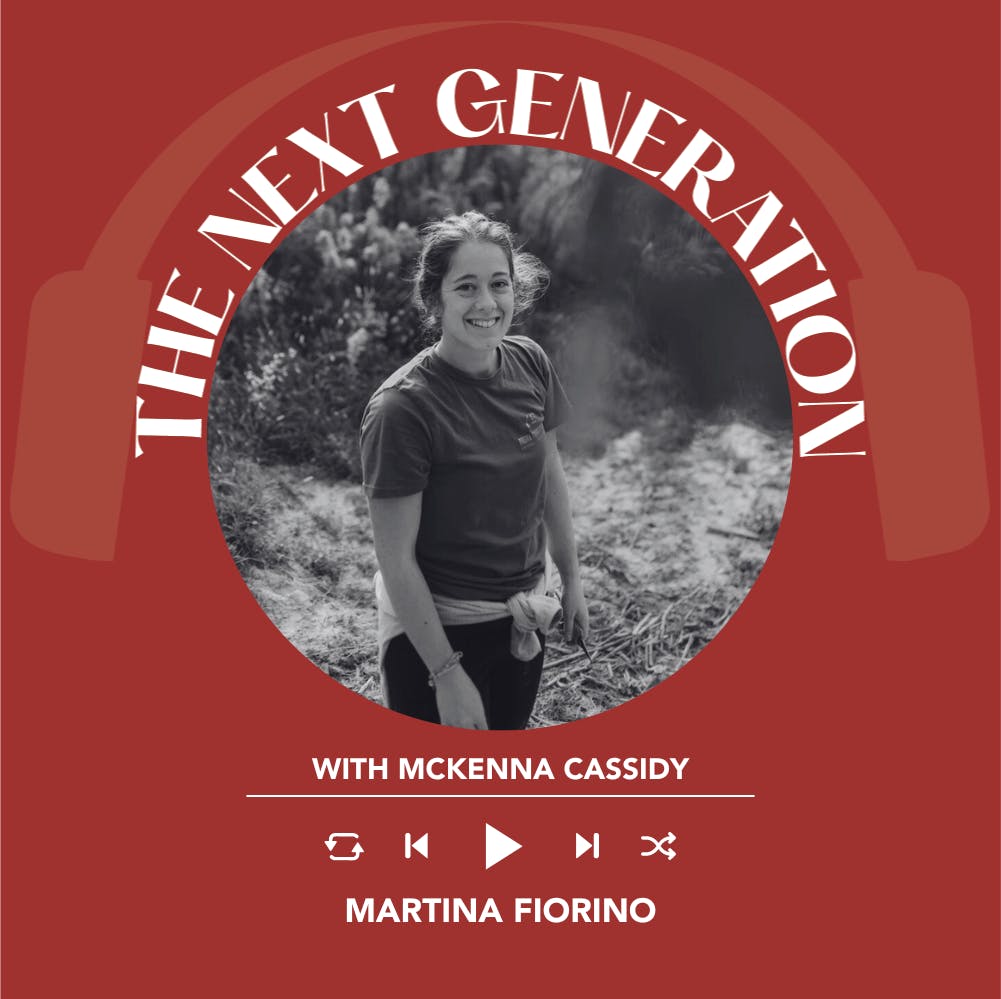
Ep. 1911 McKenna Cassidy interviews Martina Fiorino | The Next Generation
The Next Generation
Episode Summary
Content Analysis Key Themes and Main Ideas 1. The generational transition and collaborative spirit within a family-run Italian winery (Bruno Garmaldi). 2. The ongoing commitment to sustainability and organic practices in Barolo winemaking. 3. The significance of leadership, teamwork, and human resource management within the wine industry. 4. The unique terroir and historical importance of specific vineyard sites, like the Badarina cru in Serralunga d'Alba. 5. The growing influence and collaborative efforts of women in the Italian wine sector. Summary In this episode of the Italian Wine Podcast, host Mckenna Cassidy interviews Martina Fiorino, a key figure in the Bruno Garmaldi winery in Serralunga d'Alba. Martina discusses her role alongside her brother Simone in leading the family estate, emphasizing their parents' support for innovation while upholding tradition. She details their commitment to expanding sustainability beyond environmental practices to include social aspects, and their decision to adopt the traditional Albeisa bottle. Martina also shares insights from her ""Art of Leadership"" studies, stressing the importance of a passionate and motivated team and the broader concept of territorial leadership among producers. The conversation delves into the history and unique characteristics of the Badarina vineyard, emotionally tied to her grandmother's legacy and its distinctive soil. Finally, Martina highlights the increasing presence and collaboration of women in the Italian wine industry, exemplified by her involvement in the ""Baratella"" association, concluding on the perpetually evolving and unique nature of wine. Takeaways - Bruno Garmaldi is a family winery in the Barolo region, with Martina Fiorino and her brother Simone representing the new generation. - The winery is actively transitioning to organic and sustainable practices, focusing on environmental and social responsibility. - Martina views leadership as crucial for fostering a passionate and motivated team, and for cooperative efforts within the wine community. - The Albeisa bottle, unique to the Alba region, is being embraced by Garmaldi for its elegance and territorial connection. - The Badarina vineyard holds deep historical and emotional significance for the Fiorino family, known for its distinct terroir and high-quality Barolo. - Women are increasingly playing a significant and collaborative role in the Italian wine industry, exemplified by associations like ""Baratella."
About This Episode
The founder and his team have been expanding their sustainability and organic farming concept to their industry, creating a new wine brand and branded differently. They have also been studying a course on human resources and leadership and creating a better working environment. The importance of leadership is emphasized, and the community and working with people is also important. The community and working with people is also important, and the relationship between the culture and the new generation is what makes young people attracted to working in the wine industry. The culture of a certain region is a current deletion, and the relationship between the culture and the new generation is what makes young people attracted to working in the wine industry.
Transcript
The Italian wine podcast is the community driven platform for Italian winegeeks around the world. Support the show by donating at Italian wine podcast dot com. Donate five or more Euros, and we'll send you a copy of our latest book. My Italian Great Geek journal. Absolutely free. To get your free copy of my Italian GreatGeek journal, click support us at Italianpodcast dot com, or wherever you get your pods. Welcome to the Italian wine podcast. This is the next generation with me, your host, Mckenna Cassidy. For the next thirty minutes, I invite you to explore with me what young adults are up to in the Italian wine scene. Today, let's face on our discussion of Italian wine, travel, food, and culture. Thank you for being here. Grab a glass with us. Chinching. Hello, everyone. I'm Makenna Cassidy. I'm here with Martina Fiorino. Good morning, Martina. Hi, Makenna. Nice to be here. Thank you for having me. You too. Thank you. Thanks for joining us. Today, we're gonna talk about a beautiful winery based in Sarah Longinalba in Karinsana Kavor. Bruno Garmaldi is the name of the winery founded by a woman Martina's mother. So it's an absolutely wonderful story. We're gonna get into all of that detail. And Martinez is our special guest, because she is a young person in the wine industry, and she has a legacy in this family winery. Martina graduated in business administration and studied abroad as a wine buyer in London. And then she returned to Grangzana Cabore where she is from in the Barolo region of the Longay, to help her family enterprise. Her brother Simone specializes in production in the vineyard management and the winemaking and Martina manages the commercial and administrative aspects of the winery. This, like I mentioned, began in the nineteen fifties with Martinez's great grandfather, but of course, the one that he's named after her mother. So I'm so interested in learning about that story today, and it's very cool because the family works together as a unit while also looking to Martina simone to be the next generation and step up, to eventually lead the winery. So Martina, this is so awesome What is your relationship with your brother, Simone? Like? And, like, how do you guys work together with the rest of your family? It's a it's a great team, actually. We grew up in a farming and a family of winemakers and farmers. We didn't really know we're gonna get into the wine industry together, you know, when you're young, you you don't really know where you're gonna where you're gonna be when you're or an adult, and our parents never push us to study winemaking. So it was really something that came out straight from us. So we decided to this was our path, and we wanted to be together. And I'm very, very lucky because, my brother is a is a great leader for me, great mentor. He has a very in-depth knowledge of Waimec image culture. He's very passionate about wine. He's also worked in New Zealand, for one, harvest, before joining full time, the family estate, So he's for me, my shoulder. So we are a great team. We support each other. And also our parents really, leave us freedom to to make changes to invest. To decide to change things. So we were also lucky in a way that our parents are very flexible, with our new ideas and things that we want to to improve and change. Oh, what are some of those ideas? We have been changing it quite a lot of things. So, of course, switching to sustainability, organic farming that started with our parents, but we really are taking these as a serious topic for us. So we're really, you know, expanding the concept to obtainability to a much bigger to many aspects of of our industry, I would say. So not only in the environmental part, those the socials is gonna be these, so people work with us, how do we educate them to about what we're doing, why we're doing things in a certain way, and also we we change the the bottle recently in twenty twenty. We switched to Alyssa bottle, which is something that my brother and I really wanted to do, to use a bottle of this territory, which we think he adds value to the wines. And we also revised labels. And, yeah, So small steps, in a family estate, you know, it takes time, but we have clear ideas of what we want to do. And, yeah, so it's it's a nice, it's a nice team. And, yeah, we get along together quite well. We have different backgrounds, which kind of convey together quite well. So it's, it's nice. I'm very, I'm very lucky. Wow. That's great. I remember backing up a little bit. I noticed you mentioned the albisa bottle. I remember that, Renato Rati invented that shape of bottle. What about it and its connection to Barolo inspired you to switch to that bottle shape? What bottle shape were you using before? It was the borderless, bottle, like, bordeaux wines type of bottle, which Mhmm. It's it's also, well, like, glass in terms of doesn't have really an impact on the quality of the wines. It's mostly, you know, about the communication and, positioning of the wines. Yeah. And since we are one of the few regions to have a specific bottle for the ablations of these area. So the wines of alba, then, it would make sense to to use it. Also, the shape of it, it's very, I think, it's very elegant. So somehow reflects the elegance of the wines of these of this area. Yeah. It has, like, such a powerful and bold shape, but with the softer shoulders, it's definitely unique to its place. It has a different, like, slope than a burgundy bottle, so it doesn't look exactly the same as that. It's very interesting. I I love that about your wine making region. I just think it's cool that it's so unique there. I mean, not every wine region is blessed with, like, its own glassware as well. So Yeah. Exactly. That's pretty cool. It's quite cool. Yeah. So I noticed that you so you went to the university. How do you say this? Yeah. Blah. I don't I don't speak with Swedish. I pretend too. So give me three. Yeah. Yeah. I did want to I went to attend a Swedish course, when I was there, but then I quit after the second class because I couldn't I couldn't do it. It was so much. I only know how to say it's called upstairs because We, yeah, we had a lot of fun. That's a good thing to know. And I I kinda like stalked your LinkedIn. I admit and you, like, had a class called the art of leadership. What was that? Do you recall kind of what that class was like? So when I, decided to to study in Sweden, I spent there one year of my university time, and I mostly studied subjects like marketing brand brand management related subjects. And then I picked the art and leadership course, because I think human resources are quite an important assets of any organization in any kind of industry, and, So it was quite interesting to to learn how difficult he is to, you know, it's easy to read on books that, leadership, how to be a leader, but then, putting that into action and in the working environment is not that easy, and that is actually very important because if you are able to create an environment where people are, passionate, motivated and also committed towards the same goal. Whether it's a clear region, a clear mission, then, the atmosphere is much better. It's much easier to to reach goals and also create successful, working environment, which I think it's what matters the most these days. And I think in our now our industry is quite important because especially in this region there is, like, human resources are key to to any, winery. I guess we need a lot of, passionate people willing to to work long hours and to commit, for an entire season. To to vineyards, tre attending to to vines and, getting fruits back in the winery and turning that fruit into into wine, just then able to tell people around the world a lot about season, what has been done in the vineyard, but it takes a lot of time and motivation to get to that result. Leadership is, is very, very important for the ability to get the team together and make them feel part of it, feel part of what we are all working towards. These I think, the top, the leadership, applies to small estates these topics, applies to smaller states like ours, but being in a territory where we, where we produce wines and producer are somehow bringing the territory around the world through through wines. I think leadership should also applies to this bigger concept of, work all producer working as a team to promote our land. So more about the territorial leadership, so cooperating as a team between producer to bring the application to the next level, and creating more value. Yeah. And especially too, you talked about your community on-site at Bruna Grumaldi and making, like, a group of people motivated towards the, a goal together. And if you're managing those people, like, the ability to lead them towards that goal, like, you just mentioned is super important. How would you characterize, like, the mission of your winery and then How do you picture the Barolo area innovating in a similar mission? Well, the the mission is, of course, well, the vision, before the mission is, division is producing authentic wines, which, you know, are low intervention wines, sustainable wines, respect environment people. You know, they they are able to be the expression of folk, the the the the culture, the tradition of people, the tradition of this region. But at the same time, they need to be clean. You know, Ace is available. The mission is having a team on board, which, is of course, the mission is working, yeah, together as a team and reading, explaining what we're doing and why we're doing this way. So, also, the the switch to to organic for us it took a lot of time and it takes a lot of effort in the vineyards. So being able to communicate that and making everyone aware that we're doing this because it helps us as human beings. So it's a lifestyle choice, but also helps find, and helps the overall market and also the word itself. And, in terms of, the territory, we, I think, this region, because we, we work with very prestigious ablations. So we have a huge commitment. I think we, we really need to you know, take this as the starting point. We work with some of the most important populations in the world. So we must adapt and improve. And I think there is, all all producers are paying a lot of attention to these topics to, you know, improving the working conditions, improving the way we work in the vineyards, sustainability in a three hundred six degrees perspective, which I I think especially, the new generation I I belong to the the new generation, I would say. We we we tend to work together a lot and to actually share ideas, projects. So it's quite cool. To see this great corporation coming up, which I think it's probably the future. The future is working as a team, to to grow even more, and create more awareness about what we're doing. In this region. Yeah. Which wineries, who are your neighbors? Also have young people helping run them. So I have a group of friends. I'm a member of an association of, young women and wines. So under thirty five years old, it's called called Baratella. So I have a nice group of friends who are from Midmo, from the language region, but also from all over all over Italy. So it's quite a cool, association, which I'm very proud to be part of because it's also a nice, playground to grow, you know. So it's a way to to share ideas and see what we can do to to move harder. And so but also in in this region, there are a lot of wineries and we're friends of. And so we we kind of get together to see what we can do together. That's so cool. Scott Vatelllet. I've never heard that. How many women are in this group? It's around hundred hundred and twenty. I think. Just growing. It's growing very fast. So I I'm not up to date with the right numbers. So he was born. I was actually it originated in Piedmont. It was an idea of a Somier from my eyes. So he started selecting young women in wine, and then actually founded it to all regions in Italy. So we do an event every year in, in June, in, San Martino Alfieri, so about thirty minutes from from the Lange area in the Asdi area, where around sixty producers will show their wines. They come from all regions, in Italy. It's a way of, you know, getting together, also bringing this region wines from other regions and showing like, how the, the evolution of women and wine is growing. So there are more and more, women, coming up in the wine industry, more than what used to be with my mom and with my mother, with my grandmother, with my great grandmother, which at the time being, a woman, a woman working wine industry wasn't so popular and also respected, I would say. So now things are are changing, and it's, it's a beautiful It's a beautiful, yeah, team, to be part of. That's so cool. I'm on a group of women and women's spirits in the US, and it is just such a place that everyone comes with so much energy to this group. Like, everyone just wants to contribute and share ideas and have male allies as well. And it's so important. It sounds like this was actually founded by a gentleman, and then now it's run by the women. So I just think that's fascinating thing. Are you enjoying this podcast? Don't forget to visit our YouTube channel, mama jumbo shrimp for fascinating videos covering Stevie Kim and her travels across Italy and beyond, meeting winemakers, eating local food, and taking in the scenery. Now back to the show. Like, your winery really centers on women as well. I know that your mom is involved in similar groups like this. And then, of course, the Badarina is a famous crew that's specifically, connected to your family. I think it was nonna Clatta, your grandma? Yeah. So this is so cool because this crew is its own DOCG, in this area. And I was just wondering, I I know it's Southwest facing. I was just wondering if you could comment on the connection between this crew vineyard and the women in your family. Yeah. Oh, for sure. So Badarina is a is a place, I would say, like, the emotional vineyard is a place of heart, you know, because that's where my, grandmother's my grandmother was born, in nineteen thirty nine, and she got married with my grandfather. It has it was a rejoining from Green Takawood, which is where we're located now, but she brought two actors' vineyards into the state. And on time, having two actors of vineyards in Sinalunga wasn't something to be proud of, but we always remind remind my partner about her every day that he was a smart, smart guy because, Yeah. But, Dana is actually the the vineyard that has always been released a single vineyard, since the very first days. And the micro mother, she was born there for so for her seeing that this wine is being, modified and sown and is being appreciated all around the world. It's it's a huge pleasure, you know, because she she worked hard when she was young. In the vineyards with her family. She spent her childhood there, and, she she remembers that, all the time because her family was making their own wines, out of their the vineyards. And, she remembers the times, you know, in the springtime after the harvest when the the brokers were going over for lunch, to discuss pricing and to taste the wines. And the wines from that area to the East Coast of Sarlunga were always, being paid a bit slightly higher price because, they were, mostly used to to add a bit of more structure and attention to wines from other areas. So we're mostly blended in, into other wines. And so she remembers that the time that the brokers were going over, her mom was cooking, tiring, as the egg made, handmade pasta. And, chicken, cancellara, which, you know, at the time, being able to eat a meal like that was a real treat, because, it wasn't like, every day like that. So for us, Badarina is is the authentic expression of Stralunga, and today is, one of the hundred and seventy MGA, of the Brolo area. And, it's the highest point of Sarlunga, so quite, quite a cool spot, facing on the East Coast. So facing south southeast for small part also is, which goal was always released as a single vineyard, very, distinctive character from the rest of the the vineyards that we farm, which are mostly located in the northern parts of the Peru area. Okay. That's fabulous. Thank you so much for sharing that for my wine nerds out there who are in the via community. They're gonna appreciate the reminder that the soil here that she's describing in this place is the sand cemented with limestone layers. It's called, formazione de Laquiao, and that's the team in New York City. So it's the oldest, which is just, like, it's just a law. So I just Yeah. It's the oldest, so in the region, wines of the Lunga are always kind of different. In Salunga, you get attention and an energy, which is, and also aromatics are very different from the rest of the rural area. You get some kind of balsamic herbal notes which you rarely find, as well. So the the soil there is reaching the limestone, sandstone, which is, so sand cemented with, stone, and alkaline pH. So you get this beautiful, morality, and also I I like to call it energy, versatility in the wines, linear wines, which, really differs from the North Western part. Absolutely. So it's quite, cool. So my my grandmother, she's eighty five years old, this this year, and we like to to call her Patarina because she still has the energy and attention. Same as the wine. So I always love her. Like, I know why you're from Valarina because, you know, the wines are like you. You're you have a lot of tension and she she always makes, make herself heard. We know we know issues. And, she she recalls, all the time. She's been there. So it's, yeah, it's quite, an authentic, story to hear about. So if I look up Baragina on Instagram, it's gonna be like her Instagram account. Right? Yeah. For for Baragina, there is nothing else. I'm just kidding. Yeah. So I'm just curious, it feels like, and not to, like, over analyze, but it feels like there's this cool attraction between the youth and, like, the elderly or the timeless or, like, tradition. And I'm just wondering what you think might be the the obvious, perhaps, connection between those two that makes young people attracted to working in the wine industry. Yeah. I agree. So I think, tradition is what we the new generation, so thinking also my my my brother and I as an example. So we look at we look at the relation as being the guideline for us to improve and be actually a tradition, which is actually set on what we get today. So it's a current deletion actually because we, are trying to do what has always been, like, producing wines from indigenous grape varieties of this region because those belong to our tradition. So if they've been planted in this region, there's a reason why, because previous generation have, and they understood that those grape varieties were performing better than others. It was, for them. This microclimate was more suitable. So taking that that tradition of specific great varieties and trying to make the best out of it, with the conditions that we get, today. So I think that's that is what is attractive because somehow you are actually producing something that is not very breathable as wear. So it's the unique relationship between the culture of a certain region, folklore, it's human factors, great varieties, microclimate. So something wine is something that connects all these things together, and you can get a unique product, which cannot be produced elsewhere. So that is the cool thing about wine, which will probably make, push young durations to, to choose wine and not get tired of wine because there will never be a wine like the other. There is no vintage like the other. The wine will always evolve in bottle from one month to another, from one hour to another in a glass. So and, also, there is always, all the time, any vintage, there is a new story behind the wine, new seasons, so new challenges, which, somehow will impact on the final product. Wow. That was really well said. Thank you. Yes. Changes the constant. That's wonderful. Well, I can't thank you enough for, offering your expertise and your experiences and storytelling here today, Martina. I wish you and your family, much success and joy Thank you, Mckenna. And I look forward to talking with you again soon. Thank you. Thank you, Mckenna. It was very nice, talking to you, and, hope to see you soon in the language region. Tante, graz. For joining me today. Remember to catch our episodes weekly on the Italian wine podcast. Available everywhere you get your pods. Salute.
Episode Details
Related Episodes

Ep. 2789 ColleMassari: a long-term vision rooted in Montecucco with Giuseppe Di Gioia | On The Road With Stevie Kim
Episode 2789

Ep. 2788 Ep. 14: Austria and Hungary | Study Smart for your WSET Level 3
Episode 2788

Ep. 2785 From Volunteer to Speaker at TEXSOM with Samantha Cole Johnson | TEXSOM 2026
Episode 2785
Ep. 2766 Inside the U.S. Non-Alcoholic Wine Market: What Wineries Need to Know with Jill Sites | Masterclass US Wine Market
Episode 2766
Ep. 2761 Winemaking and Consulting Across Sicily with Alessandro Serughetti | Wine, Food & Travel with Marc Millon
Episode 2761

Ep. 2759 Part 2 – The VIA Educational Program & Italian Wine | Heart-to-Heart Conversation with Sarah Looper
Episode 2759