
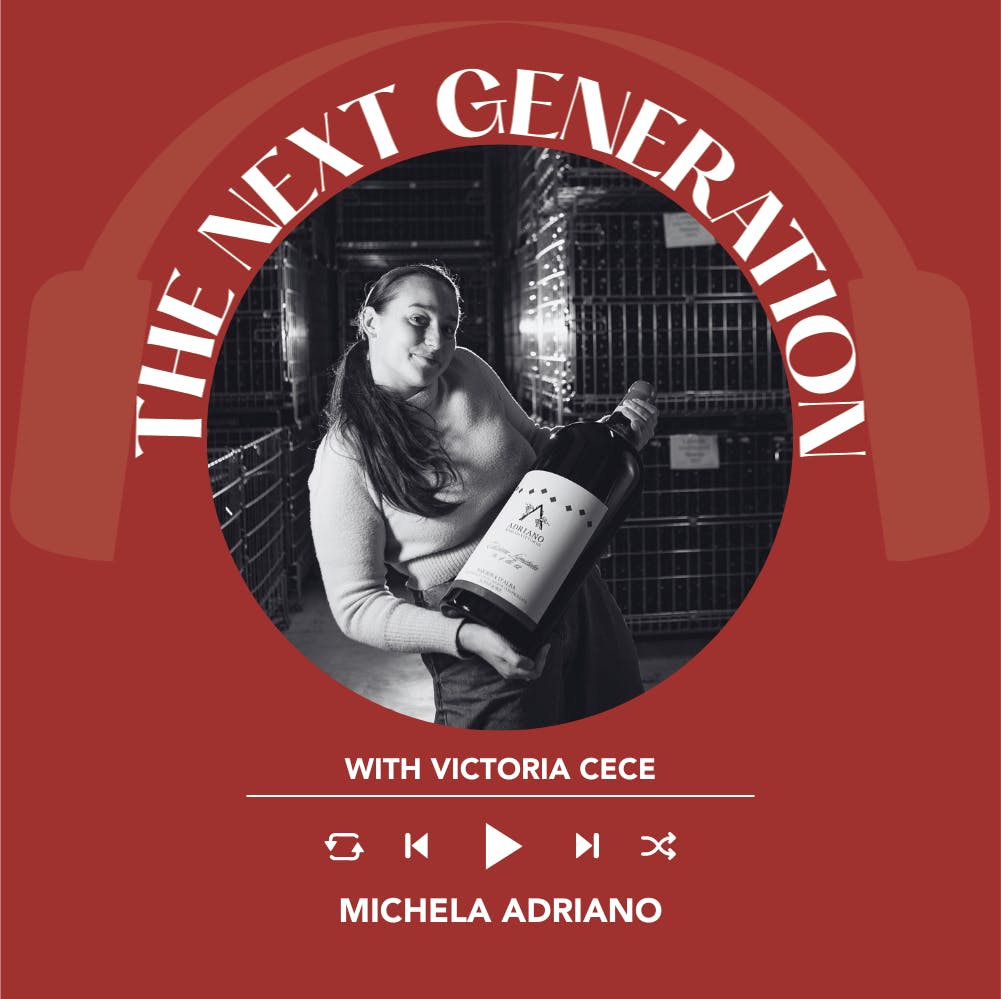
Ep. 1921 Victoria Cece interviews Michela Adriano | The Next Generation
The Next Generation
Episode Summary
Content Analysis Key Themes and Main Ideas 1. The journey and role of the ""next generation"" in Italian family wineries. 2. The importance of family legacy, teamwork, and tradition in wine production. 3. The cultural significance and unique characteristics of Dolcetto wine in Piedmont. 4. The regional food and wine traditions, particularly the ""Miranda Senior"" (Piedmontese aperitivo). 5. The concept of wine as culture, history, and a medium for storytelling. 6. Optimizing wine tasting experiences (e.g., morning tastings). 7. The multifaceted nature of working in the wine industry (vineyard vs. cellar vs. commercial). Summary In this episode of ""The Next Generation"" (part of the Italian Wine Podcast), host Victoria Cetje interviews Mikaela Adriano from Adriano Marco & Vittorio winery in Alba, Piedmont. Mikaela, 29, discusses her ten-year journey in her family's winery, emphasizing her passion for vineyard work and commercial roles over the cellar, which gives her anxiety. She highlights the crucial role of her large family and a dedicated team in building the winery over three generations, particularly celebrating the 30-year anniversary of their cellar, founded by her bold grandparents. Mikaela shares her mission to give value to her family's past sacrifices and promote wine as culture, history, and a shared experience, especially to younger generations. She fondly presents Dolcetto wine, particularly their ""Aldo"" named after her grandfather, as the true ""blood"" of Piedmont, linking it to the traditional ""Miranda Senior"" aperitivo with local cheese and salami. The conversation also touches on the best time for wine tasting and the diverse culinary offerings of Piedmont. Takeaways - Mikaela Adriano represents the ""next generation"" in Italian wine, balancing tradition with modern commercial roles. - The Adriano Marco & Vittorio winery is a testament to strong family bonds and teamwork, celebrating 30 years of winemaking. - Dolcetto, though often overshadowed, holds deep cultural and historical significance in Piedmont, serving as a daily wine for farmers and families. - The ""Miranda Senior"" tradition highlights the essential link between Piedmontese wine (Dolcetto) and local food items like cheese and salami. - Morning is suggested as the optimal time for wine tasting due to heightened sensory perception. - Working in wine is multifaceted, allowing individuals to find their niche, whether in vineyards, cellars, or marketing. - Wine is presented not just as a drink but as a vehicle for culture, history, connection, and storytelling. Notable Quotes - ""Actually, the nose and our mouth in the morning before lunch, they should be more ready to taste the wine without are being already compromised from lunch or other things during the day."
About This Episode
Speaker 1 and Speaker 3 discuss their love for the Italian wine industry and the challenges of tasting wine in the afternoon. They also talk about their personal background and the challenges of working in a vineyard. Speaker 1 talks about their family's winery and how they see the future forward in bringing their legacy. They discuss their love for the wine industry and their desire to preserve family legacy. They also talk about their plans to visit Deltchester and experience the Delt ethic.
Transcript
The Italian wine podcast is the community driven platform for Italian winegeeks around the world. Support the show by donating at italian wine podcast dot com. Donate five or more Euros, and we'll send you a copy of our latest book, my Italian Great Geek journal. Absolutely free. To get your free copy of my Italian GreatGeek journal, click support us at italian wine podcast dot com, or wherever you get your pots. Welcome to the next generation with me, your host Victoria Cetje. This is your podcast to learn about all the cool things Italians thirty and under are up to in the food and wine scene. And yes, that includes all the best things to eat. Hello, everyone. Welcome back to another episode of the next generation. Today, we are here with Mikaela Adriano. The Adriano Marco Evittoria winery. In in Alba. So we're taking a little trip to Piamonte today. Tao. How are you? How's it going? Where are you right now? Are you in Piamonte? Yes. I'm in Piamonte. Actually, I'm in our tasty room. So nobody's coming to interrupt me. Not yet. Not yet. Do you have, any tastings today? This afternoon, but this morning was great. Right? It's eleven in the morning. But, you know, I don't I don't I wouldn't turn down the tasting at eleven in the morning. I think it's it can be hard, but actually it's the perfect time to do it. Really? But, I mean, people prefer in the afternoon always Why do you think it's the perfect time? Actually, the nose and our mouth in the morning before lunch, they should be more ready to taste the wine without are being already compromised from lunch or other things during the day. So, I mean, this is what I learned during doing so many course. And then I compared doing casing of wines in the morning in the afternoon. And actually, I felt I was feeling more things in the morning, but sometimes it's hard. Oh, no. I understand. But that that makes complete sense because we're so overwhelmed by so many aromas and like anything even pollutants during the day from being out. I mean, I'm speaking from living in a city that your your whole, you know, sensory capacity is is, yeah, that makes it lots a lot more sense to do it right in the morning though. I know wine for people before lunch is a little bit, like, what? But I you're you're bringing back memories to when I did a trip with, via I was a coordinator for a trip and we went to umbria, and we had, crazy days of, like, six wineries, seven wineries a day. And I'll never forget, like, the full spread in the morning for the, like, a tasting of montefalco Roso and Sanarantino, but, like, at nine thirty in the morning. So you're, like, my I was definitely able to smell and taste everything. And I was, like, I don't know how I feel with Sanarantino at nine thirty in the morning, but but I definitely tasted it. I could tell you that. Okay. Super. I I already see. Sometimes I had to do a tasting at eight AM with the journalists that the only ad that appointment time with me and it was a little bit, worried because I was like, come on. It's eight AM. But at the end that they seen, it was really memorable. I I really felt my wines that they were more expressive, so I was super happy about that. Yeah. And I feel like everything like, tastes and smells better in the morning. I mean, of course, it depends on what side of the bed you wake up on. But I feel like there's a sense. Maybe I'm speaking a little bit too spiritually here, but there's a sense of optimism in the morning. Right? Like, when you go for that cup of coffee or or maybe the glass of tea, I know it's just a tasting, but it's like you're you're really looking for the smells and it's it's it's it's definitely more It's kinda like how the morning sun hits you in the morning. It it it really hits different. Like, you feel it. You're like, so I don't know. Maybe this is something Yeah. Yeah. We, yeah, we never I think people need to talk more about this, be a little bit less you know, I'm not I'm not promoting drinking in the morning. It's tasty. No. No. It's not good about tasting. Just to clarify to appreciate wine and start early. Yes. Yes. Oh my god. Fabulous. Well, anyways, let's talk a little bit about you, mikaela. So tell us about yourself. How old are you? What do you do with your your family's winery? Okay. So, I would be twenty nine this year. And in July, there would be ten years that I'm working together with my family, making wine and promoting it. Since when I was very young, I was always saying, I was the my parents' job. So this was always my idea. Then probably in beginning when I was a child, I was more imagining to me to be in the cellar doing the winemaking. But at the end, to me, working the wine cellar is not super passionate. I just prefer much more the vineyard works. But when I started ten years ago here in July twenty fourteen, just after the high school, I had to learn something on everything because we only make mine with our vineyard. So it was important for me to know everything we do in the vineyard, everything we do in the cellar. So first two years, I was totally in the production part to learn everything. And then because my dad and my uncle already were doing that part very, very well, they asked me to follow the commercial side because we needed someone to promote, like, a brand ambassador for us. And so, then I started to travel a lot, promote a lot of wines, started to do a very, cure the communication and a lot of promotion also to make people. Come here to understand our philosophy, taste the wines here, enjoy our, our seller. So now, actually, what I'm doing is doing the general management about the the the winery, especially the commercial part and the communication part. But, yes, if I still have a little bit of time, I much I like I like so much to go in the vineyard. I feel it's just super nice connection, and I feel also very lucky because I don't think there are so many jobs like that one. No. I agree. And I think you bring up a really interesting point about working in wine as it's so multifaceted. Like, you kinda you can there's, oh, there's a place for everyone, and you also don't have to stick in that place. Like, you know, you're working in the more brand ambassador marketing side and then being able to be in the vineyards. Like, that's such a beautiful balance. Because it can be so exhausting when you're too much in either side. Sure. Sure. I really feel that sometimes when I come back from, like, two weeks of travel, and I met so many nice people because I had to tell that one word It's amazing for connection yet with people because it's always amazing people around. But sometimes, just to be alone in a vineyard, just one hour, it's super, super recharging your energy so much. So that yeah. Then I can find the balance again. Yeah. There's nothing like getting in touch with the great babies. They're like they wanna connect with you. Okay. Yes. That's so beautiful. And can I ask? I know this is a bit of like not controversial, but a little bit, I guess, like, a question a bit. Plamica, but, like, why didn't you enjoy the working and the seller? Actually, I do. You know, I mean, I feel the working, the seller more stressful. I mean, it makes me more anxiety because I see I can make more mistake. I mean, even the in the vineyards, if you do a mistake, you can compromise the the one you're getting. But I don't know. In the center to me, it's more very, very tidy work that's to me. It's a bit too anxious. So in the cellar, I go to have, our white maker, Jacamo. We taste the wine together to to compare our opinion to see if the style that we want is there or if we need to do something. And that part, I love it because it's always super interesting to see from a juice of the grape, how it transform me wine, But really do the work in the cellar, you know, it always made me a little bit anxious. I don't know why. In the vineyards, it's different to me. It's it's funny. I wrote to each as one's own, like, certain things, like, you know, like, some people are afraid of working in vineyards. They hate bugs they're afraid to cut themselves on shears, but ever, like, everyone finds their own place. And that's so special. I feel like you you have honestly one of the best jobs, like, to be able to travel and do the face forward and then to step back and hide in in in the vines and kinda breathe from all the, you know, chaos that is there is with marketing wine, which is a whole other discussion before I get inside kinda wanted to ask, like, can you tell us a bit about your family's winery? Like, what's the vibe? What's the mantra? What's yeah. I'm so sorry. Yeah. So I feel that we are quite lucky because we are a big family. I was trying always to be a big family. So this helped a lot us during so many hard years that sometimes this job you can find. And the other part that we are lucky is that we work with nine people all year long. And with them, we could build another bigger family. So I think when when you speak about teamwork, it's really what I feel here because everybody is doing a small pieces of the puzzle. But at the end, this puzzle is really big, and you can see, that it's worth of it, at the end, you, when you find the result and you just share a bottle of wine altogether after a long day of work, you can really see that everybody is satisfied and active. So I think this part of the family was always something very, very important for us that everybody could feel. Also, what we're a lot is, the place where we are. So Actually, my grandparents, they were, shell Cooper, in Italian in Pimon, and we say, Mitsadri, they were working like farmers, someone has land, and they were getting paid, not with money, but with the the product they were making. In the forties, in the fifties, in the sixties, it was super common to be like that. But they were a little bit worried because the condition of their life wasn't very, very nice, and so they wanted to give a better future for the kids. And so that's why we are here because in sixty eight, they were super super brave because they decided to make a loan with the bank and buy their first Cashina. So when we say Cashina, it's always some land with the house. Mostly like a farm. And so they started here with the vineyard selling grapes. And their example was really like everybody together small pieces day by day, step by step, you can really make something big. Because after they work for ten years with the vineyard selling grapes, then they grow, their kids. And two of them, Mark Vitori, that you now find in the name of our company, decide to keep going this business and start to make wine. So this year we're celebrating thirty years anniversary of our seller, and I think this celebration would be a nice event that I want to to say thank you to my grandparents because if it wasn't for them, that that day they started with zero with nothing, we won't be here. And their huge example to me was, like, really that even if you don't have nothing, if you have a good team behind and everybody make his own piece, the small piece, step by step, you can really build something good and big. That's so beautiful. That's so special. Thank you. Thank you. Oh, that's like Yeah. And to have that that family legacy something so precious. It's it's that's I and now I I mean, of course, I understand why you wanted to be part of the the family business. Before, but now it it resonates even more because it's it's continuing to build that piece into the future for the next thirty years. Yeah. Yeah. Which obviously, are you working, in the brand ambassador marketing side, you see you know, is a completely different animal now than the past thirty years because Yes. Piamonte has changed. I mean, not just Piamonte, but the in wine industry internationally has changed. Are you enjoying this podcast? Don't forget to visit our YouTube channel, mama jumbo shrimp for fascinating videos covering Stevie Kim and her travels across Italy and beyond, meeting winemakers, eating local food, and taking in the scenery. Now back to the show. So how do you as someone's the next generation carrying on this legacy, how do you see, like, the future forward in bringing that? Especially bringing your wines and introducing your wines to other young people like yourself? So what I feel on me is that in the past, like you said, my grandparents, my family, my dad, my uncle, my mom, and my aunt, they did so many sacrifice. They worked so hard to build this. They never, at the time, to give value of what they did. So I feel like I have a mission, and I think my mission is to give value of what they did in the past. And so this is what I'm working also on promoting communication because I think it's we're lucky that now, longer where we are in Timonte. It's a super, super nice, area of a wine area with, so many different wineries altogether. And I think the new generation, like I am, mission is really to give the value and preserve what our the other generation did in the past. So when I see young people, I just want that they understand that it's not something that you drink. Of course, it's something you drink, but I think it's important that they go back on the history of why the wine was made. That wine is, something that you share with your family, with friends, is something that goes with food very well. It's good to to drink with food because you're also better for your health. I just want the bear, the santa is not something, only a dream, but it's part of a culture. And wine is culture to me, and it can tell you so many stories. So it's something that can really go behind the glass, you can discover so many interesting things. That's really true. It's it's a beautiful beautiful metaphor because there's so much history in in any wine in every bottle of wine you produce. And I feel like This makes me wanna ask if we were to sit at a table together and you were to introduce me the story of your family, what wine would you pick and which maybe food dish would you pick to go with it. Okay. To me, this is a super easy question. Because the wine and the food already came in my mind. Fantastic. So I'm imagining us around the table, of course, with a bottle of dulce de dalva that we name it Aldo. Aldo is my grandfather name that they just call him. No. No. Of course. Because Doceto Dalta. I think it's the wine tradition. So here in Piedmont, the house, what is super famous is, of course, Nebulaiola grape with Barolo, Barbara. There are these wines, But, actually, these wines are telling a story of a farm, area. And the farmers used to drink so much of Dolceto wine. And even my grandfather now, he's ninety two. He's still drinking one glass for lunch of doncito and one glass for night. And if he doesn't have doncito, it can get very angry. So doncito is the one. So some people still saying that too if you are real and you cut a vein. You don't have blood coming out, but you have to Cheto. So I think this thing is super, super true because Cheto was really part of a culture and is I think a very interesting one to to try because, in Piamonte, you can find so many different, characteristic in Delchester. Imagine that still now we still have ten different appellation always made with Dolceto because they are it's a great that is very well in different areas, but, of course, making different wines. And so to me, Dolcito will be telling the story of Pemonte, of the tradition, And it's the perfect wine to put on on the table with food because it's always good from the starter to a plate of pasta or something else. But I think the perfect thing is to do with that. So We can say Miranda senior is a grandparents of aperitivo because, in Piamonte, they used to do this Miranda senior. That was, like, at six PM. Just having some salami that every family was making, of course, with, some two man that is our typical cheese, some good bread. Everybody was making this in the family just to cut and offer to your house and open about all the chito. And I think that match is super traditional. Also very easy, but super, super, super satisfying and so enjoying with your friend to just start a chat, enjoy the night, enjoy a glass of Dolcito and some salami in tomorrow. I mean, what else do you want? And I have to say I'm so happy you brought up Delceto because I feel like Delceto needs so much. I mean, people know about Delceto. It's not that it's, you know, completely unknown. But it definitely sometimes, like, gets a little, you know, lost behind, like, you're saying, like, Napiola or even Barbera. Like, I feel like people are I love Barbera, but, like, I feel like people are more to say, oh, that's, like, the Piam Monteze, like, you know, stable, but Delceto really is, like, like, I love that analogy you gave if you cut the vein open, it would be Delceto. Oh, my god. That's fantastic. Now I really is I really want to meet Nolo Aldo. I mean, He sounds like the best guy, like, and it's so it's so relatable that he gets mad if he doesn't have his why. I feel like now I feel like I'm sitting at the table and I need to come visit you and have this together and experience all the good things. Because also you're you're in Cornell, which is famous for cheese. You guys have it all. Do you have like a favorite cheese? Yeah. Yeah. Me too. This is hard question. Italy, I love cheese in general. I think my favorite cheese are goat cheese, so but, I mean, I'm happy anywhere anytime with cheese. Is there a lot of goat cheese there or is it mostly like cow milk cheese? Most of the time around here, it's a mixed cheese. So sometimes you have sheep goats and cow together. Mhmm. Some of the typical cheese you can add, it is like Rascara or sometimes I mean, no. Sorry. Most of the times, it's calm. It it it depends a little bit on the area. Like, there are two small, villages in Alta Lanka. Like, one of them is called Murazano. That small village is super famous to have a a small cheese made with goat cheese, and they think it's always super super super tasty. So it depends, but, yeah, we are lucky because all around here in the hills, but also then in in the Alps, in the mountains, that it's only one hour and a half to drive far from here. There are so many different type of cheese and very high quality. Wow. Look at that. Everyone to everyone listening, we just gave you the trip idea of a lifetime. You're gonna go to Alba. You're gonna go visit Mikala at her family winery, and you're gonna have amazing tasting at eight in the morning. And then you're gonna go and pick up all the cheesy with your dreams, hang out with the sheep, the goats, do whatever made yoga, you know, people do goat yoga, and then you're gonna have a beautiful time in in, like, come on. There's nothing else you want. I I can't think of anything better. Yeah. Yeah. And if anybody needs any recommendation, we're to day, where to eat. Just asking. I would be super happy to give you my favorite spot. Amazing. Well, Mikaela, it was so wonderful chatting with you today. It was really nice to get to know you and your story and talk about cheese for a minute. Finishing on cheese is like the best. Starting and finishing on cheese. Of course. That's life. And I wish you all the best with everything. Thank you so much. No. Thank you, Victoria. It was a pleasure to have this chat with you, and I hope to see you soon here. Yes. I will. I I need to plan my trip to the longest. I think I said this, like, very recently, and it's been a long time coming. But I'm planning it. It's going to happen. I will let you know. Perfect. Perfect. We're waiting for you. Alright. Well, have a beautiful rest of your day. And to everyone listening. You too. As always a big good answer for hanging out with me today. Remember, you can catch me on the Italian wine podcast every Sunday and anywhere you can get your pots.
Episode Details
Related Episodes

Ep. 2789 ColleMassari: a long-term vision rooted in Montecucco with Giuseppe Di Gioia | On The Road With Stevie Kim
Episode 2789

Ep. 2788 Ep. 14: Austria and Hungary | Study Smart for your WSET Level 3
Episode 2788

Ep. 2785 From Volunteer to Speaker at TEXSOM with Samantha Cole Johnson | TEXSOM 2026
Episode 2785
Ep. 2766 Inside the U.S. Non-Alcoholic Wine Market: What Wineries Need to Know with Jill Sites | Masterclass US Wine Market
Episode 2766
Ep. 2761 Winemaking and Consulting Across Sicily with Alessandro Serughetti | Wine, Food & Travel with Marc Millon
Episode 2761

Ep. 2759 Part 2 – The VIA Educational Program & Italian Wine | Heart-to-Heart Conversation with Sarah Looper
Episode 2759