
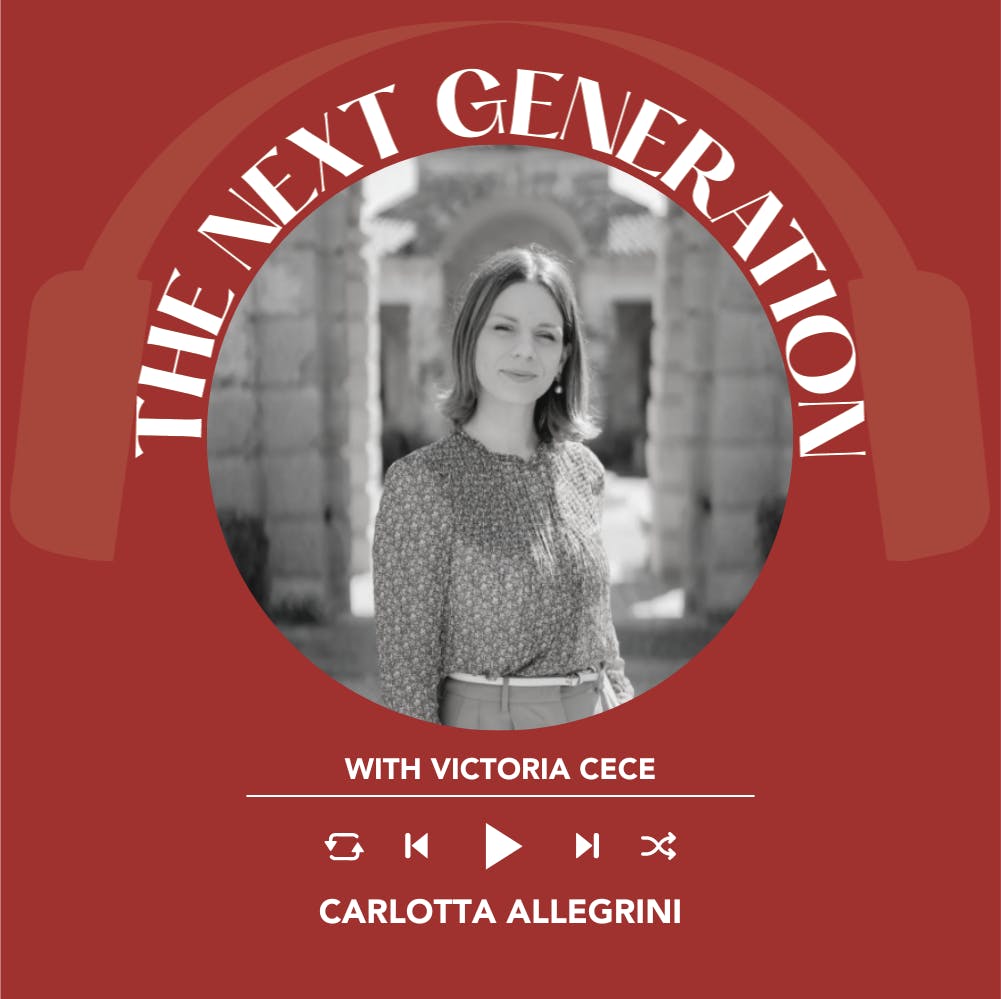
Ep. 1962 Victoria Cece interviews Carlotta Allegrini | The Next Generation
The Next Generation
Episode Summary
Content Analysis Key Themes and Main Ideas 1. The unconventional career path and personal journey of a young wine professional. 2. The synergy between a medical background and the wine industry, particularly in approach and hospitality. 3. The appeal and approachability of traditional Italian wine regions (Bolgheri, Montalcino) to younger generations. 4. The importance of authenticity, simplicity, and community in the wine experience. 5. Balancing demanding careers, family life, and personal passions. Summary In this episode of the Italian Wine Podcast's ""Next Generation,"" host Victoria Cejudo interviews Carlotta, a 35-year-old medical doctor who has also become a brand ambassador for her family's Tuscan wine estates in Bolgheri and Montalcino. Carlotta shares her unique journey, initially resisting the family wine business but later developing a deep passion for it during her medical studies. She explains how her background in medicine provides a disciplined, scientific approach to viticulture and inspires her vision of holistic wine hospitality, including wellness activities in the vineyards. Carlotta emphasizes the importance of making traditional regions and their wines approachable for younger consumers, highlighting the authentic stories, land connection, and convivial experiences they offer. She also discusses the challenges of balancing multiple demanding roles and advocates for embracing imperfections while following one's passions. The conversation concludes with a discussion on the beauty of simple, homemade Tuscan food and its perfect pairing with an approachable Sangiovese. Takeaways * Carlotta is a 35-year-old medical doctor from Italy who has successfully integrated her medical profession with her role as a brand ambassador for her family's Tuscan wine estates. * Her scientific and disciplined approach from medical school is applied to understanding winemaking and viticulture. * She advocates for a holistic approach to wine tourism, aiming to offer experiences that enhance guests' well-being, like mindfulness in vineyards. * Traditional Italian wine regions like Bolgheri and Montalcino hold significant interest for younger wine drinkers due to their historical depth and authentic connection to the land and family stories. * Carlotta's family wineries prioritize creating approachable ""entry-level"" wines to serve as a welcoming ""business card"" for new and younger consumers. * The key to a fulfilling life and successful engagement in the wine industry lies in following one's passion, embracing simplicity, and valuing community over perfection. * A favorite wine pairing for Carlotta is San Polo Rosso di Montalcino with homemade pasta and seasonal vegetables, exemplifying the value of simple, well-made food and wine. Notable Quotes * ""My my my background is a little bit particular because... I no way I'm going to work with you in one business because I choose I want to really do my, my own things."
About This Episode
The speakers discuss their backgrounds and interests in learning about wine, emphasizing the importance of holistic approach and community. They also discuss the importance of app access and approachability in the wine industry, with Speaker 3 expressing their love for traditional Italian cuisine and the desire to be flexible in their approach. They also discuss the importance of pairing and being a good wine partner, with Speaker 3 expressing their love for living in ArGeneration and Speaker 4 expressing their love for balance and approachability. Speaker 3 thanks Speaker 4 for their energy and good vibes, while Speaker 1 thanks Speaker 3 for their busy life.
Transcript
The Italian wine podcast is the community driven platform for Italian winegeeks around the world. Support the show by donating at italian wine podcast dot com. Donate five or more Euros, and we'll send you a copy of our latest book, my Italian Great Geek journal. Absolutely free. To get your free copy of my Italian GreatGeek journal, click support us at italian wine podcast dot com, or wherever you get your pots. Welcome to the next generation with me, your host Victoria Cetje. This is your podcast to learn about all the cool things Italians thirty and under are up to in the food and wine scene. And yes, that includes all the best things to eat. Hello. Hello, everyone. Welcome back to another episode of the next generation. You're with me today, Victoria, and we are talking to. We are chatting with Carolotta. How Karlotta? Yeah. Hello, everyone. How are you doing today? So I'm good. I mean, they don't have the the spring is starting because, you know, after there were, I don't know, how is in Rome, but, we have a lot of rainfalls during the last week. Now the spring is coming, and so we have a week full of appointment, but, we are ready to do it. And a week full of allergies, by the way, I must say. Full of allergies. So I I I give you all the kudos for for having a busy, busy week because it's been quite crazy on my side over here, Rome, that allergies have hit. And I'm like, oh, it's officially spring. Yes. You know? And when there is the rain before, and then the spring come in the, like, in one second, it's it's the worst things for the allergy people. Absolutely. And if you have to smell, and taste wine. Everyone has, like, a million tissues out. Yes. Because, you know, there are some drugs that you can take, but then you are a little bit full asleep. So it's difficult to taste wine in the in the best way. But you know, if he's challenging. So Yeah. It's a little a little dangerous to mix those drugs at once for sure. Yes. Well, Karam, not to tell us about yourself. So as usual, we always ask this question because it's the next generation How old are you? So I'm thirty five years old. Okay. Yes. I was born in ninety eighty nine. Okay. Cool. And tell us a bit about your what you're up to in the wine industry before I just spoil it all with my notes. You you I think it's better to hear it from the source You know that I my my my background is a little bit particular because, when I finished the high school, I was, eighteen years old, and, I said to my mom, Marilisa, I say, okay, I no way I'm going to work with you in one business because I choose I want to really do my, my own things. I didn't want to, I mean, you know, to be in the pre village, like, in in some places because, I was, the daughter of my mother. So, when I was nineteen, I moved to Florence, and I started to to study in the medical school in Florence. So in two thousand and fifteen, I graduated, so in the perfect time. And I'm a med basically, I'm a medical doctor. So this is the my particular How do you say, background? But, you know, I moved to Florence and, we have my mother started during that year, the project of our Tuscany state, So in Bulgaria, we have this beautiful winery, the disposal, and in Montalcino, we have San Paulo. And during the the the the university period, I I used to go there every weekend. And so I started to be very passionate about that. And, you know, we've I used to go to, to the vineyards with the all the guys that work in the for us, And, I always said to them, I remember. We'd always talk about this because, they say they said that, I I asked them to not say to my mom that I was going with them in the vineyards because there is something that is really I was getting very involved and the really big passion started to be present in my heart. So in the next years, I manage the two things because I used to work as a doctor. And, I I was, like, in at the same time, like, the Brenda Ambassador of our task and estate. So my my life in the past year was a pretty mess because I tried to match the both things, but, I think that helped me a lot. I mean, to have a different vision. I mean, you know, I think that, you know, having different point of view help you to to to find your own way. Wow. So, yeah, I did not know you were a medical doctor. That's pretty incredible. Yes, ma'am. I I'm a and I'm living these two different lives at the same time. Yes. How do you feel your work as a doctor translates into your work with your family's winery. Something that I strongly believe is that, you know, the medical school give me a very strong approach to study. So I very I really want to know the scientific part of the thing. So for me studying the medical things or they're, like, the technological and viticulture thing. Basically, it's the same things because I really want to study in a very, very, you know, deep and scientific way, the things. So So for me, that is very important because, the medical university gave to me a very, you know, studying method. The and I'm yes. I really wanted to to to have a deep how do you say? A deeper knowledge of the thing that I'm talking about. This is, one of the most important things. And the other one is that, I think that now, especially in the future, I mean, the the wine tasting will be very important, but another key point of the hospitality that we are really wanted to have in our, in our wineries that, you know, having, like, the holistic approach, I mean, offer offer. We really wanted to offer some extra wine service, that our consumers, can try when they come to visit our winery. I mean, tasting the wine, but also doing, like, say, mindfulness in the vineyard, something that, I really wanted to to create space where the people really feel in a best possible way. Well, that's amazing. And I can imagine how, like, you're I'm I'm I'm I'm imagining you're very good at studying because having to study for being a a doctor is it requires another kind of discipline, which I I see that you're talking about a bit. And so what is what just for the audience to understand? Like, what is exactly your role in the winery currently? So I started I mean, in the it was after because I have two child. So after Pietro was born in two thousand and twenty. So during the COVID, the and the Marco was born four months ago. So it's a very tiny. And, congratulations. Sorry. Yes. And, when I was pregnant with Mark, the pregnancy was pretty difficult. The the Peter's pregnancy was amazing. This one was a pretty difficult. So I really decided to stop a little bit working as, a full time medical doctor. And this, allows me to think what I really wanted to do because, the last the past year was pretty difficult for me because I tried to manage both I think it's impossible. So I decided to have, like, how do you say my cabinet, medical cabinet when I do, like, because I started also, acupuncture and there are other holistic methods. So I I Now talking about the medical part, I'm a little bit more flexible. And so my role in the wine business has always been like the brand ambassador of our task and state. I'm really focused on our task and state. So I'm in love with Bulgaria and Montelcino. I think there are two of the most amazing place, not in Italy, but in general, in all over the world. So and, you know, in this, time of a because my family now are reorganized in the past month, reorganize many things in the winery. So, yes, I will be the, like, the brand ambassador of the of the task and state. Wow. It's just so unimpressive to listen to you, like, and and we also get to talk to you because it's It's so amazing that your your your your your your mom, your doctor, your rat ambassador, of a very impressive wine estate, and in different worlds, obviously, and you're balancing them. I mean, what's your What's your key? Do you have, like, a secret tip to balancing all of this? I think, you know, everyone has his own, how do you say story? And I think you we don't have to do. I mean, I I'm a perfectionist, but, we don't have to be so perfect. I think in every I mean, in every we we when we do a lot of some mistakes, it's fine. I mean, sometimes we really want to show to the other people that we are, you know, very good at doing this, this, this, and I think the life or all of us are sometimes a mess. So we really I think we really want to the most important things for me is to be present in the things that we really love. I mean, for me, my child are the most important thing, then I'm in love with our with our task and stay. I mean, to follow If a person follow the passion that you feel, this is, I think the the key point of everything. And sometimes if you do some mess in your life and your life is not perfect. As you imagine, it's fine. Yeah. That's that's true. I think you can't be too at the end of the day, not be too hard on yourself. Like, I I understand that you're a human being and that it's great to strive to achieve something, you know, beautiful and fantastic, but it's it's not gonna be linear. Right? It's, like, gonna be a little messy and and and it's never gonna be perfect. No. It's it's very true. I feel like we all put a lot of pressure on ourselves, which can be good. To, like, get us to the next step, but sometimes we can be too hard where we don't see all the great things we're doing. Yes. Yes. Yeah. No. I also agree because sometimes we really want that our, you know, path that is so linear. And then I think that we are a mess sometimes. So if you the most important thing is to follow your passion and be happy and be time with the people, that work with you and, that you, that they hang out with you that they are present in your life. And this is, this is the most important thing for me, in my opinion. No. I I a hundred percent agree. And I feel like you can feel that with the people you're around. I mean, not everyone's in the greatest place in their life when, you know, all the time, but people who have, a satisfaction in what they do. And they they have that. They it it's you can you know, connect with people and and and when you have that in your community, it's it's a very positive, environment. And I think another thing bringing it back to the line is that the line is a big element of community and and people and bringing people together. It comes up all the time on this podcast, the theme of the table. Right? Like, everyone coming together and the experience you have around wine, not just what's in the bottle. And I think it's it's really special, especially to explore unique places because something not to change the subject so quickly, but something that, like, you made me think about when you're talking about your the, tuscan estate So, obviously, this podcast is called the next generation, and, you know, these young wine drinkers throughout the world. I just I kinda wanna talk a bit about, you know, vulgarie and Montalcino, in the sense of Like, why do you I guess this is my question. Why do you think those areas should be of interest to young wine drinkers or, you know, to young drinkers in general? First of all, Mulgari and Montalcino are places where the story of, the the the story of Appalachian is so strong. So I think that the, talking about the, I mean, the new generation, the the new generation really wanted I see person who see wine as a as you told be as as you mentioned before, as the wine is a as a is a way to reconnect with the true things in life. I mean, You taste some wine, but there is, much more. I mean, the land, the vineyards, the story of the population, the family that produce, the, the, that, wine. So especially for the, Italian, but also the, not Italian consumers. I mean, they they informal Italian way of being an, you know, in a table, the conviviality and the enthusiasm, the happiness That's just, in my opinion, the simple things in in life can provide. So, Bulgaria and Montalchino are like places where the new generation can approach in a in a very, you know, direct way, this is so important, talking about the historical participation. Absolutely. And do you find that there is an interest from young wine drinkers in these areas, or do you think that because they are very historic, like you're saying? And sometimes that can be a little bit sometimes intimidating to wine drinkers, young wine drinkers. Where it's something a little more classic. They don't know. But do you see any kind of movement? But, you know, I think that especially for us because Projaltisoro and sample are pretty well known, brand, but If you pair them with the, like, the, the benchmark, in, in that area, they, they are much more approachable than other brands, to the younger consumers. I mean, for me, for my mother for our team, we're we always agree about, that the the fact that, our, like, let's say, entry level wine must be very, very approachable and, even the the youngest people can buy them. And this is, you know, is the first is the first business card of your winery. Then maybe sometimes they they can try, you know, the the top wine, but, we really wanted to have, wineries that, the younger consumers, will be not afraid to to approach. I mean, in Montancino, in the boat area, there are, you know, the the most important brand but there are also some some new brands, not I mean, not just new brands, but some brands that are very focused, on the be, like, very approachable to the younger people. Of course, the app access is a big, a big part of it, like, being able to, for young people to feel like it's not something they have, like, a a bottle of wine. They have to, you know, be at a high end restaurant to have or to, like, to have, like, at least to open the door and and allow them to taste something that is really welcoming. I think that is, one of the keys, you know, in the wine industry when you think of almost, like, the house wine you get in, like, a mezzonito, like, a wine or something like that. It's, like, even though that's obviously, like, you know, spouso, it's not the best wine, but it's one way of, like, you know, opening the door at the table, being like, you know, you can enjoy this. And also, I mean, we don't need to get into how expensive everything's getting. But, you know, in this world, I I see another thing is, like, you know, people are they invest thing, you know, like, especially young people and wine. I mean, that that's a big other topic for another podcast. Next step is Victoria, if you want. Yes. Next episode for sure. But you're making me think of all these all these different things that are going on right now Are you enjoying this podcast? Don't forget to visit our YouTube channel, mama jumbo shrimp for fascinating videos covering Stevie Kim and her travels across Italy and beyond, meeting winemakers, eating local food, and taking in the scenery. Now back to the show. Well, I always love to ask something food related on my podcast because I, yeah, I love food. It's it's everyone knows this, but, I just had to ask because you told me that you were in Florence, now I'm back in in Verona. But do you, like, have a preference? Like, I know this is a bit of a very this is a very, like, like, controversial question, but, like, do you prefer cuisine, like, Florantine cuisine or Veronaiser cuisine? But, I mean, I I I really love the homemade cuisines. So it Okay. Sometimes, you know, in Florence, what I see I mean, in general, as a city where, I mean, where I where I imagine myself to live is the task scanning. Because, you know, I moved there when I was, young, so I have all my, my connection there. And then, the task and way, you know, of being is a little bit it's much more relaxed than the, than the, they're on our way. So I I it's a really, you know, much more linked to my personality. So I I prefer to ask them, but, maybe you this part, you can cut it for my family because if not, you will be jealous. But talking about food, I think that sometimes, in general, in, in, in, in Italy, there is problem that, you know, there are some restaurant where the cuisine is very made for two for tourists, And so in Tuscany, tourists can come there, and they really want to, you know, be with their advice. And in general, there are different kind of restaurant, different kind of dishes that are made, you know, without, you know, scheme, how would you say something that is very, you know? We we are more flexible. I mean, I I am more flexible if if there is a restaurant where you can eat, like, Italian, I know. I don't know. For example, homemade pasta with the some vegetable of the season. You can eat, in a good restaurant in Florida. So it, I I mean, it's not so separate the things for me. Absolutely. And I also asked you a very difficult question because your family, like, it's it's I I totally understand because you have, like, the food you grew up with, the food from home. And that's, like, one thing. So and you're experiencing a place and you may be living there, but your family isn't necessarily there. Or, you know, that's you're experiencing it, outside the home in in more eateries and whatnot. So it's it's kind of hard to make that comparison. So apologies. I I do. That is a difficult question. But Have a problem. Yeah. I totally understand. And the beauty of Italy is that, like, you know, there's so many it just wine food. It's also diverse. So you can't really lose necessarily. Mhmm. You know? That's like the the thing I I love is, like, you can always find something that you'll enjoy. And and, like, whether, you know, that be, like Yes. In different part, I mean, sometimes I really, you know, we always say in in Italy that, there is no, dishes that's your, your mother ones or your grandmother ones. So this is the I mean, if there is a restaurant with a very traditional I mean, in a very, you know, well done dish made with love and, you know, and simplicity. This is the the most beautiful thing. And you can find in Florence in Bulgaria in Montalcino, and, if you have, if you want some suggestion, I have this special place in every city, I leave. Oh, I mean, you if you wanna give away secrets on the podcast, you can, or you could just give them to me, and I could be very selfish. Okay. But I so before we wrap up, I wanna ask you, a very, very, very important question. What is your favorite food and wine pairing? It's a difficult question. But for me, for example, as we mentioned before, for me, the, let's say, the first, wine, like, the business card, one, and You want to represent the business care of you. And so the first approach to the consumer are, as much as is important at the top quality wine. So for example, I in this time of the year. I really like, our also the Montalcino of San Paulo. That is a wine that come from the highest vineyards of San Paulo. It's a wine that exhibits, like, altitude and elegance But above all, I feel that this one represent the certain purity of San Jose. And, reminds me, like, you know, the, the simple pleasure of drinking a great Sangiovese with meal, with friend, with you, I mean, when you don't have to think about, so much about the pairing and the things and the and the aromas of the wine, and you just take a bottle, a bottle that, and want to to drink about all that it's very matchable and very it's perfect, with pairing, this wine. Don't think too much about the context. For me, there is no better wine in the word than Dolores de Montalcino. And, for example, the best pairing in my opinion, for me and homemade pasta with the vegetable of the season. For example, now we have the peas. So this is the best pairing for me in the world. Oh, yes. We have a singing English. You hit the nail in the head, like, say it was perfect, like, the fresh pasta of the season. Yes. This is, you know, the simplicity, I think, is the key. I mean, is the talking about the younger consumers, we really wanted to focus, our our hospitality must be you know, very, flexible and very customized, to the person that come to visit us. And for example, a younger consumer, I think that now really wanted the simplicity. I mean, not, you know, good wine and well made, food and per the the the match with them will be like, in a very simple way you create an amazing experience for them. I agree. Right now, it's just to have good energy, good vibes to say, and, like, to be kind of welcomed into something exciting, but not, you know, not nothing that that has these barriers. That's it. Like, I agree. The key is simplicity. You don't want it complicated. And and, of course, there's a lot that goes into an excellent bottle of wine, but that doesn't mean it has to be complicated. And it can be something that's really elegant and beautiful, but also be something very approachable at the same time. Yes, sir. And, you know, yeah, I agree. And now you make me want some pasta bizarrely. No, it's good. Not for me. Yesterday, you know, my mother is a very good chef. So yesterday, we we had, like, a pasta. We made pasta with pizzelle. It was, you know, amazing, with some Pequarino, well, the the best, the best. Oh, yes. That's so good. You feel that when I when I eat that kind of food, I I I really feel that I am in balance, you know. Say, I I don't need dessert. I don't need anything extra that, you know. I agree. It, like, hits all the parts of your palette. All the it makes your stomach very happy. And you're so satiated. You're just so in peace. I know exactly what you feel what you what you mean. Like for me, I feel that, I mean, it's a little bit out of season now, but in Rome, I love living in Arrola, which is, I mean, it's out of season. It's just some of the components, like, like, artichokes are, like, you know, not no longer really. But that is, like, that spring dish that I eat it, and I'm just so happy after, like, I'm like, okay. I can go take a little nap and maybe get that to work. Yes. Well, anyways, thank you so much, Cara, for taking the time today with your insanely, you know, busy life, beautiful life. Compliment here. Jamila. And I'm so happy we got had a moment to chat. And, yeah, I wish you all the best. I wish you all the best too. And I I wait for you and all the consumer that come to want to visit us, in our in our state. I would love to come visit. I need to go to Bolgari, especially. It's been too long. Yes. Amazing. I wish you a beautiful day and to everyone listening. Okay. Also, beautiful day to you all too, and we will see you next time. Bye.
Episode Details
Related Episodes

Ep. 2789 ColleMassari: a long-term vision rooted in Montecucco with Giuseppe Di Gioia | On The Road With Stevie Kim
Episode 2789

Ep. 2788 Ep. 14: Austria and Hungary | Study Smart for your WSET Level 3
Episode 2788

Ep. 2785 From Volunteer to Speaker at TEXSOM with Samantha Cole Johnson | TEXSOM 2026
Episode 2785
Ep. 2766 Inside the U.S. Non-Alcoholic Wine Market: What Wineries Need to Know with Jill Sites | Masterclass US Wine Market
Episode 2766
Ep. 2761 Winemaking and Consulting Across Sicily with Alessandro Serughetti | Wine, Food & Travel with Marc Millon
Episode 2761

Ep. 2759 Part 2 – The VIA Educational Program & Italian Wine | Heart-to-Heart Conversation with Sarah Looper
Episode 2759