
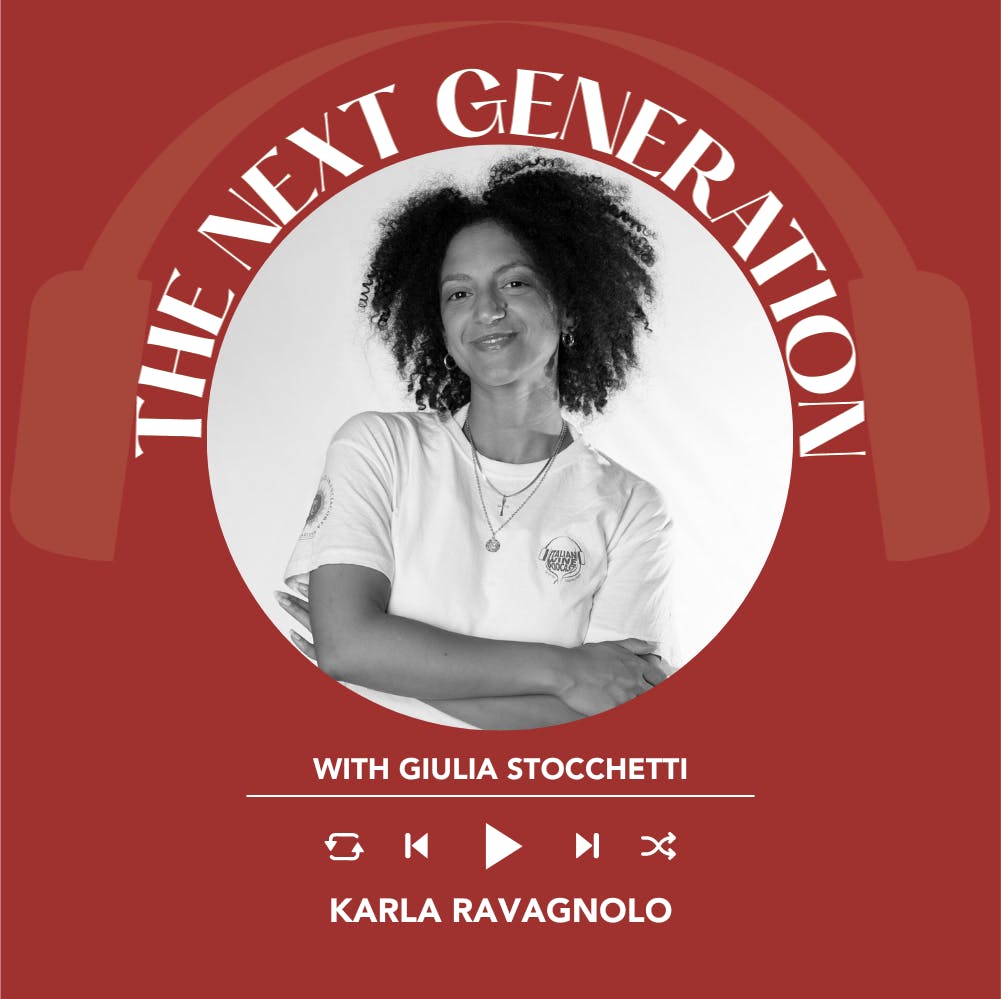
Ep. 2046 Giulia Stocchetti interviews Karla Ravagnolo | The Next Generation
The Next Generation
Episode Summary
Content Analysis Key Themes and Main Ideas 1. The importance of making wine, especially Italian wine, more approachable and understandable to a global, diverse audience. 2. The need for inclusivity and diversity in the wine industry, and how improved communication can naturally foster it. 3. Challenges in wine communication: cultural barriers, taking knowledge for granted, and irrelevant pairing suggestions. 4. The pivotal role of young generations in innovating wine communication and adapting to new industry trends (e.g., climate change, low-alcohol wines). 5. Carla's personal journey into the wine world, highlighting the impact of early mentorship and international experience. Summary In this episode of the Italian Wine Podcast's ""Next Generation,"" host Julia Stochetti interviews Carla, an account supervisor at Mama Jumbo Shrimp. Carla, who has a mixed Italian and Dominican background, shares her journey into the wine industry, starting with an internship at Vinitaly International and later working with a prestigious PR agency in New York City. Her international experiences highlighted a significant challenge: the difficulty of communicating Italian wine to a diverse, global, and intergenerational audience who often lack basic wine knowledge or find the industry intimidating. She emphasizes that many in the industry take for granted fundamental concepts (like the difference between Prosecco and Champagne) and fail to consider cultural contexts in their communication and pairing suggestions. Carla advocates for making wine more approachable, believing that genuine inclusivity will naturally follow when more people understand and feel welcome in the ""whole ecosystem"" of wine. She urges young wine professionals to think innovatively, embrace new trends, and dare to make wine fun and accessible to a wider audience, ultimately aiming to prevent ""no more Chiantis in the fridge"" and foster greater appreciation and understanding of wine. Takeaways * The Italian wine industry often assumes a level of knowledge that many consumers, especially international and younger audiences, do not possess. * Effective wine communication requires cultural awareness and avoiding assumptions about consumer understanding or preferences. * Inclusivity in the wine industry can be fostered by making wine more approachable and demystifying its complexities. * Younger generations have a crucial role in innovating wine communication and marketing to address new challenges and appeal to diverse audiences. * Mentorship and diverse experiences are vital for breaking into and succeeding in the wine industry. * Wine is a multifaceted industry (chemistry, nature, marketing, production, geography) with potential for various passionate individuals. Notable Quotes * ""I really understood how difficult it is to a lot of people to approach wine because they kind of feel like it's such an egalitarian industry."
About This Episode
Speaker 1 and Speaker 2 discuss the challenges of communicating about wine in international and inter jokational industries and the importance of being flexible in approachable approachable. They also discuss the challenges of promoting wine in new countries and the need for more inclusivity in the industry. They emphasize the importance of explaining everything, including climate, and the need for more diversity and exclusivity in the wine industry. They also discuss initiatives to promote diversity and exclusivity in the wine industry and the importance of creating a community of inclusivity and being approachable in wine. They end with a reminder to tune in for a brand new episode of the next generation.
Transcript
Who wants to be the next Italian wine Ambassador? Join an exclusive network of four hundred Italian wine ambassadors across forty eight countries. Vineetly International Academy is coming to Chicago on October nineteenth is twenty first. And while Mati Kazakhstan from November sixteenth to eighteenth. Don't miss out. Register now at Vineeti dot com. Welcome to the next generation with me, your host, Julia Stochetti. Join me as I take you on a journey to discover young stars of the Italian food and wine world, Bronte andiamo. Hello. Hi, everyone. And welcome back to a new episode on the next generation of the Italian win podcast. Today, I'm super excited for the guest because I'm here with Carla. She is actually an account supervisor at Mama jumbo shrimp, And she is a brilliant and dynamic young woman that I'm happy to work with because, yes, we are the same team. We are stevie team, right, Carla? Yes. Of course. So today, we are going to talk about one communication and inclusivity. So I can wait to get to know her better because I've been knowing her for a couple of months now, and I'm pretty sure she's a blessing, a glass. I was so excited and flutter by this person So let me say chow cutler, chow my friend. Chow, Julia. Thank you so much for having me, by the way. I'm very excited to have a talk with you. Well, how are you today? How are you feeling? I'm feeling great. You know, a lot of things are happening right now in the office, but we are full of energy. We're excited with what's coming up after the vacation. We have a lot going on as you know, but in Italy with mama jumbo shrimp, so pretty, pretty excited for and very much looking forward for what's coming up next. Yeah. So we are in the same shoes. I totally understand, and I'm so thankful that you find some time for us for the Italian win podcast because I don't know if I can spoil something, but I know you will be part of the next generation team soon by interviewing some people like for inclusivity and stuff. So Yes. This is actually a dream of mine because after leaving in New York City, I know this is a little spoiler, but after leaving in New York City, I really understood how difficult it is to a lot of people to approach wine because they kind of feel like it's such a egalitarian industry And I don't wanna say that my goal is now to make wine more approachable because that's a very hard project. I know like wine is very complicated. I'm not such an expert, but I would really like to welcome more people to not be scared of this industry, not be scared about the wine people, not be scared about, like, trying wines they've never heard about. So I really want everybody to feel welcome, and this is what I aim to do with my podcast in a way. That's fantastic. I really can't wait to listen to your parts, Carlos. So, yeah, so go for it. Now, can you just start by telling us a bit about your background and where you're from? Yes. I was born in the Dominican Republic, My mom is Dominican, my dad is Italian, so, mixed. I spent my first years in DR, and then my parents decided to move to Italy because of better opportunities for me, also in order of education and job opportunities to travel the world and everything. And I'm very, very much grateful for that because if I'm here today, it's because of the sacrifices. Also, they they they did at the time. So I was raised here in Italy, attending university. And my fun fact is that while studying here at Derona, because I was raised in Basano de grappa, but I moved to Verona to study to attend university, And while studying, I started an internship here at Vincent International, which came, you know what? Which, yeah, like, it was so crazy because I was not, I'm sorry to say this, but I was not, like, a huge one person, right? I was like, yeah, when I wanna start? This is such an international environment. I love this. And I don't know what Stevy saw in me, but I'm very much grateful. Should give me a chance because after I started to porting project managers with five star wines. If you need to leave wine selection. So I really started working right away straight away with Masters of wine, Masters of some, like, people that were so knowledgeable about why? Like, they're the maximum experts, and I didn't even know. Like, I was like, wow, this I am amazing. And the thing that really struck me at the time was that I slowly learned that they're, like, the best in the world in terms of knowledge and expertise, but they were so humble and driven because of their passion. And I was like, wow, I really wanna be like them. You know? And so this is how I started like getting into wine. I started taking some WSTT courses. And then I moved away from Vuro and I started working with spirits, and I had a little experience with the trade agency in Singapore. And the thing that stroked me in a negative way if I can't, if I may say, is that I saw many beautiful people don't get me wrong, but most of them were, like, from Italy or from I don't wanna say privileged countries in the world, but It was very hard for me to find Beapok people. And I started questioning, like, wow, like, what is happening? Like, how does it come that? Only a certain profile, like, people with certain veterans have access to this type of information to this type of industry, to this type of of knowledge, you know? And after working with spirits, I had the opportunity to join calendolin partner in New York City, which was an amazing experience as many No. Collection and Partner is one of the most prestigious and most important and praised PR agencies, specialized in wine. Here I had the chance to work with some of the most important wine names, wine journalists, wine users. And in in Calantolin partner, I had actually had, a moment of revelation in a way because I really understood while working in New York City, the difficulty of translating wine and Italian wine in particular to an international and intergenerational audience. Cause in New York City, as most of you know, like you have the possibility to to know and get to know somebody from every side of the world. Like, there's people from Asia, people from Latin America, people from Europe, people from everywhere. And it's been so challenging sometimes to explain, like, oh, this one goes really well with days or, like, what is the difference between champagne and Versaiko, I'm gonna give you a really, really fun fact. This is a private moment of my life, but I'm gonna I'm gonna put it out there. So I was I went on a date with a guy, right? He was super cool, super for fun in New York City. This happened. He was actually from China regionally, and he wanted to, you know, seduce me and everything, whatever. And he said, I have a bottle of champagne in the fridge. And I was like, oh, okay. Cool. Like, let's have some champagne. And when he opened the fridge and I saw the bottle of prossecco, I was like, this is not champagne. Like, nothing nothing against prossecco. But I was like, how don't you know the difference between champagne and prossecco? Like, For a lot of people, just the sparkling wine, it's champagne, you know, or any sparkling wine is they don't really understand the difference between Sharma and Champpin ones. So that was one of those coteratic moment when I realized, wow. Like, people really don't know or don't understand or never had the possibility to understand this. Right? And also, I was talking to my cousin. She is Dominican. And she's a gen z, like a full gen z using words like suss, med break, whatever. Like, all the slang of the gen z, and she's from New York, New York. And I remember that she was so fascinated. I remember one day I brought her home nylon from Sisui. And she was like, I really thank you Carla for bringing this bottle to me because I would have never tried it if you didn't bring it to me because the bottle looks old. And I don't know where what really, what CTilia Doc means, and I don't know where Sicily is. She was like, I just go with the label and the label and this one is ugly. So she was like, I really wish I had the opportunity to you know, fully understand that. And I was like, oh, this is another problem we have. So I had a lot of different experiences that give me inputs to recognize some challenges that people that are not from the wine industry have. When approaching wine. Yeah. Sometimes people within the industry don't even know about all these facts. I mean, they take for granted that people know the difference between prossecco and Champin or that, you know, people are actually aware of what they are drinking, but actually they're just not. I mean, we don't have to take it for granted because wine is culture, wine is sharing, and wine has a lot of history, and every single bottle of wine is unique, and it's the universe itself. So it's important to help like you working in the communication field that are trying to let other people know all these things and let the people have a glass of wine with more awareness and knowing how much valuable, actually, it is because, unfortunately, or, fortunately, wine today is still a commodity. It's not for everyone. Of course, in terms of maybe the costs, but also, like, if you don't give value to what you're having, you're not even enjoy it. So they better opt for something else, and it's it's normal. But, I mean, for sure all these international experiences you had just drove you to where you are right now, and, I mean, I guess they had a kind of huge influence on you. Right? So, like, it changes maybe the way you approach the communication. Right? Exactly. I feel like It is extremely important, and I cannot stress extremely important enough to make I don't want the wine community to be against me, but like to make wine easy in a way approachable Like, we give so many things for granted. There was actually a joke, when we were working in Galangelo, like, between us, because we were like, it is hard for an Italian person to not speak Italian. And I don't mean in a in a language way, you know, like, you can obviously translate words in English, whatever. But it is extremely hard for Italian people to put themselves in the shoes of known Italian people for example, even the other day, we were outside, we were doing a shooting for a winery. And the producer was like, oh, yeah. Because I told the importer where we were having a tasting. I don't know where. And I explained to the importer that we are fifty kilometers away from Venice, for example. Right? But the importer didn't even know where Venice was. This is what I mean by saying it is extremely important to don't give anything for granted. We need to geolocalize where we are. We need to explain the the climate, for example, or the soil. We need to explain everything, but even like an easier example when we talk about wine bearing. I had a discussion one day with a producer because he was like, oh, my wine is great with Pigeon tortellini and blah blah blah. And I was like, nobody's gonna eat Pigeon in the US. This one is because we were recording a video. And I was like, it is extremely hard person in New York City to find a pigeon, tortellini. You know what I mean? Like, this is what I mean by speaking, no Italian, when promoting Italian wine. Yeah. I mean, it's like You have to be aware of what people actually eat in their own countries before proposing some food and wine pairings. Otherwise, as you said, Pijon, who the hell is eating Pijon in the big apple? I mean, it's something maybe you can rarely found, but so if you want to promote your wines also abroad in some new countries, you must be aware of how they leave, the flavors they're used to otherwise. I mean, how can you go to maybe Kixi Anne and say, Hey, this is Lambriscoe pairs well with Noco Frito. Chinese people look at you like, what the hell is Noco Frito? I mean, you know, so and what the hell is Lambriscoe especially? Well, that's why you're here for to communicate and to open the doors of wine to a wider audience for minorities. But what are some of the biggest challenges you faced? That's a hard question. No. The hardest is, how did you overcome them? So I consider myself pretty young. I'm less than thirty years old. Okay. Carla is young. Carla is young. I have her ID right here and she is a baby, so she's super young. And my thing is that the wine industry, I would consider it mostly, mainly industry. I am very much aware there's a lot of women doing a great, great, great job, but I am also very much sure that these women had to fight the double in order to be where they are. I'm not sure I face I have faced the super hard challenge yet, but I'm very much aware that I had the opportunity to enter this industry because I had Stev Kim that gave me the first opportunity. CV Kim is an Asian person. She's a woman And she has the balls to fight against the entire Italian wine industry. Only because she gave me the opportunity and she trusted me and she believed in me. I kind of managed to get into the wine industry. But if you imagine, like, if it wasn't for us to become, Who would have probably given me the opportunity to enter one industry? You know what I mean? Like, I didn't have any, any, why knowledge. I didn't have anything. So probably they would have preferred a different type of profile. It's just that she saw the something, maybe the light. I don't know the passion, something, that that allowed me for this. So I feel like I've been extremely lucky but, not all the people are as lucky as I am. Or maybe their ears are not as open as yours because sometimes it's just a matter of being in the right place and the right moment and just get the chance that life is always ready to give us. So, I mean, every one of us has that person who just opened up the world and believed in ourselves when we maybe didn't even do that, but, you know, That's thanks to those opportunities that we can go on and make a good job. Yeah. Also because by this, I'm not saying that I didn't face any, like, racism or anything. I did, unfortunately, and I don't wanna give too much Wait. I don't wanna give too much importance on that one. So that's why on on this side of the history. But I would like people to be more aware that there are still some difficulties on this topic. So the next question just comes up naturally after this. Like, what initiatives or changes would you like to see to promote more diversity and exclusivity in the wine sector? Okay. So I think as I've been saying basically for an entire interview, I just think that we do don't need to to put pressure into inclusivity. We don't need to be like, oh, I need more vpoc people. I need more lgbtq people in my in my No. It doesn't inclusivity doesn't work like that. I feel like inclusivity will come naturally as soon as we are capable of communicating and and making wine more approachable to everybody because I this is a this is an amazing world. This is a beautiful industry. Like, there's nature in the vineyard. There's the communication side. There's the marketing. There's a production. There's chemistry. There's everything. Like, it's magical. It's a whole ecosystem. It's a whole world. Literally. So I feel like people that have they are passionate about chemistry, people that are passionate about nature, people that are passionate about geography, even. You know, like, this this is an industry that could literally be welcome anybody. We just need to make everybody aware of this. Like, there's space and there's there's an interest for everyone. You know what I mean? So once we, we are able to make people understand this side of wine, inclusivity will come naturally. So we just need more opportunities. Let's say, to give more opportunities. Yes. Nice. That's amazing. Well, because we're in the next generation, you know, I have to ask you something about young people. Like Yiwu Carla. Like, how do you see the role of young generations evolving in the wine industry? So my take, my hot take, is that we are living a pivotal moment right now and in the wine industry, as everybody's aware, like there's a climate change issue, there's the low alcohol, low to non alcohol wines, like there's a lot of changes going on. And these changes need to be. Communicated again. And, unfortunately, I would say I would use this term, unfortunately. I feel like communication and companies in general are not keeping up with the new needs that new generations have. So I would definitely hope to see more younger wine professionals taking the chance and taking the opportunity again to fully explore the potential of thinking outside the box, thinking what new people, what new generations want, and just have fun. You know what I mean? Like, wine. For me, I feel like yes. Of course, there's the the serious and technical side of wine, you know. Right? But, I feel like younger generations really have the power to take their knowledge and not minimize the seriousness of wine, but I really see younger wine professionals having the courage to dare to dare to think outside the box in Viticulture with a Talkton's grape varieties. I'm seeing a lot of people that are focusing on cultivating, going back to the origins in a way. But here, here is an example actually. They're going back to the past in a way, like recovering all these ancient grape varieties, but they are reinventing it. Right? Making it fun, making it colorful with all these, like, super colorful labels, and I know this is a awkward but like natural wine. What did you just say? No. I know. I know. But For example, like those are colorful bottles that make you want to grab a bottle just to watch it and, like, to take a chance to read the label. I feel like that's that's genius. And this reinventing process, you know, rainventing an interest rate variety, rainventing, beauty cultural practice, grain venting sustainability, and be a dynamic, can be applied also to communication to marketing. To events, there's, wine wine restaurant owner. It's not really a restaurant. It's an who, for example, is organizing. He just invites people who usually go to his sister. Yeah. Like, guests. He actually organizes a whole trip to winery. So he invites people that usually wouldn't go to a winery and says, okay, you know what? If you really like this wine that I'm having in my wine list, we're gonna go all together to visit the producer. You see, like, this is such a small idea, but I find it so brilliant because it's reinventing something that has been here for like Yeah. It's like restoring. Yeah. Yeah. Yeah. And wines creates also connections. Yeah. So, connect people. I totally So this is what I'm saying by daring and reinventing and thinking outside the box. So let's say, like, looking ahead, what are your goals and aspirations, Carla? Within the wine industry or without? I I really feel like the wine industry is the right path to follow for me. I really loved this industry. I'm very passionate about it. Maybe I'm not always super technical, even though I would love to do the diploma that visiting next time. Go for it. It's worth it. Yes. But I definitely would love to create, like, my mission is to create more inclusivity. Like, seeing the lack of information that some people have, I would just want to make wine more approachable because another example of mine, I was having a party with my Dominican friends in New York City. And I remember I brought a bottle of Guanti, but in DR, we have a wine that is called La Foursa. That it's very, very, very sweet. So they are just used to putting this wine in the fridge. And when I brought the Kianti, they put it in the fridge. They put it in the fridge, but not like the fridge fridge. It was the picnic fridge, you know, the word was. And I wish I was like, what are you doing? And they were like, yeah, worried. We'd like it cold. And I was like, no, but, you know, Canti. It's not as sweet as La Fu as La Fuerta. So you need to consider just to send that. And they were like, wow, we we didn't know that. We're gonna try and neglect it. So this this is my goal, you know, to avoid any more Kantis in the free. No more candies in the fridge. That Carlos mission. She's a woman on a mission. Exactly. And I just wanna make as many people enjoy wine as possible. That's amazing. Thanks so much, Carla, for sharing for enlightening people about wines. Thank you so much for having me. It's my pleasure. So, basically, that's a wrap, I guess. And please, all of you out there rediscover the joy of wine. Wine is love, wine is sharing. That's it. Hope you tune in also next week for a brand new episode of the next generation, and cheers and love to everyone. Tears. Bye everyone. Gracier for being with me today and listening to the next generation on the Italian wine podcast.
Episode Details
Related Episodes

Ep. 2789 ColleMassari: a long-term vision rooted in Montecucco with Giuseppe Di Gioia | On The Road With Stevie Kim
Episode 2789

Ep. 2788 Ep. 14: Austria and Hungary | Study Smart for your WSET Level 3
Episode 2788

Ep. 2785 From Volunteer to Speaker at TEXSOM with Samantha Cole Johnson | TEXSOM 2026
Episode 2785
Ep. 2766 Inside the U.S. Non-Alcoholic Wine Market: What Wineries Need to Know with Jill Sites | Masterclass US Wine Market
Episode 2766
Ep. 2761 Winemaking and Consulting Across Sicily with Alessandro Serughetti | Wine, Food & Travel with Marc Millon
Episode 2761

Ep. 2759 Part 2 – The VIA Educational Program & Italian Wine | Heart-to-Heart Conversation with Sarah Looper
Episode 2759