
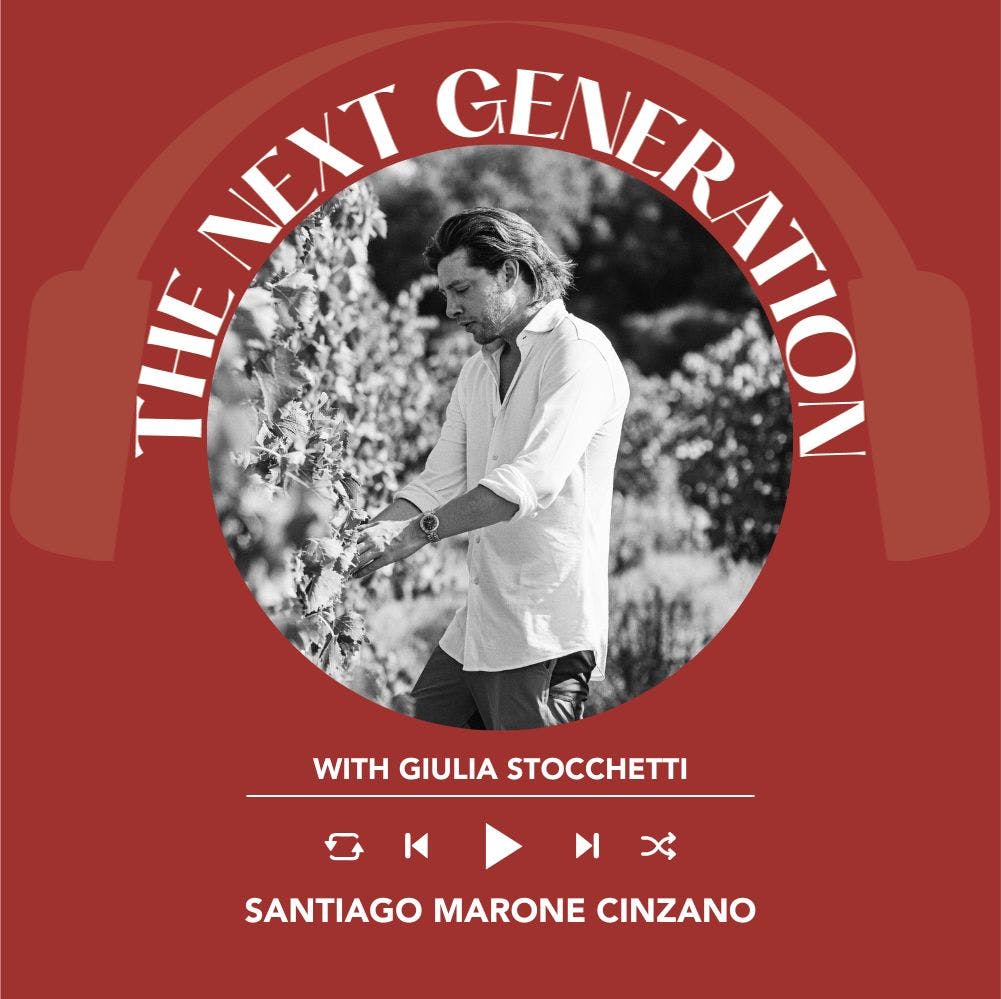
Ep. 2174 Giulia Stocchetti Interviews Santiago Marone Cinzano | The Next Generation
The Next Generation
Episode Summary
Content Analysis Key Themes and Main Ideas 1. The impact of climate change on winemaking and adaptation strategies. 2. The application and potential future of Artificial Intelligence (AI) in viticulture. 3. The philosophy and practices of biodynamic and organic winemaking at Col d'Orcia. 4. The historical lineage and evolution of a multi-generational winemaking family (Marone Cinzano). 5. Innovation in winemaking through ""itinerant selection"" vs. traditional single-vineyard approaches. 6. The diverse range of wines produced by Col d'Orcia, including Montalcino DOCG/DOC wines and Super Tuscans. Summary In this episode of the Italian Wine Podcast, host Julius Topetti interviews Santiago Marona Cinzano, a tenth-generation winemaker from Col d'Orcia winery. Santiago discusses the winery's commitment to biodynamic and organic practices, emphasizing that their wines are ""made in the vineyard"" with minimal intervention in the cellar. He shares his family's unique history, including his father's discovery of biodynamics in Chile, which influenced Col d'Orcia's transition to fully organic certification in Tuscany. Santiago addresses the significant challenge of ""climatic unpredictability,"" describing how Col d'Orcia is adapting through clonal selection and a new project, ""Lot One"" (under the Cortimano Cinzano label). This new project deviates from the traditional single-vineyard concept by selecting the best grapes from various plots each year to account for vintage-specific climate variations. The conversation also touches on the emerging role of AI in winemaking, particularly for data collection in viticulture, and Santiago's vision for respecting grape characteristics through tailored winemaking approaches for different varietals like Sangiovese and Cabernet Sauvignon. Takeaways * Col d'Orcia is a 500-hectare estate, 140 hectares of which are vineyards, operating under full organic certification with biodynamic practices. * Santiago Marona Cinzano represents the tenth generation of his family's winemaking legacy. * The family's commitment to biodynamics was deeply influenced by experiences in Chile, where traditional farming methods aligned with Steiner's principles. * Col d'Orcia's winemaking philosophy prioritizes fruit quality from the vineyard and minimal intervention in the cellar. * Climate change has led to ""climatic unpredictability,"" requiring vintners to adapt to unprecedented weather patterns year to year. * The new ""Lot One"" project under Cortimano Cinzano is an innovative approach that selects the best grapes from different plots annually, moving away from a fixed single-vineyard concept to counter climate variability. * AI is seen as a future tool for managing large data pools in viticulture. * Winemaking approaches vary based on grape characteristics (e.g., delicate Sangiovese uses large, neutral oak, while robust Cabernet Sauvignon can handle barriques). * Col d'Orcia produces a diverse range of wines, including Brunello di Montalcino, Rosso di Montalcino, Super Tuscans, and rare Muscadello di Montalcino. Notable Quotes * ""Every single vintage, we need to be prepared to see something that we've never seen before."
About This Episode
Speaker 1 discusses their approach to the wine industry, which is a minimal intervention approach based on the use of biodarginic practices. They also discuss their success in creating vines with specific characteristics and being prepared to see it, and the importance of adapting to climate change and choosing the best vintages for the best quality grades. They express their love for the industry and their desire to become vinesyard.
Transcript
We definitely have extremes. And every single vintage, we need to be prepared to see something that we've never seen before. And unfortunately, that is a reality. Welcome to the next generation. With me, your host, Julius Topetti. Join me as I take you on a journey to discover young stars of the Italian food and wine world, Pranti Angiamo. Hello. Hi, everyone. So today, I'm here with Santiago Marona Chinsano. From Caldercha winery. And it's a kind of special occasion because we actually met here at White wine, and so he sees the moment for interviewing him because he is a really talented guy full of new, projects for the future and Sam's excited to know everything about him and his reality. So welcome to the pot Santiago. Thank you so much. Thank you for having me for taking the time. And yes, this is actually my first time coming to wine to wine. Mhmm. And it's it's been great. This is the first day, but it's great for networking. Some really interesting and current themes have been tackled during the conferences. So you really feel like you're in the center of the decision making and and what's happening in the wine world. A lot of very interesting people to speak to. So, yeah, great. Sounds great. I'm happy to hear that because the theme this year is like the AI and it's something pretty new and something that people sometimes are like, what the heck is that? Because it's something that you don't even touch, but that is actually influencing all the people like nowadays. We're all still wrapping our heads around what AI really is or or better what it can really do for us in the wine world. And I mean, there's there's a very wide variety of applications and we're finding finding about that in these days. Nice. And are you considering to use like the AI at your winery yet, or it's something that you're still thinking about? Well, I think in the future for data collection, when you're managing very large pools of data, definitely AI will come into play. I think there will definitely be a certain degree of formation to be done. Mhmm. And it will be adopted maybe gradually, but definitely I see in the future a a use of AI in our business. Yeah. And I think it's gonna be pretty interesting because, actually, you work, with, biodynamic and, like, organic practices, both in the vineyards and at the wineries. So I could say, like, called Arches sustainable. Right? I mean, you really care about the environment. So it's gonna be something like three hundred and sixty degree reality because you're gonna be organic, but dynamic, but also adopting some new technologies. So sometimes they can be good. Right? Exactly. And for what I've seen, for what we're discovering in these days, the applications of AI today, are mainly in the Viticulture side. And that for us is very important because the the philosophy my father's instilled in me since the beginning is always remember we make our wines in the vineyard. And and, obviously, that's, that's a phrase. It's to be taking with a pinch of salt for sure, but making wines in the vineyard for us means our greatest focus is in the quality of the fruit, which means once a fruit comes into the cellar, our main philosophy is minimal intervention. So we will only my my father loves saying, we are farmers. We are grape growers first and foremost, and the wine is a consequence of the best fruit we grow. So the applications in the agriculture side, in the Viticulture side, are definitely something we're very interested in. Nice. And I'm happy you were talking about your father because I think you have a pretty interesting background. So why don't you tell us something about yourself? Especially, like, why your name is Santiago? I guess there's a reason. Absolutely. So, I actually grew up in South America. My father moved there when I was one or two years old, and we lived there for ten years. So up until I was twelve. And I'm a tenth generation winemaker in my family. Wow. So there is a very long history in the modern, Chinsano, Chinsano family ever since fifteen sixty eight when we first planted vineyards in We've been vinifying and producing wines since ever since then. The experience in Chile was a very interesting experience for my father. He moved there to research for the families ties with the land. So, for the for the bulk of my father's youth, the family company was Chinsano, and Chinsano was, of course, a very large company at the time, and a company that mainly made products with grape growers around the region in Santa Victoria, and we would buy grapes from. So for a couple of generations, and I I'm referring to my father and my grandfather, the real role of vignette on and the tie with the the vineyard itself was, I wouldn't say lost, but it may maybe became a bit of a secondary priority. Prioritizing the commercial side and the business side and so on. So moving to Chile for my father was this desire to plant vineyard and to re become a vineyard. And what he didn't expect was discovering biodynamics. My father didn't really know about biodynamics was before he moved to Chile, and he planted vineyards in this very isolated area of Chile, an area where I would say conventional agriculture never arrived. Definitely not intensive agriculture. And when he planted vineyards there, he obviously hired local farmers to work in the vineyard. And straight off the bat, they would tell him things like we will not prune the vineyard this week because we are waiting for the moon to be in fall phase. Rather than they had a very advanced knowledge of composting. Of course, these farmers in this very rural area of Chile, they didn't have a biogenomics book. They didn't even know the the meaning of biogenomics, but they simply treated the vineyard the way their father did and their grandfather did. And it was just passed on generation to generation. And this just happens to be a lot of practices that are perfectly in line with Steiner's principles. So really things that, that we discovered over time in agriculture and like everywhere else, what worked we kept doing, what didn't work was eventually abandoned, and that's kind of the approach that Chile still had, or at least the more southern wine areas of Chile. In the nineteen nineties. So they still had this approach. So my father definitely rediscovered what a natural approach to Viticulture is, what a minimal intervention approach is. And eventually in two thousand and five, when the family moved back to Italy, when we moved back to Tuscany, and he started overseeing the Coldarch operations again. It was a no brainer for him to switch all of Coldarch up to fully organic certification. With biodynamic practices. So today called Dorgia, it's a hundred and forty hectares of vineyard, but the bigger state in in total, it's five hundred hectares of land. It's huge. Part of it is woodland, part of it is Mediterranean shrub, but then, of course, olive groves the vineyards, of course, and then we produce, we produce barley. My brother has a beer line. That's fully organic as well. We produce tobacco for hand rolled cigars. So the whole estate is fully, fully organic today. So you produce all the delicious things that in life. Right? Everything. We're ready for the apocalypse. So if anything were to happen or or converges is self sufficient. Well, please remember me that happens. Like, well, someone interviewed me. It was nice. It was funds. Oh, the the gate in Kaldorje is always open for friends. So Thanks so much. Wow. So you have, like, all these sectors. And, like, how many wines do you make? Kaldorchardan currently has thirteen different labels. Now, three are three of these are Guonello de Montalcino or Vindenia, the classic, v e m Estagio, which is a crew, and of course, Pajal vento, our reserva. We have two Rosalimontalcinos. The classic Annvina Banditell, which has just been re released this year after a couple years of absence, two super tuscans. A pinot grillo, a chardonnay, and we made spicieri, which is our unoaked EGT. Oh, interesting. With one grapes. Spicieri is mainly sangiovese and has a splash of chili gel. Oh, wow. And for for our non Italian listeners, chilierge, and Italian means cherry. So Chile Jiolo is the cherry grape. As the word says, very fruit forward, great, great to blend with sangiovese to make a slightly more, approachable light style of red tuscan wine. And of course, we also produced the Muscadello di Montalcino, which not everyone knows. This is the traditional line of montalcino. Centalcino adopted San Jeobese. We had white muscat which eventually mutated genetically into what we know today as Moscarello de Montalcino, such an indigenous grape to Montalcino, about ten producers still produce this grape, which being only in Montal chinas, ten producers worldwide makes it one of the rarest and most unique wines in Italy. It's beautiful. And what wine do you think represents you the most if you have to pick one That's a good question. Or a wine that you really feel like that's the fruit of what we do of what we've learned in Chile. Well, there's a few different wines in Kaldorcha that are, very, very special for the family. I would say first and foremost, it's our Rosalimontalchino. When my grandfather first arrived in Montalchino, this was nineteen seventy three. This makes us one of the very first non tusks and families to plant San Giovanni and to produce Bruno de Montalcino. Only Bruno was being bottled in Montalcino. Now bear in mind, Montalcino, the nineteen seventies, was still a very rural economy. Quite underdeveloped, wine economy still at the time. So bottling in the Bordeaux seven fifty glass bottles, the classic bottles that we all know, was a very expensive practice. So local families would bottle, but they would usually have another barrel that would they would consume during the year, and that was simply the year old wine. A wine that the family consumed that would not age for three years like And it was a wine that was generally distributed in carafs or or danishans, you know, five liter danishans, which is much less expensive than the Border bottles. Now, to better this reputation of the danishan wine, They started calling it in Montalcino, which means red wine from brunello Vignans. And my grandfather took a liking to this, easier lighter style of Pier San Jolese from Bruno Vanios, of course, and decided to bottle it in seven fifty. And we've released it, in nineteen seventy five. I'm not mistaken. The first vintage was nineteen seventy three. This was, for about ten years, it stayed with this name, red wine from Brunellor vineyards, and gradually more and more Brunell reproducers started bottling this wine. And finally, the, the coronation of this project is nineteen eighty five. At the time, my grandfather Alberto was president of the Italian wine federation, and he pushed so that was created as a doc. And this is a very important moment because it's the first ever DOC in Italy given to a vineyard already subject to the OCG. So before you can make, say, in the biolo dock with Barolo vineyards, you can make prosilimontoccino from Bernalo vineyards. So We've always read this as a great recognition to the versatility of San Jose and Montalcino. The other one that's very special for the family is Olmaya. Olmai is a single vineyard pure cab, Sabignon, which was planted in nineteen eighty five. Still by my grandfather. And this is the very first vineyard of Cabernet sauvignon planted in Montocino. Really? So it's almost a forty year old vineyard and, it's always been unblended and every vintage we've produced this pure Cabernet sauvignon. Which we like to say it's our family and Montalcino's expression of the most famous red grape in the world or actually the most famous grape in the world whatsoever. And then finally, of course, Pajolvento. Or is the first vineyard my grandfather ever planted. Now, usually my father says it's the first vineyard the family ever planted in Montalcino in Tuscalo, but really going back to the fact that Shinsano was a very, commercial company at the time for my grandfather personally. Pajalvinto was the first vineyard he ever planted physically himself. Oh, wow. So this is nineteen seventy four. First Bruno vineyard we planted in in Montalcino, and it's a fifty year old vineyard today where we're undergoing a gradual renewal, but most of the single vines are still the original plantation from nineteen seventy four. And it's always been our Bruno reserve. Mhmm. And it is, of course, the crown jewel of the estate and the crown jewel of the wines the family produces. Beautiful. And I was wondering, like, what's your approach in winemaking? Like, what's your winemaking philosophy? Do you prefer big oak barrels, small bricks? What's your idea of making wines? So it hits the characteristic of Prunello. Absolutely. Of, Capsovignon, of course. So it's it's very interesting, Gretchen, and very interesting that you mentioned both San Jose and Cabernet because, there is different approaches according to what grape it is. And focusing on sangiovese specifically or approach on sangiovese being, in our opinion, a very delicate grape, a very subtle grape. The approach that we go for is exactly subtlety and minimal intervention. Mhmm. So for our sangiovese's, we use very large oaks, only exclusively neutral oak, which means the effect of the oak on the sangiovese is extremely delicate. And this means very traditional brunettes. So they stay in oak for a long time. But again, the oak has a very subtle effect. And the priority when we're producing sangiovis is the selection of the best fruit. Of course. And if if we work in the best manner possible in the vineyard, then our life will be made very easy in the cellar. And when it comes to Cabernet sauvignon, it's it's very different. And you can see this already in the vineyard. Now we were saying how Cabernet sauvignon is the most famous grape in the world. And that's partly due to the fact that Cabernet sauvignon is so versed style. Yeah. So it will grow in warm climates. It will grow in in colder climates, wet climates, dry climates. And you can see this twenty twenty three last year was a perfect example of, very aggressive mildew, perronospa, all over you. And you can see how the San Jose will suffer severely. Well, cabernet sauvignon tends to be a much more resistant grape, much more resistant vine. Now when you bring it into the cellar, this is also true. So if we take a barrique as an example, say not not even a new brick, a second used barrique still has, a decent, proportion of Oak aromas to give to the wine. If our for our experience, if I leave our San Jose is in Guldocca for twenty four months in a barrique, when it comes out, it will be very oaky. You will taste the vanilla. Your the oak will be very evident. And you could run the risk of covering the Sanja base. And when you do this with Cabernet sauvignon, is so aromatic and intense, so identifiable. After two years in Barrique, it's still very express. It's still very, or maya, very kept. So here, therefore, comes of pro or approach of having a very delicate approach on San Jose. Ma'am, we do use Barrick. My father he says he likes to take a very traditional approach, but traditional means, the traditional where the grape is coming from. So in San Jose, it's a large oak neutral wood. When we talk about cabernet sauvignon, it's more of a burdo style approach. On our chardonnay. It's more of a burgundy style approach. I love the fact that you really respect the grapes you're dealing with because basically what you're doing is making wines enhancing the peculiar characteristics of the different varieties. So that's amazing that you have the these different approaches to, to end making, depending on the kind of wines you're actually making. But I was curious, all this history and tradition do you have any new projects in mind or something new going on? What are we up to these days? So Especially because you're so young. I mean Yes. And the current projects that we have do require a lot of energy and a lot of time. But fortunately, there is space for thinking about the future, for thinking about what direction Montalcino and the Bruno world are going. And internally, the family has been working on a project for, oh, for for for good part of the last ten years. Wow. A project that will be released next year in January. Now I say the family I'm not called or just simply for the fact that this is a wine that we've bottled under a new entity, under a new company, and this pairs the family name. So So you found it basically a new company or you'll get out just with a new label. Oh, wow. No. It's a new estate, a new company, and was your idea? Or It's a project I've been championing for for for the for the longest time. Really, it was all born. Probably in what is my very first memory in Montalcino. My very first memory in Montalcino, bear in mind, as we were saying, I grew up in South America. So most of my childhood, I wasn't that familiar with Montalcino, but I took a trip to Italy with my father and it must have been two thousand two or two thousand three. So not one of the best vintages in the history of Montalcino. Now I remember a conversation between my father and the agronomist in the vineyard in in PajarVinto, so really, a a very important vineyard for us where they looked at each other and they said, I don't think we'll produce Pajal Vinto this year. Pajal Vinta is a wine that's only produced when the grapes from that vineyard are of exceptional block. It's a single vineyard. So whatever it gives us tells us whether we can produce or not. And I was very young. I didn't know the wine world very well. I was probably eight or nine, and I asked my father, why aren't we producing Pogilventon? He said, because Pogilvento this year just the microclimate in this single part doesn't have the conditions for us to produce Progyny. And my next question was, why is in Pajal vein to produce with the best grades that we have in the one hundred and forty hectares of linear that we are? Makes sense. Because it's a single vineyard. My father's from Pemonte. Mhmm. He he has a lot of experience in Montalcino, two areas where the most iconic, the most famous historical wines are single vineyards. They are expression of one, of one plot. So growing up in the wine industry in the back of my head, I've always had the start of I want to champion this project of an itinerant selection of the best fruit of the year. Wow. And the desire to use the family name to label the swine was also always in the back of my head. So The wine we will release in twenty twenty five is a twenty nineteen vintage, Bruno de Montalcino produced and bottled by Cortimano Chinsano, and this is the name of the newest state. Mhmm. And the wine is called lot one. Lot one is quite self explanatory. It's it's simply the best lot of the season. Okay. But rather than being a single vineyard, in during harvest time, we search for the very best fruit, the very best Sanjay, And of course, every vintage, there's an interactive map. There's a description of the climate of the vintage, how it played into the selection of grapes, what plot we chose, and the characteristics of that single plot, and how it ties in to that vintage's client. So if the wine doesn't taste really good, you can all blame it to Santiago because it's his idea. And he I'm sure he's gonna be the one who's gonna select, not even grape by grape, but very by vary. Exactly. That actually goes into that wine. Wow. But it's also interesting. I really hope to be able to taste it because it sounds something I mean, that's that's unique and that's really, really I mean, it requires a lot of effort. Because it's not saying it's a single vineyard that just go there to that plot and collect the grapes and make wine. No. You're just traveling around one hundred and forty hectares of vineyards to select the best grapes. But because you have, like, all the vineyards in the Bernelo collection? Or okay. So you can do a soup or Bernelo. Correct. Okay. Okay. As things are today, part of these vineyards, of course, Most of these vineyards today are still in coldarcha. Okay. But we've been planting now for a number of years vineyards and the Quintimara Necinsano soils, which are of course separate. It's it's still all in the southern side of Montalchino, but it's two different states. And as time goes on, you'll have more and more vineyards to select from, and of course. So now you have vineyards in Tuscany right Piedmont was the past, basically, where your father actually comes from, but the vineyards are o in Colarta, Bruno de Montalcino, Tuscany. Okay. Nice. I thought you still have something maybe in Piedmont going on or No. Land empty, not anymore. Okay. Alright. Well, and, oh gosh, I have so many questions. I'd like to ask you because it's it all sounds so interesting and all the passion you actually have in making wines and carrying on this family tradition. But one thing really makes me curious because you're really working hard in the vineyards to do less, to have more quality grades. Basically, how are you dealing with this climate change, because everyone is talking about climate change and, you know, what varieties are coping better, some others struggle a bit. So what's your opinion about that? So we we're definitely seeing very particular vintages, very particular climate. Most part of the history of Italian winemaking, you had a certain degree of predictability between different vintages, what we've seen in the past ten years is just speaking about my experience specifically. Right. I've been in Coldarcia for eight years now. So twenty twenty four is my eighth harvest. And in the past eight years, we've seen the warmest year on record, the driest year on record, but also the latest frost on record. Wow. The rainiest autumn on record. So, really, it's definitely climate is definitely changing. For me, the best word is climatic unpredictability. So we definitely we definitely have extremes. And every single vintage, we need to be prepared to see something that we've never seen before. And unfortunately, that is a reality. Now in Colorado, we've been undergoing research in terms of clonal selection to adapt to a change in climate with which we've had a good degree of success Vigna Estagio, or Kubrunello in Caldercha, was planted after almost twenty years of clonal selection research, which very simply means in dry vintages, warm vintages, we tend to isolate the single binds that are doing particularly well and use that genetic material to replicate it in the future videos. Wow. So really nostalgia is a perfect example of how we're choosing clones that will adapt to a change in climate. Now the parallel project, Konimano Nachin San of a lot, one Bruno, you know, builds upon this experience in the sense that climatic unpredictability means that the concept of single vineyard and of crew while still being extremely valid is also a concept that is becoming more and more challenging. Yeah. Makes sense. Because Pajal Vinto was planted in nineteen seventy four, and up until fifteen years ago, year in and year out, it gave us the best sangiovese in the estate. Now going back to the past eight vintages, arrived in in called Dorgia. The past eight vintages, we virtually had the best fruit, the best Sanjay, come from eight different plots. Exactly for the reason that we have climate that we've never seen before ever vintage. So the idea of having an itinerant selection, and using a different plot according to the year's climate every year is more and more rewarding. And in in my opinion, it's becoming more rewarding than being tied down to a crew or a single block. So in this sense, the lot one project definitely ties into what we're thinking and what we're doing to adapt to a change in climate. Yeah. I think that's great. And then not focusing just on the single vineyard, but just focusing on the best plots that I actually have. And and that you are very brave because it's much easier, you know, for people just to say, hey, this is my single vineyard. This is my best plot, but as you said, maybe one year now is the best plot, but for other eight to ten years can be this one that one or another one. So it's really brave, and I think, as you said, really rewarding. So And I find it especially interesting to be able, yes, to choose the best fruit of the season in different plots, but to, narrate this, to tell the story. So every vintage, it's not going to be only this is the plot we chose. Now it's this is the climate of the year. Therefore, this was the best plot, and these were the characteristics, which makes the consumer understand much better why we choose the rates we choose. And how vineyard growing ties into a climate of a certain season. So that's that's very interesting. It is brave in Montalcino. Definitely. It's not an unheard of approach if you look at Napa Valley, if you look at Pordeaux, However, if you focus on Piamonte and Montalcino, which are the bulk of my family's experience, it's definitely a new approach. It's definitely quite innovative in that sense. Well, that's beautiful. I love to stay here to talking to you for hours, but, you know, we have to rush for other appointments here at Wentwine. So, Santiago, thank you so very much. Thank you so much. It's been a huge pleasure talking to you and thanks for your time because I know you're quite busy these days, but, yeah, it's been great. And good luck on your new project. Thank you so much. It was a pleasure to be here, and I'll wait for you in Montalcino. Alright. Have you heard, guys? So look for Santiago Marona Chinsano and call Dorta to just reach out to him and find a visit to Montalchino and remember they're getting ready for the apocalypse. So stay tuned. Good. That's it for being with me today and listening to the next generation on the Italian one podcast.
Episode Details
Related Episodes

Ep. 2789 ColleMassari: a long-term vision rooted in Montecucco with Giuseppe Di Gioia | On The Road With Stevie Kim
Episode 2789

Ep. 2788 Ep. 14: Austria and Hungary | Study Smart for your WSET Level 3
Episode 2788

Ep. 2785 From Volunteer to Speaker at TEXSOM with Samantha Cole Johnson | TEXSOM 2026
Episode 2785
Ep. 2766 Inside the U.S. Non-Alcoholic Wine Market: What Wineries Need to Know with Jill Sites | Masterclass US Wine Market
Episode 2766
Ep. 2761 Winemaking and Consulting Across Sicily with Alessandro Serughetti | Wine, Food & Travel with Marc Millon
Episode 2761

Ep. 2759 Part 2 – The VIA Educational Program & Italian Wine | Heart-to-Heart Conversation with Sarah Looper
Episode 2759