
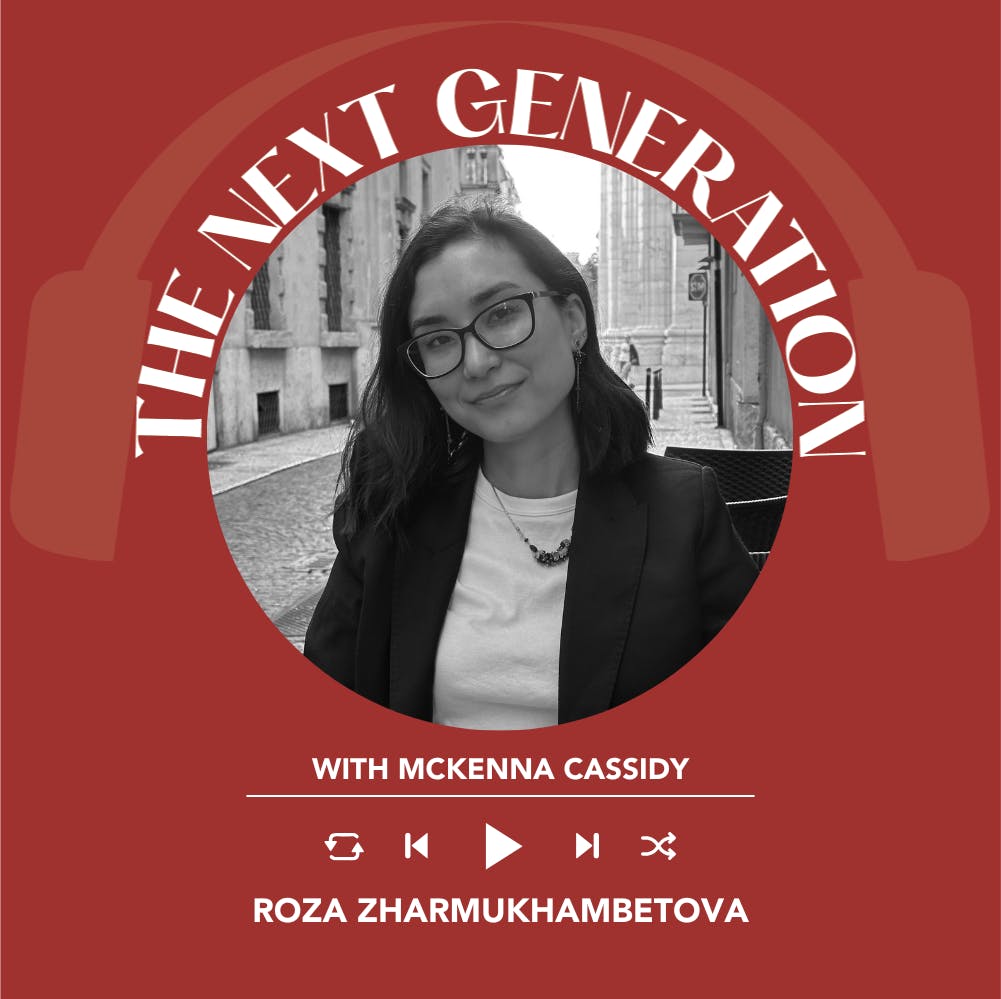
Ep. 2213 McKenna Cassidy interviews Roza Zharmukhambetova | Next Generation
The Next Generation
Episode Summary
Content Analysis Key Themes and Main Ideas 1. Rosa's unconventional journey into the wine industry, from Kazakhstan to language teaching to wine sales and education. 2. The cultural context of wine consumption and appreciation, contrasting Rosa's upbringing with wine-centric cultures. 3. The significance of specialized wine education and certifications (WSET, VIA) for professional development. 4. The importance of community, networking, and continuous learning within the global wine industry. 5. The role of the Italian Wine Podcast as a platform for education, connection, and amplifying diverse voices, particularly for the ""next generation"" of wine professionals. Summary In this episode of ""The Next Generation"" segment of the Italian Wine Podcast, host Mckenna Cassidy interviews Rosa, a new member of the podcast team. Rosa shares her unique background, growing up in Kazakhstan where wine drinking was not a cultural norm, before moving to China as a language teacher. She recounts her significant career shift at nearly 30, driven by a desire for change and an burgeoning interest in wine's craftsmanship, history, and culture, despite her initial limited knowledge. Rosa details how she began her wine education with online courses like Coursera and WSET, eventually moving into wine sales in China. She explains her strategic decision to specialize in Italian wine, recognizing its growing market presence and desiring in-depth knowledge of a single country. Rosa further elaborates on her rigorous path to becoming an Italian wine expert, including completing regional courses and the challenging Vinitaly International Academy (VIA) exam. The discussion highlights the immense value of the VIA community, emphasizing networking, mutual support, and ongoing learning experiences like ""Scholastica"" trips. The conversation concludes with Mckenna and Rosa reflecting on the pivotal role of the Italian Wine Podcast in connecting people, providing daily insights, and offering a platform for the ""next generation"" of wine enthusiasts and professionals to share their perspectives and contribute to the evolving wine industry. Takeaways - A career in wine is accessible even without a traditional wine-centric background, driven by curiosity and a desire for change. - Formal wine education (WSET, VIA) provides a strong foundation, but continuous self-study and practical experience are equally vital. - Specializing in a particular wine region or country can lead to deeper expertise and open new career opportunities. - Networking and building a strong community (like the VIA community) are crucial for support, knowledge sharing, and professional growth in the wine industry. - Podcasts like the Italian Wine Podcast serve as powerful tools for education, industry insights, and connecting diverse global audiences within the wine world. - Being vocal about one's learning journey and passions can lead to unexpected opportunities and connections. - The ""Next Generation"" of wine professionals often brings fresh perspectives, new work ethics, and innovative approaches to the industry. Notable Quotes - ""Wine drinking is not in our culture, I would say. And I didn't grow up seeing my parents or anyone around appreciating wine as a culture."
About This Episode
Speaker 0 and Speaker 1 discuss their interest in learning about wine and the challenges they faced in finding a job in China. They share their experiences with learning about the Italian wine industry and how they were able to pass certifications and pass exams. They emphasize the importance of being vocal about the fact that VIA is a community and offer tips for preparing for an exam. They also talk about their goals to attract younger wine professionals and express their passion for learning about Italian wine and being part of a group of people creating meaningful, inspiring, rewarding experiences.
Transcript
Wine drinking is not in our culture, I would say. And I didn't grow up seeing my parents or anyone around appreciating wine as a culture. I'm a nineties kid, and I'm not from a city. My family lived in a countryside. So the wine that I saw at our table was Georgen wine, mostly semi dry, semi sweet, So working in wine industry was not a natural choice for me at all. Welcome to the Italian wine podcast. This is the next generation with me, McKenna Cassidy. For the next episode, I invite you to explore with me what young adults are up to in the Italian wine scene. Let's feast on our discussion of Italian wine and culture. Grab a glass with us. Chinci. Hello, everyone. I'm Mckenna on the next generation segment of the Italian wine podcast, and I'm joined by a special guest today. Not only a new member of our podcast team, but a woman with incredible experience and story to share. Welcome Rosa. Hello, Makenna. It's so good to be with you today, and I'm really excited for the conversation that we're gonna have, talking not only about your own experience, but your experience with the Van Italy Academy itself recently passing the exam. Congratulations on that as well. Thank you. I would love to kick it off by hearing about just kind of who you are, what's your background, and how can listeners get to know you today? Okay. So I'm from Kazakhstan. I always like languages. And before coming to wine, I work as a teacher for a long time, so my educational background is languages, English and French, and then I worked as a teacher, teaching languages. And then I got my master's first in Bulgaria and then in China. MBA, and it was like master in economics. Some years of my life, I spent in China. I was based in Beijing, and I worked as a language teacher there. And the last two years in China, I started working in the wine industry. I worked there for two years. Mhmm. I worked as sales in a wine importing company in Beijing for the last two years there. And, yeah, shortly. That's my background. Okay. Here we are today. So you grew up in Kazakhstan, your family lives there. And then in your life, you kind of made a move to China. You were still in languages that you had studied in school, and then were teaching to a variety of age groups. In China. And then you made, like, this career shift. What was that like for you? Why did you go from teaching languages to going to wine? That's interesting. Right? Yeah. Was teaching kids so bad that I decided to to dive into alcohol. My experience in teaching kids was very good, and I love that a lot. But at some point of my life, I decided that I wanted to make a change So by then, I was around, like, twenty nine, almost thirty. Maybe it was some kind of crisis related to age. So I just wanted to change something. Okay. And I was thinking what's industry, what subject would be interesting for me to learn from the very beginning. And I decided wine wine sounds like something interesting because there is an element of craftsmanship history, culture, again, languages because it's an international community that you are going to work with. I could use my language skills as well. And also traveling. I think working with wine also includes some traveling from time to time, and I'm very interested in traveling too and learning about different cultures. So that is why I decided to dive into wine studies. Beautiful. I wonder, was there, perhaps, a moment when you noticed wine for the first time, or was there a particular glass that caught your attention or another drinker or friend who guided you to wine? Was there a moment like that? Well, actually, that's an interesting thing because wine drinking is not in our culture, I would say. And I didn't grow up seeing my parents or anyone around appreciating wine as a culture. Well, of course, wine was drunk during some gatherings, some celebrations alongside with vodka and Brandy. My parents wouldn't buy a bottle of wine to enjoy it during a regular dinner after work, let's say. I'm a nineties kid, and I'm not from a city. My family lived in a countryside. So the wine that I saw at our table was Georgia wine, mostly semi dry, semi sweet. So working in wine industry was not a natural choice for me at all. It was not like the kind of industry that I would choose or I would dream about? Like, when I grow up, I would become like a wine professional. No. Then later also no one in my surroundings, not my friends or acquaintances worked with wine or in restaurants, for example, or bars. Wine just came up. I don't know how, but it just came up. But before I started studying wine, for me, there was only red wine and white wine. I only knew dry wine, sweet wine, semi sweet wine. That's all. That's all the knowledge that I had before starting studying it. It actually started with Coursera don't know if you know this platform. No. Tell me about it. So it's a platform where you can get different courses. Some of them feel free. Some of them paid ones. And many different universities from all around the world. They worked together with this platform and organized some of their courses. So the first course online, which I took, was a free course from UC Davis and I fell in love with that course. It was for free. It was an introductory course, and I fell in love with it. And after that, I decided to go for paid courses. Then I found out about WSet and then all the other teaching platforms and organizations. And after that, once I got my WZED two, I decided to start searching for a job in China. And I'm very grateful to my boss there because he hired someone who didn't have experience not even in wine, but also in sales. This experience working in a totally Chinese company. There were no other foreigners in the company. It was quite a challenge for me. I knew, like, basic Chinese, I could have a conversation with people, but my Chinese was not enough for selling something. So that was quite a challenge for me. For three days in a new company, I didn't talk to anyone because it was very intimidating, especially, like, because of the language barrier But after that, everything became so smooth. And after that experience, I'm not afraid of anything, really, to start a new that was already the earliest thing that could have happened. Yeah. Exactly. That takes so much guts. That's really awesome, Rosa. Thanks for sharing that. And it seemed like you really enjoyed it and, like, wine chased you down, and it sounds like Italian wine kept knocking on your door as well. Now you have an expertise in many levels in Italian wine. Why? What directed you to Italian wine after you've noticed? There's regions attached to these styles of wine and grapes from all over the world. So what led you to Italian wine? First of all, it was not like all of a sudden I found out about Vineet Lee. I decided for myself that in wine, I had to choose one country. I wanted to choose one country to focus on and to study this country and the wine regions of this country deeply because there are so many countries producing wines, and it's impossible to know all of them very deeply on a very professional, like, expert level. So I decided to focus on Italy. The main reason why I chose to focus on Italy, it was more like a practical choice because back then in Beijing, I worked with Wines from Chile first. Okay. But then I saw some dynamics changing. When I worked at an important company, France was the first country by volume, then it was Australia, then Chile. Then the situation has changed from twenty twenty. There were very big tariffs on Australian wine. So the market dynamics have changed. So it was France, then Chile, then Italy. And Italy was a growing trend. More and more important companies, they started to import more Italian wines, more labels, and I thought that I should go for it. I should go for Italian wine. And also many beginners in wine, when they start learning about wine, they go for French wines. And I decided to take detour and start with Italian wines and focus on Italian wines mostly. That's wonderful. Thank you for sharing that. I empathize. My my journey in wine is similar with the country coming first, so that's very cool and how you were able to notice over time. Those changes through different lens, like, serving a global wine industry and then learning from that and making choices from that is, like, pretty awesome. So I know that you kind of walked through doing a few different certifications in Italian wine, Could you talk about those and and how you were exposed to Via during that time? Okay. So once I realized that I wanted to focus on Italian wines. Yeah. I started searching for different platforms. I just started to Google, and Via is the first thing that came out on my Google search. Right. So I went to the website. I learned about the, I had a look how to apply. And back then, I wanted to take the Italian wine maestro course in Beijing, but it never happened because of COVID, it was COVID time and there were many restrictions. And then in twenty twenty two, when I went back to Kazakhstan, I decided to take a sabbatical and travel to Italy and also take some regional courses to get ready for Vine Italy because I knew that Vin Italy was going to be a very tough exam. And I wanted to to pass the exam from the first take. So that is why I decided to prepare myself for that. So that is why first I went to Longet Wainambuster course organized by Barolo barbaresco Academy. And then the same year, I went to Porticello wine specialist course in Verona. That was really smart. That was really smart to do those other courses, leading into it. I feel like the deep dive before the deeper dive is wise. It's pretty cool. And the next year, I applied for Via. So in twenty twenty four, I took the VA course. But, actually, the first time I applied to Via Verona, it was twenty twenty three. But my application was rejected. But I decided to do it again. I decided to get ready properly to get all the other certifications, try again, network, get some recommendations, from other members of the VA community, and that's how I applied this year. Okay. Do you remember when you met members of the VA community? How did you get references before entering the community? It all started from language course. Okay. And then Valbridgello, of course. So during the course, I met some people who were already Italian wine ambassadors or who took the course before. So you kinda did the ratings on your own to kind of prep for what Via was? Awesome. I already wanted to take part in Via. I knew that I wanted to do that for the certification. I thought it would be a good certification in my CV. Yeah. But then when I actually talked to those people, when I actually saw what via community is, I really wanted to do that. And I already didn't care about the certification itself. I mean, the title if I'm gonna get it or if I don't gonna get it. I didn't care about that. I wanted to to take part in via and also get connected to people because it's a wonderful community, and everyone was so friendly. And also what I wanna say that I came there with I don't have a rich experience in wine. I don't have many titles in wine, but I got acquainted with so many wonderful people who are already industry professionals in their own fields, and they were so nice to me. And they just let me in in in their community and we became friends Now we're a good friends with many of them. It's such a gift. It's awesome. And you enjoyed, like, many features of VIA, like you said, the networking and the fast pace of it. So when the time came to take the exam, what was your preparation like. And I know for myself, I was able to dialogue with people who had done it before and get a sense of like, what are we up against here? And then I really enjoyed reading, Send Duvese Lebrusco, by Professor Shenza, and Serena Matsuo. And then also I really, like, you have to stay devoted to Italian wine. I'm plug two point zero and organize your notes in a way that makes sense to you that you can not just cram, but, like, no. So what were your tips when you were studying? Well, first of all, I think the fact that I already took some regional courses before Italian wine ambassador course helped me a lot. I also did Italian wine scholar course by wine scholar guilt. It also helped a lot because it's very detailed course and very straightforward and well structured. So it gave me a very strong base, I would say. And another thing I would like to say is just do your homework I mean, there are so many episodes on Italian white podcast about the book, about grape varieties. You just scroll down to those episodes and listen to them, then also read the book in advance. What I realized in Almaty, so via was in Almaty this year last year now. Mhmm. Not many, but some people didn't have the book. And I would like to say get the book get the book in advance, read it from the cover till the end, and listen to the podcast, listen to the parts where they talk about different great varieties. It's gonna help you a lot. Mhmm. And also talk to people. I mean, it's how we met. We met in Sicily during Judith Galastica, but we actually got to know each other before that. Yeah. Before I went to Verona, it's for our listeners. Makenna was the person who gave me some tips about how to get ready. So that is why talk to people. Talk to the ones who already did that. They're going to give you some some good tips and some encouragement too. Yeah. And I would also add, like, be vocal about the fact that you're studying for this. It's kind of, if you know, you know, and sharing with people that you're you're seeking an intensive course in Italian wine, not only helps build the brand of Via or the brand of Italian wine, but actually shows people that there's more to know and learn and love about Italian wine. And if you're in the industry, more likely than not, when you bring that up, someone's gonna be like, oh my gosh, I just ordered a Charaswolo, like, would you like to try it with me? Or let's do a flight of Trapiano to try to understand the differences in these producers, and those conversations won't happen unless you're vocal about what this is and what you're hopeful to do with it. Yeah. Exactly. I totally agree with that. There is a saying the crying baby gets the milk. Right? So, yeah, if you mention it to someone, first of all, there might be people who are also going to to apply for the course, for example, and you could prepare it together. Or as you said, some people, some of your friends who are acquaintances, they can share with you some of the wines you cannot get yourself. Right. That's a good one. That's I think that's a very good good tip. Be vocal about that. Yeah. All about what what you're doing and what you're up to. It it helps you get through the intensity, which is awesome. So I know you mentioned a few minutes ago that to Scholastica. What is that and how do you get involved? Okay. So once you are a member of Via Community, you have a chance to travel with Finet Lee. To travel to different wine regions in Italy. And it usually happens twice a year. For example, this year, we went to Sicily. There was a trip to Sicily, and there was a trip to Montecino. That usually, there are two trips per year. And once you're in a video community, you are going to receive emails with notifications or you are going to be notified in a WhatsApp group about that. Mhmm. So that's how you apply. Wonderful. Yeah. You can fill out a Google form. Have you been on them before? When did you pass via? And I'm grateful to have gone on Benvenuto Brunello in twenty twenty three, and we tasted about two hundred of the pre release, twenty nineteen vintage brunellos, which was cool. And then, Rosa and I went to Sicily this year, everything from Pietra Dolce to Evineri. It was a very special time to see the vineyards live and in person, hug a vine, tastes in young and old carry can't say so. And also having the last dinner with Alecio Planeta. That was cool. That was amazing. That was really awesome. I felt like home I wanted to say. So I'm I'll be staying here for the next thirteen years. I'll put myself to work, and that was awesome because remember when they took us down into the riesling vineyard that was on their property and they showed up The lava flow from thirty years ago had covered the lava flow from five thousand years ago, turning the rock color from gray to red. Exactly. That was really eye opening and helped me understand the complexity of excess soil for sure. That is why why I like, Vineet Lee, why I like Via. It goes beyond the course itself. It goes beyond the title. So once you get the title or it doesn't matter. You get the title or you don't get it. It doesn't matter you pass exam or you don't pass the exam. It doesn't matter. You become a member of your community and you get access to a lot of interesting things Absolutely. Cheers to that. So let's just lastly talk about kind of what we're doing here now. You're now helping us manage and lead the growth of the Italian wine podcast. And so excited to to work with you on that. So let's just talk about the importance of the podcast kind of the process and what's going on here. Okay. So what I see, the podcasts nowadays, not just Italian wine podcast is a very good platform. To connect to different people, and it's a very good platform to amplify your voice and have a big impact and talk to a big audience So it's a very good platform. I totally agree with you. And there's many different sections on the Italian white podcast. And I, in particular, work on the next generation, Mark Milan does Food One and Travel. There's several business focused pods and producer focus pods, so truly go into your podcast app wherever you listen and search something or pick the first episode you see and dive down the rabbit hole. It's pretty awesome. It's the only wine podcast in the world. To release an episode daily. And then we feel really lucky and blessed to be a part of this mission to continue growing the wine industry and also engaging the next gen. So we're super excited. So thanks for that rundown. Speaking of the next generation, what are the goals? And what's the status? And what are our hopes here? So the hope here is to attract more people, attract more younger wine professionals, and not only wine professionals but also wine enthusiasts, people who don't work with wine, but they're super interested in wine their regular drinkers to attract those people to see their perspectives to see their work ethics and also the way they approach wine as a younger generation. Also, their approach to wine tasting, for example, and also give a stage to speak out. And as I said, amplified their voice. Absolutely. That's the goal. And also about the podcast, I forgot to mention that what I wanted to say right now being in Italian wine podcast team, I get so excited sometimes whenever I edit an episode and I like it so much, I just make the notes for myself for my personal education, also for work. Mostly, the first reason is to do the notes for work, but also for my personal education. And I write down the names of the guests who I want to meet personally during the upcoming wine events. And I was doing that before I joined the podcast too. Mhmm. Whenever I listened to an interesting episode, Yeah. I would go to Instagram LinkedIn. I would type in their names. I would try to connect to them. And, actually, it was a good way to connect to people through the podcast. So our listeners can do the same. Whenever you see an interesting guest, whenever you listen to the interesting pod, you just knock on our house door on social media and also the guest's door It's a wonderful way to hear new stories and make new connections for sure. That's great. Is there anything else you'd like to share before you wrap today? I have loved, like, hearing your story, learning how you transitioned into the wine industry by way of curiosity and devotion and then have no journey to kind of a place that seems perfect for you at this time, this space learning about Italian wine, sharing wine stories and helping the industry thrive. Not only are your passions coinciding with your work right now, which is a really special place to be, and hopefully a joyful and exciting place to be. But also, the whole thing is a continual active curiosity in order to move forward in wine, knowledge wise professionally whatever your desire is, continued curiosity is really the key and, openness to learning. Working on the podcast now. I'm feeling really useful. I think it's a great possibility to be a part of a group of people who are creating something meaningful, and I'm feeling grateful to be a part of something that has such a big impact and to work with with such inspiring people. I think that was really well said Rosa. I feel like you told a really clear story to us today. I wanna thank all the listeners for hearing, for listening, for being invested in this conversation, and Rosa, we're so excited for the continuation of your journey in Italian wine. We're grateful that it crosses paths with the Italian wine podcast in this season. So thank you so much for sharing your expertise. I know the listeners will be seeing you around hearing you around the pod, the Van Italy events, the Italy Academy details, all of that. So we look forward to the year ahead. Happy twenty twenty five. And, Chinchin, Salut, I keep drinking Italian wine. Thank you, Chinchin. Thanks so much for being here with me today. Remember to catch our episodes weekly on the Italian wine podcast. Available everywhere you get your pods. Saluday.
Episode Details
Related Episodes

Ep. 2789 ColleMassari: a long-term vision rooted in Montecucco with Giuseppe Di Gioia | On The Road With Stevie Kim
Episode 2789

Ep. 2788 Ep. 14: Austria and Hungary | Study Smart for your WSET Level 3
Episode 2788

Ep. 2785 From Volunteer to Speaker at TEXSOM with Samantha Cole Johnson | TEXSOM 2026
Episode 2785
Ep. 2766 Inside the U.S. Non-Alcoholic Wine Market: What Wineries Need to Know with Jill Sites | Masterclass US Wine Market
Episode 2766
Ep. 2761 Winemaking and Consulting Across Sicily with Alessandro Serughetti | Wine, Food & Travel with Marc Millon
Episode 2761

Ep. 2759 Part 2 – The VIA Educational Program & Italian Wine | Heart-to-Heart Conversation with Sarah Looper
Episode 2759