
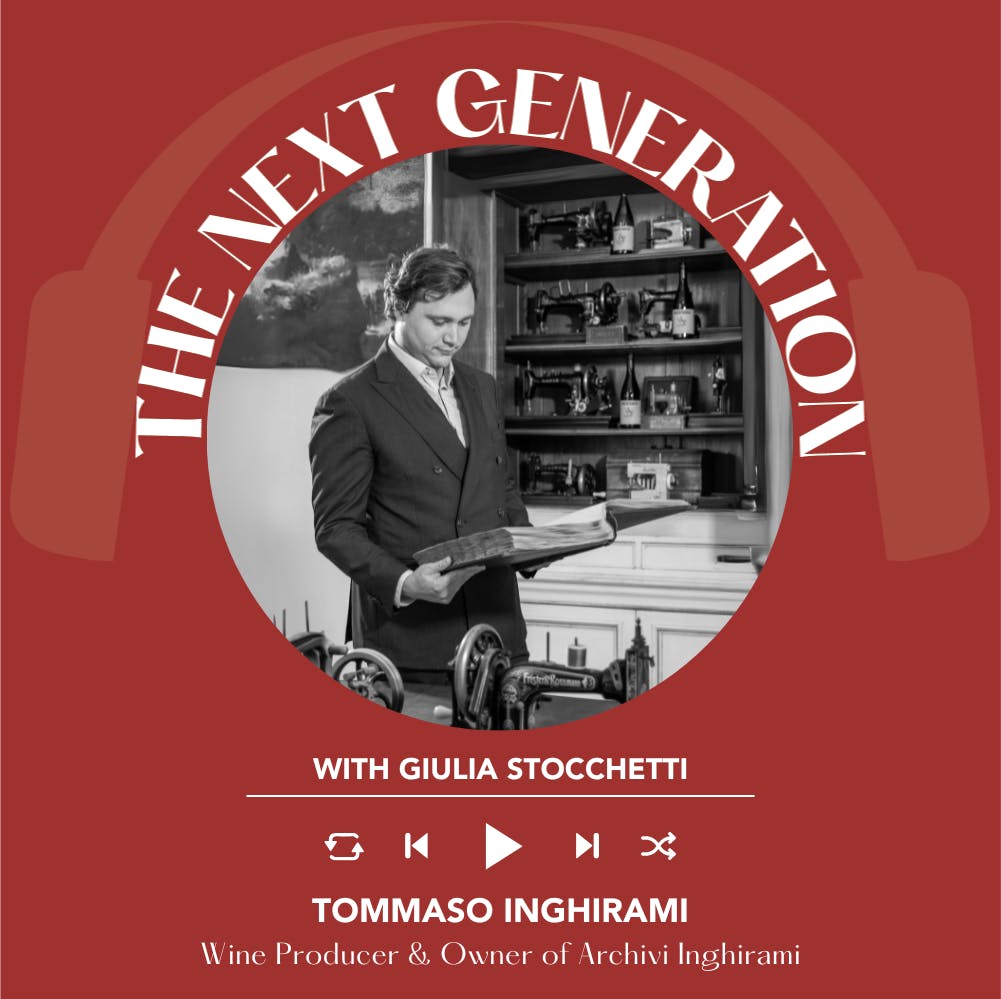
Ep 2335 Giulia Stocchetti interviews Tommaso Inghirami | Next Generation
The Next Generation
Episode Summary
Content Analysis Key Themes and Main Ideas 1. Tommaso Ingerami's entrepreneurial journey, blending traditional family business with innovative ventures in wine and fashion. 2. The reinterpretation and modernization of Sangiovese wine, particularly through the ""Senior Sanjo"" project. 3. The commitment to sustainability and circularity in both winemaking and textile production. 4. The philosophy of respecting tradition while embracing innovation and ""thinking outside the box."
About This Episode
Speaker 0, a young entrepreneur in the wine industry, talks about her past experience in California and her love for the wine industry. She explains her journey to wine, including her interest in the wine business and her own brand. She discusses her challenges and opportunities in her new business, including building a stable and scalable business and creating a new e-commerce channel. She emphasizes the importance of organic and sustainability in her business and her love for horses and art. She discusses her personal new project, which involves reusing her previous fashion background and creating new products. She provides advice for young entrepreneurs and their plans for using pinotOE in their senior son Joe collection.
Transcript
We are in this population that is Cantilufina, historical foundation. But when I came back, I said, okay. San Jose is the prince of the grapes of Tuscany. We still produce Cantilufina that is still our major wine. But I wanna experiment the SanJrovees in different reunification. The idea of a senior, Sanju born with the name, the senior sewing machines because, my grandfather, Fabio and Jeremy, started in nineteen forty nine. The shirt's production with a twenty four sewing machine senior. I am the youngest collector of sewing machines, and so, senior center is the link between a great passion of mine. Sangiovese, and, senior. So, Sandra Sanju. Ben Venuti, welcome to the next generation. With me, your host, Julia Stochetti. Join me as I take you on a journey to discover young stars of the Italian food and wine world. PRandi and Yamu. Hi, everyone, and welcome back to the Italian win podcast on the next generation. This is me, Julia. And today, I have the huge pleasure to have such a young entrepreneur here as guest who's based in Tuscany near Florence. And it's gonna be a kind of special episode I would say because today, we're gonna talk about wine, fashion, and a young entrepreneur involved in this whole process being like the sales and commercial manager of its own brand. So let's welcome to Good morning, everybody. How are you today? Oh, good. Thank you. And you? I'm fine. Thank you. You look great in your suit like a young entrepreneur full of inner even if it's Monday, today, recording, I guess, we are ready for this new week ahead. So, Tomzzo, I read about you something a couple weeks ago. There was an article of you on And congratulations, I mean, on your role because, I mean, you're so young, but you're such an important entrepreneur in the Italian Panorama would say, and also you're running your own winery business, basically. And that's why I really wanted to interview you and have you as guest here. But before that, please introduce yourself. Okay. Thank you so much for the invitation. I'm really happy to be here and you know, to talk with you about my history. I was born a small town of Tuscany, Sansepolcro that is close to Aritzo. And when I was nineteen, my dream was to move Milano, and I had the chance studying Bocco University, and, I spent there five years in two thousand eleven. I I had the chance to have a experience in, in California, in San Diego State, because one of my dreams was to understand, Americans American catcher. And so I I went there for a while. Most of my classmates were Chinese. And so I said, I came here to meet Americans, but now I'm I met also many Chinese. So in twenty thirteen, fourteen, I moved in China and Shanghai. And they're working for a while, for Monclera fashion company in the retail business. But the issue I found there was that if you don't speak Chinese, you're a little bit, you know, you are out of the business. And my study in order to have, you know, a good experience. I, maybe I have to come back in Italy. And so I went back, in Italy. I'm working for a while in, in and then, my last experience was in Ferrero because I was, I grew up with all the Ferrero product, and they had the chance to work in Alba where I was in charge, in the headquarter for the first time, and the kinder team, and then secondly for Ferrero She. And so after all, this experience, in twenty eighteen, my father asked me, my father, Giovanni, why don't you come back home? We have a wire in, in financing. Why don't you come back and take care of the wine business? Because my family invested in the wine business, during the seventies with my grandfather, Fabio, And, I'm the first one that to take the chance to take care of the wine industry and business. Nice. So you started basically studying in California, then moved to China and then back to Italy. What did you study? I studied business, business management because, when I was nineteen, I applied for Boca University, and there were many, you know, courses. But for me, the, maybe the, the course that would be more interesting for me was business. And so I started the, business and management. Nice. And did you prefer to stay in California or in Shanghai? But for vacation, for sure, California, because California has a fantastic vibe. With all, you know, the surf, the music, the weather for the business, Changai. Changai is more, you know, is more strong. And, I personally like most nowadays. For vacation, California, for business Changai, but you didn't learn Chinese though. Right? Unfortunately, you know, a little medias when I was there, I spoke, a few words of Chinese, and I remember that I couldn't live there. Really But now I lost everything because you should also believe here is what it's called most important. Yeah. I bet. But just a a question. Can you also write something in Chinese? I mean, were you able to write also something or just like speaking I'm just speaking. Just speaking. I was good at that time. Nice. Well, just speaking as reductive because just being able to speak at least a couple words of Chinese could be something really awesome because it's quite impossible language. I mean, it's it seems quite tough. So, well, that's really nice. And so after going back to Italy, you worked at Ferrero and then you decided to go back to Tuscany to your place. Yeah. How come that happened? I mean, what's your journey to wine? Just your dad asked you to come back, or you were already into it? No. I was when I was in Ferrero in Alba, I and time, you're visiting many wineries all around the language, and I was in love with Napiola. And so my father gave me the chance, if I was interested to take care of the wine business because my family is involved in other activities, and no one of my family was in charge of the wine of the winery, and so in twenty eighteen, I left Alba they went to inquire and starting taking care of the wine business. So we can say in a sense you're the first generation on actually wine involved entrepreneurs in your family. Yeah. I can say yes. We are a wine producer officially since the seventies, but I'm the first one of my family that, is taking care of full time, the wine business. Yeah. And what's your favorite thing to do in the winery? Like, you take care only of the commercial side, or you're also involved in, like, in the production in developing new products? I think, the the chance to work in Ferrero gave me the idea of of thinking always a new product and different aspect of the business. And so when I came back home, the wine business is not an industrial business. So it's more an artificial business where I had the chance to follow both the production, the nature side, as well as the verification method or the marketing, as well as the sales. So I think the further experience, giving the chance of to think Always out of the box. And when I came back, I followed all the different field in the business. For sure, for my attitude, I'm more a commercial person or a person that is involved in the relation. Nice. That's really nice. Yeah. You're lucky to have the chance to oversee the whole production of the winery and the whole aspects, but I know that you started your own brand, basically, the brand new brand called, and that's how I actually found out about you. So can you tell us please how this project was born? Like, what is a singer, what drove you to that? Yeah. Since your central is my signature in the wine industry for my personal opinion, because, when I came back home, in Grignano, Grignano is a fantastic winery in the heels of Florence, the estate was a property of the medici family of Katarina de medici. So it's in a state that has five hundred years of this. On one side, we are in this population that is, county roofinga, that is an historical foundation with a fantastic sangrovis, but my idea, was, is always good to think out of the box. And when I came back, I said, okay. Sanroviso is the prince of the grapes of Tuscany. In one side, we still produce, you know, that is still our appolation and our major line. But I wanna, first of all, have fun and try to experiment the interviews in different unification. So I started for the first my first harvest in two thousand eighteen to dignify the SanJuris in red with with a new icon degree. So, like, Arvester beginning of September, Rosier, and we've already solved the skin contact, and then white Sandro Beza, so without skin contact. And the idea of senior, Sanju born with the name born, the the idea of link to be a great question of mine. On one side, the senior sewing machines, because, my grandfather, Fabio and Jeremy, started in nineteen forty nine, the shirts production with the twenty four sewing machines. I am the youngest collector of sewing machines. I collect and buy every week, sewing machines, And so, senior Sanjay is the link between the great best of mind, San Jose, and the senior. So, senior Sanjo. That's fantastic. Basically, you're giving new life to two historic things like sangivistic, red variety, and senior sewing machines. But where do you usually go to find the seaming machines? It's not easy to find them, I guess. I'm lucky because, There are not many collector of sewing machines. And, it's not a product image that they collected sewing machines end of nineteenth century up to liberty time. So, like, beginning of twenty trip. I usually go in free markets all over Italy, or I buy them, for example, in England or in Germany, you have to imagine that the two biggest producer of sewing machines at the time were Germany and England, and so most of them come from discounts is. But in Italy, we also have two producers, especially in a kit, and, project. Wow. That's really interesting. I didn't know that. Thank you so much. Every time I interview people, I always learn something new, and that's what I love about podcasts. Guest. But going back to you, like, I guess it's not easy to start your own business. So what were the biggest challenges you had at the beginning when you founded Yeah. First of all, once that you start a new business, you have to imagine that, you know, Griano Wanery is, in a old historical land of producer. My neighbor are two of the biggest producer of Tuscany, and, Canti Roofina is, Canti, the oldest appylation of the world. So once you are in a new business, an appylation that is an historical appylation, you are young, maybe It's not easy to share the idea of, change. And, for example, Sanjuve is it, but for me, in one side, it's still the Sanjuve, you know, but in the other side is the Sanjuve is in white, Jose or red, but you've been achieved off syndrome. At the beginning, I was maybe quite crazy to think the central is in a different way. And so for for sure, the credibility, because once you start a new business, and you are not in that business, people maybe can think why this guy is doing this kind of stuff, maybe because he doesn't know too much about the business. But after seven years, I can say that most of other colleagues in the same area of me are starting, unify the sangiovese in a different way. I've seen also some white sangiovese or maybe a sangiovese red to drink chilled. So for me this is an, a new movement that is important because, we always need to to see the world in a different way. For sure, we are Italians. We have such a long history in our backyard, but we have also to see the future. And for example, the future of wine is not anymore high high school degree wine. The future wine is not anymore cork because I visited a cork production plant. And if, worldwide, we all produce only cork, how can can be sustainable. And so for certain wines, for me to look at, it can be a great opportunity. So for sure, in one side, when availability was, at the beginning, who was not so easy to build. At the same time, you know, experience because once you are a new mover, in a new business, maybe, you make some mistake. And I think make make mistakes is the greatest the greatest think of an interpreter can do because from a mistake, you can learn and then you can maybe change your point of view or idea or direction. And the for sure, be resilient and the ability to make a exchange faster because the market nowadays for our generation is not easy market. Once, you can sell wine, you can sell shirts, you can sell whatever you want. It's not a easy market. So I think our generation, and the chance also to see maybe one direction, but once the direction is different, we can change it really fast. And this is for me, really important. A hundred percent agree. I couldn't say it in a better way. So, yeah. And I guess you're like the pioneer of white sangiovese or there was already someone else, pinifying sangiovese in a white version, because I've never heard about that. So I think, this is, this is a lessons from Ferrero. Maybe you could have someone else that, is still, is, is benefiting the SanJovese in Hawaii, but If you don't know, it means that don't exist because, only if you are successful and people recognize you, you can say there is someone else. From my point of view, I can say the first ruler for sure this new idea of wine for the Sanjo is. Now there are certain other producers, but no one is successful, but not successful from the point in the bottle. It's successful for the recognition of the market. So I can say that there are a great margin of grow in this idea of central business, especially, in the beginning, you know, for me, if all the direction of wine of Tuscany is red wine, I wanna go here with white, And in fact, in twenty eighteen, you know, be, a white producer in a region of red that was not so, I can say intelligent. But on the other side, after seven years in two thousand twenty five, when now, everybody are talking about white wines, white grapes, low alcohol debris. So easy drinkable wines. And this is the idea that I had from the first time. Because for me, when I joined Greenard Weil, I opened my cellar, and I had wines of twenty, thirty, forty years ago, amazing reserve as of Audrey Barthierry, And, I said to my I said, okay. It's it's amazing to have this opportunity to have a vertical tasting with all these wines, but now I'm facing my first harvest, and I wanna make wines that I want to enjoy with my friends now, not in the next forty years. So I said, okay, my tradition is, and I I'm a great promoter of, the vertical pasting because is the longevity and elegance of the centuries. But on the other side, I said, no. Now it's time to make wines that they want to enjoy next summer with my friends in front to maybe, where I go for vacation in Marima, in front of the seaside of Tuscany because I think, you know, wine is not for me only a business. It's also a passion is, is something more. And so I started, and I had the chance. Thanks to my family to fink coats, so different product, not only related to the classical pollution of Janti roofia. That's fantastic. And how many bottles you make a year, more or less, for now? The entire, wirey, two hundred and fifty thousand bottles. So this is more or less our production. We are an average, average, winery because we have a fifty hectares of vineyards. Most of them, we are organic producer. So we are organic producer since more than twenty years. So for us, organic has always been a philosophy that my family share and have since many years. And once you are organic producer, you know, the quality, is lower the quality for me. It's good. It's great. And so the average production is one hundred to one hundred and fifty thousand bottles per year. And of senior sandro only? Twenty thousand. Oh, nice. So it's a small production. Very nice. Personal production. Twenty twenty five thousand bottles. So it's like Tomaza's personal production. I can't say reserve because you drink it when it's ready. So that's something that I'm a hundred percent agree because usually people just wait and leave the bottles there, but for me, it's like in cable. So, yeah, it's a small production, three versions of San Jose, and who designs the labels? I'm, you know, I studied business management, but I'm also an artistic person, and I'm largely causing my in my company. I have a fantastic designer that is working closely with me. And so I gave to her the brief of, which was the idea of the label. That for me was important to have, like, pop art because I really like pop art colors, with, sewing machine that should be a horse because in a court season, and, like, to think, a guy that could be every one of my company that is, riding this horse. So from this brief, born, the Central Central label. That's amazing. Do you actually ride horses or, like, in your Yeah. Yeah. I run horses. Yes. Yes. In Grignano. We have, more than forty horses around a guy, frankly, taking care of these horses. So there are horses, and they really like. But also, when I I go for vacation in Marima, Marima, the idea of Marima, area of task, and is also related to horses. That's fantastic. Well, something personal, but I grew up with horses, and I really love those animals. And they were my best friends. So, yeah, I think you need to have a special inclination, a special kind of soul to get along with those huge animals. And, yeah, that's really nice. Also that horse on the label was something I wanted to ask you about, but you already clarified everything. So there's a story also behind the table. That's fantastic. Yeah. Also, and I have another story related to the reason of the horse. Because one, we will ask, you know, journalists about San Jose. San Jose is like, the prince of the grapes is like, the prince of the grapes is, is, like, So this is the description of the SanJonese because it's not an easy grape to work with. And so I said, okay, let's try to ride resorts. I don't know what's the result, but we try to look our best. It reminds me kind of, but I follow you know, Greek mythology. Yeah. So I don't know if it's own shadow, but then where that is under everything went smooth. So it's just like you have to have feeling, feeling with wine, feeling with horses, also feeling with art and fashion, I guess, because also when it comes to choose, like, a sewing machine, I think, like, you feel that something inside yourself that says, okay, that's the one I want. You know what I mean? So And lucky because my father, Giovanni, I would say share with me the passion of art. So we are heart collector, and every sewing machine is a piece of art. You have to imagine that there is a serial number that give you the you know, the information of the production plant of the year of production. So every sewing machine is unique. So in a order of today that, there is, you know, everything is started production. In the past, there were products that every one of them, each of them was unique. And this is for me the uniqueness of every sewing machine that for me is a piece of art. That's fantastic. I love it, really. And like, you also have a fashion brand. I mean, I was talking on Instagram, taking a look at your different profiles. And I found out about this Arquivio Ingerami. And that's a project you have because you were talking about organic wine sustainability also in terms of closures like cork or the screw cup. And without giving Jeremy, I can imagine that you're doing something similar because you have, like, these ancient, precious fabrics and you're, like, giving life to, let's say, old clothes, old pieces of arts. Right? Exactly. So Thank you for the question because, this is for me really important also to share the vision behind that keeping hierarchy. So you have to imagine that every time that I had, working experience, for me was, inspiring. I was inspired by Moncler in China. I was inspired by, but for sure, for from Ferriaro the best. And, when I came back home in Grigna, I realized how much important is organic, how much important is sustainability, how much important is nature. And so I said, once I came back as well in the fashion business and I want to bring back all these, experiences, also in the fashion business. Because, if you see how much fashion is different, you know, and, I found in my, a kind in, my warehouse, some clothes of, seventies, sixties that are still well made better than now. And, in a part of the warehouse, I found lots of fantastic fabrics. In, from the point of view of the fashion of these days, seems like to have, if you have twenty meters of, fancy fabric of eighties, don't doesn't have any value because, you know, with the eighteen twenty meters, you cannot make a huge production. But I said, no, I want to give, to his, fabrics, second life because I think, the way they are made, you know, pattern, the colors are a brilliant. So thanks to the company, I I made like a team of, move on that effort me to select all these fabrics. And nowadays, as we are reusing this fabric, with the brand that, even girami, with the idea of making shirts with a modern design with a modern cut with a wide, wide adjustability. And for me, it's important also underlying the idea of genderless, and much the attention to reuse this dead stock of fabrics. And for me, every shirt is like a limited edition. So with this fabric of nineteen ninety four. For example, you can make twenty shirts inside the shirts. There is the label, with the age. So for example, we in touch, like a bottle of wine. So we in touch two thousand nineteen ninety four. And once, the fabrics is sold out because you reuse this fabric with the twenty shirts, it's good, but there are twenty people in the word to dress. These shirts that are unique and, genderless with the bullying, with the bullying model. And it's something that I really have fun now. I bet. I mean, now I want one. You should tell me where I can find one. Like, What if people want to buy your clothes or your wines? Where do they have to go? So, for example, my wines, my one of my best partners in Italy is, c CEO. So if you wanna go in Cignorvino, you can find the both the wines of, Grignano as well as the senior Sanjayline. Instead, the fashion brands, I now we just started in June, in two thousand and twenty four, making the distribution of these, shirts. And, we are going to launch, soon also the e commerce. But anyhow, due to the fact that it's not a scalable business that you hear me, is to find the right partners in each area that share with us, the philosophy, the attention to what fabrics, the sustainability. So for me, it's not only a sale but is also find the right people and the right partner that can share with us the same philosophy. So, basically, there's the same philosophy behind your winemaking and your fashion designing rate. Yeah. For me, all is related. So all is related because once you share who you are, you can talk about shirts, you can talk about wine, but the fundamental elements are the same. So for me, all the dots are linked with the these, a given, Jeremy shirts, and syndrome, and so on. How can you find the time to combine both businesses Like, do you spend more time on the wine side, on the fashion side, or is like half and half? How can you deal with that? It's a lot of work. It's a lot of work. Yes. I can say that, for seven years, as spend more time in wine, because wine, is more difficult for me because, you know, following all the process from the, you know, the beginning for the production of grapes, till, the humidification, then the bottling, and then the sales, some, so much, long work, and also tough work. And so for the first seven years, I spend much more time in wine business. Then, recently, I said to me, yes, I like wine. In fact, we are also investing in other areas of task. For example, in Casantino, we planted the pinot water. We are also looking for other new areas of why making it because for me, okay, I want to be, a first mover, always a first mover with the new ideas, and I try to do my best to be a first mover, but maybe sometimes as I told before I can make mistakes, but I like mistakes sometimes, not so often, but sometimes. But, you know, fashion is, the beginning of my family history. Without fashion, without shirts, I couldn't study, I couldn't, you know, be a wine producer. And so last year, I turned thirty four years. I I said to me, I want to come back home because I think, you know, now it's time to take care of the fashion business. But I want to make a new project. Like, at Kiwi, Miami, is my personal new project, and, is a project that combine all my history, historical background because, I'm a sewing machines collector, as I said before. We have more than ten thousand books of the fashion history. You have to imagine that we have these ancient books where we have the fabric of maybe one hundred years ago. And that is wonderful, how much fashion is a circular because from this pattern of one hundred years ago, you can, reuse the pattern and make a fantastic fabric that you can wear now. Or for example, the old fabric already knew a house to reach. So for me, it's important since I came back home to make my own ideas by respecting the past because as I respect this interest, the the county roof, you know, appellation, I respect all my past. But as I said with the wine, I want to make wines that I want to enjoy life with my friends now. I want to make fashion that I can enjoy my summertime or the special moment with my friends now by using the reusing the same philosophy that I have for wine. Fantastic. So now a sneaky question. Can you actually use a sewing machine or you just collect them? So this is a good question. I can use a sewing machines. I can use a sewing machine. I know all the elements of a sewing machine. I'm not, a good, you know, I'm not so good to sew, but, I can use it. Okay. At least you know how they work, and I guess you can fix them if they broke, maybe. Yeah. Yeah. For sure. This is for sure. Yeah. That's fantastic. Okay. So Is there any advice you would love to share with someone who wants to start his own or her own business, like young entrepreneurs, something you feel like sharing with us? Yeah. For sure, I think, more and more experiences so for me, I have experiences in other businesses in other companies as you always give you, you know, knowledge. And for me, knowledge is one of the key elements to be to be successful. Because sometimes, you know, maybe, the beginning of my business career, I was working for seed mental. And once you think about seed mental and you ask maybe our generation who is gonna hit seed mental no one maybe answer. I eat cemental, but cemental is, meat in jelly that is still the leader of the Italian market. And the front area of cemental, because he's a meat in jail in can, I also make, with a friend of mine, a stack of popcorn in can, that is called the truffle Italian? So our potato chips in can, because can can be really interesting, meet in general in can, Boccon in Canada. So at the beginning after Boccony University after, you know, Moncler experiences, young guy who's gonna be, you know, a student that wanna go to sell meeting early. Not many of my friends. Me, yes, because also in that experience, I had the chance to learn something. So they suggest I wanna share with all the guys of my age for sure is experience and see different different word, a different way of thinking because it's always important to learn. Yeah. And don't be afraid to make mistakes because sometimes they're also like the spice of life. So, you know, as you said, it's all experience you gained. Well, I got now three rapid questions for you because you're running out of time. I could stay here, like, talking four hours, I guess, because you have so much to share with us, but, you know, I must stick in a certain amount of time. So tommazo, wine, or fashion? Both. For me, both, because I will always be wine producer in my life. And as I said before, I'm interesting to look for new areas of wine production. Now in the up and ninth mountain, for example, because San Sepultra is in the up and ninth mountain. I'm looking for a place to cultivate white grapes and bubble. So for me, winemaking, for sure, will be always a part of my heart, as well as fashion. So for me, the, you know, the link of Ginger Sanchez is the answer of, your question. Fantastic. So, endangered Sanjin, three words. Original, playful, and fresh, like, you know, yeah, fresh fresh wine. Yeah. And one more thing that makes me so curious, I saw like this slogan like make sunro great again. And when I saw it, you know, I couldn't help but just smiling. I was like, what does he mean? So why do you use this slogan? What is this make sunro make sunro great again? I mean. Yeah. First of all, I want to underline that is not a political slogan. First of all, and for me, San Giovanni has always been, you know, the prince of grapes of Duscany. Unfortunately, some of a some appelation inside Tuscany nowadays. It's not popular or fancy or, you know, it was strong as it was before. And so the idea of, Nick Sandra. Again, is to underline our need, and also our idea to push the Sandrovis in a stronger way, you know, in the mind, in the experience of our generation. And so we want to break the tradition and also we've done this group of friends, that we are organizing events, parties, in Grignano where we share, you know, a moment, a special moment, like, event where you can taste wine, but not always injured, Sandra Wines. At other producer of our age that produces central based, but with a different point of view, as well as, for example, music. So, DJ said, with the free four djs. Because for me now, it's not anymore line experience, music, fashion as much we are able to link all the dots as much as successful every music can be. And so for me, the music, of Syndrome Sandro is the music of our wines, is the music of our events, is the music of the sewing machines when we need, our shirts. So this is, the, the philosophy of Dick Sandra created again. That's fantastic. Really? I already love your project. That's amazing. Congratulations to Maso. Seems like you're a volcano of ideas and you're really passionate, and and that's something really important when it comes to express themselves through art, through fashion, and through wine. So last question, do you think you're going to use also some pinot noir? You're gonna add, like, a pinot noir in your senior son Joe collection, or you're gonna stick only with San Jose. So this is a good question. Pionwara, I planted in, Port picasentino. So I planted in a fantastic place that is called, but is in is a hill between Casentino close to I think, that ginger sangro idea born with the San Jose, and I don't know if, I use the same brand with the Britain behind the pinot noir. Can be helpful, to the success of pinot noir. But for sure, I have, in my mind, a great idea for pinot noir. And so the idea is to make a standalone brand but that, is close to the fashion idea, to the cousin team idea. And, I will share with you really soon. That's fantastic. Thank you so much, Tomazo. At this point, Is there anything else you'd like, before we wrap up the episode? No. For me, you know, it's fine. It's great. Thank you so much for the invitation. I had, you know, a big time. We do sharing my ideas and, for sure, And I'll thank you for the question. Thank you so much for being my guest today. It was a really a huge pleasure. And, well, folks, stay tuned for next Sunday on a new episode on the Italian wine podcast. Grazi for being with me today and listening to the next generation on the Italian Mind podcast. A la prosima changing.
Episode Details
Related Episodes

Ep. 2789 ColleMassari: a long-term vision rooted in Montecucco with Giuseppe Di Gioia | On The Road With Stevie Kim
Episode 2789

Ep. 2788 Ep. 14: Austria and Hungary | Study Smart for your WSET Level 3
Episode 2788

Ep. 2785 From Volunteer to Speaker at TEXSOM with Samantha Cole Johnson | TEXSOM 2026
Episode 2785
Ep. 2766 Inside the U.S. Non-Alcoholic Wine Market: What Wineries Need to Know with Jill Sites | Masterclass US Wine Market
Episode 2766
Ep. 2761 Winemaking and Consulting Across Sicily with Alessandro Serughetti | Wine, Food & Travel with Marc Millon
Episode 2761

Ep. 2759 Part 2 – The VIA Educational Program & Italian Wine | Heart-to-Heart Conversation with Sarah Looper
Episode 2759