
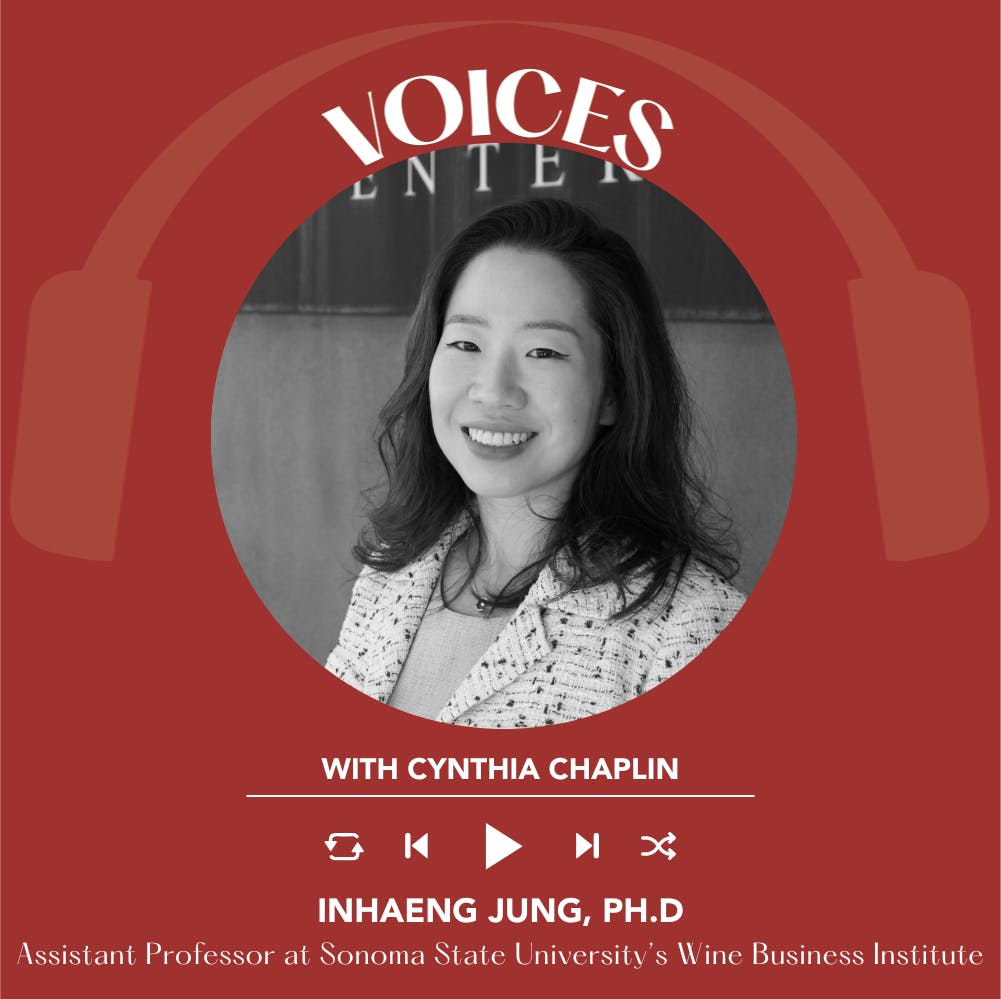
Ep. 2164 InHaeng Jung | Voice with Cynthia Chaplin
Voice
Episode Summary
Content Analysis Key Themes and Main Ideas 1. The personal journey and career evolution of Dr. Anhangu Lum in the wine industry. 2. Experiences of discrimination and bias faced by minorities in the wine sector. 3. The critical role of education in fostering diversity, equity, and inclusion within the wine industry. 4. Integrating sustainability and technology as core components of modern wine education and business practices. 5. Bridging the gap between academic theory and practical industry application in wine studies. Summary In this episode of the Italian Wine Podcast's 'Voices,' host Cynthia Chaplin interviews Dr. Anhangu Lum, an Assistant Professor at the Wine Business Institute at Sonoma State University. Dr. Lum shares her unique journey, beginning with her move from Korea to the U.S. at age fifteen and how formative experiences, such as caring for a host family member with cystic fibrosis, illuminated the profound importance of food. She recounts her transformation from a wine skeptic to an enthusiast after a pivotal Chardonnay tasting in a challenging wine class. Dr. Lum details her career shift from brand management (like Guinness in Korea) to academia, driven by a desire for a more significant and lasting impact through education. She emphasizes her pedagogical approach, which deeply integrates sustainability and technology into all curricula, and her efforts to connect academic research with real-world industry needs through initiatives like the Great Expectations research lab. A key part of the conversation focuses on the discrimination Dr. Lum experienced as a ""small Asian woman"" in the wine industry, where her expertise as a sommelier was often questioned based on her appearance. Despite these challenges, she expresses a strong sense of optimism about the wine industry's ongoing progress toward greater inclusivity and awareness. Takeaways * Personal experiences and unique perspectives can lead to unconventional but impactful careers in the wine industry. * A deep understanding of food's role in health and culture can be a gateway to appreciating wine. * Seminal experiences, like a comparative wine tasting, can dramatically shift perception and inspire a career path. * Wine education should move beyond traditional knowledge transfer to equip students with critical thinking, problem-solving skills, and industry relevance. * Sustainability and technology are indispensable frameworks for both current and future wine industry practices and education. * Visual biases and discrimination based on race, gender, and appearance are tangible barriers faced by professionals in the wine industry. * Despite persistent challenges, there is a recognized, albeit slow, positive shift towards greater diversity, equity, and inclusion in the wine sector. Notable Quotes * ""I'm a small Asian woman who's working in the wine industry, in an important position right now. But even as, like, a junior solvenier working at a hotel, just merely serving wine, I felt there was a big, barrier, additional challenge that I had to, experience."
About This Episode
Speaker 1 talks about their experiences in the food and beverage industry and their journey to come to America. They emphasize the importance of sustainability and technology in education and how it is crucial to everyone's lives. They also discuss the challenges faced by the wine industry, including discrimination, and how it affects their personal values. Speaker 0 expresses their gratitude for the interview and hopes to continue collaborating with other industry experts.
Transcript
I'm a small Asian woman who's working in the wine industry, in an important position right now. But even as, like, a junior solvenier working at a hotel, just merely serving wine, I felt there was a big, barrier, additional challenge that I had to, experience. Welcome to the Italian wine podcast. I'm Cynthia Chaplin and this is voices. Every Wednesday, I will be sharing conversations with international wine industry professionals discussing issues in diversity, equity, and inclusion through their personal experiences, working in the field of wine. If you enjoy the show, please subscribe and rate our show wherever you get your pods. Hello, and welcome to voices. This is me, Cynthia Chaplin. And today, I'm so happy to welcome doctor and hangulung to voices. She's an assistant professor in the wine business Institute at Sonoma State University in California, and she's originally from Korea, but she's worked in so many aspects of the food and beverage industry in both the United States and Korea, I can't wait to hear what she has to say to us today. She has a master's degree in food service business management from Kyyeongji University. I probably pronounced that wrong. In Korea, and also a PhD in hospitality management from Penn State University. So thank you so much, and hang for coming on today. I really appreciate you taking the time. No. Thank you so much for inviting me to be on voices. I'm very excited to be here. Good. Well, it's your story sounds so interesting. I'm so, amazed by everything you've accomplished, you know, on both sides of the globe. So you grew up in South Korea. So when did you move to the US? You know, why did you make such a big change? Because that is a big change. It depends on how you look at it. I first came to America to live here. When I was fifteen years old, I was ninth grade in high school. I don't know how it works in Italy or anywhere else, but it's a first year in high school in Korea. And I wanted to just see the other side of the globe and how things are done in America, because even back then, it was, you know, America is the biggest country, strongest. And, I wanted to learn English. I wanted to explore different culture. So it was just going to be one year experience. I came as an exchange student, but eventually I ended up living here. Wow. And what was that like when you were fifteen? I mean, I'm American too. So I I know what it's like when you're sort of in tenth grade and you're fifteen. And not everyone is very nice at that age in their life. What was it like in an American high school for you for the first time? I would say it was Everything was very different from how it was in Korea. When I was in Korea, I was asked and expected to do only studying. And we were forced to take, like, sixteen subject at a semester, and back to back classes from seven, eight o'clock in the morning until evening. And then we had mandatory night and study hall, and also to supplement all this hard school work, we had to go to, Hagwon, which is the academy to help with the school work until, like, after midnight. So when I came to America, I tell people, like, people ask me all the time, like, isn't it hard for you to be here? And I was, living in America alone, like, with my host family. And my family was all in Korea, so I was there alone. And Everyone asked me how difficult it is, and I tell them it's so easy. It was so easy to, yeah, cool, like eight o'clock, and then I would be home at three thirty. It's great. I go to school twenty hours a day. If I wanted to, I could go play soccer, swim, and do other things. And I was amazed how why this is what is asked of high school students in America, which is, like, the most, you know, strongest and have a best school in the world and etcetera. So It was very, much of a surprise, but a pleasant one. Well, and you must have liked it because, you know, you, you came back to study university as well, and you've got some very, very impressive degrees you've worked in brand management and drinks marketing and all kinds of other areas across the beverage sector. So I really wanna know what got you interested in food service business and the wine industry because maybe I'm wrong, but I think that's not sort of a typical career for, you know, fifteen year old girls from Korea. Right. Right. Yes. This is a great question. I never actually publicly shared this story, but I tell students about this story how I got into the industry because it very much leaks with the first question you asked. Like, why did you move to US and how did that go? Because when I lived with my host family, it was actually at a time when they just found out their son, Jake had a, diagnosed with a genetic disease called cystic fibrosis. Oh, no. Do you know what it is? Yes. I do. Yes. I do. So, I mean, Jake was only ten o'clock ten ten, ten years old, but he was forced to eat twice as much calorie as fully grown big man, like four thousand calorie a day just to barely keep skinny. And, it was so stressful for everyone, and stressful for him too for such a little kid to have to eat all around the clock to maintain himself. And, it was difficult for everyone. But my job as a big sister of Jake was to feed him around clock. Like, I would be with him before school. I would be with him after school. I would cook dinner here and there, and my job was to make him be entertained and have him interested to eat more and actually feed him more. After meth was that I gained about twenty pounds in a month? You were you were eating alone to keep him company. Right. Right. Right. I have to do a taste test with him, so it actually tastes good. But, I mean, he didn't really gain any weight, but I gained twenty pounds, but, it was, you know, I was young, fifteen years old. I was a little bit with my mom. I was, fortunate to have someone cook things for me, and I was always, enjoying eating, etcetera. It was never in a situation where I had to cook something, prepare something, or think about food aspects of life up to that point, but See, I had to make ten year old be genuinely interested to eat. And for for most of the younger kids I, yes, boys, it's not a difficult test, but for him, it was. And this experience got me to think and really have, learning, of how important food is in our lives, not only in a health of our taste aspects, but also in overall health or, of a family, relationship, education, and everything about life. So this experience is reason why I started to see the importance of eating and food in our lives. And I actually wanted to become a multi franchise, restaurant owner. And that's where I went to the culinary center of America to learn how to do just that, like, be successful restaurateur. But, while being in that program, I fell in love with every other perspective Food World, and, wine class was one actually that changed my life. I don't know how much of the story in detail you wanna hear, but the wine Oh, we wanna hear this. This is a really wonderful story. Yeah. Thank you. Oh, this white class was so difficult that had a failure rate, like, over fifty percent. So everyone was walking into that room every day, so frustrated and so nervous to not to miss any information. And I, for one, as you mentioned, came from Korea. I was barely, I think, nineteen twenty. I wasn't really experienced with wine, and having come from a different culture. I really didn't see any value of wine. To me, it was yeah. I'm speaking of broader wine consumers through this channel, but I have to be really careful about what I say about wine. But No. You can say what you like. We have this is why I do this show because so many people's paths into wine come from really interesting stories. It's not everyone who, you know, talks to us and says, oh, you work in wine. It must be so glamorous. That's most of the time, not how it starts. Yeah. Yeah. To me, I was a critic. I was, skeptic, of the beverage of wine because to me, at the time, Korea was for our, biggest alcoholic beverage at the time and still is soju. It's a run down water down of vodka. And it's only cost like three, four dollars, a bottle, a half a bottle. And for me, it was very difficult to understand why people pay hundreds and thousands and even millions of dollar for some bottle. And it all came from great, and it was difficult for me to under and, but I did have a motivation to be a good student in there. Not only to pass, but I wanted to become a successful entrepreneur. And one thing I knew about it is that you have to learn how to sell drinks if you wanna be successful in restaurant business. That's where the highest margin is for sure. Right. Right. I mean, you can't force feed people to order more steak, but you can ask them to order, you know, better wine or help them pair things with a better wine and make their experience so much better. So I wanted to learn that. So I had a little bit of skepticism walking into that class, but I had a very high motivation myself But after first day, which we had a, chardonnay, parallel experience, parallel, tasting of chardonnay around the world. It was actually shocking to me that Oh, you know, one plus one isn't equal to two. In this equation, for me, ingredient was everything. But from that experience, I learned that Chardonnay from this region is completely different from that region. And also, even if the reason was the same, depending on how it was made, was it stainless steel or oak, things were very different. And it got me to, be curious enough to be more enthusiastic. And eventually, I took a break for a year from the school and, like, decided to, turn my life into wine. Wine industry. This is the best story. And and I really relate to this. First of all, I love that you said wine class changed your life because I am a wine educator. I'm a professor of Italian wine, so I love it when students say wine class changed their life, but The same, sort of things happened to me when I was very young, nineteen, and university, far from home. I had California, Chardonay, and I hated it. And it wasn't until, you know, a few years later, when an older and wiser person introduced me to Shabbli and it blew my mind. I couldn't believe it was the same grape, and that was the beginning of why I got fascinated. So your your chardonnay around the world tasting really resonates with me. Right. Right. It's so fascinating. I just introduced my, sauvignon blanc hater friend. Not Shabbali. And she was, like, blown up because of this experience because she's an avid wine drinker. She drank wine over ten years, but she didn't know that she can like so many of luck. So This is the magic of wine, and and you're so right, you know, where it from how it's made. So so here we are now, and you are at Sonoma State as an assistant professor. So, you know, when did you decide to go into teaching? Because you were looking at being an entrepreneur, you were working in, you know, in brand management and things. What made you change your track and go to teaching? I think I'm just generally very passionate person by one passion leading to, opening another door of another passion. While I was working for brand manager position at Janice or Diagio, I mean, I love the job. It's very fast paced, competitive, and a lot of smart and enthusiastic passionate people working around me, and I was inspired and motivated every day. I felt like it was wrong for me to take paycheck because I enjoyed working there so much But after some time, I think I became wanting more. I loved how much influence I had in Korean beer industry. I was pretty much controlling every aspect of Guinness from import, to pricing, to packaging, to branding, advertisements, everything. And I could see my influence everywhere in the country, everywhere I went, and I was only growing into, bigger roles, and I love how important I felt what I was doing. But more and more did it. I sort of thought that, okay, this is great, but I wanted my influence last longer and have a bigger impact in life than just a drinking session. Now Guinness is a brand that I fell in love and I still love them. But I wanted to do more and have a bigger influence in I guess people's lives. And I think education was just that. I completely agree. And it is that wonderful feeling of watching a student's face light up when they suddenly get it and, being able to share your knowledge and your passion and see somebody. Sometimes there's a class of fifty people and not everyone gets it, but there's one person who suddenly just wakes up and it does feel like you've opened the magic door for them. It's a really good feeling teaching. Yes. And it's not just, like, a day to day teaching experience also, but, like, it's also it takes time for them to realize what you have shared. The education that you have shared is actually influencing them, bigger way than they thought at the time. That's so true. And it's it's This is such an interesting conversation. I'm just enjoying it so much. You went on to develop your own really interesting curriculum for your students, which I've also done for mine. So you've put in elements of wine mark and sustainability and hospitality. You've got undergrad students. You've got MBA students. So you're you're working with a lot of different people at different points in their learning process and different points in their career. So what topics are the most important to your students right now. You know, how do you think wine education at this university level should go forward? I think not only wine education, but for any education. I also teach statistics and even in statistics, I think two important aspects of, curriculum, I try to integrate all around my course is sustainability and technology because these aspects are not something that can be separated at this point, even if I'm talking about numbers and, demographics of people who are serving and etcetera, accessibility and technology doesn't come apart from any aspects of any education. So, whether it's you know, wine marketing class. I talk about how, you know, three pillars of sustainability influences all aspects of supply chains of wine, you know, from growing of a grape, moving the grapes from one place to the other crushing and making it into wine and all bottling, labeling, packaging, and distributing. All of this has some aspects of sustainability and technology element. So I try to emphasize that in every single lectures that I do. And I think for regardless of topic, these are important. I think you're my new best friend. I completely agree with you. Sustainability is something that we all have to look at in every aspect of the world at the moment, and technology is something that we cannot avoid it anymore. It's really crucial to how we live our lives. It's crucial to you know, agriculture and and so many other things. So, I'm excited to hear you talk about that. I I was speaking to Anna Britain from Napa Green not long ago, and she says there are six pillars to sustainability. So I think we are all talking about something that's very crucial. This is what I love to do on voices, get people together who are all having the same ideas at the same time as sort of a hive mentality. But, you know, you went on and you founded the Great Expectations research lab to bridge this gap between academics and actual, you know, working in the industry. So how do you see that gap between education and the workplace functioning? How are you trying to bring them closer to each other? Because I think you're really onto something. This needs to happen. We can't just study wine or study the beverage industry, you know, in an old library and not actually take part in it in real life. Right. This also relates to my own experience of why I became an academics. I I was very curious students even when I was younger and a lot of faculties recommended me to pursue the career in academia when I was, like, eighteen, nineteen years old, and I started to think about it. But then I wanted to be a business person and things about academia didn't really interest me as much at the time because there was such a big gap between what was written on textbook and what was being practiced. Especially in the service industry, what happens on the floor in the front of the house or the back of the house, it's very different from what is written on the textbook. And I really yeah. Yeah. I didn't really see how it was actually linked and how I can have fun or how we can help one another until I actually work on the in the service industry, in the hotel as a family. And I started to have a lot of questions about why do consumers behave this way? Why am I like this? Why are my, people working with me behaving this way, why why? And there were tons of questions popping up every day, but the thing is I couldn't find answers from Google or textbooks and there was a big frustration of, oh, I thought textbook had everything. And it wasn't, you know, me working in the industry for, like, two, three decades and figuring this out there needs to be a study, but it was pretty early on in my career. And I wanted to find, and answers to all my questions, and I needed to learn how to do that. And I think it's about asking good questions and finding answers or having the motivations to find the answers and having the skills to, go after the answers. And I think it's not just the bridging be between the academia and technology, but also in general education, it's less about giving information, hand handing down the information generation after generation. It's more about equipping them the skills and motivations and the curiosity of how to reach to, closer to truth and, phenomena, understanding of why things are happening in that way. And it will not only grow of future great researchers, but I think, great leaders and people who can actually make the world better regardless of whatever industry they go into. So I try to create a research lab and integrate in my course too to, motivate students to ask a question around whatever that's happening around them. And try to find the answers for themselves. And I think it's one of the best thing about life, like, to understand why things are happening. It might not be the same for everyone, but I think based on my experience working with the students, this changes their life. And I I this is the best part of my job, at Sonoma state that I get to motivate students to be more curious about what's happening around them. It gets them more involved with themselves and their surrounding and their community and their past. And I think this is, for me, how I like to change the world, and this is exactly why ended up in academia? Your your passion is so evident. Like, I can hear the smile in your voice, and I I I love that you, you know, you're really seeking to motivate your students and to give them, you know, something that takes them outside of their bubble and, you know, being able to connect the theory with something actually in practice and and put that all together and get a new perspective. I think what you're doing is very important. And I I love how happy you are with what you're doing. It really comes out in what you're saying. And I know that you've been doing a lot of research lately on, you know, as we said environmental and social issues in the wine sector. And not that long ago you wrote, and I'm I'm quoting you here because I'm a big stalker. So I found a quote from, the majority of the world still faces some level of discrimination based on various aspects such as race, gender, culture, sexual orientation, and religion. The wine industry, although significantly improved, is not an exception. So I agree with all of that, absolutely. And I'm kind of on a mission for the past few years, to try and break down some of these challenges. But how have you felt challenged by discrimination in your career? You know, what do you think we can do to change things in the wine business for our students and for ourselves? I think, this quote might have came from my recent writing for wine business today magazine that we published at Sonoma State, but I'm not really sure. I found it, and I live in verona. So this is, this is how bad of a stalker I am. Oh, yeah. Thank you so much. I'm I'm so thrilled that you have had a chance to read it. I mean, you know, I'm I don't know if you can tell from my voice or whatever that's being portrayed in this interview, but I'm a small Asian woman who's working in the wine industry. You know, an important position right now, but even as, like, a junior solvenier working at a hotel to merely serving wine, I felt there was a big, barrier, additional challenge that I had to experience. You know, when as a song made, you recommend what wine might go well with whatever dish. People didn't believe that I had such a skill just because how I looked It's so depressing. It's so depressing. No. No. No. But I I get it in a way because I was so young. I was so little. I spoke less English. See, all of these combinations don't really go well with expertise of wine and and convince people to spend their money? Yes. Yes. Yes. And, I mean, yeah, I can never sell a million dollar bottle. But the thing is, like, I I conducted a research I mean, I am conducting several research around this topic of, the perceptions and how this leads people to make a certain judgment without their knowledge or, having to think about it. The thing is, you know, so I try to not to frame it so negatively. So I try to explain it in a different scenario. Say, you walk into a Chinese restaurant. You are looking for an authentic Chinese. And when you walk into a Chinese restaurant, and this restaurant has a French person working behind the bar. And how much likely would you say you trust authentic Chinese that you, you know, face is actually authentic? We we're all very visual people, and I think sometimes your eyes tell you one thing and your brain can't get past it. Right. I mean, I do this. You know, I expect Chinese person to serve me Chinese authentic Chinese. Right? And I can totally understand why people, when they see me, you know, they don't match with their initial idea of what it should be versus what they see. And this creates sort of a gap, mental gap. And, it challenges them, and it's a challenge to overcome for every single one of us in every day for everything. But I think it just needs time. And I've been in this industry for a few years and I can already notice there has been so much change while, there is still, quite a gap between, you know, a lot of things, a lot of aspects that create a discrimination, but I think we are getting better. And, it's okay to take a bit more time to make these changes. I think I'm I'm hopeful that the industry is going toward a more, positive direction for our students' future. I completely agree with you. I'm I'm older than you, and have have been in the industry longer than you, but I I'm positive. But I I feel the same. I think we we recognize some some problems in the industry. Things aren't changing. They're getting better. In some cultures, it's more difficult. As I said, I live in Italy, so there's still quite a lot of patriarchy here. But there there's awareness now, and I think that's the most important thing. People are aware that this is a challenge we have to work with and we have to do better. And thank goodness, we have people like you and hang. I really I'm so happy about this interview today. I can't tell you how much, you've teared me up, and so much of what you said, as you as you mentioned, is positive. I don't think we should be negative about things that are challenging us, you know, growth comes from challenges. And I think that's what's happening in our industry. Thanks to people like you. So thank you so much for coming on the show today. I really appreciate it. No. Thank you so much for inviting me. And, I would really appreciate any other future collaboration opportunities, or I I really hope that industry reach out to me more, so that we can bridge the gaps between the academia and the what's happening in the forefront of the industry. I'm always looking for more opportunity to understand and contribute to the wine industry. And I really appreciate you, allowing me to have this, platform to share my story. Thank you. It was one hundred percent my pleasure. And I feel like I've made a new friend and a new colleague, and I will stay in touch. I love the educational material you're coming up with, and I hope everyone who is listening today feels a bit lifted up. So thank you so much. Well, thank you. I can't wait to see you again maybe in Verona. That would be great. You are welcome here. Thank you for listening. And remember to tune in next Wednesday when I'll be chatting with another fascinating guest. Italian wine podcast is among the leading wine podcast in the world and the only one with a daily show tune in every day and discover all our different shows. You can find us at Italian wine podcast dot com, SoundCloud, Spotify, Himalaya, or wherever you get your pods.
Episode Details
Related Episodes

Ep. 2789 ColleMassari: a long-term vision rooted in Montecucco with Giuseppe Di Gioia | On The Road With Stevie Kim
Episode 2789

Ep. 2788 Ep. 14: Austria and Hungary | Study Smart for your WSET Level 3
Episode 2788

Ep. 2785 From Volunteer to Speaker at TEXSOM with Samantha Cole Johnson | TEXSOM 2026
Episode 2785
Ep. 2766 Inside the U.S. Non-Alcoholic Wine Market: What Wineries Need to Know with Jill Sites | Masterclass US Wine Market
Episode 2766
Ep. 2761 Winemaking and Consulting Across Sicily with Alessandro Serughetti | Wine, Food & Travel with Marc Millon
Episode 2761
Ep. 2759 Part 2 – The VIA Educational Program & Italian Wine | Heart-to-Heart Conversation with Sarah Looper
Episode 2759