
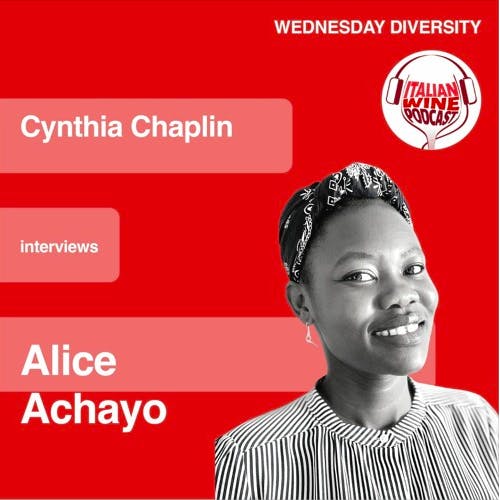
Ep. 1005 Alice Achayo | Voices With Cynthia Chaplin
Voices
Episode Summary
Content Analysis Key Themes and Main Ideas 1. Alice Chayo's Unique Journey: The unconventional path of Alice Chayo, from her upbringing in South Sudan and Uganda, through eco-gastronomy studies and bread baking, to becoming a wine professional. 2. The ""Only One"" Experience: Navigating life and career as an immigrant and a person of color in predominantly white spaces, and how this shapes identity and resilience. 3. Critique of Eurocentric Wine Culture: An in-depth discussion on the inherent biases and exclusivity of traditional wine language, descriptions, and pairing rules. 4. The Wine Linguist's Mission: Alice Chayo's initiative to expand and decolonize wine terminology by integrating global cuisines and diverse sensory experiences. 5. Promoting Diversity, Equity, and Inclusion (DEI) in Wine: Advocating for a more accessible, representative, and welcoming wine industry for all. Summary In this episode of the Italian Wine Podcast, host Cynthia Chaplin interviews Alice Chayo, founder of The Wine Linguist. Alice recounts her formative years, moving from South Sudan to the US, studying eco-gastronomy, and a surprising apprenticeship in bread baking before entering the wine industry. A central theme is her experience of consistently being ""the only one"" in various environments, from school in New Hampshire to professional wine settings, and how this cultivated a unique perspective and resilience. Chayo then passionately details the mission of her new venture, The Wine Linguist. She critiques the Eurocentric nature of current wine language and practices, arguing that they are exclusive and intimidating. Through her ""decolonizing the palate"" initiative, she aims to broaden wine descriptions by embracing global cuisines and individuals' unique sensory memories, moving away from prescriptive rules and fostering a more inclusive and relatable wine culture for everyone. Takeaways * Alice Chayo's diverse background, including eco-gastronomy and artisan bread making, uniquely informed her approach to wine. * The experience of being culturally distinct can become a powerful source of identity and a ""shield"" in new environments. * The traditional wine industry often uses language and rules that are exclusive and intimidating to non-Western audiences. * The Wine Linguist seeks to expand the wine lexicon by incorporating sensory experiences from diverse global cuisines, fostering inclusivity. * Terms like ""exotic fruits"" and rules like ""no red wine with spicy food"" reflect a Eurocentric bias and alienate many. * Diversifying the wine industry fundamentally requires a change in its language and a commitment to broader representation. * Engaging with various food cultures can significantly enrich one's understanding and description of wine. Notable Quotes * ""Eco gastronomy... has been sort of the foundation of how I am in terms of when it comes to food."
About This Episode
Speaker 2 talks about their dream of opening a small b trading store and their love for the wine industry. They discuss their past experiences with wood-fired ovens and their desire to open their own bakery. They express their desire to grow their passion for wine and their challenges at work. They also discuss their love for language and how it is a stressful experience. They emphasize the importance of representation and being able to showcase diversity of the wine language and collaborate with cooks and She's from the wine industry to create new ways of talking about wine. They express their desire to be the next ambassador for the wine podcast and hope to bring in more interested people.
Transcript
Welcome to the Italian wine podcast. This episode is brought to you by Vinitally International Academy, announcing the twenty fourth of our Italian wine Ambassador courses to be held in London, Austria, and Hong Kong. From the twenty seventh to the twenty ninth of July. Are you up for the challenge of this demanding course? Do you want to be the next Italian wine Ambassador? Learn more and apply now at viniti international dot com. Welcome to the Italian wine podcast. I'm Cynthia Chaplin, and this is voices. Every Wednesday, I will be sharing conversations with international wine industry professionals discussing issues in diversity, equity, and inclusion through their personal experiences, working in the field one. If you enjoy the show, please subscribe and rate our show wherever you get your pods. Hello and welcome to voices. I'm Cynthia Chaplin, and today I am delighted to welcome Alice Chayo. Alice hails from the Acholi people of South Sudan, but she grew up in Northern Uganda and moved to the US when she was twelve. Alice studied hospitality management and Eco gastronomy at the University of New Hampshire. And then she went on to work her way up through the wine industry with jobs at several prestigious wine shops across the Greater Boston area for a couple of years, finishing up with a four to five years sort of stint as a fine wine consultant And then in January twenty twenty two, she bravely started the wine linguist, which is a super exciting new adventure, and I really wanna talk to Alice about that. So welcome to the show. Thank you for coming. Thank you so much for having me, Cynthia. Great pleasure. Great pleasure. So I have got to ask you what got you into the wine industry. You know, you've you've, you know, come from this really outside the box background, and I wanna know where your wine passions sprang up from. Oh, man. You know, I like, every time I ask someone ask me this question, I never know, like, there is no short answer to it. So if if you have a couple of minutes, I would just give you a little a little story of how it all came to be or where I am now. You go for it. This is what we wanna hear. Awesome. So I would say definitely started out in college, and as you mentioned, I studied hospitality and Eco gastronomy. And, honestly, Eco gastronomy was it has been sort of the foundation of how I am in terms of when it comes to food. And so they are I'm gonna stop you right there. And for I'm sure a lot of people listening to this are gonna say, what the heck is ego gastronomy? Yes. Sure. So Eco gastronomy is essentially the ecology of food, and it's guided by the motto of slow food, you've heard slow food movement. Absolutely. Right? So the good clean and fair, right, you're in Italy. So, yes. Originated in BRAff, in a Piedmont region with Carlo Petrini. And so, Eco gastronomy had a tie to Carlo Petrini. And so we were, first semester, we went to study abroad. So I studied in BRA, in, I'm so jealous in Piedmont. It was it was fun. Right? And so, you know, from there, I really fell in love with food. I didn't You know, as an African, I I feel like I never I never looked at food the way I do now because it was natural. Right? We were farmers and we had access to good food. And and it wasn't until I came to the US and that access wouldn't was no longer there. You know, fruits and vegetables first, they were different from what I grew up with, but also that they were not as, easily accessible. And so I know. It's crazy, isn't it? You know, supposedly, the wealthiest country in the world, and you can't get fresh stuff. Exactly. And I found that really weird. And so through studying with Eco astronomy, I actually became more appreciative of food. And with that also, you know, the slow food foundation, you really think about the people behind food, so the lands do it. So those are farmers, your gardeners, the cooks, people who I think really keep us grounded. And I just it I resonated because I looked at my own people, and I thought, my gosh, like, that's who we were. You know, that's who we are. And so that had a close, I think, a very close place to my heart. And so I come back from Italy, and I'm just thinking, okay, I want to open a small bistro. And I want to cook everything in a wood fired oven and source it from local farmers, and it will be focused on seasonal ingredients. Right? So tiny, your tiny dream there, tiny dream. Tiny dream. And I come back, and I tend to get very laser focused on my dreams. Right? So I just that's what I will focus on. So I came back and I knew that I needed to learn how to use a wood fired oven. Were were you still in New Hampshire, I tell you? I was still in New Hampshire. That's right. Because I can't I can't imagine that there are, like, hundreds of wood fired ovens around in New Hampshire. No. Absolutely not. You're right. So I found an apprenticeship in the middle of nowhere, Pennsylvania in the Popenows where they were looking for a bread baker's apprentice to bake bread in a wood fired oven. And I forgot everything else about that title and only saw wood fired oven. This is so niche. I love it. That's what I'm coming to learn. And so I went out. I moved to Pennsylvania, like, literally middle, though, where I didn't know anybody. In the Poconos, and I I was a bread apprentice for six grueling months, and I learned how to use a wood fired oven. But what ended up happening was that I fell in love with bread. You know, it's funny because that's that the great thing to fall in love with. You know, it is really, you know, it's it's cliche to say it is a staple, but, you know, bread is a very complicated thing. It is. It is, and it isn't, though. Exactly. Yeah. So I fell in love with bread specifically sourdough bread. So that is, you know, that is skill that I am trained in. And so when I was done with my apprenticeship, and it was alright. I wanna go somewhere and bake bread in a wood fired oven, but I don't wanna do it in the middle of nowhere. Well, yeah, a social life would be good. Exactly. And so I'm thinking about where to go and it was the places around me, the states around me were like Vermont and Maine, and I love both of those places, but I, they were still too far away from where the energy needed to be around. And so Boston was the next closest thing, and they didn't have wood fired oven. I don't think it's even really legal to have them in the city, just fire hazard. Probably. Yeah. Probably. Like a proper wood fired oven. I I don't think you could have that. But I ended up applying to work at, a bakery, a very well known bakery actually here in Boston. It's been there for nearly forty years at this point. And I was a red baker there for two and a half years, but I got tired. At, like, twenty three going twenty four, I was like, my body is tired, and I'm this young. Right? Well, I guess you must have been getting up, like, in the middle of the day. Yeah. To be Fred, of course. I have to tell you, I knew the name of your bank I used to live in Boston, and that was part of how I found you because somewhere something I read about you said the name of the bakery. I think we we need to say the name of the bakery house. Oh, it's it's Clearflower. Exactly. I'm more than happy to say the name. I I love them. They since been they've taken a new owner, but yes, a great bakery. We've gotta give them a little plug. They they were great bakery when I was living there, and that was definitely thirty years ago. Yeah. For sure. But they're they're great. So I worked there and I just thought to myself, okay. I'm tired. You know, and I I need to do something else, and I I will take a pause in this, you know, come back. I thought about maybe at this point, I was like, I could open my own bakery, but I just thought, I'm I'm just tired. And so back to the drawing board, okay, what do I do? Clearly, I'm not gonna open my eastern now. And, like, maybe that will happen down down the road in my life. Because now you were more realistic and you knew how hard it was. Ex. Hey. Right. Hey. You know, where kids in high school, in college, rather, I should say. So we just get to dream, but we don't know the the the reality of making those dreams happen. And so at that point, I just started to think about all the let's say classes I took in college that I was interested in, and one of them happened be an elective that I take in. That was called, international beverage management. And so in that course, I wanna say eighty five percent of the course was on wine. Right? So this is how the wine gets plucked in. And I love I love that course. I took it one semester, then I studied abroad for the Eco gastronomy. When I came back, I actually asked to be a TA for the class because I thought I could learn more by grading students' work I guess. Yeah. Teaching is always the best way to learn. I I right? Because you you kinda have to know what you're doing. And so it it's like double the learning. And so, yeah, I became a TA for the class, and there was no other wine course at the university. And so this was my only way of kind of expanding my knowledge of wine at the time. And so, yeah, fast forward later. It's like, what do I do with my life now? And I thought, why? Yes. That still plays a role. And if I open a bistro later, I'm going to need to know wine. It's so Right. It was an evolution. I can see this. Oh, for sure. There's a there's there's there's a plan to this this madness. And so I applied to work at a fine wine shop with just the knowledge that I had, which was super basic. But You know, they hired me. They liked my personality enough that they hired me, and then they, at that time, they were offering all of their employees, paying for their W SAT certification course, so they pay for mine. And That's fantastic. I I think a lot of people don't understand what a financial commitment that is. Absolutely. It's very expensive. It's very expensive. And if your if your job is going to support you and and take on that that financial outlay. It's so helpful. So I've had that happen in my life too. It really is helpful. I wish some more people did it, more businesses did it honestly for for their employees, but, I'm hoping. I'm hoping. Me too. But, yes, so that is kind of how that took off in terms of wine. And I just fell in love with wine. And after, you know, a couple years of working in retail, well, actually, like, one and a half years working retail, I wanted more, right? I wanted more room to grow, and the latter sort of had just stopped here. So I you were at the top, basically. I well, I I couldn't really let's just say I couldn't get to the top. It was not the structure of this place wouldn't wouldn't really, yeah, I wouldn't have gone to the top, but that's okay. And so I moved on. And I had a friend who worked at a distribution company, and he was able to take my resume and put it on his boss's desk and that's how I got into Martetti Company as, fantastic. It's all you know. I went there. Yeah. And then I worked for one division because it's an umbrella company with both companies underneath it. So I worked for one division, and I really wanted to go into the fine wine and the best, the best one that they have in Martnetti is, I I might be a little biased, but it's a classic wine imports, right, with all the classic Wine. So I was there for three years and really loved it and learned so much. So that's that's I think that's really where my love of wine got developed was working with the portfolios. Well, great place to to learn and really to sort of yeah, grow your passion. That's that's such a that's such an interesting progression. And and really, you know, it it's not that far belief from bread to wine. You know, we're back in the whole biblical communion thing and bread and wine. This is an old story. You're a young person, but that's an old story. I like that dynamic. But, I mean, so, I mean, you've you've had this really interesting and and varied life already, despite the fact that you are this young person, but it hasn't been easy. I know. And, like, you've you've made it sound fun and simple, but I know you've a lot of challenges at work and and on a personal level. And I've heard you describe yourself as, quote, unquote, the only one. And this is such a fascinating and painful concept. Can you sort of explain to everyone listening what you mean by being the only one, you've said you got used to it and it became normal, which doesn't sound very great to me. But clearly, you've taken the whole experience and the concept and flipped it into a positive, forward motion in your life Tell us what what that concept means and and how did you manage to make it something positive for yourself? Yeah. Sure. So I would say it it really comes from the fact that when my family and I came to the US, and moved to New Hampshire, from Africa to New Hampshire. This is not, like, this is not an easy change. Yeah. From a village, really, because, you know, coming to coming to America was it was it could be You could be on another planet altogether. There was nothing that could have prepared us for what what we were coming into. And then when we got here, it was just like, well, you can't even be like, oh, I'm surprised that this is here or I'm surprised this is, this is who's here. You we just showed up. We're like, okay, this is what this is, I guess. Right? And so, you know, we are in a, in a new new Hampshire. It's gotten better now. The capital has a lot of, immigrants, but You know, in two thousand, it's a very small demographic. And so we were not even in the capital. We were in a small town, Paul Heenecker, and, my sister and I, literally, when we showed up, like, the diversity percentage went up by two hundred percent, right, just the two of us showing up. Oh my god. And we covered every I mean, every box you can check. We we were it. And so for us, it's just and we didn't speak English. So one hundred percent culture shock Oh, absolutely. Absolutely. And I think that that's precisely it. Right? Like, there is nothing that I will ever experience. I don't think in my life, again, that will be that shocking to me. Yeah. And I'm sure your school didn't have English you know, as a foreign language class or anything like that? They had it for a brief moment. So because I was twelve at the time that I arrived here, they immediately put me in sixth grade. I didn't speak English. Oh my god. I do have to say my name. So this is how I would introduce myself. Hello. My name is Alyssa Chayo. That's like, that was that was I was, like, tri that's what I practiced was how to, like, introduce myself. And then if you followed up with more questions, I just looked at you blankly. I there was nothing. And so, you know, they did try to provide us with ESL classes, but even that it's like when it's your first time really having somebody that's from a different culture, you they just didn't even know how to I think provide us with the right. So I think it's gotten much better now, but back then, it was really hard. And so, honestly, the first few years of my life in America was really painful, because You know, and this happens a lot, I think, with immigrant families, but specifically from Africa, like education's really important for us. And so at twelve years old, and I know we talked, briefly, Cynthia said that I was a baby, but in my culture, twelve years old, it's not really young. Right? You know, in a few years, if if nothing else, I would probably have babies by then. And so it's, like, by twelve years old, I really am already preparing. I'm in my young adulthood and with a huge sort of sense of responsibility, I'm guessing. Exactly. Exactly. So coming here, not speaking English, I would sit in the back of the room so frustrated, but mostly frustrated with myself. I blamed myself for not understanding what was being taught because I knew that so much weight on me, you know, as one of the first of my family do members to come here, that it was my responsibility to get a good education so that I then go and help my family. Right? So it just was very frustrating. Even though now I can look back and say, you know, it wasn't your fault. You didn't understand. You literally didn't speak the language, but I still in the moment. I felt like I was failing them. Right? So Thank you for listening to Italian wine podcast. We know there are many of you listening out there, so we just want to interrupt for a small ask. Italian wine podcast is in the running for an award, the best podcast listening platform through the podcast awards, the people's choice. Lister nominations is from July first to the thirty first, and we would really appreciate your vote. We are hoping our listeners will come through for us. So if you have a second and could do this small thing for us, just head to Italian wine podcast dot com from July first to the thirty first and click the link. We thank you and back to the show. But, you know, I had a great host family. They're actually, they've been my family. We just call them mom and dad. They were, they were the family that sponsored us and took us under took us in as their own as the rest of my family were still back in Africa. And they really provided my sister and I a stable home in order for us to go to school, and learn English. So when I speak, and there's no accent in my English is because I grew up in an American household. So going from zero English to learning English, you just copy everything and how everybody talks. Right? But I think going back to what I said about being the only one. You know, it can be painful, but honestly when you don't know any different, you know, when I came to the US and all I saw were the people around me, which is just like all white people. I wasn't thinking Well, this doesn't look right. Right? I was in a new country, someone else's country, and I took what I was seeing and, and, and interacting with as that's what it is. So there's nothing we would say where where are other people, where are, you know, where are other Africans? It was just we were coming to America. We didn't know what it was, and we showed up, and that's what it was, and we accepted as is. So being the only one in my high school, on my sports team, on my theater, you know, like, it just was the norm. And I didn't question it so much about, you know, I, I specifically didn't really feel like there was something missing. I just said, okay, this is America then, you know? So it took a long time for me to say, whoa. Like, actually, where are other people? Right? But it took years. And so I think I think you you can say it was painful, but I think because I accepted it, I didn't know any better, about other parts of America, and just this is what I was sort of, I landed in. I didn't know to I didn't know I was supposed to be missing something, if that makes sense. And so fast forward to me being in the wind in this and not seeing any faces that resemble mine or cultures or language that resemble mine, it it's kinda like that first feeling again of coming to the country of this country being like, yep. Well, this is just what it is. Right? So I got to the wine industry, and that's what it was. And I I didn't think too much, like, oh, you don't look like everybody, and you don't speak like everybody. I just sort of jumped in and was like, okay, let's learn it your way. This is your thing. Right? So That's incredible. Well, I mean, that's a pretty strong, wild response to that kind of a challenge. Yeah. I, you know, probably won't hear your sense of responsibility. You wanted to do it and you were gonna get out there and do it by god. That's really it. Right? It's just, like, not thinking that But I I do think that where I come from, coming from from Africa, it there is a lot of emotional shield that comes with where I come from that, you know, it's like, sure. I I growing up in New Hampshire, I'm sure that there was racism all around me, but, it's almost like sometimes if you don't know what what it looks like, you don't know. You know, so Yeah. Yeah. So for me, it's like, you know, we always hear Like, you know, sometimes, you know, people say go back to your country and I I kinda joke about this where I'm like, if somebody ever said that to me, maybe they did, and I just didn't register. But if they did, I'd be like, yeah, yeah, but give me a moment, I will. Right? Like, there's there's something really powerful about being able say, yes, I know that this is not my country, and I have my own. That's okay. Like, you're just pointing out facts to me right now. So I think there's something really powerful about that. That's amazing. That's I and that concept that I have, like, yeah, something about being able to say, I know this isn't my country and I have my own, but I'm I'm still here taking part in years. That that is. That's a hugely powerful message, actually. And I think probably has done a lot to preserve your, like, internal identity. Yes. And it's one of those things no matter what room I'm in, I know that I will never look like. I mean, it's thank goodness. It's getting better in this industry, but I I'm used to not ever admit. It took a I mean, it's still but it's given me this this shield where I know that no matter what room I'm going to walk in, I'm going to be the only one, and that's okay. It's it's that's amazing, Alice. I just I I find that concept just really amazing, and I've never heard it put that way before. And there's something there's something really strong about that philosophy. I I really I applaud you for that. It's It's amazing. I also I wanna I wanna talk about something a little more lighthearted, but I wanna I wanna yeah. I wanna congratulate you too for starting the wine linguist, you know, in in twenty twenty two, in January of twenty twenty to. Very exciting and brave for you, just coming out of a pandemic, you know, not too sure what's going on. Economy, not so great. All of these different things, and you started the wine linguist. And I've read that you were inspired to leave your very nice, fine wine consulting job because you wanted to create a project that focused on expanding wine language, and I can't agree with you more. This is something that I talk about a lot So what are your goals for the wine linguist? What do you hope to do? And and how are you gonna get out there and do it? Yeah. That's a great question. So, you know, with the wine linguist, you know, obviously over time, I've reflected on the fact that you the wine language is, first off, a language that I I believe belongs to everybody because it's a language that relies on our sensory memories, but that is not something that you're taught in wine education, and we can Absolutely not. And I was starting mine way before you and believe me. Never heard a word about that. Right? So, you know, I think for a long time, again, just taking it for what it was. I I I learned why in the way that I was being taught and then sort of had to put aside my sensory memories. They were not relevant into the way that wine was talked about. But over time, I I I just didn't feel that that was true. And I personally, you know, one of the one of the most beautiful thing for me is interacting with people, with wine in a way that when they leave, they're they they feel they feel free in how they can drink wine and talk about wine in a way that makes sense for them. And so as a wine consultant, and a wine professional, I think that it is my job to make sure that people feel comfortable in being able to experience wine in a way that makes sense to them. So that means encouraging them to dig, to really dig into their sensory memories, because it's there. You know, it just really takes us, it takes us time to, to learn to really dig into your sensory memories, but the sense that you've grown up around, the foods you've grown up eating, they're all locked in your mind. The sense are there. And so you can easily find that in wine and be able to, to talk about wine and enjoy it in a way that makes sense to you. So I was just really Let's just say I was not interested in talking about wine as if I know it all. Right? Wine professionals sometimes, and, you know, I point us out all the time that we have this, this thing about us where we, we think that we are supposed to tell people, what to drink, how to smell wine, how, you know, what food to have with it. And I just find that such BS because it takes away from the joy of of really sharing wine and food with people is that I, I want to give you some tools you know, and for me, the tool is to make you feel comfortable enough to to experience it how you want to experience it. I don't ever want to tell somebody this is what you should like and smell and drink, you know. So You're so right that it is such BS Absolutely. And, you know, it's no one can ever know everything about wine. That's part of why I love being an an educator and a presenter myself because there's something new to learn even for me every single day, and I cherish that part of it. So I I, yes, I have a very big struggle with those among our sector who do pretend or behave as if they know everything, which is also very intimidating for people who are new. So Exactly. It keeps I think it's what's really have this industry. I mean, this, this culture very intimidating for for everyone is this sort of this, this idea that you're supposed to know how to describe why the word, the correct words to use. And I'm just like, No, man. Like, this is if, you know, and I think that's so that sort of brings me to the point with the wine linguist where where I want to say that if we're going to to continue to talk about wine in the exact same way, right, and we're just regurgitating what like, every wine professional says, we as wine professionals, we just regurgitate what we hear, whether we have experiences with those scents and aromas and bouquets or not, then the wine language stays very exclusive, very limited, and very restrictive. Right? So we don't go outside. And it's almost like a secret language. You need a decoder ring. If you aren't part of the club, you you can't under and what's being said. Exactly. And so I I just think that that also not only make it intimidating, but it it gets boring really quickly. Absolutely. I think of it kind of like, are you familiar with the game bubble? Yes. I just imagine that, like, Like, imagine that the current wine language and what it's been for a long time. It's just like those letters in the in the bubble container. You just shake them around and you just try to create some sort of new something. But, like, you're just you're still limited to the letters that are in the Exactly. Precisely. Right? And so for me, with the wine language, I I want to expand the wine language. And my the way that I want to approach is through global cuisine. As I mentioned before, The wine language to me is a language made up of sensory experiences. And what has the most sensory sort of, you know, what creates the most sensory memories? It's cuisines. Right? When you think about how different cultures, the spices that they use to herbs, that, you know, even just the plants that they've grown up around, they have themselves cataloged their own sensory memories. I absolutely love this. I just love this. And it it you're you're playing into my hands because I wanna bring up the fact that I I know just a couple of weeks ago, you were a speaker at Assemblage Symposium in Oregon, with a lot of my favorite Oregon people, Remi Draftkin and and other people. For those of our listeners who don't know, Asemblage, their philosophy is to amplify the voices of women, bipoc, people, people who identify as LGBTQIA plus, people with disabilities and all of these people who are underrepresented in the wine industry. Of whom there are still far too many, unfortunately. But your session at the symposium was called decolonizing the palette. I am so jealous that I wasn't there. What was what was the concept behind this title? The the the session was described. I looked it up in the in the flyer as a critical analysis of Eurocentrism of wine descriptions and rules around wine and food pairing. So tell me what you what you were talking about, fill us in what what the problems are in this arena and why these problems exist. You touched on it about how people grow up with different foods. So tell us about decolonizing the palate. Yeah. So I think we've kind of it's funny. Like, we've kind of been talking about it all, but just to kind of bring it, into this this question. Decolonize the past. So if you think about the fact that it the wine language is is very eurocentric and really just focus on web certain society, then that means that it excludes the global majority. Right? So it's a language that's been written for specific groups of people but it excludes a lot of other people in it. So I'll give you an example just to kind of because it's it's easier once I give an example. So, you know, during during the symposium, I brought up the this point where in in the wine industry, there's this rule of thumb that says, you know, you don't pair red wine with spicy food. And I, you know, we asked the audience to say, why is that? And someone said, because it elevates the heat. I said, that's right. You don't pay a red wine with spicy food because it elevates the heat. It makes whatever you're eating hotter. And Miguel just said, you know, hotter for who. Right? And that's a question that we really have to think about anytime that we we look at the way that wine is described or talked about, we have to think about who the audience is. And for for a long time, the audience has never been anyone except for Western society. So in cultures and cuisines where they they cook with with spicy, we'll say, well, spice, we'll call that, is that their palate is already used to heat, right, to to spice heat. And so when you're doing that pairing, it only becomes unpleasant for societies whose palette is not does not have the tolerance for for heat. Absolutely. I love that quote. Who's fancy for who? Yeah. Who's who's who's to say what is too spicy. Correct. And so it's like, you know, what audience are we really talking to when when we're coming up with these different either, rules of thumb? And then the other thing too is, you know, we, we have classic pairings. Right? So again, steak and and Cabernet is a classic pairing. I I just, like, that can't get any more boring for me, by the way. I have I have to agree with that, frankly. Just, I'm, like, off. So anyway, I'm an Italian wine person. So when I eat my steak, I never drink cabernet with my steak. Good. Yeah. It's, I'm like, unless you don't like the meat, you just wanna wash it down? Sure. Do that. But, anyway, so classic parents like that are I mean, first and foremost, that's assuming everybody eats steak and that everybody eats in a certain way. Right? Because otherwise, you're really speaking to a very small demographic who will understand what steak and red wine is like. So another example of decolonizing, your palate or the wine language looks like when we describe, aromas or or notes in wine as exotic fruits and spices. Exotic for who. Right? Right there, again, you can tell that the audience is not the global majority because how weird would it be if I was talking to my sister? And rather than say mango or guava, I said exotic fruits. Yeah. That's a really good point. If you're from places where those fruits grow, they're not exotic to you. They're local. Correct. So by describing, you know, a wine with having exotic notes and and, you know, like fruits and spices, you're really speaking to a different audience. It's no longer those who come from, you know, climates that grow those those fruits and and spices. So it's it's stinking. Sure. And in the reverse, if you're, yeah, if you're talking about, you know, the old wine language, exotic fruit from an African culture would be gooseberries and apples because you don't have those things there. Precisely. Yes. That's a very interesting concept exotic for food. Exactly. And so those were kind of no, getting people to really think about the wine language and and who the audience are. And when you start to think like, you know, the goal is to at least in my work, and it seems like in yours as well, and those who were at assemblage was that we wanted to diverse ify the wine industry. And so what does that look like? Part of that is in the language that we use. Right? We cannot continue to describe, wine in a way that really only speaks to one audience and ignores the rest. Because then we're just, like I said, we're we're just stuck with this, like, boggle letters that we just we just and we continue to exclude half the world. Correct. And so that is what diversifying the wine industry looks like. And for me, it's diversifying the the language through global cuisine, I believe that if we want professionals, especially, were to expose our palates to different cuisines, right, different fruits and plants from other parts of the world that our wine language would increase simply by by trying other people's foods and and getting to know them and learning from those cultures that we would have new ways to talk about wine that was inclusive and that was more relatable to, to the majority rather than just speaking, you know, specifically to one group of people. And then the other thing too is I don't want us to just learn about these cultures and then use, their words to describe why I want to bring in people from different cultures. And so with the wine language, my goal is really to collaborate with cooks and chefs from different cuisine, have them prepare food, whether a dish that is really well recognized in their culture or has some sort of meaning behind it. I want stories behind these foods and spices and to get to know a little bit about people's culture as I'm as I'm talking to them, I'm learning about their cultures. And so I want that representation there and then be able to showcase wines that go with those foods. And there's sort of a few reasons for why I wanna do it that way. A, that is representation. And we know that representation matters, right, in any aspect of life. And so in wine, that means you know, not always highlighting the same faces that we that has been highlighted for so long. We need to see different faces because a lot of people drink wine. It's not just it's not just the few anymore. Right? That's right. And we've got a whole new generation of wine drinkers coming, and they don't wanna see a bunch of old white men. No. They really don't. They they're not interested in that. I don't really wanna see a bunch of old white men and I've been in the wine industry for a long time. It gets boring real fast. But, yeah, so I want the representation there, but I I also I want those who have never seen themselves in the wine industry to know and see their foods represented to see their own cultures represented. And then for those of us, like we said, there are a lot of people who are interested in in a different way of talking about wine. So millennials, for example, they are they love learning about other cultures, and we'll we'll try foods from other cultures. So now they will also have the knowledge to be able to pair wine with foods from other cultures. Right? They'll they'll they will actually have some guide in that as well. So there is a few different reasons for why I'm doing Absolutely. And I think, Alice, that you're missing a trick here if I if I can be so bold to to say. I think the wine linguist needs to be sponsored by some wine producers who want their wines taken to new cultures where they haven't been before. It's not just about the consumers learning. It's also about the producers learning how to present their wine. I agree in other countries where other food is consumed, where people aren't used to pairing wine with food. I think that's a great opportunity for the entire sort of three hundred and sixty degree wine sector, you know, educators and consumers and producers and importers and exporters and bringing in the chefs and and the food growers as well. I think you're really onto something important. I mean, this is something obviously very near and dear my heart, but I like the way that you're going about. I always say make a long table and keep adding seats so that no one gets turned away. And I think you're really, really onto that. So I seriously, I'm so impressed and I wish you all the best with the wine linguist. Again, everyone who's listening, Alice has only been at this with the wine linguist for five months. So, we need to get out and support you and and find you on social media and follow what you're doing because I will be an avid follower to see what happens with you. But before I let you go, I just wanna ask you my my typical, question when I'm talking to people in the wine world, especially those who are interested in sort of changing up the game. I know you've got an interesting palette and I used to interesting foods. So what's your favorite Italian wine and what we do during it with? Yeah. So, you know, I really love trying different, Italian wines all the time. And one of the ones that I recently fell upon is by, Casina Valdel Prete. They're from Piedmont, and it's this, this wine from them is called Prete Roso. And this one is it's made almost like in a Rosay style. So that it was it was a rosso that I that I was able to chill, and it is freaking delicious. So I would I would love to pair that with Sabusa, which is also known as Samosa. But in East Africa, we call it Samosa. Right. Alright. Well, I what my sort of focus and and research these days is on Italian Roses. I'm I'm very passionate about Italian Roses, which there are hundreds and hundreds that no one's ever heard of. So I'm gonna go check this one out. Absolutely. It's delicious. Well, I'm so happy to speak to you today, Alice. Thank you so much for coming. And as I said, I wish you all well with the wine linguist and all great good fortune. I know that a lot of people are gonna be so interested in what you're doing. Thank you so much for having Cynthia. This was really fun. Thanks for listening to this episode of Italian Wine podcast. Brought to you by Vineetli Academy, home of the gold standard of Italian wine education. Do you want to be the next ambassador? Apply online at benetli international dot com. For courses in London, Austria, and Hong Kong, the twenty seventh to the twenty ninth of July. Remember to subscribe and like Italian wine podcast and catch us on SoundCloud, Spotify, and wherever you get your pods. You can also find our entire back catalog of episodes at italian wine podcast dot com. Hi, guys. I'm Joy Living Denon. I am the producer of the Italian wine podcast. Thank you for listening. We are the only wine podcast that has been doing a daily show since the pandemic began. This is a labor of love and we are committed to bringing you free content every day. Of course, this takes time and effort not to mention the cost of equipment, production, and editing. We would be grateful for your donations, suggestions quests and ideas. For more information on how to get in touch, go to Italian wine podcast dot com.
Episode Details
Related Episodes

Ep. 2789 ColleMassari: a long-term vision rooted in Montecucco with Giuseppe Di Gioia | On The Road With Stevie Kim
Episode 2789

Ep. 2788 Ep. 14: Austria and Hungary | Study Smart for your WSET Level 3
Episode 2788

Ep. 2785 From Volunteer to Speaker at TEXSOM with Samantha Cole Johnson | TEXSOM 2026
Episode 2785
Ep. 2766 Inside the U.S. Non-Alcoholic Wine Market: What Wineries Need to Know with Jill Sites | Masterclass US Wine Market
Episode 2766
Ep. 2761 Winemaking and Consulting Across Sicily with Alessandro Serughetti | Wine, Food & Travel with Marc Millon
Episode 2761

Ep. 2759 Part 2 – The VIA Educational Program & Italian Wine | Heart-to-Heart Conversation with Sarah Looper
Episode 2759