
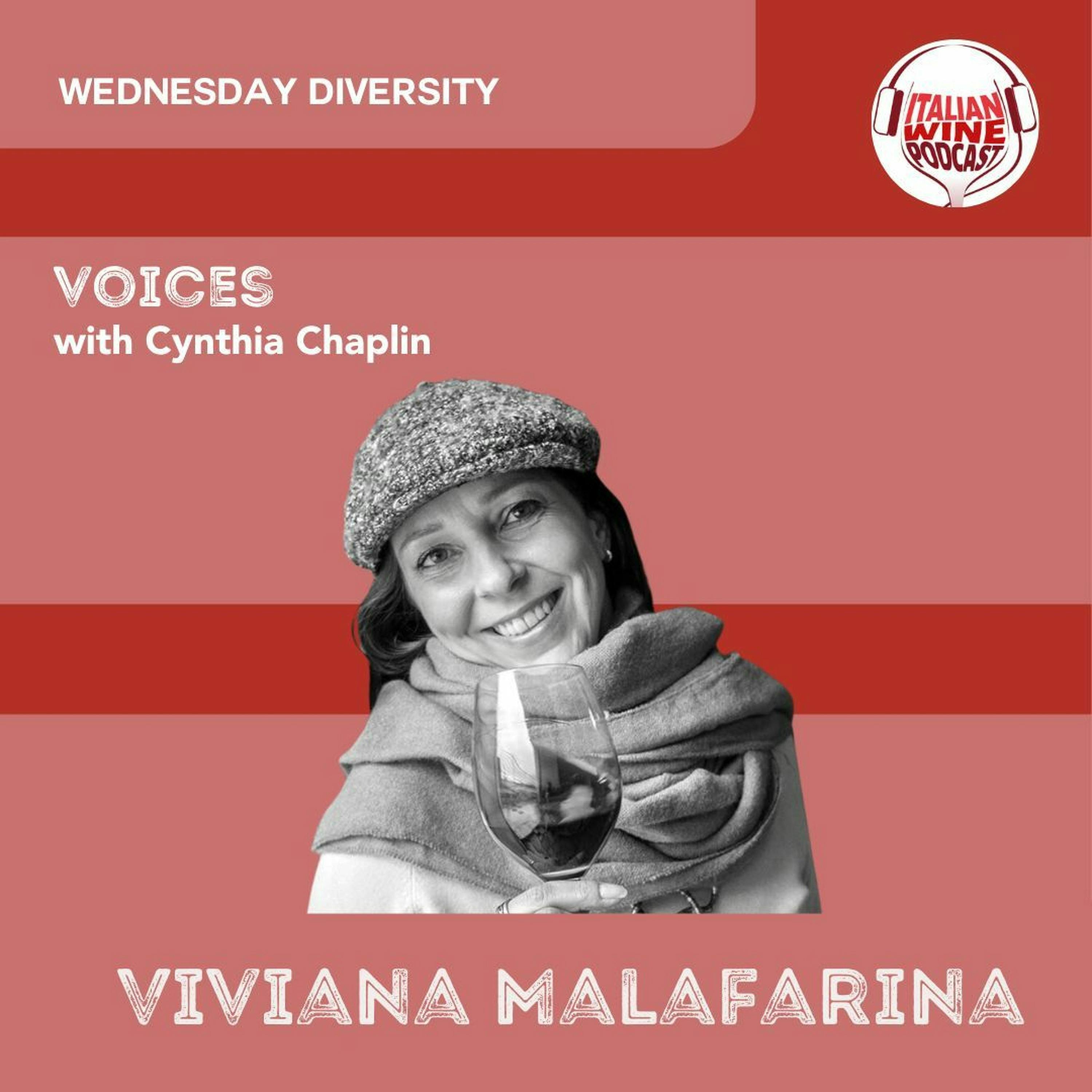
Ep. 1446 Viviana Malafarina | Voices With Cynthia Chaplin
Voices
Episode Summary
Content Analysis Key Themes and Main Ideas 1. Viviana Malafarino's unconventional journey from linguist to pioneering winery manager in Basilicata. 2. The challenges and triumphs of being a woman leading a winery in a traditionally male-dominated and conservative region like Basilicata. 3. The unique characteristics and immense, yet often unrecognized, potential of Basilicata's terroir and its indigenous grape, Alianico. 4. Viviana's innovative approach to winemaking at Vasilisco, focusing on elegance, single vineyards, and empowering a female workforce. 5. The dichotomy between agricultural/artisan work and industrial jobs, and the impact of local administration on regional development. Summary In this episode of the Italian Wine Podcast's ""Voices"" series, host Cynthia Chaaplin interviews Viviana Malafarino, the ""face and soul"" of Vasilisco winery in Basilicata. Viviana shares her unique path from a background in teaching and linguistics to managing a winery, a career shift she describes as a ""melting pot"" of her diverse experiences. She discusses the significant challenges she faced as a woman entering the male-dominated Basilicata wine scene, including initial resistance and traditional mindsets. Viviana highlights the rugged beauty and untapped potential of the Monte Vulture volcanic territory, her dedication to producing elegant, refined Alianico wines from ancient vines, and her innovative decision to employ and empower an all-female workforce, challenging local norms. She also touches upon the lack of support from local administration for agriculture and tourism, contrasting it with her group of collaborative young producers, ""Basilicata da Bere."" Ultimately, Viviana expresses her deep passion for making Basilicata's unique wine and culture visible to the world, driven by a desire to correct the injustice of its obscurity. Takeaways * Viviana Malafarino transitioned from a linguist/teacher to managing Vasilisco winery, finding that winemaking integrated all her prior learning. * Basilicata's wine industry, specifically, presents significant challenges for women seeking leadership roles. * Vasilisco winery, under Viviana's leadership, is focused on expressing the elegant and multifaceted nature of Alianico, particularly through single-vineyard projects. * Viviana actively empowers women in her workforce, training them for roles traditionally reserved for men (e.g., pruning, driving tractors). * Local government in Basilicata is perceived as unsupportive of agriculture and tourism, favoring industrial development, hindering the region's wine potential. * Collaboration among younger, like-minded Basilicata wineries is emerging, despite historical resistance to sharing knowledge. * Viviana is driven by a deep passion to showcase Basilicata's natural beauty and the overlooked quality of its wines, believing it deserves greater recognition. Notable Quotes * ""making wine agriculture first and, denification afterwards, it's really like, a melting pot where everything I've been learning before fell in."
About This Episode
Various speakers discuss the complexity of the wine industry and the challenges of finding a positive environment for learning and development. They touch on the importance of finding a positive environment for growth and finding a positive environment for community. The speakers also discuss the importance of showing the beauty of the wine and reconnecting with past ideas, and the need to show the amazing beauty of the brand and correct the injustice of the new one. They thank each other for their time and hope to see them again in the future.
Transcript
Hey, guys. Check out Italian wine unplugged two point o brought to you by Mama jumbo shrimp, a fully updated second edition, reviewed and revised by an expert panel of certified Italian wine ambassadors from across the globe. The book also includes an addition by professoria Atilushienza. Italy's leading vine geneticist. To pick up a copy today, just head to Amazon dot com or visit us at mama jumbo shrimp dot com. Welcome to the Italian wine podcast. I'm Cynthia Chaaplin, and this is voices. Every Wednesday, I will be sharing conversations with international wine industry professionals discussing issues in diversity, equity, and inclusion through their personal experiences, working in the field of wine. If you enjoy the show, please subscribe and rate our show wherever you get your pods. Hello, and welcome to voices. Today, I am very excited to have Viviana Malafarino from Vasilisco winery in Vasilicata with me. The winery's website describes Viviana as the face and the soul of Vasilisco. I can tell you that's true. I went to visit her myself and her passion and her dedication are obvious the minute you meet her. She manages all the aspects of the winery in conjunction with Pier Paulo, who's responsible for the vineyards. And I had such a great time visiting Viviana a few weeks ago, tasting her wines and walking with her in the eighty year old vineyards where she's creating incredible Alliannequin at over six hundred meters above sea level. On multivoltories, volcanic soils. So Vivianic, Pembinuti, grazie Mila Privenirioji. I am so glad you could come and talk to us. Thank you very much for inviting me. And, I'm very curious to see how this work, and I'm very, very grateful for the occasion to talk about Ultra and my work, obviously. Well, me too, as I said, I was thrilled to be there just a few weeks ago, and many of my listeners will know that I have four daughters of my own, so I always get really excited when I meet strong women in wine. It's so inspiring not just for me, but also for all the young people that I work with. So your story is so interesting. Originally, you trained as a teacher and a linguist, and I know you went on to work on super yachts, which must have been fun. We won't go down that road. But you took a temporary job at Fudy Desangrigorio, and I know that there was a reason for that. We won't talk about it. I think most of us have had a boyfriend that took somewhere. But you told me that once you got there, you fell in love with Viticulture at FeODi. What happened? How did you go from being a Russian translator to running a winery in Basarikata? As you said, I've been changing various life. And when I tricked into Viticulture, basically, I somehow felt that, making wine agriculture first and, denification afterwards, it's really like, a melting pot where everything I've been learning before fell in, including languages, including arts, whatever I've been doing, traveling is really, joining, like, altogether, like, in a life storm that condensate in one thing that express, all what I've been learning in my life. And when you well, like, people like me, which I'm a baby, I don't know. I would just say we would say in Italian, we would say Merkurica, like, mercury moving a lot and not Yes. Mercurial. Mercury going up and down. Oh, so when people like me find the the pace of agriculture and learn, first of all, that, you have to respect faces, which are not what you decide. And then, you can try every year to not do the same mistakes, but you have to wait one year. It's like a kind of, fascinating lifestyle that is over the beauty of nature and the beauty of creation. It's really to base down your heart that was enchanting me somehow. So the place where I found this meeting with nature is amazing because it's a volcano. So it's not a simple natural place. It's really a complex, beautiful reality. And that was the first falling love moment But then afterward, you really learn to live life in another way, and say. Oh, I think that's so true. I agree with you. I think wine does encompass so many things, history, and culture, and nature. And nature can be very humbling. You can't control that. You can control other things, but not nature. So it's different every year. I love that. I know that Antonio Capaldo from Fayettei spotted your talent with vines, and he offered you a permanent position as Viticulturist at Vasiliysco, and he told you what you don't know, we can teach you, and we will find you the very best teachers. And a year after that, you were running the winery all by yourself, which sounds incredibly simple, but I know it wasn't very simple. What was it like to be a woman suddenly in the middle of the wild west of Vasiligata running a winery? I can't believe that all the wine men rushed out to welcome you, did they? Yeah. No. They didn't. So sad. Actually, the opposite. Well, the first part of the your question is jump into something so unknown. It seemed silly, but it's been really scary. I remember, I'm not, ashamed to say, but the first few months, sir, I was in tears about the idea of ordering fifteen thousand bottles because I didn't know how to do it. I didn't know what they I had nothing. It was really over stressing at the very beginning. I I the first few months, I he slept like four hours a night because I really felt there was so much to learn. But afterward, honestly, Antonio's part of the game was great because, he said okay, we bought a winery because we failed. So it's like it works. That's a good word. The only thing you can do, which I wouldn't appreciate, is not do anything. So whatever you do, even if you do mistakes, it's fine for me. And that is a really good start and, really gives it a lot of space to creativity and, freedom in action. But then, yes, here in Vasiliicata was not easy to enter the Viticulture world. I think, honestly, all around Italy is still a little bit complicated for a woman, even if we have this association of Donna Delvino and, more and more that are you you can see winery run by women's. But somehow, very often, under note is that, you can do marketing, you can do accounting, but you can't really be a wine maker. And, obviously, there are many winemakers, more and more female. But, especially in Vasgata, which is a bit like, Italy a few decades ago. It's been quite difficult to be welcomed as a woman in this position. I had some colleague that was, pointing out that my hands were not properly softer and clean because I was working and I shouldn't do it. I should let other people do it, which is can be true because I'm not forced to do it. I just love it. So it's a it's a choice. But, yes, Vasiliicata is, is a very complicated place, to to start this kind of work, and even more for somebody that has never been doing it before. But as an Capaldo's promise was, fulfilled, he gave me the best teachers in, in Viticulture and in VINification. So I've been, learning, not that in university, but from scratch as, in the old days when you were going at the Pottega of an artist of, an artisan, and that would be, for me, is the perfect way because it really suits my, my temper this way of, learning how to use your hand and mind in a project. Yeah. I think every day is a classroom for you. You didn't go to a knowledge school. You jumped in with both feet, you are so brave to do something that you had never tried before and start a new career that you hadn't really thought of before and really learning hands on as you said, you know, with your eyes and your hands every day was your classroom. And it's funny. You know, I know Vasiligata is not Tuscany, obviously. No rolling hills and Cyprus trees and historic poets and all this romance. When I was there, you even told me that people in Vasiligata say nobody would ever move there on purpose. Everybody moves away instead. So I know how much you love it now. What made you fall in love with Montevault today and basilicata and Barile. It wasn't easy. I know. You said the winemakers weren't exactly, you know, very happy to see you. No. That was not the reason. Well, you know, there is a beautiful, very short, but really funny episode that happened to me. When I just arrived, there was the the wife of another producer that was kind enough to drive me around looking for, you know, grow up person of moving. And, we also went to see for a a doctor, a local doctor. And, they asked me for my permission to stay in Italy. And I I didn't understand. I said, well, I didn't realize that I need a commercial issue journal for basilicata. Of course, you have every foreigners need to have it. As if I had not foreigners, are you into? And why do you wanna move to basilicata then? So that was really, you know, a very first input, quite impressive. But, obviously, there there are many difficulty in a place like that, which is really walking slow on the task of, developing, industries and agriculture and, like, there is an old story. There is everything, but it's, like, moving slow. But the place, the landscape is such a rich of intensity, not only the volcanic oil, but the really, even the sky is different, the sky, the lights, and, most than everything at the end is, this obviously is quite a beautiful shock to see all this beauty and this nature. But the other thing is that, there is so much to do. And you do see all these huge potential that really is just starting to develop. That makes you feel like every day you make the difference. And that's his, like, a drug, basically, for people like me, I think, almost for everybody. When your work and just your life, your being in a place makes a difference every day. It's something that is really makes you addicted to, to what you're doing, I think. I love that idea. It really is such a rugged and gorgeous place and seeing the potential that a lot of people don't see. You told me it's very hard to get people to work there. They want to work in industry. They don't want to be in agriculture anymore. And really seeing that beauty for what it is and the potential that's there, you're very good at that. It's funny because I know that things were hard and you really have set your cap at making some change. You really want to see things go forward and see that potential develop. You told me a very funny story about trying to form a group of wine producers and invite them all over to have tastings together and share their wines and see how everyone could work together and improve And all of them said, you keep your nose out of my business, and I will keep my nose out of yours. Now since that time, you've become very successful with what you're doing. And I wanna know what the situation is like now with you and the other producers and the wines you're making and how they're different from what the other producers are doing. Yeah. That was quite a cold shower because I'm always been as a previous teacher, I'm always been very fond of, aggregation and, confrontation and sharing experience. So that was a bit shocking. And to be frank, I found a a positive response only in a, you know, winery, which is run by foreigners, meaning it's like non basilicata people, ex, the people that come from Tuscany. And, obviously, they're more used to this kind of, normal sharing of, information experience and whatever. So after that, I I I kept on going. As I said, also, when you were at the winery, in places like this, you really can make a difference only. Just keep being yourself. Just going on your road, and, it really gives you a different vision of what is possible to do or not to do. So for a few years, actually, I went back in my caves, as you've seen, the winery is in caves. So I really locked back myself in the cave from probably for about two years. And then I there was an occasion. Again, something that is grown up from a bad experience, meaning, a beautiful I don't know. Probably, you know, Colizione, which is a beautiful festival in Piamonte, and they always welcome winery from other regions. Me, I was in touch with them. Other younger wineries were in touch with them, and they proposed them to invite basilicata to be part of the project one year, two thousand seventeen. After a month with no answer, we just went back saying what's happening and is on. And they said, oh, what what's happening? We've been inviting you to consortium, whatever, but we we have no news of you. So at the end of the day, came out that, the consortium invited not all the wineries, just some of the wineries, and, all the others, or part of the others decided that we were not staying back just this time. So with a group of, just friends, basically, we were more linked by Gintonic rather than wine. She said, you know what? We're gonna do it. And, obviously, the, without any help from, public money or whatever, we paid our own inscriptions, all of us, to go there and be there. And the that way, is born a little group called, and we are seven wineries run by, let's say, young people like me or normally more young than me. And, in between us, things are changing because, now it's, like, five years we run together, and we do tastings together. We go around Italy talking about water together. And there is a super positive experience, but at the moment it's really, confined to this little group. But it's really inspirational as well for others, for what it could be, how it could be. Obviously, Sorry. I'm not so naive thinking that, in other territories, producer love each other deeply, but they are good at their work enough to know that if they join together, they can do a lot better. Italian wine podcast. If you think you love wine as much as we do, then give us a like and a follow anywhere you get your pods. Absolutely. As you said, you don't have to love each other, but working together and collaborating is the best way forward. And you touched on something really briefly there that you know, you had to pay your own inscriptions to go. I know you mentioned that sort of the local government in Vasiliqata is not very supportive. They're not helping the wine industry to grow and develop. What's going on there? Why do you think they are so resistant? I think somehow, they want to be benevolent in this sensor. So I think that somehow it's all connected with the same mentality that makes, young people refuse agricultural work and prefer industrial work is all connected to the same mindset we had in north of Italy fifteen, twenty years ago. Like, what is coming from the earth is dirty and heavy, and to be sitting at desk is the best work you can do. A few years ago, was the same, also in North of Italy. And down in the south, still now, they are not watching agriculture as a great possibility of preserving territory and at the same time create employment So I want to believe that, the only fail of this administration is, to have the same mentality. So they really help a lot of industry. People that builds, car, concretes, whatever is good for, mechanization, let's say, but they don't support, you know, tourism or agriculture or very, very, very small support. Basically, maybe sometime there is some promise of, intervention or any kind of, organization, but that anything keeps falling apart every time they go to a concrete, help. And, it can be, a problem for, winery like Casa, but is it huge problem for smaller winery with less money and less structure. So it really slowed down everything because I can be healthy. But if I live in an unhealthy place, at the end, I would get contagious, but this disease that in Pasadena is, non mobility, non, non energy, or whatever, it really stops and makes everything fall into a sleeping mode. It's so strange too, especially because lately, there's been a lot of focus on made in Italy and luxury products, of which wine is one. You know, of course, not all wine is luxury product, but the allianicos that you're producing on multi poultry certainly are aiming for that category. And it's odd that this administration is grouping those things into agriculture rather than luxury goods, fine wines, something that really represents the best and the future of the artisan work that gets done in Italy. So it's definitely a strange dichotomy to work with. You know, as you said, a lot of people in the south grow up thinking that, you know, to better themselves, they need a job that's at a desk not outside on the farm. And interestingly, I think that's kind of played into your hand because you are now one of the only wineries employing women in all aspects of the business because you know, women in the south need jobs. And sometimes they can't get any other jobs except in agriculture, and you've chosen to harness the power of women. So, you know, what's your vision for the future of Vasidisco and your female workforce. That's, quite a special, part of this work because in, basilicata is a, let's say, old style region has, plenty of these, you know, very strong women. They say, like, the grandmother wear. But at the same time, women's are not good for older works. A bit like, when it was in Russia the first time that the there was a lot of female workers, but not responsibility work, and not work, they could take their own decision. And in basilicata, for example, in agriculture, women are very often used for, let's say, tying up the vines and doing this kind of light and delicate works, obviously a lot less for others, which are really strong work. But, curiously, they are also not employed in many works, which are, let's say, intellectual, like pruning. Well, I never met any other one where we were the women who are trained for pruning. And, since the the woman I know, they are very tough and very good at work. I don't wanna say better than me. Look, that is what I think. So and actually, it's not only me. I was talking the other day with the guy, which is possible for the work we're doing in the vineyards. And, we were looking at the various group of people. We are employing on different issues. And, we ended up actually, he ended up saying we have problem only in the group where men's are and where women are working, everything goes faster. What I like about, the work I'm doing is that, women themselves, they don't believe they can do somethings because they're not used to think about it. So when I proposed to do the pruning with, like, three years ago, they were sort of scared, let's say, scared of not being able to. And, some of them actually started and then gave up because, obviously, he's, he's tiring. He's also a tiring worker, But generally speaking, women really, they do need work. Vasilicata is a place where there is a great lack of work. The women that want to work are normally quite affected by the fact that the majority of the year, there is a lot of work for tractors and hard, heavy work and lesser for, kind and female, as they say, but, being able to start to do the part of the job that was normally reserved to men for them is a challenge, but a great satisfaction. But only somehow between women, there is a sort of self consciousness of being the strong part of the society and also the self conscious of being to taking aside. You know, they're not involved in what they could. And being able to do things and better without too much effort is obviously, great success for them. And for myself too, I do feel, excited by the fact that when, a normal perspective on this work would be, okay, now we are entering the season where there is no work for ladies. And I'm like, okay, but at the winery, I have a lot of, repainting to do. And if they do want, I'll be happy to do it with the ladies because they are precise and clean and tidy and, very careful. So they started to do also that job when it's not, you know, a moment of the year when there is a agricultural job somehow this gives, to all the team the feeling of being, in a circular sharing of, experience and work. Absolutely. Much more of a community sense of responsibility to each other. Everybody's doing all the jobs together. I think that's an amazing thing to have created, especially when there has really been a line between jobs for men and jobs for women in basilicata. I I don't even like to say that I'm being masculine. I'm just being, you know, myself. I my father always been teaching me to do a lot of mechanical things, and I'm not afraid of driving any kind of anything. So, for example, in twenty sixteen, we were a short contractor driver, and I've been taking a couple of lessons from my agriculture responsible And for the old harvest, I've been the person carrying the grapes from the vineyards to the winery, then, verification, and then go back to the vineyards. And, it was kind of a shock for the village. The fact that I was going up and down on this tractor, I mean, It's just an engine. You just turn on the key and you are just bigger. It's nothing impressive, but, for the place, it was. Also, we were using the scales that was in a query next door. And I was going up, doing the maneuver, putting the load on the scale. They were printing the ticket, and they were looking at me staring and say, I should give it to the tractor driver. And I said, yes, but I'm on my own, and I came with a truck to. So guess what? They're gonna give it to me. And it must be a bit, you know, reorganized, doing the chest and, shocked. But on the other hand, the very cool thing is, like, after the first week, somebody came to me, actually, was a carpenter, a strong man, and he said, you are a proper woman, like my grandmother was because they are used to this model of very strong women, but somehow it's been, removed from their habits in the last fifty years. And now the women are really confined in a position very subordinated. Honestly, I think it's, unfortunately, I know is in Italy a bit everywhere, but in this place, he is normal to know that a man beat his wife, for example. Let's terrible. It's just terrible. There is a friend of mine. He's an expert. You know, he's not producing anymore, and he's probably in his sixties. And he and his wife were telling me that, at the wedding, so forty years ago, they've been took before the wedding and, to him, they told, during the first three days, you gotta be to your woman. You don't have a reason. You don't need to have a reason. She does have to know that it's possible that happens. That's shocking. It sounds like five hundred years ago. To me, it was shocking. It was, like, really incredible. Obviously, it's not like this anymore, but it's not so far away, and it's not so unusual that happens in some families. Like, a bit like everywhere, but I think here is not considered so shocking. Let's see. This is one of the wonderful things about you being there because you are, you know, inspiring women to be braver and to not be afraid of learning something new and not being scared of not being able to do things I think one thing you've left out, I learned to drive the tractor on my father in law's sheep farm, and he always said, women never break things. That's not a good point. All the men, they drove the tractor really hard, and they broke things. And he said, I don't like it that you drive the tractor, but you never break it. One thing I want to say about what you just mentioned that, I don't feel like I'm inspiring much. I feel like a sort of reminder of what they know they could do, but they don't dare. And that's really sad when women, as you said, feel so subordinated that they know they can, they know they're strong, and they don't dare. So I think I'm gonna send you a t shirt that says, dare on the front of it. That's great. Well, it's funny because externally you have a pretty tough image and, you know, you said people see US being masculine and you're notoriously a hard worker. You still don't sleep. I know that But I saw a much softer side of you while I was there, and especially with the new labels that you are making for the wines, you know, these are Alianneco wines, you know, from Montybel Tour, from the black soils, These are meant to be big robust wines. You know, I know you hate it when people say Alianico is harsh and strong. And so you created these new wine labels and they're gorgeous and beautiful. So tell us a little bit about the new labels and why they mean so much to you because they are really striking and they touched me. Thank you. I'm very glad you appreciate because that they are not new, very new because they've been around for a couple of years now, but we are still collecting all the feedback about the label. Somebody loves it. Somebody done. I do. And, I'm actually been, proposing, this kind of label for ten years now. Somehow the labels we had before were really beautiful made by Masimo Vignali. We is a great artist. His pieces are at the moment in New York. Those were the labels that took me to Vasilisco fifteen years ago when I started presenting it in Rome at embassies and and selling it. They were black and white and various dragging. Somehow, from two thousand and twelve, I started to do a project on single vineyards. And from two thousand, let's say, fifteen, actually, the bottle started to come out on sixteen. And I felt a bit down by the fact that these labels were really giving the impression of, a very, I wouldn't say monotone, but, you know, homogeneous product, where it's not. All the wines are hundred percent Alyanico from the same council, but they are all different. They all have a different soul. And I did want to express it a little bit at least on the label. So I went for, a natural paper, not bleached there, which talk about our approach, not only on Viticulture, but our place, in the planet, let's say, So more natural, more light, and with a touch of color, let's say something about the wines. It's just an idea. Sometimes, I joke also probably I told you the same thing when you wear the winery. Like, there is not much to do in Barile, so you play around with whatever you have, which can be soils, minification, labels. In my idea, this little patch of color can be like, aqua. Watercolor that's suggest a feeling about the wine. But in my mind, there is a a precise explanation for every color. But even if you don't have the clear explanation of why and what, really, I think that this color gives you a little hint of what you're gonna find in the wine, especially in comparison with the others. That's how they're born. And then there is the name basilisko. It's written in, like, French style, perceive a little bit more because the idea of crew and single vineyards in my perception comes from in my conscious, come from burgundy. So I did want to recall the French style of the idea, behind the wines, And, yes, what you said about the Janico to me should be reflected on the label. So it's not a dark and monolithic wines. Is there really open luminous and full of different colors? Wine. That's what I wanted to express on these labels. They really do. You know, as you said, each one has a different color. There's sort of like a cloud of watercolor for each single crew, and I went there specifically to see the old vines and the ungraft divines and to learn about the project you're doing with a single crew. So those labels, I think, they do really display a difference, and they do start to speak about several different aspects of Alianico rather than just one idea that Allianico is the same. So I think that work was special. I'm glad you were bored and had time to play with the watercolors. I loved the old labels, but I think the new labels are really speaking to the new project. And it's it's a difficult project. You know, you are fermenting for thirty two days a lot longer than everybody else. You've got extremely old fines, you know, on a steep slope. They have to be tied up. If canes, they're bush trained, they're very expensive, you were saying they're sort of six hundred and thirty five euros per quintal, only making five barrels, all organic, everything by hand. I just wanna ask you I know the answer, but I think our listeners will really want to hear from you What drives you to do this incredibly hard work in this inhospitable place? This land that you love and these vines and this wine that has become so special to you. What fuels this passion. You're there in this outback West Place, and you speak about it in the language of a romantic poet. You really do. I know it's something in your heart. Where do you want to see this go in the next few years? There are probably two answers to the first part of your question, which is what to fuel the passion. On one hand, I do see this amazing beauty, and I can help it and really want to show it to everybody which is not there or doesn't know that this existed. So somehow is, really the need of, showing this amazing beauty not told about, obviously, the landscape, the place, but then the first harvest that really show me a different, Alianico. To reconnect with what we were saying before this male and strong wine. Somehow can be extremely elegant and not rustic. Really can be like a strong woman, rather like a strong man. And that gives, a version of Ayanical, which is, very elegant and at the same time powerful, but in a more pleasant way from respect of what we were used to. And to show this other nature of Alianico to me is really a challenge that I love to keep, trying to fulfill. On the other hand, there is, the fact that I have the perception of an injustice in the fact that Alyanico is so unknown in Vasriicata itself. So it's not only, love this beauty and I want to transfer it to, but it's also, it's so unfair that this place doesn't have the possibility of, shining up like it should. So there is this two element that fuels my passion. Really, I feel the urge to make it visible and to show to everybody how much beauty there is outside there. And, what I do, expect or hope for this place is, I I'm a believer, and they would say. So even if every day, I hear the story that, is like, Janigu is always going to explode, but it never does. I do believe that it will explode because it is impossible that doesn't happen in my idea. So what I hope is that being there and keep doing hard work with this passion somehow makes more and more comprehensible first of all, to basilicata administrations, what they have. They have really a gold mine, and they are still working with demand, basically, because it's, more easy, more convenient, and they are used to do it. But if they start to realize how much benefit they would have, first of all, on their young people, which are still escaping from the region because there is no work. And they are hoping on, industrial work to feel safe if they could have a safe work, you know, something amazing and beautiful, like agriculture, nature, and valorization of that territory, they would be happy, and they would stay, and basilicata would be blossoming I think that that is my dream to see a play that is happy of himself. Well, I think you're right. Everybody needs to feel valued. The wine needs to be more valued than it is. People need to feel valued in what they're doing. And until that happens, it is hard to sort of correct that injustice of Baselikata being so unknown. So I know how hard you are working, and I really wish you all the success These are wines I was so thrilled to taste, tank test them, and then bottle taste them with you. They're beautiful and elegant and refined and ethereal. Not sort of the general opinion of what basilicata was, but I think this is you know, the new face of what Vasiliqata could be. And I'm so glad that you are there and leading the charge. You have your sleeves rolled up, and I know you'll never give up. Thank you. I hope enough. Well, thank you so so much for coming on today. It's a pleasure to speak to you. And I hope that you have a great season this summer. And, hopefully, I'll be back to visit you and see what you're getting up to in those old vines. Thank you. Thank you for inviting me. And, obviously, you always invited in Vasili Carta. I will be super happy to and more time with you. And thanks for the opportunity of talking about this, beautiful place to discover. Thank you for listening, and remember to tune in next Wednesday when I'll be chatting with another fascinating guest. Italian wine podcast is among the leading wine podcast in the world, and the only one with a daily show. Tune in every day and discover all our different shows. You can find us at Italian wine podcast dot com, SoundCloud, Spotify, Himalaya, or wherever you get your pods.
Episode Details
Related Episodes

Ep. 2789 ColleMassari: a long-term vision rooted in Montecucco with Giuseppe Di Gioia | On The Road With Stevie Kim
Episode 2789

Ep. 2788 Ep. 14: Austria and Hungary | Study Smart for your WSET Level 3
Episode 2788

Ep. 2785 From Volunteer to Speaker at TEXSOM with Samantha Cole Johnson | TEXSOM 2026
Episode 2785
Ep. 2766 Inside the U.S. Non-Alcoholic Wine Market: What Wineries Need to Know with Jill Sites | Masterclass US Wine Market
Episode 2766
Ep. 2761 Winemaking and Consulting Across Sicily with Alessandro Serughetti | Wine, Food & Travel with Marc Millon
Episode 2761

Ep. 2759 Part 2 – The VIA Educational Program & Italian Wine | Heart-to-Heart Conversation with Sarah Looper
Episode 2759