
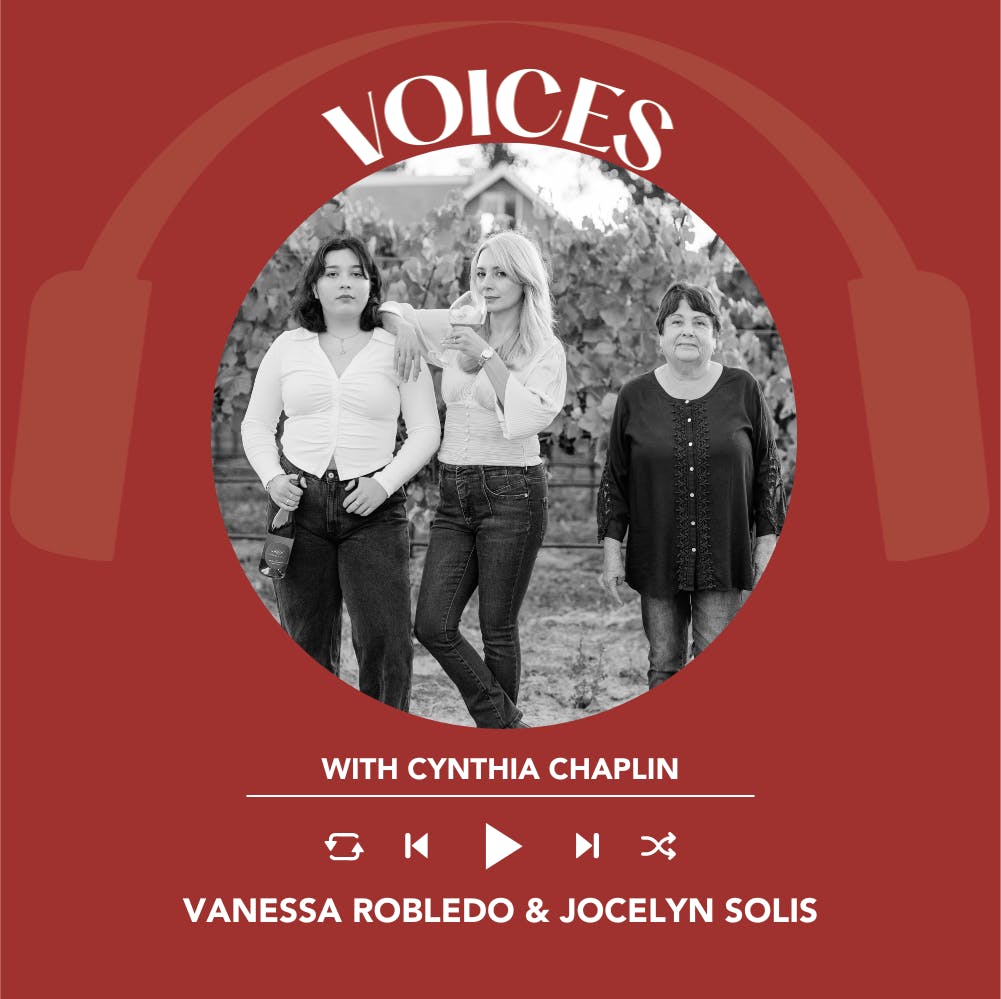
Ep. 2113 Vanessa Robledo & Jocelyn Solis | Voices with Cynthia Chaplin
Voices
Episode Summary
Content Analysis Key Themes and Main Ideas 1. The multi-generational journey and evolving role of a Mexican-American family in the California wine industry. 2. Challenges and triumphs of women in leadership within a traditional, male-dominated industry. 3. The significance of family legacy, cultural heritage, and personal ownership in entrepreneurial ventures. 4. Strategies for making wine more inclusive and accessible through education and modern communication (social media). 5. The creation of a wine brand (Vintner's Diary) that celebrates versatility, cultural pairing, and personal narrative. Summary In this episode of the Italian Wine Podcast's ""Voices"" series, host Cynthia Chaaplin interviews Vanessa Robledo and her daughter Jocelyn, discussing their family's remarkable five-generation journey in the California wine industry. Vanessa recounts her family's origins as Mexican immigrants working in agricultural fields, eventually leading to her parents establishing their own winery, the first by Mexican-American workers. She shares her experience growing up immersed in the business, translating for her father from a young age, and taking over leadership of the original Robledo Family Winery at 19, growing it significantly. Vanessa explains her difficult decision to leave the family business when traditional barriers prevented her from gaining ownership as a woman, and her subsequent success at Black Coyote Wines where she secured ownership. Now, alongside her mother Maria and daughter Jocelyn, Vanessa has launched Vintner's Diary, focusing on a versatile Rosé Grenache designed to complement diverse cuisines, particularly Mexican. Jocelyn, initially resistant to joining the wine industry, now plays a crucial role in Vintner's Diary, leveraging social media to educate consumers and demystify wine, emphasizing the human stories and connection to the land behind each bottle. The interview highlights the family's resilience, commitment to breaking barriers, and passion for creating an inclusive wine experience. Takeaways * The Robledo family's story exemplifies a multi-generational immigrant journey from agricultural labor to successful winery ownership in California. * Vanessa Robledo faced and overcame significant gender and traditional barriers in the male-dominated wine industry, ultimately prioritizing ownership and opportunity for her daughter. * The decision to leave a successful family business can be driven by a desire for personal ownership and to set a precedent for future generations. * Making wine more accessible and less intimidating is a key goal for Vintner's Diary, achieved through versatile wine styles and engaging social media content. * The fusion of cultural heritage (Mexican cuisine) with winemaking can create unique and appealing product identities. * Intergenerational collaboration, even with initial reluctance from younger generations, can lead to dynamic and innovative business ventures. Notable Quotes * ""Immigrant children take on big responsibilities because you have to grow up very fast."" - Vanessa Robledo * ""I wanted ownership. I felt I had at that point, I had worked very hard to show that I I deserved it, but because of tradition, I couldn't own."" - Vanessa Robledo * ""I didn't want any limits on on myself as a woman just because I'm a woman. Or my daughter."" - Vanessa Robledo * ""I had zero doubts in what we were doing was gonna be something special, even if it was just being able to say that I got to work with my mom."" - Jocelyn * ""It's not just an alcoholic beverage. It's more than that. There's so there's people that are behind it. They're important people that are picking those grapes. There's a story in each bottle."" - Jocelyn Related Topics or Follow-up Questions 1. What are the specific challenges and opportunities for minority-owned wineries in securing land and growing production in established regions like Napa? 2. How can the wine industry better support and promote diversity, equity, and inclusion, particularly for women and underrepresented communities? 3. What are Jocelyn's long-term visions for Vintner's Diary's digital presence and content strategy, beyond current video formats? 4. How does the family plan to balance traditional winemaking practices with innovative approaches (e.g., new varietals, marketing) as they grow? 5. What impact has the emphasis on ""storytelling"" and ""human connection"" had on consumer engagement and brand loyalty for Vintner's Diary?
About This Episode
V attending the Vintner's diary, Speaker 0 explains the importance of the wine industry and how women have long history of vine stewardship. They discuss how Speaker 2's mother had a similar experience and how her sister's strength helped her succeed in the industry. Speaker 0 explains how their family's support led them to take on the role and how they found success in the industry. They also discuss their desire to promote their own wine brand and create more wine tips and videos. Speaker 3 expresses their interest in creating more wine wines and creating more documentary style videos, while Speaker 2 discusses their plans to grow their own wine production and expand their brand in the future. They also express their desire to educate people on their brand and create more interactive videos.
Transcript
It was helpful for me because I was exposed to the business at a very early and young age. And immigrant children take on big responsibilities because you have to grow up very fast Welcome to the Italian wine podcast. I'm Cynthia Chaaplin, and this is voices. Every Wednesday, I will be sharing conversations international wine industry professionals discussing issues in diversity, equity, and inclusion through their personal experiences working in the field of wine. If you enjoy the show, please subscribe and rate our show wherever you get your pods. Hello. Welcome to voices. This is me Cynthia Chapland, and today, I am so excited to welcome Vanessa Roblado and her daughter Jocelyn to voices. Vanessa is the CEO of Vintner's diary, the California winery that she founded with her mom, Maria, and her daughter. And the Roblado family have been working in the California wine business since the nineteen forties. So Vanessa represents the fourth generation of the family, and Jocelyn is the fifth. So she's had a very success full career running Roblado family winery and working with Blackcoid coyote winery and gaining lots and lots of accolades and awards in the process. So the decision to found her own winery was especially important to her due to the fact that the wine industry is still very exclusive, as we know, and the majority of wine managers and owners are still men. So this was a conversation I've been dying to have with both you. I'm very excited. So welcome both Jocelyn and Vanessa. Thank you so much for your time. Thank you, Cynthia. We're honored to be on your show. Yeah. Thank you. Great pleasure. So this is such an interesting story. Your family came to the USA from Mexico as part of the Breceros labor program during World War two when Mexican men and women were brought into the US to work in the agricultural fields. And your great grandfather and his sons lived in a labor camp at the beginning and worked their way up to a solid reputation as excellent grape grafted by the nineteen fifties. And then in nineteen eighty four, your parents Vanessa bought eleven acres in Los Carneiro, one of my favorite places in California, and planted pinot noir. So what was it like for you? Growing up in Sonoma and Napa? You had eight brothers and sisters. I thought my family was large. I have six children, but, your your mom beats me hands down. So what was it like growing up there? It was it was very, very nice. In a way, it was very isolating because we always lived out in the country. We were always surrounded by vineyards. And, my dad was always either in charge of a vineyard or it was the one that our family had planted and was growing. So it for us, I think it was a connection that we always had with the land. Going back many generations in Mexico, when they came to the United States, naturally, they gravitated towards agriculture. And so for us, the the children now of, my parents who had worked very hard in, as vineyard workers, we, we also learned from my parents, you know, what it was. Every day, we would either after school or during weekends, we were out there working very hard. And so that as adults, we have such a deep appreciation for what the land is and also, what the beauty of the vine that creates this product, you know, the grape, and then and then which is not then converted into wine. And so the appreciation that we have for wine is grand. And, for me as a woman, it was important to stand, to to stand I wouldn't say stand alone, but create my own away from my family as well to become an individual in the wine industry. And, and so that was something that my daughter Jocelyn is now joining me and my mother, Maria, I'm so envious. I have four daughters, and I would I am desperately trying to get one of them to join me in the wine business. So we'll come back to that because that's a that's a good topic for me. But, I think it's so interesting, you know, that your family has such a long history of vine stewardship. And I think it's something that we don't talk about enough. We certainly don't talk about it in Italy hardly at all. One of the things that really, makes me quite angry at my own industry, which I love. So, you know, one of the things that you want to do is is to help that to grow. And and you're in the right area. There's so many people who are working on elevating vine stewards and vine stewardship as a as a career, not just a job. So, your parents are amazing. They started in nineteen ninety seven with their own, you know, a piece of, well, they, of course, bought their bought their land in nineteen eighty four, but they started to make their own wine in nineteen ninety seven. It's it's so interesting how I think many wineries start off you know, selling their grapes to winemakers and then change their mind. So this was the very first winery founded by Mexican American workers, and you played a huge role in the winery. As you said, you were working in it as a little kid, and then helping your father with English, and eventually you took over the company. So what was it like being a young Latino woman in such an important role in a winery at that point? You know, you had huge weight of family history, and responsibility and a new business to cope with. So were you under under a lot of pressure to succeed? You know, what were you thinking at the time when you took over? That was a big move for you. Yeah, that's right, Cynthia. If if I was to look back, I mean, first of all, I was a daughter of immigrants. Both of my parents were immigrants. They did not speak. My dad spoke English, but he spoke it with such a strong accent. That when he would go to meetings, they didn't understand him, and he was he was so such a proud man that he didn't like to repeat himself. So he would bring me along in his meetings since I was eleven, twelve years old, to translate. So that's how I learned the wine business. It's just translating, repeating, you know, back and forth. And again, my dad understood the language and understood English, but his speaking, it it it did have a a strong accent. So it was helpful for him that I came along. And it was helpful for me because I was exposed to the business at a very early and young age. And immigrant children take on big responsibilities because you have to grow up very fast. And that's what I did with my parents. I was translating for them for everything. To this day, my mom doesn't know English. Be obviously, she raised nine children. Seven boys and and two girls. And that was her life. You know, she was she dedicated to, helping my dad in the vineyard, cooking all the delicious food, and then, raising us as children. So To take on a role like that for me was I was very proud to do that for my family because I wanted to help my family. I wanted to do everything possible because I knew that both of my parents grew up with nothing, you know, basically in Mexico, they were very poor. And they would always tell us. They would always tell us, you need to appreciate the food you have on the table. You need to appreciate the work we have out in the field and the vineyard. You know, so they taught us very young to appreciate things that they didn't have. You know? So because of that, I I took on that responsibility, and it was a lot. I was only nineteen years old when my my sister married the winemaker and my dad said, okay, we're starting a new business. We're gonna take the wine. You know, so so that was really, it it everything just happened to fall into place for our family. And And so that's how the winery was was started is because my sister married a winemaker, and he my dad gave them them grapes to make for themselves, and then some grapes to make for the Roblado family winery. I have to ask, you know, what did your mother think when you took over the company? You know, you were nineteen. It's not a traditional thing in, you know, traditional Mexican culture for women to take over anything. Well, my mom always knew something was different with me because both of my parents encouraged my sister and I to learn how to cook at a very young age. And She always saw that I wasn't that good. So she was very concerned for me when I was very young. She thought, oh, no, Vanessa, you know, she can't cook. Her tortillas aren't, you know, the figure isn't right. Like, what are we gonna do with this girl? But she also but she saw that I had a talent in the business side of it, you know, with all the paperwork that we had to do for the business. So because of that, she accepted it, She still would always tell me Vanessa you need to learn how to cook because you have to be a a good wife. And the only way to be a good wife is to cook. And so I always had that pressure, the traditional pressure of being a woman that also allowed, you know, for to be I couldn't they didn't allow me fully to be strong, which is my natural character. You know? I had to kind of always downplay my strength as a woman in the beginning with my parents because they would always say, no, that's not how a woman should be. So for that, for in that part, it was very hard for me. It was very hard to downplay, you know, speaking back to my brothers, for example, or speaking back to my dad, I had to do it in a very soft way in order for it to be accepted. And, and I had to do that in the beginning of running the company too. So I had to learn had to get along with seven brothers, you know, and and and a father who was very strong. And, and I think that that taught me and gave me the strength to be able to succeed in the wine industry in general. Yeah. If you can call your weight through a family of seven brothers and a sister, I think you probably have a lot of strength. Yeah. And and being in in a male dominated family and in culture and then going into a male dominated industry. So that's, I think, how I learned to to be able to navigate the wine industry the way that I do. Jocelyn, does your mom cook now? Yes. She learned in the end. She must. But I we also learn together. We always get tips from my grandma and stuff, and we look up recipes. So we've learned. Oh, that's great. That's great. I I wanna I wanna get back to this Vanessa with, you know, with the obstacles that you faced, you know, taking over, as you said, your family was male dominated. The industry male dominated, your mom understood that it was gonna be something good for you to do. But, you know, how did everybody else react to you? How did, people in the wine business and even, you know, your own staff, react when you took over Roblado family winery? Well, I was the first employee in the company for the first five years. So I didn't have employees working with me. It wasn't until I started growing the company because we start with a hundred cases and, in ninety seven. And from there, we started growing the production doubling it and and so on. So I was able to sell it all myself. But once we started growing and opening up the tasting room, that's when we really started growing production. So at that point is when we hired people. And the wine industry took me in, because I was very genuine with who I was. You know, I was a daughter of vineyard workers, were starting the swinery, and I need help. I wanna learn. And so there were people in the industry that that taught me things. They told me how things, you know, how to sell wine, for example, because I had no idea how to do that. And so because they were able to help me, I was able to continue to grow the company. I think winery people, and I say this a lot all around the world tend to be the most generous of spirit people that there are. So, I'm I'm really glad to hear that people took you in and took you under their wing and help you out. And I your numbers are phenomenal. You know, as you said, you started off in ninety seven with just a hundred cases. And by two thousand and seven, you were making twenty thousand cases a year. So, you know, that's that's unbelievable growth. You know, what did your family say? My family was was, you know, it it it was very conflicting, Cynthia, because my dad really never expressed pride in me even to the day that I left. Because he's a very traditional man. He's just he's he's I can say he's very, he's very tough, but he has a good heart. He's a good man, you know. And, but they they were they just wanted growth. They wanted to be able to for me to continue working. And, the challenge with that was that if I can continue working at Roblado all my life, But at that point, I was a single mom. I had divorced Jocelyn's father, and, I wanted to create something for myself. And my dad said, well, you can work here for the rest of your life. You'll be taken care of. You won't need anything, but you can never own. And I wanted ownership. I felt I had at that point, I had worked very hard to show that I I deserved it, but because of tradition, I couldn't own. So because it's seen as a woman loses her last name, so it won't be multiplied by by the daughter. I had I had to allow my brothers to own. And so for me, that I just I I had I couldn't believe that. I thought, no, dad. You need to change the way things are, and my dad refused. So at that point, I left. I left the family winery in two thousand and and seven. And, to create something where my daughter would then say, I can have a piece of. You know, I I didn't want any limits on on myself as a woman just because I'm a woman. Or my daughter. And that's, you know, I only had one daughter, and I wanted to make sure that for her future, she could she knew there was no glass ceilings. Yeah. I think it's it's amazing what becoming a mother of a daughter does to you. And it does it gives you this drive to be a role model, and to make sure that your daughter sees you as a strong person and sees that being a strong woman is is something she can emulate too. You know, those are things that I never thought of before I had my first daughter. And it it kind of surprised me how fierce I got about it. So I can understand. And plus when you're, you know, you're breaking year back working so hard for the company to grow it like that and then not be able to have ownership, you know, and this was two thousand and seven, not eighteen ninety seven. So it, you know, I'm sure it must have been unbelievably frustrating but you did you moved. You made the move to black coyote wines in Napa, and they're very, very well known award winning Cabernet sauvignons that were served at the White House in two thousand eleven, two thousand and fourteen. So what, you know, what happened? How did you get hooked up with with black Cione wines. And what was, you know, what was it like walking into a completely different winery that wasn't your family's winery? Well, I waited a year. I I did consulting for food and wine festivals for a year. So that that's, I started a company and, and decided to just focus on that. And, it wasn't until after that year that I got a call from Doctor. Ernest Bates, which is a founder of Black black coyote Chateau was the name of the brand. And, and he was someone that had followed my career since I started. And he said, well, I heard through the grapevine that you're no longer with your family, would you consider running our our Cabernet wine brand. And so at that point, I knew it was, like, a high end brand. It was over a hundred dollar bottle of wine. And I I didn't have a lot of experience in that, but I had some experience in it. So I was a little nervous because I didn't really know how to sell the ultra premium brand. And, but what I did is I went into the meeting and I said, if you give me ownership, because I thought, well, I have nothing to lose. I'm just gonna ask them because that's what I mainly want. I said if if you give me ownership of the brand, I'll consider I'll consider joining and running your company. So it didn't take him long and he said, okay, we'll start you off at two percent, you know, and, and we'll see how it goes. But what I'm more interested in is I have about five people working here. Doing different things. Can you replace that, their work? And and I'll give you the salary that I pay all of them because it's too much for me to manage. I want one person to do it all. And so at that point, you know, I felt bad for everybody everybody, but I knew I could do it. And I also had to think about raising my daughter. So I thought, yes, you know, I could do it. Yeah. I mean, you it's it's one of those interesting things too. You know, you, as you said, you know, in the midst of this career, you know, big career with your family, you know, decide to leave new big career with black coyote. And all of this time, you know, you were a mom, you know, Jocelyn was born in nineteen eighty eight. And you said she grew up being your plus one at lots of wine events. My my daughters know exactly what that means. They've been dragged around vineyards and wine events for their whole lives. So What was it like for you at that point? Trying to make a new career with black coyote, taking on a lot of job responsibilities, you said, you know, you took on the jobs of five people. You know, What what was it like just trying to jumble your work and your and your home life with Jocelyn? Wine wine events are not very well known for being child friendly. Yeah. Yeah. Well, Jocelyn, I think She was born in ninety eight. So at that time, she might have been ten. And, and it was very, very challenging because she was a little girl. And, yes, she had to come to with me to a lot of meetings. It was it was difficult to, I also had support from her dad and my mom. So, from that perspective, it became easier to navigate But there were times they couldn't help. So I had she had to come along. And it was it was nice in the way, Cynthia, that I think our children pick up things that we don't even know that they do. You know, what when it comes to seeing us in a role, to from that to what we say, they pick up things. And so I noticed that Jocelyn knew a lot about wine. You know, And so I but even though at that age, she was telling me, mom, so so this gives you encouragement. Okay, Cynthia. She would tell me, mom, I never wanna get in the wine industry. That was She always said that. So, so that I'm glad that that. It didn't happen that way, because I wanted, her, I someday to work with my daughter. So, Jocelyn, what was it like for you as a little girl, being dragged along in your mom's work life? You know, I'm sure you had lots of things that you would rather have been doing at the time, as as Vanessa said, you declared you were never getting into wine. But what was it like for you during those years when you were sort of trailing your mom and seeing her be a boss? Well, for me, it was kind of just normal. Like, that's how my mom is and I kind of knew that my mom wasn't like other moms, for example, like, I would go to events with her, and it was just her and I, and she would teach me, like, how to introduce myself and how to shake hands, and I always had a firm handshake, and I just remember she taught me a lot of things about how to just be a well behaved child. And so I remember, just like being really proud of how I would get compliments that I was well behaved, and I I felt like I was, like, a little adult, and I just really enjoyed spending time with my mom because sometimes she would go on trips and I would have I would be spending time with my grandma and my dad, and I and I missed her a lot. So I felt very special being able to be one of the adults for a night or being able to be, with really, like just like an older crowd. It was really cool being like the only child there and I was I I had a lot of fun doing it and I and I think the most important part was that I got to spend time with my mom. So any moment that I got to, it was just it was a very nice time. That's so nice to hear. And it it clearly rubbed off on you. Because we know you're working with her now, but, you know, originally, wine was just not your thing. And eventually, you discovered your documentary content creating skills and you branched out on your own. So what made you decide to come back and join your mother at vendor's diary? What are you doing? How are you interacting together? You know, what are what are the roles? Is it working out or is she driving you crazy? I'm actually having a really great time working with my mom. I didn't think about doing it until twenty twenty three at the end of that year. Or was it twenty twenty two? It was at the end of twenty twenty two. Sorry. And I was I think my mom and I were both at similar stages in our lives at that point. We had met up we were at dinner. It was around Christmas time, and My mom has been helping my grandma for a really long time, especially after her divorce from my grandfather. So I knew that my mom put in a lot of time with my grandma, but I always had a sense that she wasn't fully doing anything for herself just yet. And whenever we would, like, there just wasn't anything that give her that spark in her eye that she had, like, when she worked for Black Cody or when she was president for, Roblado family. There was just something that she had like a certain drive to her at that time. And I felt like it wasn't there when we were meeting for Christmas. And so her and I talked and I and I told her that I believed it was time for her to start doing something for herself. And she agreed and she asked me if I would join and I agreed. And it was just like this crazy within two weeks, I had quit my job. I was working for a baseball team out here in Chicago. And I quit my job, and I decided to start working with my mom. And I had zero doubts in what we were doing was gonna be something special, even if it was just being able to say that I got to work with my mom. I knew that. You have just given me so much hope. I love you, Josh. One. I hope I hope that will, come my way with with one of mine, but the the two of you are making a Rosier Grenache together now. And Vanessa, you said that creating a wine production that is inclusive and versatile with various cuisines particularly complimenting lectin flavors was paramount to this project. So why did you decide to go for Rose and why Grenash? You know, we all know about whites and Fandel in California. What made you choose Grenash? Tell us tell us a bit about the wine and and the thinking behind you know, what he decided to create? Well, the reason that we were decided to work with Rose is because it is a very versatile wine. It's one of the few wines you can pair with many different dishes. Absolutely. I am totally on board with that concept. Everyone who knows me knows that I am an Italian Rosay specialist, and I believe in that. Yeah. Exactly. And by the way, you guys make some amazing Rosay. I'm a big fan. And so the the thinking behind it was Obviously, I come from a Mexican culture, and I wanted to be able to pair a wine with various different dishes that my mom makes. And my mom's an excellent cook. I mean, she Her, food has been featured in Seavor Magazine. She's been, you know, written about in People magazine and a reader's digest. So her food has been written about in various different, publications. And, and I wanted to make sure that the wine that we produced was a very balanced wine. So for us, it doesn't have the high acidity of the whites, and it doesn't have the high tannins of the reds. So that's one of the things that really makes me want to promote the wine as a versatile wine. And the reason that we selected the varietal, Gornage is because it it some of the best Skornages in the world from provence are have that grape. It there it it's not easy to find in Napa because in Napa, you get paid more per ton if you sell your cabernet. So a lot of the land is, is growing cabernet in the ver the bordeaux varietals. So I didn't I I didn't think I was gonna be able to find it. Unfortunately, I was able to find it in Napa. It's a small five acre vineyard, and I'm able to get an allotment every year. So I decided, obviously, in the Carneuros area where we have our land, it it it's very too cool. So it wouldn't grow the Gurnache grape, but this vineyard is located in Rutherford. So almost in the middle, Napa Valley floor where the vineyard is located. So it's really ideal for that Gurnage, Gornage grape. And this year, we decided to add about six percent Malbec in in the wine. So we're as we're going, Cynthia, we're really opening ourselves up to challenging ourselves in the wine into industry and trying to do something that we haven't done before because if we continue doing everything we've done, it's not gonna challenge us. It's not gonna make us, grow as people. And I think for us, that's what we want. We wanna be able to, promote our wine brand as three generations of Latinos, in California producing this one wine at this time. For the future, we'll we'll consider other varieties, but for now, we're just we're just making this one. It's it's an incredible story. I I love that your mother's still very, very much part of, you know, what you're doing. And she has, you know, made her own fame, and I'm sure, you know, a generation before you when women really weren't supposed to be doing things like this, you know, she has made her own career through her food. I'm gonna cry because I love Mexican food. And that is one thing we cannot get in Italy. I have to get my friends to send me ingredients, but, so, you know, coming up, what are what are the plans? You know, you've you released your first vintage just a year ago. So what are the goals and the ambitions for vendors' diary? You know, you've you've got your mom, you you've rope Jocelyn back in, the three amazing Latinos together. What what are you planning? For us, we're we're really opening up ourselves to, like I mentioned earlier, challenge ourselves and refine our product. We would like to grow the production. Obviously in Napa, we're limited. So I might have to source from other areas, that and also see if there's a possibility of us growing our own and finding leases or something where we are able to to plan our own vineyards and have a hundred and control of everything. But that's so our future plans are to grow. How fast and when we're not quite sure. Jocelyn can talk a little bit about her social media plans and, and what a create. I mean, Jocelyn's very creative. So she's I see her as an artist. And, she's living in Chicago now and she, from there, she works with me every day, creating content for about wine. So I'll let her talk about what she wants to do for the future. Absolutely. I love how the story has kind of come full circle. You know, your parents didn't own their own winery at the beginning, and and now you're you know, back at this part where you wanna buy some some vineyards yourself. So it's it's very cyclical, interesting family story in the way that, you know, you've rolled it out over the years. So, Jocelyn, I stalked you. No word of a lie. So I agree with your mother. You you are quite an artist. So, you know, tell us about how you're inspired by the vineyard. You know, what would you like to do differently for yourself than what your mom has done. Obviously, she's a winemaker. She's running the company. What are you bringing to the table? What do you wanna do? Let's let's hear what your plans are for the social media. We know we all know how important social media is. So where are you going with it? Well, I would I would well, I really appreciate your compliment. So thank you. But I would like to I would like to continue making our videos that are little wine tip tidbits videos. I think they're super important, and I've had a few people tell me how they have have felt less intimidated by wine, by watching our videos. So I I'm really proud of that, and I would I wanna continue to open that door to educating people on wine, through what I've experienced with my family and and from my mom's knowledge and my own knowledge, I would love to continue helping people learn to enjoy wine as much as we do and to see that It's not just an alcoholic beverage. It's more than that. There's so there's people that are behind it. They're important people that are picking those grapes. There's a story in each bottle. So we're we wanna continue sharing our story and, you know, our diary, which is the wine, with people and educating them on, how important this product is. And so, yeah, I just think, my mom has done a great job at doing that so far. But just converting that to the digital age and creating those videos and just making them more beautiful. I would love to get a a camera one day. Right now, I'm filming on my phone, but, I mean, it does pretty good quality, but I would love a camera. And I would just love to continue creating, like, continue increasing the quality of our brand and our videos. Well, see, this is this is classic daughter thing. You know, did you hear that Vanessa Christmas? I would like a camera, please. Yeah. Classic classic slip that in there. But it's so interesting that what you were saying about making people feel less intimidated. I'm a wine educator. I'm a professor of wine, you know, I'm an Italian wine ambassador. I teach WSET, you know, fairly frequently as well. And wine language is really exclusive. I am working very hard to sort of walk away from that, kind of scary, pretentious, exclusive way of teaching wine that was the past. And I think teaching line in the future is gonna be completely different. So tell us what you've got planned for, you know, what are you gonna do with these videos? You're you're doing a lot of storytelling. And I I love what you're doing, you know, trying to take away this the scary pretentiousness. What are what are the plans? How are you going about this? I think we'd love to just be we'd like we'd love to be more interactive with people. I love hearing feedback, good or bad. I think it helps us improve. So I think if I would love to hear more from the people who watch our videos of what they would like to see. But I also really wanna just get down into the into the fields and work with my mom and get some, like, content of my mom and my grandma because they really are extremely hands on in the vineyards. And I think that that that it's really unique that they have a wine brand, but they're also in the fields picking the grapes. So, I think showing that is really important. I would love to create continue to create documentary style videos in the future. That's a fabulous idea. You know, a lot of people who are doing social media in wine these days, you know, unfortunately, COVID did some good things and bad things, you know, now as long as you have a bikini on in a glass of Rosay, you're a wine influencer. And you're, you know, Rose all day, you're an expert. So I think that that idea of getting some content in the fields, seeing the background connecting what's in your glass to actually the the soil where it grew, the place that is from, and the and the people, your mother and your grandmother is a fantastic idea. And I I really wish you well. I think that's gonna be something to watch and and very, very creative and very likely to get people, much more involved So I cannot thank both of you enough for coming on today. I really appreciate it. I think your story is beautiful and important for people to hear. I'm dying to taste your wine. That's something I'll have to do next time in the States. But, I wanna wish you both the best. I'm gonna keep my eye on Vinder's diary because I wanna see what Jocelyn does. We know if Vanessa will do great. She's a boss. I wanna see where Jocelyn goes with this. So thank you both very much for coming on. Thank you, Cynthia. Thank you so much, Cynthia. And we hope that you can visit us and have some Mexican food with Verizon. Oh my gosh. That's the dream right there. Thank you for listening, and remember to tune in next Wednesday when I'll be chatting with another fascinating guest. Italian wine podcast is among the leading wine podcast in the world, and the only one with a daily show. Tune in every day and discover all our different shows. You can find us at italian wine podcast dot com, SoundCloud, Spotify, Himalaya, or wherever you get your pods.
Episode Details
Related Episodes

Ep. 2789 ColleMassari: a long-term vision rooted in Montecucco with Giuseppe Di Gioia | On The Road With Stevie Kim
Episode 2789

Ep. 2788 Ep. 14: Austria and Hungary | Study Smart for your WSET Level 3
Episode 2788

Ep. 2785 From Volunteer to Speaker at TEXSOM with Samantha Cole Johnson | TEXSOM 2026
Episode 2785
Ep. 2766 Inside the U.S. Non-Alcoholic Wine Market: What Wineries Need to Know with Jill Sites | Masterclass US Wine Market
Episode 2766
Ep. 2761 Winemaking and Consulting Across Sicily with Alessandro Serughetti | Wine, Food & Travel with Marc Millon
Episode 2761
Ep. 2759 Part 2 – The VIA Educational Program & Italian Wine | Heart-to-Heart Conversation with Sarah Looper
Episode 2759