
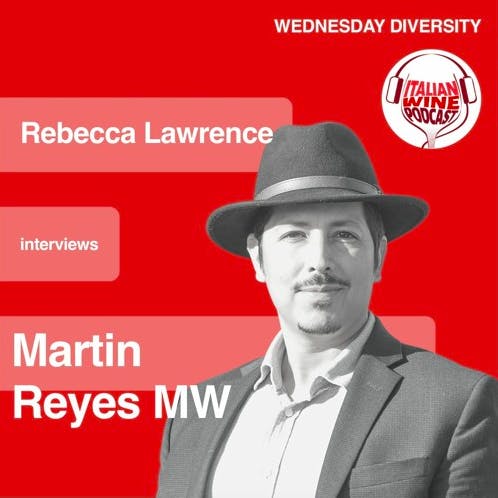
Ep. 701 Martin Reyes MW | Voices
Voices
Episode Summary
Content Analysis Key Themes and Main Ideas 1. The personal and social impact of wine, fostering connection and vulnerability. 2. Martin Reyes's career path in wine, from consumer to Master of Wine, winemaker, and educator. 3. The critical importance of sustainability across the entire wine trade. 4. The role of education in empowering individuals and promoting diversity and inclusion within the wine industry. 5. Different professional paths and credentials in wine (MW vs. MS) and their distinct focuses. 6. The growing focus on sustainability among Italian wine producers. Summary In this episode of the Italian Wine Podcast, host Rebecca Lawrence interviews Master of Wine Martin Reyes, delving into his diverse career and insights into the wine world. Reyes shares how his passion for wine began as a college student in Paris, emphasizing wine's ability to foster honesty and connection. He discusses his work directing production at Peter Paul Wines, highlighting their ethos of thoughtful, quality-driven production. A significant portion of the conversation revolves around Reyes's upcoming book on the sustainability of the wine trade, advocating for a holistic ""360-degree approach"" that involves every aspect from vineyard to consumer. He passionately speaks about the empowering nature of education, particularly for individuals from underrepresented backgrounds, and the mission of Wine Unify, an organization he co-founded to provide financial and mentorship support to people of color in wine education. Reyes also explains his deliberate choice of the Master of Wine path over the Master Sommelier, viewing the MW as a more academic and generalist qualification. The interview concludes with him discussing Italian wine producers he works with and hopes to include in his portfolio, specifically praising those like Spanne winery for their commitment to sustainable and collaborative practices. Takeaways * Wine, when shared, can create profound moments of honesty, vulnerability, and connection among people. * High-quality wine production benefits from thoughtful, logical decisions rather than purely romanticized notions. * Sustainability in the wine industry must be an all-encompassing effort, involving viticulture, production, distribution, and consumer choices. * Wine education serves as a powerful tool for empowerment, particularly aiding individuals from diverse backgrounds to overcome systemic barriers and gain industry recognition. * Diversity in the wine industry requires not just access but genuine inclusion, alongside mentorship and community building. * The Master of Wine (MW) credential offers a broad, academic perspective on the wine world, distinct from the hospitality-focused Master Sommelier (MS). * Italian wine producers are increasingly embracing and demonstrating leadership in sustainable practices, showcasing that quality and environmental stewardship can go hand-in-hand. Notable Quotes * ""When you drink wine with food and friends or family, you become more honest. And in that honesty, you talk to the person across table, you become more vulnerable. And then that vulnerability you can see each other. You become connected."
About This Episode
The speakers discuss the importance of educating and empowering individuals to create a world for the wine industry, emphasizing the need for education and empowerment. They also discuss the importance of education in empowering individuals, building networks, and creating diverse representation. The speakers emphasize the need for diversity and the importance of repositioning one's position in the industry. They also mention their interest in promoting their own brand and reaching out to other wines.
Transcript
Welcome to the Italian wine podcast. I'm Rebecca Lawrence, and this is voices. In this set of interviews, I will be focusing on issues of inclusion diversity and allyship through intimate conversations with wine industry professionals from all over the globe. If you enjoy listening, please consider donating to Italian wine podcast dot com. Any amount helps us cover equipment, production and publication costs, and remember to subscribe and rate our show wherever you tune in. This episode is proudly sponsored by Vivino, the world's largest online wine marketplace. The Vivino app makes it easy to choose wine. Enjoy expert team support door to door delivery and honest wine reviews to help you choose the perfect wine for every occasion. Vivino download the app on Apple or Android and discover an easier way to choose wine. Welcome to the Italian wine podcast. This is the voices series with me Rebecca Lawrence. This week, I'm honored to be joined by master of wine, Martin Reyes. Welcome to the podcast Martin. Thank you, Rebecca. Thanks for having me. So I really don't know where to start because you're not only currently doing so much. We've already talked a little bit off pod about how much stuff you're doing, but you've done so much already. You make wine, you write papers, you educate, speak, judge. I had a rumor that you're coming up fluent in five languages. So let's start with what brought you to the wine industry, an easy start. Yeah. That's a that's a story that that's it's fun to relive because you never you you don't know at the time, right, with, It was in college. It was a parisian dinner. There was an exchange program, and it was, you know, at the time, in your, in twenty, and you find the thrill of being in studying in in Paris and, you know, and and then this dinner with this thrilling and executing chameviality around wine. I'd never laughed so much with friends at a table with amount with the amount of food there. You know, and there was a it was there's something special about that kind of buzz that was very different than what you think of as a college kid, right, either drinking shots or having beers through your buddies watching TV. This was something special, and and it was something magical. And I'll I'll never forget that. And that has what drove me to to get into wine just as a consumer way back when I was when I was in college. Yeah. I loved the different spaces that wine created for me when I first started getting into wine. That familial convivial kind of approach to being around a table when there's wine on it with wine people. It's just so attractive. Yeah. You know, I've often said more recently as we've developed, as we've matured in our virtual conversation spaces, you know, podcasts and interviews, you know, through throughout the COVID and post COVID. And you you it's time for reflection because you you sit there in the in front of a mic and you think and you ponder these things a bit more deeply. Right? And you recognize, I've learned anyways really about to to how to articulate what I found so magical about it. And there's a when you drink wine with food and friends or family, you become more honest. Right? And in that honesty, you talk to the person across table, you become more vulnerable. And then that vulnerability you can see each other. You become connected. You, open yourself not just to their point of view, but they open up to you. And in that, there's that bridge, that grace that is added a touch of magic, touch of grace that's added to that moment, whether it's a special event moment or just a casual time. I think that's what I experienced back in Paris, and that's what we continue. You and I and in the hundreds and thousands of people and millions of people that enjoy wine. That's what that's why it retains its its persistent human gracefulness throughout forever, I think. That's such a beautiful way of putting it. I I hadn't thought about it in that context, but you're right. That that vulnerability that happen so easily and naturally is a real asset to those interactions. So we've got limited time, so I'm gonna dive straight in to some of the stuff you've been doing. Maybe we should start with the the actual product to wine, You're currently directing production at Peter Paul wines. You also have a growing portfolio with Reyes's selections. So what are you looking for when you make or select a wine? Well, the last night was our our first harvests for Batikalupi Chardonay in Russian River. So I I'm operating on on caffeine and giddiness of, of, neglected dreams. And that question comes up. It comes up often like, what am I when and when do I pick? When do we, you know, what are we doing here? Right? What is our what is our our production ethos? And I I think in a very briefly, in a succinct manner, I'd say that we do so the winery is called Peter Paul wines. That's it. That's his name. He's my boss. He's from the East Coast in New Hampshire. And he brought me on in two thousand sixteen. That's its own whole another story you could look at on, on our website. But the There's it's it's about thoughtfulness. It's about thoughtful production, but also logical decisions over the romantic ones, which I know is not a a popular idea of of wine. When we talked about this grace and magic at the dinner table, right, and all of a sudden you ask, well, what about what's what's your driving force, Peter Paul. I recognize that it is a little bit of a reality check. But but it's it's business, thoughtful business and Viticulture decisions can produce high quality if your heart is in the right place. So for instance, I would say that stylistically with one being an anemic, pale insipid, boring wine from who knows where. Right? And a ten in terms of style and and and power and ten being this overwrought extracted, dense, you know, ponderous kind of of wine. You know, we're probably somewhere, stylistically in terms of amplitude, somewhere around the seven or eight. Right? Maybe even maybe even nine, California, Napa, and Sonom are are are known, whether cynically or or or celebratoryly as very rich and relatively denser wines. We we do accept that we have a sunny temperament of Northern California coast, but we choose Pinan Warshard Nate and and cabernet that we retain the refined elements of each grape's euro European heritage. We look for a proper balance even in that amplitude of fruit of saver and structure without being overwrought. So we do deliver richness. And joy while still singing, please. And thank you. That's that's Peter Fall. I'm desperate for a glass of wine now. Sure. No. I I I, I, I, me too. Actually, even though it's nine AM. This is the problem with the podcast. We're not sitting around a table where thousands of miles away from each other. Right. Exactly. Next time you bring the wine. I will. So let's talk a little bit about your writing. You wrote a very success for paper, the rise of the consumer critic and its impact on purchasing behavior. I believe that was part of your research dissertation for the master of wine qualification. It's won an award, very, very cool, but I heard a rumor about an upcoming book project. Maybe you could share that with our listeners. Yes. You know, I think well, I'm shifting my I have been shifting for some time through, conversations and projects with clients, through my, my own company, Reyes Wine Group, in particular one client, spotswood winery that I should mention. There in Saint Helena. And a few a couple of years ago, they tasked me to address the climate, climate action, right, in the face of of climate change for in the wine industry. And that really shifted my my e my ethos and my direction from my company and for my, focus in what topics I would be researching or developing both for business reasons as well as for for writing. The topic really is, and the idea is with Anna Chilton, who this is really her idea and she and she's reached out to me. We're gonna be collaborating on a book on the sustainability of the wine trade, wine business, wine, wine, production, everything. We wanna think about it as a handbook for anybody who can pick up the, the the cause of of what action a person, whether it's a witner or a Cooper or a merchant or a retailer or a marketer, or a tasting room manager, or a bit of culturalist. What are the the, what what are we doing, what can we do, and how, and what are the resources to to develop a a person's own a wine industry, person's own, path towards sustainability and the resilience of our trade. So that's the direction that I'm I'm going to, now. And I have spots with winery in Saint Lina, continues to be a client and who I work with, I probably will, hopefully, for a long time. I I credit them for lighting this fire. I've I've become kind of a zealot of sustain of sustainability and wine and and personal. I'm looking down at my socks right now. They're like, you know, you know, they're the zero true zero waste certified non non die minimum waste b corp certified. You know, there's just you start to you start to act and purchase your way in that it that that's in line with, with your professional direction too, I think, to some degree. It sounds like the book's gonna have a real three sixty approach to it that you're not just looking at sustainability in the vineyard, but at all levels. One, I think that's something that we really need to make people aware of in the industry that when we talk about sustainability in the wine industry, it's not just what's going on at the winery in the vineyard. It's every decision that's made from from being in the the winery to buying the bottle of wine and then taking it home and consuming it. And that's something that I think this industry sorely needs and and needs a voice, such as someone like yourself, to sort of say, this is possible, and we're gonna tell you how to do it. You took the words out of my mouth and and there is a chorus of of people. There are there's an army of small right now, army of zealots across the globe who are deeply invested in this topic and who are working within their communities, South Africa, New Zealand, of course, California, you know, all all over the place. Every every region and wine is having a reckoning with this topic, our our objective really is to give a a snapshot and then also, be a a space where the conversation can continue to grow and everyone can recognize what the whole world is doing. So, yeah, there's there's There's a there's, the best thing I think for the industry is for us to recognize how much of a role everybody plays. Like you said, from the Viticultureist, the vineyard Manager production, the bottling lines, they had the weight of the bottles, the the consumer themselves choosing to buy and support wineries that are certified Napa Green, right, over this quality in Napa is there, is is great. But if you then say, where is your logo that certifies that you are you know, a Napa green vineyard, Napa green winery. And also, there is a resistance and there's a shift around the idea of of greenwashing. There is a change that's happening. It's not that there there's a lot of preconceptions that are also being dissolved over time. There's this conversation could have and it has had, multiple conferences across multiple organizations for multiple days, and we're just scratching the surface, Rebecca, but I think there's a lot a lot to to be had. So thanks for bringing that up. It's it's it's a special thing for me. And the three sixty approach kind of also mirrors your your role in the industry and how and because you've been someone who's touched on so many different aspects, like, I sort of hinted at the beginning, you know, you you write, your work, you have a portfolio, you have your own company, you're judging, and you also educate, and I was particularly tickled by the fact that it says on the Reyes Wine Group website that in your spare time you also educate. So I have to admit, one, how on earth do you have spare time? I I believe this must be a myth that you have some kind of magical device that's giving you more time. But obviously, all joking aside, it demonstrates how important education is to you. So I wanna to kind of dive into this a little bit and see if you could talk about why it's been so important for you to continue to educate given everything else you have going on. You know, I I think it starts as a child started for me as a child. You know, a lower class immigrant upbringing. My family is from from Mexico, and I was born here in San Diego. It's not an obvious background for international wine career. Right? But my in particular, my dad's contortionist efforts for for proper schooling it irrevocably changed my life in a way that I could only see now as an adult. He's meager salary as a park maintenance worker, allowed me to turn to four year university and not overly meant for families like mine, right, quote unquote, that kind of thing. And so looking back What did education do? Well, now as an adult, you say, okay. Well, I recognize now that I'm more cogent about this the topic, there's this is a space where discrepancies of access, exist and they continue to perpetuate those discrepancies of access. Right? You might wanna call it academic privilege. So for instance, number one, you you you gain knowledge, right, competency, especially in writing or critical analysis. I don't think of myself as a I still don't think of myself as a master of why I think of myself as a master of somebody who knows how to ask the right questions about wine. That's the the word master and wine early bookends around the process of of just thinking of knowing you don't know the answers, but learning to ask the right questions and that critical awareness. Right? That's to me what the val one of the value values of education. And then secondly, building your network, the friendships you call on later and the the people who you know who went through the path of w set or diploma to the friends that you you had in in the programs whether in school, in college, university, and and in wine, they they remain your friends. And then when you you grow into your careers, that network helps your own path in your own business, whatever that business may be. Right? And thirdly, the feelings of empowerment, right, the you're emboldened the education, the credentials, the graduate courses. They embolden you to assume that other things are possible Right? The other things you wanna say, like, whether that's starting a new business or making wine, or even changing a tire or even getting out of a pickle, many pickles I'm getting myself into, some of them I don't really, relish by the way. Great. Great dad, Joe. Thank you. You're you're welcome. But, you you I said to my solo more more than once since two thousand eighteen, if I did the MW. I can do this. If I did the MW, I can do this. And you calm yourself down and say, wow. Okay. I did that. This is difficult, but if I can do if I did that, I can do this. And it recalls you recall those feelings of of empowerment. So those are the things those are the reasons why at the core education, was so important to me. And in wine, education played out in much the same way, but for a little bit more of an insidious reason, education like the w set or anything else. I know the, sorry, if the w sets listening, w s e t, pardon me, the proper expression, it enables a person of of color in the US. We're talking about the US now. Right? And it may be globally forces that work to connect plates outside the US to be taken more seriously. And if you if you view the systemic racism or discrimination or negative stereotypes as the opposite type of currency, they take, you know, they take your your, value away, then the credential currency allows you to spend it during transactions with others in line, and you come out a little ahead each time. So in other words, the value provided by by education and and why in particular is like a buffer zone of sorts against the the onslaught of stereotypes. And it was true for me, and I I believe it's true for anybody who takes on this who takes on wine education as part of their career. I completely agree about both education as a whole and wine education. And I I was similarly inspired to be involved in education because of my father and because of what I saw him doing in education. And I just think it's so important to kind of, like you said, the currency that it gives you in your interactions it's not necessarily a bit about, you know, being quote unquote more intelligent than someone else. It's the interactions you can have, the doors that it can open for you, the different perspectives it can give you. On the world. And that was particularly the case for me whilst starting my wine education is seeing people come from completely different perspectives joined together by this thing that was wine, giving me new thoughts about the world that was around me, not just about wine, but about how I experienced the world in general. And I was very lucky to experience that in London, which is relatively multicultural as as wine goes, and that just opened my eyes to all sorts of things that were happening in the wine industry and in the culture that I was part of in London, and I wouldn't have had that if I hadn't have started my diploma in London, for example. So a perfect segue to talk about wine Unify, an association that EU cofounded and really has education at its heart. Indeed, you have the wine Unify education award program. So How did that come about? Was was that just a sort of natural progression of of your thoughts about education and wine education and representation? Well, the the heart of Waianify and the I I co found that it, but it was definitely not my, my baby. This this belongs to to all of us. The the co founders, three of us, Mary Margaret Mcamek, a, also a master of wine, and she's based in in California, and she is an educator. By trade before she was in the wine business. She was, a teacher. And Dylan Procter, a very well known individual. He, a black wine professional and a and a brilliant mind. They we all we three of us were bought together, Mary Margaret knew him. I knew Mary Margaret, but then I've got to know Dylan and over over the past, the past few. Well, it might have been about a year and a half now, I think. But the bottom line is we we are we recognized the power of of of education. It's empowerment. Right? And each of us had our own relationship with education and with wine and knowing how, what we just described a few minutes ago, how that plays out in wine. And you look for first wine already is an intimidating thing, right, for anybody who comes into it. Right? And there's and that that education helps some of that some of that solvent, right, against that. But that there's a second level of intimidation if you are in the US at least a person of color, whether black, Asian, latino, Native American, whatever that is, you have this second area where it's viewed rightly or wrongly as a white man's drink or a white person's, a libration. Right? I know that's we beautifully so this is changing. There's if anyone takes a look out there and either social medias or virtual spaces or white education, that is there's a there's a tectonic shift happening now. But and I and there's a lot more a lot more to be done. But the point is that we we were part of and we are part of that conversation where we we are facilitating the access. We're bringing it's one thing to say we want more diversity and wine, which we all do, but diversity does not automatically mean inclusion. Right? You can you can accept people of color into your program, whether it's UC Davis or W Set, but do they really feel welcomed? Well, maybe, maybe not. So and do they feel like they have role models or a mentor that they can speak to about this course? You know, about this test, about breaking into the wine industry, about building your resume, or about, you know, taking going after that job, or, you know, the the kinds of things that that, are normally a career in wine are in, frankly, intimidating, they take on another level of intimidation when you're at when you're Sommier at the at a fancy restaurant and you're a black Sommier, and you are approaching a table of white wealthy bankers. Right, for drinking expensive wine and who are going to look at you. Right? This is in a person's head like me as as a source of authority on as a point of authority on this. I'm gonna swallow a little bit. Right? Before I approach the table no matter what color you are. Right? And no matter what what background or what race or what abilities you have. So and that is part of the part of what YUNIFY wants to do. So we offer funds, or sometimes it's funding too. Right? So the the the ex vivo wine programs are expensive. So we offer funding and financial support for people to, for people identify as a person of color to take they they can apply through wine dot org in the in the US, and they not only receive the funds to to apply for w set, but they also, we also provide a degree of mentorship of that building of that, sense of of inclusion, but also a sense of community The the fourth part of education that is the most meaningful one is now time to give back. It's time to look back and say, who else can we bring forward? And step aside. So I'm gonna couple more questions, because I do want to touch on I'm sorry you are a master of wine. We have to talk about it because this is an incredible accolade, and you are the first Mexican American to hold the position. So I wanted to talk about a couple of those things. So first, I was really intrigued because I know you very deliberately chose the master of wine path rather than the Court of Master or the Court of Semelius, as they are now known, which is, has historically been a more coveted title, I think, in the US. So why did you make that decision to go down the NW not the MS route? You're absolutely right, Rebecca, that in the US, the MS, master sommelier, as a title is historically known, is the more coveted one. Well, back then, when I when I first started in one two thousand and four, which was in two, but then four and five is when I thought, oh, like, there's these credentials. I I these are justifications that you can work towards to, you know, as a as a skinny, brown kid on the sales floor of a high powered retail shop K, K and L in in California. It was clear to me that I needed that I wanted to be continue the education. I that's that. That was that is the touch point there for me to, to decide, okay. Well, what what what what is out there? And you look at the MS and, I simple reasons back then I was before, the wine trade, I was a shitty bartender. I was making I was good at making drinks, mortgages, but I was very slow, and I couldn't keep up with with the demand. So, and and I I didn't, I was I knew that restaurant the restaurant trade was not for me. The MS is one that is deliberately in hospitality and the restaurant trade, which is a huge force in the in in the US, massive force. The one I found out about the MW, I thought, oh my goodness. That is that's that's the place. It's it's a generalist It is an academic. It's it's not just academic, but it has an academic view. It is involved in Viticulture of VINification, the business of wine, contemporary issues. And you don't have to know a link about restaurant work to to to get down that path. And And I I still spill wine at the at the dinner table on accident, and that's just, you know, I mean, like, service and that whole the whole showmanship. I'm just not good at that. I'm also not really patient with people over, but, you know, that that, like, the immediate hey. Nice to meet you, but then if you, they ask questions about wine, there are people who are much better hospitality consistently long term than I am. So it at initially, it was very clear that the MW was my path, long term goal than the MS back then. Now though, I I think an there has been a shift in the US at least in the past generation where, look, you know, Rebecca, what drives what drives most a lot of my work is is to power the underdogs. Power the underdogs of and that's what helped. That's what propelled me into, wine Unified. I wasn't an under an underdog when I went to a four year university, right, when all the the the power dynamics, that's what drives my work and my projects. Sustainableability itself is an underdog. It is not a sexy topic. You'd rather you'd go to, you know, a shot enough to pop tasting nine times out of ten as opposed to a, what are we gonna do to save the, you know, to save the the the the Tahll region from from being, from from disappearing because it's too warm in the south of friends. That's not a sexy topic. So that itself is an underdog, you know. But anyways, so it the MW itself is an underdog in the US. And I think it's it's when you say, the the question you you pose, it's it's fair on the surface. And but beyond that, it's like what what go why go down one path versus the other well? You know, you some people wanna be movie directors. Others wanna be movie stars. And if I've often made this analogy, an MS is like a movie star in a wine star, really. And an MW is like a movie director, a little bit behind the scenes, not really as as, you know, the celebrity, it's a little bit more in Conu. Right? And the what we're talking about in the US here. And so the path of before us in wine is diverse. You could be winemaker, exporter, sales and marketing, branding, analogous, retailer, a writer, and a restaurateur. Right? So you're right. The being in the in the US these days, I want to fight against the preconception that if you say, oh, you're in wine. Oh, that means you must be a Salmier. Well, maybe, but you don't have to be. Know, what if I'm not good in restaurants? What if I don't wanna do table side service? What if what else is there? I I I want it to be in a world out of wine outside of restaurants, and live it and breathe it as we all do just not not with a suit and a pin. And the irony is that the IMW is due to masters of wine helped create the Court of Master somebody is way back in the in the I think it was late sixties or seventies. And, yeah, you're right. In in in in in the US, there is a it's shocking to many. That, to hear that there is this other pinnacle, right, that the hardest wine test in the world isn't just one. It could be one of two. So I I do acknowledge that. I I want to fight against the Not to not to fight, to resist against the conflating, being, and the hospitality, and restaurant business in the US is being in the wine industry. It it's not just that, you know. One that of every five bottles in the US is sold in restaurants, four out of every five are not. So sometimes we need to talk about diversity in in our careers as well. So I'm happy you brought it up, but, and I don't wanna I'd I'm not bad mouthing. I do not want a bad mouthing. I have many friends who are MS's, and I probably could have been could have chosen that at some point. And frankly, I think that it's deeply fearful of the exam. So, like, kudos to those who are kudos to those who have that special trait. That there is magic to that service. There is magic to that trade. All I'm saying is that that is one of the paths that one can take, and it's important for us to to acknowledge the other paths that exist. And and frankly, I think they got themselves in the trouble. The court did in part because the power dynamic was so concentrated, right, within the organization and those rep those who are who have the the top title that, you know, eventually power breeds, potentially, what's the word taking it taking advantage of that power can can can produce, unfortunate results. So I think that I think that the the the sister touching on the subject now briefly, I think that the court of Machael Summerier's will be better and will grow and will realign its true path forward. I I I really believe. So kinda like the Austria Austria Wind trade did in the eight, nineteen eighties after the the, the, quote, unquote, radiator radiator fluid, scandal. Right? And then now Austria is a badass. So I think the same thing is true there, but we we all rise together. That's that's my that's my short answer. I think it's a really great opportunity to show people that you don't have to take the path that someone else has taken. You know, just because that's the path that lots of people look to doesn't mean that that's necessarily the path for you. And you are able to make your own decisions about exactly how you want your position in the wine industry to be. And I think that's also a very important part of diversifying our approach to the industry because, you know, Like you say, so many people go, oh, you're in wine. So you're a sommelier. And I get that all the time. I was like, you do not want to see me open and pour a bottle of wine. Like, honestly, that's a hot mess. I cannot be in service. It's a skill, but it's one I do not have. And they're like, oh, so you're in the MW program. And I'm like, no, actually, that's that's just not for me. That, you know, I came out of the diploma, and I was like, for now, that's not for me. And that, you know, it's just people taking different parts. There's a role for everyone in the industry because there's so many of them. And that's one of the great things about the wine industry is There are so many things you could be doing to just share your love of wine with other people. Oh, thank you, Rebecca. So it is the Italian wine podcast. Yes, it is. So he remissed me not to ask this one question. About Italian wine. Otherwise, if I don't, Stevie's gonna kill me, I always forget because I get myself wrapped up in these amazing conversations, and I need to bring it back to the Italian wine. So you have several Italian wine producers as part of the Reyes selection. I wondered if there are any particular wines or regions that you're looking to add or maybe that you're excited about right now? Well, my market currently is, the Pennsylvania market, which is a monopoly in the US. So, right now I've got, three producers, Terras Tregata, in the, in the company region, who is a multiple time Trebicchetti winner for their Falangina and Casino Delpozo and Claudio, and Piamonte. They are known for their But I am trying to, I'm working to represent and hopefully bring into the market, too, that, I love their wines, prosecco. And, it's a it's a it's a family owned. Actually, they have a they have a fair amount of of acreage or, excuse me, hectares in in the European parlance, that they control. I think thirty or forty, which is quite significant. But so they're they're fairly close to, what one would consider on on a state grown prosecco, not very expensive and just beautifully made beautifully packaged Prosecco, that, that the the family, the Spaniel family, create. And so my hope is that knock on wood that, we get them into our Pennsylvania market. And then I know Daniel Conterno, the son, and he's a, a dynamic individual. And they're they're they're all their wines. They're they're, they're, they're, like, they're, like, and they're multiple, experiential Marolo from Citiani all the way down to Marolo Nurmali. Fantastic. I mean, ultimately fantastic, compelling Marolo. You know, recently, I did, I participated in a evini, the p m the piamonte, there's an association of, Piedmont producers as a grassroots association to, to communicate, you know, Piedmont, to export markets. And Deborah Parker Wong, a friend of mine, Anna, and a and a a brilliant educator, and wine communicator journalist. She invited me to be a participant of this, of the evening of the podcast around climate change and and the climate crisis with producers. And there was one producer of they were all compelling by the way, including, daniele Corterno of the Franco Couterno was also there by coincidence, spana spana, winery. They not only make fantastic whites, by the way. But their their approach and their their optimism around the changing climate of Piedmont and the way in which they collaborate and the way in which they share information and the way in which they focus on what matters not just quality, but also their impact on the relationship to nature, their their awareness and attentiveness to the greenhouse gas emissions to water management is a complete picture. So spanner to me is somebody that I wanna reach out to. I've not you're the first person I've told this. And when this question came up, I'm like, who else would I? And I'm like, well, they came to mind. They don't even know. Right? So I'm I'll I wanna reach out to them through Deborah if I if I can. And maybe have them join the international wineries for climate action, association that that I I work a little bit with through Spotgewood, my my client here in Saint Helena because that winery can be, taking can continue to be a, you know, a clarion call to the rest of not just Piamonte, but also, the wine industry about, about thinking holistically about one's role, not just making quality wine. Anymore, but being a qualitatively compelling steward of your land of of nature. Right? And most of these wineries, probably all of them have that long term relationship with nature, with their soil, with their land. So it's it's a natural extension, and probably they're all thinking about this. But spanner has data. They have knowledge. They have practices that can then spread. Right? And, again, that being fiercely collaborative is is the way forward for all of us to to have to build resilience in our trade top to bottom. So that's a long answer to your question about who I'm promoting and who I'm thinking about and who I eventually want to to to have a relationship with in in the wine trade for it, for it that. They're a great example for you because not only are they doing all that work but their wines are just utterly delicious. So they demonstrate that you can do all of this great work and still produce exceptional wines. Yes. Yes. Exactly. Martin Reyes, thank you so much for joining me on the Italian wine podcast today. I'm sure we could talk all evening, but we can't, unfortunately, so where can our listeners find you online or on social media to to see more of what you're doing? Sure. There's a few things. Reyes, wine group dot com. That's my company. And that's where you can go first. So I go to reyes, wine group dot com. There's there's a page there dedicated to, to dad humor, dad jokes, I'm a I'm a dad humorous, or curator of, or purveyor of, or creator of, or, I don't know, it's just a little bit of, of, of humor there for for us to not take ourselves too seriously. And from there, you can go to peter paul wines dot com. That's the winery that I manage, full time, peter Paul wines dot com. Wine Unifi, wine unified dot org is an association that we talked about earlier, and that's a place you can find me there too. I'm also a a cohost for a a wine podcast, actually food and wine podcast called the four top with Catherine Cole. So the I think it's the four top dot org or four top dot org. Oh, and then on social media, you can find me at, reyes dot what is it? Reyes wine dot m w on Instagram in particular, Instagram, I think same thing on on Facebook or or whatever. Yeah. Thank you to everyone for listening. Don't forget to follow us on social media, subscribe, and of course donate on the website to make sure we can keep these great conversations flowing. Martin, thank you once again. Thank you, Rebecca. I appreciate it. Have a wonderful evening. It's great talking to you. Listen to the Italian wine podcast wherever you get your podcasts. We're on SoundCloud, Apple Podcasts, Spotify, Email ISM, and more. Don't forget to subscribe and rate the show If you enjoy listening, please consider donating through Italian wine podcast dot com. Any amount helps cover equipment, production, and publication costs. Until next time, chi qin. Hi, guys. I'm Joy Livingston, and I am the producer of the Italian wine podcast. Thank you for listening. We are the only wine podcast that has been doing a daily show since the pandemic began. This is a labor of love and we are committed to bringing you free content every day. Of course, this takes time and effort not to mention the cost of equipment, production, and editing. We would be grateful for your donations, suggestions, quests and ideas. For more information on how to get in touch, go to Italian wine podcast dot com.
Episode Details
Related Episodes

Ep. 2789 ColleMassari: a long-term vision rooted in Montecucco with Giuseppe Di Gioia | On The Road With Stevie Kim
Episode 2789

Ep. 2788 Ep. 14: Austria and Hungary | Study Smart for your WSET Level 3
Episode 2788

Ep. 2785 From Volunteer to Speaker at TEXSOM with Samantha Cole Johnson | TEXSOM 2026
Episode 2785
Ep. 2766 Inside the U.S. Non-Alcoholic Wine Market: What Wineries Need to Know with Jill Sites | Masterclass US Wine Market
Episode 2766
Ep. 2761 Winemaking and Consulting Across Sicily with Alessandro Serughetti | Wine, Food & Travel with Marc Millon
Episode 2761
Ep. 2759 Part 2 – The VIA Educational Program & Italian Wine | Heart-to-Heart Conversation with Sarah Looper
Episode 2759