
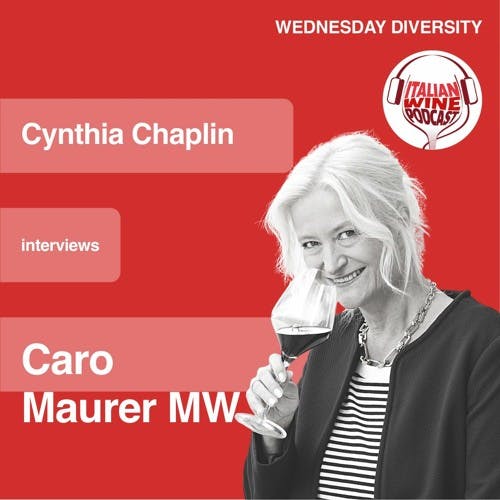
Ep. 764 Caro Maurer | Voices With Cynthia Chaplin
Voices
Episode Summary
Content Analysis Key Themes and Main Ideas 1. The career journey and achievements of Caro Mauer, the first German-speaking female Master of Wine. 2. The rigorous and rewarding process of becoming a Master of Wine, including financial and personal commitment. 3. Insights into the current state and potential of the German wine industry, highlighting key varietals and trends. 4. The significance of wine education and mentorship within the wine industry, particularly through the WSET Diploma and MW programs. 5. The role and experience of being an international wine judge. 6. Future projects and goals, including the upcoming Institute of Masters of Wine Symposium. Summary In this episode of the Italian Wine Podcast's ""Voices"" series, host Cynthia Chaaplin interviews Caro Mauer, the first German-speaking female Master of Wine. Caro shares her journey into the wine world, starting as a journalist in New York and developing a passion for wine upon returning to Europe. She details the challenging yet rewarding process of becoming an MW, emphasizing the financial investment and the personal dedication required. Caro discusses the benefits of the MW title, including increased respect and opportunities. She also offers an overview of the German wine scene, highlighting Riesling, Pinot Noir, Pinot Blanc, and high-quality sparkling wines (Sekt). As an experienced wine educator and judge, Caro reflects on the joys of teaching motivated students and the continuous learning experience gained from judging international wine competitions. She concludes by discussing her current major project: organizing the 2023 Institute of Masters of Wine Symposium in Wiesbaden. Takeaways * Caro Mauer is a pioneering figure as the first German-speaking woman to achieve the Master of Wine title. * The Master of Wine program is highly demanding, requiring significant financial planning and family support. * The MW title provides immense professional validation and opens up new career opportunities. * German wine excels in Riesling, Pinot Noir (Spätburgunder), and Pinot Blanc (Grauburgunder/Weissburgunder), and is making significant strides in traditional method sparkling wines (VDP.Sekt). * Wine education (e.g., WSET Diploma) is most effective when students are self-motivated and passionate. * Wine judging offers a continuous learning experience and fosters humility and discussion among experts. * The Institute of Masters of Wine Symposium, held every four years, is a major event for the global wine industry. Notable Quotes * ""I always did what I did as a human being. I didn't care whether male or female or diverse. I just did it and nobody doubted myself."
About This Episode
Cara, a woman who studied communication science and worked as a journalist, introduces Cara, a woman who will become a master of wine. Cara explains that it is a difficult process, but she learns from her own experiences and learns how to overcome borders. She advises Speaker 1 to share their own financial plans and to be honest about their financial plans. Speaker 1 emphasizes the importance of maintaining professionalism in wine trade and recommends not considering the financial costs of studying for the master of wine. They discuss their plans for the upcoming spring wine awards and the challenges of achieving sustainability and being a student. They also discuss their plans for the upcoming Symposium in Germany and express excitement for the upcoming event and the potential for improvement in the judge's views.
Transcript
Welcome to the Italian wine podcast. I'm Cynthia Chaaplin, and this is voices. Every Wednesday, I will be sharing conversations with international wine industry professionals discussing issues in diversity, equity, and inclusion through their personal experiences, working in the field of wine. If you enjoy the show, please subscribe and rate our show wherever you get your pods. Hello, and welcome to voices. Today, I have the great pleasure to have Caro Mauer with me. Caro was the first woman master of wine in the German speaking world and the title she achieved in two thousand and eleven. She's a journalist based in Bond where she specializes in food and wine. She has written for many magazines and other publications over the years, including Decanter, and she's a wine educator teaching WSET diploma in Germany and Australia and Italy and Norway also working with the education arm of the Institute of Masters of Wine. So over the course of her career, she has won several awards and accolades for her skills as an educator, a writer, a taster, an international wine judge, And today, it is my huge pleasure to announce that Cara will be the general chair for the sixth edition of five star wines and wine without walls being held in verona in April this year. So welcome, Cara. Thank you for joining us today. Thank you for inviting me, Cynthia. I'm really I feel honored and happy to be with you. Great. Great. Well, I just wanna dig into your background a little bit. You studied communication science and university. What got you into the wine world initially? It was actually after my studies. I started to work as a journalist and I started to work funny enough as, as a correspondent in New York. So I moved to New York in nineteen eighty eight, and actually in May or June nineteen eighty eight, and I lived and worked in New York and in Los Angeles for almost two and a half years. And I think in these days, the really good wines haven't arrived, from the West Coast to the East Coast so so far and I think I had a lot of dreadful wines where I was living in New York, and I always was looking for the better ones. And when I got back in nineteen ninety, I started to look for really good wines within Europe. Pisling is still one of my favorite varieties in the world. And in Germany, well, there's plenty of it. And, I wanted to learn more about wine, and that's why I started to drink more, to read more, to learn more, and I started to write about it. Fantastic. I think we were in New York at the same time. That's part of why I moved to Europe in search of better wine from nineteen eighty seven, nineteen eighty eight in in New York. So I understand. I wanna ask you about becoming a master of wine. Everyone in the business knows it's a tremendously daunting process. Very expensive takes a long time. How how did you find the process? How long did it take you? It is it is quite a challenging process. I have to admit that and it was challenging. It was exhausting and you're doubting yourself all the way through. But when challenging yourself, I think you learn very much about yourself and you learn how to overcome your own borders. I think this was the most interesting part of the process. I was one of the pretty fast ones. I passed it in four years. So there's actually you can do it one year faster in three years and there were two of my fellow students who passed three years. I did it in four years, which is it's fast. It is fast. But actually the one thing, the most challenging thing about the program is the financial side. So I had to pass very fast because it was so expensive. So I needed to be to be really to go through in a short time. I enjoyed very much the privilege of learning. I was forty five when I started for the with the program and pretty old pretty old. I must admit, but the privilege of learning, studying, widening, my own horizon was the best thing I've ever done in my life. And it was when I said already, it was very expensive. It was the best investment because, I invested in myself, in my knowledge, And so I think it was one of the best things I've done in my life. And I think that's wonderful. It's it is really true that, the best learning takes place when you're learning something that you love and you've chosen for yourself. So I can I can understand that? I just wanna point out for everyone listening that, four years is extremely fast. Three years is the minimum to become a master of wine, and most people take on average. I believe it's seven So that was extremely fast. Did you feel any particular obstacles or challenges because you were a woman and especially the first German speaking woman master of wine? Actually, I never felt an obstacle. It's is it was actually more the other way around. I was supported by everyone. Most important my husband for sure. And but everyone else, I think I never felt any advantage by being a woman especially not in the body of masters of wine by now, not in a study, student body, because, almost half of the MWs, almost half of the student body is a female. So I never looked at myself from the chimneys side. I always did what I did as a human being. I didn't care whether male or female or diverse. I I I just did it and nobody doubted myself. That's excellent. It's it's nice to hear that there is that ability within the the master wine Institute to, put aside issues that can be diversive in in other arenas as we know, and just to get down to the business of what you were wanting to achieve. Did you have a a great mentor, master of wine is is known for its wonderful mentoring program. Are are you mentoring now? Did you have a wonderful mentor when you were a student? I had a wonderful mentor. Julia Bruce Jones, she is British but living in France now running a winery in and, for sure, I became a mentor afterwards. I think it's, for me, it's still a really great honor and it's a really good part of my life to work with students. It keeps me on track. It keeps me on track about the study program, also about, current topics in the world of wine. So I have officially, I think I have around six mentees, and I have adopted six more, including two Italians, by the way, two Italians are with me as well. And it is I think I don't know why you wanna give back. I think that's the the the major reason when you when you become a mentor. You want to give back the good experience. You self received when being a student. I I think that's so true, especially in the world of education, a real student who really loves learning the the natural next step is sharing that knowledge with somebody else who's learning. So, the mentoring side that the opportunity to to teach and to support new master of wine candidates is is so special. What would you give sort of as advice to anybody, potentially myself? Who might want to enter the program in the future. I hear it already, Cynthia, your interest. Well, the funny thing is first or the the two first things I would tell you and everybody else is not to consider your wine knowledge on the first time, but consider the financial issues because let's say altogether, well, within the pandemic, it was probably the cheapest way to to study for the master of wine because you haven't been able to travel and uh-uh you haven't been able to taste all the wines around the world, but, usually, I make a financial plan for, let's say, five years and count in that you might want spent, let's say, roughly eight thousand euros per year on it. It's not so much the fees, the fees altogether they add up up to twelve thousand or thirteen thousand pounds, but it's, it's, you know, usually sharing the wines traveling, meeting other students, get to a testing, and go to winery and prepare, do this course or that course. So all this for all this, you need money. And so you you need to have a financial plan for a couple of years. I I would say five years, it's fine. And the second most important thing is tell your partner, tell your family, tell your employer what you're going to do and what you're probably going through, which is that wine is becoming or the study program is becoming the most important part of your world. You actually, you love the studying, you love the wine, you love to meet the students, and it's the most important thing for four to five years in your life. You will neglect everything else around you. You will neglect your partner. You will neglect your children, your dog, for example. And, you I must say, sorry, Cynthia. You probably would become the most boring person in the world because you are only talking about wine, you're only talking about what you just learned. And when you go to a restaurant, the first thing is when you get the wine list, you tell the, the, the, to serve you the wines blind, because you want to to taste and protectively. And so this is the second thing. Tell your family on and your loved ones what you're going to do so they are prepared and they know what's coming up to them. And then on the third, on the third, the third point might be all your background in Vine. You need to have a professional background. You either have to have studied analogy or video culture or you have to hold WSTT diploma level four these are the requirements for applying for the MW program. I think this is the best best advice I have ever had about this entire thing. I hope everyone who's listening, anyone who's interested is taking notes because, my fan Emily already think I'm very boring about wine, and and the thought of me becoming more boring would probably fill them with horror, but it's it's it's fascinating to hear you be so honest about what it takes to to get this job done and it's it's not something that's easy. I've I've chatted at length with a couple of the Italian master of wine students who are who are friends and acquaintances of mine, and it's really a journey and it does take take a lot. So, you know, you you got there. You did it. You became an NW. What then changed in your life in your career. With the title in your hand, I hope you celebrated with lots of bubbles, but what came next for you? I think the change was amazing. I mean, it was for me, to my own surprise, I have to say, to my own surprise, I was the fourth German NW, and the other ones haven't promoted the title so much. So in these days, let me put it this way. In twenty eleven, so eleven years ago, it was still a pretty unknown title, and I used it. I marketed the title and everybody was interested in it. It it was amazing. Everybody was suddenly be was aware of the title of the achievement, which I've done first of all, I I think that I have motivated a lot of people to look in this way as well and to try it. Also in Germany, I think we have now a lot of German and ws. We have have now altogether ten or eleven German masters of wine already. And the first time in my life, I didn't have to justify my expertise. You know, everybody knew a master of wine has to know about wine. They respected my title. They respected my work and for sure all the money which I have invested has has paid back is paid back. I mean, it was a really good investment also from the financial side. I think I'm I paid off already in one or two years. After I passed. You get the better jobs, they're better paid. And as I said, for me, very important is the respect people are paying me. That's that's really interesting. The the the fact of not needing to justify yourself not having to go through every point of your CB, people understand what master of wine means, and and there is respect. I think that's great. Well, I'm gonna I'm gonna take on from what you said about promoting the master wine title in Germany. What's your view of the wine sector in Germany these days? Where do you see the biggest potential for growth and quality. I know you love riesling. What's what's happening in in the wine world in Germany these days? I would say, I mean riesling is still, the hottest topic. Riesling is the most important part, and street bug will know which is Pino noir, the the the red, let's say, the red partner of riesling. I would say number one is riesling in Pino noir. Number two is everything, but riesling in Pino noir. There's so many so many other things to this cover in Germany, let's say, in the in the white wine side, for me, it would be Pino Pino Plau. I prefer Pino Plau over Pino Crie, and I think the Germans are really they have the sensitivity of handling Pino Bla really great Pino plas from Fals, for example, from Barton, with just a hint of oak. They're really elegant. And the, for me, they are the runner ups behind riesling. And the hot topic these days is probably sparkling. It's, sect or Vinca sect. Let me put it this way. Vinca sect. Vinca sect is its own category by, regulations. Vinca sect means that while they're made by the traditional method, and they have to stay in the bottle for the second fermentation and have to be matured over fifteen months. And the funny thing is that these wines, leasling is a variety which is very interesting to be used for sect or in the traditional method because it still shows its varietal character and I think we have some world class sparkling wines meanwhile in Germany, either from the pineal side or also from the riesling side. You're making me thirsty, Carol. I I really wanna try that now. It's a good thing that the podcast is is only audio because I'm studiously writing down all of these suggestions. So you're you're also obviously a wine educator is, as I said, one of my favorite parts of my own career in the sector, who are you teaching for these days? And sort of, what's your favorite part about being an educator? Why should people become a wine student? First of all, it's it's, I love teaching because, you know, you're not a school teacher. You don't have pupils in the age of thirteen, fourteen, fifteen sitting in front of you, which you, which have to learn what you are telling them. You have people who are paying for it who want to learn who have chosen this course, I usually teach WSTT and I only teach on the diploma level, level four. So I have a highly motivated group of professionals sitting in front of me. My students, my students, the candidates, are so thankful to have somebody with competence, with passion, with also with sometimes with humor, even as a German, and I always tell them that I I want to get them not to learn by heart, but just listening to me and understand what I'm telling them about, for example, German wines. I'm also teaching Portuguese wines. Depends where I teach. And Ocean wines are in my repertoire and, fortified wine. So my repertoire is pretty big because I'm teaching in a couple of countries over Europe. I think this is actually well, it's it's the most grateful job you can do because you get you get to hear the people passing and being happy what what you are doing and you you hear it right on the spot. You get the result right on the spot, and that's why I enjoy it very much. That's so true. You get to share the achievement in the moment. I I love that about teaching myself. It's it's really interesting. And I I like this concept of the difference between students who want to learn versus students who have to learn. It's a that's a very interesting road to go down. I wanna know what what your sort of career goals or your personal goals are for the next five to ten years, where is wine gonna take you in the next chapter? That there are actually two things. I think the one thing is that I love what I do. And if I, my biggest wish or the next, let's say, of ten years would be that everything stays like it is, but this is the a wish which never becomes true. So I have to react to change, for example, through the pandemic, but I can give you my biggest project, which I'm working on these days. And this will become true in twenty twenty three already I'm working or I'm organizing for the Institute of Masters of Wine, a Symposium in Germany in, June twenty nine to July second in twenty twenty three in Viesbaden. The Symposium is every four years, it's a four day, the possum with the the most important topics from the world of wine, the best speakers worldwide. And, this is actually the biggest challenge I'm working on these days. That sounds incredible. I'm gonna keep my eye out for that. Put it on my calendar. I expect we'll be hearing news about that in the coming months. So that's exciting. That sounds really exciting. And and Wiesbaden is actually a city I quite enjoy. So I used to have to go there for my children's sporting competitions when they were in high school and got to know Wiesbaden, and it's surprisingly multicultural. So many multicultural restaurants are very vibrant. So what a great place to be doing this? Yeah. And it's the best thing about it is, let's think sustainable. Even you from Verona, you can reach it by train. It's, you know, it's in the center of Europe whether you come from England, whether you come from Italy or France, you can reach it by train, or if you come from, a port, then by plane to Frankfurt, which is, less than thirty minutes away. That's a really good point. It is it is more central than than people think about. I am going to bring up your judging experience because, of course, that's what we're here to talk about, really, about becoming the general chair for five star wines and wines without wall. But you are routinely a wine judge at many competitions all around the world. I I judge as well. I have far less experience than you have. So I'd love to know how you approach each event that you're judging. What's a day in the life like for you as a wine judge? It's actually always the best face of the year. I agree. I agree with that. It's it's for me. It's it's, let's take Decante in London Decanto world wine awards. It's for me to just to sit on the table with usually there, I have three fellow judges. I'm a panel chair for this Southern Eastern Mediterranean wines which encompasses Turkey, Lebanon, Syria. Yes, Syria, Israel, Georgia, Egypt, Egypt, Egypt, Egypt, Egypt, and Egypt, and this is, for me, it's exciting. The wines are exciting, the discussions are exciting, and you sit there with three great other judges and you discuss wines. We taste flight by flight, usually, then we discuss single wines, and nobody's perfect. I'm out in some wines where I disagree with the others, but then you discuss it and you taste it once again, and you might change your opinion, or you might not change your opinion, but you find, a solution at the end. First of all, I love it. It makes me humble. It makes me proud. And I think I learn every day. I learn with every wine and what? The best job in the world. I utterly agree. And and no one can ever know everything about wine. So I I also really enjoyed that aspect of learning something new with every glass and with every discussion. It's it is so exciting. So that's but you sound like the ideal judge with that kind of a philosophy. I know we are all really looking forward to having you here in verona for for five star and wine without walls in April. So, give us some thoughts about what you're hoping to bring to that event and to the judging process there. I hope we're gonna line you up some other great panel chairs and other general chair people to work with. So I'm excited for you to be here and to be our chief judge and let us see what you can do. First of all, I must say it's an easy thing to say. First of all, I I'm I'm a female face within the line of, JS now. Which has been, male. So I might bring a different view. I might bring, well, I bring a woman's woman's face to the chair judges. And in a more international approach, a very experienced approach, a very humble approach, and I'm actually keen to learn once again. It will be my first time this year. So I'm I'm keen to learn about the people I'm working with, about the wines I'm tasting. And I think these are the major things I'm looking forward to. I make excited. I'm excited to have you here and to welcome you. Now, I have to ask you my my famous last question because this is the Italian wine podcast. What is your favorite Italian wine? You know, you'll also tell that everyone hates this pressure. I hate this question. That's why I love asking it of other people. The funny thing is if I would say, I I tell you, I tell you one which I or a producer which I love. I mean, if I say I love Mosquariello, which is one of my favorites. Then on the next day, I discover something else. I discover a great Amaroni. I discover a great Ponell. I discover a great lamprozco. Yes, a great lamprozco. I probably started mind drinking when I was young with lamprozco at Jantiglasco. So how how can I leave them out? And the other thing is sometimes you have to overcome your own opinion and I lately I rediscovered Swaveh. I rediscovered Swaveh as being a really pleasurable wine expressive meanwhile and I like these on warm summer days. And so it's always my favorite wine is always the next one I will discover. Oh, I'm gonna put that on a t shirt. My favorite wine is the next one. I like that a lot. Well, there'll be no shortage of Swave for you when you get here. I'm living outside of Verona right now, not too far from Swave, so I'm sort of rediscovering it myself. And, of course, Amaroni and a lot of other great Italian wines will come your way at five star and wine without walls. So I'm excited for you to arrive, and hopefully we can have an Aperitivo and raise our glasses together, Carl. Congratulations for becoming our general chair, and thank you so much for coming on the show to Thank you very much for inviting me, Cynthia. It was a pleasure to talk to you. Thank you for listening. And remember to tune in next Wednesday when I'll be chatting with another fascinating guest. Italian wine podcast is among the leading wine podcast in the world and the only one with a daily show tune in every day and discover all our different shows. You can find us at Italian wine podcast dot com, SoundCloud, Spotify, Himalaya, or wherever you get your pods. Hi, guys. I'm Joy Livingston, and I am the producer of the Italian wine podcast. Thank you for listening. We are the only wine podcast that has been doing a daily show since the pandemic began. This is a labor of love and we are committed to bringing you free content every day. Of course, this takes time and effort not to mention the cost of equipment, production, and editing. We would be grateful for your donations, suggestions, requests, and ideas. For more information on how to get in touch, go to Italian wine podcast dot com.
Episode Details
Related Episodes

Ep. 2789 ColleMassari: a long-term vision rooted in Montecucco with Giuseppe Di Gioia | On The Road With Stevie Kim
Episode 2789

Ep. 2788 Ep. 14: Austria and Hungary | Study Smart for your WSET Level 3
Episode 2788

Ep. 2785 From Volunteer to Speaker at TEXSOM with Samantha Cole Johnson | TEXSOM 2026
Episode 2785
Ep. 2766 Inside the U.S. Non-Alcoholic Wine Market: What Wineries Need to Know with Jill Sites | Masterclass US Wine Market
Episode 2766
Ep. 2761 Winemaking and Consulting Across Sicily with Alessandro Serughetti | Wine, Food & Travel with Marc Millon
Episode 2761

Ep. 2759 Part 2 – The VIA Educational Program & Italian Wine | Heart-to-Heart Conversation with Sarah Looper
Episode 2759