
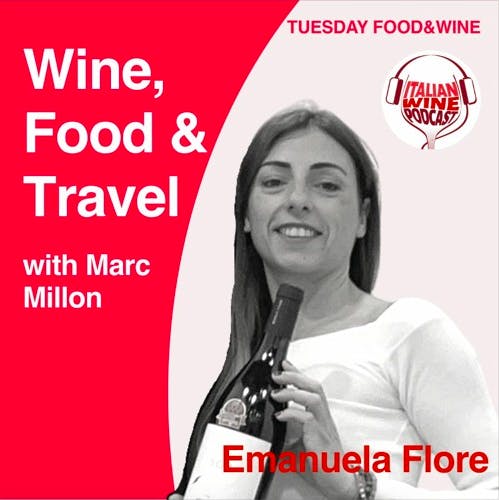
Ep. 695 Emanuela Flore (EN:IT) | Wine, Food & Travel With Marc Millon on Clubhouse
Wine, Food & Travel With Marc Millon on Clubhouse
Episode Summary
Content Analysis Key Themes and Main Ideas 1. The preservation and revival of ancient viticultural traditions and old vines in Sardinia. 2. The social and cultural significance of the Bantu Luna project in safeguarding family livelihoods and heritage. 3. The unique terroir and indigenous grape varieties of Sardinia, and their expression through authentic winemaking. 4. The direct connection between the wine, the land, and the people, embodying a ""storytelling"" approach. 5. The distinctive culinary traditions of Sardinia, particularly those from the rugged interior. Summary In this episode of the Italian Wine Podcast, host Mark Millen interviews Emanuela Floris, winemaker, and John Matteo Baldi, CEO of Bantu Luna wine estate in Sardinia. They discuss their ambitious project focused on preserving Sardinia's ancient vineyards, some of which are over a hundred years old. John Matteo explains that the project aims to safeguard a 3000-year-old viticultural heritage, prevent the social damage of abandoned vineyards (due to low revenue from old vines), and produce high-quality wines. The innovative model involves renting vineyards from families rather than buying them, ensuring continued revenue and allowing the tradition to pass to grandchildren. Emanuela highlights their winemaking philosophy of authentic expression of the terroir, utilizing spontaneous fermentation with native yeasts and grape varieties like Cannonau, Bovale, and Monica. They discuss the diverse Sardinian cuisine, noting the historical importance of the interior's meat and vegetable-based dishes over seafood. The project is presented as an inherent ""storytelling"" that reflects the island's unique history and culture. Takeaways - The Bantu Luna project is dedicated to preserving Sardinia's very old vines and ancient viticultural heritage. - The project offers a social and economic solution by renting vineyards from families, thereby sustaining their livelihoods and preventing the abandonment of traditional farmland. - Winemaking at Bantu Luna focuses on highlighting the unique terroir and native grape varieties of Sardinia, employing authentic methods like spontaneous fermentation. - The project itself is considered a ""storytelling,"" rooted deeply in the island's history, culture, and social fabric. - Sardinia's traditional cuisine, particularly from its interior, is rich in meat and vegetable dishes, distinct from its coastal seafood offerings. - The project aims to empower younger generations to continue ancestral farming traditions. Notable Quotes - ""Sardinia is in the middle of the Mediterranean, and I think is one of the places where the viticulture and the Mediterranean started. So we're talking about like a culture which has probably more than three thousand years."
About This Episode
The Italian wine clubhouse marathon is a hybrid approach to farming that is a way to improve the quality of wine and increase the value of the region. The project is a continuation of a wine cultivating culture and is linked to a modern mentality. The wine is made with a lot of manual crafting and is linked to a taste that is authentic and authentic. The goal is to transform the grapes in a taste that is authentic and authentic, and the food of appetia is about meat and vegetable. The wines are made with a lot of manual crafting and are linked to the food of the world.
Transcript
Welcome to wine food and travel with me, Mark Millen, on Italian wine podcast. Listen in as we journey to some of Italy's most beautiful places in the company of those who know them best. The families who grow grapes and make fabulous wines. Through their stories, we will learn not just about their wines, but also about their ways of life, the local and regional foods and specialities that pair naturally with their wines. And the most beautiful places to visit. We have a wonderful journey of discovery ahead of us, and I hope you will join me. This episode is proudly sponsored by Vivino, the world's largest online wine marketplace. The Vivino app makes it easy to choose wine. Enjoy expert team support, door to door delivery, and honest wine reviews to help you choose the perfect wine for every occasion. Vivino, download the app on Apple or Android and discover an easier way to choose wine. Welcome to wine, food, and travel with me, Mark Minon, on the Italian wine podcast. We'd like to welcome you today to the wine to wine twenty twenty one Clubhouse marathon in collaboration with the UK wine show, interpreting wine and Bevology Inc. Today, I'm joined by my guests, Emmanuel, Florre, winemaker, and CEO John Mateo Baldi of the Bantu Luna wine estate in Sardinia. Welcome, John Matteo. Welcome. We are traveling today to the island of Sardinia. One of the largest islands in the Mediterranean, an island of real contrasts. John Matil was telling me it's a continent in itself, a whole continent from the rugged interior to the beautiful coastal areas, and we're here to learn about a wonderful project of making wines from old vines in the center of Virginia. So welcome. Thank you both for being here to you. Can you tell me a little bit about the project? How the project began and what is the the, the ethos, the reason behind doing what you were doing? Well, the project began a long time ago, and it took a long time to be digested. The idea you know, Sudan is in the middle of the Mediterranean, and I think is one of the places where the Viticulture and the Mediterranean started. So we're talking about like a culture which has probably more than three thousand years. And right in the middle of Sedinia, you can find the same kind of uh-uh vines that they are three thousand years ago. And there's a long lasting culture, and I think it's a patrimony for everybody. Unfortunately, in the past years, of course, old vines which do belong to this kind of culture, they produce less. And therefore, revenue for the people that were actually cultivating the vines they were going, smaller and smaller. And, since the vines that are passed through generation generation, the first generation, actually, they went out to find some other job to sustain the agriculture And, at the end, now, we are in a situation where the grandfather, they're not able to pass him into the grandson because it was enough revenue. So the risk was that it's a huge patrimony. We're talking about more than one thousand and two hundred hectares of old vines, possibly slowly will disappear. So the idea was, that is a is a pity to lose that kind of patroony first of all, then is a big social damage And third, and not lastly, you can make amazing quality wines from those grapes. So, from there, we started the idea, an hour to develop a project. Okay. That's a, that's an amazing story. A real way of safeguarding, not just vines, not just wine, but really part of the social fabric of Sardinia itself. Manuel, you are, say, Okay. That's really important. This isn't just a project. You are the project because you're the generation that would have not been able to continue the vines your father had vineyards, and you are now continuing the work. Of your family? Yes. You know, It's a beautiful story in John Matteo. Just to explain, what what Emmanuel is saying here. She how how this project allows the way of life, this link with the families to continue. And I think that that is such an important part of the story of Beto Lunanak. Well, to say it in a few words, basically, is because this project puts then the men and women in the center of the project, they they actually with, a day, by day life, they actually participated the project and they grow and they make, sir, something which some of the probably, they have underestimated because it was, something given, in this way, they give a, you know, a different perspective and a different, different, opportunity for the future. Basically, this kind, this kind of cultivation has been there for three thousand years, and, as long that our civilization didn't change the commerce and and everything globalization because, you know, most of this production, they were made for the family. So the same family would produce their own wine, their own olive oil, the cattle, and everything. So now everything is different. So, for them was something which they had in the culture, and maybe they forgot the the the the powerful sense of of having vineyards in their family. So through this project, you know, they're more, self conscious. And, through the day by day, the work they do, they're getting closer and closer to what something which has been given through the generation, but they didn't really realize the sense of it. So, okay. Yeah. And as, speaking about the vineyards themselves, Quasti Vacchivitina, these vineyards have really been in this part of Sardinia for they're very, very old vines. Some of them you were telling me, we're more than a hundred years old, and it's really using these old vines that have perhaps much lower yields to make wines that are very special. I tasted the wines today with you and I was so impressed with them. They had such concentration and richness of flavor in such a pure, clean, form, complimenti. Tell me a little bit about the old vines himself. Okay. So what we're living now with this, old vines is a result of choices that were taken in in the past centuries. So from one side, we know that the people that came before us are one says that they knew that there's such a strong wisdom about the the the the the quality of the soil, the the microclimate, and everything that they've been experimenting for so many years. So they really knew the the the value of this. And this knowledge, it's just been passed down generation to generation. Is represent down to the question. So on the other side, there is, the the real nature of, Sedinia, which is an island in the middle of the Mediterranean. So many people came into the island and they brought new way of doing things, new culture, and, even new grape varieties, and even new grape varieties. And, so the result is, is this is a kind of blend of culture and, knowledge. So, we are, now basically We are we are telling something. What we have now is that is that the blend of this culture and this wind and this knowledge. So what we are telling now, the wine we're making now is basically is that the real story, our story is the story of the island, the taste, and represent what we are, and what is our history. And tastes and flavors that could come from nowhere else on earth. I think so. Yeah. So let's talk about these native grape varieties that are, most important for you. Yeah, I know you're growing only grape varieties that have been on Sardinia for a very long time. So the three the three basic one is canona, which is grenache or Garnache, same variety, Bovale and Monica, which are the the main red varieties in in the island. I can't to representative of the territory. Together with those, there are many, many, many other varieties, which they do represent the territory being blend within the other tree. And I would say something joined something more is one of the reason is that all all of these small plots of vineyards, there were family vineyards. So each family had this recipe. So each family had his own fantasy and maybe, you know, the grandfather brought back from somewhere, a variety and then the other decided that he did he delight that one. So, you know, there is a part of the creativity in that and they also they did use to like to compete on the quality of their wines. Each one that is on a secret recipe related to, you know, small addition of this variety or the other variety. That's why you find up to seventeen, eighteen different variety. That's fascinating. And I think it's also fascinating that the project isn't trying to impose your own style of wine onto what what is actually already on the island. I want to clarify about the way you work with these families because this is a very interesting part of the project that you have. How many families would be working? How many contacts? We started with eight. Okay. And now there are more than twenty five. More than twenty five. And these are small, small holdings that have been in traditionally in families for generations. Yes. And, you know, I think you said to me, John Montino, that, that the grandparents would have worked the land, the next generation couldn't make a living, and now you're actually working with the grandchildren. So that's a beautiful continuation of of a of a way of life as much as a continuation of wine. We didn't want to buy the vineyards. We rent the vineyards, so the vineyards can stay in the family. And since the issue, and that gives them revenue. And the reason not to abandon the vineyards and not to decide to dismiss the vineyards. On top of that, I think to carry on the generation is important that the grandchildren, because the father, I think, they lost a chance. They went away that that they look for other jobs. Most of them. I mean, it is always difficult to generalize, but let's say in general, most of them, they decide to do other things. But the grandchildren, I think, if they didn't have this chance, most probably they would lose the the the the the the the possibility to carry on on the tradition, on the knowledge, on the on the wine training, and on a wine cultivating. This kind of culture, has a huge effect on on the old vines because apart from the fact that they're less productive, but you need to be very, to be a very, very, very good video culture to be able to have a vine to survive a hundred and twenty years because you really need to understand the plant the way you prune it because otherwise, the the the the vineyard would die much, much harder. That's what happens in our normal vineyard. Usually after a few years that they tend to get too old. So that kind of, culture is very important to be carried on. And, I think not all of them, but at least twelve twelve young people. I mean, the the oldest one, I think, is thirty five, thirty six. They're working in, in attendance, which, and they're learning, and even through the project, they're understanding what what was, you know, knowledge passed into by words. Now they they also have a a scientific reason to what they were doing. So a more, you know, they have a better understanding of what they're doing. Okay. And actually, from Emmanuel, your point of view, to make wine again with this knowledge that would have been in your family for generations, but now with your training and as as a winemaker, Okay. Yes. Well, she was saying that this project gave it to her the the chance to make a real or a dream that she always had to to have a new perspective with this all the vines and to make a wine with a new taste which could represent sardinia all over the world. Yeah. In a way, it's linking this this old tradition with a modern with a modern mentality as well. I think, yeah. I would say, I, myself, which are not coming from there, but I, you know, I, I, I'm, I'm part of the project. I wanted the project very strongly. I, I find also some very innovative aspects in this, project, something which it could be maybe duplicate somewhere else. In a sense, for example, now most of the wine producers very involved with the concept of storytelling. So I I want to sell the wine. I need to have a storytelling. We do not have a storytelling in a sense that going so deep in details through inside the project is the storytelling. It's the story. So we don't need to invent a storytelling. We we are the storytelling. So that and that really simplifies the answer. I think that telling this story to, customers or a client and having these people to taste the wine, you know, is, is a perfect cycle. I mean, it really does work. Yeah. Yeah. I can, I having tasted the wine as of you this morning, I can really understand that these beautiful wines which I want people to understand? We started tasting a beautiful Vermentino that came from the west coast of the island, from this, where the influence of the sea, of the lagoon, was really creating a Vermentino, very different from, from the Vermentino de Gallura, from the other side of Sardinia or Tuscany. Tell us a little bit about this wine, Questo Vermentino, this wine from into terracotta amphora. In the idea was exactly that one you said. So to having spontaneous fermentation, sir, having even a stronger element to describe the territory where the wine comes from even with the yeast. So that's important. Yeah. The spontaneous fermentation, we make petticoove from each vineyards where we pick the grape. So the yeast is exactly the yeast as leaves in in the vineyards where the grapes come from. So, MRS says that she she believes that a role as a as a winemaker is to find the way to transform the grapes in a taste which is the the more, authentic interpretation of, of the, the, the soil and the, and the area. Without trying to impose europe, without trying to impose any, any Okay. And in fact, when we tasted the red wines today, I could taste that same philosophy, that same approach in the red wines. John, at Dale, can you talk to us through about some of the red wines that you produced from these great varieties, Canal, which is more well known, particularly when we know that it is a carnacha, cretaceous, but also the Mulvare and the Monika. Yes. We we we we actually make four different wines which are two are coming up basically the expression of two different crews. One is Mandro lizai, which is a DSC or the area. We have to think is a is a plateau about, like, between five hundred and seven hundred meters high, and the other one is neonelli, which is a small area just next to it, but it's different. And there are the blend of up to twelve, fifteen different vineyards, but, they are made in in exactly the same way. So when you taste them, you really taste the difference of the soil and the terroir. The other two wines, one is, there are two single vineyards. And the reason we decided to bottle them by themselves is one because it's, made only with a, with a, grenache, because that family, for example, decided that, you know, that was the only, best, grape to, to use for their wines. So we, we kept a separate. So it's a single vineyard from a single family. It's a single vineyard from a single family. They decided they only one to twelve grandache. Okay. So it's a canal and and we found a particularly distinctive and no reason to blend it with the rest. And the last one is, not a single vineyard. We decided to keep it on on his own because it's so distinctive because there's a vineyard which was planted in nineteen o five. Therefore, after Filoxera. So was was grafted. It was probably one of the very first grafted. The for something which for me is more important is before the nursery system came along. So there is a huge biodiversity and the same cannon hour grenade inside the vineyards, you might find four or five different bio types. And so the monica and so the bovale and then there are grapes within we don't know even the name. So, It's it's like, you know, tasting something which is coming from another time. Okay. And, that was fascinating. And, I I know that wine is called which means, moon wind. Yeah. Okay. A wind of the moon. I don't know. Yeah. Finally, I'd like just to turn to speak a little bit about the food of Sardinia and matching these wonderful wines with the food. Because Sardinia, again, with this rugged interior, beautiful coastline, we have cuisines that have some of the best seafood in Italy, and also the wonderful meats, the Portuguese, the foods that are really typical. So explain a little bit about. Well, as we were saying at the beginning, sadine is an island that makes different culture. The original long lasting culture is from the interior. So it's not seafood. The seafood was brought by by other people and So, basically, you have the catalan in Algaro, you have people from Latin on the other side, but the the the people, you know, the regional shepherd from Sardinia, the the the food is about meat and vegetable. Meat cooked over the open fire? Well, I we last night, we were last week that, and we tried like, something which somebody could believe is not interesting, but it was fantastic. It was a a boiled sheep. Like the, yeah, that way it's a fantastic play. They have it and they use the broth to do past and everything. Yeah, but they use either to be to to grill it or or or to boiled them in different ways or they have a special copper, closed, recipients where you put it in the in the fire. But basically, when you have a guest, you you kill an animal and, softly. No, that's true because there's a they they always have a kind of, respect to the animal. And then you share the meat with a with a guest. And you don't throw away anything. So simple, strong flavored foods to go with wines and a full of richness and flavor. Okay. Well, it's been absolutely fascinating talking to you both, Mila gratzie for beans. Our guest today, the project is an important one. It's a project I look forward to following I wish you both all the best of luck in the future with it. Thank you much. Thank you so much. Thank you. Thank you. Thank you. Thank you. Thank you. Thank you. Thank you. So that is all we have time for today. I'd like to give thanks to our guests today, John Matteo, and Emmanuela. And we will see you soon on another episode of wine to wine twenty twenty one Clubhouse marathon. We hope you enjoy today's episode of wine, food, and travel. With me, Mark Miller, on Italian wine podcast. Please remember to like, share, and subscribe right here, or wherever you get your pods. Likewise, you can visit us at Italianwine podcast dot com. Until next time. Hi everybody. Italian wine podcast on the Breights its fourth anniversary this year, and we all love the great content they put out every day. Chinching with Italian wine people has become a big part of our day, and the team in Verona needs to feel our love. Producing the show is not easy folks, hurting all those hosts, getting the interviews, dropping the clubhouse recordings, not to mention editing all the material. Let's give them a tangible fan hug with a contribution to all their costs. Head to Italian wine podcast dot com and click donate to show your love.
Episode Details
Related Episodes

Ep. 2789 ColleMassari: a long-term vision rooted in Montecucco with Giuseppe Di Gioia | On The Road With Stevie Kim
Episode 2789

Ep. 2788 Ep. 14: Austria and Hungary | Study Smart for your WSET Level 3
Episode 2788

Ep. 2785 From Volunteer to Speaker at TEXSOM with Samantha Cole Johnson | TEXSOM 2026
Episode 2785
Ep. 2766 Inside the U.S. Non-Alcoholic Wine Market: What Wineries Need to Know with Jill Sites | Masterclass US Wine Market
Episode 2766
Ep. 2761 Winemaking and Consulting Across Sicily with Alessandro Serughetti | Wine, Food & Travel with Marc Millon
Episode 2761

Ep. 2759 Part 2 – The VIA Educational Program & Italian Wine | Heart-to-Heart Conversation with Sarah Looper
Episode 2759