
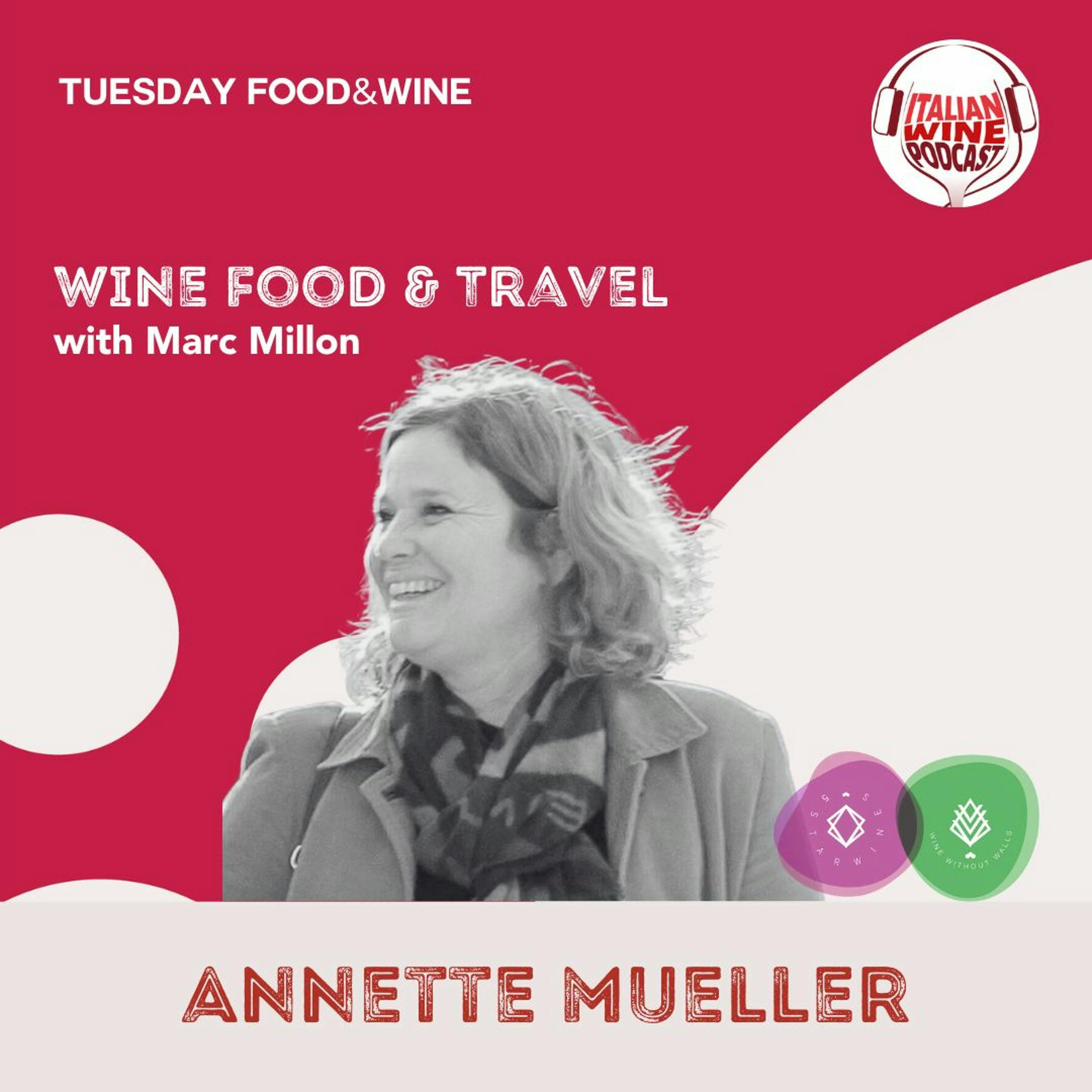
Ep. 1455 Annette Mueller | Wine, Food & Travel With Marc Millon
Wine, Food & Travel
Episode Summary
Content Analysis Key Themes and Main Ideas 1. The philosophy and practice of biodynamic and organic farming in Tuscany. 2. Fattoria La Vialla's holistic approach to agriculture, encompassing a circular, self-sufficient farm model. 3. The recognition and rising prominence of sustainable wine production in competitive awards. 4. Preservation of cultural heritage through traditional, diverse farming practices. 5. The integration of wine, food, and agritourism for a comprehensive visitor experience. Summary In this episode, Mark Millen interviews Annette Mueller of Fattoria La Vialla, a Tuscan estate recently honored with multiple awards at the ""Wines Without Walls"" competition for its organic, biodynamic, and sustainable wines. Mueller describes La Vialla's foundational philosophy, established in 1978 and becoming biodynamic in the late 1990s, centered on treating the farm as a single, self-sustaining organism. She details their circular agriculture model, which integrates vineyards with olive groves, vegetable patches, and livestock to produce a wide array of products, from wine and olive oil to flour, cheese, and prepared foods. Mueller explains how biodynamic practices, though challenging, foster resilience in their crops and regenerate soil fertility. She highlights their award-winning organic sparkling wine, ""Trenta Chinkbe,"" and biodynamic white, ""Vernaccia di San Gimignano Riserva,"" discussing innovative production methods like on-site whole-bunch pressing. The conversation also touches on the family's initiative to lease and rejuvenate abandoned agricultural lands for biodynamic farming across Italy, their direct-to-consumer sales model that bypasses intermediaries, and the immersive agriturismo experiences offered at the estate, emphasizing their commitment to cultural preservation and leaving a healthy legacy for future generations. Takeaways * Fattoria La Vialla is a long-standing pioneer in organic (since 1978) and biodynamic (since late 1990s) farming in Tuscany. * Their approach is characterized by ""circular agriculture,"" integrating diverse crops and livestock to create a self-contained, balanced ecosystem. * Biodynamic practices, including specific preparations and lunar calendar adherence, contribute to increased soil fertility and plant resilience, particularly against climate variability. * The estate won ""Winery of the Year"" along with awards for Best Organic Sparkling and Best Biodynamic White at the ""Wines Without Walls"" competition. * Fattoria La Vialla actively expands its biodynamic footprint by revitalizing abandoned agricultural lands in regions like Sicily and Puglia. * They maintain a strong direct-to-consumer model for their wines and extensive range of farm-produced foods, including a warehouse in the UK to simplify distribution. * The estate offers an agriturismo experience with farm stays and day tours, allowing guests to witness their integrated production process firsthand. Notable Quotes * ""We do look to do circular agriculture, not just viticulture, since we are a biodynamic farm."
About This Episode
Speaker 2 discusses the challenges of farming in Tuscany, where farmers must maintain agricultural culture while preserving cultural heritage. The importance of diversity and sustainability in achieving goals is also discussed, as well as the challenges of farmers in achieving their goals and the unpredictability of climate change. They also discuss the resilience of regenerative agriculture and the use of natural ingredients in vintage wines. Speaker 3 explains their success in organic sparkling wines, including their wine winning an award, and their use of VINs and the mix of agricultural farming. They offer a week long farm stay and express excitement for upcoming episodes of wine, food, and travel with them.
Transcript
Hey, guys. Check out Italian wine unplugged two point o brought to you by Mama jumbo shrimp, a fully updated second edition, reviewed and revised by an expert panel of certified Italian wine ambassadors from across the globe. The book also includes an addition by professoria Atilushienza. Italy's leading vine geneticist. To pick up a copy today, just head to Amazon dot com or visit us at mama jumbo shrimp dot com. Welcome to wine food and travel. With me, Mark Millen, on Italian wine podcast. Listen in as we journey to some of Italy's most beautiful places in the company of those who know them best. The families who grow grapes and make fabulous wines. Through their stories, we all learn not just about their wines, but also about their ways of life, the local and regional foods and specialities that pair naturally with their wines. And the most beautiful places to visit. We have a wonderful journey of discovery ahead of us, and I hope you will join me. Welcome to wine food and travel with me, Mark Millen, on Italian wine podcast. Today, I'm delighted to continue our special series that highlights the winners of the prestigious five star wines and wines without walls competition that took place earlier this year. Over the course of two long days, and believe me, they really were long days, was at the end of March, early April, just before Vin Italy, more than two thousand two hundred wines were tasted by an international jury of Italian winemakers, wine professionals, sommeliers, journalists, and Italian wine ambassadors. Those wines that scored more than ninety points were awarded certificates and will be included in the five star wines and wines without walls two thousand twenty three book, while the very best wines in each category were singled out for special awards. My guest today is Annette Mueller of Fateria La Viala in Tuscany, which won a clutch of important awards in the wines without walls competition. The part of five star wines dedicated to organic, biodynamic, and sustainable wines and fiticulture. Aviala scooped awards for winery of the year, best organic sparkling, as well as best biodynamic white wine. Many congratulations in that to you and to all at Fateria LaViana. Thank you so much. We were very excited to be able to be so present at wine without walls. Well, great. Now You said that about ten kilometers from arezzo. Tell us where you are and give us a picture of the estate and of the lands that you farm. Yeah. So, as I mentioned, it's about ten kilometers from arezzo. So we're in Tuscany. And we're about fifty kilometers from Florence and another fifty from Sienna. So we're right in the middle of Tuscany, and we are in the Kianti region. It's not the famous Kianti classical region. But it's Kanti collared. And we have an estate. Well, so we are farm and wine estate. So our main hub, so to speak, in arezzo or just arezzo in Casioki, is about one thousand six hundred hectares or close to four thousand acres. And so, obviously, we have vineyards, but we do look to do circular agriculture, not just video cultures since we are a biodynamic farm. So we also have vegetable patches. We have obviously olive groves. We have sheep. We have chickens. We do all kinds of vegetables. And then the other particularity is that we not only just farm and reduce the things, but we also package and ship directly to the end consumer in really trying to always keep the circle closed, so to speak. Well, actually, and that that's really fascinating. And it's a very large estate I'm particularly interested that it's agricultural estate, as you've explained, and it in a way is farming in Tuscany in the way Tuscany was during the time of the Metsudrilla. During the time, you know, before specialized monoculture. And I like this idea of the rotation of the fields and of producing so many other typical Tuscan products as well as wine. Yeah. So for the family, it was really important when they first started in nineteen seventy eight. So to speak to founders, Julianna, and Pierlo Franco. It was important for them to really not only, you know, do farming And it was organic from the beginning. I don't think they would have ever considered anything else. And then in the late nineties, we started with the biodynamic agriculture, but it was always an important aspect, and I'm glad you mentioned it to actually not just in farming, but to also preserve the cultural heritage that is Tuscany. So it would have never occurred to them to just do one thing aside from the fact that especially in biodynamics, you know, you really always look at the farm as a whole organism So you do need all the different aspects of not just Viticulture, but you also need other cultures such as olive groves, which are also very typical for the Tuskin area, but then also you need the animals for one, obviously, for the manure to activate the compost heap, but also we use them. For example, we make the colino cheese, which is done with a hundred percent sheep's milk, but then we also use the meat for our guests in the And then, of course, the vegetable patches that are important to avoid to have monocultures, but to actually, you know, the main aspect of it is to really increase, not just by diversity, but to also always keep the soil fertile. And what we found is that the more diverse a culture is within the whole aspect, the more resilient it gets since obviously when practicing biodynamic agriculture, just very few things that you can do in order to intervene. And so the best aspect of it all is to keep nature in balance so nature can take care of itself. That's a fascinating story. The family must have been real pioneers going back to the origins of the farm in terms of initially setting out to farm organically. This wasn't, you know, now organic farming in Tuscany in Italy is much more widespread. But in those days, it really wasn't, and there would have been all sorts of challenges in setting out on this path. So it's really something to admire that the family have been following this strada for such a long time. Yes. Like I mentioned before, I mean, one of the so today, Tatudyala, is seeking found in the second generation, or sometimes we also say in the third generation because the founding generation, Julianna, and Pierreo Day were inspired by their grandmothers who both had farms and where both of them would spend the summers, and that was the idea then to also continue that and give that part of knowledge and that love for nature and for agriculture back to their children, the three brothers who are running today, franco. And Johnny always says, the oldest, he says, why would I want to poison the land that I'm living off? And the idea that they want to leave something to their children and their children's children. And so it was never a question for them not to farm organically. And then by logic, then later also to farm biodynamically. And, yes, it was difficult in the beginning, not so much in terms of, let's say, the actual work part because, of course, Obviously, there's always challenges, but I think challenges are just anywhere when you do agriculture or video culture. More so that people were kind of thinking that they're a little bit strange for really being so intent or non using any kind of pesticides or not using any kind of synthetic fertilizers. In a way, it has inspired other farmers, and it also has inspired other people to really see that regenerative agriculture is a possibility also on a greater or larger scale and that it can also be profitable. Yes. That's actually a very important point to remind that The challenges of farming in this way organically, biodynamically are, of course, there. But also from a consumer's point of view, going back twenty, thirty years ago, certified organic wines were, as you say, alternative to traditional lines and biodynamic even more so. So it was taking on the market as well as the challenge of the land. And tell us for our listeners that aren't really aware of some of the challenges of what biodynamic farming is, what it means, and what are the some of the interventions that you do to farm in this manner? Okay. So as I mentioned before, so the two main aspects, I would say, our main three aspects is one biodiversity and the fertility of the soil. And the third aspect is to really look at the farm as a whole. So that is the reason why we don't just aren't just video cultures, why we don't just make wine, but also all the other products And it is really in trying to set up a circular economy in a way or circular agriculture. Each aspect of the farm is kind of greater than the sum in a way to put it all together. And so just very few practices. So we obviously, use their Tuven calendar, which means that we do see what days are good for planting, what days are good for pruning, for example, really trying to observe that, but that is a practice that, you know, has been going on for thousands of years. And so, obviously, in that case, we look at today. It's a great day to prune the vineyard, but should it be raining on that day? Obviously, we will wait. But this is also how we found out that it does work because generally when we prune, for example, the vineyard at the right time, you see that it's much more vibrant than maybe the part of the vineyard that we weren't able to prune in in the correct time. However, that being said, It still is that after a couple of months, it kind of levels out. And it's it's all the same again. Another aspect is that we do in the vineyards, for example, because it it's quite complex or on a large scale. So in the vineyards, for example, we use rain manure, Obviously, we do not use any kind of synthetic fertilizers or pesticides. So everything we do is kind of a prevention. So we try to maintain the balance of the land. And that way our plans, our cultures can really take care better of themselves. And that is what we found in the past that in a way our, for example, our olive groves or our vineyards are much more resilient in difficult years than maybe in farms that work conventionally or just organic. And I think it is really done. Or it's it being is because if you give the plant you know, or the culture, somewhat perfect habitat, its immune system for lack of a better word is better to fend off any kind of pest. So this is this is kind of in a nutshell. And then, of course, we use the, by dynamic corporations, There's two spray preparations, which are five hundred and five hundred one, which are cow manure that is fermented over the winter months and quartz crystal, which is fermented over the summer months. And then used in spraying. The five hundred preparation, for example, it being filled with microbes that are then dynamized actually help the fertility of the soil because you have to imagine that microbes on the soil then propagate and help, for example, and the vineyard, the the roots go deeper, and the quartz crystal horn, which is five hundred one, helps for the photosynthesis, and also for the maturation of the fruits. So this is just too too little aspects. But I think the main thing about biodynamic agriculture really is the fact that it's a degenerative practice. For example, we've been measuring over the past twenty five years our soil and the fertility of our soil. And we've noticed that through these practices, actually, and the hummus, layer as well as the organic matter in the soil is actually increasing. And even though we are using it, and, for example, in conventional agriculture, that would decrease. Italian wine podcast, if you think you love wine as much as we do, then give us a like and a follow anywhere you get your pods. Yeah. And very timely for today, you're talking about resilience that comes through this regenerative farming. And, certainly, with climate change and the huge heat that Tuscany has suffered over the past years, have you found that the vines are able and other produce that you're growing is able to cope better. So, yes. Obviously, it's a challenge either way, but we do believe that they're coping better. However, of course, we also have to see, you know, how we can deal with the climate change that's going on, which has become very evident. And it's not just the heat. It's also the unpredictability. I think that is really what makes it the most difficult. But before you you had kind of a set schedule of saying, you know, march to whether it's like this and maybe like that in in May and June like this. And this has completely kind of changed. So and I think it's the unpredictability that makes it so difficult to deal with the climate change in a way. So, well, I'm very curious to see how we can cope with what's going to happen. For example, this year, we had a lot of rain. I mean, late spring, for example, in April, we had another bit of frost, which is always difficult for the vines, especially the ones that are in the valley. And then we had just lots and lots and lots and lots which, you know, people say, oh, that's great. And in a certain aspect, yes, it's great because the water reservoirs are being replenished, but in terms of planting, in terms of of diseases. It's not that great. But, you know, we remain flexible and hopeful. Yes. Of course. Yeah. Well, you're certainly having great success. Let's talk about these lines that won the individual award first, your best organic sparkling. Tell us about this wine. Yes. So as I said, we don't only have vineyards and fields in and around Casio Pipati, Arratso, where Katuriya, Naviala is based, but the families In two thousand ten, also founded a small family foundation, the Lofranco Family Foundation with its main aim to actually find abandoned land and agricultural land and try and lease it or sometimes buy it. And then use it biodynamically. And so we were very lucky to find a parcel at a vineyard in Osterpopa Visa until the late, at the beginning, like, until nineteen twenty something. Actually there, you could still call the sparkling wine champagne. And so we were fortunate to meet a family who did not want to continue with their vineyard and released it. And that is when we started making also sparkling wines with the, Maduro traditionale or champagne method. And the trenta Chinkbe, trenta Chinkbe, as it's called, which one, best organic sparkling, is actually from Osipopaleza, and it's pinonero, pinified in white, was a little bit of chardonnay. And the reason it's called in or thirty five is because it first came out and Paturial Aviala turned thirty five years. So it was for the anniversary and also the fermentation in the bottle, so it bottle fermented is thirty five months. Oh, fascinating. And that that's really interesting that the family are looking to expand this method of farming, the biodynamic farming, and the philosophy and values in other lands, something that I've noticed you have vineyards in Lemarque also in Sicily? Yes. We also have a small vineyard in Sicily, and that is because Piero Nofranco, the founder of Fattoria Aviana, so to speak, and father of the three brothers. He has his roots in Sicily. And so that's why we also have the small and varied in Sicily. Also in Pulia, we have, for example, olive groves, And then in the Marima, which still is tasking me, but about forty kilometers from the main hospital, we have as well vineyards, as well as vegetable patches. Oh, fascinating. And, of course, turning now to your Another war, the best biodynamic white. That comes from Sanjay Muniano. Tell us about this. Exactly. Yeah. So in San Jimiano, we because Truliana, the mother of the three brothers and founder of Patabia LaVala, so to speak, She is actually from the area around San Jimiano, and they still had a vineyard. And so we are able to also make, and a few years, we decided to make also, which is basically also does some wood. But for the vintage of two thousand twenty, we actually did something very special. We did depressing on-site, meaning we harvested the grapes, and then press them. Basically brought our press to the vineyard, and then press the whole bunches immediately after having hand picked them. And the reason we did that is because never a matcha grape, even though it's not the most aromatic grape. Right? And so in order to preserve most of the aroma, we decided to do it immediately, not just, you know, to avoid any kind of alteration. We decided to do it immediately in the vineyard. And I think we're very lucky or let's say that extra work of doing it, basically, it was a success. How fascinating. So you brought the press there and whole bunch pressing, and then managed to then transport them, the most of very quickly back to the seller. Exactly. And so the reason why we did the whole bunch pressing is because the extraction of the deuce is a lot better. It flows better so to speak when the stems are there. I mean, they're just like an easy trick. You know, you you do it. It's easier to take a whole bunch of grapes with the stem and squish them in your hands and taking just, you know, the berries and squishing them. And when this was done, you knew this would be camarizerva. Yes. Our analogous and agronomists They usually taste the berries or the grapes way before they have their schedule, tasting them, and then deciding what trying to make with it. If it's just the normal, we also have a vet match, just a vet match, Adisana, I mean, I don't know or the Bharatadi reserva. And the reservoir, is that VINified differently and age differently? It's aged differently. So it's VINified differently in this case because it was VINified directly in the vineyard. Or pressed directly in the vineyard. It's also it was aged in wood for about a year. The mast was enlarged to nose, five hundred liter to nose. Okay. So that's really going back to the traditional over Natche di san Jimignano, when the white wines were aged in wood. Yeah. And I think it's kind of interesting right now because whites that are aged slightly in wood are becoming more don't wanna say fashionable, but, like, the palette right now is that people do enjoy them, you know, than the really light, fresh white wines. Obviously, those always go, but there is this nutrient whereas wood and red wine is kind of, you know, people are less and less interested in these heavy woody red wines. Yeah. I think you're right in that. And also just to make clear, it's not the oak that comes from new batik, but, the larger barrels that are not giving woody flavors, but just helping in that maturation. Yeah. So we were very happy about that. And then, of course, also the fact that we won this winery that made our analogist or made all of us really proud because it's saying, you know, it's great if you win for a certain vintage, you know, but if you win the award for best winery, that means that, obviously, all your wines, you know, on average, have such a high quality that, you know, you don't just win one award, but you win several awards. And I think that's very it's just a great recognition of all the work we've been doing in the past well, forty five years so to speak. And, yeah, so it made us grow. It is a great recognition and congratulations to everybody. And I know how, you know, these wine competitions I was judging this year, and we're tasting all two thousand two hundred wines blind about eighty professionals. We're all in separate teams, but, you know, the cream really does rise to the top because this blind tasting really does identify the best wines, the best producers. So it's a great achievement. Now if you produce a whole range of wines, we haven't talked about the quarantis you produce. I'm really fascinated by this mixed agricultural farming, and I'd like to turn to some of the foods you produce because I think this is so important that the farm is really almost a self contained community as Tuscany used to be, and I'd love to hear about some of the foods. And I'm also particularly interested because you are able to supply wines direct to consumers, but also you can supply a range of some of the foods you produce. Yes. So if you take the word Pattoria, in Italian translated, it means farm and wine instead, And as you said, in the years before, farms were always self sustained farms. They would produce everything or almost everything that they would need. And that was the idea behind Taturria LaViana to go back to that you know, being able and sometimes we're actually amazed by ourselves that we can make entire meals and, you know, feasts with everything that we produce ourselves. And so, obviously, we also make olive oil, the make our own flour. So we have different kind of grains. And then from the grains, we make pasta, as well as cookies, different kind of biscuits. Then, of course, we have different summer vegetables. To turn into tomato, sauces, pesto. So we really, you know, tried to kind of have the full range because with the vegetables, obviously, we also have strawberries. We do a crop rotation. The lens itself shows Both the grains and the vegetables always go in different fields each year because it helps divide diversity and the fertility of the soil. Then, of course, we have sheep because we make pecorino, and pecorino is deep cheese and tuscany. What is special about it, obviously, aside from the fact that it's by dynamic pecorino, but it's still from a hundred percent sheep's snow. Nowadays, a lot of people make their pecorino with either cow milk, or half and half. But we remain faithful to the original recipe so to speak and make a hundred percent pecorino with different kind of aging. So we have in the early spring We have the very fresh Pikorino, and then we have four months, twelve months. And that was really, in a way, it was genius, but it kind of happened by chance because Faturi LaViana in the beginning, it was an agriturismo. So people put common We had a few farmsteads that had been renovated where people could stay. And so for the agriturismo, we actually produced, you know, the olive oil, the wine, the picurino, and some sugars. And then the guests would say, oh, This is so delicious. We would love to have that where we live. So the family, you know, thought about it. And then in the beginning, they literally would just load up a little truck and, you know, have a list of people and their addresses and what they wanted. And then they would basically drive, in this case, it was Germany, one of the first countries, and they would go door to door and deliver in person the products. And then slowly over the years, we didn't only grow the things but transformed them and then also packaged them and now also shipped them direct to the end consumer. Amazing. That's incredible. But what about going back to those Agory Theresa roots? What about our listeners who want to come to Fateria La Viola. What do you offer them? Is there opportunities to enjoy these wonderful foods? On the farm to stay on the farm? Yes. The agniturismo side is open usually from late March until mid October. And so we do have different farmstead. So when Turiya Lavila started, I mean, one has to imagine that All the land where in that area, most of the farms were completely abandoned. And when Piero and Juliana bought the first farmhouse, they realized that there were other vineyards and other houses that were on the verge of, you know, the discrepancy were available and say they slowly bought also other parcels of land and other farm houses and then slowly, we renovated them. And again, also in the renovation, we took great care to not lose the original farmhouse character. We really wanted to preserve the cultural heritage of that area. And, so people can stay with us. We we offer week long farm stays. And then we also have the possibility for people to come and visit us just for the day. Usually, people come in the morning. We offer fine tours where you can, so we have, a transparent production area where you can see, you know, the bakery, where we make the cookies, the flour mill, where we make a flour, the production area, sauce kitchen, one reproduces sauces. Obviously, need a vineyard, the wine cellar, as well as the olive mill. And then people can have lunch. So we have different possibilities to have lunch at LaViello. And that is from Monday through Friday. Okay. Well, that's wonderful. It's a wonderful rich complex that I'm very much looking forward to visiting. You're producing award winning biodynamic wines, but clearly there's so much more. And, again, it's not just a wine estate, but a complete way of life that returns to those tuscan roots of mixed farming. So it's a really important as well as fascinating story. And that thank you so much for being my guest today. It's been a real pleasure. You are. But in the meantime, I'm also delighted to see that your products and your wines are available here in the UK. So I'm going to be right after our conversation, getting on to your website and placing an order. Yes. And for those in the UK, because I know it just has been through Brexit a little bit difficult. We always like to point out that there are no, so custom duties to be paid because we have a a warehouse in the UK. And so everything is already done and the prices are without, custom duties because it has become very difficult. I mean, not Yes. Frustratingly difficult for us. But that's very, very good to know. Annette, thank you so much. I hope to meet soon. I hope to visit, but in the meantime, I hope you have a great summer, a great harvest. Thanks to you. Oppressed for chow chow. We hope you enjoyed today's episode of wine, food, and travel with me, Mark Millen, on Italian wine podcast. Please remember to like, share, and subscribe right here or wherever you get your pods. Likewise, you can visit us at Italianwine podcast dot com. Until next time.
Episode Details
Related Episodes

Ep. 2789 ColleMassari: a long-term vision rooted in Montecucco with Giuseppe Di Gioia | On The Road With Stevie Kim
Episode 2789

Ep. 2788 Ep. 14: Austria and Hungary | Study Smart for your WSET Level 3
Episode 2788

Ep. 2785 From Volunteer to Speaker at TEXSOM with Samantha Cole Johnson | TEXSOM 2026
Episode 2785
Ep. 2767 Le Marche: Verdicchio and the Wines that Shape the Region with Gianluca Garofoli of Garofoli Vini | Wine, Food & Travel with Marc Millon
Episode 2767
Ep. 2766 Inside the U.S. Non-Alcoholic Wine Market: What Wineries Need to Know with Jill Sites | Masterclass US Wine Market
Episode 2766
Ep. 2761 Winemaking and Consulting Across Sicily with Alessandro Serughetti | Wine, Food & Travel with Marc Millon
Episode 2761