

Ep. 1755 Aldo Fiordelli | Wine, Food & Travel With Marc Millon
Wine, Food & Travel
Episode Summary
Content Analysis Key Themes and Main Ideas 1. The personal journey and philosophy of Italian wine critic and journalist Aldo Fiordelli. 2. The concept and application of ""post-modern winemaking"" in Italy, blending tradition with technology. 3. Analysis of current developments and sub-regional distinctions within Tuscany (Chianti Classico, Montalcino). 4. The emergence and re-discovery of specific Italian wine regions and indigenous grape varieties (e.g., Etna). 5. The deep cultural and historical connection between Italian wine, food, and regional culinary traditions. 6. The evolving role of wine criticism and consumer appreciation in the context of food pairing. Summary In this episode of the Italian Wine Podcast, host Mark Millen interviews Aldo Fiordelli, a distinguished Italian wine critic, journalist, and writer. Aldo shares his ""damascene moment"" that sparked his passion for wine, leading him from general journalism to specializing in food and wine, emphasizing his preference for reporting and sharing discoveries over mere critique. The discussion highlights the transformative ""post-modern winemaking"" trend in Italy, which skillfully marries ancient winemaking traditions with modern technological advancements. They explore significant developments in Tuscany, focusing on the nuanced distinctions within Chianti Classico's villages and the forward-thinking approach of Montalcino's next generation of producers. Fiordelli also details the remarkable rise of Sicily's Etna region and the increasing global recognition of Italy's vast array of indigenous grape varieties, underscoring the country's rich biodiversity. A core theme is the intrinsic link between Italian wine and its regional cuisine, with wines inherently crafted to complement local dishes. Aldo illustrates this profound cultural connection through his work on Risotto alla Milanese, showcasing how a single dish encapsulates extensive history and cultural evolution. Takeaways - Aldo Fiordelli's career exemplifies a shift from general journalism to specialized wine and food reporting, driven by curiosity and a desire to share knowledge. - ""Post-modern winemaking"" signifies Italy's ability to innovate by re-embracing traditional methods with contemporary understanding and technology. - Tuscany, particularly Chianti Classico and Montalcino, is a dynamic region with ongoing developments defining specific sub-regions and fostering a new generation of winemakers. - Regions like Etna in Sicily have gained prominence by focusing on indigenous grape varieties and producing elegant, fresh wines suited for diverse palates. - Italy's extensive indigenous grape varieties are a testament to its biodiversity and are increasingly appealing to international markets. - Italian wines are inherently designed for food pairing, reflecting a centuries-old cultural practice where wine is central to the meal. - The ""palette of Europe"" perspective in wine criticism values wines with character, structure, and acidity suitable for food, differing from approaches focused solely on ""perfect tannin."
About This Episode
The podcast covers Italian wine and food, including their love for writing about it and touring the area. They discuss the excitement of winemaking in Tuscany, Italy, which is a post-m-than modern winemaking, and the rise and rise of Aetna in the Italian wine industry. They emphasize the importance of tasting different wines across cultures and thank their audience for their interest in the podcast.
Transcript
The Italian wine podcast is the community driven platform for Italian winegeeks around the world. Support the show by donating at italian wine podcast dot com. Donate five or more Euros, and we'll send you a copy of our latest book. My Italian Grapeake journal. Absolutely free. To get your free copy of my Italian GreatGeek journal, click support us at italian wine podcast dot com, or wherever you get your pots. Welcome to wine food and travel. With me, Mark Billen, on Italian wine podcast. Listen in as we journey to some of Italy's most beautiful places in the company of those who know them best. The families who grow grapes and make fabulous wines. Through their stories, we'll learn not just about their wines, but also about their ways of life, the local and regional foods and specialties that pair naturally with their wines, and the most beautiful places to visit. We have a wonderful journey of discovery ahead of us. And I hope you will join me. Welcome to wine, food, and travel with me, Mark Menin, on Italian wine podcast. Today, it's my great pleasure to introduce my guest, Aldo Fierdele. Who is an Italian wine critic, journalist, and writer who contributes to several publications, including the Tuscan edition of Coriero Delasera, as well as Chivel Thadell Barre, and also decanter magazine here in the UK. Aldo is also a certified sommelier and has written four books about wine, food, and art. So I'm looking forward very much to our conversation. Gualdo. How are you today? And where are you today? Well, I'm very fine. I'm in Florence where I was born. It's my, it's my town. But today I'm, well, actually, I, I leave, in both in in Monte close to Milan and and in Florence. So I spend my, my time among the two. And also some time in London? Yes, sometime in London, mostly, for, for the counter, for for, the counter word wine awards, in in spring. And, when when the counter organize it, the the panel's tastings. Okay. So you move around a lot. And I'm sure you move around a lot. For you work. Tell me about yourself how you became a wine and food writer and critic. It's something that listeners are always interested to know. Oh, yes. Yes. Well, my family come from, a small village, between, Tuscany, Umbria, Marque in the, in the heart of the center of Italy, where, the food was excellent, but the the wine was really very bad. It is, is a place, a Balte Verina, if you know, it is the best place in Italy to grow, tobacco. And, and, obviously, tobacco loves, humid, soil, humid grounds, and, and weather. And, so it's the opposite, for, for the wine. And, and so in, in my house, I has eaten always very well, but the wine was, was, you know, a kind of food stuff for everyday drinking. Or otherwise, you have the old, very old bottles not always, storied properly of, Barolo, brunello, sort of things. So I started with an interest about wine, and, my my parents, had a friend, a producer, one producer, who is, Fabrice bianchi from Castello de Monsanto in Kianti Glasgow. And when I was young, I, I've found a bottle, an open bottle of the, of the previous dinner, the night before, then, of, we'll put you in nineteen ninety. And when I tasted this wine, I have, the classic, cooked the food. So I, I, I thought, if the wine is, this sort of thing, I, I would, I would know it. And, and then, I, I started to work as a journalist, so not immediately as a wine critic or a food critic, but, I started with the chronicle and I worked, up to two thousand thirteen in a newspaper, following, chronicle politics, economics, but, since the beginning when there was something about food and wine, the editor, asked me to cover it. And, and so is, this is the way I I started with, with with one journalist. But I, I, I like to say that, I like to be a critic, to work as a critic, but, what I prefer is to, to work as a reporter. So I prefer to to, how do you say, to share with the with the readers, what I can discover and, what but they can find, in a restaurant or in a winery rather than saying, simply this is very good, excellent, or not as good as usual. Okay. I understand that distinction, and I've enjoyed your articles into canter. As well. I think that's interesting that your damascene moment that excited you about wine was a great wine, and I can see how tasting a wine like that after you had grown up drinking, I guess, or in a household where wine was, as you say, a food, something to to lubricate the meals. And that would have been the time of the Metsadria, perhaps, or or or or after the Metadria when that mentality hadn't yet disappeared perhaps. Italy is one of the most ancient wine producing countries in the world, you know, with vineyards that have been in virtual cultivation since antiquity. Yet at the same time, it's one of the most innovative and exciting. And your writing is part of that discovery of your own country of this new world mentality linked to this ancient patrimony of vines. Would you say that's that's true? It's an exciting time to be writing about Italian wine and about Italian food. Yes. Yes, it's an exciting time. I think that probably in the past, it was, even more exciting. You mentioned meds Adriya correctly. I think that since the 90s, a lot of small producers, well, a lot of, Viticulturists, a lot of small farms, which produce the just the grape and, and, which, sold the wine, in in bulk. They started at that time, they started to to bottle and to produce their own wine. And, so that was probably the most exciting, time for for writing in Italy because, there was everything to, to publish, to, to show to to the public, to to the readers. Today is different. Today is a more, detailed work, but is, is exciting again because of what is happening now in Italy. I like to define, as a post modern winemaking few years ago, I I read a book, which was called a post modern winemaking. It is written by Clark Smith, an American winemaker. And, the idea, about this wine around this wine is today we can rediscover the traditional style of winemaking, and we have a lot of traditional styles in Italy with the knowledge and with the technology that we we have that we know in order to, to to to make, not natural wine, but wines in the, as much smoother way as possible. You know what I mean? Yeah. I think that's that's really interesting. And looking at that within that that historical context as well, but with all the knowledge that came about with technology, it's interesting how in many ways, as you say, there's a return to the past, for example, amphora, but with a different sensibility than simply fermenting wines as they were done, you know, over over the over the centuries. Tuscany is one of your areas of expertise. You live in in Florence. What do you think some of the most exciting developments in Tuscany are today within that context that you've just described? Well, first of all, I I think that Kianti classical is, the appalachian, and the, the sub region where there is, the most exciting changing bot wine not just because of the the new top end selection, of wines, but because of the work, what we call it, the different the more, more detailed work on the, villages of Canti Glasgow, because Canti Glasgow is a quite big, where region is almost like Bordeaux is eighty kilometers long between Florence and Siena, and you have so many different, villages, with the different styles. Today, they are producing wine, with, almost with, with almost a hundred percent, the style of way making is, always very close, very classic. So it is easy to, to distinguish the the different villages, within the Kianti Classic area. And, and for me, this is very exciting for the wild lovers. All the wild lovers are made of of details about, about the land and about, the the the differences of, of the wines. See that, we have, something very interesting also in Montalcino. Today, there is, the next generation of producers in in Montalcino, which is coming to manage the wineries. They have traveled a lot since they was, they were young, and, and so they are more open minded compared to their parents and a grandparents. I think for example that the style of montalcino is more precise that the instructions are more balanced. So even here, we have a lot of energy No. It's a classic calculation, but, it looks like a very young because of the the energy and the excitement that that there is around. Yes. That's really that's really interesting. That youthful energy coming from that next generation. But going back to the Keanty classical, I think, you're right to highlight what the consumers will know as the UGAs. Is that is that right? These communal appalachians that have Really, we're we're we're only beginning to see them now on. Is that something that you think will also begin to happen perhaps in Montel Chino where there's great variety between northern vineyards in the southern or in other Tus and wine areas? I I don't think so, to be honest. I think that, Montalcino has, clearly different areas, the southwest produces wines, more more approachable. The northeast is more, austere when, when young, the southeast is the the most classic ones. So There are there are there are macro differences in in Montecino for me, but, a lot of the producers, own and grow grapes in different areas and then then, blend it together. So I think they will not have the interest to play like in Canticlassical with that with that and also Montalcino is is smaller compared to to Canti Classic. So, it would be that's, you know, useful for for the application. I'm not sure about that. And if I can add something, the the MGA in, in, Milan gave for Barolo and Babaresco. It is very interesting. It is, a work, which today is full of, details. MGA is becoming something like, that the premier crew quality level for, for, Barrozco. But when, in the past, when, when all the producers, used to blend, the, the, the grapes from different, peanuts, all around the baroque and barbaresco. This was done, due to the the the the different vintages, you know, cool vintages, warm vintages, So, in my view is something that we are going to lose. Of course, we all love more details, but, which is the the the the price for that is also a risk that we we can have without the ability to blend, different MGA. Well, that's an interesting point, Aldo. We have the individuality of crew, but the more total complexity of a wine that blends grapes from castiglione Falletto with La Mora, for example, or Saralanga, can give a rounder and more complete wine in a different sense. Is that what you mean? Yep. Okay. Now we're talking about some of the exciting things that are happening in the world of Italian wine, and it is an exciting store. Witness the rise and rise of a wine zone such as Aetna were you know, grapes have been grown since antiquity on the volcano, but it's only in the last twenty years that Aetna has jumped to the world's attention as a wine zone of the highest quality. How come something like that can happen? In my view, this is, it's this sort of, post modern when making that we are living today. So Aetna was very tough to grow. I mean, the Davinias in Aetna are very hard to grow. So today we have, more, more knowledge, more skills, to in order to do that. And, and, and mostly, what we what what happened in in Sicily is that, the the region was, developed a lot in the, in the 90s, but following, a kind of, commercial trend like Oct de chardonnay, for example. But then the the the region, refines and refines the the the style of their wine already discovered the indigenous grape varieties such as Narello Masca in it, our caricante or and, and today is not anymore focused only on powerful wines like, you know, or, even, the the last, old chardonnay that there are in the, in the island, but is is all also focused on very fresh, crisp mineral white wines close to the sea, and, mostly in Aetna, elegant and fresh, red wines. So, in, in my view is, is both things So on one side, the the the the different style that we have today, this kind of a post model, style that we would like to have in the wines. And on the other side, that the trend, and the demand for for wines with elegance and freshness even from, warm place such as Sisley. Because as we know, Aetna is, three thousand meters above sea level, And, we have Veneers, the highest Veneers of Europe, up to one thousand one thousand to one hundred meters above sea level. Today, there is also the maturity in the, in, in, some of the most engaged consumers and and white lovers to to appreciate wines with a leaner, character, not just, full reach and smooth. But also with a leaner character, what, but full of, nuances, full of elegance and full of freshness. That's interesting too that, as you talk about the post modern winemaking, There's also a post modern wine drinker, perhaps. It has mature Coming back to America, Van Italy International Academy, the ultimate Italian wine qualification will be held in New York City from four to six March twenty twenty four. Have you got what it takes to become the next Italian wine ambassador? Find out at benito Lee dot com. I'm in the UK and so you're very aware of the consumers here. We've seen more and more native Italian grapes from throughout the country becoming more mainstream in international markets. Certainly, I'm thinking of Fiano, grillo, Falangina, pecorino, ribologiana, Verdicchio, Arnes. There's so many. It's really actually very enjoyable for wine drink because we love Italian wines to you know, discover a wine that they didn't know, Trebiano Spolletino grapes such as that. Where do you think, this is going with? And and and do you think that they're Yeah. They're Italian grape varieties that aren't yet widely known by the public that we will see more and more of what regions are exciting in that respect. Well, first of all, I'm I'm very happy about that because, for me, not only speaking about the wine, but also speaking about the food, what do we have in in Italy is the biodiversity. So we need to show to share all of our, biodiversity in great varieties, as well as in you know, speaking about cheese, vegetables, and and dishes, region by region. This could be a risk because, more niche, grape varieties demand, a more engaging consume for for more engaging consumers. We need to to work on the culture of them, on the formations, on the knowledge, about a single grape varieties which is, which is not easy. But I think that, this is the, the strength of Italy. I think, definitely, that's, Verdicchio is one of the, of the most important grape variety in the last few years, in terms of growth, because, it's, it's a very important white wine is, is a white wine that you could drink as a red wine, almost because of its structure. I think also that, that company could be grow. Here, the the wineries are, often, quite small, company accounts just the two percent of Italian wine, wine production, but there are, amazing populations and wines. I think, to the white wines, from, from Amalphy coast, and obviously, I would consider it. I think that, the, the culture and the success of the indigenous Italian varieties could, increase the interest for Italian regions, smaller regions or less known regions, such as, you know, Europeania that we mentioned, Aetna, and so we can consider Yazzy or metallic as well for for Radicchio, and and so on. Because, the the great variety at the end is any way just an instrument to to express the the soil, the land, and the the terroir. Yes. That's that's a very interesting point. I really like the way you've linked that, to the incredible biodiversity that also comes from the land in terms of food products. So this is a good opportunity to turn to discussing food and wine. Sharing food with wine is incredibly important to Italians throughout it to lead to Italians Anywhere. Perhaps more so than anywhere else in the world. Why do you think Italian wine is so intimately linked to Italian food and indeed to local and regional foods? This is a very good question. I would start in this week. Despite I am a Sommelier, I do not used to to make the the the matching from a technical point of view because in Italy, it's very easy to match wine and food if you pick both from the same place. We can do a lot of examples, a Chianti Classic with a fiorentina Steck or a Cotechino with a Lambrusco with with white truffle. It's very nice that you have this coincidence. If you if you pick the wine and and then and the tissue from, from the same place, the the match, more or more or less is always quite good. I I can't say why. I think, I think that the importance of the link with food and wine is a matter of, of a very old culture is, is our culture because, the, the food culture in the cuisine, the Italian cuisine, what was born by the base of the society is not, as the French one, we, which can, from, the monarchy, the, the diplomacy, And so, it's really something linked with the with the land. But, what what we can say, I think that, for example, we need to we need to approach, Italian wines, in a in a different way, from what is done, for example, from the American critics because some of them have a different, taste, a different approach. So for example, in my view, we we should not, search for the the the perfect tannin when when we taste the the wine. Because, yes, this is a matter of quality, but sometimes we need to look for details, in in wine. And, and we have, wines with, with tenants, but we used to, to match the wines with food. So, at the end, the perception of the wine is, with the food is different. You need to have, structure. You need to have, CDT, you need to have tenants. You need to have even, quite nervous, intense, wines not not to to drink just by the glass out of the of the meals. So in my view, we we should be able to to put the the the palette of of Europe. At the center of the of the wine critics because we have a this kind of culture of the wine, shared on the table with food And and so we need wines with structure with, with character, with details, not wines made, to be frank, well, I mean, not only wines made by the glass out of the meals. So very smooth and maybe even of dry sort of things. Yes. I know what you're saying, and I think that's really interesting to be as a professional critic, to be tasting always with that sensibility of how that wine is going to be enjoyed. You've also written books about food, wine, and art, including a book entirely about Resotto Aleenese. What is particular about this dish that's so special that it's a subject of a book. It seems to be incredible, but I'm I traveled it across, nearly fifty restaurants and Osteria to taste the different risottala Milonese and there was no one similar to another. What I like of is that is a complex dish and full of details. And so is almost always different. But what is also very interesting and is why we published the book, now, is, this time for, for a town like Milan, where the recipe was born. Cause Milan today is, after the the the spo a very international town. Milan was not so international ten years ago, for example. It was not like Rome Florence or Venice, which are used to to be open to to the rest of the world. And so the this recipe is changed a lot under the pressure of this, this town, more more international. And and with the with the more influences we we worked a lot on the history of the recipe. We discovered that probably, the recipe, was born with a yellow sausages, which was typical of, extensive court in the, in the past. So from the Amelia. And, we discovered the link, between these yellow sausages and the, and the rice, rim, her middle is a little, which is obviously yellow. But today, this recipe, became more and more contemporary. So with the less fat, less is more recipe compared to the past. Because it's a very rich dish. Yes, there there are, there are a lot of things to to to share and Fascinating. That's absolutely fascinating. And I can see just speaking to you about this, how food for you is is not just just as wine is not a wine to be tasted simply on its own, but within a broader cultural context. So it is with food where that one dish has a wealth of history and cultural overtones every time you sit down and sample it. Aldo, we could go on talking about much more. There are many other questions I wanted to discuss with you. I wanted to talk about truffles, but that perhaps we can lead for another time. We've run out of time for this podcast, but it's been really great to meet you here. And I wanna thank you for taking the time to share your knowledge and your passion about both Italian wine and food, with our listeners. So thank you very much for being my guest today. Thank you too, Mark. Thank you for inviting me. Well, it's been a real pleasure. Thank you. We hope you enjoyed today's episode of wine food and travel with me, Mark Millen on Italian wine podcast. Please remember to like, share, and subscribe right here or wherever you get your pods. Likewise, you can visit us at Italian wine podcast dot com. Until next time.
Episode Details
Keywords
Related Episodes

Ep. 2787 Prosecco Superiore by Dr Susan H. Gordon | Book Club with Richard Hough
Episode 2787

Ep. 2784 The Other Side of Valpolicella: Volcanic Soils & Sparkling Wines with Francesca Marcato of Talestri Winery | Wine, Food & Travel with Marc Millon
Episode 2784

Ep. 2780 The Bridge between the Past and the Future of Wine with Serena Costanzo from Palmento Costanzo on Etna | Clubhouse Ambassadors' Corner
Episode 2780

Ep. 2773 Trento DOC: one of Italy’s finest sparkling wines with Alessandra Caroni of Maso Martis | Wine, Food & Travel with Marc Millon
Episode 2773
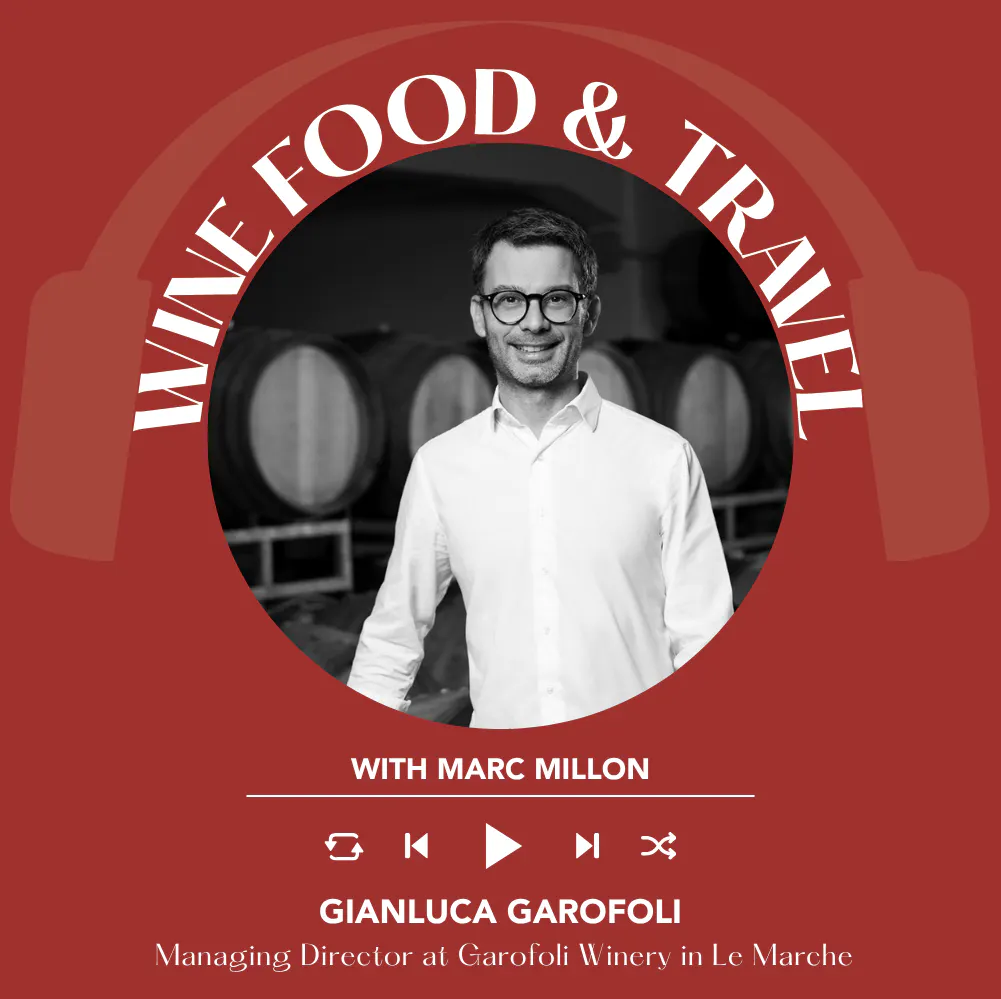
Ep. 2767 Le Marche: Verdicchio and the Wines that Shape the Region with Gianluca Garofoli of Garofoli Vini | Wine, Food & Travel with Marc Millon
Episode 2767

Ep. 2749 The Many Faces of Etna: Climate, Contrade and the Art of Volcano Winemaking with Federico Graziani | Wine, Food & Travel with Marc Millon
Episode 2749