
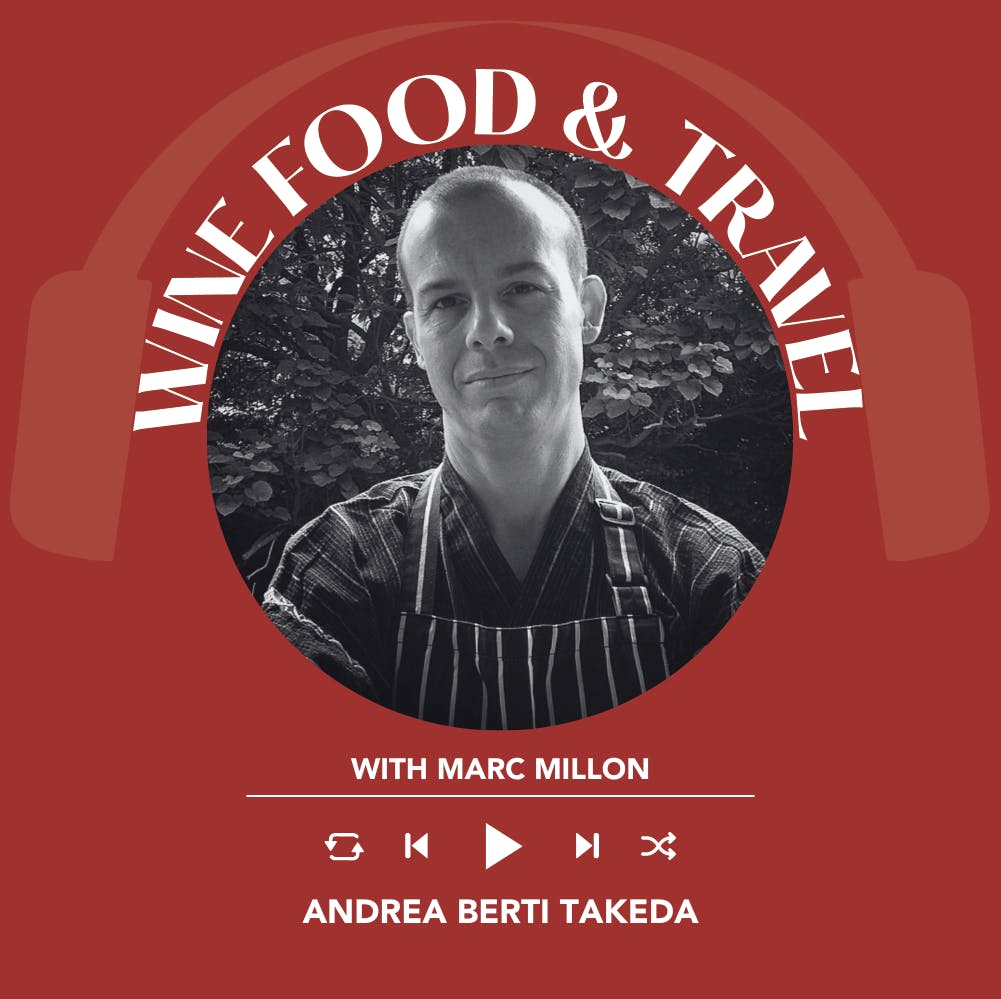
Ep. 1873 Andrea Berti Takeda | Wine, Food & Travel With Marc Millon
Wine, Food & Travel
Episode Summary
Content Analysis Key Themes and Main Ideas 1. The unique fusion of traditional Veronese/Italian cuisine with Japanese ingredients and culinary techniques (Nikkei cuisine). 2. Chef Andrea Vertel's (Takeda) personal journey from architect/designer to self-taught chef. 3. The philosophy behind Kukunouchi, a private dining experience in Verona emphasizing precision, creativity, and service. 4. The importance of local, seasonal ingredients and sustainable practices in Chef Vertel's cooking. 5. The combination of Italian spontaneity and Japanese discipline in the culinary arts. 6. The art of pairing unique fusion dishes with local Veronese and other Italian wines. Summary In this episode of the Italian Wine Podcast, host Mark Millen interviews Chef Andrea Vertel, also known as Takeda, a Verona-based chef renowned for his unique fusion of traditional Veronese cuisine with Japanese ingredients and techniques. Andrea shares his unconventional journey from studying architecture in Florence and working in design in London to becoming a self-taught chef at age 38. He explains how his design background influences his culinary approach, emphasizing precision and detail. His private dining experience, Kukunouchi, offers an intimate eight-course tasting menu, providing an ""Omote Nashi"" (invisible service) experience. Andrea discusses specific examples of his reinterpreted dishes, such as a Tataki-style beef tagliata and Pastissada de Caval with Japanese elements like kombu. He highlights the balance between the creative ""craziness"" of Italian cooking and the disciplined precision of Japanese methods. The conversation also touches on wine pairings, favoring local Veronese wines from smaller producers, but also praising the resurgence and quality of Sicilian white wines. Takeaways * Chef Andrea Vertel (Takeda) is a pioneer in blending traditional Veronese and Japanese culinary styles. * He transitioned from a successful career in architecture and design, highlighting the transferability of design principles to cooking. * Kukunouchi offers a private, intimate dining experience in Verona, emphasizing personalized service and unique flavors. * Andrea's cooking philosophy balances Italian creativity with Japanese precision, utilizing specific techniques like Tataki cuts and Umami-rich ingredients. * He reinterprets classic Veronese dishes by adding subtle, impactful Japanese details rather than completely changing them. * Japanese knife work and disciplined preparation are core to his culinary approach. * While primarily using local Veronese wines, he also recognizes and appreciates the quality of white wines from Sicily. * His customer base consists of individuals with a strong interest in innovative food experiences. Notable Quotes * ""It sounds both intriguing and absolutely delicious."" - Mark Millen * ""Is the combination between Italian and Japanese. It's a sort of Nikkei cuisine..."" - Andrea Vertel * ""Omote Nashi, which is the, ability to provide an amazing service without being asked."" - Andrea Vertel * ""I work a lot with the details. I can make a preparation, which are preparations, which are very typical of, Burores' cuisine... and by adding a few details, I can alter without, without changing."" - Andrea Vertel * ""Italians are very, creative and crazy, and these two things are fine."" - Andrea Vertel * ""My typical customer is, someone with a huge interest in food."" - Andrea Vertel * ""I normally prefer to use a continuous [wineries], which have small numbers in productions."" - Andrea Vertel Related Topics or Follow-up Questions 1. How does Chef Vertel source specific Japanese ingredients in Verona, and what challenges does that present? 2. Are there other Italian regional cuisines that Chef Vertel believes would lend themselves well to a Nikkei-style fusion? 3. What is the long-term vision for Kukunouchi, and how might the private dining model evolve? 4. Beyond food, how does Japanese culture (e.g., art, philosophy) inspire Chef Vertel's overall approach to life and work? 5. What advice would Chef Vertel give to aspiring chefs looking to blend diverse culinary traditions? 6. How has the local Veronese culinary scene reacted to his innovative approach to traditional dishes?
About This Episode
Speaker 1 describes their love for Italian wine chef Andrea Verte's passion for Italian and Japanese cuisine, including their desire to transition to a new craft and their willingness to offer their services to both private chef and through their own company. They discuss their past roles in architecture and their current career in private chef, including their love for traditional dishes and their love for Italian inspired foods. They also discuss their approach to dishes, including their micro roller grilling process and their love for traditional dishes, including their love for traditional dishes and their love for local wines. They invite their guests to visit their website and Facebook profiles to sample their food.
Transcript
The Italian wine podcast is the community driven platform for Italian winegeeks around the world. Support the show by donating at italian wine podcast dot com. Donate five or more Euros, and we'll send you a copy of our latest book, my Italian Great Geek journal. Absolutely free. To get your free copy of my Italian GreatGeek journal, click support us at italian wine podcast dot com, or wherever you get your pots. Welcome to wine, food, and travel. With me, Mark Millen, on Italian wine podcast, listen in as we journey to some of Italy's most beautiful places in the company of those who know them best. The families who grow grapes and make fabulous wines. Through their stories, we'll learn not just about their wines, but also about their ways of life, the local and regional foods and specialties that pair naturally with their wines, and the most beautiful places to visit. We have a wonderful journey of discovery ahead of us. And I hope you will join me. Welcome to wine food and travel with me, Mark Millen, on Italian wine podcast. Today, we traveled a beautiful verona to meet my guest, chef Andrea Verte, known also as Takeda. Who combines a local and seasonal produce and foods of verona inspired by traditional recipes together with Japanese ingredients and traditional cooking techniques. It sounds both intriguing and absolutely delicious. And the sort of food I really love eating myself, so I'm eager to learn more. Well, Jordan, andrea, thanks so much for being my guest. How are you today? Oh, very good. So thank you for having me. Yeah, it's carnivali in verona now. So it's a bit wild outside with going ons in the evening. Well, no, yeah. So we start to hit about twelve o'clock at twelve thirty, and, they get going, and, lots of music, lots of noise, and, kids are running everywhere. It's especially part for for kids. Besides, you know, Verona, we have a big tradition in San Zeno with the papa de Nyoko, Yoko, Nyoko, Nyoko is a Nyoki. Potato dumplings. And, we tend to celebrate quite big in the in that particular area of the the city. Oh, okay. That's really interesting. Now, Andrea, let's start with your story. Tell me where you're from and how this project this adventure began? Well, born a bread in the Verona. I started my career as a as an architect, I started in Florence, architecture, and then I moved to London at in the two thousand, I enrolled for a master, Central Samantha, school of art and design. And, soon after finishing my, degree, my master degree, I was, enrolled by, company within the center of demand. It's called the Innovation Center. So I worked basically about ten years, within, interior design and, strategic communication. Then I moved out to, I I moved to Italy to work for an Italian company dealing with the light, which is probably one of my favorite subjects in design. It's an adventure that the last, one year, a great company about a very difficult boss, and I'm I am a bit of a I'm a bit of a character myself that, besides this, two thousand and eight, I decided to go solo. And then, it was not the greatest time because during the financial crisis, the hit, worldwide in two thousand and eight. I always had, create a passion for for food. And, my father, well, since I was a little kid, he used to take me to, find any restaurant. So I had the chance to develop a nice, pallet. I I always, for friends and, friends and family. It's something that I really enjoy doing, probably after design, obviously, migrate the special. Then, like I said, there was this, particular moment, in two thousand and eight, and I decided to reinvent myself. So at the age of thirty eight, I enter a professional kitchen as a self taught chef. I had the opportunity to work Mayfair, London, for great establishment. So I learned, from a great master, including a noble, which was my inspiration for the kind of a cookie that I currently make. Is the combination between Italian and Japanese. It's a sort of Nikkei cuisine, the sort of Nikkei cuisine based on this idea of combining different flavors besides Italian cuisine and Japanese cuisine, they tend to get along very, very well. We have a difference in ingredients, but, I like the fact that, Japanese are very disciplined in the preparations, and the Italians are very, creative and crazy, and these two things are fine. You might be very that's amazing. That's an amazing story of really how you switch careers completely, but I like that interest in design, design on the plate I'm imagining, design in your in your restaurant space, and and and how that works together. So that's a that's a very interesting combination. And then, of course, the Japanese influence, you're married to a Japanese. Did you meet in London? Yep. Yes. You not met in London? Okay. So your time in London was very influential to you in many ways. Yes. Well, I was I always been, like, Philip Stark, the famous designer used same a bit of a situation. Some a bit of a citizen of the world. I lived two years in Germany, and I like to travel a lot. I go to Japan once a year, obviously, depending on the possibilities, but it's I, keep myself, in folder, and, I keep learning, and, the switching of career in reality is not is is not being so traumatic because I keep, developing my food, in the same way, the same style that that I used to develop my design. Oh, that's really, really interesting. So you offer your services as both a private chef, as well as through Yes. I redesigned my flatter, creating a spacer, which is, again, somewhere in between Italian style and Japanese style. So the the the flat was designed to be able to host dinner for up to eight people in a in a location that can be considered your restaurant, your personal restaurant, private restaurant, where we offer, normally eight course remaining between a me officer or vegetarian. I don't do gladly, but I can do. I don't cook for vegan, unfortunately, but, it's an idea that, I tend to contrast because I don't agree with, with the principles at the base of a mechanism. If, I go out, in terms like, I can say, Kateringer, I serve up to twenty five sitting down, and I can organize, one hundred in, finger foot on the, on look out location outside. Obviously, I have a team of people that help me to develop a bigger, bigger events. We do table service, as in a restaurant. We are very keen in offering what Japanese called, Omote Nashi, which is the, ability to provide an amazing service without being asked. That's sort of a, you know, it transpiring the invisible serve men or serve woman. Right. Well, I'm really intrigued by this. It sounds extraordinary and an amazing dining experience. This is called is that right? Yes. It's called Kukunouchi. What does that name mean? Kukunouchi in the Shintoism tradition of Japan is the god of a Theresa, is born, from the marriage of Earth and Sky. And this defines, our, our mission, which is to provide a local food, alignment seasonality, and especially availability. Now this is the reason why you not attend a lot to agree with, vegans because I think that the problem is to use a water is actually available rather than overproducing, for me, it's always been very important to impact that human beings, on the on the planet and then on other earth. Okay. I'm really interested in this fusion of traditional Italian foods, foods from verona, the foods you would have grown up eating since verona is your hometown. And how those marry with Japanese ingredients, Japanese cooking techniques, Japanese flavors or just the Japanese influence. I'm imagining the appearance on the plate as well. So can we talk about maybe why some of the dishes from a Veronese a tradition that have been reinterpreted by you? Yeah. I can give you the perfect example, if I may, which is, the Tayatta that, I make, which is probably my most famous dish. It's been called the best Tayatta in verona. And then, it actually really defines the way I redesign, addition, which is very common, which is a tagliata beef tagliata, grilled meter, cut in chunks, served normally with a rock salator or Arugula, like the American is used to colleagues, and, normally, a citrus, dressing. My version is, it's a very nice, cut of a Garonese Veneta, which is local local beefa coming from the Lecenia, which is the mountains, just around the Vurole, is, dressed with oil and, and salter quickly sealed in order to how do you say to close to close the meeting so that the juices stay nicely inside is cut is cut to tataki style, which is very thin cut, served like a car patch. Okay. And then the ingredients of the the other ingredients, so the rocket, the parmesan cheese, they are translated in, in a saucer, which is a rocketed. There is a saucer with a tropeya tropeya only, which is the red only on, from the south, very nice and sweeter. So the combination of the bitterness of the rocket salad together with the sweetness of the onion in a yuzu, Tresil, the user is a typical Japanese slave owner with a very nice juicer, but especially very nice scale. And, in order to replicate the the taste and the the roundness, of the parmesan cheese, we add a bit of trouble. Okay. Wow. That sounds incredible. I would love to try that super simple, but it's truly retasting. Yeah. And I like the way you've taken, as you say, a classic, a classic that we all can understand and visualize and remember tasting and how you've reinterpreted that with these details that that really bring a more precise approach to that. Visual, what does that dish look like on a plate? It's a I I normally I normally lay down the meter. I try to give a bit of, verticality because I like, I don't like flatter flatter dishes, and then the sauce is spread on top. And the the quantity of salsa needs to be, accurate so that it doesn't overpower the the taste of the needs. Okay. But I like, I like sorry to interrupt you, but I like the the the what you said about the details, because in reality, I work a lot with the details. I can make a preparation, which are preparations, which are very typical of, Burores' cuisine, retired cuisine, and by adding a few details, I can alter without, without changing. And, this is a very interesting and always very challenging because, obviously, details are more difficult to manage, but they give you a great, great satisfaction. Okay. If you got a another example that you could give us of something that we would recognize in the Italian form, but which you have reinterpreted. Well, I would say he said we we are a carnival period and we we spoke about the with the pasticata. My pasticata is a is a recipe that I took from probably the best, horse meat to butcher in Verona. Verona is quite big on horse meat from an historical perspective. I reinterpret again, and this traditional recipe, which is the recipe of the grammar, of the grammar, of the grammar, etcetera, etcetera, etcetera. I just add a few elements, which is a combo, and, Sandrite tomatoes to, provide a better roundness. Campbell combo is a combo with a seaweeder, Japanese seaweed, that normally, gives you a nice roundness on the on the dish umami richness. Umami. Exactly. Yeah. Well, I'm really interested in exploring this philosophy of yours. You've talked about the creativity and the passion. And I guess the a brilliance of Italian cuisine and a more disciplined approach, of of of Japanese techniques. Can you just explain that a little bit more? Well, you know, It, Italy is, reach, reaching ingredients, the every region, actually every town has got, their particular way to, deal with this, amazing ingredients and the seasonality of the ingredients. The other hand, the Japanese, they tend to do the same. They're crazy about food. Now what I really like is, the silence and the, the precise cuts, and, the absolute, specific balance, when they make a preparation, whereas, for us, for us, it's a little bit more spontaneous and a little bit more, I I would say probably joyful, or just just a little bit more crazy, but, like I said, it's a it's a precision that, I I like very much. And to be honest, I think that this, this is something that I did not really invent myself, but it's obvious checking, the Italian Italian Panorama and cuisine, starting with, Guatero Marquez, he's a great master of, Italian cuisine that is obviously the recent influence from heart, from heart, and especially this, would not be possible without a trip to Japan. This, is something that can be seen also in architecture with the great masters of the Corps Museum, miss Wanderolo, and Frankload Drive. Okay. That's really, really interesting too. Italian wine podcast. If you think you love wine as much as we do, then give us a like and a follow anywhere you get your pods. You had to actually master precise techniques in in knife work, I imagine, that really would be foreign to an Italian chef. Absolutely. Yes. The the the start of from the the the the shape of the blade of a a Japanese knife, compared to European knives, a Japanese knife allows you for the very shape of the blade to produce a cut that, European eyes cannot cannot produce. It's different of the way they cut the way they use the the knife, the way they use, hence, the, the position of the body. So there's a there's a lack of ritual every time you approach, you approach food, the preparation of a dish. No. That's really interesting too. Now you've talked about the Italian sort of joyful approach, a brilliant, approach to to cooking, but also I would say to enjoying and eating foods. You know, Italians as well, we all know can be so very traditional and then set in their ways. And you know, maybe, you know, they don't want some of these traditional dishes change that much. How are Italians in Verona or from outside of Verona enjoying and appreciating what you do? That's a very that's a very good question. And I I would say, Verdonese, the typical Verdonese is actually quite, closer to innovation. This is a bit of a problem. In fact, my, people customized, someone that, especially, some idea, people that, really appreciate the interpretation. I would say that, I came back to barona because I'm born and bred here about if I was in Milan, probably I'll be even more successful than the one actually here. But my typical customer is, someone with a huge interest in food. I, like I said, I I don't sell traditional traditional product per se. The beauty the the beauty is, the interpretation and the difference, and the difference on the other end, my my cuisine is, nice and rounder, very simple. No no strings attached. It's super easy. Normally, use three ingredients per dish. Okay. Great. Without going through all eight dishes on a signature tasting menu that you would be offering. Give us a few more examples of maybe three dishes that that you would say are signature dishes when people visit you just so we can get a clear idea of your cuisine. Absolutely. I I can give you a a fish one, which is a stitcher. Lobster. The lobster garden, which are, like, very much. I served it with the avocado. Again, it's a traditional combination. It's the way it is actually prepared and a nicer fragrant salad of, sprouts. The lobster, obviously, is quickly, quickly cooked, so that it stays almost, almost raw to preserve the the sweetness. Avocado, a bit of citrus, to, balance with a bit of acidity. And then, like I said, again, the user? And again, the user. Yes. The the user, I must say, since, it's, not so easy to find. I found a nice way to replicate it, but, It's very, I'll just say, you need to taste it because, it's a basically used as a combination of lime and lemon. So if you find the correct proportion, you can replicate it, in a very interesting way because the the the lime is a super zest the and the lemon root is, is is a good way to balance the the acidity. It's not the same, but might get some really, really close. So the only problem that, obviously, you need to taste the lemon juice and the lime juice before so that you can make it. You can make it right. Okay. Let me see. Let me see. Well, we struggle on, we struggle on pasta. And, if I can give you another fish dish, again, this this time, I started from a Japanese tradition which is, the, the saba, which is mackerel, mackerel, normally, Japanese, they treat it with a sugar and salt for about twenty minutes, sir, then they they wash it off, and then they dry nicely, and then they eat it in sushi. That's the typical way that, they they eat it. What we do, what we do is, to finish finish the micro roller by grilling with a torch grilling the skin. So that's, when the skin is cooked to, it releases a nice, omega three fattiness on to something that has been treated with a bit of a acidity. Yeah. We finish it, we finish it, with the Sichimito Barashi that we make ourselves. It's a combination of salad spices, which is a chili chili based. The chili that's, Japanese use is called the, tata nozume. And, there's some sesame and other spices, and we found a way to actually make up our own using chile, which are known to, to, to, to spice it. Sort there, serve with, something like, jalapeno. So, pickled pickled vegetables. Japanese pickles. Japanese speakers. Yeah. Yes. So Japanese speakers, instead of being made. Yeah. Yeah. Japanese speakers are made with the Shushito, which is, sweet, vinegar. You don't wanna use the to dress the sushi rice. Mhmm. Okay. Well, there's a really, really interesting dishes. And, again, you make me want to sample them. I love the sound of that. Well, you should come in. Is it me? Well, I'm coming to Verona and April. So I I can't I'd like to turn now to pairing your foods with with wines. And in particular with, you're living in a great wine area for all around verona, wonderful wines. How do the local wines pair with your dishes? What are some of the really great combinations or perhaps wines from elsewhere in Italy? Well, to be honest, obviously, we come from a region, which is extremely richer, and we have great labels and extremely good quality. I don't mind preparing driven fish dishes, depending on the fish dish with a with a nice red, like a pinot noir, maybe served it a little bit chilly, not too room temperature. Obviously, for meat dishes, so we can span from, you know, a classical over, but by Pollicello classical after the amar owner for the more complex, for the more complex. For example, tomorrow, I'm cooking for fifteen people. I'm doing this beef cheek, and I serve it, with, I serve it with a chocolate salsa, with a chocolate for example, they are a Guudamaroni, the Guudamaroni would be would be perfect. I'm not saying, I really like, I really like just to go the all the way down, just all the way down south. I really like Cecilium wines, especially white wines, finally probably even sometimes better than, better than hours. They have a different complexity, a good degree of, sweetness, a nice, roundness. For example, the grillo or the the Edno Bianco? Okay. Why not? But, they have great selection I must say that they did a, an amazing job in a re re value in, the brand, repositioning themselves over time. It's, ten years ago, as the CNY was probably given a, are known to the the wider public. Now, they're coming, they're coming very strong. I really, really, like, I lived there in Florida for about ten years or so. I, I have a sweet tooth for also tots combined, sir, and, not very prepared on, Pemonte. But, like I said, we are very lucky here to have, extremely great labels, great containers, great realities, I normally prefer to use a continuous, which have small numbers in productions. And so let's say twenty thousand bottles per year, something like that. And then back to my customer, working with dealing with, sommelier, normally they bring me extremely interesting things to taste to themselves. Right. Yeah. Okay. So Andrea, I'm sure our listeners, who are located all around the world and many of whom travel to verona will be intrigued by your story and will want to sample your food. So how do they find you? How can they get in touch with you? What's the best way to arrange a meal with you? Well, the do you can contact me, through my website? Of course, which is a kukunouchi dot IT, w w w kukunouchi. K u k u c I dot I t. Otherwise, we have, a Facebook, profile, which is a kukunachi experience, one dot zero. And then, obviously, Instagram, which is our favorite. Instagram, again, kukunochi, k u k u c h I underscore IT. Okay. Great. That's the best way. Obviously, you can get, my contact petals, through there. Okay. I'll be happy to I'll be able to reply. Wonderful. Well, I certainly would, love to sample your food next time I am in verona. So I hope, I hope we can meet perhaps in April. Absolutely. Absolutely. I'm looking forward to it. Andrea, thank you so much for being my guest today. I've really enjoyed speaking with you. I'm absolutely intrigued and fascinated to, to sample your food. And I look forward to seeing you soon. Absolutely. Thank you very much. Thank you. Thank you. Thank you. We hope you enjoyed today's episode of wine, food, and travel. With me, Mark Minon, on Italian wine podcast. Please remember to like, share, and subscribe right here, or wherever you get your pods. Likewise, you can visit us at Italianwine podcast dot com. Until next time.
Episode Details
Keywords
Related Episodes

Ep. 2787 Prosecco Superiore by Dr Susan H. Gordon | Book Club with Richard Hough
Episode 2787

Ep. 2784 The Other Side of Valpolicella: Volcanic Soils & Sparkling Wines with Francesca Marcato of Talestri Winery | Wine, Food & Travel with Marc Millon
Episode 2784

Ep. 2780 The Bridge between the Past and the Future of Wine with Serena Costanzo from Palmento Costanzo on Etna | Clubhouse Ambassadors' Corner
Episode 2780

Ep. 2773 Trento DOC: one of Italy’s finest sparkling wines with Alessandra Caroni of Maso Martis | Wine, Food & Travel with Marc Millon
Episode 2773
Ep. 2767 Le Marche: Verdicchio and the Wines that Shape the Region with Gianluca Garofoli of Garofoli Vini | Wine, Food & Travel with Marc Millon
Episode 2767

Ep. 2749 The Many Faces of Etna: Climate, Contrade and the Art of Volcano Winemaking with Federico Graziani | Wine, Food & Travel with Marc Millon
Episode 2749