
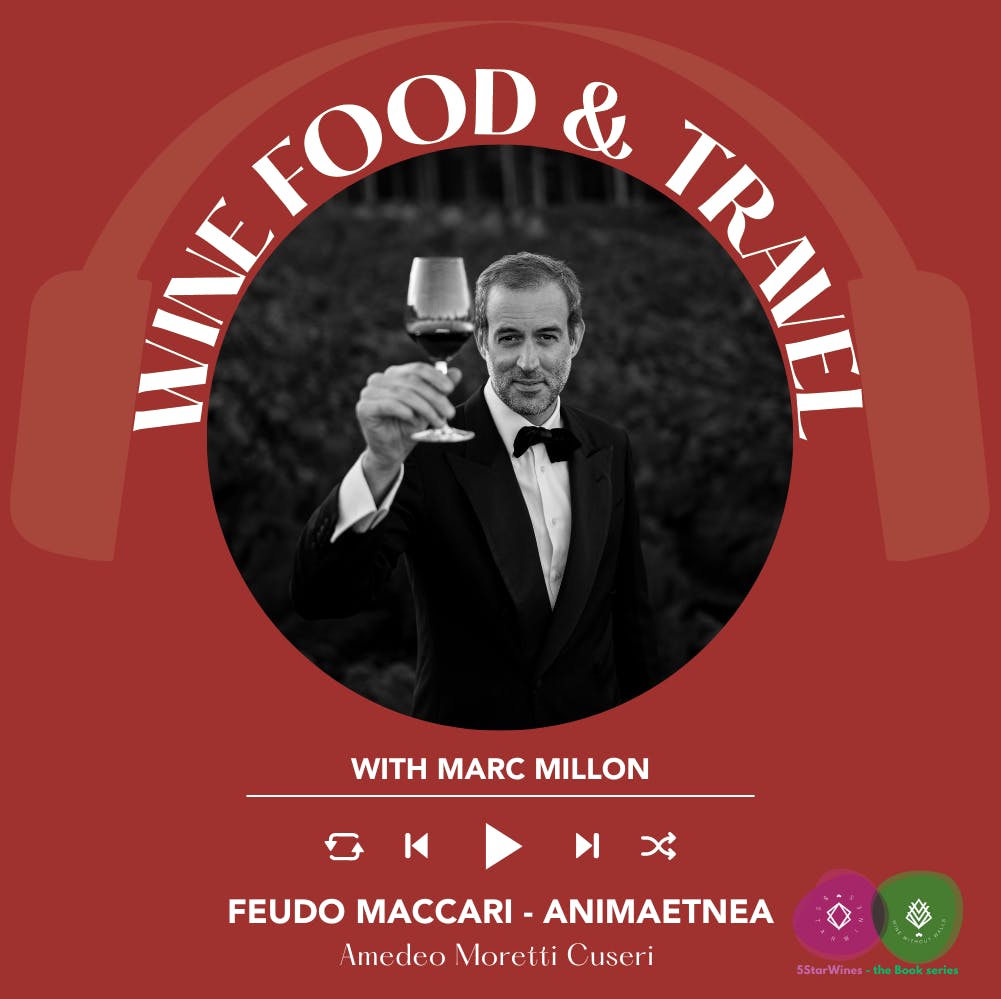
Ep. 2112 Amedeo Moretti Cuseri of Feudo Maccari Animaetnea | Wine, Food & Travel With Marc Millon
Wine, Food & Travel
Episode Summary
Content Analysis Key Themes and Main Ideas 1. The unique and challenging ""heroic viticulture"" of Mount Etna, Sicily. 2. The influence of Etna's active volcano on soil, climate, and wine characteristics. 3. Anima Etna winery and its award-winning organic white wine, 'Ani Manucente' (Etna DOC Bianco). 4. Detailed discussion of Etna's indigenous grape varieties: Carricante and Minnella (white), Nerello Mascalese and Nerello Cappuccio (red). 5. The distinctive elegance, minerality, and power of Etna wines. 6. Food pairing suggestions with traditional Sicilian cuisine and local specialties. 7. Wine tourism and hospitality opportunities at Anima Etna. Summary This episode of the Italian Wine Podcast features host Mark Millen interviewing Amadeo Moretti of Anima Etna, an award-winning winery situated on the northern slopes of Sicily's Mount Etna. Amadeo vividly describes the region's ""heroic viticulture,"" emphasizing the constant interplay between the active volcano's dangers and the unique benefits it provides to the soil and ecosystem. He details the labor-intensive, manual farming required on steep, terraced vineyards and the presence of ancient, pre-phylloxera vines. The conversation highlights Anima Etna's award-winning organic white wine, 'Ani Manucente' (a blend of Carricante and Minnella), noting its characteristic minerality and freshness derived from the volcanic soil and high altitude. Amadeo also discusses their flagship red wine, 'Anima Ardente' (primarily Nerello Mascalese), drawing comparisons to Pinot Noir for its elegance while possessing greater intensity. The interview concludes with a discussion of ideal food pairings with traditional Sicilian dishes like seafood and local rabbit, and an invitation for listeners to experience Anima Etna's wine hospitality. Takeaways - Mount Etna is a challenging yet highly unique wine region, defined by its active volcano's influence, requiring ""heroic viticulture."
About This Episode
The success of five star wines and wine without walls competition earned wines with points above 90 points, but the challenges and risks of the area include danger of a volcanic eruption and the need for a modern machine to make the harvest process. The vines are located on terraces and need proper harvest processes. The speakers discuss the history and characteristics of the Aetna wine area, including animal dente, animal dente, and the excitement and power of animal dente in the area. They also discuss the wine hospitality at Anima Aetna, where they can have a taste and experience.
Transcript
We are up on a volcano. And this volcano today is still active. On the one side is the beauty of the area because the soil and the ecosystem that it creates is very unique, but on the other side is something that is alive and it's really something that we have to think about. You have to consider that the last eruption, it happens in the beginning of the two thousand. You can see how the lava still flow today and reach not only the vineyard, but also the village where people live. Welcome to wine food and travel. With me, Mark Billen, on Italian wine podcast. Listen in as we journey to some of Italy's most beautiful places in the company of those who know them best. The families who grow grapes and make fabulous wines. Through their stories, we will learn not just about their wines, but also about their ways of life, the local and regional foods and specialities that pair naturally with their wines. And the most beautiful places to visit. We have a wonderful journey of discovery ahead of us, and I hope you will join me. Welcome to wine food and travel with me, Mark Millen, on Italian wine podcast. Today, I'm delighted to continue a special subseries that highlights the winners of the prestigious five star wines and wine without walls competition that took place in April just prior to Vinitale twenty twenty four. Those wines that scored more than ninety points were awarded certificates that have been included in the five star wines and wine without walls two thousand and twenty five book. Well, the very best wines in each category were singled out for special awards. Today, we traveled to the northern slopes of Mount Aetna in Sicily to meet my guest Amideo Moretti of Anima Aetna. A wine estate that won a very special award in the wine without walls category for the best organic white wine for its Aetna doc Bianco, Bino Biologico, Ani manucente two thousand and twenty twenty two, which gained ninety five points. Many congratulations, Amadeo. Thank you for being my guest And how are you? Is it a beautiful day? Thank you so much. I'm very happy to be here to talk with you about the beauty that we have up in the athena. So I'm very excited to be here and to explore together the area where we produce this amazing wine. And Also, thank you so much for the awards. It's a it's a great thing for for me, but all from the whole team. Yes. I can imagine it's a very much a team effort and it's a very important award. I know how rigorous of the wind without walls. I was a judge has year. And there are many, many discussions, and the top wines then get retasted again by the head panel. So it's a great achievement. So many great wines. So it's So many great wines with this standard was very, very high. Very high and across the board this year. I know that I know many of those wines, so I'm really happy to share. Now, Amadillo, you're involved with five different wineries. Exactly. But we'll focus today on animat and in particular on this award winning wine. But first of all, for our listeners who may not have been to Aetna may not have even been to Sicily You're the enemy at Nail winery on the north face of the volcano that, Santo Stefano and Paso Picardo Exactly. Is quite a unique place. And, and a unique environment. Can you describe Aetna as a place to cultivate grapes and make wine? What makes it so challenging and so special? Yeah. Sure. So just to give you an idea about where we are, the vines are located around six hundred and eight hundred meters above the sea level. And we're actually located on the north side of Etna. The area is called, Paso Picaro. Just to give you an idea for those who might know Tarmina, which is quite popular, it's about fifteen minutes from Tarmina. What made, like, special this area? When we talk about, vineyards and producing wine in Aetna, the first thing that I also was impressed because this is the main reason when we got up there and we fully meet and in love with the area. When we talk about Aetna, we see how beautiful and also dangerous and challenging is the area, the soil that's we're we are planting on vines. And this is also, the reason why we call it a roic beachy culture. Because the area itself, it's kind of really dangerous. We can stay like this. First of all, because we are up on a volcano, and this volcano today is still active. So there are eruption. There is a lot of smoke. And, itself, the volcano is the real danger. And, on the one side is the beauty of the area because the soil and the ecosystem that it creates is very unique, but on the other side is something that is alive and it's it's really something that we have to think about it. You have to consider that the last eruption, which was actually very, yeah, it was very bad for the area. It happens in the beginning of the two thousand. So the lava really reach almost our vineyards. And we can see the the result now where we have all these lava flows that, of course, now is a is a rock. But you can see how, like, the lava still flow today and reach not only the vineyard, but also the village where people live. So on the one side, we have this aspect that is very, important, and we really have to think about every day. On the other aspect is the fact that the vines are located mainly on terraces. And these terraces might be very steep. So all the process on the vineyard, they must be made by hands. There are absolutely no way to have any, modern machine or any technique that can help us to make this process in a kind of more, like everything has to be by hand. So you can imagine the re harvest. Like, there is a lot of people that they need to carry, like, degree on their back on big, chesty. How do you say chest in English? Baskets. Baskets. Exactly. And they have to bring, like, up and down to these small terraces. And also, like, the, which in Italian means the distance of each vine between the line of the vineyards and each plant, is very, very narrow, very, like, the distance is very short. You have to think that when we talk about ethanol, the distance between the plant is, if you're lucky, one meters, maybe one and a half. Comparing just to give an example in Tuscany, which is two meters by zero point nine. So here in Tuscany, for example, we have space for tractor that can get in the vineyards. So all the kind of treatment, we can be mass much more fast. And if we have, like, a fungus coming or anything, we can do treatment pretty fast. Up there, everything has to be again made by hand. So, really, the person who work in the vineyards are Eroy. That's why we call it a heroic, a beachy culture. So the first impression that you see once you get up there is the color of the soil. You will notice that the soil is mainly gray and black. This is because of the high percentage of iron of mineral that are present in the lava. So this makes very special, the soil and, of course, the wine that we will get from the vines. Let me just pick up on this, for our listeners. I want to emphasize what you're saying about heroic view to culture because I think, you know, the term heroic view to culture is used for many, many areas and indeed the labor intensive nature of of working vines in the in the Validation, the Alps or in the cinque terre is an heroic effort. But I think the term takes on new meaning on Mount Aetna, where as you say, you have the labor intensive steep slopes, the high altitude, the ancient vines, but also this ever present danger. I was on that, a few years ago when it was erupting and of course it was raining like black grit. And, you know, really you cannot underestimate the power of the volcano and the the benefits it brings, but also the danger. So this is truly heroic Viticulture in in the greatest sense. Now let's talk about those vines that you're talking about the training. Is that the ancient alvaralo at Naya system? Exactly. Can you explain what that is, Amadale? Exactly. So the area is also very special because it's one of the very rare area where we still have prevelocera vines. That means that the vines are Pierefranco. So it's original, like the entire plant, it's the original one since more than hundred and twenty years. We have a vine that's, was planted in the beginning of, nineteenth century, and we still have it. It's a very small parcel. It's, right, less than one actor. And it's so beautiful because most of the plant there are very, very old with the finless, like, ancients, ancient vines. And they're very, very beautiful. And as I said before, they plantation system is very, very narrow. This is because we don't want to lose anything of the potential soil that we could plant, so especially back in time. So each plant is very narrow to, to the other. And actually, the system originally was Albera Loboost, but nowadays since so many years have passed and the plants have grown. So over the years, the plant, like, grow a little bit bigger, and today is like a mix between Guyo and Alberto bush. So if you see it, it's a bit more wild than a albirello bush. It goes like the branch got a little spread out a little bit and got wider. But they still go from the soil to the sky, I would say. But they make, like, a little bit wider shade than a typical narrow alvaro bush. And this is the beauty because, of course, the branches are very wide antique. And, what is also very special is that the yield per hectare of this old balance is very, very low. We can get roughly thirty to thirty five tons of gray per hectare, which is very, very low comparing to an average of, ten or even maybe twelve of a much younger vine. So just to give you an idea, every plant, like, we can reach maximum four or five cluster each plant. Which are great concentration, but also a great elegance and finesse on the fruits. Okay. So we've got these old vines, the volcanic soil, and also a high altitude. Exactly. We have been planted between six hundred up to eight hundred places above the ceiling. Okay. So this really helps the freshness, for the acidity. It's like very beneficial for the, for the gray. Okay. Well, let's now turn our attention to the wine that won the award, animal Chen, and about a white wine in Aetna. I think Aetna, Aetna Bianco is less well known to some of us outside of Italy because there's less of it available, but Tell us what's very special about this wine. So, first of all, I have to say that we mainly produce red wine, frankly speaking. So the white wine for us is a great passion, but it's only production of few thousand bottles. For example, animal who changed in two thousand twenty two was slightly more than two thousand bottles, and is mainly produced by with Karicante and Minela grape, which is actually the variety that is very talked on very, special and characteristic of the area, especially, Minela. So it's it's a blend of eighty five Karicante and fifteen percent Minela. It actually come from younger vines because we didn't have very old vines of caricante, minella, in the property. But we really notice the potentiality and the beauty of the variety, especially in the Aetna. So we decided since five, vintages. So this is the, twenty twenty two is the fifth vintage to produce and to see what was going on with this, white variety. And we found, like, an unbelievable, beautiful, white wine because, like, the expression of the sulfuric notes and, of course, the minerality and the sapidity, the sweat stone aromas. It's very important because it's the typical characteristic of the soil. And, at the beginning, we really didn't want to cover the aromas of the variety. So, we decided to put a little bit of, wood on the aging, especially with the, Barriq, but, with second and third passage in order to be, like, very delicate, But in the twenty twenty two, we reduced it a lot, the presence of the wood just to give the importance of the variety, so to have, like, a fresh floral, beautiful wine that was representing the area. Okay. That's a beautiful description. Now that wine would also be have that streak of acidity that's so characteristic from the which also enables it to age for long periods. Exactly. This is another aspect. The back in time, the aging of Caricante and Manila was undervalued. So we back in time, we consider it, Caricante, Manila, not such good as an aging mind. But now, like, especially in this area, what is very important is in some interest is this, like, Paso Picciado is very well known as a very good area for red one, especially and then look at but actually most of the producer, like Casa, so many other great producer around us, they see and they're noticing how interesting the white wine are. Just to give you an idea, we are now planting two more hectares of white grape of caricante, Minel, because of this. So it's interesting how also the area is evolving and changing, seeing the potentiality of of the white wine. Because, usually, the north area of of Aetna is more, known for a, a red wine, and the east area is more for white wine. But now a lot of producers are, invest and considering the white wine as, a very good and and potentiality wine in the in the north side of Aetna. Okay. That's an important point for our listeners as well to understand the contrade of Aetna and how from the north to the east, to the southwest. The character changes the wines change, and there's a great influence from where the vines have actually been grown. Let's turn then to anima Ardente to your Edna Rosa. Tell us about this. Okay. Well, actually, it's, we we produced two wine, which one is animantica and anima Ardente. So the the the final thing is we call it the the the start from the name, which anima in Italian means soul. So once we got up there, we were fascinating and we fall in love with the Aetna and which is soul that moves and create everything. So, animatane, we saw of the Aetna, and we name all our wines with the word anima. Annimal Lucente, the white wine they got award. For example, it represents the beautiful side of brightness of of the lava because we have to consider that in winter, it's an area not in our vine vineyards, but more in in the high altitude. It's snow. So there is, also, like, climate change temperature change, sorry, during winter, which impact a lot of wines. And, with animal dente, which is our red wine, Melinerllo Mascalese, we want to represent the al dente means burning so the power and the intensity of the volcano on the red grape. And the Mardente come from our binds that are around forty and fifty years old. So, already, like, binds that they have a huge history for us, And, it's a still small production. Because overall, we only have nine actors. The property is quite, quite small, but very, very good position, especially in the area of Santa Espirito, And, animal dente is, is our most I would say that it's our most, the biggest volume of wine that we produce because we reach eight thousand bottles compared to the two thousand of the white one. And, we, we age it a little bit in, Barik, and to know. So it's a mix of the two wood. And it's actually the first one that we have been producing is two thousand, fourteen. So it's already ten years of history of our winery in the Aetna. And I think it's the the wine that represent us the most because if the one that we we produce since the beginning, and, it's, so it's the identity of what we have in the property in the states. It just explained to our listeners who may not have encountered Aetna Rosa, which is emerge. This is one of the most ancient wine growing lands in the world. Vines have been grown on Aetna for three thousand years, maybe longer. Who knows? Exactly. But Aetna itself as a as a quality wine region, has been reborn and rediscovered relatively recently in the last twenty twenty five years. But describe the beauty of Anet Nero. So what it has, you know, we we think of the great wines of italy Barolo or Bruno de Montelcino. And Aetna stands at this level. So what make the wine very special? The first thing is that they are immediately recognizable. Among, if you ever happen, then you do, like, a tasting among, like, so many different wine from all over the world, you are able to immediately recognize an a red wine from it. You know, why? It's, just to give you an idea. It's mainly compared to a pinot noir just to give you an idea for those who have never tasted, and maybe they know much more better a pinot noir. So the elegance on the palate is compared to pinot noir, but the aromas and the intensity and the powerful of the wine are much more intense and more more present. Okay. So you have the strength but at the same elegance at the same time, which makes it like very special. And of course, the presence of the volcano makes like the wine very mineral, a great sapidity, but also you have this background, beautiful background of sulfurous, of iron, of all the substance that the lava brings up from, from disruption. And this makes it, like, very special and very even like the aroma, the flower aromas, they're never like to brite. It reminds more violet, more dark fruits. It's a it's a beautiful mix that really sometimes like, they change also from every vintages. Like, what is also very interestingly, like, that every vintages so different even in terms of aromas of palette. This is also the beauty of it. Right? It's very rare that you have, like, a common, stable wine, I mean, I'm talking especially of my, of my state and what, what I see over the years. So this is also another aspect that makes the area very interesting. I think you're describing the both the white and the red Aetna's wines that have great elegance, but also this power and energy that comes from the volcano. Exactly. Yeah. Amodeo, can we turn now to food and wine to the cuisine of Eastern Sicily but also to possibly other cuisines, foods that you think are really pair well with either animal to Chantu or animal dente? Okay. So considering that they are sicilian wines, so they basically we're matching with the local food talking about in the area. For the white wine in C City, of course, it's an island. So it's facing the Mediterranean, and the fish is, I would say, main meal, man dish. You can find it like very easy. You can find it everywhere. So every time I think about my white wine, especially if I'm seriously, I always like to eat with a crude or, carpaccio, or fish, and, also, like, the beautiful past which is very typical of the area. So it's a sardinian pasta, which is actually, the sauce is so good because it's it has, like, a wide, funnel seed, pine nuts, dry grapes, which is, like, very difficult sicilian. So I would match, like, a white wine thinking about the sicilian food with all that is linked to the fish, but also, like, with the beautiful fried fish or fried vegetables. I love to have it, like, with the, with everything that is fried. For example, nice, a beautiful period of, mushrooms, porcini mushrooms. Aetna is an amazing area of my opportunity mushrooms. So we We have, like, this great fried porcini mushroom or fried zucchini or fried eggplants, which matches beautiful with wine, white wine. And it's also, like, very typical in a, in CC. That sounds wonderful. Yeah. I would say that all the main, like, first course that is linked to pasta is a perfect to pair it with a white wine. Unless you have, like, a ragu or you have more, like, salty or stupidity sauce, then I would already turn on animal dente, which I think it's already it's a better match because you need, like, a more consistent wine or some more tannins. And Imardente would pair it with everything that has meat or beef. Or even like if I'm thinking about, a special saw that is like a, which is a typical fish that, we do it in toscan, but the results are very similar, played in in Sicily where you have, like, fish cooked with a special sauce of tomato and onions. This is also, like, very good to have fish with, animal dented. Okay. And, just a funny thing, I know maybe might might sound a little bit weird. But, in the local culture, there is a lot of rabbits. So, really, in in Aetna, there is, like, this culture of having rabbit have the second meal, and they use a lot to drink animal dent. I know it sounds weird sometimes, but it's it's it's funny to mention the local culture because it's a it's part of the of the area. No. Absolutely. And how is that rabbit prepared? It's prepared. Actually, it's prepared in a very refined way because it's a oven cooked with oil, olives, and capers. I had it twice in this way, or it's a it cooked in a big pan with a tomato sauce. Oh. You don't really recognize it's, you don't see it's a rabbit because like the meat is, it's caught it in kind of little slices, but it's very, very tasty and very good. Okay. It re it reminds chicken. Oh, okay. And beautiful port from the NEbrodie mountains. Never of course. Beautiful exactly also. It's amazing. Yeah. Beautiful with the, Animar dente. Exactly. With match perfectly. Okay. Well, final question, Amendale, Tell us about wine hospitality at Anima Aetna. Sure. Can our listeners who will be inspired to visit having listened to your beautiful descriptions? Can they visit? They can visit. They can come. We have, like, a beautiful area where we can have a testing and, also, we can organize a lunch or a dinner if we can book in, in advance. And, what is very nice is that we will work through the vineyards. So we will see the ancient Vignantica, the one who's prephylosso and is one hundred and fifty years old. And we will walk to the beautiful terraces that are planted around eight hundred meters. And they're so beautiful. And after that, we can have a tasting on our tasting, house. And that sounds absolutely perfect. That's the way to experience what Aetna has. You must feel it. You must walk it. You must pick up the soil in your hand and smell it. And then you can understand this unique, utterly unique environment. I mean, Dale, you've taken us to Aetna this morning. It's been a real pleasure speaking with you. Congratulations again for this fabulous award as the best organic white wine for, and thank you for explaining and taking us to your world. So I hope you have a very successful harvest this year. Yeah. Not only at Ana, but at the other properties as well. Thank you very much. Thank you very much. We're working hard. Now we are harvesting in almost every wine estate. So we're very busy. But, I'm, I'm, I'm, I'm happy to welcome you soon in Nani Maitaneeya, and see you soon to taste together the wines and see the beautiful area. Great. Well, I will definitely try to come down and see you as soon as I can. We hope you enjoyed today's episode of wine, food, and travel with me, Mark Millen, on Italian wine podcast. Please remember to like, share, and subscribe right here or wherever you get your pods. Likewise, you can visit us at Italianwine podcast dot com. Until next time.
Episode Details
Related Episodes

Ep. 2789 ColleMassari: a long-term vision rooted in Montecucco with Giuseppe Di Gioia | On The Road With Stevie Kim
Episode 2789

Ep. 2788 Ep. 14: Austria and Hungary | Study Smart for your WSET Level 3
Episode 2788

Ep. 2785 From Volunteer to Speaker at TEXSOM with Samantha Cole Johnson | TEXSOM 2026
Episode 2785
Ep. 2767 Le Marche: Verdicchio and the Wines that Shape the Region with Gianluca Garofoli of Garofoli Vini | Wine, Food & Travel with Marc Millon
Episode 2767

Ep. 2766 Inside the U.S. Non-Alcoholic Wine Market: What Wineries Need to Know with Jill Sites | Masterclass US Wine Market
Episode 2766
Ep. 2761 Winemaking and Consulting Across Sicily with Alessandro Serughetti | Wine, Food & Travel with Marc Millon
Episode 2761