
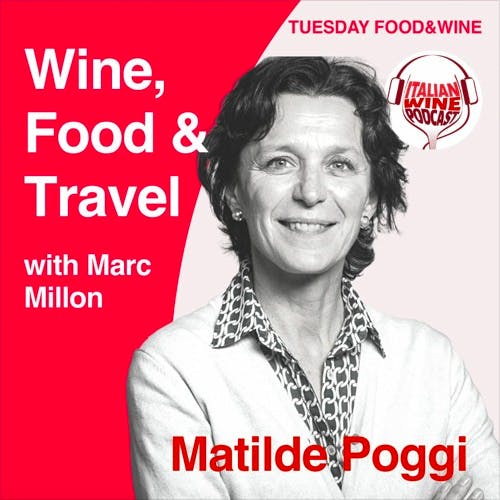
Ep. 665 Matilde Poggi | Wine, Food & Travel With Marc Millon
Wine, Food & Travel
Episode Summary
Content Analysis Key Themes and Main Ideas 1. The unique terroir and climate of the Bardolino wine region near Lake Garda. 2. The personal journey and winemaking philosophy of Matilda Poggi of Agricola Le Fraghe. 3. The characteristics and production of Bardolino Chiaretto and Bardolino wines. 4. The strong connection between local Lake Garda cuisine and Bardolino wines. 5. The historical context of winemaking in the Veneto region and the evolution of a family winery. Summary In this episode of the Italian Wine Podcast's ""Wine, Food, and Travel,"" host Mark Millen speaks with Matilda Poggi of Agricola Le Fraghe, located on the eastern shores of Lake Garda in Bardolino. Matilda describes her region's unique morainic soil and windy climate, which produce elegant wines with lower alcohol and tannins. She recounts her family's long history in winemaking dating back to 1881 and her personal decision to start her own winery, Le Fraghe, in 1984 at the age of 22, embracing organic viticulture. Matilda details her key wines, the delicate Bardolino Chiaretto rosé and the versatile Bardolino red, explaining their production methods and the grape varieties (Corvina and Rondinella). She highlights the distinct differences between Bardolino and Valpolicella wines, attributing them to soil variations. The conversation extensively explores the perfect food pairings for her wines, emphasizing local Lake Garda dishes like delicate fish, pizza, pasta e fagioli, risotto, and polenta. Matilda concludes by recommending local eateries and inviting listeners to visit her winery and agriturismo. Takeaways * Agricola Le Fraghe is an organic winery located in the Bardolino region, near Lake Garda in Veneto. * Matilda Poggi is a pioneering female winemaker who started her own winery in 1984, continuing a long family tradition. * The unique morainic soil and strong winds of the Bardolino area result in elegant wines with naturally lower alcohol and tannins. * Bardolino Chiaretto is a pale and delicate rosé, while Bardolino is a light-bodied, versatile red wine, both primarily made from Corvina and Rondinella grapes. * These wines pair exceptionally well with the Mediterranean-influenced cuisine of Lake Garda, including fresh fish, pizza, and traditional dishes like risotto and polenta. * The winery offers tastings and agriturismo accommodations, inviting visitors to experience the region. Notable Quotes * ""Our soil is a moraine because there was once a glacier... and our soil is very rich minerals. So is the soil which is not pushing too much the vines because it is poor but it's making, it's going to make wines very elegant and, and luckily with not too much alcohol."
About This Episode
Speaker 3 talks about their experience with winemaking wines and how their family grew up with a small family. They discuss their success with winemaking wines and their use of different varieties and varieties to make their own wines. They also discuss their love for the local foods and their plans to make a new type of wines with a mild Mediterranean climate. They recommend a local restaurant or trattoria in small apartment areas for popular dishes and thank their listeners for their time.
Transcript
Welcome to wine food and travel with me, Mark Miller on Italian wine podcast. Listen in as we journey to some of Italy's most beautiful places in the company of those who know them best. The families who grow grapes and make fabulous wines. Through their stories, we'll learn not just about their wines, but also about their ways of life, the local and regional foods and specialities that pair naturally with their wines. And the most beautiful places to visit. We have a wonderful journey of discovery ahead of us, and I hope you will join me. Hi everybody. Italian wine podcast celebrates its fourth anniversary this year, and we all love the great content they put out every day. Chinching with Italian wine people has become a big part of our day, and the team in verona needs to feel our love. Reducing the show is not easy folks, hurting all those hosts, getting the interviews, dropping the clubhouse recordings, not to mention editing all the material. Let's give them a tangible fan hug with a contribution to all their costs. Head to Italian wine podcast dot com and click donate to show your love. Welcome to wine food and travel with me, Mark Millen, on Italian wine podcast. This morning, we journeyed to one of the most popular and beautiful places in the Veneto, the Eastern shores of Lagodigarda. Lake Garda, just north of Veruna, and into the gently rolling Rain wine hills of Bardellino, where we meet our guests for today, Matilda Pogci, Avaziena Gricola Le Frage, Good morning. Thank you so much for being here with us. I know this is a very busy time of year for you. I'm imagining that gorgeous sunshine in in your wine You live in work in an absolutely beautiful place. Can you tell us a little bit about your story? How long your family have been making wine? And perhaps describe where you are to give our listeners a a picture of of how special your corner of the world is. Thank you, Mark. Yes. So I am, located in north east of Italy. So we are, between the eastern shore of Lake Garda, and River Adija Valley So, River Adija Valley is going to the north till Bolzano. So in Suttirol, so there is, every day on on this area, there is, a lot of wind because there is, changing, the temperature of the lake is warming up for the the air. And then he's coming down. He's moving up and he's coming down the air from the north, which is cooler. So is a is a place very windy and very good to to great vines. Our soil is a moraine because there was once a glacier which made the River Adija Valley and the lake Carter when it went back, it left a lot of stones, and our soil is very rich minerals. So is the soil which is not pushing too much the vines because it is poor but it's making, it's going to make wines very elegant and, and luckily with not too much alcohol. So they are not pushing too much towards tenants and also sugar level is normally not so high. So we make wires between twelve and maximum thirteen degrees, which is something I I really appreciate in my wires. So my family, was moving. We we are original of Geneva. Eegoria, and then we we moved to to this area in eighteen eighty one. And we used grape vines, vineyards, and we we had also family wine winery, which began in bottling and selling wines since, nineteen sixties. My father was not directly involved in the business although he was partner of the family winery, but he had another job. And, in beginning in the 1980s, I I decided that I I wanted to try, and challenge with winemaking And so I started benefiting one little vineyard of my father. And then I went on, and now I am benefiting everything all the vineyards of my father. And I already also increased the the buying some other actors in the area. So I decided to do that. I was very young in nineteen eighty four because I was twenty two. And One is, and by growing something already with me during my children's life because we had a winery. And so I remember after the school, we went, in the afternoon, in a October. We came back from school, and we went, harvesting the graves. We were living in a very big family house. We were nineteen cousin altogether, belonging to to three families. So my father and his two brother, So you can imagine to us really. Wow. Quite a big family. You know, in nineteen sixties, in Italy, there was baby boom. So, and so we went all together, yes, harvesting. And then, in November, and during winter, when needed, we helped with the leveling. And so it was something, and I was very much impressed of this, seasonal, cycle going on in the vineyard. So you start in winter. It seems everything is dead, but it's not. And then it's coming. The buds are going to open, and then summer, and then the harvest. And then the leaves are going down. And and, yeah, so it's something, I was very fascinated of that, and, I decided to to to challenge with winemaking. So And, that's why now I am, more than thirty six. So this is my thirty seven harvest. And, because, I went out of this family my own winery. The name is Le fraga. I was free to to make wines. I didn't have anybody making wine before me as Le fraga. So I decided to make wines, I really loved. And I tried to make wines because the winner is small. We have just thirty actors. So it's it's a small production. I decided to make wines. I really love and, to find the end consumers who agree on this, winemaking idea. So I want to make wine, sir, that reflect my idea of wine, and of course reflect also the area where we come from, which is something very particular. Yes. It sounds very special. And I I love that that you grew up with wine in your blood in the rhythms of the year, and being in the vineyards was just something you had to do. In the nineteen eighties, though, early on, you must have been there must have been a very brave decision when you were so young and as a woman as well to set out to make your own wines. Yes. So it was not easy, but of course, I was helpful from with from my father. And who always encouraged that we are six children and, for, women and two guys. And, my father always always encouraged women to go on and not to think that, they are women and Right. Yeah. Have to stay behind. So, and, of course, I was very young. I made a lot of of mistakes and, but, I am happy because I know that what it is now le fraga. It is something coming, reflecting all my story. So What does le fraga mean in in English? Yeah. Le fraga means actually strawberries in our dialect. Oh, of course. Yeah. And, in Italian, it's, like, a fragment. But in, yes, in our dialect is, and, is, the name is a toponymo. So the name of the vineyard in front of the winery, which was the first vineyard I started to winify. And we don't know exactly where the name come from because nobody has a remembering of cultivating strawberries in this area. But, since I am organic So since two thousand six, so we are certified that this till, from two thousand nine, I stopped using herbicide, and I saw that this vineyard has a lot of wild strawberries in summer. So I guess that the name comes from that, but I'm not sure of course. Right. Yeah. Can we talk about, two of your most important lines, Bartolino Ciarreto and Bartolino itself? And, the grapes for that, the Corvina and the Romvina. Yes. So, yes, the, the main grape varieties I have is Corvina, and then I have also San Juan. But the main variety I have is Corvina. And because when I I started my winemaking process, I had the the old vineyards, I had all the varieties mixed. But since I started replanting the vineyard, as soon as they were not producing, anymore, few fewer grapes. So I I planted the varieties separate. So I could see that in this area, Covina is, ripening much better. So I was increasing much more the Covina. Now I have about eighty percent Covina and just twenty percent on Dinella. Just to remember that to make a curator in Babolino, you must have both varieties. Then you can have any addiction and some additional varieties. But I decided to have just Covina Rondinelle. So quereto is my idea of Rosay is to make a very is made with Covina eighty, Rondinelle twenty. Part of it is with six hour skin contact. And part of it is made directly in the price and is very pale because I guess is the one is very delicate. And so I think you must give the idea and to the consumers from the color to what they should expect from the wine. So if you see a very pale pink, color, I think that the expectation are for a wine very delicate and with the bright acidity and no sugar left and this is exactly what is my wine. So and I I produce, in the same number of bottles, Badalina, and caretos. So I was increasing caretos much more in the last years. So, in the last ten years, can I say? And, and so we make the same amount of bottles, padulino, and character. Padulino, is made with a thirteen days skin contact. And that we will make it, both wines are made, partially in, stainless steel tanks or in concrete. So we we mix then the concrete and the stainless steel to make then the couvey. And, badalina is, when I go abroad to introduce badalina to people that that I have no idea what it is. I think I always say that it is very similar to Bosie although great variety is different, but this is So it's a young red wine, very delicate. You can see to the color. So it is, very it's not, had not too many tenants and is very enjoyable with food You can drink it also a little bit cooler, and it can pair, yes, white meat, fresh cheese, also fish. Fish pairing with fish is very good. And, so is the wine I I could say for every day? So the character Corvina and Crondinela in Bardellino is very different from Inval Pollicello on the other side of the AdiJ. You get this delicacy and freshness Yeah. Yeah. Because the soil is different. So our soil is, has a lot of stones and is very rich and minerals. So it's a soil which is not the going towards tannins. It's not pushing any tannins. And so the wines are low have low timings. So they are very fluidy, very, and badalina is very as it is young, it is very fluidy, and then it's becoming more and more spicy with some ears in the bottles. And and you can, definitely taste this, black pepper note, which is coming out after two, three years of the in in the bottle. And while the polyachella, the soil has more clay. And, so the wines have, are more deep, have, more concentration and, have more attendees than Badolino. So and also, we we should say that while in Badolino traditionally, we make Kirito. And the name comes from Vignum Clarooms as, when the Romans were here. So it was traditional to make this wine. In Vawi Chala, they have a strong tradition to make dried up grapes wines. So wines coming to hide up waves like Repasso and of course, Amaronic. Of course. Let's talk a little bit about food and wine. Lake Arta has a very special mild Mediterranean climate. They all love River, for example. I think people are very surprised to find All of trees growing so well as far north as lake garda, and even lemons growing along the lake. This reflects in the cuisine, and perhaps this special climate is also why, wines such as your Kiareto, and Vardellino go so well with the local foods. Can you tell us a little bit about some of the local foods that that pair best with your wines? So for Jose, I would say, so that is the king of of summer wise. So people doing, a lot of Rosay during summer season, on lake Art, which is also a season where we see a lot of tourists arriving here. And, it is, very good. We we're doing it like aperitivo or just with a slice of bread with some oil, olive oil, or something like that. We're doing it a lot with our fresh trees and super still surprised that it's very typical salami coming from, from the owner, and it is very fresh. And so it's very good with the Jose. And of course, it is very, very good with, fish coming from lakeada. Fish coming from lakeada are very, delicate white fish and, so like LaVarello, which is typical of lakeada or our daughter also coming from lakeada. And, and, of course, I like very much to drink with pizza. Yes. Pizza is not the typical food of verona, but you you find all over Italy, but pizza is an curator is something very special. Yes. I can imagine having a pizza sitting alongside the lake in summer, and the bottle of Kyrette would be a wonderful, wonderful pairing. Yes. And in Corona, also there is in Corona area, and while, San Petoria which is which were considered the best pizzeria all over Italy. Wow. Some years ago from a, a guide, was selecting, the best pizzeria in Italy is famous. For pizzeria Gourmet. And, for Badolino, we make a special soup in in verona. The name is pasta Fajoli. So it is made with beans and pasta and part of the beans are melted. Can you say that? You're right. Yes. Yeah. So part of the beans are whole. Yes. And some are not. So it is like a cream with some whole beans. And you can eat, it and we put some pasta in it. And, this is very good for badalina powering. And, also, we eat here some, fresh chisis coming from, from the Montebado, which is the mountain right behind our winery, which is two thousand meter high, and that they they grow some cows over there. They make, then, milk and cheese. And so it's very good with that. But I would say that, Madolino is a very easy faring, wine. So you can have it, nearly with everything except for food, which is very strong with sauces, very concentrated. So it would be to match for Badulina. But if you eat, I'm who do you say? What do you eat every day? It is perfect. What about result though? Because you have the wonderful rice coming from isola Delascala South of verona. I mean, I imagine result is a important part of the food traditions. Yes. It is a very high tradition. So we, grow, yalona, in, yes, south of verona, and also some carnaroli, but mainly is with the is yalona Nana, We eat a result of very often. So now, right now, we eat a lot, a result of with pumpkin. It's very good to have badalina with it. Absolutely. And then in spring, we eat a lot, result of with, power. Oh, the asparagus. Yeah. Okay. And it would be, more suitable to Carita. And polenta as well as well. Would that be important part of all the local food? Yes. Yes. Polinda Wall is something in our tradition since ever. They say, normally, Bennett or Paulinton. Yes. This is when we speak to people coming from Vennet or they say you are Paulinton. It means you are very low. Very young. Don't understand to match. You you move slow. You don't want to to make so much, and you are not so energetic. And, because we we say that because it is popular So it is tradition in Venator. Venator was a very poor region in the past, and many people from Venator had to move to US as migrants. And because it was a very poor region, and we were growing, and we were eating a lot Paulenta. So we have polenta with cheese, with the goulash, with the we make also very good, like, the stitcher with polenta, some five cheese, and some, tomatoes. Then you put in the in the oil and it's very good. Cool. It comes wonderful. And, we we eat for later, yes, with a lot and of course with with cheese and, with meat. Yes. Absolutely. And also with Samragu, you know, a good one or you you eat with pasta, but you can also have some a good and some polenta, which is also very good, and they make it, very often at home. Oh, wonderful. I I'm under, Matilda. If you could recommend for our listeners, a local restaurant or or trattoria that serves absolutely faithful Cucina titicap. Perhaps something near to your winery or in the area. Yes. I would recommend in our area in Caballona. There is a valid the name is Tratorea Villa, which is in Cabayon on the on the road, which brings, which brings you from Cabayon towards Bangladesh. So it's very, very nice. And it's very typical food, and they make our own made pasta. And, there are two they are three sisters. They work in, in the trattoria, and they make very good. And then on the other, if you look for something more creative, more, I would not say in a very cuisine, of course, but more creative a little bit, always made with, so with food coming from the area, ingredients coming from the area. I would recommend, absolutely, Jardino Delesperiidi in Bardolino, which has an excellent, wine list, as well. Now I know you also welcome visitors to your state for wine tastings and also have some beautiful agriculturalismo apartments. So I hope our listeners will perhaps pay you a visit when they are in the area, and I look forward to visiting you myself. Yes. So we have, yes, we make, of course, one tasting, for tourists, and for visitors, and, we make as we have, as well, a good reasonable, two small apartments where we we can welcome, visitors, whenever they want, except for during, harvest because I know that during harvest, it is very, very busy for us. And we are also a little bit is not so quiet. So if people look for quiet, good way better, to to come during summer or or whenever there is not the harvest because during harvest is a little bit confusion. Of course. Well, I know it's been a very busy moment, and I really appreciate you taking your time today to to be our guest. It's been an absolute pleasure talking with you and discovering your very special corner of the world. So thank you so much Matilda for sharing all that you do with our listeners, and we wish you all the best for the two thousand and twenty one. Yes. So thank you very much, Mark. And, I hope to welcome you and people who are listener to our winery as soon as possible. Thank you. I hope so to you. Bye bye. Bye bye, Mark. I hope you enjoyed today's episode of wine, food, and travel. With me, Mark Millen, on Italian wine podcast. Please remember to like share and subscribe right here or wherever you get your pods. Likewise, you can visit us at Italianwinepodcast dot com. Until next time.
Episode Details
Related Episodes

Ep. 2789 ColleMassari: a long-term vision rooted in Montecucco with Giuseppe Di Gioia | On The Road With Stevie Kim
Episode 2789

Ep. 2788 Ep. 14: Austria and Hungary | Study Smart for your WSET Level 3
Episode 2788

Ep. 2785 From Volunteer to Speaker at TEXSOM with Samantha Cole Johnson | TEXSOM 2026
Episode 2785
Ep. 2767 Le Marche: Verdicchio and the Wines that Shape the Region with Gianluca Garofoli of Garofoli Vini | Wine, Food & Travel with Marc Millon
Episode 2767
Ep. 2766 Inside the U.S. Non-Alcoholic Wine Market: What Wineries Need to Know with Jill Sites | Masterclass US Wine Market
Episode 2766
Ep. 2761 Winemaking and Consulting Across Sicily with Alessandro Serughetti | Wine, Food & Travel with Marc Millon
Episode 2761