

Ep. 926 Giovanni Brumat | Wine, Food & Travel With Marc Millon
Wine, Food & Travel
Episode Summary
Content Analysis Key Themes and Main Ideas 1. The history and evolution of Cantina Toblino as a cooperative winery in Trentino Alto Adige. 2. The unique viticultural and geographical characteristics of the Valle dei Laghi region. 3. The significance and recovery of the indigenous Nosiola grape, particularly for the acclaimed Vino Santo Trentino. 4. The production process and distinct characteristics of Trento Doc sparkling wines. 5. The integration of local gastronomy and wine tourism at Osteria Toblino, showcasing Trentino's culinary heritage. Summary This episode of the Italian Wine Podcast features Mark Millen interviewing Giovanni Luigi Brumat, Brand and Export Manager of Cantina Toblino, a cooperative winery in Trentino Alto Adige. The discussion centers on Cantina Toblino's winemaking philosophy and its award-winning wines, especially the sweet Vino Santo Trentino. Brumat describes the unique Valle dei Laghi region, characterized by lakes, mountains, and distinctive winds, highlighting its suitability for viticulture. He traces Cantina Toblino's evolution from its founding in 1960, its move towards organic practices for its 600 growers, and its role in promoting local grape varieties like Nosiola. A significant portion of the interview is dedicated to Trento Doc, Italy's traditional method sparkling wine from the mountains, and the intricate, multi-year production of Vino Santo Trentino, made exclusively from the Nosiola grape. Brumat also touches upon the Osteria Toblino, which champions local Trentino cuisine, including surprisingly, high-altitude olive oil, and pairs it with the winery's extensive range of wines. Takeaways * Cantina Toblino is a cooperative winery in Trentino Alto Adige founded in 1960, committed to organic practices and sustainable viticulture. * The Valle dei Laghi region, north of Lake Garda, provides a unique microclimate with lakes, mountains, and winds ideal for quality winemaking. * Nosiola is an indigenous Trentino grape that was once declining but is now being revived by Cantina Toblino, particularly for its award-winning Vino Santo. * Trento Doc is a distinctive Italian traditional method sparkling wine produced in mountain vineyards, known for its high acidity and significant aging potential. * Vino Santo Trentino is a highly unique sweet wine made exclusively from Nosiola grapes, undergoing an exceptionally long (up to 6 months) drying process and extended aging (12+ years) in barrel. * Osteria Toblino integrates local Trentino gastronomy, featuring ingredients like lake fish, mushrooms, and even olive oil from the region's high-altitude groves, paired with Cantina Toblino's wines. Notable Quotes * ""Valle dei Laghi is a beautiful place located in the south-eastern part of Trentino Alto Adige, near Lake Garda... it's a really, really nice area both for everything. For nature, for sports, for leisure, for food, and, of course, for wine."
About This Episode
The Italian wine Congress and wine without walls series on wine food and travel are discussing the success and cultural importance of Italian wine industry, including the development of organic farming and sustainability. They also discuss the success of Tr opinion D in Italy and its impact on crafts like many wines. The speakers emphasize the importance of organic farming and sustainability in the region, as well as the success of Tr opinion D in Italy and its potential for success in other regions. They also discuss the history and structure of the Italian wine industry, including the use of residual sugar and alcohol to create a unique wine with high quality and a unique taste. They introduce a tour of the Valley of Laewand and offer information on the podcast and a donated campaign.
Transcript
Welcome to the Italian wine podcast. This episode is brought to you by Vinitally International Academy, announcing the twenty fourth of our Italian wine Ambassador courses to be held in London, Austria, and Hong Kong. From the twenty seventh to the twenty ninth of July. Are you up for the challenge of this demanding force? Do you want to be the next Italian wine ambassador? Learn more and apply now at vunitly International dot com. Welcome to this special five star wines and wine without walls series on wine food and travel with me, Mark Millen, on Italian wine podcast. For the next weeks, we will be focusing on a dozen trophy winning wineries from the competitions that took place in verona at the start of Vin Italy in early April. The winning wines are without doubt some of the very best that Italy has to offer. What I'm most interested in discovering are the stories behind the bottles, learning about the wines themselves, of course, and also about the people who make them. Where they're from? What they eat, how they live. It's a fascinating journey that will take us all across Italy, and I hope you will join me. Welcome to wine, food, and travel with me, Mark Millen, on Italian wine podcast. In this special five star wines and wine without walls edition, I'm delighted to shine a spotlight on Cantina Toplino. In Trentino Alto Adijay, which has just won the best sweet wine award at the prestigious five star wines competition that took place in Venetaly in April. My guest today is Giovanni Luigi Brumat. Brand and export manager at Cantina tobrino, joining me from this important cooperative winery in the heart of the beautiful Valley de laude. Congratulations on this important award and Thanks for being my guest today. How are you? Good. Thank you, Mark, for, this beautiful invitation to it is a pleasure to be here. And, in a sunny day, it's even it's even better. So, I'm more than happy to talk briefly about our awards, where we're teachers of the world with, faster wise and, about continue to be. Great. Well, I'm imagining that sunshine in in your beautiful area. So for our listeners who may be anywhere in the world, Can you give us a a vivid picture, describe the countryside of where you are so that we can all picture this Valley de lagi, a countryside? Of course. So, Val de lagi is a beautiful place located in the southampton part of, Trentina Alto region, near Lake Garda. We are about, tank Nantes from the river, and Gabali is characterized by eight small lakes, that are very, very helpful, even for Viticulture because they, they retain it during summer periods and they slowly release it in the winter and spring periods. So, they have a kind of, mitigation, function in the area. Another important factor is, of course, the wind that, comes from lakearta. So a warm wind that usually grows in the afternoon, and the stronger colder winds coming from the north. That are blowing, during the late night and early morning hours. So imagine this beautiful valley, with the lakes, with a lot of, green, with a lot of vineyards that is surrounded by Monte, both in the east, west, and northern side. So we in this area, you can do almost every if you want. You can go tracking, you can go walking, you can go biking, using e bikes. You can go climbing, you can do base jumping in a less than one hour. You can go skiing in the beautiful Madomani Camilla, for instance. You can do sailing sports in Lakeata. So it's a really, really nice area both for everything. For, for nature, for sports, for leisure, for food, and, of course, for wine. That's what we are here for. Wow. It sounds absolutely beautiful. So we're just north of Lago de garda, Lake garda. Into Trentino Alto adige around this system of lakes. Just picturing the vineyards and the mountains. It really sounds quite stunning. Now the Cantino Toblino is a cooperative winery. Can you tell us a little bit about the history of Cantino? Of course, Cantino was founded in nineteen sixty. And at the beginning, we weren't really producing wines. We were just bringing together, grapes that were coming from, various growers in the, in the area. And after a few years, so I would say in nineteen sixty four, nineteen sixty five, we started producing the first wines both bottled and pulp wise, especially from a true grape varieties that, back then were really popular in this area, and they were both kind of local grape varieties. So there was Nasula for the whites. And Scava for the reds. Nowadays, New Zula, is becoming popular again. We can say, but, in sixty years, it has lost more than ninety percent of the total production in terms of vineyards and in terms of great produce. But thanks to the, I would say thanks to the awards that you are gaining, with our New Zealand both for dry wines. So the sweet wine has happened with the FireWise Awards. We are trying to, recover. We can say, Naziola, because it can, produce stunning wines. So regarding our history, we can say that in the 1780s, there was a huge development in terms of, land management and agriculture here in Duval de Beilagi, with the introduction or, spreading of international grape varieties, international training system, like the Guyar, that was substituting the traditional popular Trentina them to allow more, let's say, an easier work for the wine growers' individuals. And then in the nineties, there was another, changing. We can say from a a low point of view, because in nineteen ninety three, the train to dock, Appalachian was the first Italian operation entirely dedicated to the traditional method, the classical metal, sparkling wine production in Italy. So that was another turning point that, for Cadito Dina, for the old Tarant, for because from that point, the growers started to plant more and more chardonnay for the production of Sparking wise. And then in a near year two thousand, there was another changing for, continue to Dino, because we aren't just a competitive company right now. We also have an, at Zinda Glikola of thirty eight hectares, from which we started, the conversion to organic production and sustainable production that, of course, over the years, became popular in the area, and, even more right now, a third, I would say, of our, wine growers already use organic practices. So right now, we can count on more than six hundred wine growers that cultivate around nine hundred hectares or vineyards, including, of course, the thirty eight hectares of our ads in the regular. And one third, so almost three hundred hectares are already certified organic or in conversion to be organic. So the organic part is one of the most important things for us. And organic for us means not only a trend in the market, but means quality. Because, we believe that quality, not only starts inconvenience, but starts from the choice of the best plot of land that the, or the perfect exposure, microclimate, etcetera, for a certain grape variety, for a certain style of wine. Therefore, everything starts from, really, from the beginning and ends up in, in the glass. Another major change that happened was in two thousand and seven when, we founded also restaurant. So, right now, I would say that our restaurant, became one of the first brand ambassadors of our wines and the of the fruit and cuisine of, Drentino Valley de la. Right. Well, we'll talk about the restaurant a little bit further on, but it's a really interesting story to see how this cooperative of of wine growers has evolved over the decades. Italy being a very cooperative country, and in indeed, Italian wine is still cooperative led. And this award is a demonstration of how cooperatives the best cooperatives are able to create truly great lines. So it's a very important story as well. Confused. You also have the forty hectares of the ancient Bishop property. Is that different from the asean degree? No. It is the asean degree. That's the asean degree. Yes. That's right. Because those lands, as almost all the lands in Balilani were owned by the Prince Bishop of, the church Frental Okay. Which was one of the most important ones in Italy after Vatican, I would say. So in the late nineties, the early two thousand, we rented those thirty eight hectares of land and we created the Zendesignacula tolino SRL. From which right now, we, five years ago, we launched a project called tolinovent that is a project of, really premium, super premium wise, especially with, some international and kind of local grape varieties that received procedures awards in the first, year in the first vintage that we launched in twenty twenty. Okay. Now before we turn to, talking about this grape you've already mentioned, nosiola, which is such an interesting grape. I just want to bring his attention to something you've also mentioned, the trento doc being, one of the areas of, real quality classic, me to do classical, secondary fermentation in the bottle sparkling wine. Now, Trento Doc, what does Trento Doc offer that is unique in in character compared to say, Franca Corta or Altaanga? Because these are the, you know, the great sparkling wine areas of Italy. And I think they're not so well known outside of Italy, and they deserve to be much better known. Yeah. I totally agree with you. I would say that, it's not a case that, Trentadok is always linked to the word to the phrase, Bolicini, Montana, so launching bubbles. Because most of the Trento Doc, vineyards are located. We can say above three hundred meters above sea level, but the IS sites can reach even nine hundred meters above sea level. That means that we are talking about, mountain agriculture. And so that this is something that distinguishes us from, other regions that are producing traditional methods, park lines in Italy or or abroad. So the first thing that, we might notice is, of course, the high acidity that most trained adult wines have. At the same time, with, a really long aging potential, we can see. First, another thing that, I have to mention is that, most of the Trent doc is, associated with the the chardonnay grape varieties, even though, of course, there's quite a lot of, pinot noir also and a little part of pinot Monier and pinot blanc. But I would say the focus is, of course, the chardon. The chardonnay is the, nowadays, the second most planted green light in Latino after the region, but for a really long time, was the first one. So it it means that shared an effort as is important both for the production of Trinto doc and, excellent, still white wise. Right now, Trinto doc, as, why it's a good production, let me say that, last numbers were between seven and eight million bottles. Out of which, of course, Ferrari is the major player, and then there are others big players, bigger or smaller players, but the thing is that, everyone is starting to, to do excellent rental doc, and, every rental doc has its own space on the national or international market. So I would say Trento Doc is one of, the leading productions right now in, in Clinton oil to Adigieg. And, of course, it is associated also with, like, celebrations, with the sports events right now, Ferraris, like promoting, the sponsoring the formula one, for instance. So I would say Trento doc in the now and in the near future who will become even more and more successful. Are you enjoying this podcast? Don't forget to visit our YouTube channel, mama jumbo shrimp for fascinating videos covering Stevie Kim and her travels across Italy and beyond. Meeting winemakers, eating local foods, and taking in the scenery. Yes. I think so, you know, some fabulous fabulous wines being produced some of the ones you've mentioned, and, I look forward to trying the Cantina toBLino as well. But let's turn our attention now to this award winning wine and to the grape that is used to produce it. Your award was for the the two thousand vintage. But let's first talk about Naziola. You mentioned that you mentioned that it was once much more extensively growth in this area just north of Lago de garda. What does noseiola have that makes it so well adapted not only to this fabulous sweet wine, but also to the dry still wines? For support, right now, missiola, as, around, we can say, fifty five actors or vineyards for, that means a really, really tiny production, zero point two percent of the total vineyard area in twenty twenty, not just to have an idea. Of, of what we're, of what we are talking about. But thanks to, all the characteristics of the Mozilla. So the IS CT, the quiet child, the potential, the layer twice that you can, you can produce, with the full migration of the grapes. So it has all the characteristics that can make a really great wine both for drywides and, and sweet wines. The thing is that, there are other grapes that right now are more popular on the market. So the even our members, our wangers, are usually, paid more for other grape varieties, especially, for instance, the chardonnay or other or aromatic grape varieties like a Burseminer. So what we decided to do in the, the last couple of years is to bring the level of, payments, so the price of the nozzurra grapes, almost at the same level of, the chardonnay for the sparkling wine production. Therefore, our wine growers are more than keen on, keep on, we can say, planting or replanting noseiola inconvenience. Because, out of fifty five of the fifty five actors existing of Mozilla, more almost sixty percent of that are owned by our white growers. So we have, the owner of bringing this tradition, this great variety into the future. Okay. And that's a really good way to, to encourage that. Since you have that high proportion and amongst your members, you can keep this great variety alive. Otherwise, it was at risk of even being extinct It's so totally right. And, you know, Nasiola, we have tried our best to make those Nasula known worldwide. We can say, even though it's a tiny production. If you think about it, at continue to be we're introducing, I would say, should really great wise. One of them is the being a center that comes to the market after, let's say, fifteen or sixteen years of aging. That is a sweet wine. And then we also have another wine called La Gillette that comes to the market after seven, seven and a half years of phasing. That means that New Zealand not only has a really huge aging potential But at the same time, after that, also, we can say different while making techniques in the cellar to be put in place. In our case, we are using, a French oak of different size from the bricks until the big bottles of, six thousand liters that we use for the largeinar. Another one that we deliver. We also use acacia bottles. We are starting to experiment with the amp for us. Some other producers are using concrete, concrete text, etcetera. So it's a really ugly adaptable wine and grape variety. Well, that's really fascinating. Let's turn our attention then to the Vino Santo, and indeed to how this, unique wine is made. I think some listeners will be familiar with a different wine, the vincento from Tuscany, but the vino Santo from, from your area from Trento is quite unique. Can you explain to us a little bit about this? Link the aging process and the production method. Yeah. First of all, the most important difference is that, Vino Santino can only be made with the nozzarella grains. So that's the main difference. And if you think about Vinosanto fantastic, you can do you can do it with, white and red grape varieties. If you think also about being sent off to the Permice that can be made with sangiovese for instance. So that's the first searching point. And then, Devino Santo, have a little bit of history, was kind of mentioned, at the time of the continuum of Trento because the bishops that were meeting together to, like, reform the catholic church after their protestant, reform, where served, we can say, an ancestor of the Vino Santo Trentino. Because they were talking about a wine that was made with white local grape varieties and was kind of sweet. So with the kind of, trying a passimento, and the the, like, the unification, you know, etcetera. But the real story, the real beginning of the Venus Santo Trentino, was in the early twentieth century. So in nineteen twenty, nineteen thirty, when, some producers in the area, like, rebel, or the family Santay, tapison, etcetera, was starting to make their first Venus. Even though the operation, came later on. The thing is that, the Venus Santa wasn't that popular back in time, especially in the second half of the twentieth century. So some producers stopped to make it and started again in the 90s or early two thousand. But since its first vintage in nineteen sixty five never stopped making So we can say that this year with the two thousand and five intaget that, came to the market one month ago, we reached the fiftieth vintage of the Los Angeles. Oh, that's amazing. Yeah. So the production starts in the, of course, with the ancient or very old vineyards of, New Zealand that can be between thirty, thirty five years old that have a really low production, really low yields, that concentrate the grapes. We are just at the end of September, early October with different picking days, different picking days, we can say because, we want to reach the full motivation in all the grapes when the grapes turn almost gold in color. And then the drying process starts. We select, the grapes every single grape, manually, and we place it in, some gratings called the where the drain process starts and can last, for almost six months until the early week until the end of March or early eight days. That's an incredibly long period of a passing month on. Actually, it's it's the longest, the longest one that, is in the, in the wine market, in the wine sector. And after that, we press the grapes with the vertical press where it can do up to five cycles of pressing on the same grapes, and we start the fermentation. The yield of the grape mask is twenty, twenty five percent. And, so the fermentation takes quite a long time because we have more than four hundred grams of residual sugar at the beginning. And it stops naturally when we reach one hundred and sixty, one hundred and seventy grams and thirteen, forty percent, you know. This process of fermentation can last up to two, two and a half years. After that, we'll keep the wines for additional twelve years in the small oak barrels that can be even sixty years old of barrels. And, and then one and a half year in the bottle. In the end, we end up with, final yield of ten, twelve percent due to the evaporation that happens into barrels over those fourteen or fifteen years. So it's a unique wine. It's a very precious wine, very particular, but at the same time, not entirely because we are pairing the residual sugar with the alcohol level, with the structure, with the complexity, but first of all, with the ISCT key. The that acidity yeah, letting it age and it evolved for this lengthy period. It's a fascinating wine, and I love that link back to the Council of Trent. This incredibly important moment in European history when, as you say, it was at the time of the reformation and a very important events happening throughout Europe. Well, I know that, Cantina Toplino produces an extensive range of white wines, red wines, a wonderful Rosato from La Grane. Sadly, we don't have time to to discuss, more of the wines, but I I will, hope our listeners will look out for the Cantina Toblino name. I'd like to briefly, turn our attention to the Osteria Toblino. And to just, if you could talk us through some of the classic dishes of Trento that pair well with the wines from Nikstantino, sort of foods that people can come to the Austria to enjoy. And this is what I love about, and tasting wines is enjoying them, discovering them with the foods that go so well with them. Yeah. Officer Toplino, in, changed the, I would say, in the twenty eighteen with the arrival of the chef, first, Sebastian Sartorelli, a young chef that had many experience in, like Mission Star restaurants and also in, in various field of the, of the food world, we can say, of the restaurant world, so he uses mainly, local raw materials. So first of all, the lake fish, river fish, mushrooms, vegetables. She's from a Trentino. So everything that is local. And one of the most important elements is also the oil. Oil that is grown in, this area is called the, Casa, cultivar, that brings this very, very nice soil. This quite characteristics of the area because it's the highest, not the most, all of, cultivar cultivated, I mean, in the world. Oh, I didn't know that there was olive oil in Trentino out to our DJ. There is. There is. There is. So, I would say that, the cuisine, at Australia Toplino brings together raw materials from the area, the traditions at the same time, with the gourmet touch. So presenting it in a very fancy, very trendy, trendy way. At the end of course, as I mentioned before, it's, the first bread and ambassador of Cantino Tovlino, and, the local grape varieties in, grown in Trentino. Therefore, we pair all of our raw materials, so the fish, the cheese, the vegetables, mushrooms, etcetera, with the accent wise from, from the area. But it sounds absolutely delicious. Just give me One, example of a pre mall with, with a pairing, wine pairing, and then a so condon, maybe a dull check just to entice our listeners to come and visit you and enjoy this fabulous experience. Yes. I would say the first thing, that can be, paired with our large alert, Naziola, can be a risotto with, mushrooms, with different types of mushrooms. So very like, easy going dish, very typical, but it's almost this the perfect pairing with our legendary that is very elegant, quite acidic, structured, complex, very long finish, etcetera. And another pairing that I will suggest with, our Venus Santo, for instance, is, another traditional dish called, torta de Fragolotti, which is kind of cake made with the almonds, nuts, etcetera. So a very dry cake. That is similar. We can say to us, I have some, some of of the listeners known. It is a perfect pairing with, our, you know, Well, they both sound absolutely wonderful. And you've been a great ambassador for both Cantina Toblino, but also for this beautiful area, the Valley de laue, and I hope our listeners will be inspired to come and visit you and to discover your wines and also the beautiful area. Thank you very much for being my guest today. It's been a real pleasure meeting and talking with you, and I hope that I can come up to the Valle de laggy soon and and actually meet you in person. Grazia Giovanni. Thank you very much, Mark, for the invitation. I will ask you as soon as possible when you're coming to Italy until twenty. Thank you very much, and I hope to see you soon. Thanks for listening to this episode of Italian wine podcast brought to you by Vineetli Academy, home of the gold standard of Italian wine education. Do you want to be the next ambassador? Apply online at benetli international dot com. For courses in London, Austria and Hong Kong, the twenty seventh to the twenty ninth of July. Remember to subscribe and like Italian wine podcast and catch us on Sound flag, Spotify, and wherever you get your pods. You can also find our entire back catalog of episodes at Italian wine podcast dot com. Hi, guys. I'm Joy LIVings Den, and I am the producer of the Italian wine podcast. Thank you for listening. We are the only wine podcast that has been doing a daily show since the pandemic began. This is a labor of love and we are committed to bringing you free content every day. Of course, this takes time and effort not to mention the cost of equipment, production, and editing. We would be grateful for your donations, suggestions, requests, and ideas. For more information on how to get in touch, go to Italian wine podcast dot com.
Episode Details
Keywords
Related Episodes

Ep. 2787 Prosecco Superiore by Dr Susan H. Gordon | Book Club with Richard Hough
Episode 2787

Ep. 2784 The Other Side of Valpolicella: Volcanic Soils & Sparkling Wines with Francesca Marcato of Talestri Winery | Wine, Food & Travel with Marc Millon
Episode 2784

Ep. 2780 The Bridge between the Past and the Future of Wine with Serena Costanzo from Palmento Costanzo on Etna | Clubhouse Ambassadors' Corner
Episode 2780

Ep. 2773 Trento DOC: one of Italy’s finest sparkling wines with Alessandra Caroni of Maso Martis | Wine, Food & Travel with Marc Millon
Episode 2773
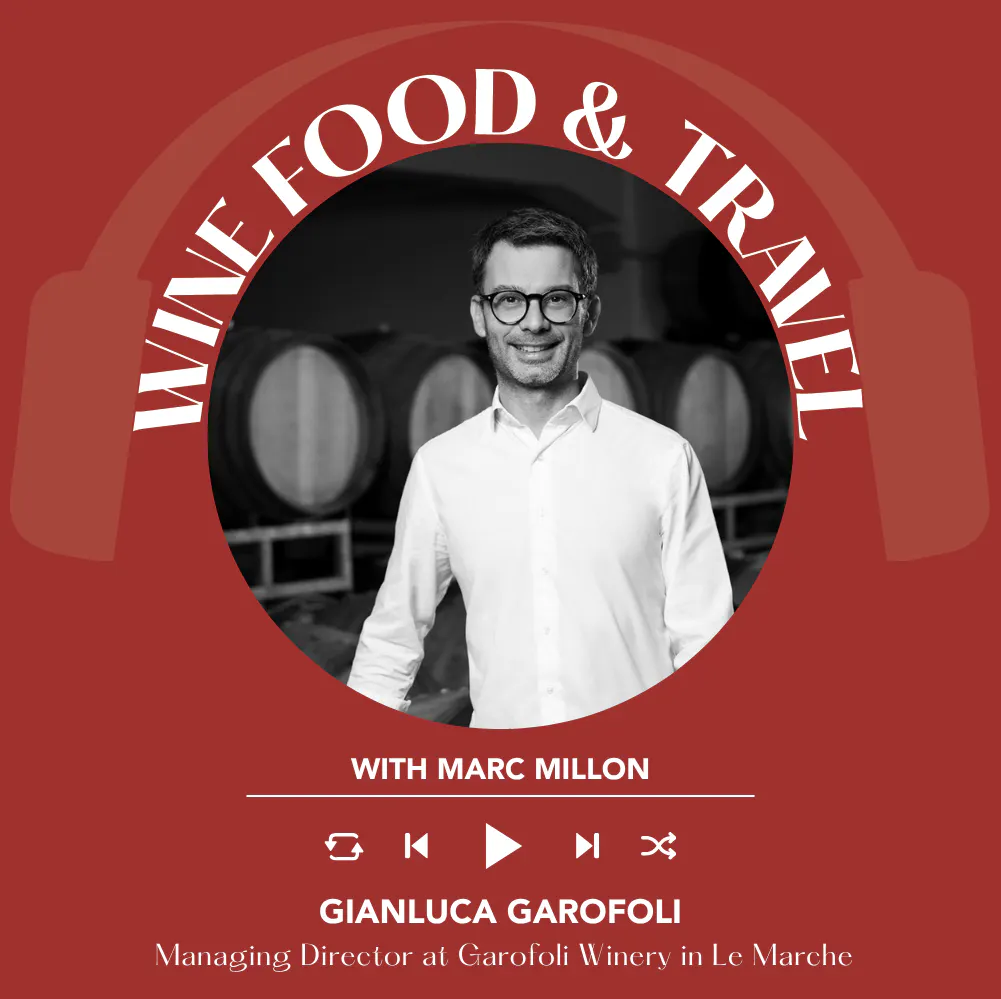
Ep. 2767 Le Marche: Verdicchio and the Wines that Shape the Region with Gianluca Garofoli of Garofoli Vini | Wine, Food & Travel with Marc Millon
Episode 2767

Ep. 2749 The Many Faces of Etna: Climate, Contrade and the Art of Volcano Winemaking with Federico Graziani | Wine, Food & Travel with Marc Millon
Episode 2749