
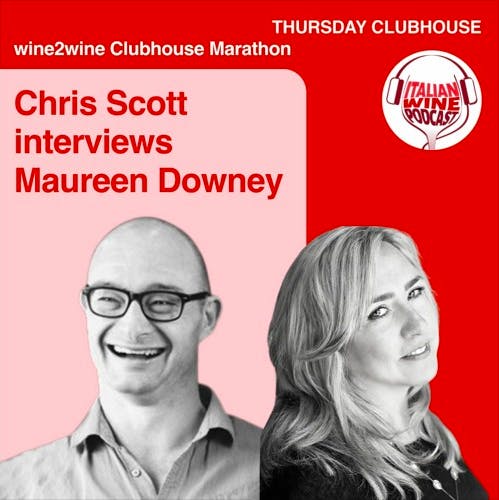
Ep. 702 Chris Scott Interviews Maureen Downey | Wine2wine 2021 Clubhouse Marathon
Wine2wine 2021 Clubhouse Marathon
Episode Summary
Content Analysis Key Themes and Main Ideas 1. The growing prevalence and sophisticated nature of wine fraud globally. 2. The ""high reward, low risk"" nature of wine counterfeiting for organized crime. 3. The impact of wine fraud across all price points, from entry-level to fine wines. 4. Critique of current industry anti-fraud measures as ""cosmetic"" and ineffective. 5. Introduction of blockchain technology (Shea Vault) as a more robust solution for wine provenance and authentication. 6. The importance of professional training and certification for wine authenticators. 7. The broader societal implications of wine fraud, including loss of tax revenue. Summary In this episode from the Wine to Wine 2021 Clubhouse marathon, host Chris Scott interviews Maureen Downey of Cheers Consulting, a leading expert in wine authentication and fraud detection. Downey reveals that wine counterfeiting has become a ""high reward, low risk"" crime, attracting organized crime groups globally. She stresses that fraud is not limited to high-end wines but also affects popular, entry-level brands like Yellowtail. Counterfeiters employ increasingly sophisticated methods, often replicating authentic packaging, anti-fraud measures, and even using the same production facilities as legitimate wineries. Downey criticizes the wine industry's current anti-fraud techniques as largely ""cosmetic,"" easily circumvented, and often secret, rendering them ineffective for consumers and vendors. She then introduces her company's solution, the ""Shea Vault,"" a blockchain-secured system designed to provide verifiable provenance and authenticity for wines. This system uses proprietary chips that are damaged if the bottle is tampered with, allowing for online verification before purchase. Downey also details Cheers Consulting's rigorous global training program for professional wine authenticators, emphasizing vetting and continuous education to combat this international ""blight"" on the industry and society. Takeaways - Wine fraud is a significant and growing global concern, increasingly driven by organized crime due to its low risk and high reward. - Counterfeit wines span all price categories, from mass-market brands to ultra-fine wines. - Modern counterfeiters are sophisticated, often replicating existing anti-fraud measures and entire production processes. - Many current anti-fraud solutions implemented by producers are deemed ""cosmetic"" and offer insufficient protection. - Blockchain technology, like the ""Shea Vault,"" is proposed as a robust solution for tracking wine provenance and ensuring authenticity. - The ""Shea Vault"" uses unique, tamper-evident chips to provide verifiable proof of authenticity accessible online. - Professional training and a collaborative community of authenticators are crucial in the ongoing fight against wine fraud. - Wine fraud has a broader impact beyond consumers and producers, contributing to significant losses in tax revenue. Notable Quotes - ""In the last fifteen, ten to fifteen years, organized crime... have realized that getting into the business of counterfeit wine production and sale is a very high reward, very low risk crime."
About This Episode
The rise in fraud in organized crime in China is due to factors like drugs and human trafficking, and high-end wine production is a result of factors like these. The use of cosmetic techniques and anti-dumping techniques is a problem, but the use of blockchain technology and addressing fraud is a solution. The company offers a short clear capsule with a chip and a hologram for wine fraud, and provides a resource for wine fraud dot com and a resource for galleries to help train up to become authenticators. The program is a combination of online presentations and video, and people have to send in assignments. The training process for certified guys is also discussed, and the annual all-inclusive certifications and a refresher program for their own safety are available.
Transcript
Welcome to this special Italian wine podcast broadcast. This episode is a recording off Clubhouse, the popular drop in audio chat. This clubhouse session was taken from the wine business club and Italian wine club. Listen in as wine lovers and experts alike engage in some great conversation on a range of topics in wine. If you enjoy listening, please consider donating through Italian wine podcast dot com. Any amount helps cover equipment, production, and publication costs. And remember to subscribe and rate our show wherever you tune in. This episode is proudly sponsored by Vivino, the world's largest online wine marketplace. The Vivino app makes it easy to choose wine. Enjoy expert team support door to door delivery and honest wine reviews to help you choose the perfect wine for every occasion. Vivino, download the app on Apple or Android and discover an easier way to choose wine. Hi. My name's Chris Scott, and we're gonna be welcoming in wine to wine's two thousand and twenty one Clubhouse marathon. That's right. This is part of a big old marathon, involves the UK wine show Italian wine podcast. Interpreting wine and Bevology Inc. Today, I'm gonna be talking with Maureen Pronie from Cheers Consulting. Maureen is a leader in authenticating wines and finding dodgy wines also runs a company Cheers Consulting, that is set up to help and train the wine world to find these wines, something that we all need. So you're at wine to wine. I'm recording this from, London. I I didn't manage to make it to wine to wine, but, what I wanna talk about today is, something you really comfortable with, I imagine, is, I I wanna touch on a couple of bullet points. The first is, just talking about what wines are being fraudulently copied, not just the fine wines, but also the entry level stuff common fraud techniques that people use, but I'm also quite interested in seeing talking a little bit about the new methods that wineries are implementing to try and manage fraud going forward. I know that, you know, if you bought a wine from the nineteen eighties and it's a high value wine, you need all the techniques that you're using, but there must be things that people are doing now to improve the quality of or the authenticity of the wines maybe twenty years down the track. And the last thing I wanna touch on today is talk a wee bit about your training because not only do you guys do the fraud detection yourself. You have a your own school that trains people on how to do exactly your thing. So they're the sort of fraud points I wanna talk about. So let's start off with, the types of wines that are being made illegally because I've seen cases where yellowtail has been made illegally in the UK. It's not just Mouton Ross childs that are are being fraudulently managed. Yeah. So what what's really interesting, not interesting, but kind of pathetically said, but true, is that in the last fifteen, ten to fifteen years, organized crime in China in, eastern Europe, in South America, kind of all over the place, have realized that getting into the business of counterfeit wine production and sale is a very high reward, very low risk crime. So, you know, if they get caught trafficking drugs, they go to jail. If they get caught trafficking people, they go to jail. If they get caught traffic in line, maybe they get a slap on the wrist and a tiny fine. So, unfortunately, what we're seeing is a is a rise in the large scale production using the same exact printing presses and glass production and everything else that a producer would use to make wines at all levels. So it's, it's it's an interesting time. I mean, everybody thinks, okay, Rudy Cunningham was arrested, and he went to jail. So the issue was over. Unfortunately, I think that he was not just a catalyst, but he was an inspiration for a whole new, a broad range of fraud going on. Okay. So what we're saying is that and and are the are the gangs doing high volume, lowest priced stuff, or are they doing focused on the high end? All of it. I mean, they're doing Carlo Rossie in China. They're doing yellow tail in the UK. You know, they're doing Sausicaiah in Italy and, you know, Pinges and UNESCO and in Spain. There's just there's no real there's no real rhyme or reason. You know, obviously, when they're doing the high end fraud, they need to be able to get that to market. But, you know, getting several bottles to market on a high end sale with the internet is just not difficult. I mean, we've got we've got international markets that are completely opaque. And, you know, a lot of these a lot of these fraudsters can just open up their own wine store online, you know, offload a whole bunch of wine and disappear. And so nobody's nobody's for the wiser. So it's, you know, I would love to be able to say You know, if you if you're only buying in this category, you're safe. If you're only buying in this category, you're safe, you know, and the same goes for spirits, you know, one of the things I'm gonna talk about in my presentation tomorrow is we've seen a rise of, production in conflict zones. So, you know, you would think that a place like Syria would have more to worry about than producing counterfeit lines and spirits, but it's lucrative. So anywhere that, you know, you can have gang activity where they need to fund other illicit operations where they would have historically, you know, dealt with drugs or or, you know, human trafficking, some of the the more quote unquote classic kinds of crimes. These guys have realized that that wine is a good way to go. Scary. Yeah. No. No. I'm and I suppose if just thinking about the UK because it's the I'm from the UK or living in the UK now, things like the yellowtail, the advantage you've got is not only do you not pay the brand premium that yellowtail does have almost certainly these guys aren't paying any taxes or duty, which is the bulk of the price of an entry level wine. You know, the wine itself probably only has twenty fifty pence worth of wine in it. Everything else is tax and margin and markup, etcetera. So they can be in a high volume product quite lucrative. Incredibly. And if and then so one of the things that I always like to remind people of, and it's interesting because I just spoke at the National Conference of State Licker authorities in the United States. And I tried to impress upon these people who really, they only care about shipping. Like, they care about shipping because there's a lot of lobbying money behind shipping, but there are fraudsters out there like Mark Lazar who sell wine, who don't have a license, By the time Mark Lazar got caught, he owed the city of Saint Louis four million dollars in back taxes. He was also selling out of New Jersey, Chicago, and California. So, you know, the next time you wonder why schools aren't funded, This is a reason. And so this, you know, to look at wine fraud and say, oh, it doesn't affect me. I don't drink Mouton. You know, I don't drink DRC. That's just not true. You know, if you use the roads and the schools, believe it or not it's affecting you because you're right. The majority of some bottles, you know, are are related to to tax payments, and we need those tax payments to make our societies work. But, you know, so I was in London last week. We were inspecting lines for a client and to take advantage of being on this side of the pond. And I and I was reminded that I when I was out for the international wine challenge a few years ago for the lockdowns, I got a bottle of Hendrix at a weight roast and it froze in the freezer. Oh, okay. In the freezer. Jim shouldn't freeze. Yeah. So that was counterfeit, you know. So it's it's everywhere. Sadly. What's the, what are the common methods of fraud that people use? Is is there a particular style of wine that they like to do or particular tools that they use? No. I mean, it depends on the counterfeitter. You know, it's just like asking about counterfeit art mean, some counterfeiters are gonna do different types of art. Right? People usually specialize. What we are the current trend that we're seeing. So, you know, kind of the old guard. I called party road stock and Rudy Credit Union one were the old guard. Right? They made a number of different kinds of wine or, you know, they used classic production methods. So in some cases, like, hard some of hardy rodent stocks bottles, you know, they're plate pressed. They've They've got good. He he went to a good amount of effort to try to age the labels and such. Rudy was a little bit different because he didn't just make Bordeaux. He made Bordeaux. He made burgundy. He made champagne. He made red wine. He made white wine. He made California wine. I mean, So that was really a, a unique situation. What we're seeing today and, and again, Ruby made old and rare vintages. So he had to age the paper and he had to age the capsules and doing all those things. I mean, every time there's another thing that he did, that's gives us another, you know, bread crumb to grab onto and find a counterfeit. What we're seeing now is that the current trend is that these these counterfeit operations are more highly funded. So there's a lot more organized crime. They are using the same methods of production that the producers do. So, you know, like the the Sasekaya ring that was broken up. It was broken up in nineteen. It was, it became public in twenty twenty. It still hasn't gone to court, but those guys had the correct glass made. They had printer, you know, professionally printed labels with anti fraud. They had the tissue paper made that looked exactly perfect. They had original wooden cases made, and they had a warehouse of these things. So they're not it's not really just about the bottle or the juice inside. It's they're they're doing the packaging. And the thing that's really, really scary is that they're now doing the anti fraud. You know, a a professional digital printer costs about a half a million dollars in the United States for, you know, US. If you're making Romani or Sasakaya, that's not a huge investment. So it's worth it for these guys, and and, again, because they're so well funded. They can afford to make the investment. Once some obviously, you mentioned Sassakaya, quite a famous Italian wine that's had a bit of a forecast. Lots of French Bordeaux has obviously been fraudulently made in the past. What techniques are these guys using now to make sure that their wines are harder to fraudulently produce in the future? They're doing, you know, there must be some techniques you can do as a producer to stop it. Is there anything that they're doing? So, like I've spent over twenty years looking for the best solution, and I think that I've created it. Every other solution on the market currently is cosmetic. They are feel good solutions that make producers feel like they're doing something to attack the problem. Unfortunately, in most cases, all that they're doing is creating ways for counterfeiters to either refill authentic bottles and then substantiate the counterfeits or to replicate that anti fraud and have it, you know, be something where people go, oh, well, there's anti fraud. It must be real. So, you know, I I'm gonna detail this kind of I'm gonna go through this in detail in my presentation. Tomorrow in person, but, you know, the problem that we're finding is that wine is an incredibly opaque market. There is no oversight into the into the supply chains. I mean, even so you take the you take the UK market. There's supposed to be some assurance that wine in bond. Is somehow safer than not. But wine and bond doesn't mean anything. It just means that the duty hasn't been paid on secondary market wines that are brought into the country. So, you know, all of the counterfeits that we found last week were coming from bond. Were they were they purchased from the winery and fiddled in the bond or did he buy them and they went into bond through another person and he got them transferred to himself or her? They were sourced somehow. Yeah. It's a sourcing though. It's a problem. Right. There were sourced somehow they ended up at a at a at a trustable, you know, at a merchant that I would trust very much, who sold them in bonds to the client. You know, this merchant didn't know they were they were selling counterfeits. They're damn good counterfeits. But, you know, the fact that they're coming from bond, I think a lot of people, especially outside of the UK, have some sort of misdirected belief that just because something is in bond, it's never hit the secondary market. And that's that's just not true. So but when it comes to the producers, what they're doing is they're putting, you know, they're putting holograms in the paper. They're putting invisible ink on the on the labels and on the capsules. They're putting, you know, holograms. They're etching. They're using QR codes. All of these things aren't marketing. And cosmetic. They don't help in a situation like the one in Europe. Last year, the year before, there was a a gang of bandits who were going around and collecting empties from hotels and restaurants. And refilling them and then selling them online, you know, at online auctions. And, you know, if if someone were to inspect those, they would see all of that great authentic print and the authentic anti fraud. And you know, the the all these other things, you know, unfortunately, you can you can three d print a fake proof tag. Now one of the other problems that I I have two major issues with with cosmetic beyond the obvious that it is cosmetic and it can be used to substantiate a fraud. The first one is a lot of the a lot of the efforts that producers go to to, and, you know, crypt and put things on these labels on the bottle are secret. So even the vendors don't know what to look for. So unless every single person who ever buys a bottle of Pinterest is gonna take it back to Petris, you know, what's the point of having the anti fraud if it's secret? And they're doing that because they don't want, obviously, the counterfeiters to know what they need to do to make a perfect counterfeit. But if it's secret, that doesn't help consumers and vendors either. So that's a little bit difficult. And then the the the main issue that I have and the the thing that we have we have solved with the with the Shea Vault, which is our blockchain secured solution, is that all of these cosmetic anti frauds, all these little things that you have to scanned that you have to do, you have to be in proximity to the bottle. Almost all fine wine. So, I mean, if it's your yellow tail, yeah, you can scan that at the at the store and see, but, you know, a smart counter fitter is gonna make a fake website, and that is gonna go to a fake website. Right? So when it comes to fine wine, very few people buy Mouton Rothchild by going to a store and deciding they're gonna drop fifty grand on you know, first growth. You buy it at auction. You buy it on premier. You buy it through a broker. You buy it in in response to an email that you get. Well, in all of those cases, you are not there to inspect the bottle. So what we have done with Shea Vault is we've enabled consumers to be able to see that certificate of authenticity and pro amounts online in advance of the sale. So the vendors can can actually put a URL to a particular bottle's blockchain secured certificate of authenticity and problem ops that has a photograph of the actual bottle and a condition of the actual bottle. And so the the consumers can make an informed decision. Because right now, everything that we look at almost, we have a few smart clients who ask us to look at wine before they buy it. But we're almost always dealing with wine after, after the people have bought it, you know. And in that case, you gotta, you know, you gotta fight to get your money back and pop so we wanna empower people in advance. Does the blockchain go from purchasing on Pemaera, whether it's been purchased all through its life? So it's a it's a life cycle of its history, or and then you can see if there's been an issue. It's, went to John's house and in, I don't know, in London and therefore now it's back on sale. Then there there's an opportunity for some underhanded behavior to occur. So you can you can see where the security chain is broken. Yes. So our blockchain solution has you can actually see the line of provenance. So, you know, if it's inputted by the producer, that's the best. Right? Cause you can see that this this line was certified by the producer at the time of production It can also be inputted by the primary retailer. So somebody who would have proof of direct purchase, you know, and we require that those documents actually get put into the blockchain, even though, they are then encrypted and nobody can ever see them But we, you know, we wanna make sure that this is a that it's real and it's secure. So, you know, if we need to have some oversight, we can go back in as administrators and and see that. And then the third way that a that a bottle would get in is by one of our authenticators. Right? So as you mentioned, I've been training people, Shamann Turner, M. W. Happy to say that. And I have been training people in authentication all around the world for quite a while. So now we have people who are in training and or certified, certified or in Hong Kong, both coasts of the United States, the UK, France, Switzerland, two in France, one in Switzerland. We are also, training people in Norway, in Italy, in Canada, on mainland China, in Singapore, in Australia, and in New Zealand. So we've got a pretty good team out there. And so these bottles can be imported. And if they're inputted, you know, in the secondary market, we try to put in as much provenance as we can prove. So my whole thing about provenance is I wanna trust you, but I'm going to verify because I don't trust you. You know, if we could trust people, wine fraud wouldn't be an issue because every single counterfeit wine comes with a counterfeit tale of provenance. Oh, trust me. I've been buying for this guy forever. Oh, trust me, this guy's the greatest collector ever. All that's bullshit. I want proof. So if we can prove that the wine is authentic and we check it out and it looks good and it looks sound because you have to remember for producers that a wine being in sound condition is just as important as it being, you know, authentic. For in the eye of most producers, if you drink their wine and it's out of condition, that's equally bad as it being counterfeit because in both situations, you're not tasting what they intended. So the wine has to also be sound to be put in to the end of the shave off. And then once a sale has happened, the, you know, the provenance gets updated. So if a wine changes hand three times, and then you go to sell it, you know, at a Zaki's auction. Zakis will put that little URL right in their digital catalog. You can click on that bottle and you can see, you know, when it was bottled and then it was sold through Berry Brothers and Rod. To an American who shipped it to the United States, and now he's selling it, and it's lot one seventy three at Zaki's sale, blah, blah, blah. And then when you buy it, the information will update. Your name doesn't have to be there. Your name can be encrypted, but the sale information will never be encrypted. Don't you get into the same risk of refilling though if the is it is it a sticker on the bottle itself? No. It's see, this is the thing. Our our our chips. We we have proprietary chips that go in the case of primary market wine. They go underneath the capsule. We have worked with our partner enoplastic to create a tin capsule through which a chip can be read. This is totally proprietary. This is new world, new day stuff. So that's in the primary market. This chip, the antenna is wound so tight that if you pierce it with coravin, it will the chip will read, damaged. So it'll it'll say that it's been adulter. The whole purpose of the Shea Vault is when it comes to the selling of a wine forward. So if that chip has been damaged, you can't sell the wine forward. In the secondary market, what we do is we plan over cap that is a short clear capsule with a chip and a hologram. Again, made by enoplastic. And those are those are shrunk, you know, their their heat shrunk on very quickly. I also don't like glue. And so the the it's the same thing. So you can't take the if you take the capsule off, it's out of the blockchain. If you pierce the cork, it's out of the blockchain. Okay. Now it sounds like a good solution. Just before you close-up, I just want you to talk us through a little bit about your courses that you run for helping people train up to become authenticators. So, yeah, we do have wine fraud dot com, which is a resource that a lot of people around the world use. We're always adding to it. We're always adding galleries. But then there are a lot of people who have found that they wanna get involved in you know, the the business of of authenticating wine. And some of them do it because, they own wine stores, and they wanna be able to open to keep their own stuff. And some of them are doing it because they wanna actually get into the business of authenticating like I do. You know, like last week, we were in London at a warehouse and, you know, spent four days doing authentication. So it's an on it's a combination of online presentation and video. It's ten modules. It's invigilated by Chevron Turner, m w, and she ran the institute of Masters of wine prior to to this project. What we do is we we go through the module. There are certain kind of homework assignments. So at the end of every module, people have to send in the assignments. Chevron will have a meeting with them to make sure that they've understood everything and that they've they've grasped all of the the German topics and learnings of the module. And when they're ready, they move forward. There are two modules that are practical where you have to come and work. Either you have us come and work with you or you come on a a trip and work with us, in a real world setting so that, we know that people have real world experience. So It takes most people, about a year, a year and a half to get through the program. But as I said, we've now got, you know, five or six certified guys and several more that are very close to being certified. So Hopefully soon, I will be able to stay home a little bit more, and these guys can take over. And the important thing is once they're certified, they are they are licensed. They are not my employees. They are their own bosses. So, every one of them have their own companies, and they go out and do this on their own. But we really do work as a community, which is good because it it enables us to find, you know, to, to, to recognize different frauds around the world and, and, hopefully, put a stop to them sooner than if if we were a bunch of loan wipes. Yeah. Fraud fraud is international, and it could be the same problem can be pairing in multiple places at the same time. You mentioned your website, wine fraud. Is that the repository for imagery, of fraudulent and non fraudulent bottles? It is. We don't have everything up there. I mean, there's a lot of things that I think producers would stop talking to me, you know, for for posting. So a lot of the anti fraud and things like that, we just can't share. It's too sensitive. But, yes, we do have examples of counterfeit wine and examples of authentic wine. And, you know, we try to we try to educate as responsibly as we can. To allow consumers and vendors to know what to look for. You know, if they have questions, then obviously when people are members, you know, we encourage them to assess questions and, you know, we we we're we're we're we're we're there to help. You know, we're all trying to stop this blight. So But, yeah, there are there are tens of thousands of of images. My database is now over a terabyte and a half. So we've got a lot of images to add, but, yeah. And the last question is, you've talked about how your training people up to become experts in detecting wine fraud, who is keeping an eye on the on the gamekeeper? You got the I mean, if you train someone up who be could potentially become the next Rudy, Curawan, So how how do you make sure that those people don't go down that road? We vet people pretty hard, not only. So we do we also have done live seminars in the past, but we not everybody in the world is allowed to be a member of wine fraud dot com. There have been a lot of people that have sent us money to come to our seminars. And we've said thank you very much. Here's a refund. You're not allowed. Before we allow people in the program, they get vetted because we need to make sure that they are they are good guys. They are doing the right thing. They have the right intentions. And then, you know, one of the other things about the Shea Vault is it allows us oversight into going in and looking at what they're authenticating. You know? So producers would have oversight into the movement of their wines in secondary markets as they change hands. And we have oversight into our authenticators to make sure that, you know, the bottles that they're putting in are correct. The other thing that we do is they have an annual all the authenticators have an annual, like, refresher. So it's not like, you know, a scuba thing where you pass at once, and then we never talk to you again. We're we're pretty active on on working together. Cheers very much, Maureen. That's all the time we've got today. Thank you very much, Maureen Downey from chair consulting, and thanks for joining us at wine to wine two thousand and twenty one Clubhouse marathon. Listen to the Italian wine podcast wherever you get your podcasts. We're on SoundCloud, Apple podcasts, Spotify, email ifm, and more. Don't forget to subscribe and rate the show. If you enjoy listening, please consider donating through Italianwine podcast dot com. Any amount helps cover equipment, production, and publication until next time. Hi everybody. Italian wine podcast celebrates its fourth anniversary this year, and we all love the great content they put out every day. Changing with Italian wine people has become a big part of our day, and the team in Verona needs to feel our love. Reducing the show is not easy folks, hurting all those hosts, getting the interviews, dropping the clubhouse recordings, not to mention editing all the material. Let's give them a tangible fan hug with a contribution to all their costs. Head to Italian wine podcast dot com and click donate to show your love.
Episode Details
Keywords
Related Episodes

Ep. 2787 Prosecco Superiore by Dr Susan H. Gordon | Book Club with Richard Hough
Episode 2787

Ep. 2784 The Other Side of Valpolicella: Volcanic Soils & Sparkling Wines with Francesca Marcato of Talestri Winery | Wine, Food & Travel with Marc Millon
Episode 2784

Ep. 2780 The Bridge between the Past and the Future of Wine with Serena Costanzo from Palmento Costanzo on Etna | Clubhouse Ambassadors' Corner
Episode 2780

Ep. 2773 Trento DOC: one of Italy’s finest sparkling wines with Alessandra Caroni of Maso Martis | Wine, Food & Travel with Marc Millon
Episode 2773

Ep. 2749 The Many Faces of Etna: Climate, Contrade and the Art of Volcano Winemaking with Federico Graziani | Wine, Food & Travel with Marc Millon
Episode 2749

Ep. 2744 Ep 25: Pantelleria, Salina e il fascino del vino insulare | Pellegrinaggio Enoico con Attilio Scienza
Episode 2744