
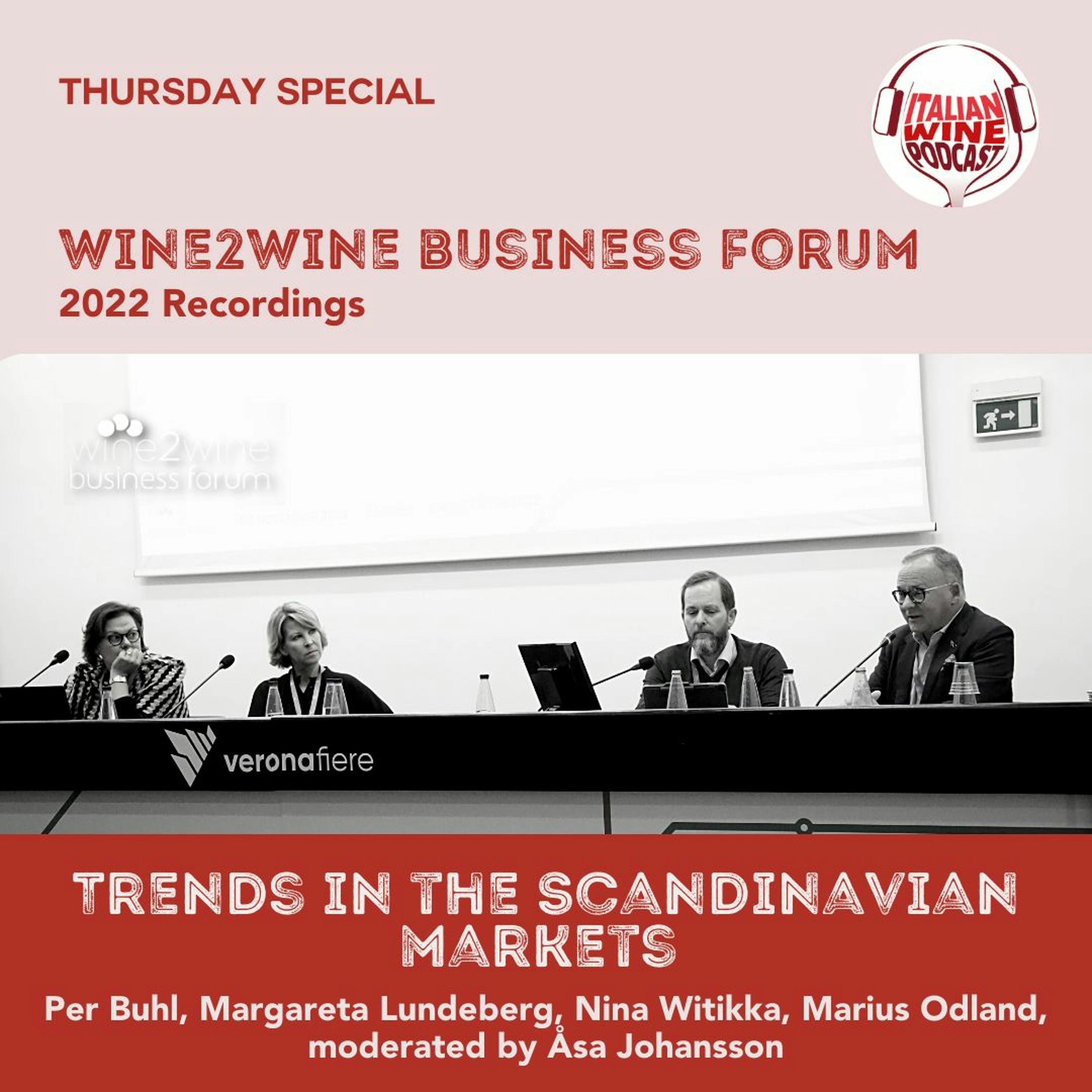
Ep. 1517 Trends On The Scandinavian Markets | wine2wine Business Forum 2022
wine2wine Business Forum 2022
Episode Summary
Content Analysis Key Themes and Main Ideas 1. Overview of Scandinavian Wine Markets: Examination of Denmark, Norway, Sweden, and Finland, highlighting differences (monopoly vs. non-monopoly) and commonalities. 2. Italian Wine's Position and Trends: Analysis of Italian wine's market share, popular styles (red vs. white, bulk vs. premium), and evolving consumer preferences in each country. 3. Role of Monopolies: Detailed discussion on how state monopolies (Norway, Sweden, Finland) regulate wine imports, listings (tenders, local, temporary), and impact producer entry. 4. Importance of Sustainability and Certifications: Emphasis on the growing demand for organic, sustainable, and environmentally conscious wines, driven by both consumer interest and monopoly requirements. 5. Challenges and Opportunities for Italian Producers: Insights into market entry strategies, pricing pressures, distribution channels, and future growth areas for Italian wines in Scandinavia. Summary This segment of the Italian Wine Podcast, moderated by Rosa Joanson, features a panel discussion with wine importers from Denmark, Norway, Sweden, and Finland, focusing on the state of Italian wine in their respective markets. Pat Bille from Denmark highlights the country's open market, where Italian wines are popular in volume but often at lower price points, with a strong presence of red wines and bag-in-box formats. He notes a shift towards higher-quality cool-climate white wines and the importance of certified sustainability. Marius Oldland outlines Norway's monopoly system (Vinmonopolet), explaining the tender process and alternative entry points through local listings and monopoly fairs. He observes continued Italian wine dominance, with a growing interest in natural, orange, and cool-climate wines. Margareta Lounbei discusses Sweden's monopoly (Systembolaget), emphasizing the risks of large tenders and the preference for working with smaller producers through temporary or exclusive listings. She notes the decline of appassimento styles in restaurants and the increasing focus on acidity and minerality, along with Sweden's high demand for organic wines and its new ""Sustainable Choice"" label. Nina Vitikka from Finland details her country's smallest Scandinavian market, where bag-in-box and alternative packaging are popular due to convenience. She highlights the prosecco and Riesling booms, and the monopoly's strong push for sustainability certifications and CO2 neutrality. The panelists collectively emphasize the challenges of rising costs and the need for Italian producers to understand each market's unique dynamics, focusing on certifications and adapting to evolving consumer palates. Takeaways * Market Diversity: Scandinavian wine markets vary significantly, with Denmark being an open market and Norway, Sweden, and Finland operating under unique state monopolies. * Italian Dominance: Italian wines hold strong market positions across Scandinavia, often leading in volume, though value can vary. * Monopoly Entry: Entering monopoly markets (Norway, Sweden, Finland) typically requires importers to navigate complex tender processes or leverage alternative listing opportunities (e.g., local listings, temporary tenders). * Sustainability Imperative: Organic and sustainable certifications are increasingly crucial, driven by both consumer demand and strict requirements from the monopolies. * Packaging Trends: Lightweight bottles, screw caps, bag-in-box, Tetra Paks, and PET bottles are gaining popularity due to sustainability efforts and convenience. * Evolving Palates: While traditional Italian reds (Amarone, Ripasso) remain popular, there's a growing interest in cool-climate wines, high-acidity styles, natural wines, and specific white wine regions. * Cost Pressures: Rising costs for glass, transport, and logistics are impacting prices, directly affecting importers and indirectly consumers, though wine purchase volumes remain strong. Notable Quotes * ""Italian wines are very sexy in Denmark."" - Pat Bille, Denmark * ""To work in the Scandinavian countries, you need to have an importer."" - Rosa Joanson (summarizing Marius Oldland) * ""Winning a tender, you get a basic listing...Getting a local listing means that one shop will buy your product."" - Marius Oldland, Norway * ""My work as importer started to be fun when I stopped working for the big tenders."" - Margareta Lounbei, Sweden * ""Italy, me, myself, I love Italy. It's like twenty, twenty countries. So so there are many regions still not the, available."" - Margareta Lounbei, Sweden * ""My neighbors don't hear how much wine I buy because it doesn't say you said, boom, boom, boom, mister. Oh, clear, clear like the bottle does."" - Nina Vitikka, Finland (quoting a consumer on PET/Tetra) * ""If you have some something special, it's always a possibility to enter the Norwegian market, not with tenders, but with another strategy."" - Marius Oldland, Norway Related Topics or Follow-up Questions 1. How do cultural differences within Scandinavia (e.g., drinking habits, dining out frequency) further influence wine consumption patterns and preferences? 2. What specific marketing and communication strategies are most effective for Italian producers targeting different segments (e.g., supermarkets, fine dining, online) within Scandinavia? 3. Given the monopolies' focus on sustainability, what innovations in winemaking or supply chain management could Italian producers implement to meet future requirements? 4. How do exchange rates and global economic fluctuations uniquely impact the import and pricing of Italian wines in these markets? 5. What role do wine tourism and direct-to-consumer sales play (or could play) for Italian producers looking to connect with Scandinavian consumers despite import regulations?
About This Episode
The Italian One podcast has been performing well in the Scandinavian wine market, with Italian wines performing better than French wines. The Danish wine market is a larger market for wine importers, and the company is focused on organic and sustainable certification. The company is a unique opportunity for building brand and has a unique opportunity to import products from Scandinavia and build their brand without tenders. The company is interested in finding potential producers and the challenges of finding good producers in the industry. The company uses social media and other platforms to find potential producers and is interested in finding local varieties and sparkling wines from other regions. The company is focused on sustainability and creating strategies and creating a common vision for sustainability.
Transcript
Since twenty seventeen, the Italian One podcast has exploded and expects to hit six million listens by the end of July twenty twenty three. We're celebrating this success by recognizing those who have shared the journey with us and giving them the opportunity to contribute to the on the success of the shows. By buying a paper copy of the Italian wine unplugged two point o or making a donation to help the ongoing running costs, members of the international Italian wine community will be given the chance to nominate future guests and even enter a price draw to have lunch with Stevie Kim and Professor Atigioshenza. To find out more, visit us at Italian wine podcast dot com. Italian wine podcast is delighted to present a series of highlights from the twenty twenty two White wine business forum, focusing on wine communication and bringing together the most influential speakers and the sectors to discuss the hottest topics facing the wine industry today. Don't forget to tune in every Thursday at two PM central European time or visit point wine dot net for more information. Yeah. So welcome, everyone. My name is, Rosa Joanson. I'm a Swedish wine journalist. Based in Tuscany. And today, I'm gonna moderate, this talk about the Scandinavian markets. The goal today is to get a brief overview of the Scandinavian markets. Take a look how the Italian wines are doing on each market, the importance of organic, or sustainable certifications and the ongoing trends, today. And I'm here with the, our four representatives, starting from my left, your right. We have mister Denmark Parbille from, the wine importer, Laudrop, And if someone is into soccer, it's, half of the companies owned by Michael Lauruk, one of the very well known football players. And then we have mister Norway, Mario's Oldland, wine journalist from the beginning, editor in chief that then went to the other side and became a wine importer, from United Wine Group. And then we have miss Sweden Margarietta Lounbei from the wine importer handpicked. And then behind me, I'm not gonna try not to fall on these steps. We have miss Finland Nina Vitica from the wine importer wine world, that is part of a bigger group. But Nina will tell us more about about this. So we're gonna jump in, directly, to the information, and I gotta let these wonderful speakers, take the word. So we're gonna start with Denmark, because as you know, the Scandinavian markets are, except for Denmark. But Norway, Sweden, and and Finland, is heavily regulated by wine monopolies. So we can understand if there any differences between the three monopolies in the different countries and how they work. But we're gonna start with the most southern country, Denmark. So, Pat, can you please give us, an introduction to the Danish wine market today? Yes. I could do that certainly. Actually, Italian wines are very sexy in Denmark. It has been for many years, in the past, it was more wines from Chile and France. And so over the last five years, we have seen quite increase on Italian wines. It is though still, when we talk price quality, lower wines in terms of of the price compared to France. So if we look at the figures up there on the screen, you will see that that Italy has twenty two percent of the market in terms of volume. And France has fourteen percent But actually France, when we when we look at the at the value, France is over Italy. So that means, basically that France or French wines, sold at fifty percent more higher priced than Italian wines. That goes with a lot of back in box, which is basically re exported a lot of that to the German border or even to Sweden and other Nordic countries. So, we would love to see some other trends in Denmark in respect to Italian wines in the future. Instead of just bag in box and bulk wines. So when we look, to, to the total wine into Denmark, it's about two hundred million, two hundred million liters, into into Denmark and Sixty, sixty seven percent of that is red wine, but it would take the next slide. We will see that Italian wines, it's, it's a lot more. It's even up to eighty percent, on on the next slide. So each thing basically consume about forty eight forty eight liters per year, which is a lot compared to the southern Europe. But if you then take the Italian wines, It's eighty two percent of the wine is red wine. So, that is a lot of wine from this area, ribasco, amarona, and so on. And only seven million leaders are actually red, white wine. Again there, we would love to see a lot more white wines into Denmark. And and, what about the distribution channels? Where is the wine sold in Denmark since you don't have the monopoly? We love not to have the monopoly. Yeah. I know. You do. So, in Denmark, we have about five thousand registered importers. So it's a huge market for, for wine importers. There's a lot of private people as well driving down Chicago Lake and taking a pallet in the car, going back again and even down to Kianci class, you go and having some agritories more than go back with a lot of Kianci, but, if we look at the at the top, then then ninety two percent is sold in supermarkets. Ninety two percent. At which price point? That's below fifty krona per. So that's something like six and a half to seven euros per bottle. Our average is is more than ten what we sell to the restaurants and so on. So, it's, ninety two percent is a high volume, compared to, you have three big supermarket chains in Denmark. It's selling, it's co op, and it's menu, which is the So they stand for, yeah, the bigger part. We love to be independent, like the rest of the Danish importers. We sell to the supermarkets as well, but only the the top wines, into we we just had a discussion about that in the previous one, but, we sell to supermarkets as well. We can sell a wine to a top restaurant, Michelinx down, and the wine can be in the store the next day. People love to look at Vivino or any other app and then purchase the wine online or in the store next day. There's no barrier there. And which are the strongest Italian regions or the most sold Italian wines in in Denmark. And is there a difference between restaurants and supermarkets? Yeah. That's a we we see in the restaurants, it's basically Piamonte. In Denmark, we call Piamonte for the the Italian burgundy. It's very like burgundy and pinot noir. We see a lot of barolo, because the four bs with barolo, Babresco, Babera, and and Pronello, that's, that's a focus on the restaurant chain. But in in respect to the to the reading, we see a lot more, Amaron, Haripaso, and whatever they call it down here in terms of, Amapaso and ri rihanna or whatever they and that's why we have this a big bulk, so they they just find a label and and sell it in the daily supermarket. Unfortunately. And you also told me when we were talking, Pat told me you told me that your agency left Italy a little bit, and now you're, going back to import more of Italian wine. So which regions will you focus on and why? And we see a lot more in terms of, when we look at the future, it's, it's alto adige. We look more at white wine as well. We see alto, up in the mountains. Basically, our company, we have hundred and thirty five different suppliers, fifteen hundred different wines from all over the world. We basically import climate wines. We see Tuscany coming, but again, Tuscany not the warm district, not from the coast, but but more up in the mountain. Some Lombadilla as well, in the future. That's, where we are focusing. Actually, unfortunately, Italy is only number six in our market in in in outlook. Used to be number three and four, but, we have had more focus on France and and Spain, California lately, but due to the rate of exchange. We said next year, Italy will be our target. Good to know, And what about, in in the Scandinavian countries, their organic and sustainable certifications, are very important. How is the situation in Denmark? Is it relevant to Danish customers. And is it important both in, in in restaurants and in the supermarkets? We find it a lot more relevant in, in the supermarkets, we see of Cooper because, again, when you sit in a restaurant, you don't focus on the wine list if it's a ecological or certified or even sustainable. Some restaurants are checking that out and even vegan, but but but it's more obvious in a supermarket. Our we see that online as well when we market sustainability and and the green wave, ecological, we see a lot more customers online purchasing from us And we have seen a trend in Italy as well. We have a great supplier, Elboro, which is owned by Salvador in, in tuscany, a super tuscan wine inside up in the mountain, has really taken off, instead of Satikaya and Alayan or the other ones. It's it's nice to see these family owned wineries really kicking off Lindenmark. So, sustainability is and again, if you go back, and we saw the bump of, if somebody can remember that being as old as me, when he dropped the bump in, in, in in New Zealand, the market of French wine in Denmark went from sixty two to twenty six. And that was back in eighty five. We have seen several scandals in Italy as well, but, people just continued drinking and and purchasing Italian wines. So, that can be that's nice to know that that you have a big, public, you know, a lot of Danish, nice, Danish purchases in Denmark. And, if you would give this suggestion to an, Italian producer to enter the Danish market today, three things. What to think about for Denmark? Well, first of all, I would love that. If you look at the Italian, wineries, I would love that a son or daughter takes over. So it's not as old fashioned as it used to be. I've been traveling the last fifty years in Italy visiting wineries, and I love when I see, the next generation taken over, making cool climate wines, making wines up in the mountain, using new techniques like full punches and, and, new technique they have learned in burgundy or in New Zealand. That's what we like. That's what our palate and especially all distributors do love in the future. But of course, it's it's obvious that sustainability, ecological, the stamp, not that you are converting, and maybe next year, that's that's no good. It needs to be a stamp. It needs to be certified and we need to see a track record over the last three, five years with, ecological wines. Thank you so much. Thank you. Now we're gonna go into the monopolies and when I travel in Italy and talk to different producers, they say, oh, you arrived to Denmark, and then there's a wall. And yesterday, I talked to a person, and we talked about Norway. And, these producers oh, we don't call it Norway. We call it Norway. Because it seems impossible to to enter these markets. So we're gonna try to figure out, how they work. First of all, so Marius, I know you like to talk, but I have my clock here, so I'm gonna control you. So could you just briefly explain how, the Norwegian mo monopoly that is called Vine Monopolet? You need some wine to be able to pronounce that. Could you briefly explain how it works? Yes. That will be a pleasure. There is, several ways, not no way to get into the Norwegian market. As you know, the state owns the monopoly, owns the monopoly shops. They hire the people. So in Norway, the importer, like we, have all the responsibility to import the wine, and to keep it in stock, to do the distribution, everything. So we own all the goods. The monopoly on the other side, the sides, what to buy through tenders, but also in other ways. So I'm I'm thinking I'll go straight to the important part telling you how to enter the market. Listen up everyone. Tenders is, of course, important. It's a door opener. You get a lot of shops. But it's difficult for you as a producer to approach us with your wine, unless there is a tender. So, a good way would be to follow the tender list carefully, get, get information about all the tenders, all the time. There is, about there is more than one hundred tenders every year. So there is a possibility that the tenders will fit your your wine production at some point. The the tenders are very specific, and this is a frustration for many producers. But we we know what we are doing. So we will find you. We will find the product that fits the description, and we will make contact. So what you're saying is that Well, to work in the Scandinavian countries, you need to have an importer. Whether you work with the on trade or off trade, you need to have an importer. And I'm just trying to translate a little bit. What you're saying is that it's not the producers finding the importer, but it's the importer that finds the producer. Yes. When it comes to tenders, that's, that's the only way to do it. And is it possible to work in Norway without winding a tender? That's, that's a very important question because, it is possible to get in without tenders. In in Norway, we have this unique possibility, to, not only import whatever product we want to, but also to meet the monopoly. At the monopoly fears. The these are fears, arranged all over the country every year. It used to be almost one hundred. After COVID, it's about six sixty seventy players still, quite a lot. It's all across the country. We, we, invite all the monopoly shops to come to us, the importers, to taste our wine. And we can and they can taste, not only what they have in the shop, but also, the the products that we choose to register at the online system of the monopoly. The online system will be what is, possible for the consumers to order through the web shop, but, the products are not in the shop physically. Unless the monopoly comes to a comes to these peers, taste the wine and make a decision to bring it to their local shop. So winning a tender, you get a basic listing, meaning the monopoly will choose a number of shops for distribution of your product. Getting a local listing means that one shop will buy your product one product and put it in their shop. How big is the percentage that they can choose? Each store, because each store can then choose a wine to put in that particular store that will not be in other monopoly stores. And how how big percentage is that? That's about twenty percent. And the the shops are different sizes. So you have the big shops, which means that twenty percent is, a lot more than the smallest shops. That can only, add a few products. So going around all the country, inviting every shop, we will get local listings. And, it's a big opportunity to build your brand without tenders. So you you introduce your product, no tenders. You, the importer will take your product around the country. We sent it to all the shops, three hundred and forty shops, and, yeah, you will get local listings from the shops that, that, wants your product and, that's a matter of what kind of product it is, what is the, price what is the quality, the label, all the normal sales, factors, the sales elements, when selling a wine. Okay. Number, your your time is finishing, Mario's, So, you're, we want to know about Italian and wine in Norway. Yeah. What is going well and what is not? Everything is going well, actually. It's the the biggest, the biggest country for, wine in Norway, there's no big increase except for, Rosaybein, especially from Piedmont. Piedmont, Veneto, and, Tuscany is the biggest regions, for us. So, it's going going well. And, yeah. And which, how how important are the organic and sustainable certifications. What can you tell us about that? Well, the monopolies in Scandinavia has a cooperation, about the sustainability. Both for the the vineyards, the, wine, wine production, and the packaging. As you can see, these are are the requirements from the Norwegian monopoly. Not requirements, like, every public has to do this, but, the these are the future requirements that the, the Scandinavian monopolist wants to implement for the nearest, years to come. And it's really something they are focusing on. So, basically, the consumers, they don't care as much. But, since the monopoly are the ones who buys the wine, we need to care. We need to make sure that, we have the focus on these requirements because it makes it easier for us to sell the wine to the monopoly. Yeah. Good answer, Mario. And last question, which trends do you see right now? What, what do you think the future? Maybe future regions or fruit future stars, of Italian wine? And what about the packaging? Because I know that the monopolies are also very, like, focused on the different types of packaging. What can you tell us about that? Well, about, the packaging to start with that. It's the same focus, the sustainability focus, for the Scandinavian monopolist, like, lightweight bottles, screw cap, sorry about that, and, sustainable packaging, in general. As for trends, we see trends for natural wine, orange wine, pet nuts, you call it on the least, in Italy, and cool climate, wines, like, less sugar, more more fruit, and, fresh acidic wines, easy to drink. That's yeah. I think that's Okay. Sum it up. Yeah. Thank you very much. We're gonna move on. We're gonna move to Sweden. So the biggest of the Scandinavian countries so Margarietta, the I the monopolies work very closely to each other. So they have a common vision. They wear often meet and have, to create strategies together. But listening to Mario's, is there any differences that you can see when it comes to the Swedish monopoly? Yes. I think it's very interesting to listen to, modems, because I think there are a lot of differences between our monopoly countries. And, I think Sweden, Finland and Norway, we are very different, and the monopoly works very differently. Of course, we have tenders. Actually, I think my work as importer started to be fun when I stopped working for the big tenders. Because there are other ways to enter system and log it. And, you can do it with exclusive tenders, with temporary tenders, via order assortment, and, of course, restaurants. So I started two thousand five, that's seventeen years ago. And from beginning, I worked a lot trying to get the big tenders, but nowadays, I feel much more confident and safe to not risk a lot of things with going for the big tenders, and I don't want to put my producer in that position either because there are a lot of risk with these big tenders. What rich risks are there? Because the system will log if they never guarantee any, continuous listing, even if, you win the tender, and they say probably you will sell about one hundred thousand liters. And maybe you sell one hundred thousand liter, but that is not enough because you are compared to other wines from other origins. And if you don't, keep your position, then you will be delisted and then you may be sit in the market with twenty, thirty, forty thousand liters, and it's a little bit difficult with, to do that in the monopoly market. So for us, we are working with small and medium producer, and for us, it's much better to work with more, temporary tenders. Yeah. And could you explain, like, the different because they're different in the different segments, when it comes to these temporary listings, could you explain just a little bit how it works? Yes. I think it is about two years. They started with these temporary tenders, and it is like a tender process. But instead of the, they, they don't request samples. From all the requests they receive. They only, re ask for sample for maybe ten to fifteen, importers, and the wine needs to have good score, and it has to be, the the kind of style they are looking for, they are much more particular, in their criterias. But in another hand, it's, it's a little bit more, good volumes for our producers. It could be everything from five thousand liters to fifteen thousand liters. And then they do still the blind testing, but, then, of course, they guarantee the volume. So that is very good. And then we have these exclusive listings, and that is not a tender process. That is, I go to the buyer and I present the wine, and the I sell I sell it, and they can decide themselves. And often, the volume could be maybe, yeah, it could be from thirty six bottles up to five thousand bottles. And for us, that is good volume. And the if we are working with producer, that is often good because we have restaurant sales, and it's more stable volumes. And then sometimes we get this exclusive listing or temporary listings. Italian wine podcast brought to you by mama jumbo shrimp. And which which trends do you see when it comes to Italian wine? And is there a difference between the own and off trade in Sweden? Yes. I think so. Definitely, still there are, like, Denmark, all these Apassimantes styles. It's still very popular, but the trend is yeah, going down. And for restaurant, that is no, no, no, you don't come to the restaurant to sell an appossemento wine. And, in the restaurant business, you want higher acidity, you want fruit, you want minerality. You want, volcanic. You want natural. You want pet nuts. But in the, in the monopoly, most of the wines are sold below, one hundred twenty Swedish Crown twelve euro. The, yes, still, a lot of, pastime is really, really going well now in Sweden. And there's, when you when you look at the figures, the the red wine from Italy has, it's the biggest one on the market. It has forty percent, almost the red wines. Yes. But while the white wines, are on fourth place, I think, or fifth even? Yeah, something like that. Yeah. Yeah. If you, in the future, would focus on Italian white wines. What would you I love Italian white wine. I actually, I like Italian white wine, maybe even more the right wine. No. I think there are so many fantastic regions with Marke with, Campania and Sicily, and there are so many good. So and I think white wine from Italy could definitely be a trend, especially for the restaurants, for the good restaurants and sommeliers. Mhmm. And, going at we're gonna take a look also at the the, organic and sustainable because organic sales Sweden stands for twenty five percent. Yes. And now they're also focusing on other certifications. What do you think about that? No. I think it's good. It's very good because a few years ago, they're only focused organic certification. And nowadays, they are focusing in, other certification like Aqualitas, like Viva. And that is really, good, I think, because now they are not only focusing in something that is not working very well in all regions. So, it's yeah. They are focusing, of course, of sustainability, but also about packaging. So nowadays, there is a label. It's called sustainable choice. And to get this label, you need to have both environmental and climate, impact reducing, and then promoting human, human rights in the industry. And, then you need to, my head there. You need to be sure that, the producing, the producer and as as an importer we need to prove that, the wine is done Yeah. This way. Yeah. Because there's a saying that sustainable choice is a new label. It came out in March, this year. And, correct me if I'm wrong, but it's the Swedish monopoly that has created this label, and they have created their own database, with different certifications. And then they have added, information about the CEO to print, for example, for packaging. But there's a lot of controversies regarding this because they have taken into consideration the production of the packaging and not the transportation, for example. And it's only for the fixed segment, and it's not for the temporary listings or order segment. So there has actually been, they have reported this to the European Commission that we look into it if it's okay or not. So we will see what happens. There are there are still very few wines, with this label. I think it's about two hundred. Okay. So very small still. Yeah. Yeah. And, what's the biggest challenge you think for Italian wine in Sweden? Difficult question. I still think that I mean, Italian Italian wine has twenty five percent market share. So that is fantastic. And I think there are still room to get even higher because Italy, me, myself, I love Italy. It's like twenty twenty countries. So so there are many regions still not the, available. I think basilicata, I think, Frioli and Alto Adigi has still a lot of, opportunities. And all the new, way to make wine and the natural wine. And so I think there are still a lot of good possibilities for Italian producer to even grow. Yeah. Hi. That's positive. Just the last question for you, Margarita, because Mario said it's not the producers finding us. It's us finding the producers. How do you find your producers? Lot of networking. I my producer, I work with today's usually, I ask them if they have someone they can recommend. So, yes, reading magazine. I'm very open. Yes. Do you the and the fares are the fares still important? Like, when you say, for example, for you? I don't find new. If I find a producer on a fair, I have always, some information before I have booked appointment before. So it's not like I'm just going and check But, yeah, I think Ferris is nice, but I think it's less important today. Mhmm. Thank you very much. We're gonna move to Finland, with Nina. Nina, you're like Mario's. You also like to talk a lot, so I will have to control you. Okay. So Nina tells us a little bit, about Finland. Finland is the smallest of the Scandinavian, wine markets, and beer is still more popular than wine or not? Yes, unfortunately. Yeah. We have, no, wine is gaining. And, actually, Finland differs from from Sweden and Norway in that sense that that, stronger beers can be sold on retail. So it's five point five percent and over. In alcohol beverages that can be sold in in, the monopoly of alcohol. So, yes, we do drink a lot of beer. We used to drink a lot more vodka today. So but wine is gaining, Historically, if we look on the last year, the whole market is, this figure here is, calculated in one hundred percent alcohol, which is like the official way of counting it. So you see that the market is declining. I also gained a lot of sales during the COVID, pandemic. I've never seen so much back in box wines being sold because, you know, we are very funny, kind of people. We kind you know, we are very afraid of two things, when something happens. There was worldwide trend of, buying a lot of toilet paper. And then the second was that, oh my god, now Anko shops are going to close. So everybody ran and and, you know, bought a lot of wine. And, and, what do you buy when you're a little unsecure? You buy back in boxed because it's, you know, it's three liters, and and then, of course, maybe a brand that I know, etcetera. So that was crazy. But it didn't tell anything of where we're going because now we're back to normal and the market is going down. Of several reasons, not not heavily. There are a couple of, of, a couple of, of, departments that is growing. And, you know, what what do we do in a declining market we we we catch on to what is going well. On trade, it's almost back to normal. We look forward to a very good Christmas party season, which is very good for for wine sales and also for Italian wine sales. We will again see something that's not good for us, but travel are important. It's like the same as in in Denmark and Sweden. We things go over to Estonia to buy cheaper alcohol. And also during COVID, I mean, this is a worldwide trend, e commerce is is growing. People don't want to spend time in shops anymore. We also need to remember one thing is that that wine is not commodity in our country. The average pin goes to an auto shop less than once a month. And when they go, they spend three minutes on average. That includes the time that they're at the cashier. So they go in, grab what's on display or what they usually buy and go out. So our challenge is to get those people to know what they're going to buy beforehand, which means, you know, click to the web shop, go and pick up the wines that we suggest, from the shop, or, you know, to have that in mind when they go, but they need to secure because not everyone is in on or in every shop shelf. So how do you work with that communication? Because there's it's also a lot of regulation when it comes to alcohol, alcoholic beverages in the Scandinavian countries. So how do you work with that communication? We use a lot. I mean, why would Finland we first of all, a little bit like like Margarita here is that we don't wait for tenders. It's just something we that we'll be leaving. We put it into the sell to order assortment. Okay. That's not automatic. That's where we have to work it out, how to get people to get it. So we use a lot. We've done quite a good, successful campaigns on social media and other platforms also. Always tactical call to action. Click click where to go, where to get the information. And that's that's, been quite successful. We went from two listings when we started in two thousand and sixteen. Today, we have a hundred and forty eight which many of them are, sale to order items, and most of the wines that are in the regular assortment has gone through that. So we are not good at winning tenders, but we're good at finding something that people would love. And, to buy it again. So, that's maybe one of our strong parts. And about Italy. Yeah. What is going well and what could do better in Finland? Do you wanna look at the slide? Yes. Okay. So there's a little bit of what's going on. White wine is increasing, and there's a riesling boom in Finland. I'll come I'll come back to that if we have, time pouring. Prosecco. Okay. The prosecco boom started a couple of years back before COVID. And, part of the reason of prosecco boom is that in my view and, analyze what we've done is the prosecco is not just wine. It's a beverage that also competes with other beverages. It competes with cider, ready to drinks, maybe beer, especially in the younger audience. And prosseco started to gain and, social media and that skin had a lot to do with that internationally. At the same time, because the younger generation, they look at maybe, influencers from outside of the Finnish border, the wine influencers in Finland that are quite boring. So they don't look at the younger audience. But, you know, for seco, it's easier. It's easier than cow, it's, of course, cheaper and easier than ten champagne. And, you know, everybody doesn't want to drink. Difficult things, especially, you know, if you go to a wedding, you know, and you have a beautiful champagne, and then your grandma goes, and it's too sour. It's too dry. So, you know, why, you know, drink prosecco, it's much easier. And then, of course, it's a small small boom in Champagne, especially at the Rosay, and that is a part of the Rosay train, where Italy is not doing very well. But where are we doing well in the Finnish market? Let's go to the next one. Oh, let's do this one first. So the I mean, bibs are big. It's very convenient. You know, we hunt. We we go to our summer places. We go boating. Etcetera. So baggy box is easy to to carry with. We're very practical people. And that's the part also why Tetra and, and PT is growing in Finland. And one of the reason is it's quite funny, and this is directly from, from a consumer. When I buy a PET bottle or a Tetra, my neighbors don't hear how much wine I buy because it doesn't say you said, boom, boom, boom, mister. Oh, clear, clear like the bottle does. So that's, you know, one of the it's very practical. So, I mean, Tetra is growing, and a couple of pretty big bulk, wine produced also in there. PT is, Finland has been foregoing in that in in the monopoly markets. The most tall Italian white wine is packed in a bib. At the most tall Which region is the? I don't remember. I think it's sicilian. It's the one we do with Okay. The black the octopus on it. Yeah. It's a caparato from Oh, it's a caparato. Okay. So we still have two minutes. Two minutes? Yes. Okay. So we have two minutes left, and then we're gonna have some questions. Yeah. Italian wise, has pretty good market shares in different price points. I mean, we the biggest growing price category in Finland in wine is twelve to fifteen euros. Still, there are big leaders in under ten euro, but the problem is that nowadays, we we're still not able to sell wines under ten euro because nobody's making money. You're not making money. We're not making money. The only one making money is the tax authorities and the monopoly because they're marching is the highest in, scandinavia. Oh, sorry. There's some other people here. All wines, I mean, if we talk about Italy, the market share is fifty nine percent in twenty to fifty euros, and that explains the the wines, the repasto, and the marona. It's very strong. This big growth also in Piamonte, but it's in the higher price ranges. And, pacimento is also popular, but not as strong as in Sweden, which has been a really crazy market for, pacimento style wines. So if you would give a suggestion to to an Italian producer, to enter the finished market one minute, only. And then we're gonna have time for for questions. But just, some advice, what to think about. It could be certifications. It could be Yeah. That's very important. I mean, the the sustainability and the certifications always have to be on the label, then you get the green dot. Alco works a little differently. They have a goal in two thousand and thirty to have, their own, ways the working will be, CO2 neutral, but also that at that time, that we have I think I have a small picture here of the green dots, of the green symbols, that most of the wines sold will be have will be with the green symbol. And the green symbol is what you get. If you have an organic certification, if you have a sustainable certification, if you're natural, if you have a lightweight bottle, vegan, biodynamic, or the newest one, which is c o two neutral. Perfect. Yes. And shortly. Yes. Very good, Nina. So we have few minutes for for questions. We have one from Delletta. I can give you my microphone. Wait. Thank you. Thank you. I just have a question about these partly wines. We just talk about prosaicco for the Finnish market, but I really wanna know a little bit about something not only prosaicco sparkling wines from Yuli. Sparkling from other regions or, other different varieties, probably from, local Italian varieties. What about that? If easier market interest about something new or you know, unknown denomination that is my question. I can start, I can start from Sweden. So I think definitely there are interests for local varietals. I think it depends on the importer and the place you want to sell. And I think even a monopoly could be interested for, for a small listing in the, temporary as a temporary listing. But definitely, I think, yeah, there are many wine bars in, especially in the biggest cities interested of local varieties and sparkling. I can I can follow-up about Norway? For the tenders, in Norway, I'm sure there will be tenders for, other, appalachians than prosecco, and Transiacoietta, and, you know, more tactrello or, other less known. So, I because the the monopoly sorry about the law loudness, the the monopoly, are actually launching tenders in all categories. It's not only only about big volumes. It's small volumes, big volumes, low prices, high prices. So everything can happen. And then, Mark, I can add a little bit on, especially for the wine festivals and the music festivals. We have seen a increased, quite a huge increase, on the the party bottles or the colored, like, I think it's called Bottega Gold or something, you know, we've seen that a lot, as well, Lambrusco and so on, in the marketplace when we have the peak music festival. So that's increasing a lot. And that's not ecological, unfortunately. And, Finland? Yes, especially the on trade. And, there is more demand for higher quality, sparkling wines from Italy. We see, I mean, the Trento names, so not to mention any, also Alta Long, are very interesting, Frances Corta, and also we see a small up to three years ago impossible to sell magnums outside of Champagne, but nowadays, many of the restaurants pour from, top quality Italian, sparkling wines from magnums also, which we're very happy about. So it's not just Puroseco. For Magoo. Now we have a problem with the price of the glass of Magoo, and Gerald. That is crazy. Yeah. And and that that that is really, and it's so sad because now that we're finally getting there, you know, and and also the price increases and and, you know, but this is something that we have to all live with. The problem is now, you know, going a little back to that with your energy prices and especially, I mean, Italy is especially hit with that. Is that, you know, we've had to increase prices on our bigger sellers, in alcohol. And, you know, it's really, you know, how much can the consumer really take? Yeah. No. That's That's interesting. Yes. We have, another question, Katarina. You want to ask a question? Okay. So I'm Katarina Anderson. I think it was a bit, in connection to the Delletta question. So, I mean, so I've heard that there's, for the future, a lot of, piedmont, burgundy style wines, fresh wines, Tuscany. So, basically, the future is a bit like the past, but I think a lot of people here, if there were a lot of smaller producers, we'll probably want to learn more about how a small producer in Italy could actually, navigate if he would like to arrive to it to Sweden or to Norway or to Finland or well, Denmark is easier. I mean, and then they have all routes, and so it's but, I mean, I think I mean, you talked a bit about it, but I think there could perhaps be a bit more explained if you would find a mortgage state to have a way to, arrive to Scandinavian on their own. And the second part of the question is, like, with the post pandemic world and the costs are increasing, like for the US, for import. It's it's becoming more and more of a problem with crusts also for the importers. So do you see it changing that in Scandinavia with higher crusts for you, which also would, influence how you choose the producers and and the price points and so forth? Let me just start on Denmark then. We see we see all the small, suppliers being a lot interested at least to our company and to several other companies in the medium range. We see Valadorosta being a future. We see Aetna like we talked about all the volcanic areas, and we talked about early small family producers. Valjelina Abil Lombadi is is as well upcoming area for us. It has never been interested in the past, but now young players are coming on, and that's what the soup, especially all the Sumley is asking about. And that's what we focus on with the some of the best restaurants in the world in Copenhagen. Yeah. But there's no obvious what I think what Katarina was asking is that there's no obvious way to arrive to you as an importer? It is. But it it depends, what product you have. But if it's, If you if you have some something special, it's always a possibility to enter the Norwegian market, not with tenders, but with another strategy. And, we have that strategy not only my company, but also other importers, of course, that we can, help you, to enter the Norwegian market, but it needs to be a long term strategy. You cannot rush it, and we need to choose the right time and place. And, we need to, you, you need to understand in a recent market. We need to understand you as a producer. And your product. So definitely always interesting if the products are interesting. To totally agree to that one. It is always, interesting. I think with new, producer and new different varietals. And, so I never say no before. I have checked the mail, checked the website, and have had the dialogue about it. So yeah. I, I agree with everybody else here, and and wine world, Finland. We work with many smaller producers who we know very well also personally. We import we might buy a mixed pallet from somebody small or then a a truckload of bigger wineries if we have that listing in the monopoly. So it's, But of course, I mean, honestly, we get a lot of contacts. I mean, twenty five emails per day from producers who wants to introduce themselves. And it it's quite hard work and, you know, if we don't answer the email, it's not because we're rude. It's just that, you know, that You don't have enough time, right, to answer? No. No. It's so blunt too. That's okay. So send it again. Yeah. The the the second question, was about, the higher prices. This will be the lead then we have to finish. So do you see a change in what your choices you heard, Katarina's question. When it comes to the future after the pandemic inflation, etcetera, etcetera, will it change the way you work? Pat? Yes, indeed already now. We see, you know, just from United States, the rate of exchange increased by twenty five percent. So we increased the prices by thirty to forty percent, even from Europe, like you talked about the glasses, it's difficult to get glass and cardboard and so on. We have increased all our prices by between eight and ten percent and people just continue purchasing. You know, people love wine and especially from Italy. So, but of course, we need to then find some other suppliers with cheaper wines like two euros. That's important as well. It's not it's easy to sell wine at ten, twenty euros, but it's all the the smaller ones, for our market, at least. Really, really short now because then we have to finish. We we all we also suffer in Norway with higher transportation cost. The warehouse is going up. The handling is going up and distribution is going up. So so, I think, we are on on both sides, we are seeing, expenses, rising. Do you agree, the two of you? Perfect. So we say thank you. We close here if there are no other questions. Otherwise, you can come up and talk personally or outside. So thank you for coming and listening. Thank you. Listen to the Italian wine podcast wherever you get your podcast. We're on SoundCloud, Apple Podcasts, Spotify, HimalIFM, and more. Don't forget to subscribe and rate the show. If you enjoy listening, please consider donating through Italianline podcast dot com. Any amount helps cover equipment, and publication costs. Until next time.
Episode Details
Related Episodes

Ep. 2789 ColleMassari: a long-term vision rooted in Montecucco with Giuseppe Di Gioia | On The Road With Stevie Kim
Episode 2789

Ep. 2788 Ep. 14: Austria and Hungary | Study Smart for your WSET Level 3
Episode 2788

Ep. 2785 From Volunteer to Speaker at TEXSOM with Samantha Cole Johnson | TEXSOM 2026
Episode 2785
Ep. 2766 Inside the U.S. Non-Alcoholic Wine Market: What Wineries Need to Know with Jill Sites | Masterclass US Wine Market
Episode 2766
Ep. 2761 Winemaking and Consulting Across Sicily with Alessandro Serughetti | Wine, Food & Travel with Marc Millon
Episode 2761

Ep. 2759 Part 2 – The VIA Educational Program & Italian Wine | Heart-to-Heart Conversation with Sarah Looper
Episode 2759