
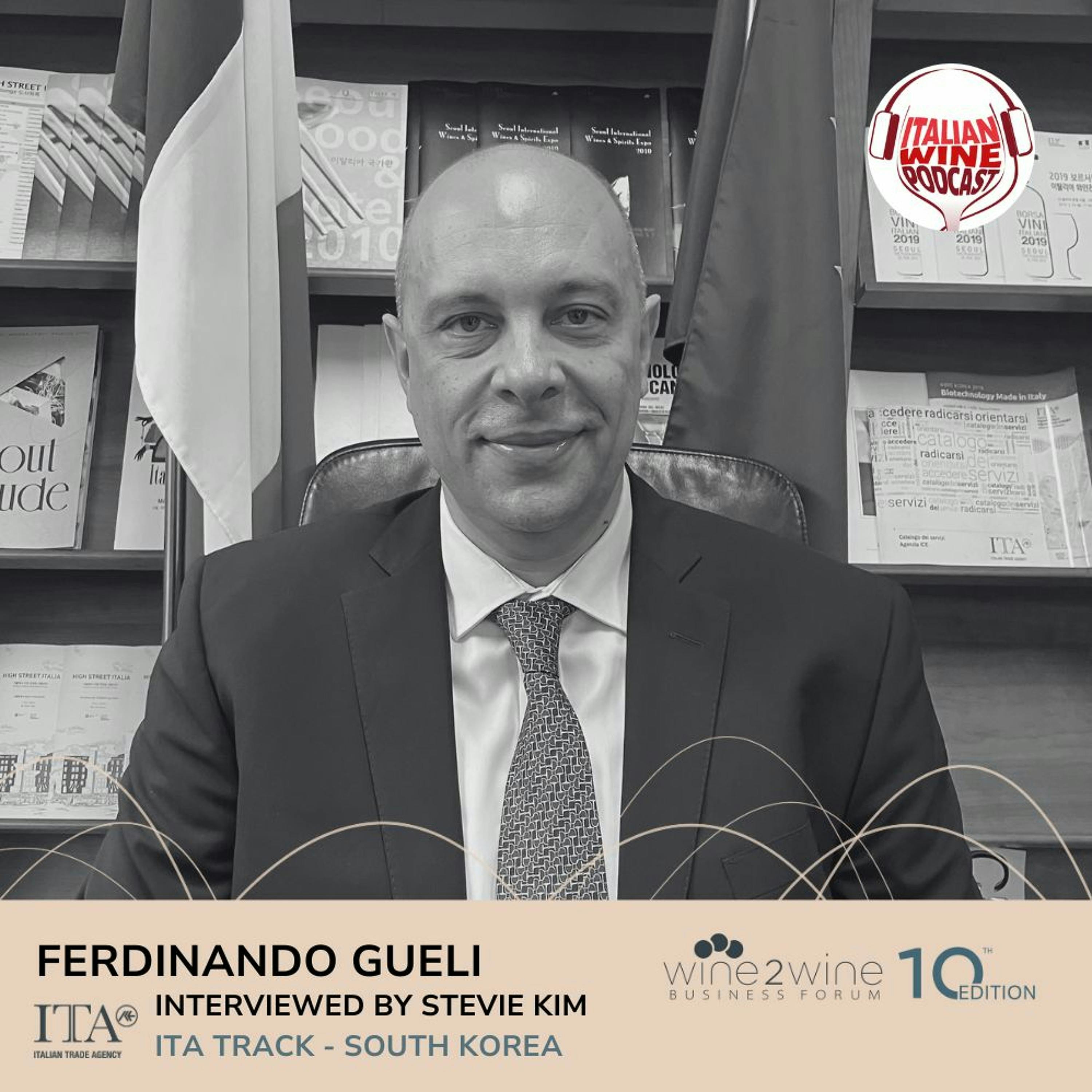
Ep. 1628 Stevie Kim Interviews Ferdinando Gueli | wine2wine Business Forum 2023 Series
wine2wine Business Forum 2023 Series
Episode Summary
Content Analysis Key Themes and Main Ideas 1. The rapid growth and unique characteristics of the South Korean wine market. 2. The Italian Trade Agency (ICE)'s role in promoting Italian wine exports to South Korea. 3. Challenges and opportunities for Italian wines in a competitive market. 4. The strategic importance of pairing Italian wines with Korean cuisine. 5. Distribution channels, e-commerce limitations, and consumer preferences in South Korea. Summary In this episode, host Stevie Kim interviews Ferdinand De Gueli, the Italian Trade Commissioner at ICE's office in South Korea, to discuss the South Korean wine market. De Gueli describes Korea as one of Asia's most dynamic wine markets, with Italian wine exports steadily increasing four-fold in ten years following the 2012 EU free trade agreement. He notes that wine is gradually replacing other alcoholic beverages and Korean consumers are highly interested in learning about wine. While French wines currently hold a larger market share, De Gueli emphasizes Italy's competitive advantage in offering a vast diversity of wines. He highlights the crucial need for strong marketing investment and consumer education to overcome the ""knowledge gap."" A key strategic opportunity identified is exploring food pairings between Italian wines and local Korean cuisine, working with Korean sommeliers and restaurants. De Gueli also details ICE's two-pronged B2B (Borsa Vini) and B2C (V by Vino) promotional strategies, aimed at supporting both new entrants and established wineries. He touches on the dominant distribution channels, the recent ""whiskey boom,"" and the current limitations of e-commerce for imported wines in Korea. Takeaways - The South Korean wine market is dynamic and has seen significant growth in Italian wine imports since 2012. - Korean consumers are sophisticated and eager to learn more about wine, offering a prime opportunity for educational marketing. - Despite competition from French and US wines, Italy's vast diversity of native grape varieties provides a unique competitive edge. - A major untapped opportunity for growth lies in actively promoting Italian wine pairings with Korean food. - Italian wineries need to invest significantly in marketing and education to succeed in the Korean market, rather than just shipping products. - Current e-commerce regulations in South Korea require physical pick-up for online wine orders, limiting direct delivery for imported wines. - The Italian Trade Agency in Seoul actively supports Italian wineries through B2B events (like Borsa Vini) for market entry and B2C promotions (like V by Vino) involving restaurants and sommeliers. Notable Quotes - ""Korean wine market is a very interesting market, especially in the last few years, it's been became in one of the most dynamic market in Asia."
About This Episode
The Italian wine market is increasing in demand due to the increasing demand for Italian wines and the importance of traditional drink formats. There are rules and regulations involved in importing wine to Korea, but it is manageable and affordable. The importance of marketing and support for importer is emphasized, and there is a need for training and pairing with Korean cuisine. The traditional way of distributing wines online is not possible due to restrictions, but there is a new option for online orders where consumers can purchase wines from shops and pick up the bottle. The Italian wine market is expanding, but there is still a lot of job to do. The speakers emphasize the importance of educating consumers about different Italian wines and promoting the wine list. There is a one-yearly appointment for importers with Italian wines, and the training session for restaurant partners and media is ongoing. The speakers emphasize the importance of improving organization and promoting the wine list.
Transcript
Since two thousand and seventeen, the Italian wine podcast has exploded. Recently hitting six million listens support us by buying a copy of Italian wine unplugged two point o or making a small donation. In return, we'll give you the chance to nominate a guest and even win lunch with Steve Kim and Professor Atilio Shenza. Find out more at Italian One podcast dot com. White to wine business forum is a training and networking event for anyone involved in the wine business held in verona on November thirteenth and fourteen. This year, the forum will involve over ninety international speakers and over fifty sessions on topics ranging from marketing and communication, sustainability, strategy, new market trends, and market focus in collaboration with the Italian trade agency. A number of market focused sessions will be broadcast in a podcast series on the Italian wine podcast, a media partner of the wine to wine business forum. Welcome to Italian wine podcast. My name is Stevie Kim. Today's podcast is part of a special series from the wine to wine business form two thousand twenty three. We will be focusing key international markets for Italian wine. Today, the focus is on Yep. South Korea. There it is. And our special guest is Ferdinand De Gueli from Iche. The Italian trade agency. Ferdinand De Gueli joined the Italian trade agency in November two thousand. He has extensive international experience promoting Italian brands and manufacturing in particular in the United States and China. In September two thousand twenty two, he was appointed the Italian trade commissioner at Eche's sole office in South Korea from where he takes a close interest in the South Korean market. Hi, Stevi. Good morning to everybody. Thank you for or inviting me. What time is it in Korea now? Okay. Here at this moment is at five PM next Saturday. Okay. So it's ten AM here. Can you give us a little bit about I don't know if you have the numbers at hand. Tell us briefly about Korea wine market in terms of demographics and consumer preferences. Okay. Korea wine market is a very interesting market, especially in the last few years, it's been became in one of the most dynamic market in Asia. In particular, since the, you know, the free trade agreement with the European Union in two thousand twelve, so let's say, ten years ago, more or less. Italian export wise to Korea has been steadily increasing. Even if the last year, two thousand twenty two week, experience, a little moment of, you know, stabilization, but we've been increasingly, like, four times more in ten years. The peak we experienced in two thousand twenty one, exactly during the COVID. And, actually, this is part of the phenomenon of the wide map in Korea, the wine consumption in Korea, that wine has been gradually replacing other alcoholic beverages in the habits of Korean consumers. Wine became the first alcoholic beverage imported from abroad in two thousand twenty one. After that, wine became the first alcoholic beverage imported from abroad. At the moment, the situation is like this. The wine is still a small percentage of the overall consumers, three point four percent of the overall alcoholic beverage market. Because in Korea, there are some very traditional beverages like soju, which is quite known. And Macoli. Right? Magali is, my favorite personally. He has a wine beer and rice beer. Also, they are local beers, but wine is increasing every year, and, especially in the high end market. It's very interesting because I found the Korean wine lovers are more interested in learning about everything about the wines. So they are not only enjoying drinking wine, but they want to know more. They want to understand. They want to explore. And I think this is a very good opportunity for us. With such kind of consumers, we can have more opportunities for introducing the great variety of the Italian wines, which in this respect, we have no competitors worldwide. So can you tell us, skinny overview if there are any particular rules and regulations with regards to importing wine to Korea for the Italian wine producers. Of course, there are rules and regulations, sir, but, let me say that this should not be, scanning our support or the companies because at the end, it's everything is possible to manage. So besides the usual documents that they are necessary for importing, all products in Korea, there are other regulations. So, for example, the certificate of analysis that is not compulsory anyway, and, in particular, the labeling, labeling procedure, which is very important. But this is, manageable, affordably through a local importer. So the importer is still a key element in accessing the Korean market because Once you find a good important, he will take care of all these stuff from the Italian company for the Italian partners so we know major issues because we have to say that You know, we have experience worldwide in the different countries and the customs. Sometimes it's a very big headache. I have to say that in Korea, maybe sometimes they are very, you know, rigid with the procedure, respecting the procedure and the regulations. But at the end, everything is quite efficient and is quite timely, manageable. So this is the message I want to address. Okay. So what are the challenges and at the same time, opportunities? Regarding Italian wines into Korea market. I think the challenge and the opportunities, two phases of the same coin. Why? Because as I said, the Korean consumer is very interested in learning more about the product characteristics and discovering new features and also stories. But this means that we needed to have a strong marketing commitment. So When you approach the Korean market, you should be aware of being ready for an investment in terms of marketing and support to the importer and not to just, you know, ship the containers from Italy. But otherwise, you know, you risk to remain in the border, let's say, border, not in technically custom border, but, which means you are not going to really expand in the market. So telling the customers about the wine, let them understand more and the characteristic in the future of the the wines. It's very important. And, it's not enough to have a very good wine because, you know, competition is very fierce. And Of course, there is also a gap of knowledge. I mean, the you cannot expect the Korean consumers. Some of them, they already are, but most of them, they are still not so informed about all the differences of the different kind of varieties. Wines. So it's very important, to be ready to support the sales with the marketing activities. At the same time, another important element that the my opinion the real, opportunity for the future is to explore, and we are already doing as a Italian agency in our own promotional activities, exploring the world of the Korean cuisine. Because, you know, here, the Korean cuisine, the local cuisine is very important. But if we just, remain, confined on the international Italian restaurants, which can be one of the main channels to enter the market, But at the end, you're not going to really expand to really reach the most of the consumers. So it's very important to start working with the Korean restaurants and exploring all the pairing opportunities between Italian wines and Korean food. And I have to say that on this respect, my opinion, we have a competitive advantage and we compare with the other countries, watch because we can offer a much wider variety of wines. So we can better find and fit and match the taste of the Korean food with our wines. That is really in my opinion, one of the key channel to explore in the future. So far it's not been explored too much. That's why we are really focused on this. Also, in our own promotion, strategy. So you are focused on promoting, let's say, the food and wine pairing with Italian wine with Korean food. Is that correct? Yes. I think that's the one key point to expand in the Korean market and to reach a wider number of consumers. Even if there are other niche market, for example, wine bars, especially young generations or high class, young generations, but honestly, the market in this area is still a little bit limited. So entering the Korean cuisine, restaurants, channel will be the one of the key elements to expand in the future. Wine to wine business forum. Everything you need to get ahead in the world of wine, supersize your business network. Share business ideas with the biggest voices in the industry. Join us in Verona on November thirteen to fourteen twenty twenty three. Tickets available now at point blind dot net. Yeah. It would be fantastic if you can provide, you know, like kind of the guideline as to how to pair Korean food with Italian mind. That would be really nice. Yeah. First of all, a key role is played for example, having a partnership with a Korean Somelier. They are very, very professional and a highly educated Somelier here. We found many of them that they have a huge knowledge. Of Italian wines. That is a key element, especially for training activities. So one key element of the marketing strategy should be the training. Training to both for professionals, and the four culture. And, for example, Korean, so many as Korean professional already expert in Italian wines, it's very important. It's a key element. Why? Because they can deliver the message to the Korean people in a better way because they know culture, they know the Korean cuisine better than us. So they can find the pairing opportunities with Italian wines and also, you know, interacting, for example, with the chef with the sommelier in the restaurants, So I think that is a very important part where you have to focus your marketing strategy here. So just out of curiosity, Fernando, Italian wines are always, quote unquote, in competition with the French wines. And to a certain extent also the Spanish. How do they fare in Korea market? Yeah. That's true. Also in the Korea market. At the moment, of course, the French wines, they have the higher share of the market. But this is, something we have been experiencing in other markets in the past, where then after a while, the Italian wines have been, you know, succeeding and recovering positions compared with the French wines because I have to say, as we all know, French wineries, they are usually bigger size and they are very powerful in marketing. So they can enjoy an advantage position at the beginning But, once the market is evolving and the consumers are going to discover new wines and new products, sir, Italy has much more to offer. So we have to leverage this element in order to recover the position in the market because this is a market that is very dynamic. As I mentioned at the beginning, there is a number of consumers already well educated, but it's still a young market. We are to say young and, meaning, not of in terms of demographics, but in terms of the wine is being introduced here not long ago. So still the market needs to evolve and to change. And we have the opportunity there. So we should not look at the past or at the present, the way we have to look at the future. So have you got any some numbers at hand for us to understand to contextualize Italian wine market share? So at the moment, let's use the data of the entire year. It's two thousand twenty two because you mentioned the wine market. I think to utilize only the partial data because during the year, it's not really a wise move because it's a market that is not regular, not during, along the seasons. So talking about two thousand twenty two, if we consider the data in the euros, but they are US dollars, Italy has been supporting eighty six millions of US dollars in two thousand twenty two, United States, one hundred, transit two hundred millions, and, Italy, eighty six. K? And US, you said, American one hundred. Is that correct? America is one hundred. Exactly. So we have prepared the position in the market. Well, I'm surprised about America, actually. Yes. America, because, you know, the California wines, especially, they are quite popular because they've been introduced in the beginning. As you know, there is a special relations between Korea and the US, also considering the number of US experts Sure. Here. Mhmm. So that's possible to explain also with this, effect. And also because the US had, you know, free market access, free trade before the European Union agreement. Would you mind telling us a little bit about the principal I suppose commercial distribution channel. Can a distributor be also an importer and vice versa? Because in America, for example, with the three tier system, it's very rigorously regulated. Here is a little bit more simple. And normally, the importer, especially in the cellular area, which is, you know, the most part of the market. Normally, the importer is also the, distributor. Eighty percent, let's say, of the market is in Sable area. The local distributor as additional step, it's only in, especially in the, remote areas, far from Sable In that case, importers normally, they work with local distributors, so they don't distribute directly. And, another important feature of the market, you know, the distribution system is that at the moment, there are ten big importer, importing companies that they are, you know, controlling almost eighty percent of the mark. And this one, of the imported ones marked. But there are also newcomers coming up, emerging the importers. They mark this still growing. Even if, last year, I'm talking about the data. So we were talking before. Overall, import was increasing only three point seven percent compared with the past years. So the the growth rate was declining, but we believe this is just because there was a boom in two thousand twenty one, probably also because of the COVID. And, you know, there are the market's situation for probably very high. So we have to be patient and consider the long term trend. There is another trend that is interested in the market. It is about the whiskey boom. Mhmm. It's something very recent. Let's say in two thousand twenty three, ma'am, especially young generations at this moment that it seems they are very fascinated by the whiskey. Oh, really? That's a very recent trend, but, we don't know how we'll be became a structural, element, or it's just, you know, a temporary fashion that we don't think this will affect too much in the long term, the growth over the wine consumption. And what about Renando e commerce? What is the state of the art of the e commerce business? Okay. E commerce is increasing back to the problem for the e commerce that is, not possible to sell the wines. There are some limitations. In selling wines through the commercial locally, domestically, it's possible. But, for imported wines, it's more a problem. Two thousand twenty, actually, it has been opened online market. But, there is also one restriction that the consumer, they have to go to pick up the bottle on the shop. So at the end, it is just the ordering, not the the leading bank is still limited for these reasons. Probably in the next few years, this, regulation will be released, because, of course, the commerce is increasing. We're also here in Korea. Sooner or later, has to be more open and, released those three restrictions. Are the normal decisions like this? Okay. So there has been some progress because I recall when I was in Korea last time, e commerce wasn't allowed at all. So now what you're saying is that the consumers can order online, but they have to physically go to the shops to do the pickup. There's no delivery. And in any case, this is always for domestic online market. It cannot be cross board, but in many cases. So no imported wines. On cross border orders. You know, you cannot import wine online Mhmm. From abroad. Okay. But they can purchase the consumers order Italian wines online. Yeah. Unless it's a very limited quantity, but, not the big orders. Yeah. We could probably spend an entire day just talking about e commerce. Yeah. Because there are a lot of regulations, on that. Right. But the e commerce in general in Korea is, expanding as all over the world. But it is possible to predict that there would be those regulations will be a little bit released in a long time. Okay. So my next question is particularly regarding the consumer market. How do the consumers perceive Italy and Italian wine. Let's say there is a good potential of, I call sympathy to Italy in general, especially, for example, in the fashion, luxury market, Korea is the first, Asia market if we consider the our export per capita. So we consider also the population, demographics is the first market in Asia for, fashion and luxury for Florida. So the wine is also benefiting the same image. So there is a very positive image of Italy, but having said that there is a lot to do in terms of education, in terms of, you know, telling the Korean consumers how many different wines we have, the varieties, the characteristics, the pairing, the opportunities with the food. So on this area, we there is still a lot of job to do. So the the knowledge of the different Italian wines is still limited. Maybe Kianti and some Piedmont wires. They are very popular, but the rest, there needs to be explored. Because, you know, as you know, while the French wines, they have big companies, big binaries, and they push a lot. The few names they have. For Italy, they accept the opposite situation. So we have so many varieties, but normally, we are not so powerful. You know, that our wineries, they are smaller and, difficult to be always in the market, and then, doing a very regular marketing activity. Yeah. I mean, of course, the Italian mind reflects the Italian people and Italian country. Bio diversity also is a double edged sword. Right? It's great. All the different arrays of varieties, but at the same time, it's incredibly fragmented. Exactly. Excellent. So which is the strength point and also weak point at the same time. Yeah. At the same time. I am able to say that is, in the long time, I perceive it as a strength point in Korea for those, runners that they will decide to approach the Korean market a long term with a long term approach, but needs a big effort in education and training, marketing, communication, information. Of course, we are trying to do our part, being trade promotion agency, but, of course, it's not enough for what we do. And, we need also to have a single winery solution day products, in the market. But anyway, we are doing well. There is another element. It's about Saul, we have a a special place that is called High Street, Italian, and it's a unique place, ITA network worldwide. We have this place we call the showroom of maybe in Italy. We have two floors that they are open to the public every day. It's a permanent showroom that we protect the products every six months. And we opt this to all the Italian companies. Of course, sir, it's necessary to be present in the month to BX opposed to the public, then if they like the product, they need to find it in the market. Otherwise, it's just a pure disability with no result in sales. But, I didn't say that, it's a good opportunity to have a disability to have a kind of showcase. Also, since last year, we managed us to have a wines in this showroom. Now originally, it was not possible because of the more specific regulation in terms of sales license, but at the end, we managed it get the license for the shop and, of course, the single importers, they can, go there and, exposing and selling the wines to the park. So where is this high street? It Tanya located. Exactly. In Gatnam district, especially in an area that is one of the traditional shopping, the street in Seul, which is Garosugil. Mhmm. I don't know if my pronunciation is correct. I can't help you with that. Yeah. Unfortunately. I I suppose you know this, street, this road. That's a Yeah. It's very famous. One of the most famous, traditional shopping streets in Seoul, there's the famous song gangnam style as well. Excellent. Thanks. I gotnam, of course, it's a, you know, the most dynamic crowded area in Seoul officially for sales and the shops, there are so many different kind of shops and shopping areas in Gannam. So we are in the middle of the commercial district, you can say. And so this is a very important information, for the Italian companies. Of course, as I said, it's not just this alone. You must have a market strategy. You must enter the market having a good partner with marketing investment. And then, of course, you can consider also this place as a showcase, as a special showcase, to the Korean fabric. Okay. So let's get into this in terms of how Iche Ita can help the Italian wine producers trying to approach and enter Korea market. So there are logically two groups. Right? One group is the, kind of the newbies. They've never been to the courier market. They don't have an importer. So we need to give them some ideas as to how they would approach the market. And then for those who are already present, what kind of strategies would you recommend to increase their presence and their, I would say, in Korea market? Right? So let's address these two issues. Let's start with first, the nonrepresented Italian minorities. Let's say newcomers. Exactly. Actually, this is exactly the strategy we are putting in place since last year, and we are going to continue also this year and next year. Which is, two channels. So the b two b and b two c. B two b is mainly for the newcomers, and b two c is more for the companies as of the for the products that are already in the market, and they want to expand. So for the b two b, we have, started again this year in two thousand twenty three with the so called Bors Sabini, which is a, you know, a format that, the company said that following a a financial agency, they already know because they have a experience also in other markets worldwide. Since this year, we also have the in Korea in Seville. Bolivine is an event that you get only to Italian wines. Why we decided to do this way and not maybe attending a a local trade fair? Because, to be honest, we realized that local trade fairs in Korea, they are not so interesting. They are not so impactful especially if you want to enter the market, you if you want to have the b to b opportunities. Normally, they are more for consumers. They are more very local, not so many international exhibitors and visitors. When does campaigning take place? What time of the year? We didn't fix it yet officially, the for next year, but most probably it will be in the beginning of May. This year, we did at the end of May. Next year, we are planning to do at the beginning. First, let's say, first two weeks. Okay. Within the first two weeks of May. Also, that is not the very close to Vine Italy. And, also, we are not overlapping with other events here in Korea. Mhmm. Each Italian companies can participate and having one area slot, one, both position, not it's not a boost. It's not an exhibition. Okay. Male as a table with support services for, for example, glass cleaning services. Also, of course, from our side, we will support in terms of communication and especially in terms of attracting, all the professional, importers and buyers. In particular, there will be one session which is going to be dedicated only to the importance. This is very important because in our experience, what we have been seeing here in, you know, there are many events about Italian wine. In Korea, to be honest. And, this is not always positive, especially if they are b to b events. Because b to c, the more the better. The b to b, as you know, as we don't, there are not so many professional importers. You can imagine those people, they cannot be invited every month or even every week to an Italian event because they are not going to come. So, the reason also we decided to do the bossa one is try to aggregate the Italian companies and to have one event, one yearly event that should be the real appointment for the importers with Italian wines. And so that's why we also decided to dedicate one special session reserved only to the importers. Then we will have a other session also for professional buyers, but they are maybe more from restaurants, wine bars, local distributors, and so on. We try to avoid in this event, wine lovers, seeing global individuals coming. We want to limit it to the professional people because this is for the newcomers. For companies that don't have all the s they just started in the market and they want to find the other importers. They want to, you know, consolidate their position, in the market. Then for the company that the wines that they already hear, in this case, the the target is more the the consumers. So the b two c, we have another format, another event that is called the V by Vino. And this is something new for us, and it's a new format. We we experienced this year for the first time. We call that there was the year zero. So the zero addition, and maybe next year, we can say this is a fast vision because it's a very experimental program. So we involve the selection of restaurants, wine bars, and wine shops among the restaurants, both Italian restaurants, international, and Korean. As I mentioned before, it was the first time of additional events in the Korean restaurants. So we selected those restaurants in partnership with an important, magazine and bar and dining. And, at the same time, in total, there were twenty two among restaurants, wine bars, twenty two partners. And at the same time, we involve the some of the major Italian wine importers. So the importers, they've been, committing in offering discounts on their, wines while the restaurants and the wine bars, they committed in, doing a special promotion and in their wine list for the Italian wines. And, also not compulsory. We didn't want to create too many rules, but, we encourage them also to increase the wine list with more Italian wines just for the period of the promotion, which was three weeks. And then if they were happy, they can continue later. So we give the opportunity to the importers to enter a new to access the new channels. This is a b two c activity that the involving importers, involving a rest restaurants. But addressed to the consumers at the end. So we did the communication also through influencers, media, social media, digital media, and also we publish, brochure distributed in all these restaurants, with also information about the Italian wines. And another important element of this program was the training. So we had one Sommelier, a Korean Sommelier, and we organized a training session for the restaurant partners. They attended through the, maybe the bank, committee or the Somelier in the restaurant. They attended this special training session on Italian wines. Done by this, Korean Somer. So he introduced them more on the the world of the Italian wines. And not only we did this training session before the promotion, but during the promotion, the Somer, visited each single restaurants, and he went to the restaurant doing some on-site training for the restaurant staff. In order to be able to communicate with the customers, and, explaining them some features of the Italian wines in the list, promoted them in the wine list. This format was working quite well. We had a very enthusiastic, reception of the partners. And, we are going to continue. We will do some improvements because it was the zero addition, so we have to improve something in terms of organization. And, some, elements of the the program, but, we are going to continue next year with the new additional Vivint, you know, probably with the longer period because this year, we did the three weeks maybe next year, we are going to do it in a longer time. The next year is also one hundred and forty years anniversary of the relations between Italy and Korea. Together with the embassy of Italy and the other vital institutions, there are going to be, more events, more activities, celebrating this, important anniversary. And we are going to focus on the some of the key elements made in Italy doing some, special promotion wine for sure will be one of the key elements involved in this special producers or anyone who's interested in in getting in touch with your office in Seoul. How do they do that? Where what is the best email or the website they can reach? Customer area in our website. Okay. They can send an email to our office. It's very simple. It's a sale with the, you know, the international, wording. So s e o u l, sehul at I c dot I t, or they can reach us through the, area clienti in our website. Okay. Fantastic. So I think we can kinda wrap it up here for Thank you so much for your time, Fernando. That was Fernando Guedli from each of South Korea in Seoul Office who shared his expertise and knowledge about each activities and with regards to Korea wine market. Fernando, thank you so much. And I hope to meet you in person sometime soon, either during van Italy or in Korea. Thank you, Steve, for such a great opportunity. It has been a pleasure talking to you. And, really, I hope we can meet soon in person. We wait for you Listen to the Italian wine podcast wherever you get your podcasts. We're on SoundCloud, Apple Podcasts, Spotify, EmailIFM, and more. Don't forget to subscribe and break the show. If you enjoy listening, please consider donating through Italian wine podcast dot com. Any amount helps cover equipment, production, and publication costs. Until next time, teaching.
Episode Details
Keywords
Related Episodes

Ep. 2042 When being collective leads to uniqueness | wine2wine Business Forum 2023
Episode 2042

Ep. 1804 What Does 'natural' Mean In Wine? Pt. 1 | wine2wine Business Forum 2023 Series
Episode 1804
Ep. 1802 Sofia Ponzini Of Tenute Bosco | wine2wine Business Forum 2023
Episode 1802

Ep. 1758 Serena Storri Of Famiglia Cecchi | wine2wine Business Forum 2023
Episode 1758
Ep. 1736 Federico Moretti Of Cantine Provima | wine2wine Business Forum 2023
Episode 1736
Ep. 1714 Raffaele Foglia Of Villa Bogdano | wine2wine Business Forum 2023
Episode 1714