
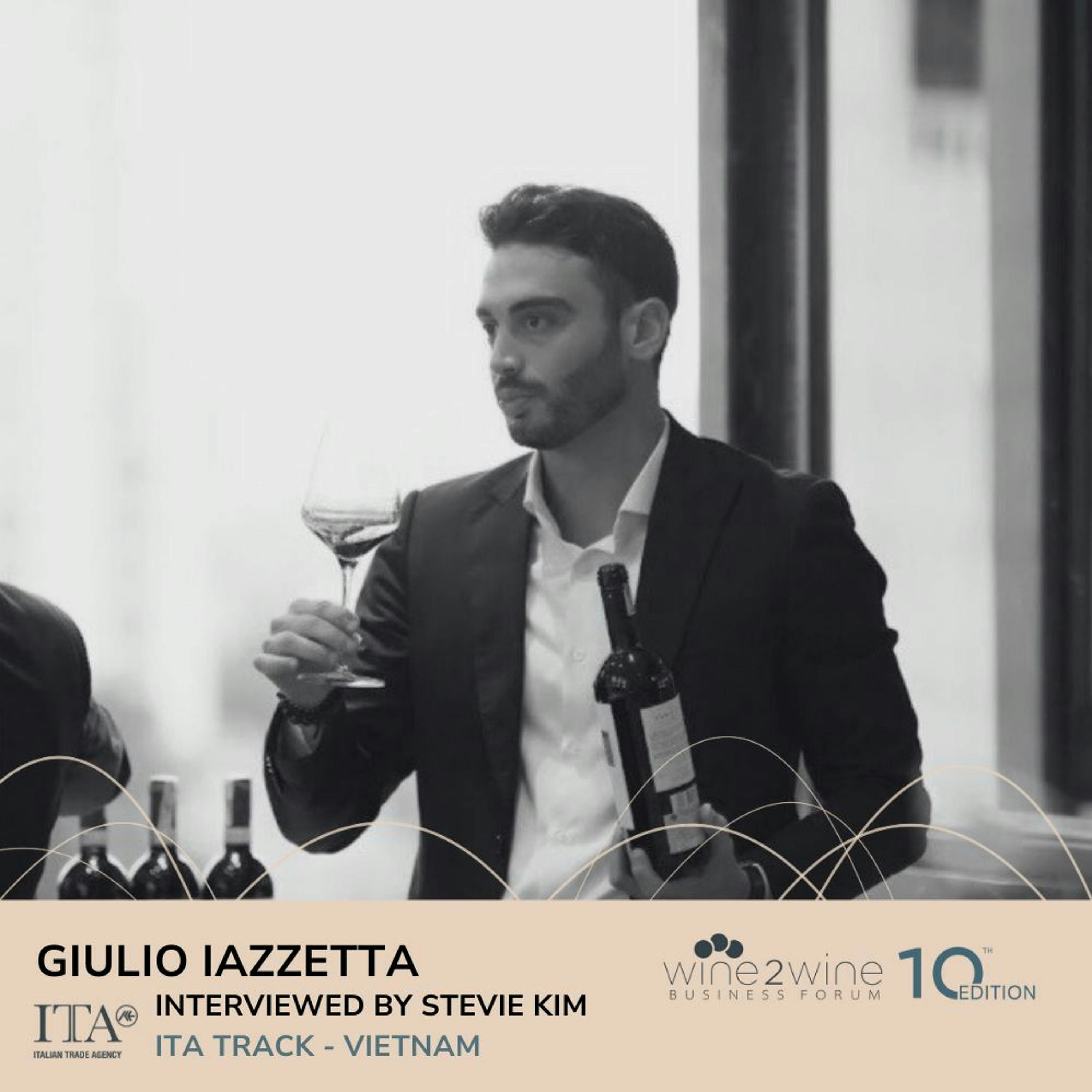
Ep. 1638 Stevie Kim Interviews Giulio Iazzetta | wine2wine Business Forum 2023 Series
wine2wine Business Forum 2023 Series
Episode Summary
Content Analysis Key Themes and Main Ideas 1. The emerging and rapidly growing wine market in Vietnam. 2. Challenges and opportunities for Italian wine producers entering the Vietnamese market. 3. Vietnamese consumer preferences and consumption trends for wine. 4. Import regulations, taxation, and distribution channels for wine in Vietnam. 5. The role of organizations like the Italian Trade Agency (ITA) and the Vietnamese Sommelier Association in market development. Summary In this episode of the Italian Wine Podcast, host Stevie Kim interviews Julia Yaceda, Deputy ORECA Director for Wine Cellar and a representative for the Italian Trade Agency (ITA) in Vietnam. The discussion focuses on the Vietnamese wine market as a key international destination for Italian wine. Julia describes Vietnam as a young, vibrant, and fast-growing economy, though still in its early stages compared to more developed Asian markets like Hong Kong or Singapore. She highlights the significant challenges posed by high import duties and taxes (25% import, 35% excise, 10% VAT), which make wine a luxury good. Consumer preferences lean towards full-bodied red wines and sweeter varieties like Prosecco and Moscato, often influenced by the local palate's liking for sweet and savory profiles. Julia outlines the main distribution channels, including major importers, supermarkets, and hotels, and emphasizes the importance of official registration for all imported wines. Despite the hurdles, Italian wine is perceived as high-quality, accessible in price relative to French wines due to taxation, and well-suited for educating the local palate. Opportunities for Italian producers include participating in ITA-organized events like Vinitaly and the Food & Hotel exhibition, and collaborating with the newly formed Vietnamese Sommelier Association. Julia also shares insights on general tips for Italian producers looking to enter the market, stressing the importance of direct engagement and understanding local dynamics. Takeaways * Vietnam is a rapidly growing but relatively young market for wine, often compared to China a decade ago. * Importing wine into Vietnam involves high taxation (25% import, 35% excise, 10% VAT), making it a premium product. * Local Vietnamese consumers generally prefer full-bodied red wines and sweeter styles like Prosecco and Moscato. * Major importers control a significant share of the wine market in Vietnam. * Italian wines are perceived as high quality and offer good price accessibility compared to competitors like French wines, especially considering the tax structure. * The Italian Trade Agency (ITA) organizes key events (e.g., Vinitaly, Food & Hotel) that provide crucial networking opportunities for Italian producers. * The nascent Vietnamese Sommelier Association plays a vital role in educating consumers and promoting wine culture. * Educating Vietnamese consumers about the diversity of Italian appellations and grape varieties is an ongoing challenge and opportunity. Notable Quotes * ""Vietnam, it's a quite relatively young market, I would say, considering its history. But at the same time, it's probably one of the most exciting vibrant and fastest growing economy in Southeast Asia."
About This Episode
The podcast "IT Tuesday" will focus on international markets like Vietnam, South Korea, and the craft wine industry. The company imports and distributes wine, including glassware and glassware, and is recognized for its success in the Italian wine market. The Italian lifestyle and local taste are key pillars for consumers, and regulations surrounding wine importation and regulations on documentation are stricter. The Italian wine market is a combination of local and international consumption, with regulations being stricter. The importance of finding proper documentation and working with local restaurants is emphasized, and marketing strategies are suggested for Italian wine producers.
Transcript
The Italian wine podcast is the community driven platform for Italian winegeeks around the world. Support the show by donating at italian wine podcast dot com. Donate five or more Euros, and we'll send you a copy of our latest book, my Italian Great Geek journal. Absolutely free. To get your free copy of my Italian GreatGeek journal, click support us at italian wine podcast dot com, or wherever you get your pots. White to wine business forum is a training and networking event for anyone involved in the wine business held in Verona on November thirteenth and fourteenth. This year, the forum will involve over ninety international speakers in over fifty sessions, On topics ranging from marketing and communication, sustainability, strategy, new market trends, and market focus in collaboration with the Italian trade agency. A number of market focused sessions will be broadcast in a podcast series on the Italian wine podcast, a media partner of the wine to wine business forum. Welcome to Italian wine podcast. My name is Stevie Kim. And today's podcast is part two of a special series from the wine to wine business form two thousand twenty three. We will be focusing on key international markets for Italian wine, Naturally, that's our specialty. And today, the focus is on Vietnam. The last episode was on South Korea. And our special guest today is I hope I said that correctly. Ciao Julia. So, yeah, it was correct. Thank you. Okay. Yazetta. On behalf of Eche, I always say Eche, but now it's called Italian trade agency. So before we start, I wanted to tell you a little bit about Julia, and Julia is a graduate of university of, I suppose, Polenza. Is that correct? Yeah. Correct. It is the famous University of Gas and has an MSC master of science in wine and spirits management and an MBA in wine, marketing and managed from Inseag. The school in Bordeaux. He gained his first experience of wine in Vietnam during an internship in Hochi Min city. He has been based in Vietnam since two thousand nineteen. So for some time now, and is currently Deputy Oreca Director for wine cellar, where his main clients include luxury hotels and fine dining restaurants. Welcome, Julia. Thank you. Pleasure to be here with you guys. Yes. So, you know, here at Italian Line podcast, and especially wine to wine, we are incredibly obsessed about learning objectives. So what we'll be doing today just to get a audience on the same page is that first, there will be an introduction to Vietnamese food and beverage industry. Of course, your specialty is oreca. So that will be a special focus. Market leaders and main outlets for wine consumption. Importers and distributors, consumer trends, and what you do specifically well, I guess not you specifically, but what Italian trade agency, offices, activities, and promotions do. And the Italian wine in the orica market. And of course, a special perspective is the Vietnamese consumer with regards to Italian food and beverage. And perhaps if we have time, maybe we can get to the future trends. So you are the representative of Eche, Vietnam, and who is the director there now? At the moment, is mister Abio De Chees. Okay. I understand it's a transitional period. So first of all, Julia, why don't you tell me a little bit about yourself re regards to your company, wine seller. What is wine seller for our audience? Wine seller, it's a Vietnamese phone company. We focus mainly on importing and distributing wine. We do not carry only wine. We do also carry glassware, but our wine cellar is focusing since now seven years of only importing and distributing wines all over Vietnam, only Vietnam. So give me some of the brands that you carry at Wainsela, the Italian wines. Main Italian brands we carry at the moment is from Criscobal de Group. San Martano fantini wines, then we would go into some more, let's say, for the realities, like, course starting with the BFT from Piedmonte, Rubeneli Bayal from the Collegehallar region. I would say very quite Cabiro group, for the Let's say for the more entry level range. Okay. And, quite a wide, big selection, you need to carry the the moment from Henkel, Flexinette. So it sounds like you have substantial portfolio of Italian wines. Yeah. It was a big one. Yes. Absolutely. So, Julia, would you like to tell us briefly about your market, the Vietnamese market in terms of demographics and consumer preferences? If you can contextualize to food and beverage industry based in Vietnam. Vietnam, it's a quite relatively young market, I would say, considering its history. But at the same time, it's probably one of the most exciting vibrant and fastest growing economy in Southeast Asia. That's why wine as a I would say luxury good due to taxation at the moment. It's growing. I would say quite fast. If I'm correct the GDP in, Saigon before COVID was, Seigon talking about watching a city. It's the same. It was around eleven percent when the account kgDP was around six point seven percent. Growth per year. So this makes a good number. I think one of the most attractive market for any wine producer, I would say. Of course, in its early stages, so firstly, big brands would arrive starting to, let's say, conquer the market, and those are the first one that are imported by distributors. And consumers at the same time are also growing their experience through what's at the moment. I would say selected by the distributors to be imported because the main obstacle would be that any wine that is sold in Vietnam or distributed in Vietnam has to be registered and officially imported by an official So in the grand scheme of things, Julia, how would you place Vietnam in terms of market size when you compare with Hong Kong or Singapore or the neighboring wine market countries? Station system and, being, of course, more developed market. I mean, Vietnam is not there yet. We roughly say that Vietnam is a little like China was ten years ago, even comparing to another neighboring council, which is a Thailand which means city is not as developed as is a bank account. We do believe that in the future, it may reach the size of a country like Thailand. For example, maybe the current volume that Thailand has we will hope so. So would you be able to say something about the market leaders and I suppose the main outlets for wine consumption? Yeah. Sure. I would say at least within our channel, but our importance usually do sell on different channels within, Oracle retail wholesale. Even one seller, we do sell to supermarket, other resellers, or directly to private customers. At the moment, the key leaders in terms of deporters are city, the warehouse and wine cellar with, around the between, I would say, one thousand five hundred to two thousand labels. So this would be the size of these top three importers. And these three importers, let's say, control most of the share of the wiring Vietnam because of the size of the companies at the moment. What are the other outlets, main outlets? Quite classic supermarket restaurant wine bar is not that developed yet, but this is more because of a lack of culture of, food and beverage figures in Vietnam that are not acknowledged or about the one in the three due to the independent member. So I would say five hotels that are also consumption based on tourism, business tourism or leisure tourism, and the role, I would say, yeah, restaurants and, supermarkets. One line is developing, but it's not, I would say, as developers, we were hoping. So, Julia, you spoke briefly about the different taxation system in Hong Kong and Singapore. So in terms of importing wine, can you give us an overview of the regulation for importing wines into Vietnam? Wine to wine business forum. Everything you need to get ahead in the world of wine, supersize your business network. Share business ideas with the biggest voices in the industry. Join us in Verona on November thirteen to fourteen twenty twenty three. Tickets available now at point wine dot net. First of all, once the important decide to import a specific wine, that specific wine will need to be registered registration usually takes around three months for the process. Considering the x works price, we would have three different taxes. Twenty five percent on the, let's say, it works, acceler cost. Will be by twenty five percent in products, thirty five percent excise tax and ten percent VA. Twenty five. Yes. That's why I roughly calculate that, for example, our wholesale price to an hotel or restaurant would roughly be in the range of retail price in Italy, usually more expensive. That's a lot of tax. And consumer, I would say it's divided into foreign consumer and local consumer, also driven by local taste versus, let's say, tourists for not living in the numb taste. As wine was not part of the culture has been introduced later on. It's in the first stage wines, like full body wines, full bodied red wines, where and still are the main trend for consumption, especially for local consumers, we can see that this trend is slowly changing, but, because of the appealing and the liking of local consumers to Let's say, the relatively sweet product, food, and drinks, and the trends, of course, reflect also on wine consumption. Even though the weather here is pretty, let's say, hot and it's not the best weather to drink, like full body, red wine, but still the main trend at the moment for local consumer. Oh, yeah. Obviously. And what about the consumer, the end consumer? I would say at the moment, for Italian wine, our, biodiversity and richness in terms of styles. And the appalachians and regions. It's a little bit of an obstacle because of the knowledge of the consumer in Vietnam. As now, we are seeing that, of course, the bigger and most famous appalachians or regions are the first one penetrate the market as in every country. Then my question would be, what are kind of the main challenges? And on the other flip side of the coin is, of course, opportunities for Italian wine producers to sell their wines in Vietnam. What are the main challenges and opportunities, if you will? Here, there is there's so many association. It's starting to be built now with this also new development, but It's been founded only in two thousand and nineteen. And what is it called? The Sommelier Association. It was a SAGO Sommelier Association. Who's born in Sagram, actually? So it's a Vietnamese Sommelier Association. And how do they get their qualification as Sommelier? I wouldn't know exactly. I assumed they were working with another association with a third party, the possibility of getting the certification. So you've been living in Vietnam for some time now. What is your opinion with regards to the Vietnamese, you know, typical Vietnamese consumer, wine consumer, if you will. What are their ideas? How do they perceive Italy and Italian wine in general? I would say Italian, Italian wine, a link that goes together. I would say Italian lifestyle and Italian wine can be perceived as a general Italian lifestyle. It's perceived as a top quality producing country with fine wines. I would say the main competitor, as often we see it's a France as a country producing wine, but we can see that also the recently development of opening of many Italian restaurants allows also Vietnamese consumers to get the closer to Italian wines. The price and the quality of Italian wines also considering the taxation in this country allows Italian wine to be consumed in volumes more than French wine. So I would say that, Italian wine for me is possibly the best wine to introduce to Vietnamese in order also to educate the palate and the general wine culture because of quality and price accessibility and the outlet of consumption. Julia, can you give us an example of, like, your typical Vietnamese cuisine and how you would pair that with, Italian wine? Vietnamese cuisine, we need to consider that it's a quite fresh and healthy cuisine. It is spicy, but not too spicy. Much less than island. For example, it's quite sweet and savory, but without being heavy as maybe Chinese one. So in that sense, I would say that some Italian red wines, but from medium to full body are perfectly suitable. And, in terms of white wines, for example, pinot grigio is an market leader in terms of grape variety and prosseco. If we talk about prosseco as well and Moscow actually mosquitoes, anything that is classified as aromatic as an aromatic green variety of course because of the herbs used in the cuisine, it actually helps to get the wine with the local food. Also because of the residual sugar. Right? Yes. Also. Yeah. Correct. As many, you know, new markets, they tend to first be very open to, you know, the sweeter wines, if you will. Yes. Correct. Within the local market, local channel of consumption, because the sweeter wines are still, the leaders. And is there a big expat community in Vietnam? There is, especially, let's say within, by customers, most of the consumers are actually foreigners. The community is growing. Now the thing is that regulations to be able to work in Vietnam becomes more and more strict. So you need to provide the for the documentation requested for the position that you are applying for, which, restrict a little bit the possibility for unqualified people to come and work in but it's, extremely dynamic and diversified community. I would say at the moment still not many Italians. And this of course, interfaced a little bit development in turning off food and beverage. You don't need a specific visa to enter Vietnam as an Italian citizen with an Italian passport. Right? Is that correct? At the moment, if I'm correct, there is a three month tourist visa Okay. That can be applied for since recently, actually, I think, since August the two thousand twenty three. So you can come freely for three months? Yeah. If I'm correct. Yeah. It's more like a tourist visa. Yeah. Tourist visa. Yeah. But then you would need proper documentation to work that. Yes. Like, for example, I do carry a work permit of two years, but in order to get more permit, you also need the approval from the company hiring you, and you need to present all your certificates of studies. Translate them and, another series of documents that will allow Vietnamese government who certified it for, an expert in that sector that is needed for the development. So would you be able to give some useful tips? I don't have three useful tips for an Italian wine producer to enter the Vietnam wine market? Best would be following, I think, the chance to link to the the digital agencies. Those are, I would say, extremely important for, any wine producer that hasn't found a a direct contact with an importer and wants to come to Vietnam and see what first how Vietnam looks like and also meet the importance directly because, for example, the event they will organize next year after a long time with Sabini for the for the hotel event that we did work every year. I would say the best chances to come and have the chance of meeting, in person, some of the importers. When does that happen for serving in Vietnam? What period of the month? One month out of the year? I think that they were still, trying to fix the day because of all the other winters in a Europe, in Italy, etcetera. I think the has to be moved around June, July. Okay. In June. So just before the summer. Okay. Yeah. But as I was discussing with the director was more because of trying to find the time to have the people of the industry busy with a big, one first. Right. Okay. So does ita organize anything else besides for Sabini in terms of promotional activities for Italian wine? I mean, it's always present. There is the pavilion at the food and left there every year. Okay. Which is another possibility to meet the most of the importers and distributors in Vietnam. And they also do collaborate with the mega market, which is from a Metro group, which is one of the biggest supermarket in Vietnam, and they do also import products by themselves without having to work with an importer. They can also introduce producer to this type of independent importers that they resell through their own shops? I guess we're kinda coming to a close, Julia, of our conversation, but is there anything you would like to say before we close in terms of any advice you might have or any, you know, wisdom that you can share, any insights with our Italian producers with regards to marketing strategies or increasing awareness of Italian wine in Vietnam. Yes. Of course, I would say participating at all the possible events organized. There is, from Italy agency like the Bosaveni or the food and hotel exhibition. I think as soon as you put a first put in the country and you realize about the dynamics and how this country is growing fast, then you will need to find, I would say, the best important for, who you are. Sometimes not because, the bigger report. Yeah. It's the best. Sometimes smaller importance also do a very good job for especially less popular appalachian or grape varieties, for example, because they have more time to educate the customers. I think this together plus every activity that would involve a and the family association is the most important thing because the Vietnamese so many young extremely motivated. For example, because of there is a issue that the admins have in order to travel to Europe. For example, they never really experienced what, winemaking. So I would say that shouldn't try to see whenever there is a possibility to be, I think, that's, with them and, any sort of event that involve food and beverage, products on Okay, Julia. Thank you so much for joining us. That was Julia Yaceda. And, you know, a few years back, we had each a truck at y two line, Vietnam, as one of the market focus. And it was one of the more popular sessions to be attended by the attendees. So this is proof that Italian wine producers are indeed interested in entering into the Vietnam wine market. Thank you for that. Thank you for some of your insights, and we will definitely be looking out for the Vietnamese Sommelier Association to see any update, and maybe we can do an outreach to them as well. Thanks again for joining us. Signing off for Italian wine podcast. My name is Stevie Kim, and hope you can join us next time. Thank you. Bye. Listen to the Italian wine podcast wherever you get your podcasts. We're on SoundCloud, Apple Podcasts, Spotify, HimalIFM, and more. Don't forget to subscribe and rate the show. If you enjoy listening, please consider donating through Italian wine podcast dot com. Any amount helps cover equipment, production, and publication costs. Until next time. Chichi.
Episode Details
Keywords
Related Episodes

Ep. 2042 When being collective leads to uniqueness | wine2wine Business Forum 2023
Episode 2042

Ep. 1804 What Does 'natural' Mean In Wine? Pt. 1 | wine2wine Business Forum 2023 Series
Episode 1804
Ep. 1802 Sofia Ponzini Of Tenute Bosco | wine2wine Business Forum 2023
Episode 1802

Ep. 1758 Serena Storri Of Famiglia Cecchi | wine2wine Business Forum 2023
Episode 1758
Ep. 1736 Federico Moretti Of Cantine Provima | wine2wine Business Forum 2023
Episode 1736
Ep. 1714 Raffaele Foglia Of Villa Bogdano | wine2wine Business Forum 2023
Episode 1714