
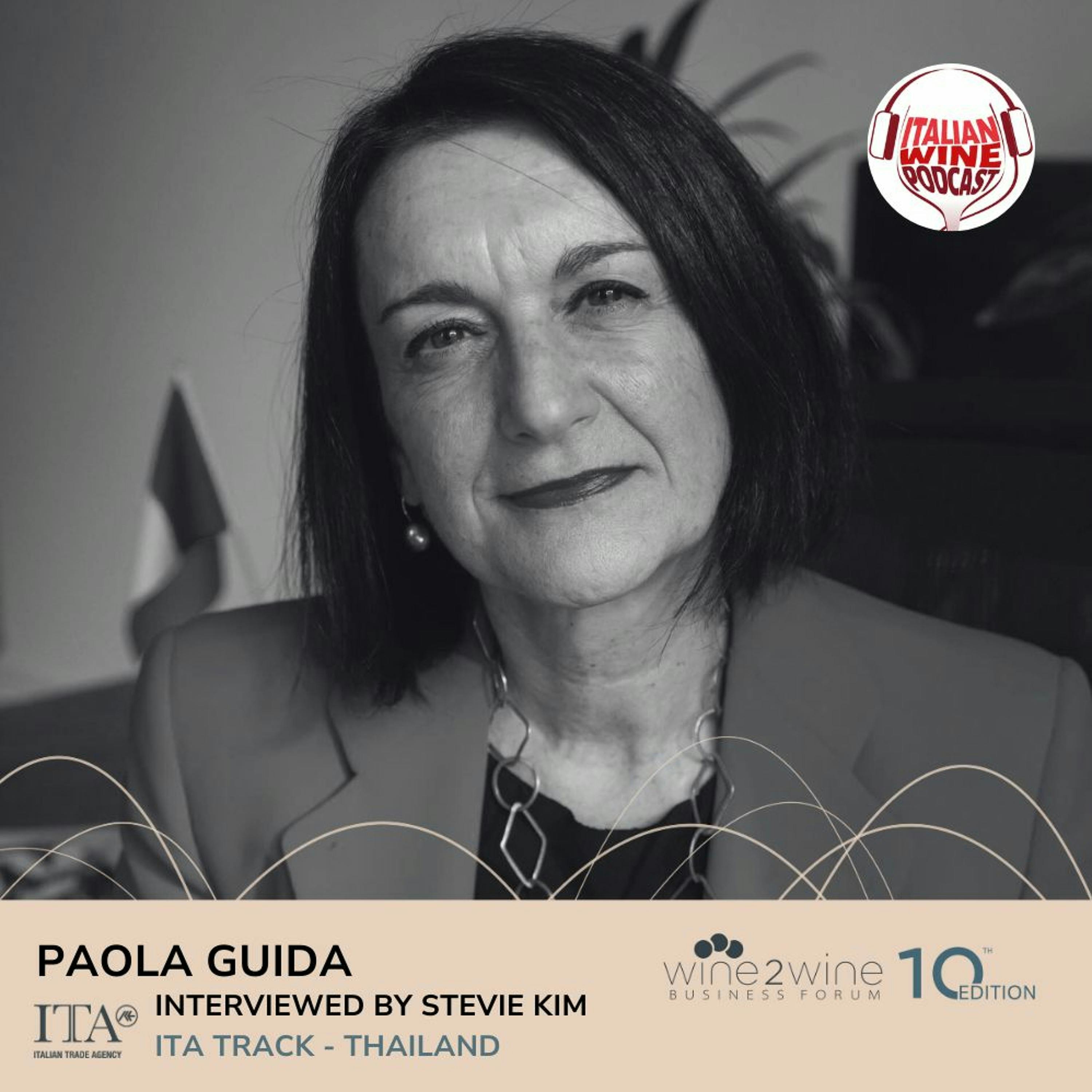
Ep. 1648 Stevie Kim Interviews Paola Guida | wine2wine Business Forum 2023 Series
wine2wine Business Forum 2023 Series
Episode Summary
Content Analysis Key Themes and Main Ideas 1. The dynamics and growth potential of the Thai wine market for Italian wines. 2. The role and services of the Italian Trade Agency (ITA) in supporting Italian wine producers. 3. Challenges and regulatory hurdles for importing and distributing wine in Thailand. 4. Consumer demographics and preferences within the Thai wine market. 5. Strategic advice for Italian wine producers on entering and succeeding in the Thai market. Summary This Italian Wine Podcast episode features an interview with Paola Guida, the Trade Commissioner of the Italian Trade Agency (ITA) in Bangkok. The discussion focuses on the burgeoning Thai wine market, highlighting its impressive growth trajectory, with Italy registering a significant 36.6% increase in exports in 2023, positioning it as the third-largest wine exporter to Thailand. Guida describes the Thai wine consumer base as predominantly young, curious, and eager to learn, contributing to a vibrant market. She outlines the key market players, distribution channels (both on-trade and off-trade), and emphasizes the strict regulatory environment, high import duties (60% ad valorem), and complex licensing procedures that characterize the market. A crucial takeaway is the necessity of securing a reliable local partner. Guida also details the support provided by the ITA to Italian producers and offers practical advice, stressing the importance of market understanding, finding the right partner, and direct investment in marketing and client engagement. Takeaways - Thailand is a rapidly growing market for Italian wines, showing a 36.6% increase in exports from January to September 2023. - Italy is the third-largest wine exporter to Thailand, following France and Australia. - The majority of Thai wine consumers (60%) are young, aged 25-44, and possess a strong desire to learn about wine. - The Thai wine market is heavily regulated, with high import duties (60% ad valorem) and complex, annually renewable licensing procedures. - Securing a proper local import partner is crucial due to the regulatory complexities and costs involved. - Both supermarkets/specialty stores and HoReCa (hotels, restaurants, cafes) are significant distribution channels. - The Italian Trade Agency in Bangkok offers vital support, data, and connections for Italian wine producers. - Direct engagement, marketing activities, and consumer education are essential for successful market penetration. - The Thai market presents higher barriers to entry compared to Hong Kong, requiring more strategic preparation and support. Notable Quotes - ""The wine market in Thailand is growing and in 2023, supposed to reach two billion US dollar..."
About This Episode
The Italian wine industry is growing due to the pandemic, with the potential for growth in the wine industry and the importance of being in touch with local importers. The Italian wine industry is regulated and highly regulated, with the need for proper preparation and license procedures. There is potential for growth in the wine market in the future, with the importance of educating consumers and investing in marketing activities. The Italian wine industry is still experiencing high barriers of entry due to competition and the need for proper partners.
Transcript
The Italian wine podcast is the community driven platform for Italian winegeeks around the world. Support the show by donating at italian wine podcast dot com. Donate five or more Euros, and we'll send you a copy of our latest book, my Italian Great Geek journal. Absolutely free. To get your free copy of my Italian GreatGeek journal, click support us at italian wine podcast dot com, or wherever you get your pots. White to wine business forum is a training and networking event for anyone involved in the wine business held in verona on November thirteenth and fourteenth. This year, the forum will involve over ninety international speakers in over fifty sessions, on topics ranging from marketing and communication, sustainability, strategy, new market trends, and market focus. In collaboration with the Italian trade agency, a number of market focused sessions will be broadcast in a podcast series on the Italian wine podcast, a media partner of the wine to wine business form. Hello. Good morning, everybody. My name is Stevie Kim, and welcome to the Italian wine podcast. Today's podcast is part of a special series. It's actually one of my favorites because it talks about the different markets in the world. And since the pandemic, my travel has been very limited. And it's a special series dedicated to wine to wine business Form two thousand twenty three, which is imminent. It's just literally around the corner. We've started the countdown already, and we will be focusing key international markets for Italian wine. Today, the focus is actually Thailand. And Myanmar. How do you say that, Paola? Myanmar, I suppose. We're both bad at saying that. So our guest is, of course, you have intuitive is Paula Guida, and she's a trace commissioner of Iche Bancock of Italian trade agency. And I've met Paula actually when she was the trade commissioner in Hong Kong a few years back. When was that? Well, it was two thousand twelve and up to two thousand sixteen quite a long ago. Oh my goodness. I can't believe it's been that long. And then you were also working at the US, the New York office. Is that correct? Because I remember seeing it vaguely because I don't know exactly what your role was. What were you doing there in New York? So in New York, I was, in charge of all the fashion eyewear cosmetics or consumer goods, but food and wine. In United States, the Italian trade commission offices are divided by sectors. So I was in charge mainly consumer goods for fashion. Right. So you've been working with the Italian government for the past thirty years from what I understand, right? And you've been working just over, I suppose, fifteen years based abroad, working in different countries, definitely in Hong Kong. I've met you now. You're in Thailand. You've been stateside. How long have you been, Thailand? Well, forty days. I'm just arrived. I mean, you come. Yeah. So you're a newbie to Thailand, but of course, you have, you know, the desk in Thailand where there is full of information and supporting activities for our Italian wine producers there. So let me just call out what we'd like to do here at the podcast is we'd like to outline kind of the learning objectives. So we align the expectation of our audience. And today, we'll be talking about, you know, a brief overview of the local food and beverage industry. We'll be delving into also market leaders and main outlets for the wine consumption. If you can give us information about that, and then, of course, specifically the nitty gritty of the different wine players in the market, whether they're importers, distributors, and which leads segways into consumer trends. We would also like to understand what the activities ETA provides directly for the Italian wine producers. And if you can, I'm not saying you're nostradamus, but if you can, especially since you've been there only forty days, if you can give us a little bit about the future trends. Are you okay with those topics? Yes. I hope to be, you know, in line with your expectation. Okay. Great. Alright. So, I mean, our objective is to provide a deeper understanding and the current status of wine sector in Thailand. As you know, you know, since the pandemic, Thailand has become one of the more interesting market for the Italian wines and wine industry in general. I would actually say that Hong Kong has lost a bit, not because since you've left. But because since the pandemic, especially. So we're very interested to learn about what you have to say. Let's start with this. Tell us briefly about Thailand in terms of the demographics, and preferences for whatever the food and beverage industry is based. Okay. So, actually, as you said, the Thailand is a growing market both for wines, beverage, and food. Not only for Italy, of course, but what I, in my little time here, I understood, is that they are very sensitive about, any kind of food and beverage. They're very curious customers. And So this is helping us because, they appreciate a lot of international cuisine, but they start appreciating Italy and, even, of course, a European country, but mostly Italy for the food and wine. Actually the wine market in Thailand is growing and in two thousand twenty three, supposed to reach two billion US dollar and with an increase of five point four percent in twenty twenty four. And this is quite a number because Thailand looks like a small country with a niche market, but, is not exactly that. The wine consumer is definitely most related to young population from twenty five years old to forty four years old, they are the sixty percent. We represent the six percent of the consumer of the wide sector. We do have, sort of, great results in twenty twenty three for Italian wines. We are the third country in exporting to Thailand after France and Australia. France because it's France and Australia because they still have special agreement with, but we re register the over thirty six point six percent increase compared to the ninth month of last year. So as you said, yes, this is a growing market. And what I really have to say is that, these, increase, you can feel it. You can feel it going out to restaurants and bars. You can feeling going out to supermarkets, hypermarket, and specialty stores. People is always very much interested. So they are scouting for new products. They are scouting for new food, new pairing with wine and food. And we need to say that thanks to the Italian a great varieties, a wider range of grapes. You can find, a lot of, quite easy to manage the pairing with the Thai and Asia food as it was even in Hong Kong at the times, actually. What I saw is that really is the feeling that, people here wants to get more every day. So it's quite interesting. Okay. Paola, your office has been so kind provide us with tons of data and infographics. And if you're okay, we would love to share this with our audience and the Italian Line producers. Absolutely. I mean, we can talk about that. Later, but I think it will be really helpful because I am looking through them right now. You have data of the input of wine for the past few years, as well as information about the average revenue per capita. And specific information about consumers. So if you're okay, we would love to share this with our audience, maybe in form of a blog, to compliment this podcast here. So they can follow also very nicely. Our conversation. So my next question to you is, I suppose can broach who the market leaders and the main distribution outlets for wine consumption in Thailand. Italian wine podcast brought to you by mama jumbo shrimp. For the market leader, you know, they are the very big companies, in the beverage sector, but we need to focus on, importers and outlet of those. The market leaders is mainly big corporates, like, boiling at a in IIM wineries that is local market, producer and distributor, considering that, in any case, this is a country where all the big company are here. And so they are monitoring the market very closely. But for what concern Italian producer, so we do have two channels that, of course, is that they announced in the out out in the orica. So for what regards the outlets, I mean, supermarkets, supermarkets, specialty stores, We do have, tops, wine cellar, central. We do have wine connection, italia, Q Galleria, that are the most popular wine, outlets in Thailand and mainly in Bangkok. White food importers. We do have, a lot of importers, a smaller and big one, but the most important one. I mean, the one that are more big in terms of selling, roast wine and spirits, the Bank of beer and beverage, global vineyards, g four, a bank of liquor, Thai beverage distribution, come to a, Franceis. So there are many. What we can provide to Italian company, of course, is still a way to know better the market. Thanks to the work of my colleagues. We do have a very into the sector of people working for us, and we can provide the ways of being in touch with local importers because entering the market is no easy. The sectors, the alcoholic sectors, and the beverage is very, strictly regulated in Thailand. So the procedure for entering the market is not smooth. And generally speaking, you need to have a partner and importers. Someone who helping you in, go through the procedure. And even bear the costs, all the costs related to registration, to import license. When you get the license, the license lasts for one year, and then if you change anything in the label, you have to request for new permit. For a new license. So it means that every year that you're changing the vintage, your import as it has to go through the procedure every year. So it's something that will affect costs besides the custom duty unwinds that is quite high because it's percent of the Advallorem. So this is a market that you have to face, with a proper preparation and with a support. No matter if you ask to us or to any other consultancy company, but you have really to find someone who can help you go through it. You have many years of experiences from Hong Kong. How does it compare with Hong Kong, for example? In terms of all of these, it seems it's a higher barrier of entry in general, right, for the wine producers. Definitely. You know, on Kong is a, let's say, easy market because on Congress, no VAT, no tax, no duty. It is a, sort of, big free trade zone. So when you your main goal is to beat competition because Hong Kong has a lot of competition because it's so easy to enter. In Thailand, it's different because the procedure to enter is a quite tough one. Mostly you have to get a proper partner. There is less competition, but getting into the market and spread in this market is not as easy and smooth as can be in Hong Kong. Mainly, you know, the big market is Bank against your mind and you have other area very populated, very touristic, for example, like Ocett, that is growing, booming, really quite unbelievable. I heard so many things about, the orica and the wine market in in Brooklyn. So means that most probably in the future when tourism will be more easy and will growing, you know, as pre call it level. Because we need to say that Thailand is still quite affected by a few numbers of tourists compared to the last years. And tourists is a very great because they are used to drink. They are used to drink their own home. So today, tourists are not that much compared to the past. So the government is, try to make it easier for tourists to come to Thailand. They are waving visas. They are trying to make it everything more easier for anyone who's coming to Thailand. So they are prolonging, opening hours for bars and restaurants in order for tourists to feel more welcomed. Okay. So Paula, I'm looking at the first table. It's the data that the graph that you provided us, and it seems like Australia, France, there are the two leading countries in terms of importing of wine into Thailand, and their market share currently is twenty seven percent in terms of increase in share. And they're similar, actually. In terms of the market share, Australian, France. And then the third place is in Italy twelve and a half percent in terms of market share. But actually, when you compare to twenty one, it's a substantial increase. Right? So it seems like there's a trend of the growth rate is thirty six percent from January to September in twenty twenty three this year. So it seems like it's good news for the Italian wine. Right? How does the consumer market perceive Italy and specifically to Italian wine? So you're right. And this is what I was trying to figure when I saw first this, south because it's very positive trend. We are growing more than others. Of course, France and Australia, for many reason, they are still very far ahead but we are growing much faster. And this is something that is, really related, what I was saying before that is, because the consumer base is mostly young, gen z and millennial, They are open up to new experience much more than in the past. So they are wealthy, but maybe not as worth as buying, French vine, for example, but they do not want to go cheap. So Italy has such a huge varieties, and they offer so many different things. And still, you can go from very high level wines to super good wines with the middle price. And this kind of, trend for the young, you can find even when you go to events, they need to be educated. They wants to be educated. They wants to learn. They want to understand what they are buying, what they are drinking. And how to do it. And we, for example, we are organizing a master class with a wine, workaround. The request for the master class is overwhelming even from, you know, sector people working into the sector. So means that they want to learn. And Italian wines are the last known that French wine, even because we are so much diverse. So I think that this is a plus that we need to catch and to push forward and to open up two new ways of, catching the consumer. So having educational, many ways you can get it. It's a good point because people here, they want to learn, and they want to know new things. So I think that is, something that we need to think about even when we create new activities for promoting, made in Italy. So it's promising. Right? It seems like the trend is very upward. I would just vaguely recall going to Hong Kong quite frequently when I met you and the years following that Hong Kong market was quite small and they tie in market share was not increasing by any means. It was always very, very tiny. Whereas Thailand, it seems like, you know, maybe it's a smaller market, but there is a potential for growth for Italian. There's room for growth for Italian wine. Would that be fair to say? I think that's you're right. Because first of all, Thailand is a big country compared to Hong Kong. They have very different kind of status, social status, and education as a you know, most of the countries. But, people here like to enjoy life, to learn new things, eating out, but even having, you know, in the your home. So this is why if you think of the graph that I sent to you, you find that, the wine boats in the supermarkets more or less it's the same of the wine people used to drink in the restaurant. So it means that the consumer in Thailand they go both. So they go out because they like dining out every day anytime whatever kinds of food. Of course, here, you can find an amazing quality of Italian restaurant. Really. I was really surprised because I was not expecting that high quality, but they are eating anything, Japanese, Chinese, Thai, French, Greek, everything. So they are very much open to new experience, food experience, and so even, wine experience, but they still buy wine to drink home. So and this is a very, very interesting aspect. Of course, in the long run, they will go more on the arreco side, but still the fact that they buy for drinking home makes a huge difference. We have to kind of come to a close end, but just couple of more questions. First of all, how is the your EHA office organized? Are there specific department specialization for, you know, food and wine? How many of you are there? And what kind of support can you give the wine produces? So we do have, let's say, desks about food and wine, machinery, fashion goods. This is a small office with a lot of flexibilities. So we do have, around six to eight people. But the core business is three main, colleagues. And, the colleagues in the in the wine, and food sectors, is a very dynamic one. She know the sector quite well. And so we can give most of the support that the company needs to first bite of the market. If I can say so, and that we can help them in, finding partners, put them in contact with importers so that can steal one of the most important thing for a company wants to enter here. For the ones that are here already, we can support them in organizing events. One of the most, relevant marketing activities here in Thailand because of the interest in learning of the consumer is education no matter what kind of what level, but you have to let consumer know about the different kinds wines, greats, history, and heritage. Very different level. So and then we do have, even for the next year, we will have the Italian pavilion Tifex that it will be happening in, May. And we do have, agreement with the central, with the GDR. And for central, when he's in the mall, so it's, in, in the supermarket, yes, they are open to evaluating the wines. So we will go for it. Okay. Very good. So, I mean, if you can kind of narrow it down to I know you have many useful tips for the Italian wine producers. But if you can give us, like, the top three useful tips for entering the Thailand market, what would they be? Understand the markets because you need to be prepared to face the market so far away from us and with a very different culture. You have to find the proper partner to work with that it seems easy to say sometimes not but here you can build up a very good relationship. So and you have to help the partner in understanding better what is your product. And the first thing is what, I suggest is that, even if you find a good partner, you have to invest. You have to come here. You have to do marketing activities to even know your clients. Because being, here, let them know you can make a very big difference. This is something that I learned in Hong Kong, and I think that here you can have exactly the same attitude. The meeting the producer makes a difference. It's something that is super valuable, and, you are one of a kind. So this is my suggestion. Great. Well, I think that's a very good way to end our conversation. We can go on for hours and hours. Thank you so much for joining us, Paola. Guida, the Italian trade commissioner in Bangkok. And we really hope to see you here or there soonest. How long will you be there? Four years. So we we have plenty of time to work with together at CV. Great. Thanks again, and we are looking forward to sharing this, of course, our discussion on Italian wine podcast. And this is a wrap. Thanks again for joining us today, Pala Guida from Bangkok. Italian trade agency office. Thank you, Steven. Thank you. Bye. Listen to the Italian wine podcast wherever you get your podcasts. We're on SoundCloud Apple Podcast spotify, email IFM, and more. Don't forget to subscribe and rate the show. If you enjoy listening, please consider donating through Italian wine podcast dot com. Any amount helps cover equipment, production and publication costs. Until next time.
Episode Details
Related Episodes

Ep. 2789 ColleMassari: a long-term vision rooted in Montecucco with Giuseppe Di Gioia | On The Road With Stevie Kim
Episode 2789

Ep. 2788 Ep. 14: Austria and Hungary | Study Smart for your WSET Level 3
Episode 2788

Ep. 2785 From Volunteer to Speaker at TEXSOM with Samantha Cole Johnson | TEXSOM 2026
Episode 2785
Ep. 2766 Inside the U.S. Non-Alcoholic Wine Market: What Wineries Need to Know with Jill Sites | Masterclass US Wine Market
Episode 2766
Ep. 2761 Winemaking and Consulting Across Sicily with Alessandro Serughetti | Wine, Food & Travel with Marc Millon
Episode 2761

Ep. 2759 Part 2 – The VIA Educational Program & Italian Wine | Heart-to-Heart Conversation with Sarah Looper
Episode 2759